"A
great empire, a nuclear superpower, split into independent countries
that could co-operate with each other as closely as they wanted, and not
a single drop of blood was shed. It wasn't a tragedy at all. We decided
to shut the prison of nations. There was nothing to feel contrition
for."
"All
versions of the union treaty boiled down to the restoration of the old
ways or to Gorbachev's proposal of a new structure where he still would
be the boss."
"Kravchuk
[Ukraine's Leonid Kravchuk] was focused on Ukraine's independence. He
was proud that Ukraine declared its independence in a referendum and he
was elected president on December 1, 1991."
"Gorbachev
told me in a mentor tone: 'Do you know what the international community
would say?' And I responded that I do know. By that time the
conversation with [U.S. President] Bush already started and I was
hearing it. I said that Yeltsin was telling Bush about it and he [Bush]
was reacting in a positive way."
Stanislav Shushkevich, 86, Republic of Byelorussia (Belarus)
"What
they so hastily and stealthily did in Belavezha was like a plot to kill
an injured but still living person by dismembering it."
"The striving for power and personal interests prevailed over any legal arguments or doubts."
Mikhail Gorbachev, 90, former USSR president
"The
Ukrainian independence referendum and the subsequent decision by the
Ukrainian Supreme Soviet to disavow the 1922 treaty on creation of the
USSR put a political and legal completion to the process of
disintegration."
"Yeltsin
and Shushkevich first tried to persuade Kravchuk to maintain some form
of union, but after the referendum, he wouldn't even like to hear that
word."
Sergei Shakhrai, top Yeltsin aide
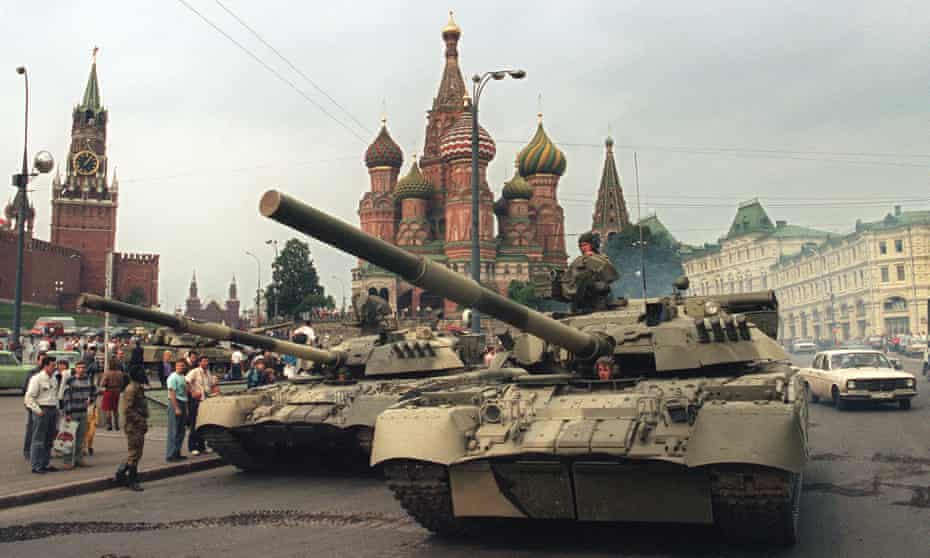
Soviet tanks near the
Kremlin in August 1991 after an attempted coup against Mikhail
Gorbachev. The deal signalling the USSR’s demise was signed months
later.Photograph: Dima Tanin/AFP
The
beginning of the end was heralded unintentionally by former general
secretary Mikhail Gorbachev when he introduced the Soviet Union
reformation concepts of glasnost and perestroika, the
political movement within the Communist Party of the Soviet Union
(CPSU) during
the 1980s, whose revelation became a worldwide sensation, that the USSR
was opening up as Mr. Gorbachev tried to ease tensions between the
Soviets and the West. He was a passionate reformer, one critical of the
excesses of Stalin, like Nikita Khrushchev before him.
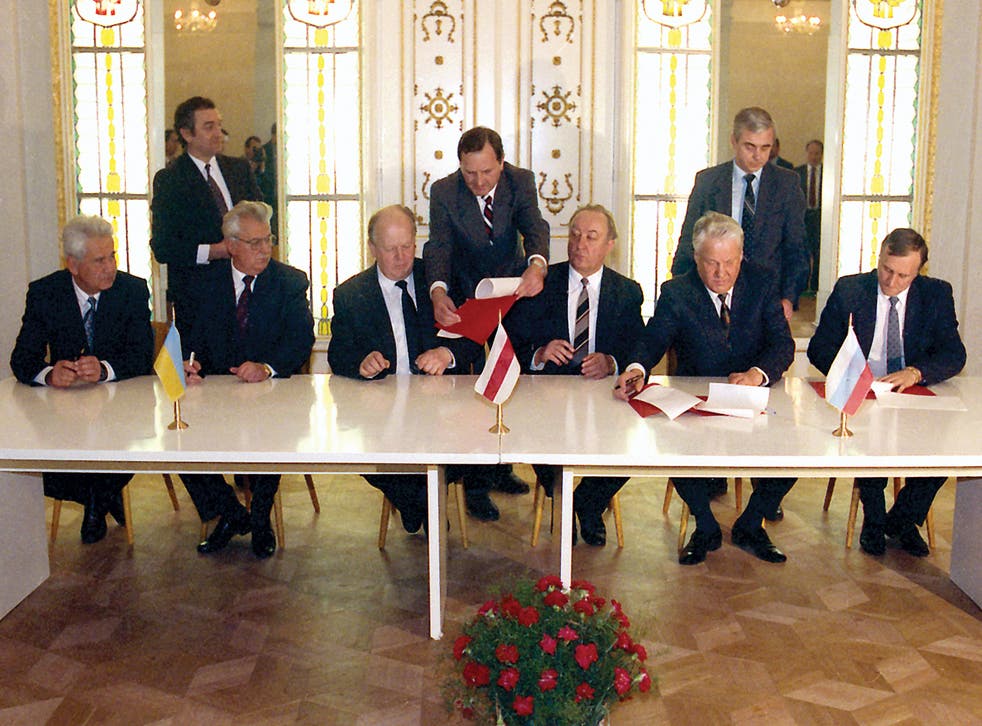
With
the first crack of solidarity within the union, three Slavic republic
leaders on December 8, 1991 met at a hunting lodge, a dacha in Viskuli,
Belavezha forest to declare "the USSR ceases to exist as a subject of international law and as a geopolitical reality".
Boris Yeltsin of Russia, Leonid Kravchuk of Ukraine and Stanislav
Shushkevich head of the republic of Byelorussia took pride in co-signing
the agreement, producing a "diplomatic masterpiece" of dissolution.
Eight
other Soviet republics swelled the alliance two weeks later, thus
terminating the authority of Soviet President Mikhail Gorbachev. The
former Soviet republics revolving like satellites around the sun of
Moscow, was no more. In his memoirs, the former president was bitter
about the 1991 agreement destroying his own efforts to save the USSR
from collapse with a new "union treaty" among the republics.
The
rebuttal from Shushkevich pointed out that he and the other leaders
felt Gorbachev's plans to resurrect the union was pointless. Latvia,
Lithuania and Estonia had already seceded and the backdrop of the failed
August coup against Gorbachev had seen his authority eroded, an
encouragement to other republics to seek their own independence.
The
three schemers, Shushkevich, Yeltsin and Kravchuk were accompanied by a
few senior aides when they arrived at the Viskuli lodge. The atmosphere
was later described as tense with the realization that the stakes were
high including the risk they were taking of arrest on charges of treason
should Gorbachev be so inclined. Eduard Shirkovsky, head of the KGB
also at the hunting lodge had assured Shushkevich no threat to their
safety existed.
Gorbachev
had decided against moving against the plot fearing bloodshed in a
volatile situation at a time the loyalties of the Soviet army and law
enforcement were split. "If
I decided to rely on some armed structure, it would have inevitably
resulted in an acute political conflict fraught with bloodshed", he later wrote, blaming Yeltsin for spearheading the Soviet collapse, ambitious to take over the Kremlin.
Ukraine
had declared its sovereignty after the August coup that had weakened
Gorbachev's authority. The previous week Kravchuk had been elected
Ukraine's president in a vote that gave full support to its independence
from Moscow. At the hunting lodge Kravchuk was forcefully determined,
rejecting a revamped version of the Soviet Union.
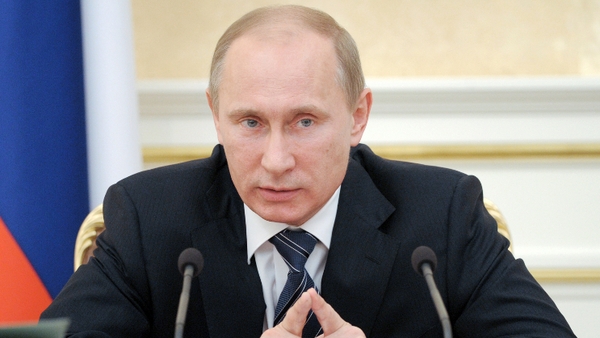
Describing the collapse of the Soviet Union as "the greatest geopolitical catastrophe of the 20th century",
Vladimir Putin continues to to state his conviction that Ukraine
unfairly inherited historic areas of Russian heritage with the demise of
the USSR. Russia's response ultimately was to annex Crimea and back
ethnic Russian Ukrainian rebels in eastern Ukraine, leading inevitably
to the current Russian buildup of troops along the border with Ukraine.
Russia Soviet Collapse Anniversary
(Yuri Ivanov)
"Modern Ukraine is entirely the product of the Soviet era."
"We know and remember well that it was shaped -- for a significant part -- on the lands of historical Russia."
"It's crystal clear that Russia was effectively robbed."
Medical specialists carry Russian opposition leader Alexei Navalny on a
stretcher into an ambulance on their way to an airport before his
medical evacuation to Germany [Alexey Malgavko/ Reuters]
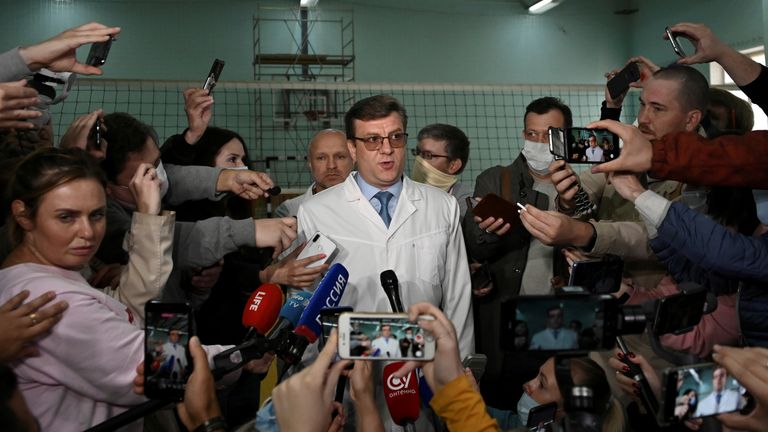
"Tests were immediately taken for the presence of toxic substances
in the body. Already today we can say that
oxybutyrates, barbiturates, strychnine, convulsive or synthetic poisons
have not been found. Alcohol and caffeine were found in the urine." Omsk regional health ministry
"So clearly, being an outspoken opposition leader or being a
corruption fighter or a whistle-blower in Russia is a dangerous business
indeed." "Navalny was doing a lot of work exposing corruption, including at
the highest level … and this is what they do to retaliate against their
critics."Ariel Cohen, senior fellow, Atlantic Council
"He
survived the flight and he's stable. It's obvious that something
terrible happened. He's a healthy, strong man with a good constitution
-- the night before the attack he was swimming in a
river." "Obviously
this was an attack on his life ... A healthy man suddenly was in life
danger and maybe could have died and maybe he can still die."Jaka Ibzili, German organization Cinema For Peace
"It takes a while to rule things out. And particularly if
something is highly toxic — it will be there in very low concentrations,
and many screening tests would just not pick that substance up."Alastair Hay, emeritus professor, toxicology expert,
school of medicine, University of Leeds
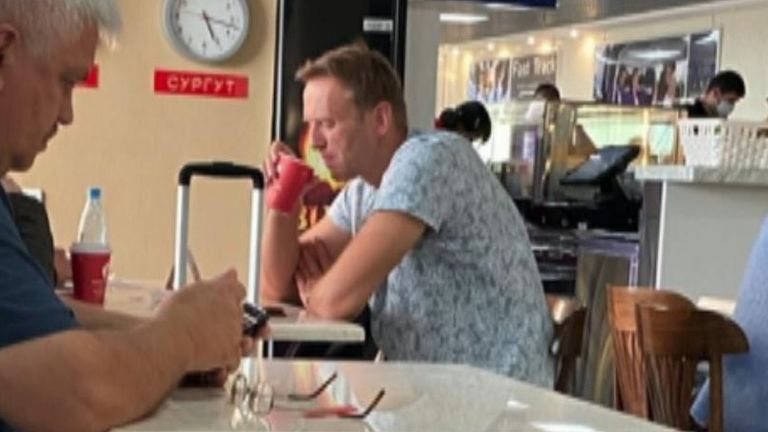
Mr Navalny is on a ventilator after drinking what is thought to have been poisoned tea. Pic: @djpavlin
A standoff between doctors and allies of Kremlin critic Alexei Navalny
came to a head on Friday when official clearance was granted for his
transfer to a Berlin hospital from the Omsk Emergency Hospital where he
was being treated after collapsing and falling into a coma on a routine
flight from Siberia to Moscow. It is assumed that he was poisoned, a
not-incongruent method frequently used to silence critics of the Kremlin
and of Vladimir Putin, and possibly the second time poison was used on
Mr. Navalny himself who survived the first attempt and may this one as
well.
Others have been less fortunate. Conflicting
accounts on Mr. Navalny's condition and whether he might be taken aboard
a specially outfitted German medical evacuation flight waiting to
receive him at the Omsk airport were eventually concluded. Omsk
Emergency Hospital chief physician, Alexander Murakhovsky early on
Friday said the patient's state of health mandated he not be moved, but
hours later he reversed himself, saying transfer to German care could
proceed.
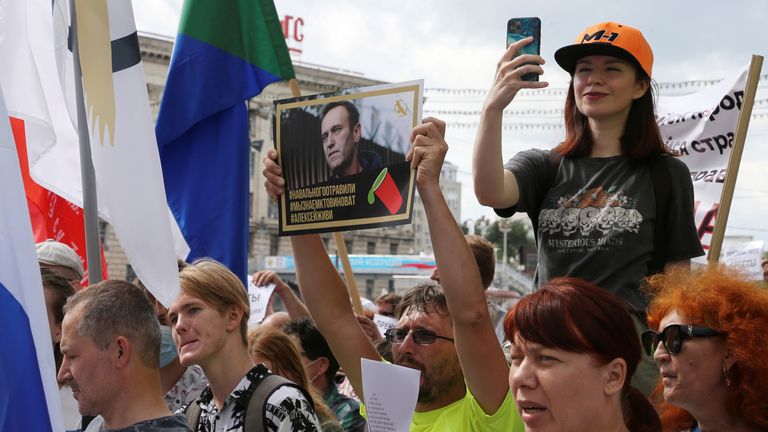
Anti-Kremlins: 'Navalny was poisoned. We know who is guilty. Alexei, live'
Dr.Murakhovsky
also stated that no indication presented itself that Mr. Navalny had
been a victim of poisoning, despite that he had said earlier it would
take two days before laboratory results would be received. Those
speaking for Mr. Navalny were under no illusions that he hadn't been a
poisoning target, the most recent victim of state-ordered poisoning. His
condition had improved from Thursday when he had been stricken, but no
details were available from attending doctors.
The
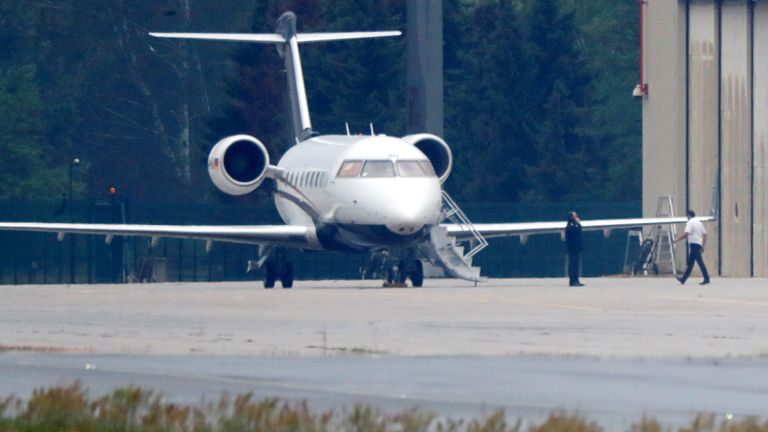
human rights activist Jaka Bizilj's Cinema for Peace Foundation was
eager to leave Saturday with the patient on a chartered ambulance
aircraft, for Berlin. When it arrived in Omsk Friday, three German
physicians were aboard who eventually were permitted to examine Mr.
Navalny. The German doctors were made unavailable -- forcibly escorted
elsewhere by Russian authorities -- for their conclusions to be shared
with Yulia Navalnava, Mr. Navalny's wife, nor with his colleagues; all
blocked from speaking with them.
As far as Mr.
Navalny's spokeswoman Kira Yarmysh was concerned, Russian doctors were
guilty of endangering the stricken man's life by prolonging his Omsk
Hospital stay rather than assent to his immediate departure for Berlin,
as a reflection of their intentions to hinder an investigation "until the poison in his body can no longer be traced". She charged that "The
ban on transporting Navalny is an attempt on his life, which is now
being carried out by the doctors and the deceitful authorities who
sanctioned it."
Doctors in Omsk hospital said there was no trace of poison in Mr Navalny's body Sky News
Doctors at his hospital, said Dr.Murakhovsky, were possessed of "five working diagnoses", without divulging any details. The most likely cause of the coma that Mr. Navalny fell into, he later stated is "a
metabolic disorder caused by a sharp drop in blood sugar levels during
the flight [from Siberia to Moscow, which was aborted when Mr. Navalny
fell suddenly ill]." Transportation police, on the
other hand, had informed a Navalny associate, Ivan Zhdanov, that they
had discovered poison deemed a danger not only to Mr. Navalny but anyone
else close to him, meaning access to Navalny not be permitted without
the protection of a full haz-mat suit.
The
explanation proffered by the Omsk physicians was an industrial chemical
substance found on Mr. Navalny's clothing, denying that the chemical
poisoned Mr. Navalny. Mr. Navalny's enemies are those of whom he has
been ultra critical; his Anti-Corruption Foundation served to expose
excesses and corruption carried out by members of Russia's elite,
enriched through their Kremlin connections.
"The plane with Alexei has taken off for Berlin. A huge thank you to everyone for your support." "The
struggle for Alexei's life and health is just beginning and there will
be much more to go through, but at least now the first step has been
taken." Kira Yarmysh
The emergency medical plane transporting Mr Navalny lands at the Tegel airport in Berlin
"We have the impression that [the] FBI, instead of fulfilling its main responsibilities in fighting crime, is fulfilling openly political orders." "It's coming from those forces that are continuing to fuel Russo-phobic hysteria [in the United States]." Maria Zakharova, spokeswoman, Russian Foreign Ministry
Maria Butina speaks at a Moscow press conference in 2013.STR/AFP/Getty
This is a quite impressive woman, Maria Butina, the young Russian woman who apparently enjoyed her freedom to bounce back and forth from Russia to the United States in pursuit of an agenda that, incredibly, revolved around the right to gun ownership. Doubtless she made quite an impression with the National Rifle Association. Her one-woman campaign to loosen Russian laws on gun ownership to make it more like the U.S., where people can avail themselves of guns quite readily, accounting in great measure for astonishing incidents of mass shootings, may even be popular in Russia.
What a resume this woman has acquired, not only in establishing her bona fides as an excellent entrepreneur, but as a quasi-political figure who has acquired some interesting contacts at elite political levels, both in Russia and the United States. And all by age 29. It's head-spinning, actually. She was obviously born to intrigue and manifestations of capability leading to trust and an unerring instinct to ingratiate herself with those capable of further advancing her remarkable career.
It is, unfortunately, a career put on hold, for the moment. She and her presence in the United States, have been seized upon as representing the damning issue of a dark power geared to penetrating government agencies and lead players for the unforgivable purpose of spying. Shucks, the United States has no agents installed in the Russian Federation or elsewhere for that matter, acquiring sensitive data useful to U.S. intelligence agencies -- perish the thought!
But relations between the U.S. and Russia are currently at a sensitive pitch of feverish accusations. Not so much Russia since it is held to be the aggressor, but the United States most certainly where denunciations of state interference in the last presidential election that saw the elevation of a most improbable candidate to the presidency, elected by quite a large margin of votes in a contest of two incompetent liars of low-to-absent principles, saw a man with a benevolent attitude toward a Russian president whose actions have been nothing short of alarming globally ascend to power.
Returning to Maria Butina, that enterprising woman of ambition and talent to match; born in the steppes of Siberia, she acquired a university education, opened a furniture store and in short order transformed one store into a furniture empire. But other options to spread her prodigious talent called and she entered the United States on a student visa to further her academic eduction there. In the process she acquired a fascination with guns and mounted a challenge in Russia to relax gun laws.
This young woman has been charged with conspiracy to act as an unregistered agent of the Russian government to gather intelligence on American officials and political organizations. And get this: to work toward establishing back-channel communication lines for the Kremlin. Facilitating open communications between Donald Trump and Vladimir Putin? Oh, dear! The Washington establishment will not, simply not have it! An enemy is not a competitor with whom one consults and exchanges views.
And when the U.S. views their president as having been Trumped by the slick imperturbable manner of a sly fox such as Putin they are enraged. Hatred, not a bland form of nation-to-nation communication is the order of the day this day in Washington. And plucking the presence of a Russian university student into the ambit of an FBI investigation of a woman who publicly posts social network updates on her travels between the U.S. and Russia offers speculative fodder for yet another threat emanating from Russia. "It's psychosis. A witch hunt", her father stated from her hometown of Barnaul, in Russia. She is on the cusp of graduating from American University with a master's degree in international relations, finishing with a perfect 4.0 grade point average. Smart woman, wrong place, right time.
Alexander Torshin, Scott Walker, and Maria Butina in April 2015.Maria Butina’s Facebook
"It is showing the world the great things it can do." "The government might not be able to provide safety, good health care and education, but it can provide big projects. If you cannot do bread, you can at least do circuses." "It signifies in the most visible way the connection between Crimea and Russia, that Crimea is part of Russia." Ekaterina Schulmann, political scientist, Russian Presidential Academy of National Economy and Public Administration
"All this discussion about geology, ice, wind, waves -- it would have been relevant fifty years ago." "Now, it is just a question of cost." Mikhail Y. Blinkin, director, Higher School of Economics, Moscow
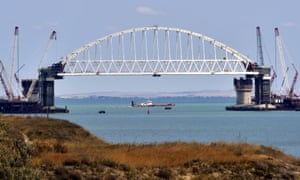
The bridge will span 12 miles across the Kerch Strait when complete. Photograph: Lev Fedoseyev/TASS
Three years ago, after the Ukrainian Crimean Peninsula was hoisted off Ukraine's unwilling hands to Russian ambitions to restore what Moscow saw as Crimea's place in Russian hearts, an interesting article appeared in The Moscow Times: https://themoscowtimes.com/articles/crimean-adventure-will-cost-russia-dearly-39112. It was fairly pessimistic, pointing out that with Russia's straitened financial situation it would be too devastatingly costly for the country to build a bridge link between Russia and Crimea, after Ukraine cut off all water, electricity and trade with Russian-held Crimea.
"Since the beginning of the crisis in Ukraine, the U.S. and the EU
have sharply criticized Russia's assistance to separatists in the east,
arguing that Moscow's provision of fighters, weapons, equipment,
and even direct military support are deeply destabilizing to the region.
But Washington and Brussels have paid far less attention to the
economic assistance Moscow is providing to Crimea, the formerly
Ukrainian peninsula that Russia annexed in March." "Annexation, however, will not magically enable Moscow to govern
Crimea, which has no overland connection to Russia and which had been
dependent on its land bridge to Ukraine for trade, travel, public
services, and essential services like power and water. Crimea's
geographic separation from the Russian mainland will also complicate
Russia's ability to exercise authority and promote economic development
in the region." Larry Hanauer, senior international policy analyst, RAND Corporation, Sept 2014
That was then -- moving briskly ahead to 2017 we find things have changed and an ambitious bridge is under construction, whose cost will ring in at $7-billion, a cost significant enough that it will drain much of the budget set aside for road and bridge construction throughout Russia. The considerable outlay for an engineering marvel set to carry 40,00 vehicles and 94 trains daily between Russia and Crimea will span the Kerch Strait.
The megaproject is expected to be open to traffic in a year's time; December of 2018. "The bridge itself is difficult, the scale is huge and it is tough to meet the deadline", according to Oleg Skvortsov, a bridge specialist involved in an advisory council. This is a bridge whose construction was a matter of consideration over the last century, but whose cost and complexity of engineering was sufficient to ensure that it was placed well back on a high shelf for some future date.
Vladimir Putin decreed that date had arrived. Work is proceeding on schedule. In an immense operation involving hundreds of workers, a 6,000-tonne railway arch was lifted into place 35 metres above the sea. The bridge, on completion, will be twelve miles in length, open to road traffic in 2018 and rail in 2019 to consolidate the Kremlin's intention to integrate Crimea with Russia.
In an operation viewed by the international community as illegal, with Crimea still viewed as part of Ukraine. Since its annexation in a rapid military operation, Crimean officials and companies have been under western sanctions.
The Kerch Strait runs between two mountain ranges with howling winds whipping throughout its confines, and where rivers line the seabed with 80 meters deep of fine silt and ice floes tumble in spring thaw in an area susceptible historically to earthquakes. Thousands of pylons had to be driven into the seabed to ensure stability for the bridge. Parts were built aerodynamically ensuring that winds would flow around the structure.
Once the bridge is in operation it's likely the current ferry systemm inadequate to the task of ferrying vehicles in required numbers, will be mothballed. Two close friends of Vladimir Putin, billionaire brothers Arkady R. and Boris Rotenberg, have stepped in to oversee the bridge project. Both Rotenbergs are suspected of having enriched themselves by siphoning off 15 percent of the 2014 Winter Olympics' cost of $51-billion, a Russian tradition whereby friends of the political elite are suitably rewarded.
Politics is a rough game, but in Russia it surpasses most other countries' leading parties' techniques in dealing with their opposition numbers since in most other countries of the world it is definitely abnormal to make a habit of unleashing assassins against a competing political party's leaders who have been effective in persuading a good portion of the electorate that it is past time to demolish the current government's hold on power and select an alternative.
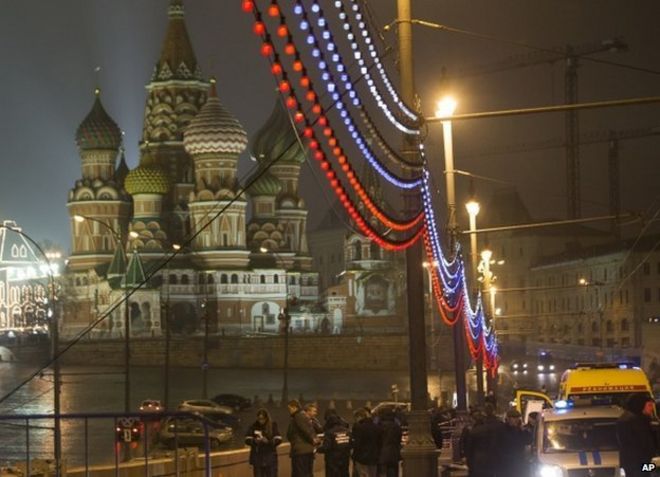
Mr Nemtsov was shot on a bridge within sight of St Basil's Cathedral and the Kremlin Associated Press
In Russia assassins do not hesitate to murder an opposition leader in view of the Kremlin itself, nor to send operatives on such missions abroad to dispatch critics of the government. Persecution of journalists, opposing a free press, dispatching the military to cross sovereign borders is the work of dictators, but such political figures seem to thrive in some countries absent a tradition of firm democratic order.
Russian aircraft casually, impertinently and at times threateningly approach other nations' aircraft while in the process of entering sovereign airspace of other nations. As for Russian ships and submarines, they too are often seen well beyond their own coastlines, entering the precincts of other nations in a blatant ploy to demonstrate there are no firm boundaries that will keep Russian presence to a minimum.
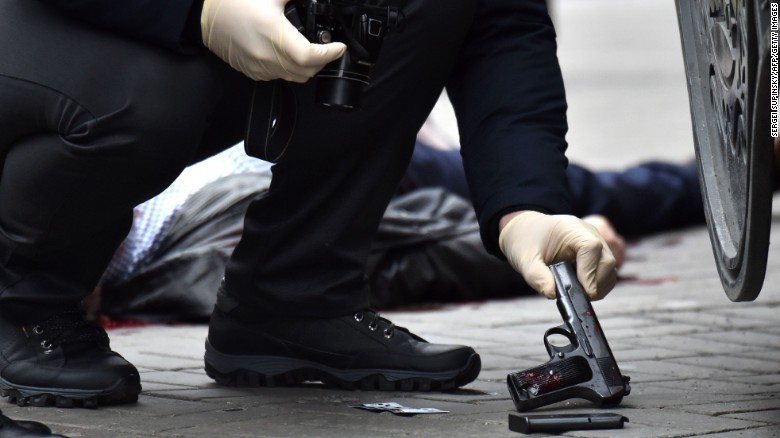
A Ukrainian police officer seizes a gun at the scene where Voronenkov was shot dead CNN
Directing assassins to enter a foreign country on a mission to prevent testimony from a senior Russian politician implicating the Russian government in episodic misdemeanors the government would prefer not to be aired, sign their own death warrants by betraying their insider knowledge to enquiries mounted by foreign nations whom Russia has belligerently invaded with the pretext that those involved do so without government sanction.
Exploits with poisoning critics of the Kremlin living abroad, with the use of materials so rare and deadly that only powerful governments could have provided them, is another signature of the Russian government, complacent that it will never be held to account for its crimes, only held to judgements they readily shrug off as unimpressive in its lack of clout.
How to assess a government that has so many outreach concerns on its agenda, all of which tend to represent aggression and threats against neighbours near and wide, still hungry for power and recognition, prepared to ally itself with the most unsavoury and brutal dictators to gain influence?
The Kremlin's decision to support Syria's butchering dictator at a time when the Syrian opposition was gaining momentum has turned the tide in the regime's favour and gained Russia an air base and deep sea port.
It has also gained Russia the enmity of the world at large for supporting a government whose power is based on terrorism and violence. And just incidentally brought to its own doorstep revenge that has impacted Russian civilians whose permission was never sought to expose them to such dangers as when hundreds of Russian tourists in the Sinai were killed in an on-air explosion credited to Islamic State.
Russia's near-abroad includes proximity to Muslim majority nations like Kazakhstan and Chechnya out of which comes committed jihadists hundreds of whom have migrated to Syria and Iran to join the Islamic State, though some may choose to remain where they are to carry out jihad against the kuffars. As did Akbarzhon Dzhalilov, 22, from Kyrgyzstan who martyred himself while killing 14 Russians and wounding another 49.
A makeshift memorial at the
Technology Institute subway station in St. Petersburg, Russia, on
Wednesday. Credit
Dmitri Lovetsky/Associated Press
This jihadist was a Russian citizen who carefully set two bombs in the St.Petersburg metro system, one of which he wore on his person to qualify himself as a martyr while dispatching his duty as a jihadist to take with him as many innocent people as he could manage. St.Petersburg evidently distinguishes itself with containing a large Kyrgyz diaspora finding work in Russia and becoming citizens.
St.Petersburg, a city of five million residents, cannot afford to concern itself unduly worrying at the presence of a large contingent of Muslims among whom some insignificant number may ultimately choose to sacrifice themselves and others for an ideology of death both personal and impersonal. Despite the intrigues of their government and the threats of their neighbours Russians want to be able to live in peace and prosperity.
Some will achieve their goal, some will die in the effort to do so.
Decisions and Their Consequences : Living High on Corruption
"[Navalny along with other leaders of the weekend protests across Russia were guilty of a] provocation [and of] offering certain rewards [to schoolchildren to become involved in the protests]." "The Kremlin respects people's civic stance and their right to voice their position. We can't express the same respect to those who consciously misled people and who consciously did it yesterday and provoked illegal actions." Dmitry Peskov, spokesman, Vladimir Putin
"You can't detain tens of thousands of people. Yesterday we saw the authorities can only go so far." "A time will come when we'll put them [government officials in Vladimir Putin's administration] on trial too -- and that time it will be fair." Alexei Navalny, opposition leader, Moscow
Top Putin opponent Alexei Navalny, shown in this Feb. 27 file photo, was arrested during Sunday's protests.(KIRILL KUDRYAVTSEV)
He hasn't yet been marked for assassination; perhaps it is for the time being a mere matter of time. He is not an oligarch, so he cannot have his vast financial holdings confiscated and turned over to the Kremlin to dispose of at the behest of the president. He has not yet been charged with offences so egregious as to merit a very long prison sentence in a federal institution that will keep him out of commission for a very long time.
Just fifteen days in prison for disobeying a police officer in central Moscow at a rally he was hugely instrumental in planning and coordinating. And a fine of 20,000 rubles for proceeding with the organizing of a clearly 'illegal' demonstration, unsanctioned by the government. Dmitry Peskov claims the Kremlin respects Russians' civil rights to protest. That 'right' is so respected that a required permit to allow such a demonstration to proceed would not be granted, making it an illegal activity for which a thousand people were arrested.
In 2012 when Russians came out in their thousands to protest Mr. Putin's election machinations calling on him to resign, the Kremlin had arranged for counter-protests to take place, strong-arming people to come out to show their support for Vladimir Putin. At that time it was basically a Moscow-only campaign when knowledgeable, middle-class, educated Muscovites expressed their anger at Putin's designs for Russia's future under his ongoing aegis.
The protests were assigned the status of being unrepresentative of Russians outside Moscow.
Now, however, in 2017, the spread of the protest movement is undeniable; it was not only the capital's boulevards and squares that were packed with protests, representing a metropolitan elite. This time demonstrations took place in 82 cities, where the regional capitals of places like Nizhny, Novgorod, Novosibirsk, Yekaterinburg and Vladivostok saw crowds of thousands organized not by those in control from Moscow, but by local organizers committed to the same anti-corruption movement as those from Moscow.
There can be little doubt that the evidence amassed by Mr. Navalny with the help of drone videos that showed a renovated 18th Century manor with a duck pond and accompanying duck house catering to the whims and pleasures of Prime Minister Dmitry Medvedev invoked anger from Russians experiencing financial hardships in the faltering economy. Russians are outraged that their officials live in opulent luxury while they attempt to muddle by.
But of course, during the days of the USSR, Russian notables had their big, expensive imported luxury cars and their country dachas.
And it's not just middle-aged grumps who have been demonstrating against corruption, but the young as well, those in their 20s, and teenagers appeared on Pushkin Square and other cities this past Sunday. The unemployed, struggling through the recession and seeing no opportunities for their futures. Navalny spoke for all of them at his Monday court appearance, calling for Medvedev to explain the corruption that had people so enraged.
It seems Vladimir Putin has been so busy on the international stage he hasn't had time nor the inclination to have a good look around at home to get a sense of the brooding public, resentful of where their president's choices in adventurism has taken the country. From intervention in Ukraine and interfacing with NATO and the European Union, struggling with the crippling Crimea economic sanctions and faltering oil prices, and the Russian military presence in Syria and the impact on the Russian economy.
It's a long distance from the spendthrift days of the Sochi Winter Olympics in 2014, and the adulation heaped on Putin for bringing the world to Russia's feet. The billions in corrupt payoffs and opportunities to Putin cronies can't have helped an already faltering economy, and the vast financial investment Mr. Putin and the Kremlin committed to in rebuilding the Russian military's upgraded state-of-the-art munitions took place at a time when Russia's income had already dwindled dangerously.
This is simply Moscow's ducks leaving their placid lakes and coming home to roost on the roof of the Kremlin.
"The United States strongly condemns the
detention of hundreds of peaceful protesters throughout Russia on
Sunday."
"We were troubled to
hear of the arrest of opposition figure Alexei Navalny upon arrival at
the demonstration, as well as the police raids on the anti-corruption
organization he heads."
"Detaining peaceful protesters, human rights observers, and journalists is an affront to core democratic values."
U.S. State Department spokesperson Mark Toner
"Today we are discussing (and condemning) corruption, not the
detentions. Well, I was detained. So what. It OK. There are things in
life that are worth being detained for."
"[Medvedev has a portfolio of assets including] huge pieces
of land in the most sought-after regions, yachts, apartments in old
mansions, agricultural complexes and wineries in Russia and abroad, [purchased through] bribes from
oligarchs, and state bank loans."
Alexei Navalny, Putin critic, politician, political opponent, protest organizer
CNN
"It is pointless to comment on the propagandistic outbursts of
a convicted opposition figure, who has already announced he is running
some kind of election campaign and fighting against the authorities."
Natalya Timakove, Medvedev spokeswoman
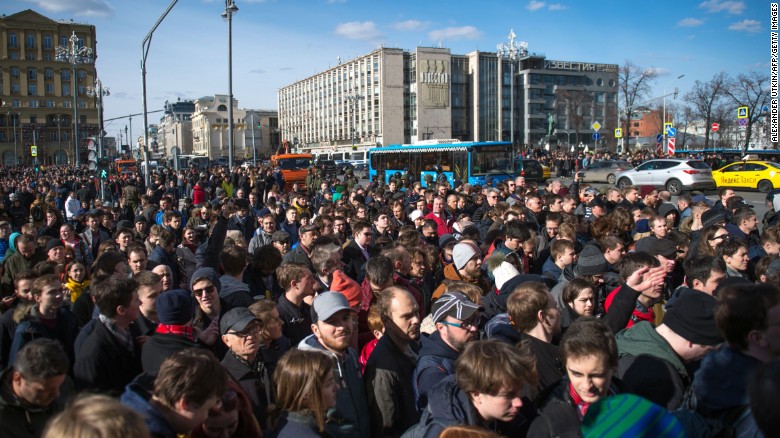
Russians gathered in surprising numbers in Moscow and other cities across the country, in support of protests against the government of Vladimir V. Putin and his cronies, whose deep-seated corruption has outraged Russians having to live under economic constraints in a struggling economy where revenues have decreased thanks to diminishing returns for natural resources and the effect of Ukraine-related sanctions by the West biting deeply into the nation's economic prospects.
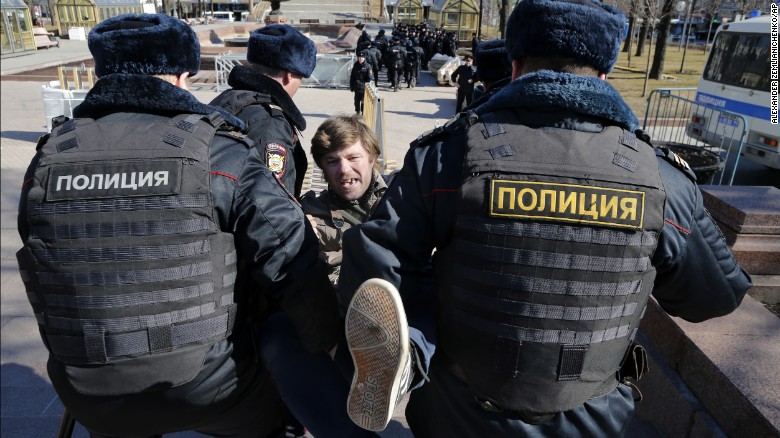
Police set up barricades, responding with tear gas and mass arrests in answer to the protests taking place in cities right across that vast national geography. Riot police wearing body armour and helmets manhandled over a thousand demonstrators in central Moscow alone, hauling them out of crowds estimated at well over ten thousand demonstrators cheering, whistling shouting 'Shame! Shame!" Shame, unfortunately, on the part of authorities, was in short supply.
CNN
Alexei Navalny, a courageous opponent of the government, was chiefly responsible for the large turnout and the organization behind it. His status as a chief troublemaker for Vladimir Putin places him in dangerous territory. It takes immense courage for Navalny, let alone the protesters who came out in droves, to express their enmity and contempt for their government in light of the very real fact that this government has few scruples when dealing with those it considers threatening to its existence.
Prime Minister Dmitry Medvedev, known for his nimble proficiency in playing revolving chairs of President-to-Prime-Minister-and-back-again with Vladimir Putin, was an especial target this time around. Mr. Medvedev had obviously taken his cue from Mr. Putin who had previously spent hundreds of millions in building a palatial palace befitting a czarist-era president-for-life. Mr. Navalny spoke of the prime minister's vineyards, luxury yachts and mansions to a value of over $1-billion.
Russian opposition leader managed to fly a camera over Medvedev’s
vacation digs, which supposedly belong to a charitable foundation. Weisss-Navalny files
Contracting out assassinations, whether in sight of the Kremlin, of major political opponents, or those who travel abroad to London, or next door to Ukraine, to help the government in Kyiv assemble a slate of actions by the Russian state against its neighbour, can be guaranteed. Mr. Navalny's Anti-corruption Foundation fails to find favour with the Kremlin, quick to charge it with extremism. It is even illegal to broadcast news of the rallies taking place.
Pushkin Square and surrounding areas were teeming with protesters; major streets were full of people decrying the corruption of their government. Anyone carrying a sign imputing malevolent motives to the government was ripe for being picked off and shoved into large buses moved onto the scene by police with the obvious intention of arresting as many protesters as possible to deliver the message that the protest was unauthorized.
Authorities would "bear no responsibility for any possible negative consequences", stated senior Russian police official Alexander Gorovoi. People who presented themselves at the protests expressing outrage at corruption, were considered fair game for authorities who made it clear that informing people of the rallies and encouraging them to come out to express their grievances was "illegal".
Rallies took place across Siberia and in the Far East of Russia where protesters were detained there, as well. Interior Ministry troops wearing combat gear pushed the protesters around while a loudspeaker blared: "You are participants in an unsanctioned demonstration. Consider the consequences."
"It was in Crimea, in the ancient city of Chersonesus or Korsun, as ancient Russian chroniclers called it, that Grand Prince Vladimir was baptized before bringing Christianity to Rus ..." "Christianity was a powerful spiritual unifying force that helped involve various tribes and tribal unions of the vast Eastern Slavic world in the creation of a Russian nation and Russian state. It was thanks to this spiritual unity that our forefathers for the first time and forevermore saw themselves as a united nation ...." "Crimea, the ancient Korsun or Chersonesus, and Sevastopol have invaluable civilizational and even sacral importance for Russia, like the Temple Mount in Jerusalem for the followers of Islam and Judaism." Russian President Vladimir Putin
Russian President Vladimir Putin, attends the Orthodox Christmas service
at a cathedral in the village of Otradnoye, Voronezh region, Russia.
(AP Photo/RIA Novosti, Alexei Druzhinin, pool)
Everywhere in the West, birth rates have declined. In Russia there is another phenomenon entirely; rising birth rates and expanding families. Everywhere in the Western democracies a spirit of secularism has overtaken religion that has long been separated from state affairs. Religion has been on a steep decline; parishioners barely dent the seating of churches, and a population that once flocked to church on Sunday no longer does anything of the kind. Churches have been abandoned, the buildings sold to be converted to health clubs, restaurants, theatres.
The Russian Orthodox Church has seen a renaissance under President Vladimir Putin. This is a man who decries the death of the USSR and with it Russia's sublime place in the world order, a powerful nation commanding the obeisance of satellite countries inextricably bound to Mother Russia, eager and willing to do its bidding. And though Vladimir Putin mourns the passing of the Soviet Union, he has no fond memories of its abandonment of religion, the religion he has taken pains to resuscitate.
One might think -- and one does so at risk of failing to understand the Slavic mind that adores its strongmen -- that the stress placed on the Russian economy through crippling sanctions linked to the annexation of the Crimean Peninsula and Sevastopol, and the invasion of eastern Ukraine, then the fallen world oil prices crippling the Russian economy with a weak ruble, that Russians living in penurious expectations for better times would resent the actions of their president.
But this is a man whose posturing is seen as admirable, whose refusal to back down before Western demands endears him to his population. So much does the West know.
Russians see their Vladimir as a hero, a leader of great principles unafraid to counter Western aggression, its contempt for Russia, which despises Western values. The vain expectation of the West that Russians would prefer liberal democracy to the autocracy they live under is a symbol of Western obtuseness and perhaps deliberate unwillingness to fully understand Russian values and expectations. Better to remain oblivious and feel contentedly superior.
Aetheism no longer reigns in post-Communist Russia. The Russian Orthodox Church in its heritage traditions now bespeaks the re-awakened values of Russia. And in Russia, President Putin leads the way to penalize divorce [despite his own], to prohibit abortion services, criminalize pornography and stamp forbidden toward "homosexual propaganda", in stark contrast to the West. Under Vladimir Putin, tens of thousands of abandoned churches have been restored in a spiritual, moral rendition of the new Russia.
That the Russian Orthodox Church maintains an allegiance to Syrian churches provoked the president to protect Christian minorities in the Middle East. Another link, aside from the newly established Syrian airfield for Russian fighter jets, and the Syrian deep sea port for Russia's naval fleet, between the two countries. Syrian president Bashar al-Assad is a man after Vladimir Putin's own heart as an ally; the protector of the ancient Christian community in Syria; ten percent of the population whom Muslin extremists would exterminate.
In Iraq, by contrast, where Sunni Islamist extremism bred the Islamic State of Iraq and the Levant, once home to 1.5-million Christians in their own communities where they had lived pre-Islam, those communities have been fairly well wiped out; those who feared for their lives fled, leaving their ancient homeland to the Muslim sects eager to wage deadly war on one another.
Russians are content that their president has his moral compass on the absolute correct setting, ensuring their pride in his stalwart defence of Christianity and Russian moral values remain firmly protected.
"The fact Mr. Putin called me the next day after the coup attempt was a very strong psychological factor [in their fortuitous re-engagement]." "The axis of friendship between Moscow and Ankara will be restored.l" Turkish President Recep Tayyip Erdogan
"Your visit today, despite a very difficult situation regarding domestic politics, indicates that we all want to restart dialogue and restore relations between Russia and Turkey". "It is our principle position (that) we are always categorically against any attempts at unconstitutional deeds [attempted coup occasioning Erdogan's purge of conspirators]." "Do we want a full-spectrum restoration of relations? Yes and we will
achieve that. Life changes quickly." Russian President Vladimir Putin Constantine Palace, St.Petersburg
Russian President Vladimir Putin shakes hands with Turkish President
Tayyip Erdogan during their meeting in St. Petersburg, Russia. | Photo:
Reuters
How charmingly touching, what a lovely resolution to the misfortune of unpopularity striking two renowned figures in a world of hostility to overt self-aggrandizing bullies and autocrats, preying on vulnerable neighbours. Which just goes to prove that there is empathy and kindness in the world. Two kindred souls rediscovering one another, and in the process once again swearing allegiance to each other's qualities as world leaders that other world leaders have chosen to conspire against.
How swiftly things change in the world of Realpolitik. And just to think of it, the crumbling chaos that is Syria brought these two star-crossed lovers together Despite that Russia is air-bombing in support of the murderous Syrian regime, and Turkey was and perhaps still is, supporting the Islamic State. But accommodation to opportunities when it seems as though erstwhile friends and colleagues have created a discomfiting distance, is the stuff of which diplomatic self-interest is made, after all.
During times of stress when friends and supporters melt away in disgusted distaste at a NATO colleague's resort to tyranny and violence, Turkey's Erdogan's dismay at the distance created by his imperious decision to attack the only militias the West is reliant upon in the Kurds, to confront Islamic State, further widened by his later determination to order the United States of America to render unto capital punishment justice Fethullah Gulen whom he accuses of creating the coup.
"If the U.S. does not deliver [Gulen] they will sacrifice relations with Turkey for the sake of a terrorist", announced Turkey's Justice Minister, Bekir Bozdag, repeating his master's voice, busy for the nonce in St.Petersburg, mending fences that will bring Russian tourism back to Turkey and restore plans for a gas pipeline traversing Turkey to European clients eager for Russian gas.
Russia's isolation from the wider world community was occasioned by Moscow's decision to scoop the Crimea out of Ukraine's geography. Allies are hard to come by, and Erdogan's deeply felt apology for ordering a Russian jet entering Turkish airspace for a millisecond was an object lesson in humble regret. Ankara's need of Moscow's support, having decided to sacrifice its position in NATO and an uneasy alliance with the U.S. simply represents the reality of crisis management.
And to hell with a European Union that turns up its nose at offering membership to Turkey. Ankara still holds the trump card of restraining Syrian refugees from once again flooding Europe, which erred strategically when it hemmed and hawed over visa-free travel for Turks to the EU's Schengen zone. For which they will yet once again pay dearly.
This represents a general opinion site for its author. It also offers a space for the author to record her experiences and perceptions,both personal and public. This is rendered obvious by the content contained in the blog, but the space is here inviting me to write. And so I do.


![Medical specialists carry Russian opposition leader Alexei Navalny on a stretcher into an ambulance on their way to an airport before his medical evacuation to Germany [Alexey Malgavko/ Reuters]](https://www.aljazeera.com/mritems/imagecache/mbdxxlarge/mritems/Images/2020/8/22/0c3401b879844ad19570195f1278fee9_18.jpg "Plane carrying Russian politician Alexei Navalny lands in Germany")
/cdn.vox-cdn.com/uploads/chorus_image/image/60413605/GettyImages_1000696098.0.jpg)
/cdn.vox-cdn.com/uploads/chorus_asset/file/11709577/Screen_Shot_2018_07_18_at_1.23.36_PM.png)






0 Comments:
Post a Comment
<< Home