Wednesday, November 02, 2022

The Khalistani Rebellion

"We don't want any violence. We don't want any violence from pro-Khalistan forces or the Indian side."
"We are saying, let's give votes a chance ... We are fighting for our own political opinions to be heard."
Gurpatwant Singh Pannun, Sikhs for Justice
 
"They're using Canadian territory for activities which could jeopardize India's security and interests."
"If the [Canadian government can do something about the referendum] and try to prevent it, that would be useful because it only creates a bad atmosphere and incites violence against India and Indians."
Manish, Indian High Commissioner to Canada 

"Secessionism amongst Sikhs has been very much in retreat in India itself."
"My sense is that there aren't serious tensions between Hindus and Sikhs."
"The main attacks that Hindus or Muslims or Sikhs have faced have come from white nationalist groups -- racist groups -- attacking all of them equally as people of colour."
Dr. Narendra Subramanian, political science professor, McGill University
Trudeau and then-Defence Minister Harjit Sajjan, left, met with Chief Minister of Punjab Amarinder Singh in Amritsar . (Sean Kilpatrick/Canadian Press)
 
Relations between Canada and India, long friendly, have become somewhat strained in the last several years. Jagmeet Singh, the leader of Canada's third political party, the New Democratic Party (NDP) is a Khalistan proponent and supports the referendum being carried out on Canadian soil. Harjit Sajjan, now Minister of International Development was formerly Canada's Minister of Defence, and a supporter of a Sikh homeland in the Khalistan movement to separate the Indian Punjab from India to become a Sikh-autonomous region.
 
When Prime Minister Justin Trudeau visited India in 2018, his manner of dress was bizarre enough to draw the amazed attention of Indians; the Trudeau family costumed themselves throughout the trip in flashy outfits not even Bollywood stars would appear in. At a reception, the appearance of a former Khalistani convicted of attempted murder of a visiting Punjabi official to Canada, proved an embarrassment to Canada, and a provocation to Narendra Modi's government.
 
A former premier of British Columbia Ujjal Dosanjh, himself a Canadian Sikh, had years ago been savagely beaten by Sikh separatists for his public condemnation of the separation movement. A British Columbia Sikh newspaper editor who had also been critical of the movement was murdered by Sikh separatists. And Canada's worst terrorism event took place when in the mid-1980s Khalistani terrorists placed bombs on Air India Flight 182 flying from Canada to India, killing all 329 aboard. 

There are 800,000 Sikh Canadians comprising 2.1 percent of the Canadian population, a huge diaspora. In 2019 the Statistics Canada total for all Indo-Canadians came to 1,008,995. By no means does the total, whether Hindu or Sikh support the separatist movement of Sikh nationalists. After the Air India bombing, the Khalistan movement receded to a degree in its provocations. At the present time, however, another movement has arisen calling for a referendum on separatism among the global diaspora of Indian Sikhs.
 
Khalistan Referendum in Canada (Source: Twitter/@Azhar Javaid)
 
Called the Punjab referendum, it asks people of Sikh origin their opinion of the Sikh-majority Indian state of Punjab separating, fulfilling the dream of Khalistan. Canada has become one amongst the first to hold votes, organizers claiming that over 100,000 people participated in the balloting near Toronto a month ago. A group calling itself Sikhs for Justice is careful to point out theirs is a peaceful exercise in free will. A situation that New Delhi sees as an abhorrent attempt against its territorial integrity and sovereignty.

Whatever the outcome of the referendum it has no legal status; it is not binding, and completely unofficial. Its organizers hope to strike a 'moral' victory to enable it to apply international pressure on India. Voting on the referendum began in the U.K. a year ago, went on to Italy and Switzerland, and a second round resumed in Brampton, just outside Toronto a month ago. It is destined to move to Montreal, Edmonton, Calgary, Vancouver, Surrey and Abbotsford early in the coming year before travelling to the United States.

With the balloting complete, its organizers hope to be able to present a compelling proof to the United Nations that Indian Sikhs have a moral and traditional heritage right to their own geography independent of India to be self-governed by Sikhs alone. The ghostly horror of the partition of India and Pakistan, and Pakistan and Bangladesh in 1948 comes to mind. India's reaction to the movement has been predictably condemnatory.

The truly curious thing about the entire situation is that separation appears to be entirely led by the expatriate Indian Sikh community. Within India, Sikhs, particularly those living in the Punjab, appear rather less than interested in separating, more than a little comfortable with the status quo. Indian Sikhs appear not to be influenced by the strenuous, disruptive efforts of the diaspora to impose upon them a state they're not asking for.

And what is passing strange, is the fact that their peers populating the globe in foreign countries as citizens of those countries, expend time, energy and political will in expounding their vision of a dire need for an exclusionary homeland, one where neither they nor their descendants will cleave to and live within. In Canada, a rift is appearing between Canadian Hindus and Canadian Sikhs. The former becoming targets of the latter.

Liberal Member of Parliament Chandra Arya last month accused "Khalistani extremists' of painting  graffiti on the BAPS Shri Swaminarayan Mandir temple in Toronto. In July, a Rutgers University report warned of an explosion in "Induphobia:" online. The source not Sikhs, but white supremacists, Islamists and Iranian trolls sowing division.
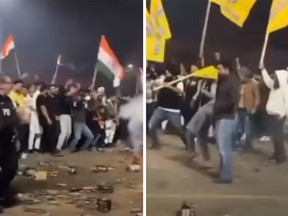
A crowd waving Khalistan flags faced off with nationalists brandishing the Indian flag in a Mississauga, Ont., parking lot on Diwali. Police watched as the two sides yelled and set off fireworks, but there was no violence.
A crowd waving Khalistan flags faced off with nationalists brandishing the Indian flag in a Mississauga, Ont., parking lot on Diwali. Police watched as the two sides yelled and set off fireworks, but there was no violence. Photo by SherePunjabRadio AM600 /YouTube


Labels: , , , , , ,

Monday, September 26, 2022

Claiming Russian Title to Ukraine's East


"Encroachment on to Russian territory is a crime which allows you to use all the forces of self-defence."
“This is why these referendums are so feared in Kyiv and the west."
Dmitry Medvedev, former Russian president, deputy chair, security council
 
"There is no referendum. There is a propaganda exercise which is being called a referendum."
"It means nothing. It will be a few staged things where there will be Russian television cameras."
Mykhailo Podolyak, senior aide, Ukrainian president Volodymyr Zelenskiy

"From the very start of the operation … we said that the peoples of the respective territories should decide their fate, and the whole current situation confirms that they want to be masters of their fate,"
Russian foreign minister, Sergei Lavrov
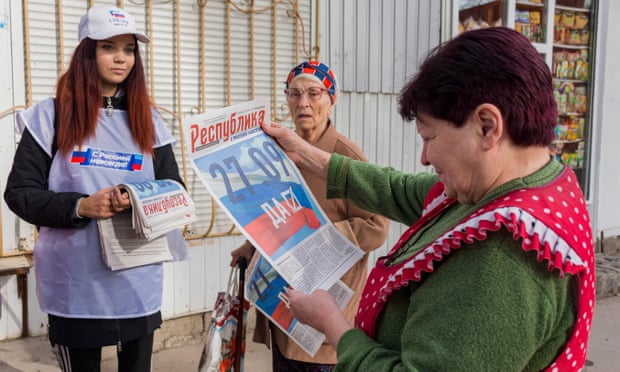
A volunteer distributes the Republic campaign newspaper with the slogan '27.09 – Yes' during a campaign rally for a referendum to join the Russian Federation in downtown Luhansk, Ukraine.
A volunteer distributes the Republic campaign newspaper with the slogan '27.09 – Yes' during a campaign rally for a referendum to join the Russian Federation in downtown Luhansk, Ukraine. Photograph: EPA
 
The sudden launch of a 'referendum' whose purpose is to demonstrate to the world that Ukrainian citizens living in occupied Luhansk and Donetsk regions of the Donbas would produce an overwhelming vote in favour of joining Russia, is meant to give legitimacy to Vladimir Putin's illegal occupation and invasion of Ukraine. All the more desperately sought as validation of Russia's claims of historical regional ownership in consideration of recent setbacks where the Ukrainian military has launched its counteroffensive with gratifyingly obvious success for Ukraine's reclamation of its territories and towns.

Moscow, however is leaving nothing to chance. It is clear that the population of the Donbas is being coerced to 'vote' in Russia's favour, leaving an oppressed population little choice but to support Russia's claim that the population agrees it is in favour of leaving Ukraine and joining Russia. Ukrainian officials speak of people being banned from leaving some of the occupied areas while the four-day vote is being conducted.

And as additional measures to make certain that people do as they're told under duress, armed groups go directly to homes forcing people to cast their ballots. Elsewhere, employees face threats of losing their employment should they fail to participate. "Today, the best thing for the people of Kherson would be not to open their doors", advised displaced first deputy council chairman of Kherson region, Yuriy Sobolevsky..

With Ukraine's recapture of large swaths of the northeast in their counteroffensive, the voting manoeuvre was organized in great haste. The same Ukraine counteroffensive highlighting a weak Russian military response, impelled Vladimir Putin to act on a matter he has been famously loathe to call upon, knowing the furious public reaction that would result, by calling up a partial military draft to swell the military by 300,000 troops to deploy to Ukraine.

Moscow envisions succeeding in new attacks to retake the initiative in the grinding conflict. By formally incorporating vulnerable, occupied areas of Ukraine, as essentially Russian, Vladimir Putin would then regard attacks on those areas by Ukraine as representing attacks on Russia itself, to justify a response possibly as frighteningly severe as a nuclear attack. Nothing would merit such a starkly globally extreme attack in the Russian attack against Ukraine, but the reverse obviously would.

References to Russia's nuclear arsenal have gone well beyond idle talk; they are now being invoked as a possible option should Russia find itself in extremis. There is little that could be viewed as more terrorizing than unleashing a nuclear bomb in the context of a war Russia has imposed on a neighbour, with its far-reaching menace and ramifications throughout Europe. Much less a necessary response that would draw the entire region and beyond into a wider conflict.

In the east and northeast, voting in the provinces of Luhansk, Donetsk, Kherson and Zaporizhzhia represent a desperate attempt by the Kremlin to legitimize the illegality of the occupation of a third of Ukraine, in what is essentially the country's industrial heartland. Serhiy Gaidai, Luhansk's Ukrainian governor, spoke of the population of the town of Starobilsk banned from leaving, with people forced from their homes to vote. The situation, he said, was "elections without elections", where people were forced to complete "pieces of paper" lacking privacy, in kitchens and yards.

"The mood of the Russians is panicky because they were not ready to carry out so quickly this so-called referendum, there is no support, there's not enough people", explained Sobolevsky from Kherson. The votes have been condemned by leaders of the West and the United Nations, viewing the issue as an illegitimate precursor to illegal annexation, simply put, with no independent observers where a large percentage of the pre-war population having fled. 

"It's all nonsense, bluff and political manipulation to frighten us and the Western countries with their nuclear stuff", remarked 64-year-old Oleksandr Yaroshenko, resident of Kyiv. Previously, a referendum was staged as a pretext for annexation of Ukraine's Crimea in 2014. Russia's little set-piece strategies for returning its neighbours to their pre-Soviet-disintegration servitude.

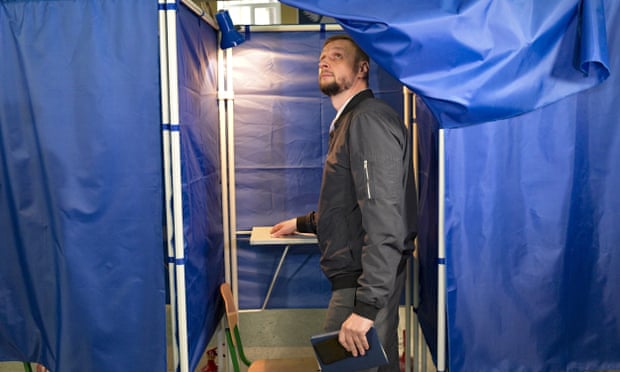
Vladimir Vysotsky, the head of the Central Election Commission of the so-called Donetsk People’s Republic, inspects a polling station before a referendum in Donetsk, eastern Ukraine.
Vladimir Vysotsky, the head of the Central Election Commission of the so-called Donetsk People’s Republic, inspects a polling station before a referendum in Donetsk, eastern Ukraine. Photograph: AP

Labels: , , , ,

Wednesday, September 27, 2017

Visualizing a Dream

"I hope the northern Iraqi administration gathers itself together and abandons this adventure with a dark ending ."
"The moment we shut the valve [for the pipeline through Turkey] it’s finished for them. [No country other than Israel supports the] invalid, fraudulent] Iraqi Kurdish referendum on independence]."
Turkish President Recep Tayyip Erdogan

"[The landmark vote represents a] historic and strategic mistake by the Kurdish leadership."
"I will not give up on the unity of Iraq, that is my national and constitutional duty."
"[The vote and its outcome] threatens Iraq, is a danger to the region."
"We will take measures to safeguard the nation's unity and protect all Iraqis."
Iraqi Prime Minister Haider al-Abadi
A Syrian Kurd takes a selfie in the northeastern Syrian city of Qamishli on Tuesday, during a gathering in support of the independence referendum in Iraq's autonomous northern Kurdish region.
A Syrian Kurd takes a selfie in the northeastern Syrian city of Qamishli on Tuesday, during a gathering in support of the independence referendum in Iraq's autonomous northern Kurdish region.  (DELIL SOULEIMAN / GETTY IMAGES)
Turkey remains the conduit for landlocked Kurdistan to export its oil. But Erdogan is bypassing the reality that Moscow has signed a deal with the Kurds for their oil production, and it is highly, hugely unlikely that Ankara is prepared to dispute Moscow over Kurdish oil exports. Empty bluff. What may not be so empty is the military option that Erdogan could always muster. And if it is done alongside Iraq's threat to use force to impede Kurdish sovereignty, a problem could arise. On the other hand, would Sunni Turkey ally itself with Shiite Iraq?

The independence referendum that the Kurdish leadership lauded as a long-awaited exercise in self-determination brought out a strong response in the Kurdish population, as an estimated five million Kurds went to the polls, determined to finally see themselves as a sovereign nation whose geographical rights to their heritage status would be internationally recognized. That intent is viewed as a hostile act by both Iraq and Turkey, fearing that their own Kurdish population will be emboldened, as will those in Syria.

Baghdad visualizes the unsupportable, a redrawing of its borders, with a significant portion of the country's oil wealth slipping away along with that changing border. Iran too has its own fears that the independence of Kurdistan will persuade their own long-suffering Kurdish populations to agitate anew for the same recognition from the international community. Though the international community has not responded positively, with the exception of one sole country whose own trajectory toward sovereign status was hard come by and remains contested.

The 'yes' vote will not immediately serve to bring independence to the region which won autonomy a short few years ago, after suffering horrendous violence from the previous Iraqi government ruled by Saddam Hussein. The referendum, carried resoundingly by the anxious assent of its residents has raised tensions and apprehensions of instability in Iraq and the larger Middle East. Which, in fact, is already in a semi-permanent state of tension and instability. Kurdistan above all, represents the success of regional stability, a bastion of human rights and democracy.

Intimidation is seen to be in order, as hours following the closing of polls across northern Iraq's Kurdish region, Baghdad's Defence Ministry announced a "large-scale" joint military exercise to take place with its neighbour, Turkey. Recep Tayyip Erdogan, the irascible Islamist that he is, had already threatened military intervention, while Iran held its own military exercises along their border with Iraq. The territory that Kurdish peshmerga captured fighting the Islamic State is considered by them as part of their territory.

Kirkuk included, along with its petroleum resources, a bitter pill for Baghdad to choke on. Masoud Barzani has congratulated his people on asserting their determination to achieve independence, a long-held dream so dear to the hearts of the Kurds and so distant in the past, brought to a head with the referendum that succeeded in shouting out to the world that it is past time that justice be done. "We are ready to pay any price for our independence" calmly stated this world-class leader.

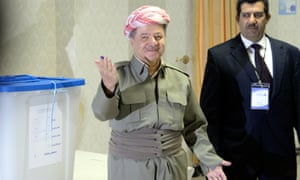
Iraq’s Kurdish leader, Masoud Barzani
Iraq’s Kurdish leader, Masoud Barzani, appealed for ‘peace and dialogue’ and said: ‘Threats will solve nothing.’ Photograph: Depo Photos/REX/Shutterstock

Labels: , , , , , ,

Follow @rheytah Tweet