Trafficking in Chinese Brides
"We trusted them. I had a sense I was being sold, but I could not escape."
"I said I didn't want to get married. I wanted to go home."
"When I saw Burmese letters on the signs, I was so happy [on her return to Myanmar]."
Phyu, 17, Burmese trafficked to China as a 'bride'
"The families of the husbands are mad about the case because they spent a lot of money but lost their wives."
Niu Tianhui, spokesman, Xiangcheng police bureau
"Bride trafficking is very common here in Shan State."
Zaw Min tun, member, anti-human-trafficking task force, northern Shan
"[Her baby, 9 days old, looks] like her father. The same lips. Chinese."
"I wanted to give her away but I looked at her and I loved her."
"Even with that Chinese animal's lips."
Nyo, 17, Burmese trafficked to China as a 'bride'
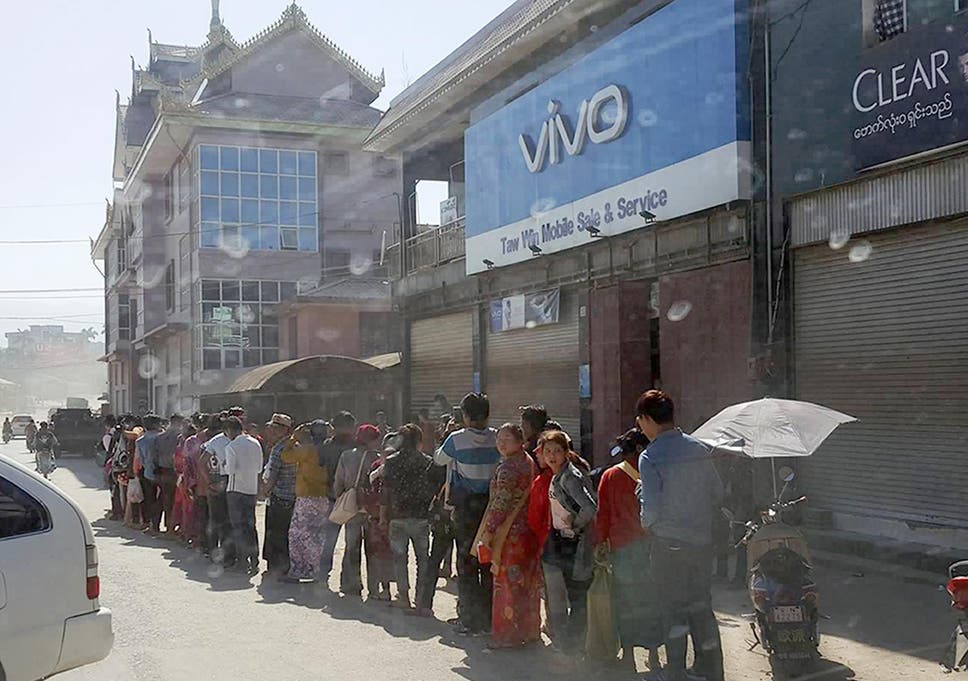 |
| The Human Rights Watch report found vulnerable young women from
Myanmar’s conflict-ravaged northern Kachin and Shan states are being
trafficked into sexual slavery in China
(
AFP/Getty
)
|
Two schoolgirls, good friends, lured by a neighbour, Daw San Kyi, promising them well paid waitressing employment if they would travel to the border with China. He knew a wealthy villager who would assist them, so early one morning a year ago, a van arrived to pick them up and take them to the identified destination. There was a long drive on a mountain road that made Phyu nauseated. Four pills given her by Ms. San Kyi helped, leaving Phyu disoriented, but she recalled that someone used a syringe to inject her arm with a substance.
Her friend Nyo, also 16 years old, refused pills and she recalls some of what occurred but her memory too is confused. There were guesthouses along the border where they stopped and there they were informed that heavy rain had closed the area and the roads closest to the restaurant where work awaited them. A boat ride ensued and then additional car travel. They were a full ten days in transit and by then it seemed that the restaurant promise was nowhere in sight. The girls attempted to free themselves and run home but failed.
They were in a strange place with a strange language and had no idea where they were, where they could run to. Chinese-speaking men arrived to look at them. Some of them pointed at Phyu, others at Nyo. When Phyu began crying, the trafficker said she must stop otherwise she would not look pretty enough to attract a potential husband. The girls were taken separately and paired each with a 'husband'. They thought they might be in Beijing.
Phyu was locked into a room by her 'husband' Yuan Feng, 21. Yuan would arrive in the evenings, inject something into her arm and force sex on her. Nyo was also locked in a room by her 'husband' Gao Ji; she was beaten. Once he began to trust her he allowed her to use social media and that is how she discovered that she was in Xiangcheng County, Henan Province, one of China's most populous provinces, with 100 million people, double the population of Myanmar.
Henan Province has one of the widest gender disparities in China, thanks to the gender-based abortions forced on Chinese for 30 years with their one-child policy, with the emphasis on boy babies, and where female babies were aborted or abandoned. Now that the boy babies are grown there are no female counterparts for them, leading Chinese men to import wives from countries nearby, forcibly if need be.
Phyu, it turned out was in Xiangcheng as well. A Shan Chinese woman who helped to rescue girls such as Nyo and Phyu from sexual slavery in China alerted a police officer and two months after the girls' arrival in Xiangcheng, police knocked on their husbands' doors. The law mandated that Mr. Yuan and Mr. Gao be detained for 30 days. Giving the girls the opportunity to leave and weeks later they returned to Mongyai, Myanmar.
Nyo was pregnant, and she decided the child would be given up for adoption. And when the baby was born she was unable to part with the tiny girl.
 |
| Photograph, Minzavar, The New York Times |
Labels: Brides, China, Myanmar, Sex Slaves
Doubly Victimized, Traumatized, Brutalized
"I could feel it. She was a piece of my soul. I loved her from that first moment [of birth]."
"I held her so tight, and I kissed her until it was time to go. They [aid workers] gave me a receipt for her."
"The difference is that I was honest [that she had been repeatedly raped by Islamic State terrorists, as a Yazidi sex slave, resulting in her pregnancy], and these mother were not [claiming their children were born of Yazidi men, not Muslims]."
"They [Yazidi Supreme Spiritual Council] told me to get rid of my daughter, they said I had no honour. Now it's done."
Hiyam, Yazidi, 21, escaped Islamic State sex slave
 |
| Hiyam, Photo: The Washington Post |
"To make special examples in this case would be to whitewash the result of the Yazidi genocide."
"We know that they're just children, and that they have no guilt. But in this case religion and society just cannot accept them."
Karim Sulaiman, spokesperson, Yazidi Supreme Spiritual Council
She was one among the thousands of girls and young women who were captured as sex slaves when Islamic State terrorists invaded Sinjar, slaughtering and beheading Yazidi men and taking young girls and women as captives to be bartered and sold as sex slaves. Eventually thousands of the assumed twenty thousand who had been abducted and forced into slave labour as sex objects to be raped repeatedly, then discarded and sold elsewhere, escaped their captors and made their way back to the Yazidi community.
Some of those survivors faced suspicion, and a reluctance among the community to be accepted. For many the warmth of belonging to their community is withheld. If they are pregnant, if they gave birth to a child begotten from their slavery as sex objects, the community is constrained to welcome their return. The Yazidi faith is an ancient one, and it incorporates elements of pre-Islamic beliefs, scorned by Muslims as 'devil worshippers'.
When Hiyam discovered herself to be pregnant by an Islamic State terrorist who 'owned' her as his sex slave, the fourth in a procession of owners, she wept in despair and viewed the pregnancy and the impending birth with a certain dread. She attempted to miscarry and at night wept endlessly at her fate. A midwife handed her the baby, a tiny girl, and Hiyam's doubts completely vanished seeing her baby daughter's little face, mouth in a wide yawn.
The Yazidi highest religious body issued an edict in April that children born to an Islamic State father could be welcomed into the fold. That changed in the wake of the edict when a popular backlash harshly denounced the decision. Then hundreds of mothers faced the agony of a miserable option. they could choose to exclude themselves voluntarily from the community for the rest of their lives, or they could abandon the child and be welcomed back.
The Kurdish-speaking Yazidi community in Iraq, where Hiyam came from has long been accustomed to persecution. They have maintained their independence through strict obeisance to their spiritual leaders' guidance. With the mass enslavement of Yazidi women, Yazidi elders broke with centuries of precedent to decree women and girls would be free to return to the community, defying stigma associated with marrying or having sexual relations outside the faith.
Children born of forced unions became a matter of bitter contention since a child cannot be recognized as a Yazidi without both its parents being Yazidi. When Hiyam's child was born, she named the little girl Hiba,
"a gift from God", in Arabic. Her family questioned smugglers and other girls who had escaped from their captors but no one knew of her whereabouts. Eventually Hiyam telephoned her mother, informed her of the baby's existence.
Her mother Shireen found her daughter Hiyam in 2017 close to the city of Mosul, bringing her back to the displacement camp where the community had been established in exile. Soon everyone knew of the child and pressure grew. Some in the community suspected her of sympathizing with ISIL. Causing her extended family members to inform her that she had to decide how to dispose of the child. She started remaining in the tent with the baby, until neighbours threatened to burn it.
So, one morning she awoke, bathed her child, dressed her in a new dress, picked up her little girl, walked out the tent door and past the neighbours, through the camp to a prefabricated building where she handed her sleeping baby over to aid workers, who then dismissed her after handing her a receipt for Hiba. Hiba awakened and in her mother's absence began screaming. She heard the baby's screams growing fainter as she walked away.
Hiyam has hung onto a small pair of white shoes, a woolly headband, and a bottle that had belonged to her baby. Mementos, all she has left of a beloved child. She valued the truth more than a sorrowful future of self-recrimination. Her troubled soul will struggle forever with the loss forced upon her. She will always think of her baby and the milestones of her development and growing maturity. Hiyam was deprived of her human dignity, violated, humiliated, given a gift, and forced to surrender that gift.
 |
| Hiyam's family lives in a tent refugee camp. Photo: The Washington Post |
Labels: Iraq, Islamic State, Sex Slaves, Tragedy, Yazidis


