Sunday, December 19, 2021

Eastern Europe in High Stress

Eastern Europe in High Stress

Ukrainian President Volodymyr Zelensky, left, and NATO Secretary General Jens Stoltenberg are seen at a news conference at the European Union headquarters in Brussels on Thursday. (John Thys/AFP/Getty Images)

"The message today to Russia is that it is for Ukraine as a sovereign nation to decide its own path."
"We call on Russia to return to diplomacy. To de-escalate. And to respect Ukraine's sovereignty and territorial integrity."
"Any further aggression against Ukraine will have severe consequences. And would carry a high price."
Jens Stoltenberg, NATO Secretary-General

"We will emphasize here once again, that the inviolability of borders is one of the very important foundations of peace in Europe, and that we will do everything together to ensure that this inviolability actually remains."
German Chancellor Olaf Scholz

"I'm worried because the military concentration, especially on the Ukrainian border with Russia [is] very strong."
"We are prepared to avoid the kind of surprises we met during the occupation of Crimea."
Slovenian Prime Minister Janez Jansa, EU revolving presidency

"Probably we face the most dangerous situation in the last 30 years. I think we have to do everything that is in our hands to prevent the worst scenario, which we [cannot] exclude."
"This scenario is possible military intervention into the territory of Ukraine."
Lithuanian President Gitanas Nauseda
 
"There will be no talks on European security without European allies and partners."
"[Washington will hold discussions with its allies but] we will not compromise the key principles on which European security is built, including that all countries have the right to decide their own future and foreign policy, free from outside interference."
Jen Psaki, White House spokesperson
Russian President Vladimir Putin speaks at a conference in Moscow on Friday. (Sergei Guneyev/SPUTNIK/AFP/Getty Images)

Over 100,000 Russian  troops have been massed on the Russian border with Ukraine, leaving leaders of Europe to warn of the most dangerously tense episode occurring in real time, in the past 30 years since the dissolution of the Soviet Union when its satellites went their separate ways, assuming full sovereignty for themselves after years of orbiting helplessly around the powerfully-enforced magnetic star of the USSR. 
 
With the last European Council summit of the year in Belgium, EU heads of state and government gave ample warning to the Kremlin that it would face "massive consequences and severe cost" should there be a repeat of the annexation of Crimea in a violent 2014 takeover. But Vladimir Putin remains resolute; should Europe wish to achieve a relaxation of tensions, NATO must withdraw its 2008 assurance to Ukraine that it would be welcomed along with Georgia into its bloc. No agreement, no de-escalation.
 
Moscow's published list of demands for de-escalation and recall of Russian troops and war machinery has failed to impress NATO  and the EU. Russia's insistence of a legally binding guarantee that NATO surrender all military activity in eastern Europe and Ukraine is part of its list of security guarantees to be negotiated with the West if any progress is to be made in de-engaging from its current level of intimidation and threat.
 
The detailed demands, Moscow stressed, are essential, without which tensions will not be diminished in Europe, and the crisis over Ukraine defused. However, the world could be assured, Moscow reiterated, that it has no intention whatever of planning an invasion of Ukraine. Demands include an effective Russian veto on future NATO membership for Ukraine. Other elements relate to the removal of U.S. nuclear weapons from Europe alongside the withdrawal of multi national NATO battalions from Poland, Estonia, Latvia and Lithuania. 

None of those demands were met with ingratiating deference. Russia does not, after all, control with the
EU or NATO and its allies, led by the United States, envision for Europe; total abandonment of the Baltic states and the rest of eastern Europe to the kind remonstrances of the Kremlin to convince former satellites that their futures lie with a resumption of their former devotion to a mighty Russia's formation of a strong Europe.

According to Russian Deputy Foreign Minister Sergei Ryabkov, Russia and the West must begin with a clean slate to rebuild relations gone sour. Russia being fully prepared to begin talks as soon as possible. As far as the Kremlin is concerned, its position is one of response to threats to its security from Ukraine's increasingly warm relations with NATO and its aspirations to join the alliance. 

The best possible scenario the Kremlin envisages if that NATO  return to the situation that existed before May 1997; predating the accession to NATO of any of the former communist states in east Europe; that NATO relinquish any military activities in Ukraine, eastern Europe, the Caucasus and Central Asia. Wait for it.

Ukraine’s foreign minister has asked Canada to help strengthen its defences amid escalating tensions with Russia, while NATO warns Russia will face “high impact” sanctions if it attacks


Labels: , , , , , , , ,

Monday, June 01, 2020

COVID Stress, as Universal as the Pandemic

"[It's vital to identify environmental threats from a] fitness survival perspective."
"We only became predators much later in evolutionary history [leading us to over-interpret risks to survival because the human mind is poor at probability-estimating; a heritage of our hunter-gatherer brains]."
"[With COVID-19, there is uncertainty] because the medical news changes every day."
"...Generation Z and millennials were already very vulnerable, they were already prone to anxiety and depression and for many of them, I fear the confinement has made it much worse."
"We're still not sure what happened, where the virus came from and COVID conspiracy theories are spreading."
"Just the simple act of being able to share food and stories with your friends has become very special."
"The constant state of anxiety and uncertainty, the isolation, the lack of meaning and purpose, these are all things that are accompanied with negative affect, which make us more prone to being victims of our own emotions."
"We're constantly missing out in these tiny little micro actions, but these micro actions eventually amount to us becoming better persons for the sake of others. Doing things that people had lost track of because of the rat race of our daily lives."
Samuel Veissiere, anthropologist, assistant professor of psychiatry, McGill University
https://images.theconversation.com/files/336864/original/file-20200521-102682-1mmgo9e.jpg?ixlib=rb-1.1.0&rect=21%2C451%2C4533%2C2266&q=45&auto=format&w=1356&h=668&fit=crop
"We don't really know, especially because we don't have that comparator to say, this is how many would be experiencing lifetime anxiety prior to the pandemic."
"But it's important for people to understand that if you are experiencing those symptoms, you're not alone. This is an unprecedented time."
Tara Elton-Marshall, scientist, Centre for Addiction and Mental Health
"These are stressful times and there are things to be concerned about. But a healthy level of anxiety gives people agency."
"It's when the feelings start to impair functioning in your ability to work, to parent, to be present in a healthy way in your relationships, that a  health professional needs to be involved."
Dr.Valerie Taylor, chief, department of psychiatry, University of Calgary
Experts in the field of mental health swiftly became concerned about the impact of fear, isolation and pandemic policies on the human psyche when the global pandemic was declared, the series of shut-downs in various countries in response to the invasion of the SARS-Cov-2 virus which began to spread COVID-19 in populations, altering peoples' lives in ways never before encountered, taking an unheard-of toll on society in general, on the business world, on governments and the international community.
Worry, Gratitude & Boredom: As COVID-19 affects mental, financial health, who fares better; who is worse?
Our vulnerabilities, once the scaffolding of civilizational norms and our habitual place in the order of things were suddenly reversed and social-isolation mandated, struck people with a sense of total helplessness and uncertainty how to respond, in a growing sense of psychic dislocation. "It's sad, but not surprising", to see that outcome, commented Dr.Veissiere, co-director of the Culture, Mind and Brain Program at McGill, of the fact that a new national survey indicates a sizeable number of people have been severely affected psychologically.
One quarter of Canadians, according to the survey results, experienced moderate to severe levels of anxiety, another quarter experiences occasional or frequent loneliness, and 20 percent reported depression. Close to a quarter of the 1,005 survey participants reported at least once-weekly binge-drinking. Women, parents with young children, 18- to 39-year-olds appear to be faring worse than others, and notable numbers report being nervous and edgy, unable to relax.
People are irritable, readily annoyed, with a problematical number of days spent concerned that "something awful might happen", over the coronavirus hanging over society, like a Damaclean Sword. This survey represents the first in a planned series by the Centre for Addiction and Mental Health, collaborating with Delvinia, a research tech and data collection company, offering access to the survey data "to help mental health professionals get ahead of what's coming".
covid19 mental health
Angus Reid
Within any population there are people whose minds are geared to accept or struggle against situations, so that "if you're a 'no-big-deal' kind of person, you'll find the information confirms that bias", while catastrophizers who believe something is far worse than it actually is, react otherwise. When the World Health Organization first declared the death rate of COVID-19 at 3.4 percent, that data caused a frisson of fear. 
The U.S. Centres for Disease Control and Prevention this week released their 'best estimate', placing the overall death rate at 0.4 percent, a more reasonable, less fear-inducing figure for those who show symptoms, at the same time estimating 35 percent of infected people will never develop symptoms. Because of the shut-down conditions Canada imposed in an effort to 'flatten the curve', two million jobs were forfeited in April.
Resulting in a large segment of the population left to struggle with feelings of boredom, frustration and fear. Younger adults appear to be the most anxious, with people 60 and older less so, even as it is the older population that is more susceptible to the more serious effects of COVID than the younger demographic in one of those peculiar twists of irony in human nature. Experts hazard the opinion that people given to anxiety under normal circumstances now stressed under COVID have simply become more anxious.
According to the survey, it is women more than men who have ended up struggling more over the conditions they now find themselves in. More likely to have lost employment, to be shouldering child and elder care, and for many women home isn't quite the haven it should be. "We're seeing an increase in domestic abuse", notes Dr.Valerie Taylor. A 50 percent increase in texts and calls has been reported by Kids Help Phone, a national support service for youth.
covid19 mental health
Angus Reid
Anxiety represents uncertainty about what might happen. The more one thinks about possibilities and dwells on worst-case scenarios, the likelier they are to have heightened anxiety and depression. The very fact that SARS-CoV-2 remains a universal planetary threat speaks to our susceptibility and uncertainty. And when people feel helpless to avoid disaster fear and panic can set in, and spread. The antidote to that is to find comfort, reassurance, to restore feelings of safety.
And those can be found in re-establishing contact with those who have a meaningful impact on our lives, in a relaxation of the shutdown, and opening up of opportunities to once again be together with people we know and care about. To share experiences, meals, the meaning of life as social creatures dependent for our happiness and satisfaction on our contact with others, deriving pleasure from ordinary things that under normal circumstances are taken for granted.
anxiety
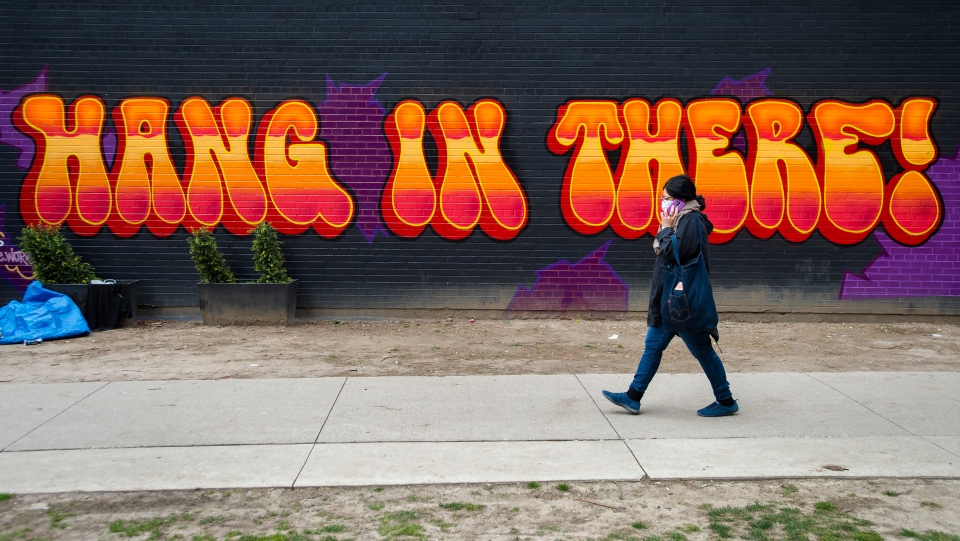
A woman wearing a mask talks on her phone during the COVID-19 pandemic in Toronto on Tuesday, April 28, 2020. THE CANADIAN PRESS/Nathan Denette

Labels: , , , ,

Follow @rheytah Tweet