``When
he heard he`d got 25 years` împrisonment¸ he said: `My self-esteem has
gone up, I understand that I did everything right.``
``Ìt`s the biggest score I could have got for what I did, for what I believed in as a citizen and a patriot`.`'
Maria Eismont, lawyer for Vladimir Kara-Murza, Kremlin critic
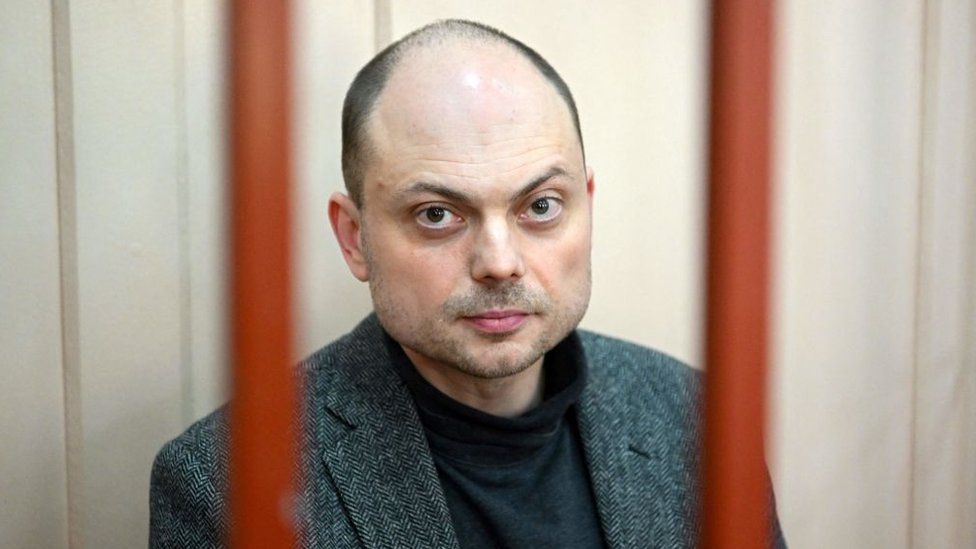
Vladimir Kara-Murza pictured during a hearing in October 2022 AFP
Found
guilty by a Moscow court on Monday, 41-year-old British-Russian citizen
Vladimir Kara-Murza has been sentenced to 25 years` imprisonment, the
absolute harshest sentence of its kind following Russia`s invasion of
Ukraine. Found guilty of treason and other related offences he denied he
committed. That he is a critic of the Kremlin and of President Vladimir
Putin, is without doubt. He has been lobbying Western governments for
years to impose sanctions on Russia in recognition of its many human
rights abuses.
He
had been accused by state prosecutors of treason, of discrediting the
Russian military by spreading `knowingly false information` about the
conduct of Russian servicemen in Moscow`s `special military operation`in
Ukraine, for which prosecutors requested a 25-year prison term. Prior
to his arrest Kara-Murza in an interview said Russia was run by a
`regime of murderers`. He had spoken throughout the United States and
Europe, lecturing and accusing Russia of bombing civilians in Ukraine.
When
he heard the verdict on his punishment after he was pronounced guilty
of treason and other offences, and knowing the next 25 years he was
destined to be an inmate in a maximum security penal colony, Kara-Murza,
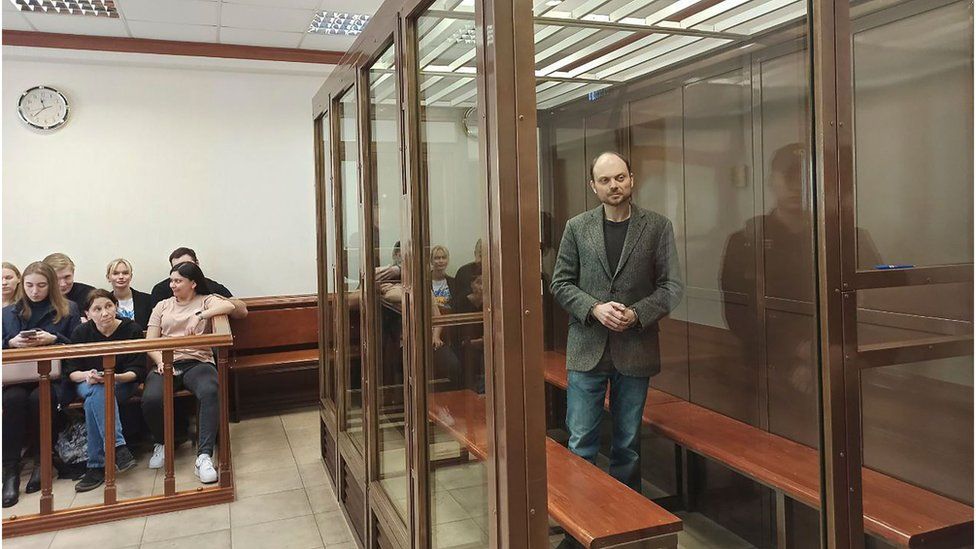
seated within a glass courtroom cage, pronounced his own verdict of his
country: `Russia will be free`,
he stated calmly. He smiled and said the harsh sentence was regarded by
him as recognition of his effectiveness as an opposition politician.
A
week ago in a final speech to the court, Kara-Murza compared his trial,
held behind closed doors, to Josef Stalin`s show trials in the 1930s.
He was proud, he said, of everything he had accomplished, declining to
ask the court for an acquittal. His lawyer, Eismont, announced that the
legal team planned to appeal the verdict which she described as having
been marred by legal violations.
"I love and hate this man for his incredible integrity,"
"He
had to be there with those people who went out on the streets and were
arrested,`
"He
wanted to show that you shouldn't be afraid in the face of that evil
and I deeply respect and admire him for that. And I could kill him!"
Vladimir Kara-Murza's wife, Evgenia
Britain
in 2020 had imposed sanctions on the presiding judge, for human rights
violations. And London summoned the Russian ambassador to protest the
`politically-motivated`conviction. `Criminalization of criticism of government action is a sign of weakness, not strength`,
commented U.S. Ambassador Lynne Tracy, speaking alongside British
Ambassador Deborah Bronnert who told reporters Kara-Murza had been
punished for courageously speaking out against Russia`s Ukraine war.
`Discrediting``
the army is punishable by up to five years in prison, in reflection of
Moscow having introduced sweeping wartime censorship laws, used to
silence dissenting voices. Accordingly, spreading `deliberately false
information` about the war can result in a 15-year jail sentence. Mr.
Kara-Murza hit the jackpot.
Vladimir Kara-Murza will serve his 25-year sentence at a penal colony Shutterstock
"[Russian President Vladimir] Putin is a killer his soldiers are fascists, 352 children have been killed [in Ukraine]."
"How many more children should die for you to stop?"
"May the murdered kids haunt your dreams tonight."
"I do not plan to stop, I am not afraid despite the constant intimidation from the authorities."
"The next 10 generations won't be able to clean themselves from the shame of this fratricidal war."
"I'm ashamed that I allowed myself to tell lies from the television
screen. Ashamed that I allowed Russians to be turned into zombies.We just silently watched this inhumane regime."
"The
[Mach] interrogation lasted for more than 14 hours, I wasn't allowed to get in
touch with my family or friends, I was denied access to a lawyer."
"It
was my anti-war decision. I made this decision by myself because I
don't like Russia starting this invasion. It was really terrible."
Marina Ovsyannikova, former state Russian TV journalist
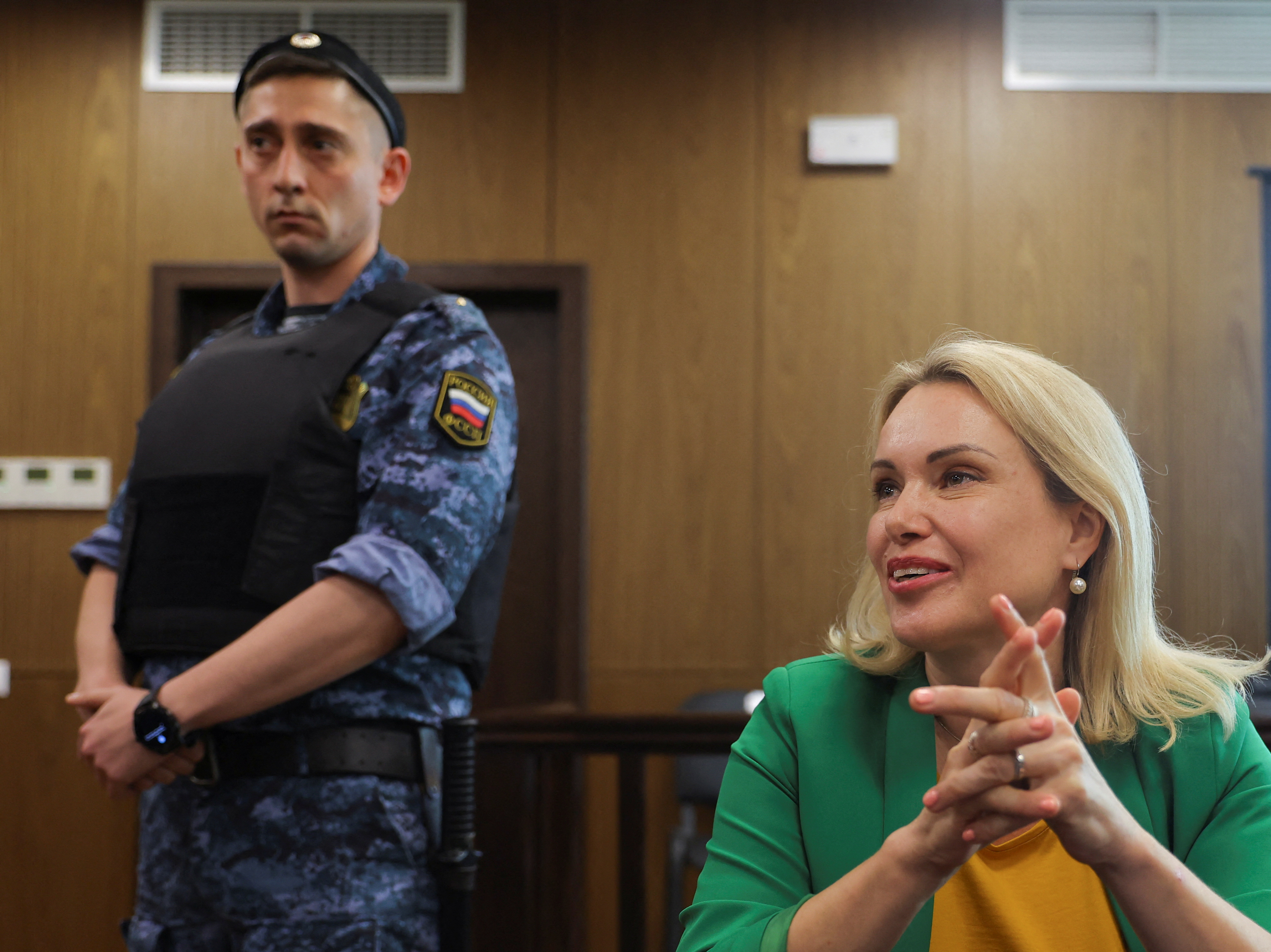
Marina Ovsyannikova in a Moscow court room.AP Photo/Alexander Zemlianichenko
She
is defiant and courageous. She will not be intimidated, she speaks
what she believes and feels. She is a Russian hero, a formerly admired
state journalist whose presence on television was familiar to all
Russians. When the Russian 'special military operation' was still in its
infancy, not yet a month after the February 24 invasion, she staged an
on-air protest against the war campaign that Moscow forced on Ukraine.
Following her first March protest she was briefly placed under arrest
and fined.
She then left Russia given a short contract with the German newspaper Die Welt.
When she returned to Russia it was with full knowledge that she could
be re-arrested. Her return was occasioned in early July, drawn to fight
for access to her two children following her ex-husband having filed a
lawsuit for sole custody. And nor was she determined to keep a low
profile even at that. This Russian daughter of a Ukrainian father
continued to stage public protests against Russia's conflict in Ukraine.
On
August 10 police raided her home to arrest her. A day later, she was
charged with spreading fake news about the military, an
offense that carries up to ten years in prison under a special Russian
law enacted in the wake of the invasion. Any criticism, even referencing
the 'special military operation' as a conflict, or the use of the word
'war' could have a protester arrested and face years of incarceration.
Even while Ms.Ovsyannikova sat in the glassed-in courtroom cage, she
lifted a hand-lettered sign reading: "May the murdered kids haunt your dreams tonight."
A resident stands next to a house destroyed by a Russian military strike
in Marhanets, a town in Ukraine's Dnipropetrovsk region on Aug. 10. (Press service of the National Police of Ukraine/Reuters)
She
was ordered by the court to be placed under house arrest. To await a
trial on charges of spreading false information about the Russian armed
forces. Involved last month in a street protest where she held up a
banner condemning Vladimir Putin as a killer, if convicted she could be
penalized by ten years in prison. That being the case, the woman who is
prepared to fight for the right to have access to her children may not
see them again. In the mid-July protest there were two dolls lying at
her feet, covered in red ink to simulate blood.
Her
trial is set for October 9. A wide crackdown on anti-war protests
across Russia to stamp out dissent has victimized many loyal Russians
who just happen not to be loyal to Vladimir Putin. His violent incursion
in Ukraine has appalled his critics, detractors and opponents.
OVD-info, an independent Russian human rights watchdog, estimates that
over 15,000 detentions have taken place since March, with up to 178
people facing court trials who could end up with lengthy prison
sentences.
Former Russian state TV employee Marina Ovsyannikova Reuters
"I hope to be able to put the word 'victim' into the past."
"When
things like this happen you have no repair possible. That's why you
have justice, [even if] justice can't do everything."
"It puts an exclamation point at the end of it."
Arthur Dénouveaux, Bataclan massacre survivor
"The assassins, these terrorists, thought they were firing into the
crowd, into a mass of people,"
"[Hearing the testimony of victims was] crucial to both their own healing
and that of the nation."
"It wasn't a mass — these were individuals who had a life, who loved, had hopes and expectations."
Dominique Kielemoes, whose son bled to death at one of the cafes
Families of victims, journalists and lawyers attend the courthouse where
the trial took place under heightened security on Wednesday. (Abdulmonam Eassa/Getty Images)
Salah
Abdeslam, chief suspect and the sole survivor among the 2015 terrorist
attackers who massacred 130 people -- claiming their massacre was due to
the influence of the Islamic State group -- has now been convicted of
murder. His sentence was the most severe possible under French law; life
in prison without possibility of parole. He denied being a murderer and
pleaded forgiveness for his error in judgement.
A
special terrorist court had been convened to try the case of the
terrorist attack against the Bataclan theatre and a number of other
attacks at cafes and a sport stadium in a coordinated night of terror
and death in Paris. Abdeslam was found guilty of murder and attempted
murder related to a terrorist enterprise. While he had contended a
change of mind led him to abandon his explosives vest, in fact the court
heard, it was a malfunction in the explosives vest that kept him from
detonating it and slaughtering even greater numbers.
A courtroom sketch shows Abdeslam as the verdict was read at the courthouse on the Île de la Cité in Paris on Wednesday. (Elisabeth de Pourquery/France Televisions/Reuters)
A
special French court Wednesday also found twenty men to be guilty of
involvement in the Bataclan attack as well as on Paris cafes and
France's national stadium. Presiding Judge Jean-Louis Peries read the
verdicts surrounded by tight security, to close out the nine-month
trial. Eighteen defendants aside from Abdeslam were given
terrorist-related convictions.
Harrowing
victim accounts were heard in the packed main chamber of the 13th
Century Justice Palace aside from the testimony of Abdeslam, the sole
survivor of the ten-member attack team that gave Paris a Friday night
that would forever haunt the city. There were a dozen overflow rooms and
they were fully packed. Of the other defendants six were accused of a
direct role in the Mach 2015 attacks in Brussels, claimed as well by the
Islamic State group.
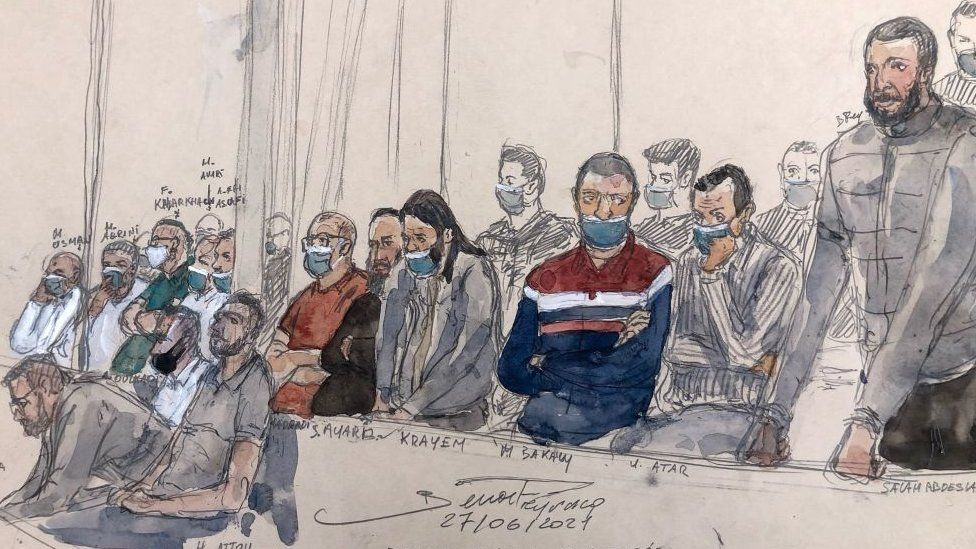
A court sketch shows Salah Abdeslam standing (far R) alongside the other 13 defendants in court this week Benoit PEYRUCQ/AFP
The
remainder of the defendants faced accusations of assisting with
logistics or transportation. The most conspicuous change related to that
fateful day in March 2015 is armed officers patrolling public spaces
constantly. Most of the attackers were born and raised in France and
Belgium, which led to soul-searching by authorities while at the same
time the lives of those who suffered losses or bore witness were forever
transformed. Of the ten-member attacking team, six are presumed to have
been killed in Syria or Iraq.
A French police officer stands guard in front of the Bataclan concert
venue during a ceremony marking the fifth anniversary of the deadly
terror attacks in Paris, on Nov. 13, 2020. Chief suspect Salah Abdeslam
was convicted Wednesday of murder and other charges and sentenced to
life in prison without parole. (Benoit Tessier/Reuters)
"I experienced a situation that not many people have experienced, people who took a step back, who changed their minds."
"You're there, in prison, you say to yourself, 'I should have triggered the thing'. That's what you think when you're in solitary confinement."
"I wanted to say today that I did not kill anyone and I did not hurt anyone. Not even a scratch."
"It's important for me to say this, because since the beginning of this case, people have not stopped slandering me."
"Islamic State's fight is legitimate. I want to live under Shariah law. But why would that make me dangerous. If I am released, I won't hurt anyone."
Salah Abdeslam, 32, accused Bataclan Islamic State terrorist, Paris
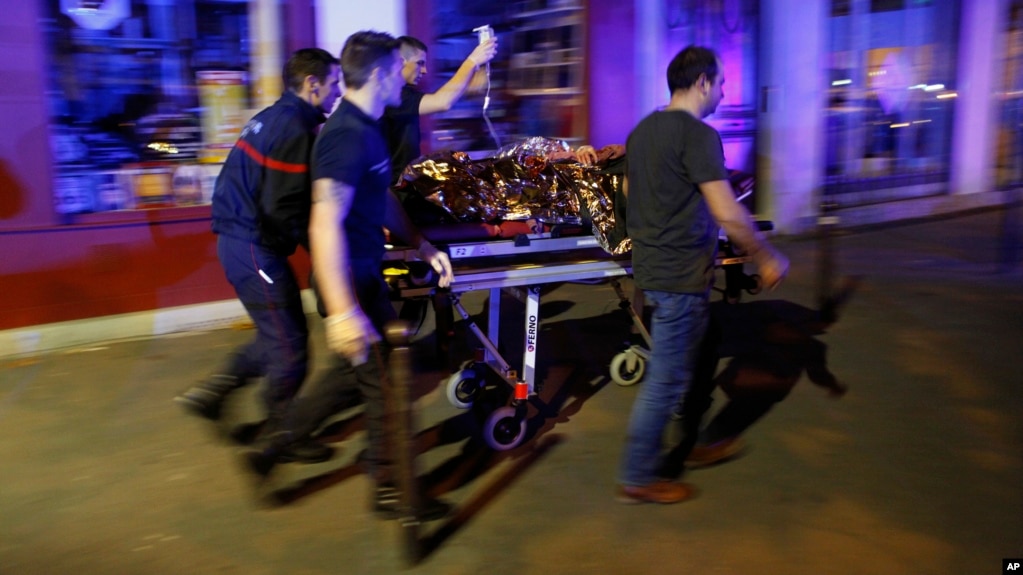
In this November 2015, photo, a person is evacuated after a shooting, outside the Bataclan theater in Paris.
Slandered, absolutely outrageous. What exactly is it that these would-be jihadis who find the methodology of Islamic State in asserting itself as a champion of Islam so praise-worthy that they are willing to commit mass murder in solidarity with the ISIL mission, yet don't fathom the revulsion felt by normal people for whom psychotic acts of pure barbarity are unfathomable? That, as a result of committing to terrorism, other people decry the presence of such ideological psychopaths in their midst is seen to be gratuitously insulting to an aspiring jihadi.
Salah Abdeslam is a French national of Moroccan origins who pledged allegiance to Islamic State a mere two days before the onslaught in Paris that resulted in the deaths of 130 innocent people. It is the belief of French investigators that the sole surviving member of the Islamist conspiracy to slaughter innocent people in a synchronized gun and bomb attack on six restaurants and bars, the Bataclan concert hall, and the national soccer stadium fully intended to carry out his part in the mass attack.
He claims he had a change of mind, that he held back from detonating his suicide vest out of compassion for those who would be killed. Presumably, including himself. Making him, in his mind, totally innocent of any crime and puzzled by the charges laid against him since, after all, he contends, he harmed no one. Prosecutors were informed by investigators that the intention remained unfulfilled because his suicide vest malfunctioned, failing to explode.
He fled the carnage to Belgium, where he was later arrested. He was convicted in a Belgian court in 2018 of attempting to evade capture by shooting at the arresting officers. However, as he insisted in the Paris court, he had not harmed anyone. Simply not for lack for trying, on the other hand. His reasoning: because he was not responsible for any deaths, what's all the fuss about? Of 20 defendants Abdeslam is the only one directly accused of murder, attempted murder and hostage-taking.
The court heard him out, explaining that compassion for the plight of the Syrian people, and not religious views compelled him to join Islamic State. For us Muslims, it's humiliating", he said of the West imposing its rules and values on others. Compassion for Syrians, had he possessed an iota of reasoning, would have led him to excoriate the Alawite Baathist Shiite Syrian regime of Bashar al-Assad which victimized and killed hundreds of thousands of Syrian Sunnis.
While never having travelled to Syria, he explained to the court, he admired the willingness of Islamic State terrorists to surrender their lives for the greater purpose of glorifying Islam through their personal martyrdom to the cause of jihad. As for the reason that his wish to live under Shariah law makes him dangerous to non-Muslims and moderate Muslims alike, his actions tell the story.
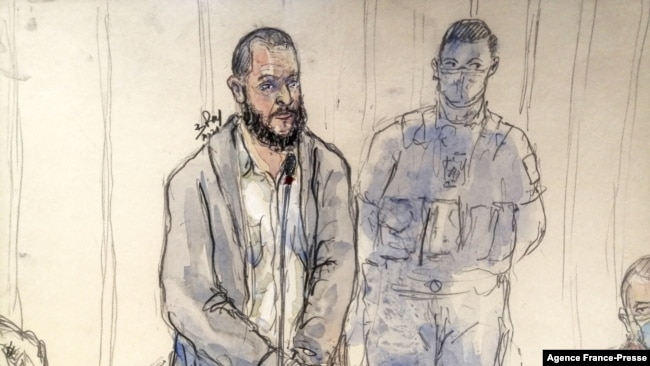
In this court sketch made Nov. 2, 2021, Salah
Abdeslam, left, the prime suspect in the November 13, 2015, Paris
attacks, attends the trial taking place in a temporary courtroom set up
at the Palais de Justice of Paris.
"Spark of Life" Sparking Controversy in Murder Trial
"Mr. Floyd in this case is entitled to have the jury realize he was a human being, he was loved, he had a family."
"As soon as you start getting into propensity for violence or propensity for peacefulness, then we're getting into character evidence."
Hennepin County District Judge Peter Cahill
"[The hope is that testimony by Floyd's brother would show the victim as a] person who would light up a room with a smile."
"So often in these trials where the victim is a marginalized minority, nobody works to humanize that person."
"He was loved and that there was something taken from us taken from society, taken from the world."
Benjamin Crump, civil rights lawyer, representing the Floyd family
Defence attorney Eric Nelson (left) and former Minneapolis Police Officer, Derek Chauvin (right) Court TV pool via pool
Minnesota law has embraced a controversial type of evidence permitted to be presented in criminal trials for the purpose of reminding jurors and judges and all concerned through the prosecution of a trial that a victim of crime was not merely some faceless person, but was rather "imbued with the spark of life", to quote a ruling by the Minnesota Supreme Court.
In the murder trial of former Minneapolis police officer Derek Chauvin, prosecutors are entitled to present to the jury photographs of George Floyd as he appeared in his youth and to question one of Floyd's brothers, expected to reminisce about Floyd's close relationship with their mother. Both photographs and reflections are not meant to shed light on the central question; whether Chauvin, white, committed a crime in his fatal arrest of the black man in handcuffs.
Despite video footage clearly showing that the-then police officer, in the process of arresting the 46-year-old handcuffed man lying prone on a street, while pinning him by his neck to the ground for a full nine minutes despite pleas by Floyd that he was unable to breathe, Mr. Chauvin has pleaded not guilty to murder and manslaughter charges.
This type of presentation is permitted in criminal trials in Minnesota even though defence lawyers and some among legal exports have long extended the argument that allowing this kind of testimony with no bearing on whether a defendant is guilty demonstrates exactly why federal courts and U.S. states other than Minnesota disallow it. Such accounts are usually given voice only following a conviction, during a sentencing hearing.
"The 'spark of life' doctrine is controversial because it violates the foundational principle of relevance in evidence law", pointed out Ted Sampsell-Jones, law professor at Mitchell Hamline School of Law in St.Paul, Minnesota. The Minnesota Supreme Court ruled such 'evidence' is permissible so long as it did not invoke undue sympathy or inflames the jury's passions. "You don;'t want to go too far where the jury is just deciding things on raw emotion", stated University of Minnesota law professor David Schultz.
Should Floyd's brother Philonise Floyd, describe George Floyd as a "gentle giant", it has the potential to lead to his being grilled by Chauvin's lawyer, pointed out presiding Judge Peter Cahill. This, while the judge denied requests by Chauvin's lawyers to admit evidence relating to Floyd's previous criminal convictions, including a violent robbery that took place in 2007, cautioning this background to be irrelevant to the case.
Floyd's girlfriend already testified before the jurors. In tears Courteney Ross spoke of their romantic walks and his love for his daughters. She also revealed that she and Floyd were addicted to opioids. Floyd's death was ruled by the county medical examiner as a homicide at police hands though the medical examiner also found fentanyl and methamphetamine is Floyd's bloodstream. Lawyers for Mr. Chauvin argue drug overdose may have been the cause of death.
"Spark of life" evidence was characterized by Chuck Ramsay, a Minneapolis defence attorney as an unfair doctrine. "It is damning to the defence. The line between undue sympathy for the deceased and prosecutorial misconduct is a thin one", he said, having seen such evidence used against his own clients.
Philonise Floyd and Rodney Floyd raise their fists on the way to
the Hennepin County Government Center on the eighth day in the trial of
former police officer Derek Chauvin, who is facing murder charges in the
death of George Floyd, in Minneapolis, Minnesota, U.S., April 7, 2021.
REUTERS/Nicholas Pfosi/File Photo
The Psychosis of Psychopathy Masquerading as Autism
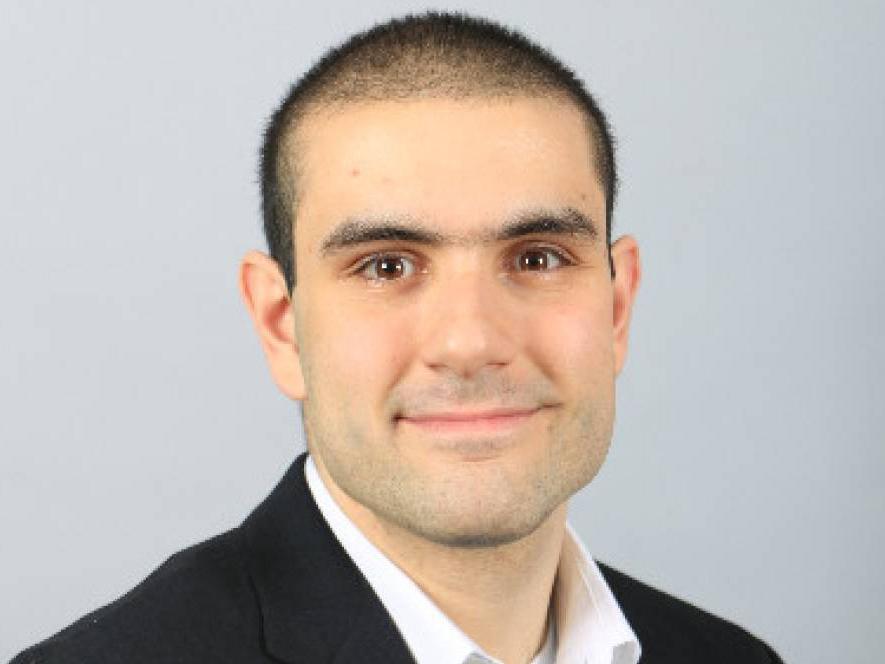
Alek Minassian
"Am I really going to be able to hit the accelerator or am I just going to chicken out and just drive past the intersection?"
"Because it is such a big act, people didn't normally do this, obviously I was hesitating."
"I was thinking negatively on purpose just to make myself do it. I wanted to do it but I also wanted to want to do it ... I was trying to push out all thoughts of trying to talk myself out of it."
"As soon as the light turned green my mind did a complete 180 and I thought I'm just going to go for it. And then I slammed the accelerator and drove onto the sidewalk."
"I remembered to post that message on Facebook. The car was rolling forward at slow speed. I unlocked my phone and pressed send -- and I have that feeling of satisfaction that I have completed that task. At that point, I felt much more satisfied and happier and I continued driving forward."
Alek Minassian, mass murderer, Toronto
"I don't think he was wrestling with the morality of the decision, I think he was wrestling with whether he had the guts to do this."
"I don't think he was having a moral struggle. I think he was struggling with daring himself and putting things in place to ensure he didn't chicken out."
{[Minassian could articulate the wrongfulness of his actions] on an intellectual level [but couldn't understand the emotional and moral implications."
"He wasn't being constrained by the impact of what he was about to do. He doesn't have the faintest idea."
Dr.Alexander Westphal, American forensic psychologist specializing in autism
The continuing trial of Alek Minassian has aired some compelling testimony from the man himself, describing his thoughts while driving down Yonge Street in Toronto on April 23, 2018. That he had almost come to the decision not to follow through on the action he had planned for weeks and rented a van for that purpose. To drive it at speed toward a crowded sidewalk intending to hit and kill as many people as he could possibly manage.
That was his goal. His purpose was to make a name for himself, to be noticed in the darkly sinister corners of the WorldWideWeb where criminal notoriety was admired by a wide circle of critically disaffected people rejecting societal norms, psychopaths by endowment of birth and inclination. Dr. Westphal is invested in persuading the court that the man he had interviewed and videoed was not a psychopath, but someone suffering from autism, a condition that limited his understanding of the outcome of his actions.
An ambition that seems quite at odds with the testimony of this man who disappointed himself by killing a mere ten people, young and old, men, women and children, injuring another sixteen, a horrible act of psychotic fusion with a distemper for life. He regretted that he was unable to kill more people. More women in particular. He invoked the message of incel, 'involuntary celibates', men who claim that women ignore and pass them over for other men and they dream of vengeance. Alek Minassian saw himself as a tool of revenge and that his accomplishment would be his claim to fame.
He would gladly have given his own life to have been able to kill far more than the mere ten lives he took. And during a police interview shortly after his arrest he said all that, and more. On the day of the action, he said, he was "nervous", while he performed a "mental rehearsal" of performing the act that would lift him to acclaim in the underground world of benighted deviants. He imagined pushing the pedal, mounting the curb. To "rev" himself up in the week leading to his launch he focused on the incel ideology of raging misogyny, leading to "forcing myself into the mindset ... so that I didn't chicken out at the last minute".
His destination was to drive further, into downtown Toronto (from where he set out from where he lived with his parents, in Richmond Hill). But as he approached Finch Avenue in north Toronto he happened to notice five people waiting to cross the road at a light. And it was there, instead, that he put his plan into action. With considerable success, although not to his complete satisfaction. Managing to kill ten and injure sixteen innocent people enjoying a fine spring day in the sun, strolling along a popular leisure route.
And though he expressed his dissatisfaction at a work unfinished during that interview after his arrest, that he would be prepared, given the opportunity, to go back and do it all over again, but better, to achieve a higher kill, he claims he should not be held criminally responsible for the atrocity since his autism ensured he was incapable of fully understanding that what he was doing was wrong. His trial for mass murder aired all of this. Leading Crown prosecutor Joseph Callaghan to question the expert witness, Dr.Westphal in his opinion that Minassian was unable to fully comprehend his actions.
Dr.Westphal responded that Minassian knew his attack would conclude with events that would end with him being arrested and imprisoned, if not killed during the attack himself. "I don't think that that means it was being referenced against some moral framework." While the attack was progressing, Minassian paused; as part of his plan, one detail was to post a message he had earlier composed on his Facebook page to the effect that the attack he had embarked upon was linked to an "Incel Rebellion".
During Monday's hearing, Minassian dozed off continually, eyes closing, head nodding down before jolting upright, then repeat and repeat and repeat. In contrast with his behaviour throughout the trial proceedings on previous occasions; ramrod straight posture, attentive focus.
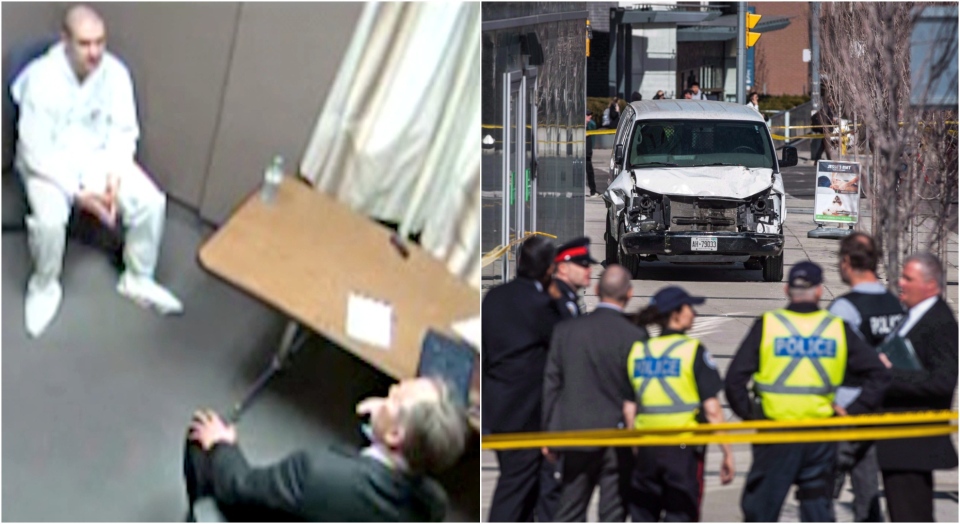
CTV News 28-year-old Alek Minassian police interview (left) Scene of the carnage (right)
A Psychopath Is A Psychopath Is A Psychopath : Choices and Consequences
"There
is no question he has a very highly developed concept of the
rule-nature of the wrongfulness of this. The problem is his
comprehension of the real, horrific impact that something like this
would have on other people."
"Which I really, honestly, like, whatever I say in this evidence, I don't think he understands that."
"He
is stuck at an early developmental stage of the development of moral
judgement. He understands the rules, he can articulate the rules, he has
a very sophisticated understanding of the rules."
"It
was in that environment [shadowy corners of the Internet] that he
conceived of what he ultimately did. He was saturated in horrible
material ... it became for him one of his areas of real focus and so it
was something he spent a lot of time looking at and thinking about and
ruminating on and, I don't doubt, that in the absence of this sort of
thing, this would not have happened."
"He
doesn't have any emotional connection -- he doesn't experience remorse,
he doesn't experience regret, but he also doesn't experience sadism. It
doesn't feel to him like he is great now, it is just nothing."
"I
hate to bring this up, but it really has the dissociative quality of
someone who is playing a video game. That really is the flavour of how
he completely and dispassionately talked about all of this. It is as
abstract as killing people in a video game, which is a horrific thing
for me."
Dr.Alexander Westphal, psychiatrist, autism specialist, Yale School of Medicine
"[If Minassian has a clear understanding of the physical consequences of his actions], what is it he doesn't get?"
"I
don't think that's the measure of it, though [that Minassian appears
incapable of fully appreciating the impact of his actions]. If he kills a
person who is alone in the world with no friends and no relatives and
nobody to mourn his loss, it is nevertheless a murder."
"I
don't know that to understand that you've committed murder and what its
consequences are you have to envision how many people will be upset
about it."
Justice Anne Molloy, Ontario Superior Court
At
the ongoing trial for Alek Minassian, 28, diagnosed as a child with
autism, considered to be high-functioning, and never known to exhibit
violent tendencies, but who was charged with ten counts of murder and 16
counts of attempted murder for having deliberately driven a rented van
through a busy sidewalk in Toronto in 2018 for the express purpose of
hitting as many people as he possibly could, the mental state attributed
to him at the time of the atrocity is front and centre.
The
man freely agrees that his intention was to kill people, but he has
pleaded not guilty, insisting that his autism had been in the way of his
complete understanding of the outcome of his actions and their
seriousness. He is asking to be found not criminally responsible for
having planned the carnage by renting a van and setting out to drive it
onto a busy intersection on a beautiful day in Toronto when people were
out enjoying the sun, doing their shopping, and generally appreciating
life.
Dr.
Westphal is a forensic psychiatrist who specializes in autism, a
professor at Yale University. He was hired by Minassian's legal team for
an expert opinion on the man's mental state which propelled him to
attack defenceless people and target them for death. He holds that the
autistic man had a distorted view of reality, to the degree that he
suffered delusions, generally recognized as the basis for legal defence
of not criminally responsible for reasons of mental disorder, similar to
psychosis, while at the same time attesting that people with autism are
by and large not violent.
Excerpts
of video interviews that Dr.Westphal undertook with Minassian were
shown to the court, where Minassian recounted his attack in detail,
speaking matter-of-factly, referring to the initial group of those he
hit with the vehicle at speed as "the first batch". Of another group of victims, he said "I hit them all in a line", referring further to some of his victims recalled as "an old lady", a "man crossing the road",
seemingly detached, merely describing something he had witnessed, as
though it was not he who was the cause of the destruction and bloodshed.
Alek Minassian, screengrab of the booking video.Photo by Toronto Police Service
Minassian
expressed personal outrage only when it was suggested that he might be
viewed as a "bully" for choosing to inflict such deadly violence on
vulnerable people. A suggestion that caused him to erupt loudly with a
heated disclaimer: "I'm not a bully. I hate bullies, how could anyone think that!"
A statement that seems consistent with Dr. Westphal's assertion that
though 28 years of age and a high-function person with autism, Minassian
labours with a childlike conception of morality.
What
appears not in dispute is that Alek Minassian immersed himself in the
dark areas of the Internet where he became obsessed with school shooters
and mass murderers, fringe sub-culture and black humour and death.
Where delivering death is lightly regarded as an assault on humanity,
and the deliverance of death seems to be a venerated topic. He was
absorbed with online forums dedicated to the ideology of 'incel'; the
'involuntarily celibate', a marginal subculture of angry men furious
about their incapacity to attract women's sexual interest.
"My personal opinion is that, I accept
that autism spectrum disorder, including high-functioning autism
spectrum disorder, is a significant mental disorder. I don’t believe it
reaches the impact that psychosis does."
"To
get to the type of impact on the operating mind that I’m used to, you
need to be psychotic. So I can’t get my head around how this would
impact on a person’s operating mind to the person that would get them
into Section 16 [the section of the Criminal Code
that lays out the criteria for being found not criminally responsible]."
"[Based
on the assessment done by himself and his team, Minassian is not a
psychopath, which would include being manipulative and showing a]
callous lack of empathy, [and does not have narcissistic personality
disorder or depression]."
Dr.John Bradford, professor of forensic psychiatry, (retired), head, Division of Forensic Psychiatry Faculty of Medicine, University of Ottawa.
"I
would have probably still gone ahead with it and made sure I would have
died instead of being arrested [on another attempt, and be more
selective in targeting, seeking out female victims between the ages of
18 and 30, for] sensationalism [to add
to his killing spree] narrative [making it more interesting and
memorable]."
"[Female victims would be more] consistent [with his incel story, something he would get a] pat on the back [for
from people on the Internet]."
"I’m not sure if I would or not [attempt an another act of mass murder if he were to be released]. I would certainly
think about it. I’m not sure if I would actually go through with it or
not."
"I would be hoping to achieve maybe just like another recognition of it or the fact that there is another kill count."
"[A website tracks] score cards [for mass killers noting their] kill count versus their survivor count."
"Let’s say they kill 20 people and then there was 100 percent all 20
people he intended to kill died, that would be a very high score,
especially because of the number of killings."
"Now that
would basically be the purpose of the kill count."
Alek MInassian, post-carnage interview with Toronto Police Service
Not Criminally Responsible? "I Just Floored the Pedal"
"[My
client's] state of mind at the relevant time and in the days, weeks and
months leading up to April 23, 2018, are expected to be the central
issues at trial." Boris Bytensky, lawyer, Alek Minassian pretrial material
"You
look at the interview which happened reasonably quickly after the
incident -- and he appears to be oriented as to time and space, he is
not thought-disorganized, he doesn't appear to be suffering from a break
with reality." "He
clearly had the ability to plan this and he had the ability to drive,
which in itself indicates you're fairly well oriented. And his
motivation -- although it is very difficult for us to understand it --
is not one that suggests he is suffering from voices in his head telling
him to drive down the sidewalk." "He
was surprisingly lucid when he was answering questions. He does not fit
in any of the classical understandings of having the most usual major
mental disorder that people have when found to be NCR, which is
schizophrenia." "Of course, we don't know everything at this point. We don't know his psychological antecedents." "What I saw there is somebody that is very angry at the world and that is not a defence in law." "It's
a responsible step to take to explore that option, because if indeed he
is not criminally responsible he would not belong in the correctional
system." "I
can't predict the future, but whatever facility he is in, whether it's a
correctional one or a mental health one, he is going to be spending a
long, long time there." Ian Scott, Toronto defence lawyer, law professor, Western University
"It
is a very snapshot moment in time [when the crime was being committed].
It is about what was going through the mind of the accused at a
specific moment." "The
court has to weigh how that information relates temporally and
otherwise to the mental state of the person at the time of the
commission of the offence -- not how they may present at the time of the
interview." "It is a high threshold." "The result of an NCR designation, at the end of the day, is not an
acquittal. There is a very common public misunderstanding that the NCR
designation is a get-out-of-jail-free card. That is not what happens." Anita Szigeti, Toronto lawyer, president, Law and Mental Disorder Association
The 10 people killed in the attack were, from top left: Sohe
Chung, 22, Renuka Amarasingha, 45, Andrea Bradden, 33, Dorothy Sewell,
80, Geraldine Brady, 83; from bottom left, Munir Najjar, 85, Anne Marie
D'Amico, 30, Ji Hun Kim, 22, Betty Forsyth, 94, and Chul Min (Eddie)
Kang, 45. (Ben Shannon/CBC)
He outright killed ten people, by ramming them with a lethal weapon, a
rental van. Another sixteen people were injured in last year's van
attack. Alek Minassian planned the attack, and meant to kill as many
people as he could manage to. He was angry, angry with the world, angry
with women who failed to appreciate his gentlemanly qualities, angry
with the stupid men that those women who ignored him flocked to. He had
online contacts with other men who were similarly angry that they too
were unable to attract the attention of young women. They named
themselves the 'incels'.
And they planned their revenge on a world where women chose men other
than themselves, ignoble men, as opposed to the gentleman-like behaviour
of the 'involuntary celibates' group like themselves. They would take
their revenge by selecting a random group of victims to pay the price of
their psychological agony created by a baffling biological selection
system where women are attracted to certain types of men with typical
masculine attributes, while leaving the intellectually choice and
female-respecting men in high dudgeon, deprived of the emotional and
physical comfort of partnerships.
Above all, stressed Alek Minassian, he was a 'gentleman'. That gentleman
is a destroyer of lives. Deliberately targeting strangers to pacify his
inner rage at being left behind. So he rented a van for the specific
purpose of using it as a battering ram, targeting a busy street crowded
with pedestrians. He is proud of his exploit, satisfied that he
succeeded in what he set out to do. He would have preferred, however, to
have taken a greater toll. Regret? certainly not! Any compunction over
killing people? Perish the thought.
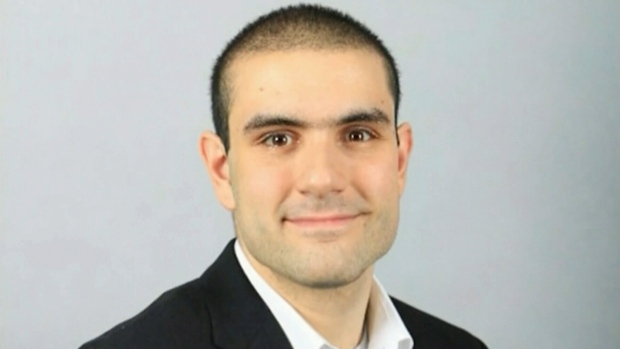
Alek Minassian, 25, of Richmond Hill, arrested after he drove a van into pedestrians.
LinkedIn
He had what he felt was a good reason for committing what society
considers a shocking atrocity and what he feels is due vengeance on that
society condemning him. And he may yet get the last laugh. In an
interview with police directly after the dreadful event, he was clear in
informing his interrogator that the result of the van-ramming pleased
him greatly. "I feel like I accomplished my mission", he responded when asked how he felt afterward. Oh, and just incidentally, he is pleading "not guilty", and will so declare in February of 2020 when the trial is scheduled to commence.
As for guilty or not, trial judge Ontario Superior Court Justice Anne
Molloy's pretrial ruling noted that the identity of Minassian as the van
driver in the attack is not at issue, and nor has the man's lawyer
disputed the admissibility into evidence at trial of his client's
detailed confession to police. He killed and wanted to kill greater
numbers, but is pleased with the outcome, and would do it all again
given the opportunity. But guilty? Why would he be seen to be guilty of
committing an act killing perfect strangers nominated by him to
represent the very society that had so horribly harmed him?
Last week the video of his interrogation was released. It was seen and
weighed by experts in the field of criminal law and psychiatry.
Minassian had informed Detective Rob Thomas that the van attack was
planned by him and committed as part of a larger, "incel rebellion".
Video statements, personal history and psychiatric assessments --
according to Anita Szigeti who focuses on mental health and the law, and
who spoke in a general scope -- can all be useful in guiding the court
to decide whether the accused in such a case qualifies to be designated
NCR.
It would be difficult to argue, using the same logic and viewing the
calm statements from the accused, that anyone sufficiently aroused in
anger and planning to exact revenge, can claim to be themselves not
criminally responsible, since the state of rage rendered them incapable
of viewing their intention as a grievous assault on public safety and
security. All crimes of passion, then, could be absorbed into the NCR
net. How high is that threshold?
And oh, that other little factoid, that accused held not criminally
responsible are confined in psychiatric wards and hospitals, placed on
drug protocols to control their mental illness, and invariably remain
incarcerated for far shorter periods to protect the public, than those
found guilty of crimes they commit and imprisoned. Even though
psychiatrist reports deem them likely to re-offend should they not
commit to their medications or other causes, they are given early
release back into society. And society must live with that.
Minassian carried out the attack in a busy area of Yonge Street on April 23, 2018. (Aaron Vincent Elkaim/The Canadian Press)
"She would like to come back; she has asked for pardon from her family, her friends, her country." Mother of Emilie Konig, German convert to Islam, ISIL 'terrorist'
"A Kurdish state does not exist, and French citizens cannot be judged by the Kurds." "They [children born to ISIL women] did not ask to be born in Syria. Nor to be detained by the Kurds, and they cannot be held responsible for the choices of their parents." Marie Dose, lawyer for French female jihadist "[If] there are legal institutions capable of guaranteeing a fair trial
assuring their right to a defense [women arrested in Kurdish-held
Syria should be] judged there." "Whatever crime may have been committed -- even the most despicable
-- French citizens abroad must have a guaranteed right to a defense. We must have confirmation of that." French government spokesman Benjamin Griveaux
Now 33 years old, Emilie Konig originally resident in a small town in Brittany, decided to convert to Islam while a teen. She later married, became the mother of two small children. She never felt quite comfortable living in France since she took to wearing a black abaya and niqab veiling her face. Since France did not seem to value her presence, she felt more comfortable leaving her two small children to travel to Syria where she became a propagandist and recruiter for the Islamic State of Iraq and the Levant. There, she felt appreciated.
This woman is exceptional in that she became an important recruiter for ISIL, whereas other women who travelled from across Europe to Syria to join the ISIL caliphate were more content to be breeding mares for the Islamist fundamentalist movement. They too were important, raising ISIL "cubs" taught from childhood ISIL's values and indoctrinated into the militancy of its murderous ideology. Who can forget in the heights of its abysmal notoriety the photographs disseminated widely of children wielding firearms, shooting at prisoners, helping to decapitate prisoners?
This was the world-class purveyors of hatred and bloody gore that Emilie Konig exalted in her propaganda, urging Muslims to commit themselves to jihad, ISIL-style. In October when Raqqa, the erstwhile Syrian capital of Islamic State was finally taken from the barbarian Islamists, mostly through the courageous actions of the Kurdish militias, the women and children who were resident there were taken to prison camps in Syrian Kurdistan. Europe, needless to say wouldn't mind if the ground beneath Raqqa had swallowed these European jihadist females.
Many of them were indeed discovered underground in the many tunnels that Islamic State had built. It makes eminent good sense for captured felons, murderers and their enablers to stand trial in the very place where their crimes were committed. All too often compensation for murder is not Paradise but state punishment of execution. And since European countries writhe in an agony of discomfort at the very notion, they are faced with the dilemma of claiming their own to have them extradited to stand trial at home for crimes against humanity committed elsewhere.
This photo taken on October 20, 2017 shows fighters of the Syrian
Democratic Forces (SDF) walking down a street in Raqqa past destroyed
vehicles and heavily damaged buildings after a Kurdish-led force
expelled ISIL fighters from the northern Syrian city, formerly their
"capital". Bulent Kilic / AFP
An estimated 4,300 people left Europe to join the battle in Syria and Iraq, according to the International Center for Counter-Terrorism in The Hague. This is not a hard-and-fast number since other agencies place that number even higher. Foreign fighters remain in Syria of whom an estimated 43 percent are women. French President Emmanual Macon stated that decisions on retrieving women and children to return from Iraq and Syria would be reached on a case-by-case judgment basis.
Mustafa Bali, speaking for the Syrian Kurdish Defense Forces stated that his leaders have urged "all countries, European or other, to extradite their women and children". Presumably that advice has been set aside in indecision; the countries involved uncertain whether they plan or wish to return their nationals to stand trial at home, where no crimes were committed by them. Kurdish journalist Arin Shekhmus on visiting three camps where Arab, Asian and European "war prisoners" were kept, said he had seen up to a100 women and children.
They should be returned to their home countries which include Russia, Kazakhstan and Indonesia, however: "The European governments still haven't reached out to extradite their citizens", he said. They don't want their wayward and blood-stained citizens to return necessarily, and presumably remain content to have them remain under the stewardship of the Kurds. Yet should the Kurds take the initiative to rid themselves of the camps' inmates and executive their due punishment, those same European countries would rise up in irate disgust to sanctimoniously slam the Kurds for 'taking matters into their own hands'.
Both the United Nations and the United States took the unusual step of distinguishing Emilie Konig in recognition of her vital role for Islamic State, of listing her as a terrorist, subject to sanctions. On her arrival in Syria at age 27 she started to post propaganda videos and to appeal to Muslims to recognize their jihadist duty to support the Islamic State caliphate. From all accounts her valuable services were duly appreciated and recognized as heroic in nature.
Emilie König, a Frenchwoman suspected of recruiting fighters for Islamic State who appeared on US and UN blacklists, has been arrested by Kurdish forces in Syria, her mother said on Tuesday.
This represents a general opinion site for its author. It also offers a space for the author to record her experiences and perceptions,both personal and public. This is rendered obvious by the content contained in the blog, but the space is here inviting me to write. And so I do.









/https://www.thestar.com/content/dam/thestar/news/gta/2020/11/27/forensic-psychiatrist-continues-testimony-at-alek-minassian-van-attack-trial/yonge_st_.jpg)