The Middle East Chess Game
"[The
meeting with Netanyahu] aimed to highlight that MbS [Mohammed bin
Salmon] is more willing than his father to take steps toward
normalization without first reaching a two-state solution."
Neil Quilliam, Associate Fellow, Chatham House think tank
"We
have supported normalization with Israel for a long time, because we
are the authors of the 2002 Arab Peace initiative, which envisioned
complete normalization with Israel."
"But
there is one very important thing that has to happen first, which is a
permanent and full peace deal between the Palestinians and Israelis that
delivers a Palestinian state with dignity within the 1967 borders to
the Palestinians."
Prince Faisal bin Farhan Al Saud
"[Iran has exploited a 2015 nuclear deal with world powers] to intensify
its expansionist activities, create its terrorist networks, and use
terrorism. [This had produced nothing but[ chaos, extremism, and
sectarianism."
"A comprehensive solution and a firm international position are
required. Our experience with the Iranian regime has taught us that partial
solutions and appeasement did not stop its threats to international
peace and security."
"We support the efforts of the current US administration to achieve
peace in the Middle East by bringing the Palestinians and the Israelis
to the negotiation table to reach a fair and comprehensive agreement."
"This terrorist organization must be disarmed."
Saudi Arabia’s King Salman bin Abdulaziz
 |
| King Salman reiterated the need for a Palestinian state [File: Waleed Ali/AP] |
"[There have been reports about differences within the royal family,
particularly between King Salman and Crown Prince Mohammed bin Salman,
on whether Saudi Arabia will follow others in the region and normalize
ties with Israel.] So this was an opportunity to publicly before the world reiterate
Saudi Arabia’s long-standing position … that there needs to be two
states – an independent state of Palestine with its capital East
Jerusalem."
"That’s a clear re-affirmation of Saudi Arabia’s stand and a
real rejection of the current efforts to push Arab states to normalize
with Israel. That was critically important."
Hillary Mann Leverett, former US official, CEO, political risk consultancy STRATEGA
The
meeting between Israel's prime minister and the crown prince of Saudi
Arabia messages both allies and enemies of the deep commitment the two
countries have forged for the mutual concerns of containing the Islamic
Republic of Iran's ambitions. The covert meeting that took place last
Sunday in the Saudi city of Neom, publicly denied by Riyadh perhaps for
several reasons, one being that King Salman had no prior notice of the
impending meeting, conveyed a message to incoming President-elect Joe
Biden. Allies of the U.S. are closing ranks, and they're focusing on
future U.S. relations with Iran.
No
other Israeli leader has ever been in the position that Benjamin
Netanyahu finds himself within, given current events in the region with
softening attitudes evinced by Arab Muslim countries toward their Jewish
neighbour whose support they all seek in their commonly-shared caution
about the intentions of their Persian neighbour exploiting sectarian
divisions, supporting and financing terrorist groups, fomenting regional
problems, aspiring toward attaining nuclear weapons.
The
covert visit had the effect of emphasizing the depth of concern shared
by both Israel and Saudi Arabia about Iran, demonstrating just how
serious opposition to Tehran is responsible for arranging a strategic
realignment of countries in the Middle East in support of their common
interests. "It's very important to create the axis which isolates Iran", explained Israeli cabinet minister Tzachi Hanegbi, commenting on the meeting.
The
fear all now share with the clear understanding that the Trump
administration is preparing to vacate the White House and
President-elect Joe Biden is that is prepared to adopt Iran policies
reflecting those practised during the U.S. presidency of Barack Obama
which had the effect of straining Washington's connections with its
traditional regional allies. Mr. Biden has made clear that he intends to
rejoin the international nuclear pact with Iran that the U.S. under
President Trump left in 2018.
Mr.
Biden visualizes working with allies in strengthening the terms of the
agreement should Tehran resume strict compliance. Which is expecting a
lot, since it became clear soon after the 2015 agreement was signed by
all concerned parties that strict compliance to the terms was never on
Tehran's real-time agenda. Iran's network of armed Shi'ite militias
across the Arab world, from Iraq to Syria and Lebanon and into the Gulf
and Yemen, is alarming to its Sunni Muslim neighbours.
Saudi
Arabia is particularly concerned with the Houthi rebels from Yemen,
backed by Tehran attacking Saudi oil installations. On Israel's part, a
silent war against Iranian forces through air raids in Syria on Lebanese
Shi'ite paramilitary Hezbollah, on Iran's Revolutionary Guard Corps,
and the focus on disrupting supplies of weapons shipped across the
country, is ongoing. At the meeting on Sunday U.S. Secretary of State
Mike Pompeo was present, along with the chief of Israel's Mossad.
Mr.
Pompeo's active prompting of Gulf relations with Israel, helped in
formalizing Israel's already warm relations with the United Arab
Emirates, Bahrain, and eventually Sudan in normalizing relations with
Israel. He has continued his efforts to persuade other Arab nations that
it is in their best interests for a variety of reasons to join suit,
with the expectation that more will follow. Saudi Arabia's position on
normalization hinges on King Salman, adamant that a peace treaty with
the Palestinians take place.
"Normalization ... is a carrot to get [Biden's] focus away from other issues, especially [Saudi] human rights",
suggested a foreign diplomat in Riyadh. The death on Friday of Iran's
chief nuclear scientist may have been planned to put a spanner in the
works of Mr. Biden's plans to resume the nuclear deal with Iran, and if
so, it will have been worth the condemnation on the part of other
nations looking in from the outside, none of whom have to overly concern
themselves about the malign, disruptive and violent plans of a near
neighbour.
Labels: Bahrain, Collaborative Clique, Iran, Israel, Saudi Arabia, UAE, United States
Report: Qatar’s support for Islamists has ‘alienated its allies’
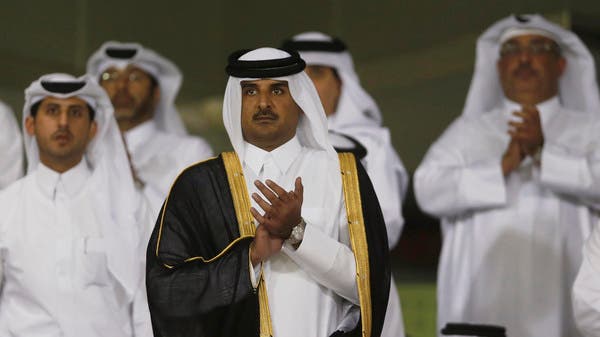
The Emir of Qatar, Sheikh Tamim bin Hamad al-Thani (middle). Qatar
has been accused of supporting the Muslim Brotherhood, leading to the
deterioration of relations with other GCC states. (Reuters)
By Staff Writer
| Al Arabiya News
Tuesday, 9 September 2014
Qatar’s continued support for Islamists has alienated its allies both in the region and abroad, a New York Times
report published on Sunday argued.
The
report cites a number of religious personalities that have been allowed
to raise funds for al-Qaeda’s Syrian affiliate, the Nusra Front.
David
Kirkpatrick, author of the article, also wrote that the Qatari state
has on occasion provided some direct assistance, “to the Taliban of
Afghanistan, Hamas of Gaza, rebels from Syria, militias in Libya and
allies of the Muslim Brotherhood across the region.”
In response,
Kirkpatrick said, next-door neighbors Saudi Arabia and the United Arab
Emirates have rallied, along with Egypt, to portray the peninsular state
“as a godfather to terrorists everywhere.”
The United States
pentagon has even accused Qatar of being behind the Islamic State in
Iraq and Syria, an allegation the analysts and Arab diplomats cited by
the piece said was “implausible and unsubstantiated.”
In Libya,
Qatar’s support of militias rivaling those supported by the United Arab
Emirates has driven another wedge into relations with its next-door
neighbor as the latter, the report states, is weary of Qatar’s support
of the Egypt’s Muslim Brotherhood.
Kirkpatrick writes that Qatar
further alienated the United States after extremists in a militia
supported by the gulf state broke away to form their own militant group,
Ansar al-Shariah, which “played a role in the death of the American
ambassador, J. Christopher Stevens.”
He added that Qatar continues to back groups “loosely allied” with Ansar al-Shariah.
However, the crackdown on the Muslim Brotherhood in Egypt, the report says, forced Doha to “recalibrate.”
The
article says Western diplomats and Islamists who have worked with the
Qatari state point that Doha has been refusing to provide money to the
Brotherhood “for fear of further alienating its gulf neighbors who
backed the takeover.”
“The big falling-out is over Egypt, not
Syria,” Paul Salem, a scholar at the Middle East Institute is cited as
saying in the article. Since the military has taken over in Cairo,
Egypt, Saudi Arabia and the United Arab Emirates have all withdrawn
their ambassadors from Doha.
The New York Times article also
claims that there are other Gulf countries such as Saudi Arabia and
Kuwait where donations for al-Nusra Front were allowed to be collected.
However, it stresses that United States Treasury officials have singled
out both Qatar and Kuwait as “permissive jurisdictions” for terrorist
fund-raising.
Last Update: Tuesday, 9 September 2014 KSA 15:32 - GMT 12:32
Labels: Egypt, Islamists, Qatar, Saudi Arabia, Security, Sinai, Terrorists, UAE
Libya's Democratic Transition....
"...Yet activists tell us that dozens of homes have been damaged by rocket attacks, mortar shelling and anti-aircraft weapons."
"It is extremely hard to establish which side is causing damage because the shelling is reckless."
Magdalena Mughrabi, researcher, Amnesty International
Outside interference in Libya exacerbates current divisions and undermines Libya's democratic transition. [Libya was in a] very fragile place."
Jen Psaki, spokeswoman U.S. State Department
"[Reports of an Egyptian role are] unsubstantiated rumours. We have no direct connection to any of the military operations on the ground in Libya."
Egyptian Foreign Minister Sameh Shukri
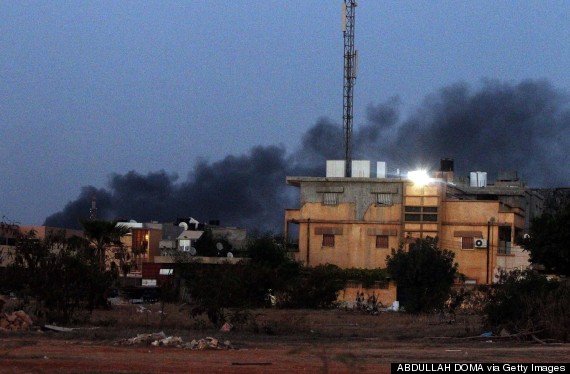
Smoke
billows from buildings during clashes between Libyan security forces
and armed Islamist groups in the eastern coastal city of Benghazi on
Aug. 23, 2014. (ABDULLAH DOMA/AFP/Getty Images)
Gangs of armed men went on a rampage, burning and destroying the homes of government supporters, levelling entire neighbourhoods in Tripoli. Libya's airport and seaport are now closed, destroyed, leaving a shortage of fuel and food. And thousands of Libyans have fled their homes in a search for safety. Between five thousand to six thousand Libyans were reported to have crossed into neighbouring Tunisia daily, leaving authorities in Tunisia to close the border.
The danger level is intense enough to persuade some international aid groups to recall their employees, while many countries have chosen to close their embassies and consulates because of the violence.
For months Egypt, the United Arab Emirates and Saudi Arabia, the Middle East's strongest Sunni Muslim nations have looked on in dismay as Libya falls apart -- a weak government with no military of its own, but using militias they pay to act on their behalf -- tremulously attempts to portray themselves in control, even though violence forced them to move parliament from Tripoli to another city where they are felt to be safer.
This violence began in the wake of Libya's June parliamentary elections when the Islamist-dominated parliament lost to liberal and federalist candidates. As in Egypt, with the unseating of the Muslim Brotherhood and the Brotherhood elite and its followers' refusal to accept their loss of power, the Islamists and their backers would not recognize the newly elected body forcing the new MPs to move from the capital to establish parliament in the eastern city of Tobruk.
Now the Islamists have resurrected the old parliament in Tripoli as it was before elections took place and they have as well installed their own prime minister, gifting a country at war with itself with two prime ministers and two parliaments.
Powerful militias have seized the initiative in this power vacuum leaving the central government incapable of creating a police force or unified military. But Islamist forces have now had to contend with a counter-offensive after losing their place in parliament, led by former Gadhafi-era officer, now rebel, General Khalifa Hifter.
Who has the support of Egypt, Saudi Arabia and the UAE, but not Washington which has more or less washed its hands of interference in Libyan affairs, just as the current American administration is rarely seen on the international stage where eruptions of chaos and madness reign.
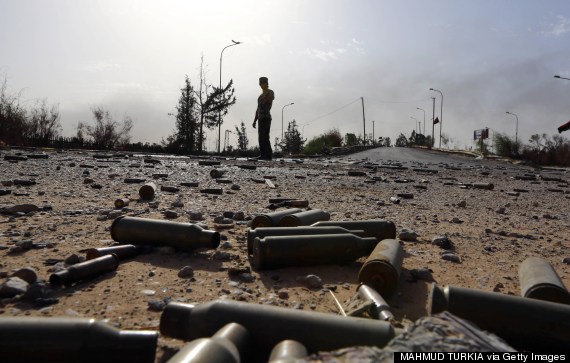
Bullet
shells litter the ground as a member of the Islamist-linked militia of
Misrata walks past following three days of battles in the area of
Tripoli's international airport, on Aug. 21, 2014. (Mahmud
Turkia/AFP/Getty Images)
Airstrikes against the Islamists looking to gain complete control of the country were thought at first to be the work of Gen. Hifter's forces until it emerged that Egypt and the United Arab Emirates had secretly carried them out. Although the US administration had been made aware of their plans and cautioned strongly against such action, the two countries carried through regardless in support of Gen. Hifter, in the hopes that he might stem the Islamist tide they fear will gravitate onward.
Britain, France, Germany and Italy echoed the concerns for non-involvement of the United States, but in fact, this is not their geography and it is time enough that the powerful, populous and wealthy countries of the Middle East exert their influence and their up-to-date military to hold back fanatical Islamists with their jihadist campaigns. According to several Egyptian officials, Egypt has been involving itself closely in Libya's power contest for months.
Egyptian intelligence garnered data on training camps, hideouts and barracks for extremist groups in the east like Ansar al-Shariah, blamed by the United States for the 2012 attack on its Benghazi mission and the murders of four American diplomatic personnel. The Egyptian intelligence operation was complete with an Egyptian elite force named "Rapid Intervention" formed by President Abdel al-Sissi to counter terrorism within and outside of his country.
Seeing it in Egypt's interest to work with Saudi, UAE and Libyan military officials in support of Gen. Hifter's counteroffensive.
Labels: Conflict, Egypt, Islamists, Libya, Saudi Arabia, UAE, United States
Violent Lunacy in Libya
"We took control of the airport yesterday and today we have forced Zintan from their two remaining bases. The bases are now under our control."
Abubaker al-Huta, member, Libya Shield

Islamist fighters after capturing the Tripoli international airport on August 24, 2014 (AFP Photo / Mahmud Turkia)
Muammar Ghadafi is gone and with his ferociously controlling authority absent is also gone any vestige of control, order and normalcy in Libya. The fiction of having removed a tyrant, as dreadful as he was, to free the country from violence and mayhem had a short shelf life. When NATO decided to create a helpful free-air zone in aid of the motley militias representing a variety of competing and ruthless tribal, ethnic and sectarian groups it little understood what it was setting the stage for.
Islamist militias have succeeded in taking possession of the country's international airport. Why not, since they have taken control of the capital Tripoli, forcing the elected parliament to move to the eastern city of Tobruk, to conduct the nation's business and still remain alive in the process. The government itself has no national army, relying on the collaboration and good graces of militias to maintain public security.
These officially sanctioned as it were forces receive state salaries and they proudly wear distinguishing uniforms, but they report not to the government but to their own independent commanders. Armed factions fight among one another for control; chaos rules, there is no order, there is no normalcy, there is no public safety, but there is ample organized theft and looting and other crimes along with oppression of the vulnerable and there is competition between tribal militias.
A brutal contest for power rages in the capital between armed factions from rival cities and tribes. They are Islamists all, divided by some of a more secular and nationalist bent and those who are strictly and fiercely Islamist. The country's new parliament condemned the taking of the airport, characterizing the Islamist fighters who took it as "terrorists" from Misrata.
The Islamist-dominated body named the General National Congress is in business, its members, also part of the two main Islamist armed groups are effectively operating as a counter-government to the duly elected one. Unidentified warplanes have now bombed Islamist targets in Tripoli. A renegade general was suspected of having been involved, a loyalist from the time of Gadhafi waging a campaign against Islamists.
The air strikes hit the military bases of Islamist militias and seemed to have been conducted with a view to slow their advance on the international airport in Tripoli. While the Libyan air force denied it had anything to do with the airstrikes, and that was a reasonable denial since it hasn't the capabilities or technology required, suspicions were raised that foreign countries might be involved.
Italy, Algeria and Egypt have denied being the cause of the airstrikes, however, it appears that the escalating crisis in Libya has moved Egypt and the United Arab Emirates to carry out those airstrikes without the knowledge of the United States in an attempt to halt the crisis in Libya.
Arab and Muslim countries engaged in one paroxysm after another of self-destruction, committing atrocities on their own and shocking the world with the ferocity of their raging lunacy.
Labels: Chaos, Conflict, Egypt, Islamists, Libya, UAE
UAE backs Saudis on Brotherhood blacklist
Al Aribaya -- 9 March 2014
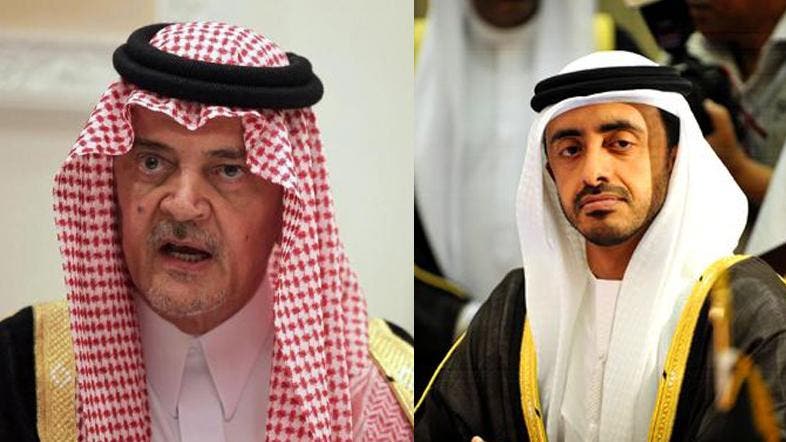
UAE Minister of Foreign Affairs Abdullah bin Zayed al-Nahyan (R) and
Saudi Minister of Foreign Affairs Saud al-Faisal. (File photo: Reuters)
By Staff writer
| Al Arabiya News
Sunday, 9 March 2014
The United Arab Emirates announced its support of neighboring Saudi
Arabia's decision to label the Muslim Brotherhood a terrorist
organization, deepening Gulf Arab pressure on the group.
The
UAE government will cooperate with Saudi Arabia to tackle “those
terrorist groups through liquidating all forms of material and moral
support,” the Western-allied Gulf federation's foreign ministry said in a
statement, according to
WAM news agency.
"The
UAE will not spare any effort to bolster the cooperation with brothers
in Saudi Arabia to tackle those terrorist groups through liquidating all
forms of material and moral support in all circumstances," the foreign
affairs ministry said in the statement.
"The significant step
taken by the KSA in this critical moment requires concerted efforts and
joint collective work to address the security and stability challenges
that threaten the destiny of the Arab and Muslim nation," the statement
added.
Saudi Arabia blacklisted on Friday the
Muslim Brotherhood as a terrorist organization, Al Arabiya News Channel reported, citing a royal decree.
The kingdom also designated the kingdom’s branch of the Shiite movement
Hezbollah and Syria-based militant groups the Islamic State of Iraq and
Syria (ISIS) and the al-Qaeda linked al-Nusra Front as terrorist.
Egypt was the first Arab country to label the Brotherhood terrorist in
Dec. 2013, after accusing it of carrying out a series of bomb attacks in
Cairo
Labels: Egypt, Muslim Brotherhood, Saudi Arabia, UAE


