Identifying Vulnerable COVID-19 Demographics
"There's a sense that if we were to collect socio-demographic data that includes things like race, ethnicity and income, we can get a better sense of what's actually happening."
"I think given the specific pandemic, we should be much more nimble and responsive and able to actually ensure that we're doing things effectively."
Paul Bailey, president, Black Health Alliance
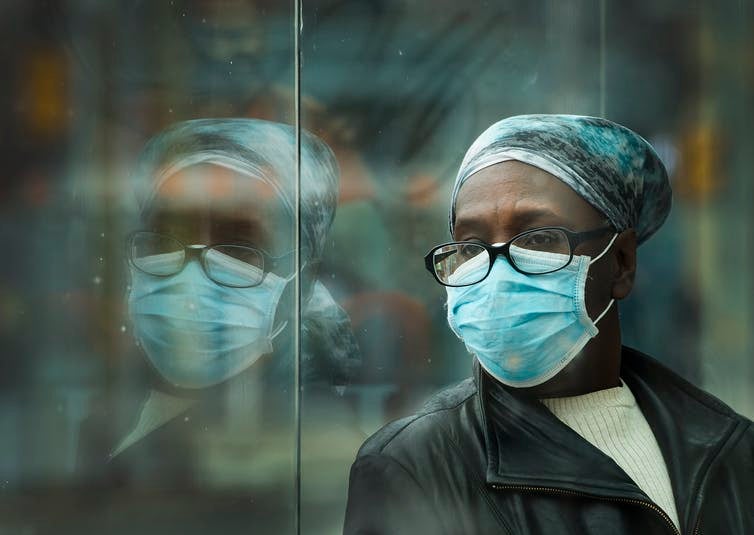 |
| A woman waits for a streetcar in Toronto on April 16, 2020. Many Black
community members who work in essential jobs do not have the luxury of
staying home during the pandemic (photo by Nathan Denette/Canadian
Press) |
The Public Health Agency of Canada is considering the possibility of collecting more demographic data related to the disease, following months of calls from advocates for a clearer idea of who, within the general population is contracting COVID-19 and how those populations identified as vulnerable are being affected by the global pandemic.
In the United States, public health officials have discovered that the deadly virus was affecting black communities disproportionately. Researchers at several American universities recently released a study finding counties in the U.S. representing the highest proportions of black Americans have been responsible for over half of all COVID-19 cases, and 60 percent of deaths in the country. This, even though they make up 22 percent of counties. The study was led by the Foundation for AIDS Research and Emory University, awaiting peer review.
In Canada, advocates insist a similar situation is more than likely to be playing out on a smaller scale. Yet because government fails to collect data it is difficult to understand which segments of the population may be most at risk. This, aside from the demonstrable reality that Canadian long-term care establishments and seniors residents have been responsible, between them, for at the very least fifty percent of all COVID-19 relatable deaths.
 |
| In Chicago, black residents are 30 per cent of the population, but make
up more than 70 per cent of COVID-19-related deaths. Canada doesn't
track racial data, something many advocates would like to see change. (CBC/Radio-Canada) |
Marking the reality that the elderly vulnerable and the health-impaired have been the largest demographic in global death rates, and that within Canada a larger-than-average by far vulnerability to COVID-related deaths. They are vulnerable on a number of counts; that they are frail, elderly and health-impaired, and assembled in close quarters where social distancing is difficult to obtain, while being cared for by inadequately-trained-and-remunerated aides.
A situation not that far off the mark for black Canadians who are more likely to have poor health outcomes in chronic diseases, more greatly impacted by socio-economic factors such as poor access to healthy food, housing and employment than the general population. Factors in the aggregate that place them at higher risk from COVID-19.
In Canada only basic data about people who test positive for the disease is currently gathered, including age and gender.
"I think there's a number of gaps in that data", suggested Dr.Theresa Tam, Canada's premier public health officer who stated that efforts are underway to examine how to improve the situation.
"Everyone is stretched in terms of working under extreme circumstances", elaborated her deputy, Dr.Howard Njoo, stating that the situation must be balanced against the workload.
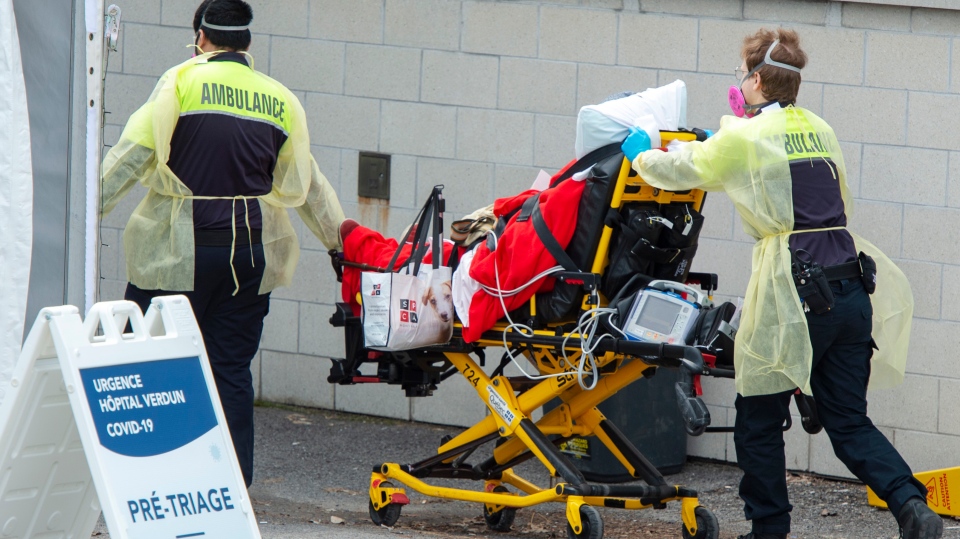 |
| Paramedics transfer a patient to the emergency unit at Verdun Hospital,
Tuesday, April 14, 2020 in Montreal. (THE CANADIAN PRESS / Ryan Remiorz) |
Labels: Canada, Demographics, Novel Coronavirus, Victims, Vulnerability
Another Human Rights Battle Lost by the Iranian Republic
"I see no reason to deprive the plaintiffs of their entitlement to costs of successfully defending these motions [to charge the government of Iran for payment of legal costs]."
"[The case involved] complex and important issues that had not been previously decided. [The victims' lawyers had discharged their obligations in a] cost-effective manner."
Justice Glenn Hainey, Ontario Superior Court
The previous Conservative government of Canada had disinvited the Islamic Republic of Iran to maintain its embassy in the capital and its other missions within Canada, as it withdrew its diplomats from Tehran, returning them to Canada, having no wish to further permit Iran to interfere in Canadian affairs, as it had been doing, a malign force for ill will and destabilization. Canada at least took those steps to indicate it had little appreciation for the Republic's campaign to inflate its influence in the West.
The current Liberal government of Canada has announced its intention of restoring diplomatic relations with Iran, to reinstall Canadian diplomats in its Tehran mission, and inviting the Iranian theocratic administration which makes no secret of its detestation of the West and its democratic institutions to return to full diplomacy. The Iranian regime has indicated that it may reciprocate intentions to restore relations should the Liberal government take steps to overturn the Ontario court ruling that it must pay victims of the terrorist groups that Iran sponsors.
The Islamic Republic had been ordered in June of 2016 to transfer millions of non-diplomatic assets in Canada to three groups of people who had suffered violence inflicted upon them by terrorist groups Hamas and Hezbollah, armed and supported financially by Iran. In fact, the potential total of the amount that Iran has been ordered to pay in penalties for such international criminal offences will go well beyond the value of the non-diplomatic assets held in Canada, upwards of $1.7-billion.
The Iranian regime had some difficulty imagining that it would be found liable in international courts for the violence it promulgates and incites through its proxy terrorist groups, but reality hit when American courts imposed similar penalties upon Iran, and Canadian courts followed suit once U.S. and Canadian governments made it lawful. This is yet another form of exacting justice for victims of violence such as that promoted by the Republic of Iran.
Which had the unmitigated audacity to inform the world -- as a push-back to the new American President Donald Trump's assertive promise that the United States will go to new and deserved lengths to ensure that Iran's aspirations to achieve nuclear and intercontinental ballistics supremacy will not come to fruition -- that Israel is the
"biggest threat to the peace and security in the region
and the world", as voiced by Foreign Ministry spokesman Bahram Ghasemi.

Iran’s
Foreign Ministry spokesman Bahram Ghasemi briefs journalists at a press
conference in Tehran. (screen capture: YouTube)
Iran, according to the Ontario Superior Court justice was attempting to set aside
"substantial judgements". The Justice for Victims of Terrorist Act, enacted in 2012, ensures that immunity would be stripped from terrorist-sponsoring regimes. This gave victims of terrorism the opportunity to sue such regimes by collecting civil damages in Canadian courts, following the American example.
The latest ruling that Iran would have to pay the $300,000 legal bills of victims who had turned to the Ontario court to seek compensation under the JVTA, simply represents the most recent loss in civil court for Iran. The Republic had invoked grounds that it had the protection of state and diplomatic immunity. That ploy, under the circumstances, no longer works.
Labels: Canada, Hamas, Hezbollah, Iran, Justice, Terrorism, Victims


