Canada and the United States, Neighbours, Allies, Trade Partners
"America has been carrying Canada for decades, but no longer!"
"The U.S.A. will always be far bigger, richer, and
stronger than Canada. Without the United States, Canada couldn’t survive
— It’s where they get all of their money and, because of their current
bad leadership, primarily Governor Carney, and his Flunky, Ford, they
will not be allowed to keep taking advantage of the United States —
Their key to survival."
U.S. President Donald J. Trump
"Canada
is a country that has under-invested in its military that quite
literally would get invaded by a foreign country were it not for the
umbrella of protection provided by the U.S."
"We have to remember Canada is a state. Sorry, Freudian slip."
"That was actually an accident."
U.S. Vice-President J.D. Vance
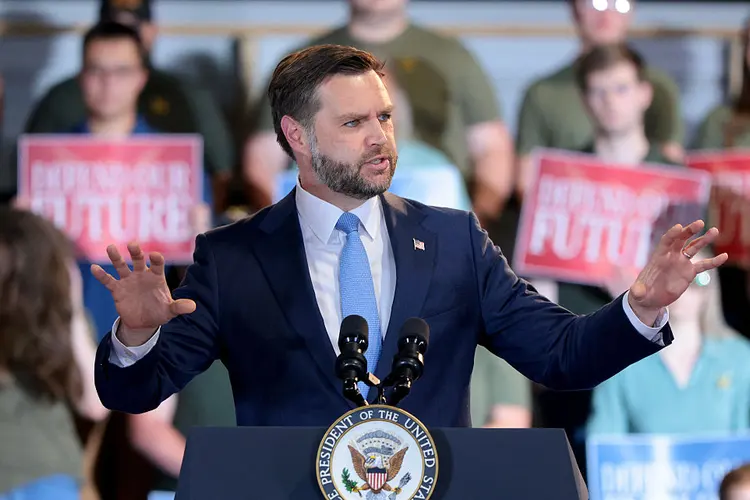 |
| U.S. Vice President J.D. Vance delivers remarks in Brewer, Maine, on Aug. 24, 2026. Anna Moneymaker—POOL/AFP/Getty Images |
"Fact: Canada has a brave and professional military. It has deployed into combat with us many times, including D-Day."
"Canadian troops, under my NATO command, faced intense fire in Afghanistan where many were killed in action."
"I honour their memory and salute them."
James Stavridis, retired U.S. admiral
"Mr.
Secretary [U.S. Transportation Secretary Sean Duffy: Canada is 'a
country that doesn't have a military'] please stop embarrassing us."
"I served in Kandahar, Afghanistan in 2009-2010 alongside Canadian soldiers."
"They were skilled, courageous and effective."
"We were lucky to be on the same side with them."
Ben Hodges, former commanding general of the U.S. Army in Europe
 |
| Corporal Brandon Bourdon, 1RCR B COY 4 Platoon,
fires an M72 rocket launcher at insurgents that set up an offensive in a
grape hut, Kandahar, Afghanistan. Photo: DND AR2010-0320-78 |
Post-U.S./Canada
trade negotiations called off a week earlier has brought sarcastically
undiplomatic recriminations and insults from both countries, in verbal
attacks against one another. New tariffs on $20 billion worth of
Canadian goods was slapped by Washington on its erstwhile trading
partner in a show of strength and bad faith. The trade war has now
morphed into a strident war of words, with few holds barred.
President
Trump has once again reverted to speaking of the Canadian prime
minister as 'governor', presumably of another de facto U.S. state, the
51st such state that Mr. Trump has been dangling before Canada for over a
year, mocking Canada's sovereignty and endearing himself in the process
to patriotic Canadians. President Trump stated on Monday his intention
to increase levies on Canadian cars and automotive parts to 50 percent.
Canada's response on retaliatory tariffs arrived a day later, despite
U.S. threats not to advance toward retaliation of the punishingly steep
U.S. tariff escalation.
President
Trump is fond of declaring his contempt for Canada's trade offerings,
sneering time and again that Canada has nothing that the United States
needs or wants. The reality is, the American farming community would be
lost without the potash fertilizer it obtains from the world's largest
producer of potash -- Saskatchewan -- which provides the U.S. with over
90% of its needed potash. Although few countries produce potash, it is
fungible, since Belarus and Russia also produce it, but given relations
between the U.S. and those two countries they would be an unlikely
alternate source.
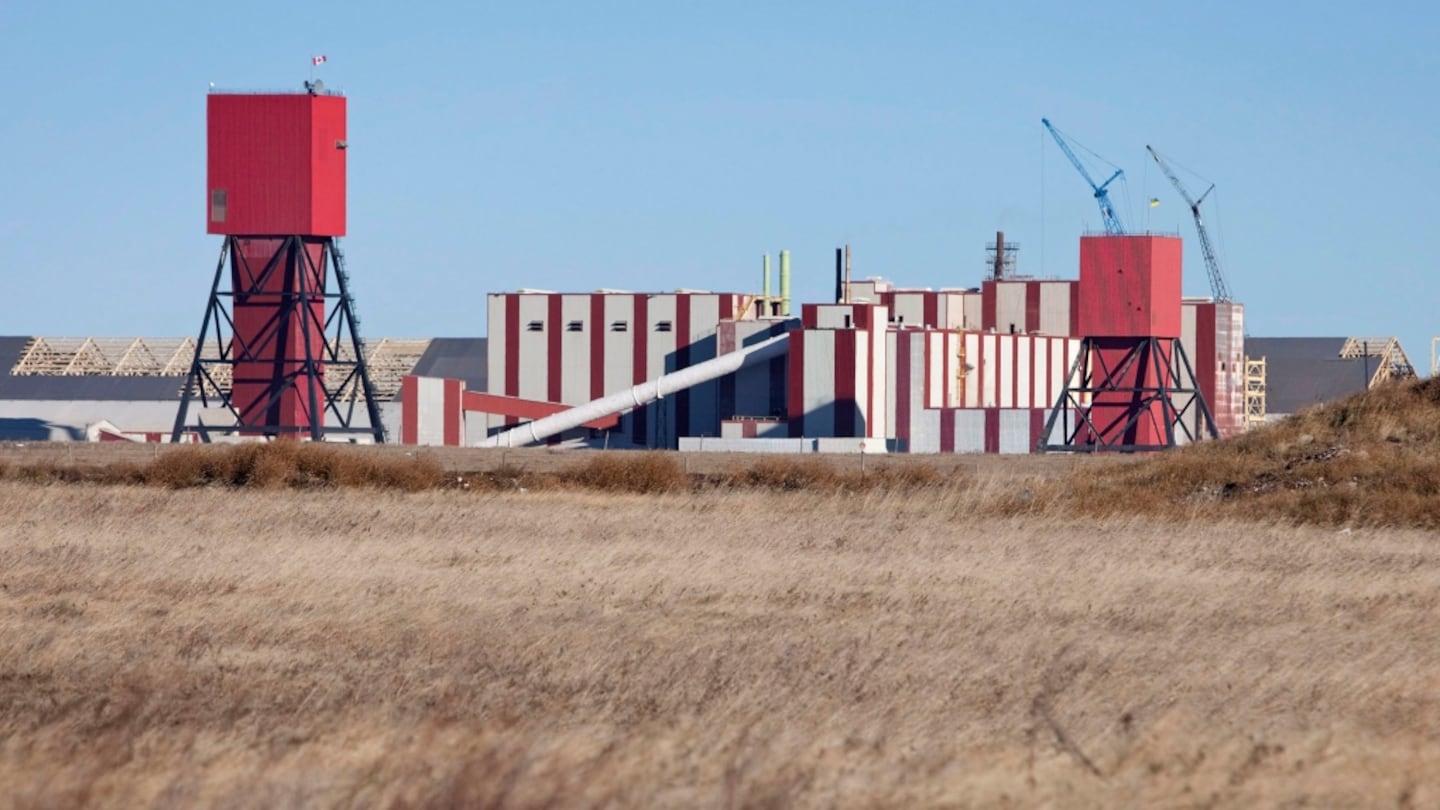 |
| The exterior of PotashCorp's (now
Nutrien's) Rocanville potash plant near Rocanville, Sask. (THE CANADIAN PRESS/Troy Fleece) |
Canadian
gas and crude oil are also exports to the United States that contribute
to serving the needs of America. In this new conflict expressed in
insults and innuendo, the U.S. vice-president has added his voice to
describing Canada as the 51st state. Battleground states for Republicans
see themselves struggling in the upcoming mid-term elections with
resentment fuelled by the escalating tariff war. Tariffs are a form of
punitive taxation that U.S. citizens recognize is impacting their own
costs of living. Border state governors who do ample business with
cross-border Canadian provinces are anything but pleased over the impact
the tariffs have inflicted them with.
Now,
to add to the voices critical of the Trump government's fixation on
punishing tariffs imposed on global allies and foes alike, former U.S.
national security officials and some Republications are expressing their
impressions of embarrassment they feel over the verbal demeaning of an
ally and neighbour. The more recent barbs in description of the Canadian
military have not sat well in the regard of high-placed U.S. military
members.
After
musing over renaming Lake Ontario to Lake America, The U.S. president
proceeded to do just that formally, expunging the Iroquois name of the
lake that has long been globally respected and accepted, in exchange for
his personal preference. Even conjecturing that he might feel persuaded
at a later date to rename both the Atlantic and Pacific Oceans.
Clearly, this is a governing administration that has got out of hand.
The formal signed-into-law transitioning of Lake Ontario to Lake America
was occasioned, stated the president because "we don't expect to [be] doing much business with Ontario any longer". How the two issues are related is beyond comprehension.
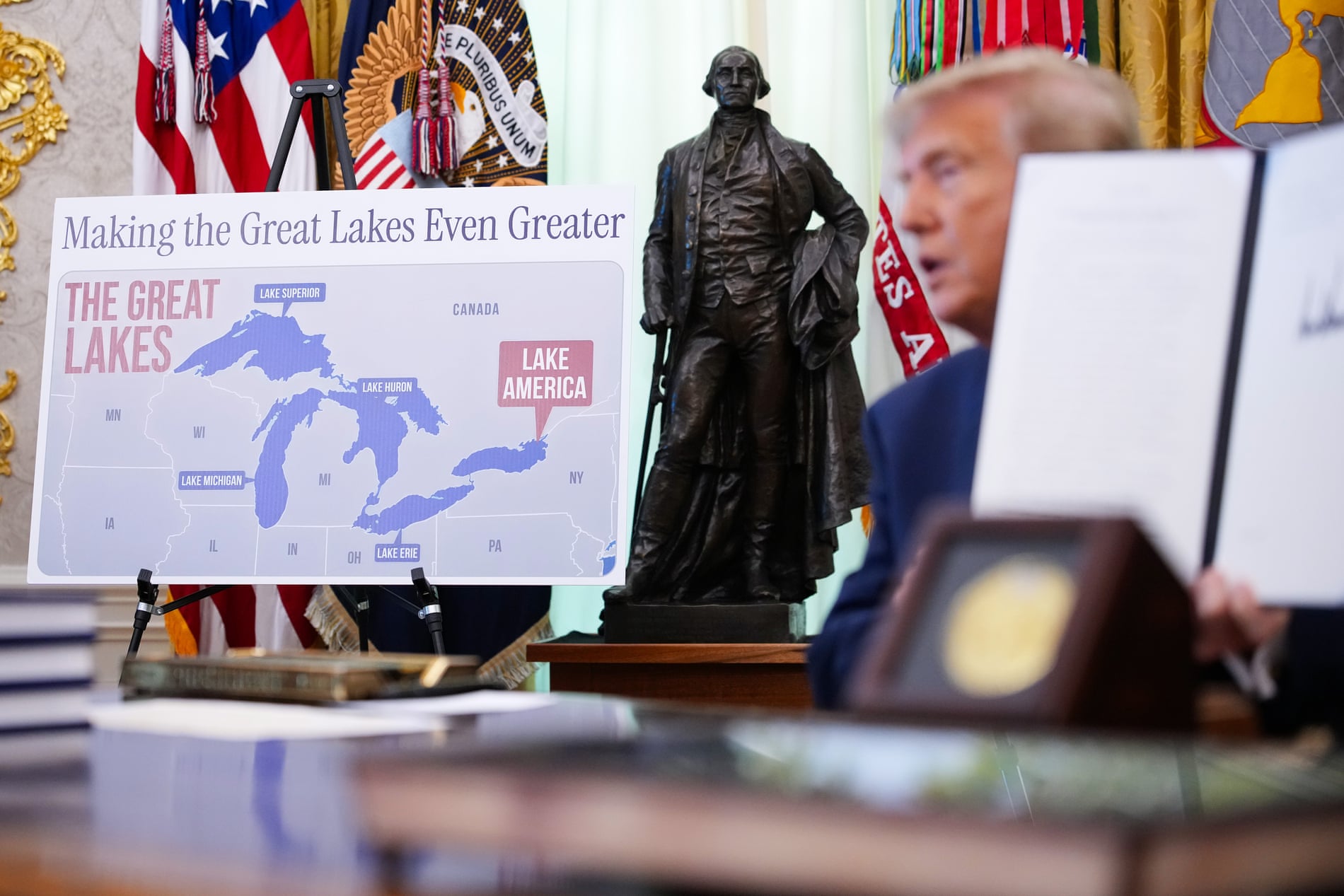 |
| Donald Trump signs the executive order in the Oval Office of the White House in Washington DC on Thursday. Photograph: Andrew Harnik/Getty Images |
Canada,
as it happens, deployed some 40,000 troops to Afghanistan over a period
of twelve long years, and continues long afterward to mourn the death
of 158 of its servicemen and women on the Afghanistan battlefield. As a
member of the North Atlantic Treaty Alliance, Canada is the closest
geographic military partner with the United States. In addition, both
share the North American Aerospace Defence Command, a mutual defence
organization.
"I still think imposing new tariffs on Canada is a mistake [that will increase costs for Mainers]."
"We produce a lot in Maine -- our blueberries, our potatoes, our lobster,r our lumber -- that is processed across the border."
"If it comes back with a huge tariff on it ... that increases the cost of eating, building homes, and our best known products."
Republican U.S. senator Susan Collins, Maine
Labels: Canada/U.S. Relations, Impasse, Predatory Tariffs, Souring Relationship, Tariff Impositions, Trade Negotiations, Trump Government
Canada Versus U.S. President Donald Trump's Trade War
"He's a different guy and doesn't have a history with Trump. There was some baggage with Trudeau."
"That's positive because Trump is very sensitive to personal interactions."
"There's a fine line between going after Trump, and alienating him entirely."
Daniel Beland, political-science professor, McGill University, Montreal
"The difference between [Mark] Carney and Trudeau is Carney doesn't seek to make a point or to virtue-signal. When he goes to see Trump, it's about getting a deal."
"The president's transactional, and Carney has a lot of experience in negotiating over the years."
Lisa Raitt, former Conservative cabinet minister
"Canada needs to continue having a proportionate response to any and all economic attacks from the U.S."
"We will do that, in part, by keeping our tariffs on the Americans for as long as they have their own tariffs and until the Americans show us respect and make credible, reliable commitments to free and fair trade."
Spokesperson for Carney
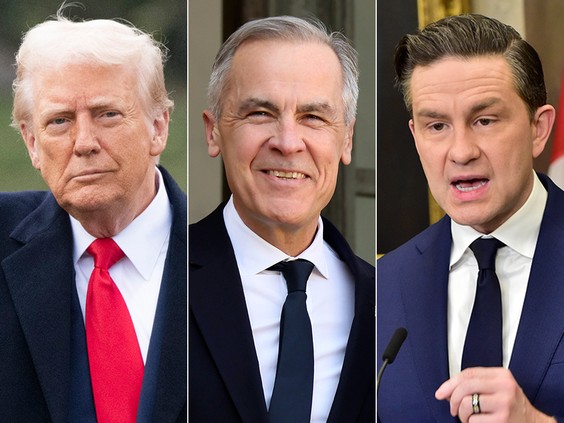 |
| From
left: U.S. President Donald Trump, Prime Minister Mark Carney and
Conservative Party Leader Pierre Poilievre. Trump said on Tuesday “it
doesn’t matter” to him which one of the other two wins the next Canadian
election. Photo by Roberto Schmidt/AFP via Getty Images; Thomas Padilla/AP; Dave Chan/AFP via Getty Images |
Since Donald Trump's re-election in the United States, he has repeatedly spoken of Justin Trudeau, while still Prime Minister of Canada, as 'Governor' Trudeau. Strained relations between the two date back to Mr. Trump's first term in office as President of the United States. They since went from cold to downright frozen, with Mr. Trudeau referring in public statements to 'Donald'. And cementing that hostility by calling his tariffs "dumb". But that was a month ago, and PM Trudeau is no more, to the great relief of most Canadians. In his place is the new leader of the Liberal Party, elevated to the Prime Minister's Office at least as long as it takes for an election to be called.
U.S. President Donald Trump has made the political situation in Canada even more tense, at a time when the Canadian economy is hobbling along due to poor decision making and inaction in necessary exploitation spheres of Canadian resources by the Liberal government, hobbling business and trade with its overweening focus on the environment to the detriment of the Canadian economy. Thanks to Mr. Trump's truculent, eruptive behaviour it is not only Canada, but Mexico, China, and the European Union, Japan and South Korea whose economic futures have been thrown a fastball with the threat of steep American tariffs.
For the present, PM Mark Carney governs Canada with the mind of a technocrat and global economist. The country's goal, he has said, must be to build the strongest economy in the Group of Seven. The fly in that aspirational ointment is that while Trudeau's embrace of environment issues was inconvenient to economic growth for Canada, Carney's will be even more so, as a committed environmentalist whose past statements and actions distinguished him as every bit as passionate on the issue as his predecessor.
Mr. Carney has stated he is in no hurry to visit Washington to meet with the man who has said that Canada is not a viable country. But that it would make a very good 51st state, in surrendering its sovereignty and that it is his intention to destroy the Canadian economy in a bid to convince Canadians that joining the United States is where their destiny lies. Generally speaking, a great preponderance of the Canadian public has no interest whatever in doing such a thing, and the resentment engendered by these repetitive utterances is of magnitudes of disgust.
At the "appropriate time, under a position where there's respect for Canadian sovereignty", stated Mr. Carney, he would be willing to undertake such a trip. On the other hand, the recognition must be there, that no one can talk reason to an unreasonable mind. In the meanwhile, Carney has undertaken trips to France and Britain in a bid to shore up relations with the two founding countries during the colonial days prior to confederation when relations with the Indigenous populations of the country were fraught with all the ills that accompany colonization.
Canadian officials from the provincial to the federal governments had been visiting Washington to speak with their counterparts over the issue of tariff threats. Those threats have turned out to be predictive of the man making them having no intention of not imposing them. Threatening further that if counter-tariffs were to be imposed it would be his intention to raise already-high tariffs even more. In the end the U.S. levies have been matched tariff-for-tariff on incoming U.S. goods to Canada, infuriating the U.S. president, that any other country would be so bold as to thwart his intention of one-way tariffs.
Canada's official opposition through Conservative Leader Pierre Poilievre is now appealing to the voting public with his own agenda items; curbing public spending, reducing foreign aid, cutting taxes and stimulating business investments. The frank hope for the future is, once a general election is called and the voters finally have the opportunity to make their choice between a Liberal government that has spent a decade beggaring the economy, mounting a colossal public debt, alienating the country from East to West, transforming its culture and heritage and burdening the country with an impossibly high and divisive immigration rate that has failed its public health service and housing market, Canada will have a new, commonsense Conservative government.
 |
| Prime
Minister Mark Carney, while speaking in Iqaluit on Tuesday, announced
that Canada will be working alongside Australia to build an early
warning radar system in the Arctic. CBC |
Labels: Counter-Tariffs, Government of Canada, Tariff Impositions, U.S. President Donald Trump
Canada's new Trump-averse "Buy Canada" Mantra
"It's
shocking that our view of the U.S. is now veering closer to how we feel
about Russia, a country that is viewed very unfavourably."
"In
25 years of polling I don't recall it ever being this low. And to see
the United States viewed only a little more positive than say China,
with whom we've had problems, shows how much damage has been done to a
relationship with a country that has long seen us as its closest ally."
Jack Jedwab, president, Association for Canadian Studies, Montreal
 |
| A new poll by Leger suggests Canadians are divided on whether they see the U.S. as an an ally, a neutral country or an enemy. Photo by iStock |
A
historic 'realignment' regarding the countries that the Canadian
population view as their main allies has become sharply evident in the
very short reign to date of American President Donald J. Trump. Mr.
Trump's hostility toward Canada has reshaped public opinion in Canada to
a degree never before countenanced in reaction to his economic and
sovereignty threats against Canada. Although he himself signed a trade
agreement (Canada-Mexico-United States -- or CUSMA) he has now
unilaterally negated it with his imposition of massive tariffs on goods
imported into the United States from his North American neighbours.
With
that imposition of tariffs, interrupting the flow of manufactured and
raw materials in a continent-wide intertwined economy in production, has
come a warning from the man himself that his more malign intention is
to impact Canada's economy to an extent that his invitation for Canada
to fold itself into the United States as its 51st state will find favour
with a population he has beggared. His conceit of himself as a great
'negotiator' is to go for the jugular and he has done this with gusto,
leaving former friends and allies dazed at the swiftness of their
inter-relationship's demise.
Canadians
now look to the European Union and United Kingdom as the countries most
likely to remain their friends, allies and trading partners. The
wreckage of the Canada-Mexico-U.S. free trade relationship will lead
both Canada and Mexico to search out other countries with which business
can be conducted on a trustworthy basis. There is now scant-to-none
left with the United States whose moves can be characterized as
dishonourable.
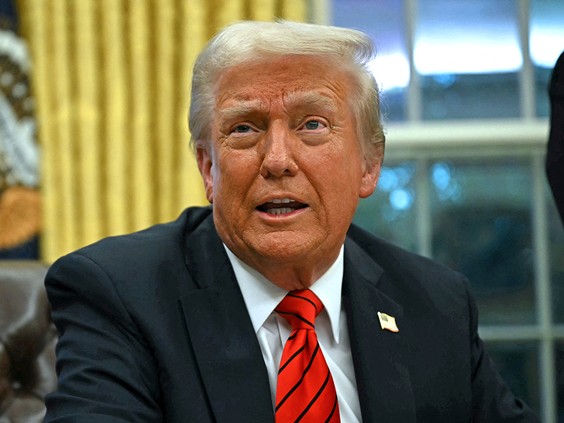 |
| U.S. President Donald Trump speaks to reporters after signing an executive order in the White House, on February 10, 2025. Photo by ANDREW CABALLERO-REYNOLDS/AFP via Getty Images |
Some two-thirds of Canadians feel that Mr. Trump's "expressed interest to make Canada the 51st American State" must be taken "very seriously",
with a slim majority of respondents to the Leger poll commissioned by
the Association for Canadian Studies going on to state that they are
personally willing to defend Canada should the situation turn into a
military threat of invasion. The historical view by Canadians of
Americans has been one of deep friendship, trade and military alliance
aside. That has now dwindled remarkably.
Positive
opinions of various countries from June to the present day had been
tracked by the survey, with the sole country's opinion on a steep
downward trend in Canadian eyes being the United States. The current
survey of 1,548 respondents indicates positive opinion of the United
States remains most common among young respondents, 25 to 34, a 42
percent. Among an older demographic, 55 upward, it is 27 percent. Asked
the same question relating to the American people, rather than their
government, positive numbers leap, still reaching overall just 50
percent.
"While
the 50 percent is low compared to past surveys, it still shows that a
distinction is being made between our views of Americans and our view of
their current government."
"Clearly for the time being, President Trump has soured our relationship."
Jack Jedwab
Over
the past year, all other countries' favourability rating remain stable,
moving no more than two percentage points: Ukraine at 66 percent,
Israel at 36 percent, China at 30 percent, Iran at 17 and Russia at 18.
Young Canadians, 18 to 24 appear fairly negative about Israel, just 25
percent with a positive opinion in comparison to 46 percent of people
over 65 years of age. Young people on the other hand, are relatively
positive on China, at 38 percent, compared to just 28 percent older than
65.
Interestingly
enough, the young in Canada appear quite a bit more interested on Iran
and Russia in comparison with older people, at 30 percent of those age
18 to 24 holding positive opinions of both. Those over 65 are just 12
percent positive on Iran and nine percent on Russia. Men appear more
positively disposed than women to the U.S., Israel and Russia. The split
is 12 points for Israel with between 42 percent of men with a positive
view as compared to 30 percent of women.
As
for defending their country, fully 38 percent of those 18 to 34, would
do so, in comparison to respondents older than 55 seeing 17 percent
commitment. Two thirds of Canadians overall agree a travel boycott is an
effective response, while among young people that falls to 56 percent.
Among those older than 55, 78 percent agree on a travel boycott. "Buy Canada" has become a popular message.
 |
| Graphic assembled by The Maple staff using photo of the American flag by Charles "Duck" Unitas via Unsplash and official presidential portraits via Wikiepdia. |
Labels: Canada, CUSMA, Free Trade Mexico, Sovereignty Challenges, Tariff Impositions, Threats, United States


