"Unless
we get one heck of a boost, it's projected to take chunks out of our
town and surrounding areas. It's looking very ugly right now."
"We're begging for air support [to help douse the fire]. It's really crucial."
Mayor of Flin Flon, Manitoba, George Fontaine
"It's a very serious situation that we're faced with. We do need some rainfall."
"We
need that sooner rather than later, and in light of that not being in
the forecast, we most certainly are putting in place every measure
possible to prepare the province."
"Resources are stretched thin because of the severity of the situation
that we're facing and the intensity and the proximity of the fires."
Saskatchewan Premier Scott Moe
"My husband was trapped on the other side of the barricade with no
pills, no food, no nothing. They wouldn't let him come to me to
evacuate,"
"[Reunited], we're trying to register with Saskatchewan Red Cross; I've
tried numerous times."
"Worse happens,
we're sleeping in the car. We'll just keep traveling from town to town
to town to town till hopefully we find something."
Sandy Oosterlaken, evacuated from Denare Beach
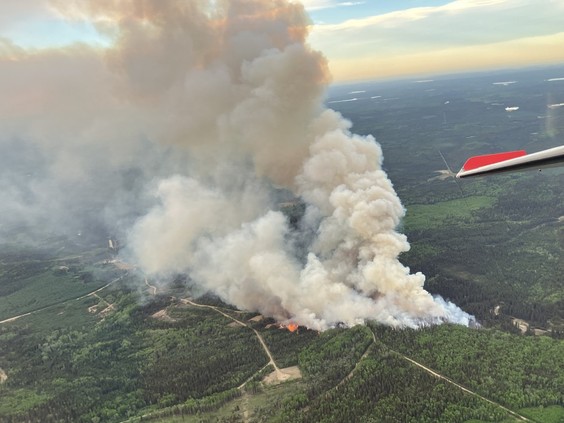
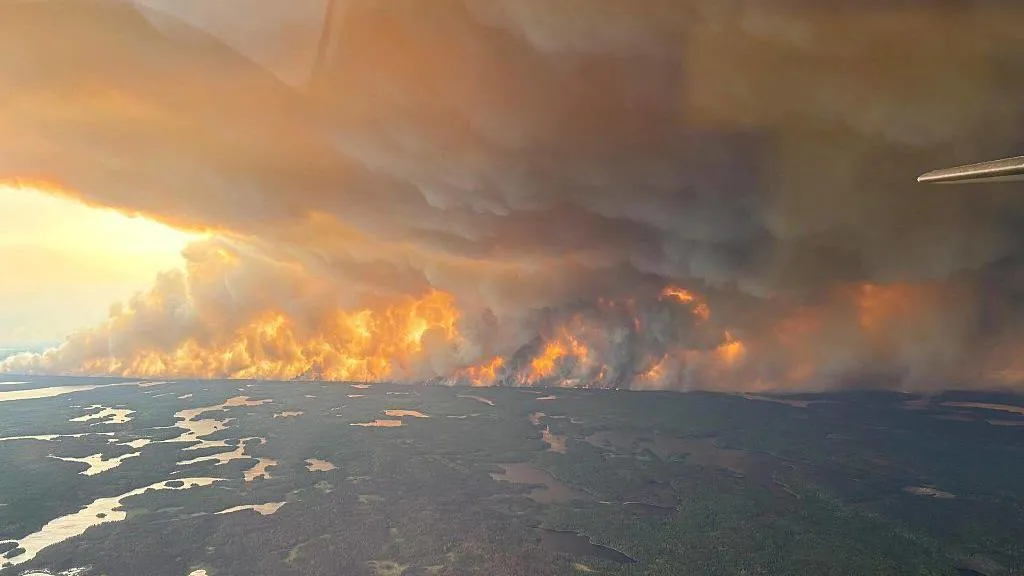
A wildfire in the Sherridon, Man.
area is shown in a government handout photo on Tuesday, May 27, 2025.
THE CANADIAN PRESS/HO - Manitoba Government
Fierce,
shifting winds threatened to propel a nearby raging wildfire into the
city of Flin Flon, Manitoba where buildings, both homes and civil
infrastructure would be vulnerable to the flames. The municipality 630
kilometres northwest of Winnipeg served notice to its 5,000 residents to
begin emergency evacuation. A wildfire that had started over the
boundary in neighbouring Saskatchewan had swiftly reached Flin Flon's
northern perimeter.
Another
thousand people are resident in cottages and homes surrounding Flin
Flon. All remaining residents were directed by the city to leave before
noon on Friday. Buses were driving those who don't have shelter, to
Manitoba's capital city, Winnipeg. A total of 17,000 residents in
Manitoba have been forced to leave their towns and homes in the last
several days.
Small
communities and towns stretching from northern Ontario to British
Columbia -- Canada's east-to-west geographic arc -- face an early fire
season whipping through forests. From a blaze that started Monday near
Creighton, Saskatchewan, after jumping the boundary into Manitoba and
menacing Flin Flon, the wildfire has grown to 40 square kilometres, with
firefighting crews struggling to contain it. As a result of heavy smoke
and a drone incursion, water bombers were grounded intermittently.
A wildfire that broke out across the North Saskatchewan River, in Parkland County, on May 8. (Noam Olsson photos)Photo by HO /THE CANADIAN PRESS
Residents
of Creighton, 1,200 in number, have been ordered out of the range of
the wildfire. Over 4,000 people have fled wildfires raging in
Saskatchewan, under a province-wide state of emergency. Alberta, which
in recent years has suffered immense wldfire damage, this year has fared
comparatively better. Northwest of Edmonton, however, the 1,300
residents of Swan Hills have been ordered to evacuate, along with the
900 residents of Chateh in Alberta's northwestern corner.
In
Chipewyan Lake, about 450 kilometres north of Edmonton, a crew of eight
firefighters were temporarily trapped overnight but finally were able
to drive their way out to safety. A wildfire in British Columbia that
prompted an evacuation order Thursday, quadrupled in size overnight
while firefighters prepared for "intensifying conditions" in the parched northeast of the province where the concentration of most fire activity is located.
The blaze "displaying aggressive fire behaviour"
in the Peace River Regional District near the community of Kelly Lake
was about 46 square kilometres in size Friday, substantially larger from
the 11 square kilometres it registered the day before, according to the
British Columbia Wildfire Service.
Military aircraft and helicopters are being used to evacuate residents in Manitoba from fast-moving wildfires EPA
British
Columbia has about 60 wildfires ongoing at the present time, 34 of
which are classified as burning out of control. According to the B.C.
Wildfire Service, 18 percent of the active fires were human caused, 77
percent started by lightning taking advantage of the drought situation
and tinder-dry forests, and five percent of unknown causes.
"It's been another challenging day here in Manitoba."
"[Firefighters were using] water bombers flying overhead [and] helicopters dropping buckets of
water."
"But at the same time, all the smoke in the air is making the evacuation effort that much more difficult."
"Our provinces here in Canada are immense. By the time
somebody makes it to Winnipeg, some of them have been on the road
overnight. They've had to be on a flight for a few hours and then on a
bus for several hours after that."
Manitoba Premier Wab Kinew
A Royal Canadian Mounted Police (RCMP) patrol vehicle is parked as
a water bomber flies over the plume of smoke from a wildfire near The
Pas, Manitoba, May 27, 2025. Manitoba RCMP/Handout via REUTERS
A wildfire burns near Sherridon on May 27. Several out-control blazes
have forced the evacuation of thousands of people in northern Manitoba
this week. (Government of Manitoba)
"We
could see [the fire] very well throughout the night. The night before,
the wind was in our favour ... but then we were told that the wind was
going to change on Wednesday, and it did."
"We could see [the fire] perfectly. Red [skies] and lots of black smoke."
"Some of the residents, like my kids, live right off the perimeter, which is only one-and-a-half kilometres from the fire."
"[First responders] were going door to door, telling them to get out."
Rob Burroughs, resident of Flin Flon, Manitoba
"Pray
for Flin Flon, pray for Pimicikamak, pray for Mathias Colomb, pray for
Cross Lake, pray for everybody in Manitoba who's out of their homes
right now."
"As we head into the weekend, pray for rain. We haven't seen rain in the
forecast yet. That could really help — sustained rainfall, in
particular."
"But in the absence of that, the past few days
have been very challenging, and that may continue."
"We
cannot thank other jurisdictions enough, [other provinces and
territories — now also being bolstered by 100 more firefighters and 25
logistics managers from the U.S]."
"It really does just underline how serious this situation is."
Manitoba Premier Wab Kinew
"I hear … there's choppers now, that smoke has engulfed the airport."
"We're getting desperate now. It's
getting rougher. We're going to be heading for the lake … shortly if
nothing turns out, if nothing puts the flame out."
Chief Gordie Bear, Pukatawagan Cree Nation
Evacuees from Pukatawagan Cree Nation arrive at the Brandon Municipal
Airport Thursday night. Thousands of residents were stranded in
Pukatawagan, also known as Mathias Colomb, after the nearby fire shut
down its airport at around 6:30 p.m. CT, the First Nation's chief said. (Chelsea Kemp/CBC)
Cars
lined bumper to bumper with Flin Flon residents evacuating to Winnipeg
for shelter from the wildfires threatening their homes were in for a
long drive. From the highway, the frightening sight of the wildfires
accompanied their journey as Winnipeg awaited the thousands of evacuees
during Manitoba's province-wide state of emergency.
Flin
Flon residents were informed they had to leave their homes and go south
with their essentials, by Wednesday night. Even before the evacuation
orders were disseminated, hospital patients had been sent out of the
city where fires have forced 17,000 residents from their homes in remote
communities and First Nations. Some 6,000 people were dispatched from
Flin Flon alone.
Advance
emergency preparations had been made to house evacuees at a Winnipeg
arena while others would be housed at larger facilities like recreation
centres and soccer fields. According to Manitoba's premier, this is the
province's largest exodus of this nature in living memory. The military
has been called upon to assist evacuation flights to Winnipeg.
A fire is currently closing in on the city boundaries of Flin Flon, a community of some 5,000 people Government of Manitoba Handout
Nearby
Creighton, Saskatchewan was involved in the Flin Flon fire on Monday
when it crossed the boundary, then exploded in volume as crews struggled
to contain it Tuesday. A drone in nearby flight kept water bombers
grounded at a critical time in attempting to manage the runaway fire.
Upward of 1,200 residents were informed they had to leave the town.
Wildfire officials informed Creighton Mayor Bruce Fidler that flames
could move in by Thursday, cutting off road access.
"We
declared a state of emergency and put out a mandatory evacuation so
that we can get as many people out of the area as possible, to be safe
and before the roads become impassable", explained the
Creighton mayor. Wildfires have forced thousands of residents from
Manitoba to Alberta from their homes in the heated summer atmosphere
prevailing. Advancing wildfires forced evacuation of residents from the
town of Lynn Lake northwest of Winnipeg.
According
to the Wednesday count, 22 active wildfires were ablaze in Manitoba
where 102 fires this year have marked the province's growing
vulnerability to more extreme weather conditions where the 20-year
annual average has been 77. Firefighters from New Brunswick, Alberta,
British Columbia and Prince Edward Island were relocated to give
assistance in Manitoba. Three First Nations in northern Saskatchewan
declared a joint state of emergency where thousands have been forced
from their communities amidst escalating wildfires.
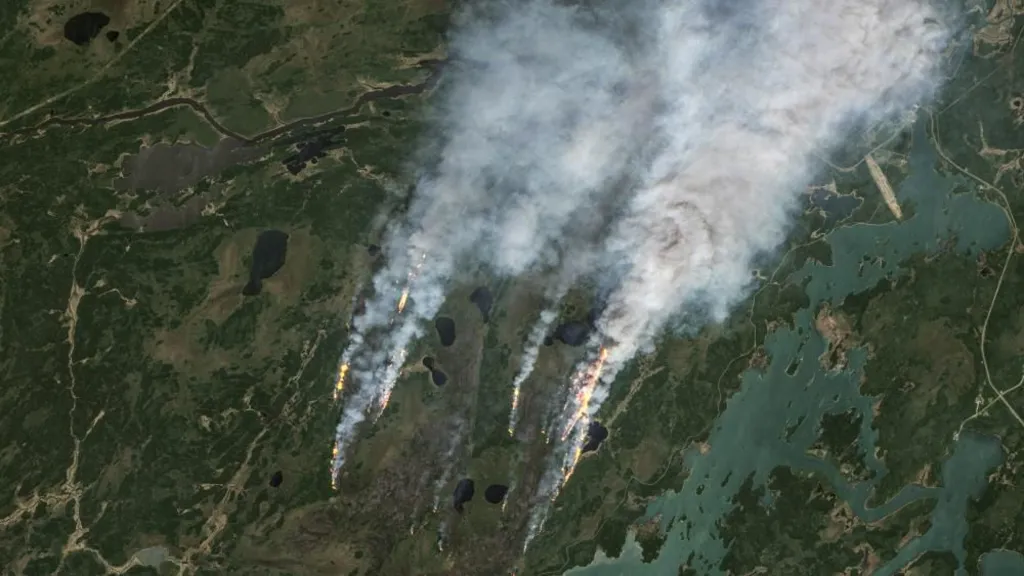
Smoke rises from wildfires in Manitoba, Canada Copernicus Sentinel-2/Reuters
They report that there are "critical shortages"
of firefighting resources, personnel and air support, a joint statement
by the Lac La Ronge Indian Band, Peter Ballantyne Cree Nation and
Montreal Cree Nation and Montreal Lake Cree Nation advised. 1,300
residents of Swan Hills, north-central Alberta, were ordered on Monday
to leave ahead of an advancing fire whipped by raging winds.
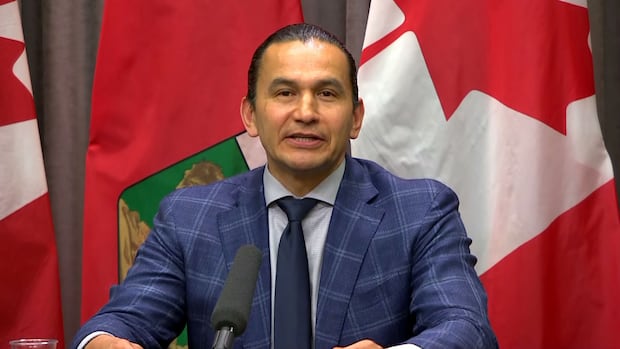
Premier Wab Kinew updates on wildfires.
"Everyone who is working on your behalf is working together, and ...
we are making important progress to move Manitobans to safety, to push
back the wildfires and to ensure that people will be able to return to
their homes and the lives that we're so proud of here in this province."
"I think the most important thing for
Manitobans to understand is that we need to be calm. The situation can
be very concerning, can be very emotional."
"I don't remember everything in detail. When I get healthy, I will remember everything." "I didn't remember everything because I'm sick. I need a doctor."Deng Mabiour, 54, South Sudanese refugee, Red Deer, Alberta
"The individual went in with a goal, and so it wasn't a random
attack.The individual went into the clinic for that
purpose." "In 27 years of policing, I've never seen a doctor attacked like that." "Dr.Reynolds' colleagues as well as member of the public in the clinic acted quickly to come to the aid of the victim and to minimize harm to others."Supt. Gerald Grobmeier, commander, Red Deer RCMP detachment
"I took pictures of all the doctors and it was just to put on
our TV screen so everybody could see which doctor was which." "He was the most kind, loving person ever. He was a jokester. We always joked around. He was just very, very kind." Kristen York, former Clinic employee
A memorial of flowers, balloons and stuffed animals was
growing on Wednesday outside the Red Deer. Alta., walk-in clinic where
Dr. Walter Reynolds was fatally attacked. (Travis McEwan/CBC)
Patients were sitting in the waiting room of a central Alberta walk-in clinic, waiting for their appointments. They heard a commotion, then heard someone screaming for help, and calling out for 911 to be called. That desperate voice called out 'Help me!'. When one of the clinic staff, rushed over and pushed open a door she rushed right back out and called for help. Two large men who had been in the waiting room went through the door and though the details have not yet been released, may have attempted to restrain a man holding a hammer and a machete -- and to give aid to a dying man.
Dr. Walter Reynolds (Walter Reynolds/Facebook)
That man was 45-year-old Dr.Walter Reynolds a father of two young girls, who had emigrated from South Africa a decade or so earlier to practise in Alberta. And it was Dr.Reynolds who had, in fact, set up the Village Mall Walk-in-Clinic. It was 11:00 a.m. on Monday. Police responded to the 911 call for help in a matter of minutes. Deng Mabiour of Red Deer, Alberta now faces a first-degree murder charge in the death of Dr.Walter Reynolds, the man whose passion was to serve people like him, as a medical professional.
It is entirely possible that the arrested man is, as he claims, mentally ill. For, when he made that statement to explain why it is that he cannot recall anything that occurred, he ended his explanation with a laugh. Reiterating that he needs a doctor despite having murdered one who tried to aid him. From among the many and varied communities of refugees arriving in Canada, people who have undergone the experience of internecine violence, in a culture of tribal, clan and sectarian antipathy, an unsurprising number of people suffer from mental illness.
Or, put another way -- bring their primitive violence against others with them, so deeply ingrained is it. Canada does its best to provide compassionate support through government and private-sector resources, providing language services and English as a second language, funding for accommodation, welfare services and medical needs to be met. Integration into the prevailing culture of Western values and social, civil behaviour is more readily hoped for than accomplished.
The arrested man is charged as well with assault with a weapon and assaulting a police officer.
Deng Mabiour has been charged with first-degree murder, assault with a weapon and assault. (Facebook)
Dr.Reynolds was rushed to hospital but there was no power on earth that could have retrieved him from the possession of the Angel of Death. The man who had dedicated his life to the healing profession and whose regard for others and determination to help wherever he could, had his aspirational future rent from his grasp and in one fell swoop his community became that much poorer in their bereavement. Arrested at the scene, Mabiour appeared in court on Wednesday.
One officer was struck with the hammer that Mabiour wielded, while attempting his arrest. This officer's treatment in hospital will be far more effective in restoring him to normal duty. Mabiour, according to court documents, is accused as well of carrying, using or threatening to use a "machete or an imitation" against Dr.Stephen Nel, another physician who works at the clinic. Dr.Nel escaped harm.
Memorial outside the clinic. (Travis McEwan/CBC)
"It's a shock to the whole of Red Deer, not only to the physicians, but also to the many medical staff that work in our clinic. And I think a lot of them are looking over their shoulder today and are quite anxious. It's utter shock and horror. Every emotion goes through you, that such a thing could happen to a physician in their clinic while seeing a patient. I think all of us today are in the same mindset. Why did this happen and what can we do to try and prevent this in the future? He was a family man and an all-around very friendly, great guy. He was an excellent doctor. You know, he really cared about his patients. He was a great doctor and a great family man."Dr.Peter Bouch, one of a tight-knit South African expatriate physician group in Red Deer
Canada is in an economic quandary. Always an exporter of raw goods resulting from our great store of natural resources, we have tried to find salvation in the production of finished goods on the global market. Oops, China has more or less sewn that industrial performance up quite nicely, so blue-collar jobs have evaporated steadily, not only from Canada, Ontario in particular, but right across the Globe. Trade competition is fierce and the struggle to open avenues to free trade agreements does nothing to diminish the giant footstep of China as the world's trade Goliath.
An
investment by the Alberta government would do nothing to quell the
unwavering political opposition that has stalled construction of the
Trans Mountain pipeline expansion, some experts say. (Trans Mountain)
Among the vast resources that Canada has in abundance is petroleum products. Canada's infrastructure, its refining capacity, shipping and pipelines simply don't match the potential product output. To be viable and bring back a return reflective of the value of the product, investments in reliable means of transporting natural gas and oil must proceed. The XL pipeline meant to go through the U.S. to refineries on the West Coast met hysterical resistance from U.S. environmental groups far less concerned about American fracturing and coal-fired furnaces than 'dirty' Athabasca 'tarsands'.
Former President Barack Obama also looked past the U.S. coal industry's carbon footprint and found fault with the Keystone XL pipeline, stringing Canada along in the wake of one successful environmental clearance after another to finally inform Prime Minister Justin Trudeau it could not proceed; overturned by President Trump, yet obstacles remain thanks to the vigor of environmentalist groups. Those same groups which have crossed the border into Canada to fund public relations ploys that succeeded in convincing British Columbia that no Alberta pipeline should sully B.C. territory.
So, where are we now? In a national debate over Canada's energy future. With Alberta and British Columbia at loggerheads; each with a New Democratic government viewing the situation from very different vantage points. British Columbia accepts Alberta oil for its own domestic purposes. Alberta oil is sold at a discount on the world market because it cannot expeditiously and economically move it to markets anxious to take advantage of it. Alberta's wealth as a 'have' province subsidizes 'have-not' provinces like Quebec yet Quebec too will not hear of a pipeline besmirching its geography.
All in the name of conservation, of environmental stewardship, of keeping a watchful eye on greenhouse gas and carbon emissions. "Coal production is a mainstay of the province's economy, generating billions of dollars in annual revenue and supporting thousands of well-paid jobs", the website for the B.C. Ministry of Energy, Mines and Petroleum Resources reads. Coal, yes coal, is the premier export commodity of the province.
Ships are loaded with coal at Westshore
Terminals in Delta, B.C., on Wednesday February 19, 2014. The terminal
is North America's largest single coal export facility.The Canadian Press
Vancouver may represent anti-pipeline central, but it also ranks as the largest single exporter of coal in all of North America, where Vancouver's coal facilities exported 36.8 million tonnes of coal in 2017. Vancouver ranks above Norfolk, Virginia -- the busiest coal port in the United States. In 2017, a massive spike in American coal exports saw 31.5 million tonnes of coal moving out of Norfolk.
Vancouver's coal ports accommodate a huge increase in exports of thermal coal, used in the production of electricity; almost all of this thermal coal emanates from the United States resulting from Washington and Oregon shutting down their coal ports due to environmental concerns. Thermal coal producers there now shunt their products through Canada. Much of Vancouver's own coal is metallurgical coal for the production of steel and exported to Asia.
Coal is moved at Neptune terminals, North Vancouver, April 28 2017.Gerry Kahrmann / Postmedia File
British Columbia's coal exports harm climate as much as any products that may be transported out of the TransMountain expansion which plans to move 215 million extra barrels of diluted bitumen per year; total product shipped through the expansion is projected to emit between 129 million and 158 million tonnes of carbon dioxide over its life cycle.
But the expansion won't be built if British Columbia continues to deny Kinder Morgan right-of-way to its vast investment. This is not a provincial jurisdiction but a federal one, something both British Columbia and the federal government appear to have trouble remembering; with the former intruding on the latter's bailiwick and the latter so engrossed in the tail wagging the dog that it's forgotten its bark.
"Under
the leadership of Justin Trudeau, the Liberal government has created a
toxic environment for energy investment, which is why these projects
keep getting cancelled or suspended." "Not
only has the prime minister failed to show any leadership on the
inter-provincial Trans Mountain dispute, he is actually making matters
worse for the Canadian energy sector by imposing harmful policies such
as the carbon tax and new regulations that penalize Canadian oil
exports." Federal MP Matt Jeneroux
"Just given the size, scope and complexity of the Fort McMurray [Alberta] wildfire, firefighters will continue to monitor the area." "Honestly, you wouldn't see anything [above ground]; these hot spots are quite deep down." Laura Stewart, wildfire information officer, Government of Alberta
"Literally, you've got men and women out there on their hands and knees feeling for heat." Kevin Skrepnek, chief fire information officer, Province of British Columbia
Darryl Dyck/BloombergThe
Horse River Fire at its peak surges behind abandoned vehicles on
Alberta Highway 63 near Fort McMurray on Saturday, May 7, 2016.
Around High Level, Alberta, the smouldering remnants of a 40,000-hectare fire left over from 2015 opened the 2016 fire season when fire crews managed to extinguish the remnants which had over-wintered, to present a threat from spring forward. Winter temperatures and snow often snuff out smaller fires but conflagrations such as the Horse River Fire, the true name of 'The Beast' that ravaged Fort McMurray six months ago, are much more difficult to put out.
The Horse River Fire peaked with temperatures of 1,000 C. Heat was radiated deep under the forest floor. Peat, tree roots and mineral-rich soil deep under that forest floor all readily ignited. It was the Fort McMurray Regional fire chief Darby Allen who named the Horse River Fire 'The Beast'. When it advanced toward the suburban outskirts of the oilsands capital, the threat it represented appeared too difficult to transcend.
Jerome Garot via National Post Wildfires encroach on Highway 63 near Fort McMurray on May 3, 2016
But the regional fire crews orchestrated a desperate triage in an effort to restrain the roaring flames, and keep them from key parts of the city whose citizens had been hastily evacuated only hours earlier. It took no more than a few hours for flames to claim almost two thousand structures, causing an estimated $3.6-billion in damages. Firefighters converged on northern Alberta in a quasi-military effort to tame the beast. But it was a much higher authority who managed to bring it to heel.
Once the fire crossed the border from Alberta to Saskatchewan it was met with a number of summer rainfalls so severe it brought the added agony of flooding to the already desperate residents of Fort McMurray. That was then. Now, crews are resting up for winter, preparing for spring and the last strike against the Horse River Fire, even while the city of Fort McMurray has hardly dented the destruction left in its wake. It is estimated that by 2022 Fort McMurray may be restored.
Larry Wong/Postmedia NewsHomes destroyed by the wildfire are seen in Fort McMurray on Wednesday, May 11, 2016.
For now, however, the fire is just a nightmare memory that will never be forgotten, written in the annals of fear and misery. What is there of the fire is no longer visible, not even smoke, let alone any open flames. In remote areas of Alberta and Saskatchewan, distant from Fort McMurray, the fire is known to be present and it is being monitored as one would a dangerous beast.
Government of Alberta Image of a "holdover fire" smouldering underground throughout the winter.
When the fire was first seen it was two hectares in size. In three days following the initial spotting it had opened a giant maw of 10,000 hectares and swooped into Fort McMurray. Although it has been declared to be in an "under control" state since early July, the fire is in a threatening hibernating state. The beast is preparing to survive over-winter, a phenomenon known as "holdover fire", set to strike once winter withdraws and spring arrives. The fire, like all beasts who enjoy threatening the vulnerable, smoulders, awaiting its advantage.
Holdover fires are known to flare up on spring's arrival, enabling a wildfire of sufficient size to be resurrected so as to constitute the kind of threat that the Beast represented, to burn for years. So, as soon as the 2017 fire season arrives after snow melt, Alberta wildland firefighters will be on the scene, with crews looking to find and destroy the last remnants of MWF-009, the devastating wildfire gifted with a variety of names.
Helicopters will first fly over the area searching for "hot spots" with the use of an infrared camera. If spots are identified, crews will be dropped into the area to commence the process of "coldtrailing" whatever is left of the Horse River Fire. Firefighters moving along the forest floor feel for signs of heat; that's cold trailing. When and as warm spots are identified they are then dug with picks and shovels and water pumped in from a neighbouring creek or dropped from a helicopter, to drown it.
We humans have a tendency to go where we should not, particularly. We love the challenge of living in unsustainable areas; floodplains, for example, and far too close to forests, making our lives and the infrastructure that has such meaning in our lives vulnerable to nature's idiosyncratic weather systems that can impact so disastrously on what we think, in our naivete, is permanence.
"Fire itself is always going to occur in these forest ecosystems. But we try and come up with solutions as far as mitigating the impact of those fires on communities." "[FireSmart Canada's function is to help homeowners, industry and communities living at the intersection of the] wildland urban interface [cope, to protect themselves]." "It keeps the fire [clearing out dead brush, pruning trees] on the ground, so there's a higher likelihood of success for firefighters on the ground of suppressing the fire." "The first ten metres, we really focus on trying to significantly reduce the fuels, period. We really discourage the presence of conifer trees within the first ten metres and flammable vegetation, like junipers, within the first ten metres of homes, as well as sheds, wood piles, fences -- anything that can burn and help transition a fire towards the structure." "Unfortunately ... with climate change and our forest health conditions, these fires are burning in conditions that we've never seen before. And they're burning hotter, bigger, faster and more aggressively than the fires that we've seen in the past and they're becoming a big challenge." Kelly Johnston, executive director, Partners In Protection Association, FireSmart Canada "It's important for people to understand that all the air tankers, all the suppression equipment, people, when conditions line up and that fire's ripping, it's going to do what it wants to do. You won't put it out, unless you do that work with the fuels." Larry Fremont, wildfire education and prevention co-ordinator, Ministry of Environment, Saskatchewan
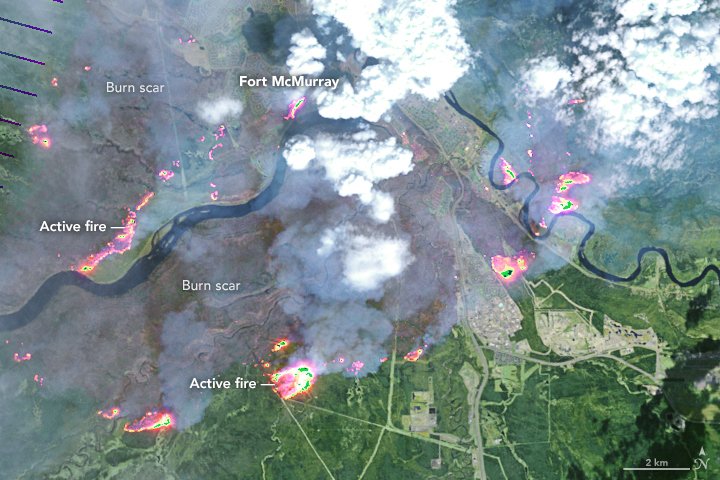
NASA Earth
Alberta forestry authorities cleared out strips of forest around eleven northern communities last fall, removing what was seen as potential fuel to encourage forest fires. Wildfire prevention co-ordinator Larry Freemont cautions, that despite that preemptive work, he has himself seen fires jump breaks, including rivers or lakes. And now he can also include six-lane highways, because the situation seen now in Fort McMurray is quite exceptional. And science tells us these conditions are here to stay.
On their way, perhaps to becoming even more flagrantly lethal to people placing their trust in the skills and courage of firefighters and the equipment that has been developed in the past to fight fires that no longer reflect the types of fire situation now seen in northern Alberta and forecasted to increase in numbers, depth and capacity, given climate change and the ferocious alterations in climate moisture, winds and heat.
A report produced in the wake of a devastating blaze that took place in Kelowna, British Columbia in 2013, warned that past protocols no longer work and indeed add fuel to the fire. A buildup of trees, brush and other dry vegetation in forests -- everything that a fire depends on to help it grow and sustain its impact -- left lying on the forest floor because of past fire suppression protocols, has helped to produce the perfect firestorm. That biofuel that has been built up represents the potential for more severe wildfires and greater numbers, where people and the forest intersect.
And because people live, and work and spend their leisure time in and around those intersections of human habitation and natural surroundings of dense forests there is a certain vulnerability quotient that can be triggered. Where, though many forest fires are set by lightning strikes, many more result from human carelessness. And experts evaluating this fire that has consumed Fort McMurray tend to believe that something as mundane and yet as dangerous as a flicked cigarette butt, or a campfire not adequately put out, might have triggered this blaze.
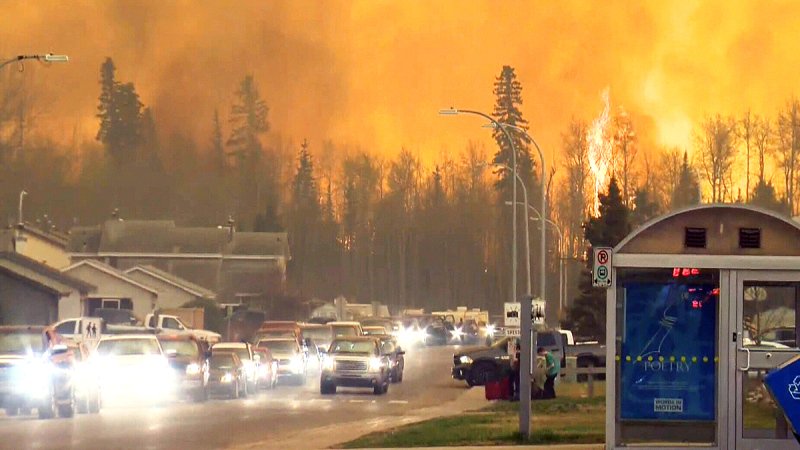
This current wildfire raging through northern Alberta, destroying Fort McMurray and the hopes and dreams of the tens of thousands of Canadian living there fits the pattern of the dire new expectations. Tens of thousands of people using the only highway permitting entry and departure north and south from Fort McMurray have found themselves stranded. They've had to drive through dense, dark smoke so thick at times visibility was almost nil. They've seen, as they've driven, the fire up close and very personal. They've been stuck in stop-and-stall whenever the highway is closed for safety reason, as when fire jumps across and fears become even starker.
Sara Peats: Praying I have a home to go back to. Fire isn't over officials say the worst is yet to come. #FortMcMurrayStrong
Some families have had to remain on the highway, stuck in a traffic line-up that will not begin again any time soon, for a day, for 36 hours, desperately awaiting the start-again. And Good Samaritans have set out from their comfortable and safe homes elsewhere in Alberta to truck in food, water, and gas in a convoy determined to do what they can to ensure that the residents of Fort McMurray who have lost everything they own but the clothes on their backs, their lives and those of their children -- and sometimes their pets, will know they're not forgotten. Some families fleeing the fire have taken shelter in communities north of their destroyed city, only to find the fire is tracking them there, too.
This fire, which looked serious on Monday, looked as though it might be under control by Tuesday, and then hot winds helped it grow tenfold from its Tuesday status, and mandatory notices went out to communities to flee. In one day it grew in size and ferocity 750 percent to encompass 850 square kilometres. People have taken the evacuation orders seriously. Although they will have lost everything they ever worked to own, none have yet lose their lives to the fire. Fort McMurray resembles a war zone, nature's own scorched-earth vendetta on humans who become too comfortable with themselves and their aspirations.
This represents a general opinion site for its author. It also offers a space for the author to record her experiences and perceptions,both personal and public. This is rendered obvious by the content contained in the blog, but the space is here inviting me to write. And so I do.