Sunday, June 01, 2025

Wildfires Sweep Across Canada From East to West

"Unless we get one heck of a boost, it's projected to take chunks out of our town and surrounding areas. It's looking very ugly right now."
"We're begging for air support [to  help douse the fire]. It's really crucial."
Mayor of Flin Flon, Manitoba, George Fontaine
 
"It's a very serious situation that we're faced with. We do need some rainfall."
"We need that sooner rather than later, and in light of that not being in the forecast, we most certainly are putting in place every measure possible to prepare the province." 
"Resources are stretched thin because of the severity of the situation that we're facing and the intensity and the proximity of the fires."
Saskatchewan Premier Scott Moe 
 
"My husband was trapped on the other side of the barricade with no pills, no food, no nothing. They wouldn't let him come to me to evacuate," 
"[Reunited], we're trying to register with Saskatchewan Red Cross; I've tried numerous times."
"Worse happens, we're sleeping in the car. We'll just keep traveling from town to town to town to town till hopefully we find something."
Sandy Oosterlaken, evacuated from Denare Beach   
https://www.ctvnews.ca/resizer/v2/RIZQK456RBGMHCQEH7WZPRLUJA.JPG?auth=84b8ca47b9d19f362af71a3844f7de0980a108ed38e81748be592867698eb665&width=1440&height=664
A wildfire in the Sherridon, Man. area is shown in a government handout photo on Tuesday, May 27, 2025. THE CANADIAN PRESS/HO - Manitoba Government
 
Fierce, shifting winds threatened to propel a nearby raging wildfire into the city of Flin Flon, Manitoba where buildings, both homes and civil infrastructure would be vulnerable to the flames. The municipality 630 kilometres northwest of Winnipeg served notice to its 5,000 residents to begin emergency evacuation. A wildfire that had started over the boundary in neighbouring Saskatchewan had swiftly reached Flin Flon's northern perimeter.
 
Another thousand people are resident in cottages and homes surrounding Flin Flon. All remaining residents were directed by the city to leave before noon on Friday. Buses were driving those who don't have shelter, to Manitoba's capital city, Winnipeg. A total of 17,000 residents in Manitoba have been forced to leave their towns and homes in the last several days. 
 
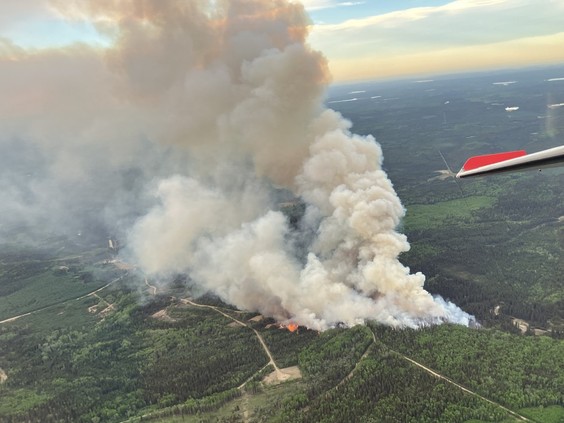
Small communities and towns stretching from northern Ontario to British Columbia -- Canada's east-to-west geographic arc -- face an early fire season whipping through forests. From a blaze that started Monday near Creighton, Saskatchewan, after jumping the boundary into Manitoba and menacing Flin Flon, the wildfire has grown to 40 square kilometres, with firefighting crews struggling to contain it. As a result of heavy smoke and a drone incursion, water bombers were grounded intermittently.  
 
https://smartcdn.gprod.postmedia.digital/vancouversun/wp-content/uploads/2025/05/wildfires-bc-20250529_295888309.jpg?quality=90&strip=all&w=564&h=423&type=webp&sig=eRS_OjNqnBsYfWkGKR4BZw
 
Residents of Creighton, 1,200 in number, have been ordered out of the range of the wildfire. Over 4,000 people have fled wildfires raging in Saskatchewan, under a province-wide state of emergency. Alberta, which in recent years has suffered immense wldfire damage, this year has fared comparatively better. Northwest of Edmonton, however, the 1,300 residents of Swan Hills have been ordered to evacuate, along with the 900 residents of Chateh in Alberta's northwestern corner.
 
In Chipewyan Lake, about 450 kilometres north of Edmonton, a crew of eight firefighters were temporarily trapped overnight but finally were able to drive their way out to safety. A wildfire in British Columbia that prompted an evacuation order Thursday, quadrupled in size overnight while firefighters prepared for "intensifying conditions" in the parched northeast of the province where the concentration of most fire activity is located. 
 
The blaze "displaying aggressive fire behaviour" in the Peace River Regional District near the community of Kelly Lake was about 46 square kilometres in size Friday, substantially larger from the 11 square kilometres it registered the day before, according to the British Columbia Wildfire Service.   
 
https://ichef.bbci.co.uk/news/1024/cpsprodpb/8630/live/96a0c090-3e3d-11f0-b6e6-4ddb91039da1.jpg.webp
Military aircraft and helicopters are being used to evacuate residents in Manitoba from fast-moving wildfires    EPA
 
British Columbia has about 60 wildfires ongoing at the present time, 34 of which are classified as burning out of control. According to the B.C. Wildfire Service, 18 percent of the active fires were human caused, 77 percent started by lightning taking advantage of the drought situation and tinder-dry forests, and five percent of unknown causes.  
"It's been another challenging day here in Manitoba."
"[Firefighters were using] water bombers flying overhead [and] helicopters dropping buckets of water."
"But at the same time, all the smoke in the air is making the evacuation effort that much more difficult."
"Our provinces here in Canada are immense. By the time somebody makes it to Winnipeg, some of them have been on the road overnight. They've had to be on a flight for a few hours and then on a bus for several hours after that."
Manitoba Premier Wab Kinew
https://www.reuters.com/resizer/v2/5WEAUMP6DBIXZCJOCHTVJHYLYA.jpg?auth=d8e748fd883d08c0de716255cd12d5aa99a2b20b82b93a6b39e80a7c3572bc4e&width=640&quality=80
A Royal Canadian Mounted Police (RCMP) patrol vehicle is parked as a water bomber flies over the plume of smoke from a wildfire near The Pas, Manitoba, May 27, 2025. Manitoba RCMP/Handout via REUTERS


Labels: , , , , , , , , ,

Monday, April 11, 2022

The Venerable, Trusted, Federal Policing Agency

The Venerable, Trusted, Federal Policing Agency

"Wortman drove for about six minutes from Hunter Road and was approaching the New Annan Road intersection. He could likely see Lillian Hyslop turning the corner and walking away from him on the other side of the road. She got a little more than 100 metres down the road, just pas the big, green rectangular road sign alerting drivers to turn right for West New Annan and Tatamagouche."
"It was around 9:34 a.m. when Wortman either drove across the highway or made a U-turn, stopped near Hyslop, took aim at her head with his laser sight and shot her, killing her instantly. She was his seventeenth victim in about eleven and a half hours."
Excerpted from 22 Murders, Paul Palango
Lawyer Roger Burrill, part of the presenting counsel team, releases details at the Mass Casualty Commission inquiry in Halifax, N.S. on Tuesday, March 1, 2022.

Two years ago, in April, Gabriel Wortman, a Halifax, Nova Scotia denturist, 51, set out on a nightmarish vendetta against people he knew, innocent of the knowledge that they would be hunted down and murdered by a man known to be violently irascible and controlling, who collected firearms and decommissioned RCMP vehicles. He would end a two-day killing spree by killing 22 men and women, some of whom he knew, others complete strangers, including an RCMP constable.
 
Those two days in April constituted the deadliest mass shooting event that Canada had ever experienced. And the federal police agency tasked with maintaining peace and good order failed to demonstrate on that singular occasion that they remain the stuff of legendary policing history. An enquiry was called, and now the Mass Casualty Commission is in the process, begun in February, of hearing testimony to enable them to reach a consensus on how this mass murder spree failed to be apprehended on the very first day that thirteen people in Portapique, lost their lives.
 
Gabriel Wortman committed mass murder in Portapique, where he and his common-law wife had a cottage, and set fire to homes of many of those he shot to death. 911 calls went out immediately the first of the killings began on his murderous rampage and he eluded capture as RCMP began entering the town. He spent the night in hiding, and by 6:36 a.m. the following morning set out to continue his killing spree. The enquiry heard that the RCMP failed to make use of its Alert Ready system which would have ensured an audible warning was circulated to the community and beyond.
 
The RCMP blocks the path to Gabriel Wortman's property in Portapique during a criminal investigation into the shootings. (Jonathan Villeneuve/Radio-Canada)

Reasonable speculation has it that notification of the community and its further surroundings would have alerted people to danger, and possibly saved an additional nine lives. It took too long for police to begin sending out alerts, including the predator's description -- and took even longer for additional alerts to be circulated warning that he would be driving an RCMP look-alike vehicle. Initially, back in Portapique, the first three responders to the "shooting" came close to firing on an innocent person thinking him to be the shooter.
 
He was actually a man visiting his father who lived in Portapique and had gone out to look for his brother, who, hearing inexplicable sounds had gone out to investigate. The man had gone to a nearby forest, shining his flashlight, when he discovered the body of his brother, shot dead. This was the man the RCMP constables mistook for the killer, but they lost sight of the figure when he turned off his flashlight because he saw the lights illuminating figures in the distance that he thought might be the killer.
 
Another RCMP constable saw the killer bearing an "unsettling grimace", drive past him in the opposite direction on the highway on the second day of the massacre when a hunt for the murderer was well underway. "If I stop and this is the bad guy, I'm going to get shot here, I'm going to get killed", the constable told lawyers for the enquiry. He drove on before finally turning back, thinking if he attempted to turn, on the tight two-lane highway he could be ambushed. When he finally drove in the direction the killer had taken, he had lost him.
 
Soon afterward, Wortman encountered RCMP Const. Heidi Stevenson, who recognized who he was, rammed his vehicle, and was shot to death by Wortman in a follow-up exchange of gunfire. The killer took Const.Stevenson's firearms and set off again. On another occasion, RCMP came across another victim on April 19. Heather O'Brien 55, was on the phone with a friend while seated in her parked Volkswagon Jetta. Wortman fired several shots into the vehicle that hit the woman. And then sped away.
 
When RCMP arrived they checked the woman's condition, declaring there was no pulse and her digits were 'cold'. They would not permit paramedics to approach, nor would they allow the woman's daughter to go to her mother's vehicle, telling them it was unsafe to remain there, the killer could be nearby. "You need to go. It's not safe for you to be here", one constable said to the woman's daughter. It was later discovered through the woman's Fitbit that she was registering a heartbeat nearly eight hours after being shot.
 
Twenty-two people died on April 18 and 19. Top row from left: Gina Goulet, Dawn Gulenchyn, Jolene Oliver, Frank Gulenchyn, Sean McLeod, Alanna Jenkins. Second row: John Zahl, Lisa McCully, Joey Webber, Heidi Stevenson, Heather O'Brien and Jamie Blair. Third row from top: Kristen Beaton, Lillian Campbell, Joanne Thomas, Peter Bond, Tom Bagley and Greg Blair. Bottom row: Emily Tuck, Joy Bond, Corrie Ellison and Aaron Tuck. (CBC)


Labels: , , ,

Saturday, May 23, 2020

Playing Police : Mass Murder

"The retired RCMP officers related to the gunman have been interviewed as part of the investigation. The origin of all police-related items is still under investigation."
"We respect the Court's decision to release the redacted documents. Because the unsealing of the ITOs is a matter before the courts and in consideration of our ongoing investigation, the RCMP is not currently in a position to provide additional details."
RCMP Constable Hans Ouellette

"I've been a police officer for 30 years now and I can't imagine a more horrific set of circumstances than looking for someone who looks like you."
RCMP Superintendent Darren Campbell 
The gunman torched several homes including his home in Portapique, N.S. (Steve Lawrence/CBC)
On April 18 and 19, beginning in Portapique, Nova Scotia, a small seaside town, 51-year-old Gabriel Wortman set off on a psychotic murder spree that he had obviously planned, taking with him an arsenal of illegally-acquired firearms, as he entered neighbours' homes to shoot them to death then set their homes ablaze, as he came across perfect strangers on highways en route to larger Nova Scotia cities to arrive at the homes of others he meant to kill, taking in total 22 lives, men and women, friends and strangers alike.

He began his murderous journey dressed in an RCMP uniform, and driving a look-alike police vehicle. On first seeing him no one might suspect that they would be next to die. But those two days of bloody carnage and burnt-out buildings and vehicles produced the worst mass murder in Canada's history. In Portapique where he began his rampage, he killed 13 people before leaving the town, cutting across a field rather than drive the sole highway leading to the town, where the RCMP was arriving in response to 911 calls.

Failing to find the murderer in town, the RCMP set up a roadblock, but he was long gone. And in the morning that followed, driving his replica police cruiser, wearing his uniform, his murder spree continued as he targeted people at random, and searched out those he knew. During the police manhunt an RCMP officer was shot, another had her car rammed by Wortman's and he shot her to death. He appropriated her service revolver and ammunition, adding them to his own, then torched her car and his own, disabled by the crash.

A Halifax regional police investigator is seen in a suite above the Atlantic Denture Clinic April 20, 2020 in Dartmouth, N.S. The clinic was owned by the gunman, Gabriel Wortman. (Tim Krochak/Getty Images)
RCMP investigators search for evidence at the location where Const. Heidi Stevenson was killed along the highway in Shubenacadie, N.S. on Thursday, April 23, 2020. THE CANADIAN PRESS/Andrew Vaughan
When a passerby stopped to provide help at the scene, he was shot to death too, and his SUV provided the next vehicle the murderer would use as he went on to continue his rampage. It was when he stopped to gas up at a station in Enfield that another RCMP car stopped for gas. It was the officer driving that police car that ended up shooting the killer at the gas station. As the RCMP got on with their post-mortem of the tragic event, their investigation led them to the finding that the killer was related to two former members of the RCMP.

 A Nova Scotia judge had ordered that police documents be released to the media, even as the investigation continues. A colleague who had worked with Wortman at one of the denture clinics he owned, had informed investigators of Wortman's uniform, stating that he would dress up as a police officer and would "role play". By no means or measure was he merely 'role playing' when he set out masquerading as an officer of the law to enact a prolonged and deadly drama representing the worst mass murder Canada has ever mourned.

Little remained of Wortman's Portapique home after he set it on fire. (Steve Lawrence/CBC)

Labels: , ,

Sunday, May 17, 2020

Canada's Federal Police Force : U.S.-Smuggled Firearms

"Honestly, what this really shows us that a lot of Canada's problem with guns actually originates in the United States."
"The lack of regulation in the United States, and the dominant gun culture of the United States, not only limits what we can reasonably do in terms of legislation in Canada -- but also creates this ongoing hazard for Canadians."
"The big question now is how did he get that gun?"
Andrew Somerset, author "Arms: the Culture and Credo of the Gun"

"I think it is reasonable to believe that limiting the domestic legal supply of some semi-automatic firearms, combined with reducing the flow of illegal guns from the United States, could in the long term reduce the likelihood of mass shooting events in Canada."
Blake Brown, Author, "Arming and Disarming: A History of Gun Control in Canada" professor of history, Saint Mary's University, Halifax

"We have a fairly good idea that, in Canada at least, he didn’t have a firearms acquisition certificate."
"Whether it’s transportation, weapons, the uniforms, the vehicle itself, associates here and elsewhere, these are all the elements in the investigation currently being explored."
RCMP Chief Supt. Chris Leather
https://images.theconversation.com/files/331766/original/file-20200430-42942-bf2vxa.jpg?ixlib=rb-1.1.0&rect=0%2C112%2C2986%2C1491&q=45&auto=format&w=1356&h=668&fit=crop
A woman places a pinwheel in front of a mural dedicated to slain RCMP Const. Heidi Stevenson, a victim of a shooting rampage carried out by a man with unlicensed weapons, in Cole Harbour, N.S., on April 24, 2020. THE CANADIAN PRESS/Tim Krochak
Three of the four semi-automatic weapons used by mass murderer Gabriel Wortman in Portapique, Nova Scotia last month, according to the RCMP, are believed to have originated in the United States. Without doubt the RCMP has much more information, but is withholding it, since there is an ongoing investigation into the mass killings that left 22 people, some known, others not, to the gunman.

The news release issued by the federal policing agency fails to list the model or calibre of two rifles and two handguns in the gunman's possession when he began his murderous rampage in the small community town west of Truro, Nova Scotia. One semi-automatic weapon had been obtained by the killer in Canada, according to the investigators; again without specifying whether it was a rifle or a handgun.

When Gabriel Wortman embarked on his killing spree all four weapons were in his possession as he shot to death 13 people in Portapique and another nine on his way to Truro, as he escaped the RCMP cordon set up to arrest his flight, by avoiding the one highway that led in and out of the small seaside town, and driving his look-alike police vehicle across a field, instead, while dressed in an RCMP uniform.

The denturist-turned-mass-killer, 51, made use of an accelerant to set fire to buildings, some of them homes where he had just killed the inhabitants, and vehicles, in his frenetic psychotic state. It was noted in the communique that he had a robust supply of gasoline at his own home in Portapique, one of the buildings he had also set fire to. Making it likely that his murderous rampage had been well planned long in advance of the dread occurrence.

The recent announcement of the Liberal government enacting a ban on 1,500 'military-style' assault firearms was a consequential government response to this massacre-by-gunfire. The two semi-automatic rifles that the killer used in the mass shooting now sit on the prohibited firearms list recently published. As to model and calibre of the weapons, the RCMP noted such details must be kept confidential in light of the ongoing investigation.

The policing agency also pointed out that it is engaged with the Canada Border Services Agency in the search to discover who it was that brought the weapons used in the mass atrocity into Canada. But according to Andrew Somerset, little evidence exists that the Liberal gun control measures would be able to prevent another such mass shooting. As far as Canada's Public Safety Minister is concerned outlawing assault-style rifles represents a first step in an overall gun-control plan.

Specialists have been engaged by the RCMP to conduct a post-mortem psychological autopsy of the gunman, with the goal in mind of attaining some insight into the man's motivation to commit the mass murders. Victims of his murderous rage included a female RCMP officer, two nurses, two correctional officers, a family of three, a teacher and some of the killer's Portapique neighbours.

Without a scintilla of doubt, no one will mourn the well-earned death of this monster, fatally shot to death by a Mountie when both had stopped at a gas station in Enfield, Nova Scotia, on April 19.

RCMP officers prepare to take a person into custody at a gas station in Enfield, N.S. on Sunday April 19, 2020. Police say the man who went on a murderous rampage through five Nova Scotia communities was likely using unlicensed firearms, and investigators are trying find out how he obtained illegal weapons.Tim Krochak / THE CANADIAN PRESS

Labels: , , , , ,

Saturday, May 16, 2020

Profile of Mass Killer, Portapique, Nova Scotia

"She ran to my house and said Gabriel was beating on her and she had to get away. She was afraid."
"He had her on the ground, was strangling her ... He was beating on her."
"On that incident, I called the RCMP and I told them what happened, and I said he has a bunch of illegal weapons, and I know because he showed them to me."
"From what I got from the RCMP, because [the partner] would not put in a complaint, as she was scared to death, they basically said, 'There's not much we can do. We can monitor him but there's not much else we can do."
Brenda Forbes, 62, Canadian Forces veteran
The faces of some of the victims killed by a gunman in Nova Scotia. (CBC)

Domestic violence is a scourge that occurs everywhere. Usually a violent, often jealous, and acutely controlling male who threatens verbally, then graduates to physical violence. Women are often fearful of asking for  help, fearful of trying to get away from their domestic persecutor who has made it clear that should she try to escape he will inflict more pain that she cannot avoid. In the case of this now-notorious couple, the man in the common-law partnership threatened the life of her parents.

And usually when a life is at stake, as these matters evolve, a woman will be the victim of another instance of domestic violence, killed by whatever means the man had at hand or planned for, to assuage his rage. In this instance, in a small seaside town in Nova Scotia, Portapique was the venue, and the killer's name will go down in the annals of mass atrocities for having murdered 22 people. This, after beating his common-law wife and tying her up, then leaving the premises. She survived.

He struck out toward neighbours' homes where he shot people to death in a psychotic rage, then set their homes on fire. An emergency 911 call went out to local RCMP who arrived with plans to secure the area, but Gabriel Wortman eluded them and drove out of Portapique toward Truro, stopping now and again to kill strangers while dressed in an RCMP uniform and driving a look-alike police car, on April 18. He had shot 13 people to death in Portapique and went on to continue killing until 22 victims were dead at his hand.

And while the RCMP searched the area for the man, they failed to send out a red alert that would have informed people in the area that they should remain indoors in relation to a mass shooter on the loose. An alert that would have spared some of the people who died in that mad rampage of killing rage. Then it was revealed that a former neighbour of the man had reported him for domestic violence and ownership of a cache of firearms years ago. His erratic, threatening behaviour so disturbed this woman and her husband, both former members of the Armed Forces, they felt constrained to move.

In 2013, Brenda Forbes informed police of reports of her neighbour's vicious assaults against his common-law wife. Gabriel Wortman had moved to the town in the early2000s and acquired quite the reputation. Ms.Forbes had attempted to persuade her neighbour to look for help but potential repercussions kept the woman from acquiescing; sheer fear of consequences. When she approached the RCMP herself for assistance she was interviewed. She had tried to encourage another neighbour one of three men who had witnessed the savage beatings to come forward to the RCMP, but to no avail; he too was fearful.

Ms.Forbes's husband spoke of being shown the weapons cache that Wortman treasured: "He knew I had weapons, being in the military, so he was always one of those guys who had to show others that whatever they had, he had something better", explained George Forbes. "We reported that to the police also." According to police no license was possessed for those weapons the gunman used in his killing spree.

"He dragged her over to my house, pounded on the door. My husband answered the door and [Wortman] ... started screaming."
"I came downstairs, and he was screaming at me."
"And I said, 'If the shoe fits, wear it.; I said, 'I've seen countless women at your place'."
"And he grabbed her, hauled her out the door, and he said, 'You're going to pay for this' to me."
"Well, after that, she was no longer allowed to talk to me, come anywhere near me, nothing."
"My husband ended up going to Africa for the military, and I was basically by myself. I would go to work and come back. And as soon as I got home, he'd show up in his vehicle, park it right outside my house, get out, stand and stare at the house for a good half-hour. And he did that for a few days.
And I went, this is crazy. I'm scared to death now."
"I could no longer live like that. My husband came home from Africa and I let him know what had been going on."
"[Wortman] showed up again, and [my husband] is like,"Yeah, we're moving."
"So we put the house up for sale and it took over a year to sell it. We took a huge loss in it, because I just wanted to get out of there."
"The one thing that I have regret about was the people that bought the house. I should have let them know what he was like, because they ended up getting killed too."
Flowers pile up at a makeshift memorial in the small community of Portapique, N.S. (Jonathan Villeneuve/Radio-Canada)

Labels: , , , , , ,

Friday, March 15, 2019

Humble Canadians And Shabby Treatment By China

"They didn't say [postponement], just that for now the trip was off. They just left it in very simple terms."
"I see it as a bump in the road, but every indication is that it is a postponement. We have the highest regard for that relationship and we will continue to cultivate that in the coming months."
"They gave us no reason. We would only be speculating as to why at this stage."
"It's a disappointment, absolutely, because we see tremendous potential. We have seen right across the board in all of our exports a quantum growth ... and now the cultural sector with our art, our music and visual arts."
Nova Scotia Heritage Minister Leo Glavine
Maud Lewis stands outside her humble yet colorful home. A tour of her famous paintings in China has been cancelled, the province announced on Tuesday.
Maud Lewis stands outside her humble yet colorful home. A tour of her famous paintings in China has been cancelled, the province announced on Tuesday.  (Bob Brooks)

No reason? Puzzled? Give that man a good, hard shake!

Treasuring the opportunity to share the province's cultural artefacts with China and unable to understand the cooling off of an anticipated arrangement for an exhibition showing the naive folk art treasured by Nova Scotians produced by a modest woman, one of their very own, whose art has been recognized as special internationally. Like the art work of William Kurelek of a farming community in Saskatchewan, appreciated for its vibrancy and artistic vision, Maud Lewis's paintings have roused the popular imagination to acclaim for her vision.

During her lifetime of hardscrabble existence in rural Nova Scotia, living in a tiny house with her controlling husband, Maud Lewis sold her paintings for a trifle. They were popular for their bright, cheerful, childlike quality of celebrating life. Like many such artists before her, her fame arose after her death and the prices realized in the sale of her artwork has soared exponentially. Had that been the case during her lifetime, it might have eased her life, but she was an expressive, happy person by character.

Arrangements had been underway for a Chinese art museum to exhibit Maud Lewis's artwork along with the art of other female contemporary Nova Scotian artists. It was to coincide with a cultural trade mission in the spring, to augment the many trade missions that have arisen with Nova Scotia sending representatives to China in recognition of trade ties; China buys a lot of produce of the sea that Nova Scotia fishermen excel in.

China represents the tiny maritime province's second-largest trading partner after the U.S. Exports have grown from 2012's $150 million to $494 million in 2016. Six trade missions were embarked upon by the Nova Scotia premier to China in recent years. The sudden cancellation of the cultural exhibition is quite the disappointment. Landscapes around Marshalltown where Maud Lewis's tiny house stood, close to Digby, a much larger Nova Scotia town, featured large in her output.

She painted animals, snow-covered landscapes, oxen pulling sleds filled with logs, and idyllic coastal village scenes, seagulls coasting on the wind. One of her most famous paintings, Three Black Cats, sold for $36,000 at a Toronto auction in 2017. Before she died in 1970, in the 1960s her paintings began attracting international attention; two were bought during the presidency of Richard Nixon by the White House.
 (Consignor Canadian Fine Art)

What mystifies Nova Scotia authorities isn't all that difficult to decipher. No whiplash too obscure for Beijing to manipulate to send a message to Ottawa that the federal government has been remiss in its international diplomatic exchanges by honouring an American Justice Department's extradition request, and arresting giant Heuwei Technology's CFO Meng Wanzhou on December 1 in a stopover at the Vancouver airport.

Since then, while Meng Wanzhou is out on bail, free to do what she pleases in Vancouver while living in one of her luxury mansions there, China has harangued and threatened Canada with repercussions. Those repercussions started with the arrest of a former Canadian diplomat in China, along with a Canadian businessman on trumped-up charges of espionage. Another Canadian sentenced to death for drug trafficking. And a halt placed on the importation to China of Western Canada-produced Canola.

And now, this latest little backhand slap proving that no stone will go unturned nor thorn set aside that will produce discomfiture and loss of trade between the trade giant and its smaller trade partners who happen to be unguarded enough to expose themselves to China's wrath.

The Maud Lewis house, where the late folk artist lived and painted for years in rural Nova Scotia, is one of the enduring displays at the Art Gallery of Nova Scotia in Halifax on Nov, 19, 2007. A Chinese art museum has postponed its exhibition of Nova Scotia folk artist Maud Lewis, but there are few details as to why.
The Maud Lewis house, where the late folk artist lived and painted for years in rural Nova Scotia, is one of the enduring displays at the Art Gallery of Nova Scotia in Halifax on Nov, 19, 2007. A Chinese art museum has postponed its exhibition of Nova Scotia folk artist Maud Lewis, but there are few details as to why.  (THE CANADIAN PRESS/Andrew Vaughan)

Labels: , , , ,

Friday, September 21, 2018

Tagging The Beast

"This was our second tagging attempt in Canadian waters."
"To our knowledge, this is the first time that an archival satellite tag or any type of satellite tag has been applied to a white shark while in Canada, although we have had information from tags applied in the U.S. that have come to Canadian waters previous to this."
"We will have to wait patiently, but when the tag does pop off, we'll be able to analyze its depth and temperature use relative to some ocean current modelling that's been done, to look at both where it was in Canada as well as how it was behaving, how close it was to the coast, as well as what its behaviour might have been."
"There have been more sightings of whites up in around Canada. There's more tagging effort as well and so there's been more tag detections."
"But there's been no population size estimate for white sharks in the North Atlantic, so it's unknown whether this represents substantial population increase." 
"We would have information on things like swimming speed and those types of questions."
Heather Bowlby, researcher, Bedford Institute of Oceanography, Halifax
A great white shark was tagged in the waters off southwest Nova Scotia last week. (Department of Fisheries and Oceans)

"We started having bait being taken from us."
"Nathan was the one who actually seen [sic] this splashing and white water all over the place --- and so we went racing over there and that's when we pretty much got our confirmation that it had been a white shark. He had taken the bait, bit the line off, and was swimming around the red float for a bit and then left."
"[Nathan] had come back to check a bucket to give it a shake for a drift, and when he went back and looked over the side, mister man was looking at him. So it was quite a little fright that he had."
"There was one time where the fish tail came up and whacked the side of the boat. It's amazing the adrenalin that will start going through your body once everything starts happening."
Art Gaetan, skipper, charter boat, Eastern Passage
Getty Images/iStockphoto
Tag information will assist in understanding great white shark movements.
andythirlwell/Getty Images/iStockphoto
The purpose of tagging the lone great white shark, a juvenile predator seen off the coast of Nova Scotia, was to improve scientific understanding of this particular beast's movements off Canada. Tagging would provide an information assist to understand where white sharks move while in Canadian waters, informing recovery and protection efforts. This is a critical issue since white sharks are listed as endangered in the Canadian Species At Risk Act.

Anticipating that data collected from the archival tag will not be available for nine months, a gestationary period where eventually the tag will pop off the shark and float to the surface. When it does, it will transmit the vital information to a satellite. It was important that minimal interaction with the shark take place while the tagging was going on. It did so swiftly, in the water for minimal impact on the beast's behaviour in hopes of being able to "get the best information possible."

It is entirely possible, according to Dr. Bowlby, that greater numbers of white sharks are moving into Canadian waters. While working at the Bedford Institute of Oceanography in a team of three researchers, she often collaborates with other organizations equally interested in the welfare of the species. The team held off naming the white shark caught last week which they estimated to be about twenty years old. Naming was withheld until the completion of a photo identification catalogue in development in the United States where photos of its dorsal fin had been sent to determine whether it has already been named.

An American group, Ocearch, is now operating in Nova Scotia on shark research with the intention of tagging mature females to track them to a birthing site. Ocearch tagged a celebrity great white shark named Hilton who was tracked off Cape Breton on Saturday. Hilton has its own Twitter feed with close to 45,000 followers. Did he but know!
Hilton the great white shark is shown being tagged in March of 2017 in Hilton Head, S.C. Hilton has travelled from the Gulf of Mexico in the spring to the coast of Nova Scotia this summer.
For the first time in Atlantic Canadian waters, scientists have successfully tagged a great white shark. Hilton the great white shark is shown being tagged in March of 2017 in Hilton Head, S.C. Hilton has travelled from the Gulf of Mexico in the spring to the coast of Nova Scotia this summer. - Contributed

Labels: , , , ,

Follow @rheytah Tweet