At a time when European art masters looked for patronage to the church,
producing sacred art to satisfy their financial benefactors, the
greatest artist of all time, the 16th Century genius who mastered every
manifestation of science, art, invention, military strategy used his
extraordinary talents to produce a mind-boggling array of sketches,
scientific formula, mechanical devices, treatises on the earth's
elements and a paltry twenty paintings, most of which hang in
prestigious public art galleries throughout the world.
One of his paintings depicts the Christ figure, the "Saviour of the World",
titled Salvator Mundi in Latin. And while the painting languished in
obscurity for centuries with little-to-no care given to its preservation
its presence eventually rose to be recognized by the art world and
finally authenticated as a work by the Great Master. It went to auction a
year ago, the winning bidder paying far more for this work of art than
any other lavish expenditure for any of the world's other outstanding
artists, yet none could approach the stature of Leonardo da Vinci.
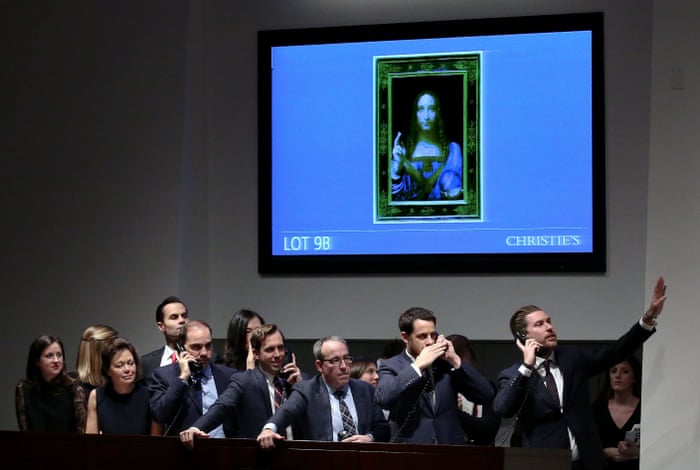
Record sum …
excitement at Christie’s New York as bidding neared its end on 15
November last year. Photograph: Peter Foley/EPA-EFE/Rex/Shutterstock
"Nobody outside the immediate Arab hierarchy knows where it [the restored and authenticated and auctioned painting] is." "The mystery of its location is, of course, disturbing." Martin Kemp, art historian, authenticator
"It
was a very intense picture and I felt a whole slipstream of artistry
and genius and some sort of otherworldliness that I'll never experience
again." Dianne Dwyer Modestini, art restoration specialist
"[Salvator Mundi is] a painting of the most iconic figure in the world by the most important artist of all time." Loic Gouzer, Christie's auctioneer
"[The painting known as the male Mona Lisa represents the] Holy Grail of Old Master Paintings." "[Its sale is] as close as I've come to an art world miracle." Alan Wintermute, Christie's auctioneer
Quite the art world miracle that is. That the greatest of all Western
European artists' rendition of his vision of Christ is hidden from the
public, hidden from the world of art, spirited away by a ruler of one of
the most fundamentalist Islamist countries of the world, to enjoy an
unparalleled masterpiece depicting Christ, the most sacred figure in
Christianity, depriving a Christian audience of ever contemplating its
message as well as the splendour of that Old Master's superb genius.
The painting itself took a mysterious, circuitous, almost anonymous
route to its current notoriety. It was said to have been owned by the
17th century English King Charles I, from its earlier presence in the
French royal court. In a private collection since 1900 in England, it
made its way to the ownership of a Catholic choir master in Baton Rouge,
La.., Basil Clovis Hendry, who inherited it from his aunt and uncle who
had bought it for $45 in 1958, to complement their collection of
European paintings.
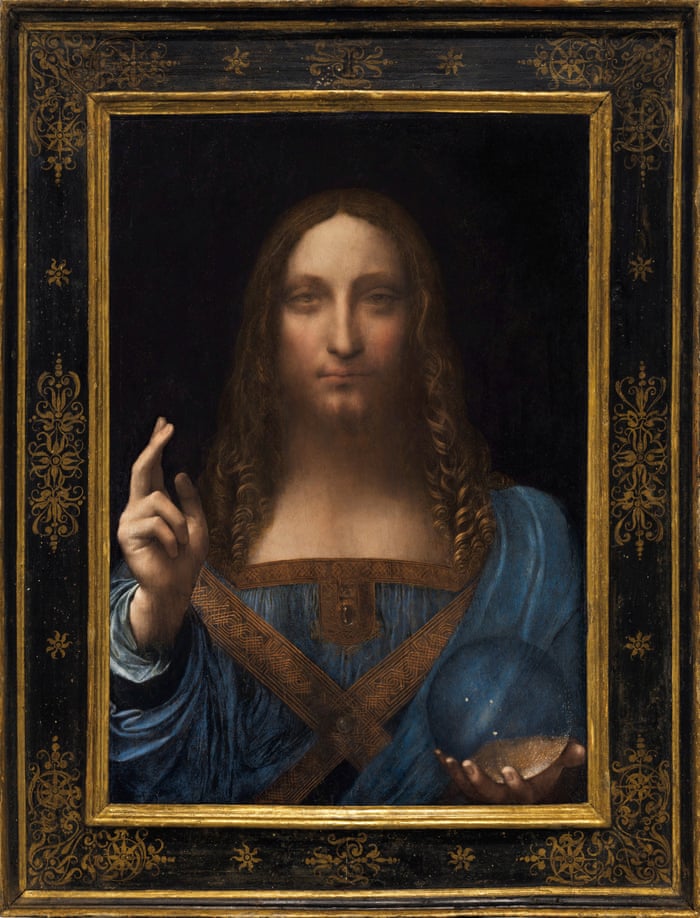
Salvator Mundi before it was sold at Christie’s in 2017 GETTY IMAGES Salvator Mundi vanished after it was sold last year for $450 million. There are fears for its safety
They had thought the painting was executed by a minor follower of the
Master da Vinci, Giovanni Voltraffio. Hendry's daughter, after her
father's death in 2004 sold it for a few thousand dollars; no one ever
suspecting it might actually be an authentic da Vinci painting. The
painting was bought by two art dealers for less than $10,000 at the
estate sale in New Orleans featuring Hendry's possessions. The art
dealers, Robert Simon and Alexander Parrish, commissioned art restorer
Dianne Dwyer Modestini to work on the badly neglected painting (a controversy all of its own).
Later, experts in London were shown the painting and "signs of Leonardo's magic asserted themselves",
as the painting gained recognition as a genuine work from the hand of
the master. England's National Gallery, after authenticating the
painting, showed it there in 2011. Following which the two art dealers
sold the painting to a Russian billionaire, Dmitry Ryboloviev through a
Swiss art dealer When Ryboloviev decided to put the painting up for
auction in New York, the bidding was fierce with Christie's announcing a
sale price of $400 million and an additional $50 million in fees.
The successful bidder was a Saudi prince acting for Mohammed bin Salmon,
Saudi Arabia's Crown Prince who later elevated the bidder to head the
Saudi culture ministry. Yet another Saudi prince, MOhammed Bin Zayed,
Crown Prince of Abu Dhabi had been competing for the painting, though
each never knew the identity of the leading bidders. Their bidding
rivalry succeeded in driving up the price well beyond its estimated high
bid, one tenth of the successful bid.
So this iconic painting by the most famous artist of all-time recorded
history, who had executed a superb image of the most celebrated,
honoured and venerated religious figure of all time is now in the hands
of an Islamist Kingdom, out of eyesight, much less knowledge of the
whereabouts of this priceless sacred icon.
Excessive restoration? … how the work looked at auction, when it became the world’s most expensive painting.
"I felt that among all the possible exhibitions, this would be a particular priority." "Oftentimes, there is a lack of knowledge about and comprehension of other cultures, especially Islamic culture." "There are tensions that come out of the present day, on both sides." Eike Schmidt, director, Uffizi Gallery, Florence, Italy
"For us, Islam is nothing new; it's a culture that we know well." "Florence has had an uninterrupted relationship with the Islamic worlds from at least 1400 to the present day." Giovanni Curatola, professor of Islamic art and archeology, University of Udine
"[The Florence exhibition] helps Italians understand that Islam is not something attributed to primitive and illiterate people, but a great civilization that had relations with Italy." "It also gives Muslims in Italy a reason to be proud, and a sense of belonging." Stefano Allievi, professor of sociology, University of Padua
Quite obviously the academic and arts community of professionals in Italy do not share their current government's attitude toward the flooding of the country's islands as an entry to Europe of countless Muslim refugees, many of whom, if not most, are anxious to escape the chaotic violence, repression, oppression, persecution, conflicts, insecurity, threats and economic instability of their Muslim-governed countries of birth and residence. So much for the great heritage of Islam trickling down to the present day.
Islam is basically a tribal religion, one that foisted itself on the Middle East, Southeast Asia, North Africa and parts of Europe, including parts of Spain, Portugal and of Italy, until Christianity reasserted itself and transported Europe back into the realm of its Christian heritage. Al Andalus is the Muslim cry of agony over its loss of the splendour of its occupation of Spain; Muslim scholars and clerics deplore that loss, convinced it is but a matter of time before Islam once again reasserts itself to its lost place in Europe.
From how things stand at present, through generations of immigration, in Germany and elsewhere as cheap, temporary labour, Islam has managed to infiltrate most of western Europe and the north, more latterly as refugees, while eastern Europe has been firmly closing its borders to the entry of Muslims viewing them in the harsh reality of deliberate displacers of the prevailing religion of Christianity, as well as importing the culture, values, laws and ideology of Islam in a slow but steady conversion of European culture and values and laws.
The golden age of Islam during its occupation of Europe did see an explosion of vibrant art and architecture, scientific invention including the rise of complex mathematics and astronomy, and then that brilliant flash of genius appears to have evaporated, leaving behind the richness of its invention for posterity. In the wake of which Islamic progress fossilized and the ideology festered focusing on the acceleration of conquest, arrested by the European push-back and exiling of Muslims until the current era.
Islam has ossified into its original structure and purpose, as an invading violent force of conquest. From Islamic scholarship in mathematical theory, geometry and optics along with artistic representation of exquisite beauty what is left is a primitive, medieval mindset and a tribal savagery that has decimated its populations from Syria, Iraq, Iran and Lebanon onward to North Africa in Sudan, Somalia, Mali and elsewhere. Where fundamentalist Islamists have regenerated slavery and the brutalization of minorities, ethnic groups and other religions as unworthy of existence.
Gentile de Fabriano’s gold-encrusted 1423
“Adoration of the Magi” altarpiece features Arabic script on the Virgin
Mary’s and Saint Joseph’s haloes(Wikimedia Commons)
Karen James, a member of
the 1972 Canadian Olympic team that travelled to Munich in 2005
remembers the horrific events that unfolded there, very well. She was
among the athletes who had returned late at night to the Olympic
Village. Who chose, instead of taking the long hike to the entrance gate
of the village, to scale the surrounding chain-link fence, taking a
short cut that would appeal to young and athletic people, enthused with
where they were, what they were there for, and their acrobatic
capabilities.
They hardly took notice when quite close
by their group another group was doing precisely the same thing,
climbing over the chain link fence behind the Athletes Olympic Village.
Where most competitors were already bedded down for the night.
Particularly those whose competitions would be coming up the following
day. Or those for whom the day had included an exhausting episode of demonstrating their athletic prowess in world competition.
On
that evening of September 5, 1972, a horror took place, an atrocity
that shook the world of sport. Though it did not, in fact, stop the
Games from proceeding once the gore and the bloodshed was done with. The
Games must, after all, go on. Or is that the show must go on? And
wasn't it quite the show? Eight Palestinian terrorists from the Black
September wing of the PLO had set out to demonstrate to the world that
no Israelis were safe anywhere in the world. It was their group of eight
that had clambered over the fence close by the Canadian athletes.
On
entering the building where the Israeli competitors had been
accommodated, the terrorists rounded up the occupants of two apartments,
the Israeli athletes, at 4:30 a.m. There was a struggle as two of the
Israelis fought back against the terrorists, and they were killed, the
other nine taken hostage. Several of the Israelis escaped, and alerted
authorities. By 5:10 police were on the scene. At that point a list of
demands was made public; that 234 prisoners were to be released from
Israeli prisons in exchange for the release of the nine athletes.
One of the eight Palestinian terrorists
comprising the Black September group stands on a balcony of the Olympic
Village during a standoff after they kidnapped nine members of the
Israeli Olympic team and killed two others on Sept. 5, 1972 in Munich. (Getty Images/Stringer)
They soon
demanded two planes be provided to fly them to Egypt. German officials
agreed, but planned to mount an offence to stop the terrorists from
leaving with their hostages. The plan was to storm the building, but it
was a plan that was televised to a shocked and curious world, so that
when the gunmen turned into television, the intentions of the German
officials was revealed to them.
An agreement was reached to transport the terrorists and their hostages to the Furstenfeldbruck
airport by helicopter where the Germans had decided they would seize
the opportunity to confront the terrorists, and stationed snipers at the
airport. Once there, the terrorists noted a trap awaited them, and as
the snipers began shooting, they shot back. The Germans awaited armoured
cars and when they arrived one of the terrorists fled to a helicopter,
shooting four of the hostages, then tossed in a grenade.
Another
terrorist fled to the other helicopter using his machine gun to kill
the last five hostages. German snipers and armoured car personnel killed
three terrorists, and three survived, to be taken into custody. Two
months later the three in custody were released by the government of
Germany when two other Black September terrorists hijacked a plane,
threatening to blow it up if the three weren't released.
The mastermind of this atrocity was a Black September chief by the name of Salah Mesbah Khalaf,
a founder of Black September. He has been immortalized as a martyr. His
face and name appear on the cover of an exhibit called "Invisible"
appearing in the City of Ottawa's Karsh-Masson Gallery at City Hall. The Toronto-based Palestinian-Canadian artist Rehab Nazzal
claims to be reflecting Palestinian cultural history in placing this
man along with other terrorists with blood on their hands on proud
exhibit.
The Ottawa taxpayer is funding this 'art exhibit' whether or not they like it, though deputy city manager Steve Kanellakos
is of the opinion that city politicians should not place themselves in
the business of selecting what art is displayed in the city gallery: "I think it's dangerous when (our personal) opinions can influence what is going to be shown in a public space", he said in response to the Jewish community's protests at the exhibit.
A detail of Rehab Nazzal's wall-sized mosaic of Palestinian
prisoners, in her exhibition Invisible at Karsh-Masson Gallery in Ottawa
city hall. (Photo by Peter Simpson, Ottawa Citizen) Despite an intervention by the Israeli Ambassador to
Canada, clarifying that the exhibit was glorifying terrorism, the city
refused to close down the exhibit and it will run its course to late
June. In the words of Karen James, the Canadian Olympic team member who
recalled clambering over the fence, another group close by doing the
same: "I can ... imagine the outrage that would be generated were the City to host an "art" display memorializing Osama
bin Laden and the 9/11 hijackers. The Munich attacks may have been more
than 40 years ago, but the passage of time does nothing to mitigate the
loss of life and the pain of victims' families. "We
all embrace freedom of expression. Indeed it is one of the values that
make Canada the envy of much of the world. But the glorification of
murderers is something that no taxpayer should be forced to subsidize,
let alone host at our public institutions."
Join the Protest Against Photo Exhibit Glorifying Terrorism
Join the Protest Against Photo Exhibit Glorifying Terrorism
July 3, 2013 9:00by Simon Plosker
Last month HonestReporting condemned the Jeu de Paume museum
of contemporary art in Paris for displaying a photographic exhibit that
glorifies Palestinian terrorists. This “art” exhibit refers to Israel
as a “colonial power” and Palestinian terrorists as “fighters” and
“victims of the Israeli military.” Suicide bombers are referred to as
“militants” who heroically set out to “assassinate Israelis.”
Our critique generated a deluge of complaints to the museum. The Jeu
de Paume’s response was utterly inadequate. The museum explains that the
following text has been added in the exhibition rooms:
“To avoid misunderstandings, the
Jeu de Paume wishes to make it clear that the artist Ahlam Shibli’s
series Death, a work centered on images, is neither propaganda nor an
apology for terrorism. As the artist herself explains: “I am not a
militant. My work is to show, not to denounce or to judge.”
Death explores the way in which
dead or imprisoned Palestinians –“martyrs,” according to the term that
Ahlam Shibli reuses – are represented in public and private spaces
(posters and graffiti in the streets, inscriptions on tombs, shrines and
mementos inside homes, etc.), thereby regaining a presence in their
community.
All of the photographs in this series are accompanied by captions written by the artist that are inseparable from the images.”
So the museum claims that the exhibit is “neither propaganda nor an
apology for terrorism” while the artist claims not to be a “militant.”
At the same time, the artist refers to the dead terrorists as “martyrs”
while the museum ducks the issue by saying that the term is simply being
“reused” by the artist.
Is it possible to be non-judgmental when referring to members of a terror organization as “martyrs?” We don’t think so.
Does the Jeu de Paume really believe that this “disclaimer” absolves
it from responsibility for the message that this exhibit promotes?
SIGN THE PETITION
This exhibition is running until September 1, 2013. It’s not too late
to make a protest to both the Jeu de Paume museum and the French
Ministry of Culture and Communications that is responsible for
overseeing museums.
Sign the petition below and we will deliver the names.
We believe that the Jeu de Paume’s exhibition of 68 photos
entitled “Death” by Ahlam Shibli glorifies Palestinian terrorists and
call for its removal from the museum and the end of public subsidies to
the museum as long as these photos remain exhibited.
* Your privacy is important to us, and
your first and last name only will be added to this petition. We will
update you by email with developments on this story and other
honestreporting alerts. Please ensure action@honestreporting is added to
your safe-recipients list.
Infamously, Nazi Germany, while on the rampage to destroy all vestiges of European democracy, along with its intention to annihilate all human beings who had the misfortune of having Jewish ancestry, busied itself also in expropriating, lifting, acquiring, appropriating, stealing, valuable art works from various sources. From sources such as the museums and galleries of other countries they occupied and from private collections of undeserving art lovers, such as Jews - destined for mass murder, in any event.
Since the end of World War II, and the very public knowledge of the pains the Fascists went to, to rid Europe of its Jews through the planned and quite successful Holocaust, Germany officially rid of fascism and extremism has made strenuous efforts to redeem itself, to make amends, to secure itself back into the good graces of the international community. As a country and a nation deserving of taking an honoured place among its peers.
In the process it has indeed succeeded in putting its blemished past behind. A country that had once indulged in the most massive-scale invasions of other nations, confiscating their national authority in place of its own, netting and gathering its Jewish populations for transport to death camps, absorbing estimable items of historical and cultural value for its own displays, Germany has admitted its dreadful past, disowned it and become a trusted ally of those it once occupied and dominated.
At the initiation of WWII, Germany and Russia were allies; fascist Germany and the communist USSR, part of the Axis that included Italy, Japan and more minor countries like Iran, Finland, Hungary and Romania. But then there was a falling-out between Stalin and Hitler. And Nazi Germany sought to invade Communist Russia. It failed, but in the attempt it did manage to loot a Berlin museum of its priceless artefacts from the European Bronze Age.
The Hermitage Museum, St. Petersburg, Russia
"I think this is a very sensitive question... So if we want any progress, we should not blow the problem out of proportion but seek ways to solve it. Probably we should not start a discussion now because people will appear on the Russian side who would evaluate the damage done to our art during World War Two." Russian President Vladimir Putin
Germany, at a time when it has made good on its promises to return looted art to its true owners -- and at a time when museums all over the world have become sensitive to having deprived nations of their ancestral artefacts when in the 19th Century and before it was common for militaries like that of Napoleon's entering Egypt to destroy and to loot ancient treasures, as was also done by envoys, diplomats and entrepreneurs, finally returning ill-gotten treasures -- would appreciate reciprocation.
Angela Merkel, Germany's chancellor, had scheduled a joint news conference with the Russian president on the occasion of both appearing in St. Petersburg to open an exhibition at the Hermitage. An exhibition that includes a hoard of 821 ancient gold pieces: plates, rings and ornate bowls. Called the Eberswalde Hoard, the treasures were discovered by in an excavation east of Berlin in 1913.
Chancellor Merkel had planned to appeal to the Kremlin for the return of the art - reflecting international law. Germany has requested its return for decades. Russia has declined the requests, considering them to represent just and due reparations for the damage inflicted during Hitler's military invasion of the Soviet Union.
"I like the idea of showing the other side of the coin. We are talking about a diverse world that goes from the Atlantic, Spain and Morocco to India. It brings complexity. "We are suffering from simplistic views on the Islamic world. (Some) would make us believe that there is just one Islam, which is just not true." Sophie Makartou, head, Islamic Art Department, Louvre
It is by no means representative of a new initiative. It has been eleven years in the making. But the Islamic Art department of the Louvre has now been completed and opened to public view. One might imagine that the representative treasures, objects of art and a culture that has now long passed, although the religion that inspired it is still with the world, as the second largest religion by adherents in the world, might reflect the best in that religion.
It doubtless does. But it does not reflect the history of the religion, its birth as a Bedouin-inspired desert faith torn by tribal and sectarian animosities, the historical blight of assassinations and bloody wars of conquest in a prodigious effort to expand relentlessly in as wide a geographic swoop as possible in the name of Islam, during which time the conquered peoples were forcibly turned to this religion, to forswear their own, or pay endless taxes to be permitted to survive. The Louvre Museum in Paris, France, is described as one of the
largest museums and the most-visited museum in the world. It is a
one-time fortress and palace. It houses 380,000 objects and has 15 acres
of display space. (Bob Downing/Akron Beacon Journal/MCT)
That, of course, is history. The art in and of itself is a magnificent reflection of the minds that were taken in celebration of their faith, to praise it with works of human ingenuity in architectural brilliance and decorative arts the equal of any produced by any other culture, theistically-inspired or not. The legacy of that art on later art produced by the geographies that freed themselves of Islamic control enriched their heritage as well.
The richness of the art represented in the Louvre's new exhibition hall represents 18,000 artifacts, dated between the 7th Century to the 19th. Among the wonderful pieces of artistic brilliance demonstrating the evolution of Islamic art are depictions of the Prophet Mohammad. "I think Muslims will be shocked", mused a historical constant for the Louvre.
"We felt we had to use them, to illustrate (Islamic) history the way we see it", she said. That consultant, Charlotte Maury stated that Mohammad's face was not available for public view after the 1600s, no longer depicted in public art beginning in the 15th Century, a time when Muslim scholars of the day decided it would represent a more respectful worship of the Prophet's time in history if his face remained mysteriously absent.
For, it was pointed out, the Koran has no prohibition specifically denying depictions of the man whose historical vision brought Islam into being. Despite which, some of the consultants whose opinion the Louvre seeks out feel that some Muslims might be "shocked" by images of Mohammad with his face exposed, appearing in the newly opened wing.
Those Muslims who would be "shocked" would of course, react in the usual manner, blindly shrieking blasphemy and cursing those who bring indignity to the central figure in their religion. That to do so represents forbidden idolatry would be a cautionary sentiment perhaps foreign to them; more to the point would be their assertion quite simply that it is forbidden and to do otherwise is to commit an unforgivable assault on Islamic values.
The display in all its meritricious artistic grandeur will represent yet another offence that non-believers have yet again perpetrated upon long-suffering and devout followers of Islam. Whose duty most surely is interpreted by the pious clergy who impress upon their flock the dire necessity to react with outrage and to embark on yet another rampage, this time stamping rage on the Fleur de Lis.
This represents a general opinion site for its author. It also offers a space for the author to record her experiences and perceptions,both personal and public. This is rendered obvious by the content contained in the blog, but the space is here inviting me to write. And so I do.





:focal(949x645:950x646)/https://public-media.smithsonianmag.com/filer/a5/1f/a51f83ee-41fb-4bbf-bfb1-366410faff7e/746px-gentile_da_fabriano_adoration.jpg)


