"[Moscow] can choose the path of diplomacy that can lead to peace and security, or the path that will lead only to conflict, severe consequences and international condemnation."
U.S. Secretary of State Antony Blinken
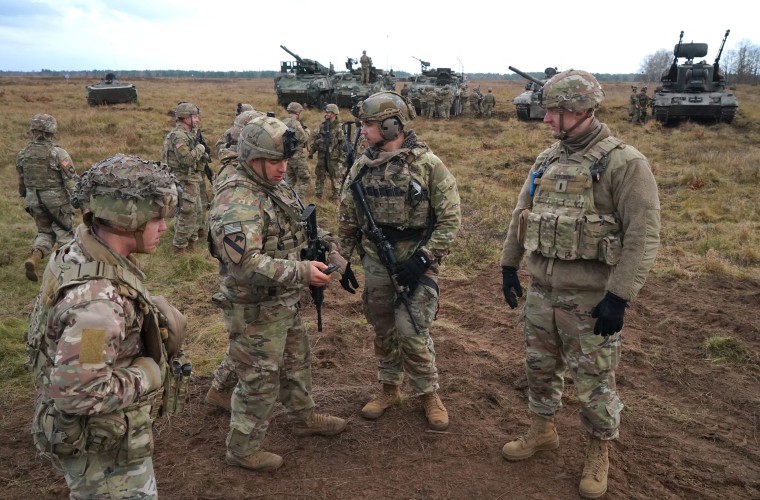
Soldiers
from Poland, Britain, US and Romania take part in a joint military
exercise at the military training ground in Bemowo Piskie on Nov. 18,
2021.Janek Skarzynski / AFP via Getty Images
Berlin denied reports circulating that its new Chancellor Olaf Scholz had chosen to turn down an invitation for a face-to-face meeting with President Biden for the purpose of discussing Ukraine. Yet another symptom of divisions expanding within NATO over the best way to respond to the assumed threat of an impending Russian invasion of its neighbour. A short-notice invitation from the White House for the German chancellor to fly to Washington was reported by Der Spiegel.
Since both the White House and the Chancellor's office deny the claim, curious onlookers and troubled partners in NATO must take that at face value even while the report threatens Western unity is being undermined in the wake of diplomats from Russia and the United States having failed to come to any semblance of an agreement reflecting a breakthrough on emergency talks in Geneva.
Russia would face a "swift, severe" response should it invade Ukraine, admonished U.S Secretary of State Antony Blinken. Not to be outdone, Russian Foreign Minister Sergei Lavrov spoke of Moscow awaiting a written response to its security guarantee demands. Both remain open to further dialogue in the hope that mutual security concerns could be addressed to the satisfaction of each.
In view of the reality that each has made demands the other cannot accept, appears an irrelevancy to the cycle of consultations. Russia insists unreservedly that all foreign NATO forces must leave Romania and Bulgaria, both of which have been members of the alliance since 2014. Romania's contiguous border with Ukraine makes the Kremlin edgy. Both Romania and Bulgaria have coastlines on the Black Sea, critical to the deterrence of a Russian operation in south Ukraine.
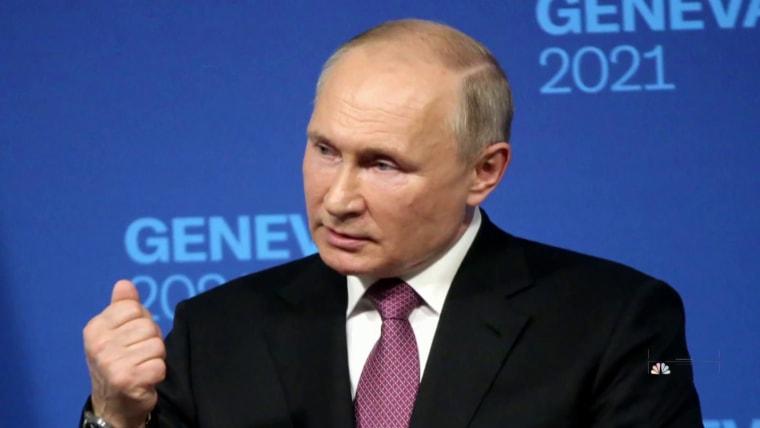
Biden and Putin hold high-stakes phone call over Ukraine still from video
Ukraine has the assurance that the United States, the United Kingdom and most of Europe threaten severe economic sanctions. Military action in the face of an attack? Hmmn, not quite. Ukraine's requests to Germany for military assistance is a non-starter. And Germany is not particularly on the same page as the U.S., U.K. and Ukraine when it comes to cancelling its Nord Stream 2 pipeline to pump gas from Russia, should war erupt.
Leaving Ukraine to accuse Germany of blocking arms supplies through NATO on an earlier occasion. It doesn't appear to have helped that CIA director William Burns arrived in Berlin to present evidence to Chancellor Scholz of a Russian military buildup. Nor Blinken informing Scholz to back sanctions should he continue to block arms deliveries to Ukraine.
As for France, President Emmanuel Macron was accused of blindsiding his allies in sabotaging efforts in containment when he informed the European parliament the EU should launch its own security dialogue with Russia. Paris and Berlin, according to Le Monde, are "perplexed" by the "alarmist" tone emanating from Washington and London respecting Russian troop deployments.
So to the rescue for Ukraine through the defence ministers of Estonia, Latvia and Lithuania assuring Ukraine they will provide it in its time of need with U.S.-made anti-armour and anti-aircraft missiles, having secured the go-ahead from the U.S.. "Estonia, Latvia and Lithuania and their allies are working together expeditiously to hand over the security assistance to Ukraine", they communicated in a joint statement.
With Estonia to provide Javelin anti-armour missiles and Latvia and Lithuania to send Stinger anti-aircraft missiles to augment Britain's airlifting of anti-tank weapons to Ukraine earlier in the week in response to Vladimir Putin's threat of "military-technical" measures to be taken should the West not deliver on its demands, inclusive of Ukraine never permitted to join NATO.
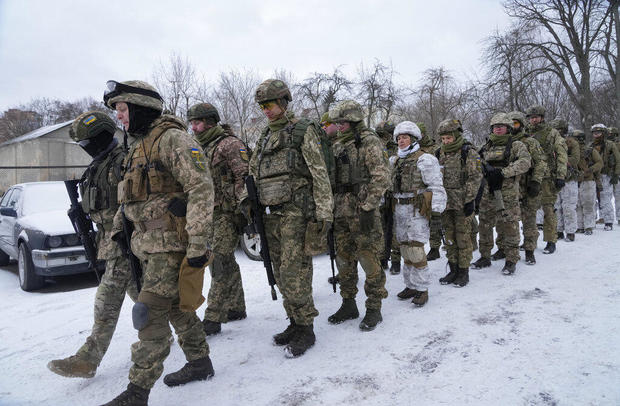
Members
of Ukraine's Territorial Defense Forces, volunteer military units of
the Armed Forces, train in a city park in Kyiv, Ukraine, on January 22,
2022.
Efrem Lukatsky/AP
"We
don't know whether President [Vladimir] Putin has made the decision to
invade. We do know that he is putting in place the capacity to do so on
short order should he so decide."
"Should
Russia follow the path of confrontation, when it comes to Ukraine,
we've made clear that we will respond resolutely including with a range
of high impact economic measures that we have refrained from pursuing in
the past."
U.S. Secretary of State Antony Blinken
"Our recent warnings have indeed been heard and are having a certain effect: tensions have risen there [NATO-U.S.]."
"It
is important for them to remain in this state for as long as possible,
so that it does not occur to them to stage some kind of conflict on our
western frontiers that we do not need."
Russian President Vladimir Putin
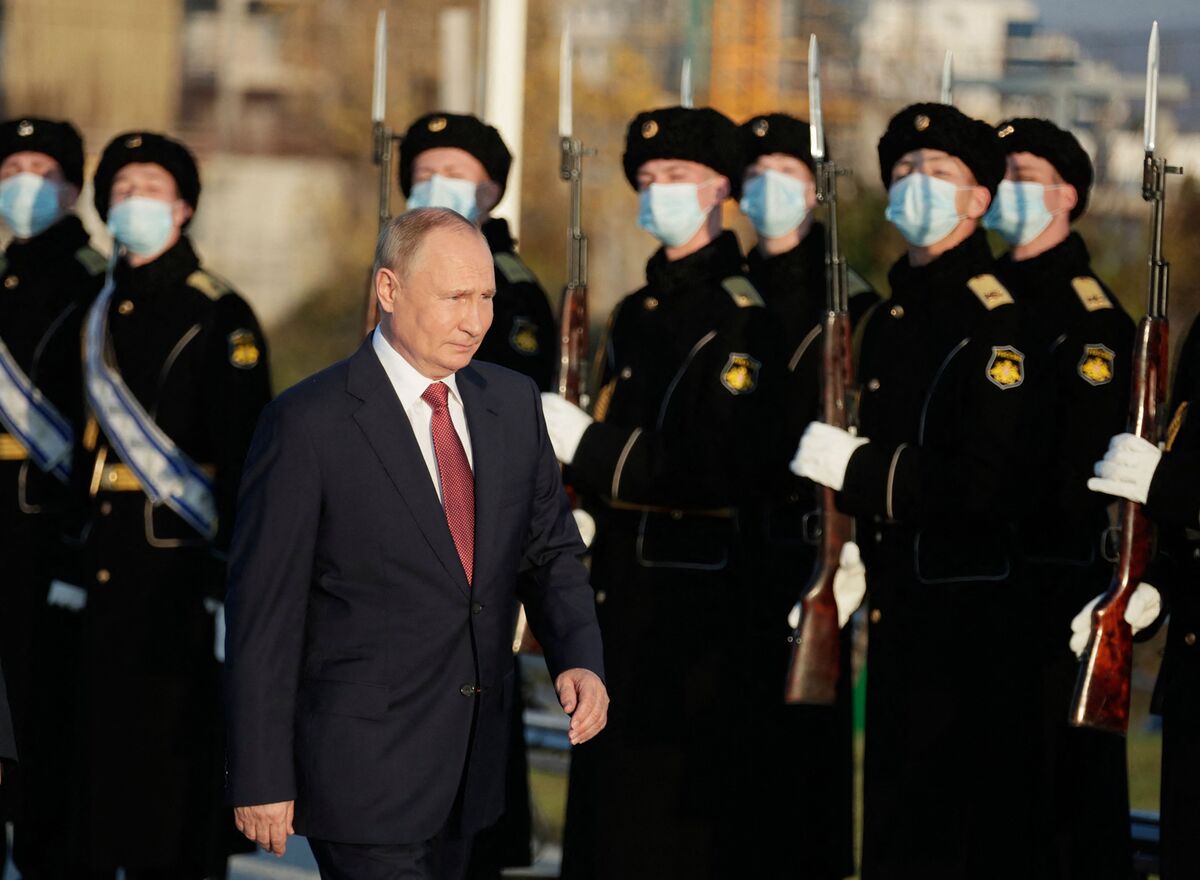
Vladimir Putin Photographer: Mikhail Metzel/AFP/Getty Images
"I would like again to officially state that Ukraine does not plan any military offensive in Donbass."
"This is Russian propaganda nonsense in order to cover up Russia's own preparations for a potential attack."
Ukrainian Foreign Minister Dmytro Kuleba
"[Stability
and predictability mean] less American meddling in our domestic
affairs, with less attempts by the U.S. to limit our completely legal
and legitimate interaction with our friends, allies and partners all
over the globe."
Sergey A. Ryabkov, Russian Deputy Foreign Minister
Mr. Putin's end game: for Asta Skaisgiryte, foreign policy adviser to Lithuania's president, there is a simple answer: "To restore the Soviet Union".
That's a given. Well enough understood by Mr. Putin's statement of
profound regret that Greater Russia is simply that, no longer the Soviet
Union, its hegemonic tentacles tightly gripping its neighbours'
sovereignty as Moscow's own. Time and the tides provides no answer for
Mr. Putin for he plans his legacy as the restorer of what once was; if
subtle persuasion won't do it, violent aggression will.
For
Mr. Putin, Russia's near-abroad is Russian hegemonic territory. The
encroaching presence of NATO in support of Baltic states cringing at the
very prospect of once again being caught in a Soviet-style ambit
represents their living nightmare. That they have the support of the
United States extending to NATO and its member-states is their assurance
that they won't go into that dark night of Russia's grasp whimpering
helplessly. They have Western champions.
To
the Kremlin, to Mr. Putin, the presence of Western troops under the
NATO aegis in Russia's area of disputed control is a major threat. They
have no business in eastern Europe, it is Russia's bailiwick. And if
Russia feels like reminding its neighbours of how good their lives were
once as part and parcel of the USSR, that's Russia's business. The
buildup of Russian troops beside Ukraine is a statement of regional
power, not defiance, but a promise of what could unfold and may yet.
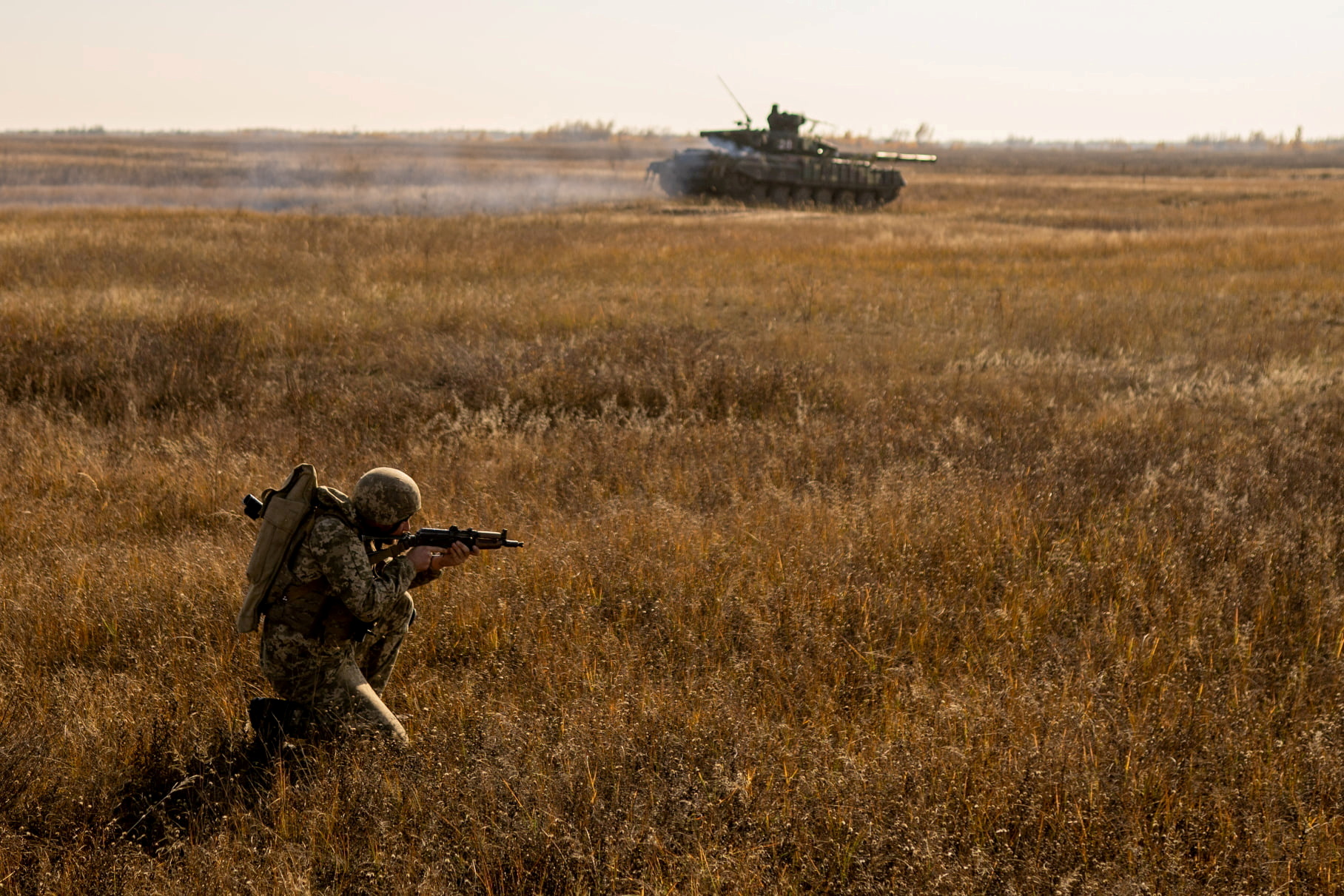
A serviceman of the Ukrainian Armed Forces takes part in military drills
at a training ground near the border with Russian-annexed Crimea in
Kherson region, Ukraine, in this handout picture released by the General
Staff of the Armed Forces of Ukraine press service November 17, 2021. via REUTERS
The
volatile situation is not Russia's fault but that of NATO and the
United States daring Russia to take another step further to claim its
historical patrimony. From the Baltic to the Black Sea competition for
influence amidst a threat of an emerging potential for military conflict
is seething. Russian long-range nuclear bombers flew patrols repeatedly
near the border of the European Union with Poland. Leaving Western
intelligence warning the Kremlin could be planing groundwork for another
invasion of Ukraine.
Last
month Mr. Putin made clear his use of the Russian military to bring the
West to a respectful attitude toward Russian interests in the region,
and succeeding. It is now known in the Western halls of power that
Russia is serious it will defend its 'red lines'; NATO has no business
being present near its borders. The Belarusian gambit of creating
friction by massing Syrian refugees on the border with Poland as
punishment for the EU's interference in the after-effects of the Belarus
election is generally viewed as another irritation engineered by Mr.
Putin. Ditto the energy crunch in supplying natural gas to Western
Europe.
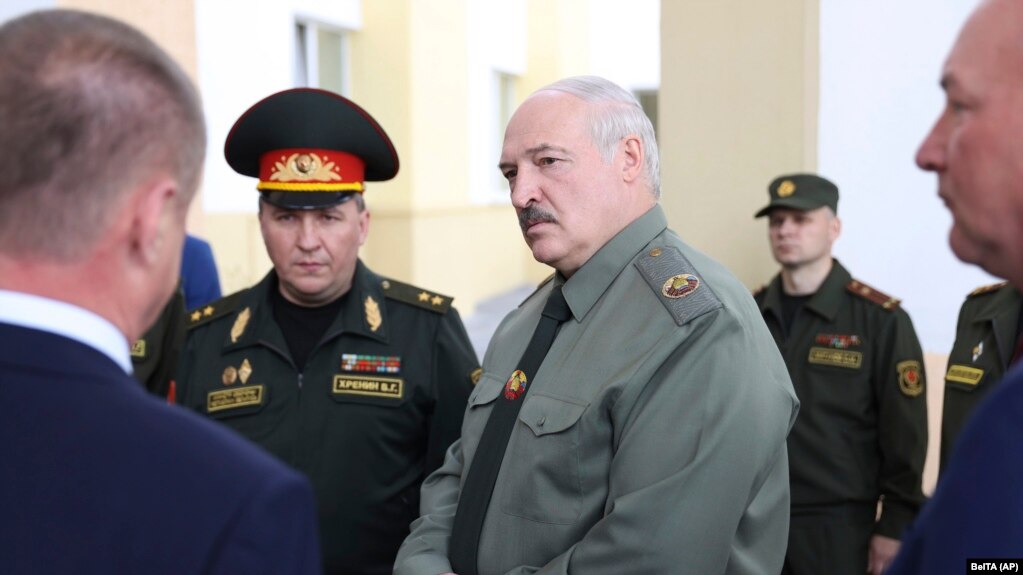
Belarusian
President Alyaksandr Lukashenka (center) attends a meeting on
territorial defense issues in the town of Shklov in June with Defense
Minister Viktar Khrenin (left).
Despite
repelling challenges to his presidency from opposition groups,
imprisoning those whose campaigns prove too inconvenient as an
alternative to assassination or forcing others into exile, Mr. Putin
rests easy in an approval rating above 60 percent, making him
indisputably a more popular leader than most Western-based leaders.
Russia may be suffering a dreadful COVID toll, but the
United Russia party saw victory in its September parliamentary
elections, and Mr. Putin has established himself as President-for-life.
Changing the country's constitution proved so popular that other
dictators have followed suit.
It
is, however, the possibility that the West will continue its incursion,
expanding a military presence in post-Soviet Eastern Europe where
Latvia, Estonia and Lithuania have become NATO members satisfied with
their bonus of hosting Western troops; too close for Mr. Putin's
comfort. In September the Kremlin stated that the "broadening of NATO infrastructure on Ukrainian territory" would
cross one of Russia's red lines. Recent military activity by the U.S.
and its NATO allies in the Black Sea region near Ukraine has served to
further infuriate Russia.
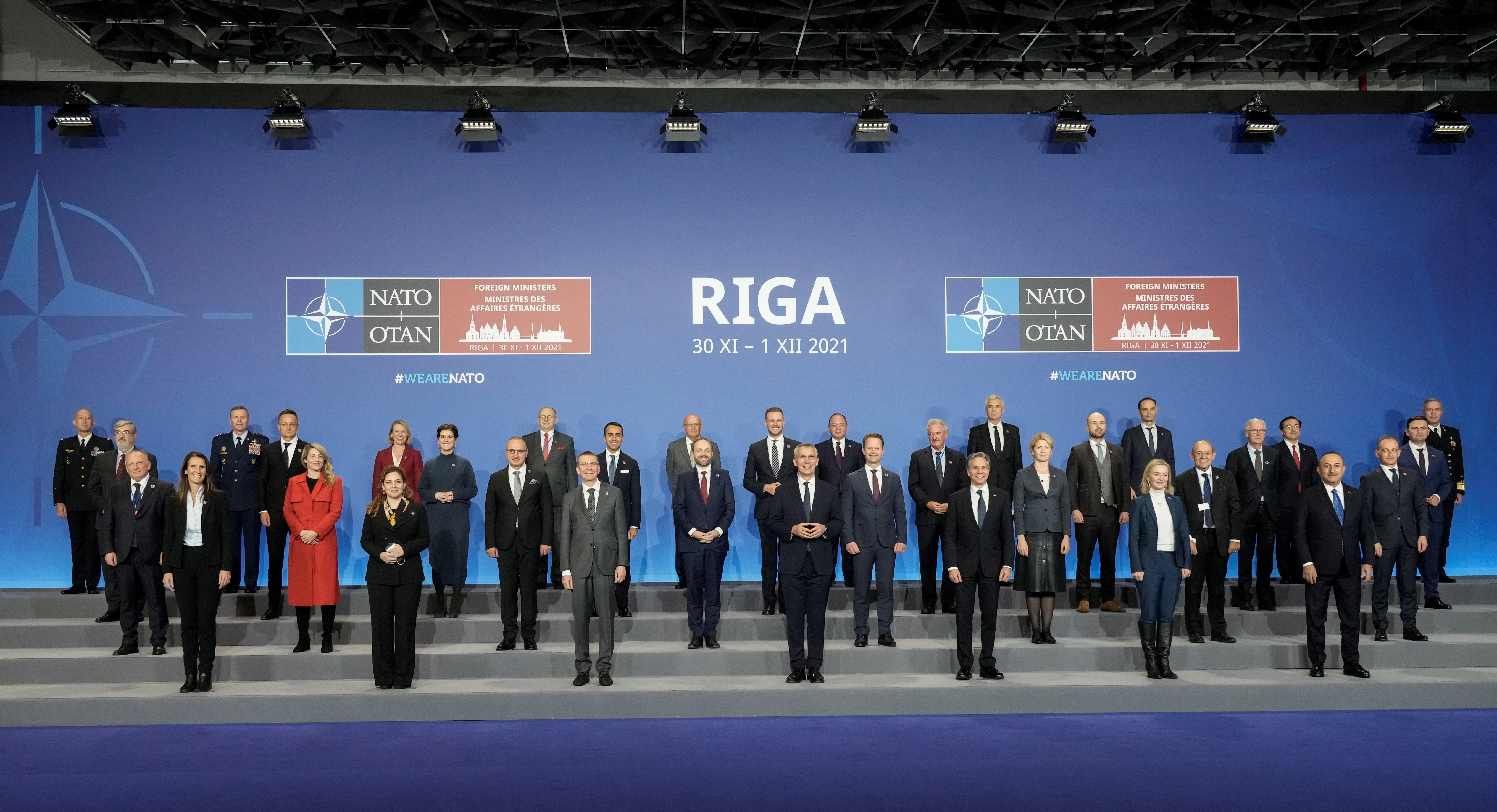
NATO Secretary General Jens Stoltenberg poses with foreign ministers for
a family photo during a NATO Foreign Ministers summit in Riga, Latvia
November 30, 2021. REUTERS/Ints Kalnins
"President Putin has come to the conclusion that normal diplomatic channels, means, forms and methods are not working."
"The situation is, potentially, a rather bad one."
Dmitri Trenin, head, Carnegie Moscow Center think tank
"We cannot calmly look on at how people are going to these places to
hold rallies, with the same flags under which fascists organized the
murders of Belarusians, Russians, Jews and others." "We cannot allow this, and I categorically warn that if order and
calm is disturbed in these places, you will not be dealing with the
police, but the army."Belarus Defence Minister, Viktor Khrenin
"It seems ... she [Belarus opposition leader Sviatlana Tsikhanouskaya] has started to make political statements, harsh ones, demanding walkouts, strikes, protests."Sergei Lavrov, Russian Foreign Minister
"I am proud my nation heeded the call and came here to encourage Belarus." "We are not indifferent, and we will never be indifferent." Lithuanian President Gitanas Nauseda
"Navalny will survive poison attack, but be incapacitated for months as a politician." "If he gets through this unharmed, which we all hope, then he'll certainly be out of the political arena for at least one, two months."Jaka Bizili, founder, Cinema for Peace Foundation
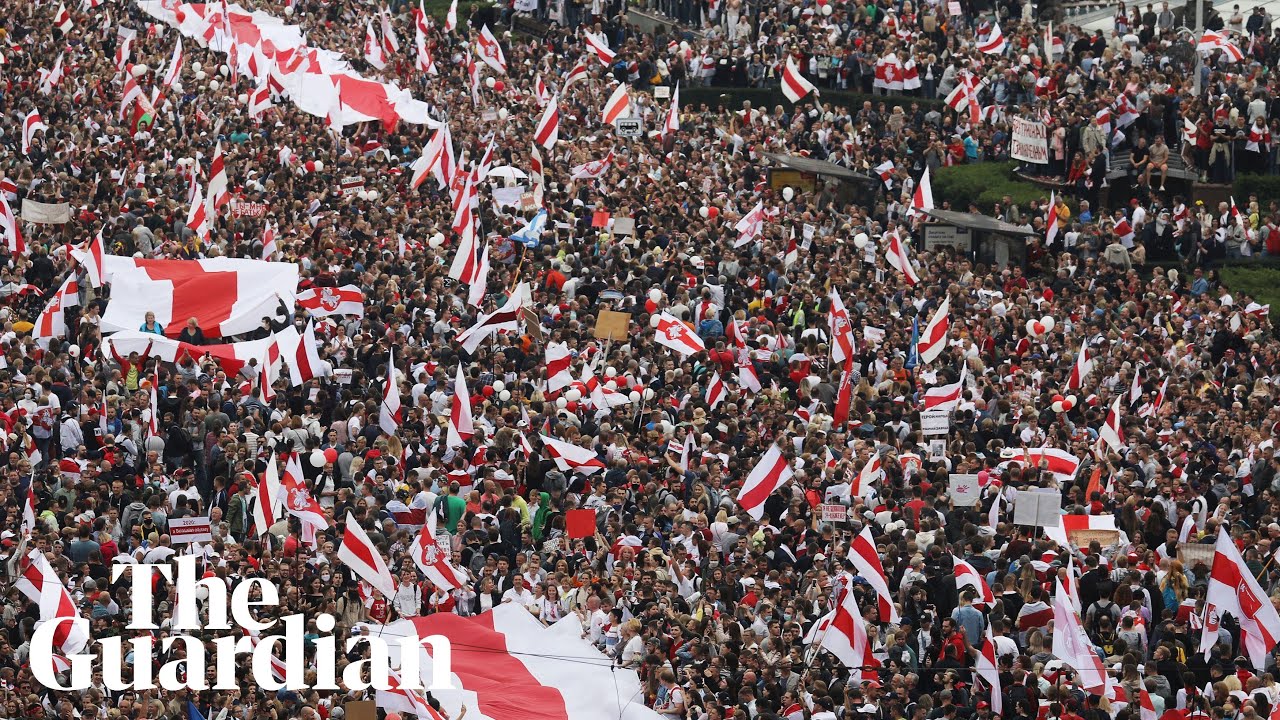
Belarus: tens of thousands of protesters flood Minsk for second week
Belarusians, it seems, feel they've been governed long enough by their leader Alexander Lukashenko after 26 years in office, urging him to vacate the presidency in favour of a more trustworthy opposition leader who, under threats, has taken refuge in neighbourly Lithuania, whose population is in complete sympathy with Belarusians. According to Mr. Lukashenko, the protesters are 'rats' and as such clearly beneath his notice, other than to promise that the fate designated for rats could be extended for them.
President Lukashenko has ruled Belarus for 26 years.Credit...Sergei Gapon
And he is serious, as can be seen in his donning of body armour, grasping a rifle as huge nationwide demonstrations caused by a disputed August 9 election widely held to have been interfered with guarantee that the population has little intention of accepting the same old. Minsk streets have become an outraged symphony of red and white with flags carried by demonstrators in their opposition to Lukashenko, chanting for him to exit and for a new election to be arranged.
A crowd estimated at 200,000 rallied in central Minsk, the second such protester-dense demonstration of just how unloved the people of Belarus feel toward their Soviet-era ruler of long standing. "They have scattered like rats", sneered Lukashenko as the crowed began dispersing in the early evening. The "landslide" election victory of August 9 has created a landslide of negativity toward the man who, like his mentor Vladimir Putin, feels entitled to govern in perpetuity.
Official Russia is quite displeased at this show of ingratitude by an ignorant public. The Kremlin knows how to deal with its opposition, which shines a spotlight of wisdom on Ms. Tsikhanouskaya's decision to flee Belarus for Lithuania for the time being, out of reach of recriminations for her lack of loyalty to the enduring president, taking her cue from Kremlin critic Alexei Navalny's current condition under close scrutiny in hospital post-poisoning.
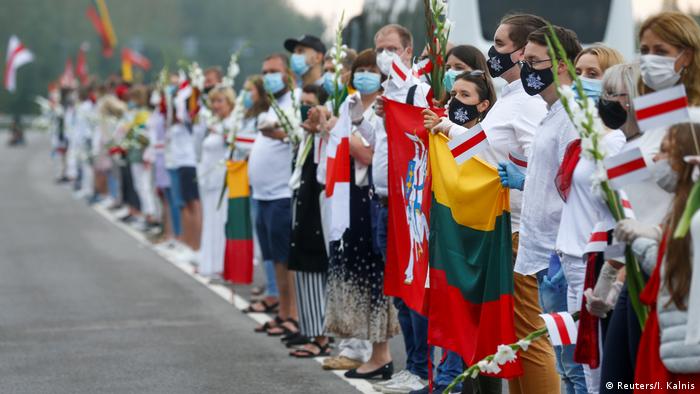
And protests are not only taking place in Belarus; in sympathetic support, Lithuanians demonstrated their own version of condemning and rejecting a dictatorship by forming a human chain from central Vilnius to the Belarus border on Sunday -- 35,000 Lithuanians stretching 34 kilometres in solidarity with their neighbours.
Thousands formed a human chain on Sunday in Lithuania, in a display of
solidarity with protesters in Belarus on the 31st anniversary of the
famous Baltic Way protest.
"Over 40 new intercontinental ballistic missiles capable of penetrating any, even the most technologically advanced missile defence systems, will join the nuclear forces in the current year." Russian President Vladimir Putin
Vladimir Putin and Defence Minister Sergei Shoigu arrive for the opening
of the Army-2015 international military forum in Kubinka, outside
Moscow
"I believe the [US] statement must be looked at together with other similar statements, which have recently been numerous." "A
few days ago, reports started to turn up about certain [American]
missiles put in a certain location and about certain ammunition depots
in Eastern European countries and the Baltic. It looks like our colleagues from NATO member states are pushing us into an arms race." Russia's deputy defence minister Anatoly Antonov
Russian defence ministry official General Yuri Yakubov stated earlier in the week
that US proposals to build up an allied army on Polish soil would be
"the most aggressive step by the Pentagon and NATO since the Cold War. Russia
will have no option but to build up its forces and resources on the
Western strategic front". Tensions are, if anything, continuing on the rise between Russia and its erstwhile Western allies.
Events moved swiftly enough; from Ukrainians deciding that the Kremlin-centric President they despised being ousted and replaced by the 'people's choice' reflecting a broader Ukrainian move toward the West and shutting the door on closer economic and social-political relations with Russia, to an ethnic Russian-Ukrainian rebellion, partnered with Moscow that resulted in the annexation of the Crimean Peninsula and the later punishing sanctions installed by the West.
The friendly mat extended by NATO and the United States toward closer relations with Russia was just as unceremoniously withdrawn as Vladimir Putin's decision to expand Russian territory into his neighbour's sovereign geography proceeded. The Baltic States, ever fearful of the fierce hugs expressed by a resurgent Russia nostalgic for the glory days of a world power in the USSR, appealed to NATO.
But a 1997 reassurance agreement signed by NATO with Russia agreed there would not be any permanent stationing of Western troops in Eastern Europe.
In light of the ongoing aggressive moves at intimidation of both Eastern and Western Europe states by the Russian bear feeling fairly growly about the 'unfairness' of its situation, NATO has decided to install heavy weapons, equipment and warfighting supplies in Eastern Europe (notably Poland) on a permanent basis, but in the case of an emergency, it would be a revolving, term-limited NATO force that would respond.
The Russian response to the plan has been predictable, Vladimir Putin boasting he could match tank for tank, missile for missile with NATO. At the opening of an arms show west of Moscow, an immense display of armaments showcased Russia's resurging military might in the light of Estonia, Latvia and Lithuania pressing NATO to deploy ground troops permanently to their nations, to deter that bear.
Washington has been duly warned. The deployment of new American weapons near Russian borders would have the effect of producing a dangerous level of instability in Europe. And whose fault would that be? NATO's, naturally. When Mr. Putin spoke at the arms show, vowing to continue arms modernization for Russia, economic plight be damned, he pointed to the Armata tanks claiming them to "have no analogs in the world."
The Russian military is prepared to begin testing its new long-range early warning radar whose intent is to monitor the Western direction. Another is destined to be deployed in the East. The new top priority for the Russian military is the decommissioning of its Soviet-built ICBMs. And to replace them with the more advanced defence systems to modernize Russia's nuclear forces. Look out, world!
But the situation though dire, is not entirely hopeless, after all. Mutual assured destruction intervenes, the acronym known as MAD, quite fittingly, since anyone who would threaten nuclear Armageddon would have to be certifiably lunatic, and no one suggests Mr. Putin is that; merely grandiosely assertive and yearning for past glory. He knows well that to threaten is one thing; to attack quite another in the instance of international forces aligned with NATO deployed in the Baltics being attacked by Russian troops, to trigger a catastrophic response.
Ain't gonna happen. We trust, sincerely.
Russia demonstrates first 'microwave gun' that can disable drones and missiles from up to six miles away at Army-2015 One of the vehicles that can fire Buk missiles (AFP)
Russian generals delegated by their president to express his views met with Washington officials in April, to speak to them of the dangers inherent in further 'interference' in Russian affairs by the West. Supplying weapons to Ukraine is an offence that Moscow cannot abide. If the Kremlin has determined it will continue ensuring that the pro-Russian Ukrainian rebels are well equipped to continue performing at Russia's will, that is a strictly internal affair, an issue that the United States would do well to absorb, evidently.
Russian generals at the meeting were speaking with the president's approval -- Getty images
Russian nationals who were activated in Ukraine can just as readily be prodded into action in Estonia, Latvia and Lithuania, they suggested. Should NATO dream of returning the Crimean Peninsula to Ukraine, it would face actions "forcefully including through the use of nuclear force", impediments to their impractical interference in Russian affairs. Furthermore should it become evident that Kiev has been supplied with weapons that would be viewed as "further encroachment by NATO to the Russian border." From that direct message of intent to the United States, to other messages delivered here and there at seeming random. As though to emphasize the vulnerability of the besieged city of Mariupol, Reuters reported Wednesday that Russia was busy massing rocket launchers, tanks and artillery close to the border with Ukraine. A new offensive in the offing? Impossible, Vladimir Putin insists that the Donetsk and Luhansk separatists are busy with their own rebellion; nothing to do with Russia. Estonia reports a large number of Russian military flights and huge unannounced exercises at the border, with up to 80,000 Russian troops engaged. Estonia experienced a nasty jolt when a security officer was abducted and paraded on Russian TV, as a spy. Lithuania's foreign minister has raised the alarm that Russia was using information warfare and cyber-warfare in an effort to destabilize the region; at the very least, raise hackles and alarums. The government of Finland has been facing aerial harassment by Russian aircraft, and last month released depth charges into their coastal waters when an underwater vessel (submarine?) was detected in the very near vicinity. Airspace violations have repeatedly alarmed Sweden, along with a possible submarine in the Stockholm archipelago. A Russian jet with its transponder switched to off almost collided with a passenger jet over the Baltic.Norway has reported to NATO that it has intercepted 74 Russian warplanes off its coast last year. Norway is now restructuring its military as a reflection of a "new old normal" in memory of the Cold War. Russia plans to station missiles with nuclear capabilities in Kaliningrad on the Baltic, sandwiched between Poland and Lithuania. Poland has plans to build six watch towers on the border with Kaliningrad, accelerating a military modernization project, buying U.S. Patriot missiles.That's all on Russia's 'near abroad'. On the other hand, internally, a propaganda campaign labelling Ukraine in control of fascist fanatics has Russians convinced that whatever their president is doing in Ukraine is precisely what Ukraine needs to save it from itself. The Kremlin is on the way to convincing Hungary, Greece and Cyprus that the West will let them down, but Russia will come to their rescue.More recently, Moscow has announced its latest plans to move nuclear forces into Crimea. Thousands of Russian troops are now assembled at the Ukrainian border, with Mariupol on the menu. Transnistria is a willing accomplice, it seems to its migration from Moldova to become part of Greater Russia, somewhat like Georgia losing Abkhazia and South Ossetia; there but not there, 'protected' by Russian troops.
"It's a great idea ["very high readiness" force of 5,000 ready to deploy in 48 hours] but [if 48 hours advance is all it [NATO offers] it is probably, in terms of the realities, just too late." Estonian President Toomas Hendrik Ilves
"Putin cannot risk shooting down a British plane." "He does not want a war with NATO." Estonian commentator
And nor would NATO particularly look forward to a war with Russia. Vladimir Putin, after all, didn't hesitate to bring up the matter of Russia's nuclear stockpile when he was discussing Moscow's disagreements with Kyiv; how much more thinly veiled a threat than that one? Leaving the Baltic States in an atmosphere of concern over how much NATO countries would be willing to sacrifice to protect their newer members in view of the risk of a nuclear war.
Eurofighter Typhoon’s role in NATO BALTIC AIR POLICING
They are relieved on the other hand, to have NATO's Baltic Air Policing mission in evidence over their skies. Eurofighter jets which make several low passes over Tallinn in Estonia are welcome sights and sounds. They are there to make it evident that NATO is fully cognizant of the fact that it is obliged to look after the sovereignty of any of its members. Should any NATO country be threatened by invasion or conflict, all NATO member states are obligated to come to their defence.
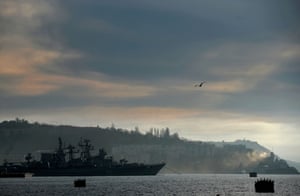
During the days of the Soviet Union stranglehold on Estonia, for example, hundreds of thousands of Russians were encouraged to move to Estonia. The result is that at the present time Estonia is comprised of 24 percent ethnic Russians, many of whom remain the holders of Russian passports. Vladimir Putin has stated more than once how obligated Russia is to the welfare of its people, wherever they happen to live. Speaking darkly of how threatened they are by their countries of residence neglect and other poor treatment. A view of the Russian navy Frigate 'Pytlivyy' docked in the port of Sevastopol. Photograph: Filippo Monteforte /AFP /Getty ImagesIt is one of the contentions that underpin Russia's support for and encouragement of Ukraine's ethnic Russian rebels in their determination to eviscerate Ukraine and which is exemplified by Moscow's sudden self-entitlement to take possession of Ukraine's Crimean Peninsula. Another barely masked threat was directed to the Baltic States when Mr. Putin stressed how responsible Moscow felt itself to be for the welfare of oppressed ethnic Russians living in Ukraine and elsewhere.
Like China dispatching Han Chinese to become residents of Tibet to support its insistence that Tibet is Chinese territory, Moscow sees the Baltic States as once again joining "Greater Russia"; the Russian Federation expanding once again, to incorporate shuddering satellites who hoped they could escape the grasp of their giant, militant neighbour. So, once Estonia had its independence and joined the EU and NATO, it sighed with relief.
Since Article 5 of the North Atlantic Treaty assures that each NATO member must defend any other member, subject to an attack. Estonia, Latvia and Lithuania, get especial treatment, however. In 1997 NATO signed an agreement with Russia prohibiting permanent deployment of "substantial combat forces" in the Baltic states. A breach of the commitment could prod Russia to object and intervene.
If the agreed-upon limits to troop deployment in the three Baltic States were to be exceeded, Moscow could be handed a reason to embark on further belligerent adventures, and NATO's hands would be half-tied, in theory. But NATO is nothing if not practical. While NATO limits its presence in Estonia to a temporary deployment of six British jets, 150 American ground troops and joint military exercises, it seeks compensation for its limited presence through "very high readiness".
A force of five thousand soldiers capable of deploying into Baltic states within 48 hours is one solution. Estonia, Latvia and Lithuania announced recently their intention to request that a full brigade of NATO troops be based in the Baltic states. With battalions of 700 to 800 soldiers rotating through the three countries leading to a technical avoidance of a breach of the 1997 agreement with Russia.
The three Baltic states have understandably longer memories of Russian duplicity and imperial penchants to conquer, absorb and control than does Western Europe. They remain uneasy and alert to the potential of Russian saber-rattling and invasion. While Britain has permitted its gas supplier Centrica to sign an agreement for purchase of over 4 billion cubic metres of natural gas yearly from Russia's Gazprom. So much for the meaning and practicality of sanctions as deterrents.
As for the United States, even in the face of ongoing Russian aerial manoeuvres geared to set alarms ringing and sending counter-air-defence units scrambling into the air around Europe, Secretary of State John Kerry met with Vladimir Putin in Sochi last week to discuss Washington-Moscow cooperation in the slight matters of Iran, Syria and the Islamic State.
This represents a general opinion site for its author. It also offers a space for the author to record her experiences and perceptions,both personal and public. This is rendered obvious by the content contained in the blog, but the space is here inviting me to write. And so I do.