"We
Germans know that a world in which only power is taken into account is a
dark place. Our country took this path in the twentieth century all the
way to its bitter and evil end."
"We
Germans are adhering to our legal obligations. We consider this
strictly within the context of our nuclear sharing in NATO -- and we
will not allow zones of differing security to emerge in Europe."
"These talks are in their very early stages. We know that we have to make some
strategic and military-political decisions here, but again, the time is
not yet ripe for that."
"We are holding strategic talks on this issue
with the countries involved."
"In the era of great power rivalry, even the United States will not
be powerful enough to go it alone. Dear friends, being a part of NATO is
not only Europe’s competitive advantage. It is also the United States’
competitive advantage."
"So let’s repair and revive transatlantic trust together."
German Chancellor Friedrich Merz
"This is the right time for audacity. This is the right time for a
strong Europe."
"Europe has to learn to become a
geopolitical power. It was not part of our DNA."
"We have to reshuffle and reorganize our architecture of security in
Europe. Because the past architecture of security was totally designed
and framed during Cold War times. So it’s no longer adapted."
French President Emmanuel Macron
"I think it’s at a defining moment … the world is changing very fast
right in front of us."
"[The
U.S. is] deeply tied to Europe, and our futures have always been linked
and will continue to be." "So we’ve just got to talk
about what that future looks like."
U.S. Secretary of State Marco Rubio
British Prime Minister Sir Keir Starmer speaks with President of the
European Council Antonio Costa at a meeting during the Munich Security
Council. The U.K. and France are NATO's European nuclear-armed states. (Stefan Rousseau/Pool/Reuters)
"Nobody
[was considering fully replacing the American nuclear umbrella, which
has shielded Europe's NATO countries for decades]."
"I think every discussion in Europe making sure that collectively the nuclear deterrence is even stronger, is fine."
"But nobody is arguing in Europe to do this as a sort of replacement of the nuclear umbrella of the United States."
"Everybody realizes that is the ultimate guarantor -- and all these other discussions are in addition."
NATO Secretary General Mark Rutte
Making
a call to reorder the transatlantic relationship in light of the
turmoil that has resulted from U.S. President Trump's declarations about
NATO, German Chancellor Friedrich Merz has been in serious discussions
with France relating to potential European nuclear defence, warning at
the Munich Security Conference against a new era of great power
politics. Germany and Europe, he stressed, are required to increase
their security and independence in tandem with one another while seeking
out partners in other regions. The ultimate message: the world has
changed.
"This order, as incomplete as it's been even at the est of times, no longer exists as it did",
an audience of leaders and security experts were informed in the
Bavarian capital on Friday. And although he reiterated his 'confidential
talks' with French President Emmanuel Macron are ongoing on nuclear
deterrence, he also warned his audience not to "reflexively write off" the United States. There remains great potential that can be realized still by engaging with Washington, he cautioned.
A
year ago U.S. Vice-President JD Vance delivered a shocking message to
Europe on the Munich stage over migration and freedom of speech and ever
since European leaders have been on a search for directions that might
help in restoring the post-Second World War alliance. Alternatively,
there is the recognition of reality, that Europe may require their own
path to proceed with security in an increasingly dangerous world.
In citing Europe's "enormous" military
economic and technological potential, Chancellor Merz stated that his
country had no choice but to move forward by building alliances and in
so doing, foregoing the restrictions and protectionism bullying deployed
by the Trump administration. While in the process of discussing nuclear
deterrence in a reality where Germany itself has no nuclear weapons and
following the Fukushima nuclear disaster, Germany phased out atomic
power, but recognizes the region's vulnerability.
European
leaders, including Chancellor Merz, French President Macron, Prime
Minister Keir Starmer and Ukrainian President Volodymyr Zelenskyy were
present at the conference, along with U.S. Secretary of State Marco
Rubio. Over 50 members of US. Congress were delegated to be present at
Munich. The conference report explored transatlantic ties at their
bleakest time in eight decades, making reference to the "wrecking ball politics" stirring the globe with President Trump appearing determined to dismantle pillars of a post-war system the U.S. itself led.
European
policymakers are engaging in growing discussions about nuclear
deterrence, concerned over Russia's aggression amidst uncertainty about
America's ongoing security pledges. Getty Images
"[There
was] no low-cost or risk-free way out of Europe's nuclear predicament
[bearing in mind Russia's territorial threats in Europe]."
"The era in which Europe could afford strategic complacency has ended."
"[European policymakers must work together] to confront the
role of nuclear weapons in the defence of the continent directly and
without delay -- and to invest the resources needed to do so
competently."
"This is another escalatory and unnecessary step that threatens us all."
"We urge Russia to tone down its dangerous rhetoric regarding nuclear weapons."
Linda Thomas-Greenfield, U.S. Ambassador tot he United States
"The
end of the Cold War meant that the prominence of nuclear weapons, the
significance of nuclear weapons and the threat of nuclear war dropped
off dramatically."
"Rising
tensions [have] once again begun to raise concerns about the nuclear
threat, that any direct confrontation between Russia and the United
States could escalate or could lead to a situation for miscalculation or
by accident to a threat of nuclear war of some kind."
"A flight time [between Russia and the United States] of 30 to 35 minutes has not changed."
"So,
fundamentally, the logic of mutually assured destruction continued for
the Cold War, and it's still with us to this very day."
"So
are we supposed to take [the report's claim] at face value? Or are you,
as has been so often the case in the past, exaggerating Russian
capacities or Russian practices in order to heighten a sense of threat
that may not actually be there?"
Allen Sens, nuclear weapons expert, University of British Columbia
"[Russia
has] demonstrated its willingness to use force to alter the map of
Europe and impose its will on its neighbours, backed by implicit and
explicit nuclear first-use threats."
"A
shared belief in nuclear deterrence is not the only plausible
explanation for this avoidance of nuclear war. Rather, individual
decision-making, often in disobedience of protocol and political
guidance, has on several occasions saved the day."
"[Russia
may believe using a nuclear weapon on the battlefield, for example,
could convince opponents to end] conflict on terms favourable to
Russia."
"these mistaken perceptions increase the prospect for dangerous miscalculation and escalation."
2018 American nuclear-assessment report
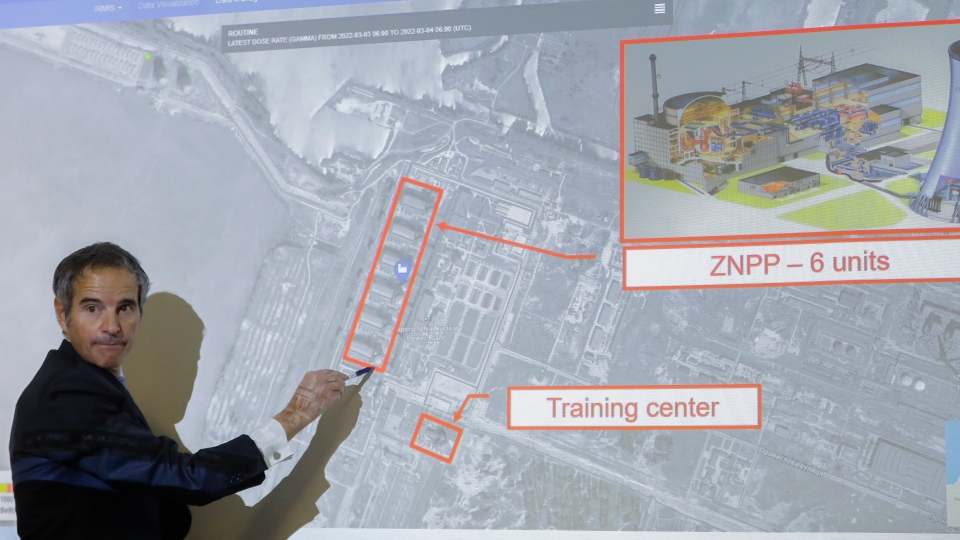
IAEA Director General Rafael Mariano Grossi speaks at a press conference
about the situation at the Zaporizhzhia Nuclear Power Plant in Ukraine
in Vienna, Austria, Friday, March 4, 2022. (AP Photo/Lisa Leutner)
Western
powers have been placed on due notice. Interfere in Russia's
peacekeeping mission in Ukraine and you risk the kind of escalatory
punishment nightmares are made of. You will face consequences "such as you have never seen in your entire history". And to ensure that the message was adequately clarified, the ominous move to place Russian nuclear forces on "special combat readiness".
Expert and casual newspaper readers alike drew an immediate conclusion;
Vladimir Putin chose to bring in the heavy guns of nuclear threats.
Basic
Principles of State Policy of the Russian Federation on Nuclear
Deterrence, a 2020 document, states the President of Russia makes any
decision of the use of nuclear weapons. At all times a briefcase is
maintained in close proximity to Vladimir Putin wherever he happens to
be. It links him to the command and control network of Russia's
strategic nuclear forces. Within the briefcase is not a hot button;
instead the means to transmit orders to central military command.
China,
France, the United Kingdom, India, Pakistan, North Korea and Israel
also maintain nuclear weapons. Among them all the largest stockpile of
such weapons are Russia's with 4,500 nuclear warheads, while the United
States has a total of 3,800, representing between them 90 percent of all
nuclear weapons held globally. Considering the destruction potential in
one nuclear warhead, numbers are almost irrelevant; it would take a
small proportion of each nation's stockpile to destroy the world.
The
treaties devised and agreed upon in the aftermath of the Cold War,
designed around nuclear weapons and inventories and non-proliferation
resulted in a decrease of such weaponry. By the mid-80s there were over
60,000 nuclear weapons, currently that number stands at about 10,000. In
the past ten to fifteen years geopolitical tensions have risen to the
point that arms agreements are no longer in effect. At a time when
nuclear warheads can be placed on cruise missiles.
Delivery
timeline is roughly analogous for an intercontinental ballistic missile
currently as it was decades earlier. Should a nuclear attack be
launched from a submarine off a coastline, that changes the time
equation. As it would with geographical proximity. No longer will either
the U.S. or Russia wait to verify an impending attack to be confirmed
by a first explosion. And the most powerful of nuclear weapons are those
of the city-destroying variety, as opposed to those for battlefield
use.
Experts
now discuss various possible scenarios in the disturbed wake of
Vladimir Putin's warning threat: a strike detonated over the North Sea
as a warning shot -- away from populated areas -- to serve as an
penultimate warning. "All
the evidence so far is that [Putin's threats were] just a 'I'm just
gonna throw this out there as a reminder to everybody that you're
dealing with a nuclear power. and we're pissed off'", said Jane Boulden, professor at the Royal Military College of Canada.
"Are
you going to start launching nuclear weapons in Russia? No. Because the
moment you do that, they're going to reply, they're going to escalate,
right, and fire right back", added Dr. Sens. "Putin's actions do not mean that a nuclear war is imminent and his
actions do not mean that the Russian military is going to use nuclear
weapons anytime soon in Ukraine or anywhere else. but what it does mean
is that it raises the level of hostility and distrust and tension and
magnifies the possibility of mistake, error, miscalculation -- and
that's the last thing anybody wants."
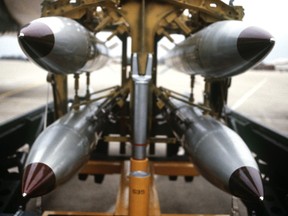
A frontal view of four B-61 nuclear free-fall bombs on a bomb cart.Photo by US Department of Defense
"We
don't know whether President [Vladimir] Putin has made the decision to
invade. We do know that he is putting in place the capacity to do so on
short order should he so decide."
"Should
Russia follow the path of confrontation, when it comes to Ukraine,
we've made clear that we will respond resolutely including with a range
of high impact economic measures that we have refrained from pursuing in
the past."
U.S. Secretary of State Antony Blinken
"Our recent warnings have indeed been heard and are having a certain effect: tensions have risen there [NATO-U.S.]."
"It
is important for them to remain in this state for as long as possible,
so that it does not occur to them to stage some kind of conflict on our
western frontiers that we do not need."
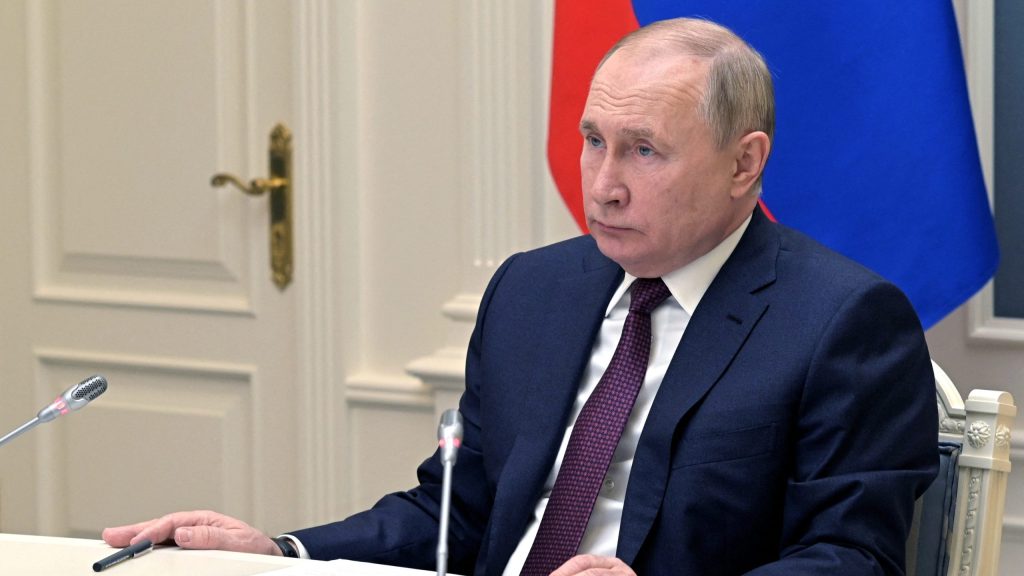
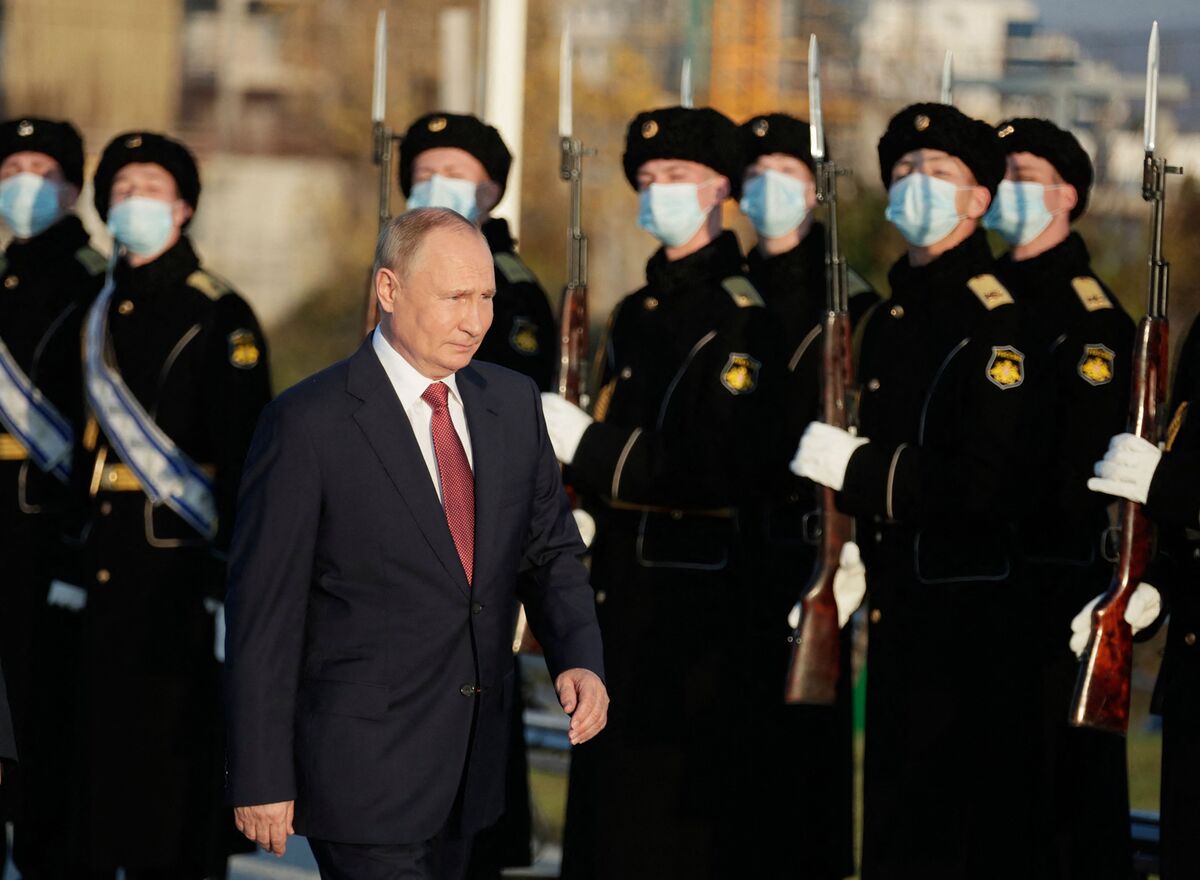
Russian President Vladimir Putin
Vladimir Putin Photographer: Mikhail Metzel/AFP/Getty Images
"I would like again to officially state that Ukraine does not plan any military offensive in Donbass."
"This is Russian propaganda nonsense in order to cover up Russia's own preparations for a potential attack."
Ukrainian Foreign Minister Dmytro Kuleba
"[Stability
and predictability mean] less American meddling in our domestic
affairs, with less attempts by the U.S. to limit our completely legal
and legitimate interaction with our friends, allies and partners all
over the globe."
Sergey A. Ryabkov, Russian Deputy Foreign Minister
Mr. Putin's end game: for Asta Skaisgiryte, foreign policy adviser to Lithuania's president, there is a simple answer: "To restore the Soviet Union".
That's a given. Well enough understood by Mr. Putin's statement of
profound regret that Greater Russia is simply that, no longer the Soviet
Union, its hegemonic tentacles tightly gripping its neighbours'
sovereignty as Moscow's own. Time and the tides provides no answer for
Mr. Putin for he plans his legacy as the restorer of what once was; if
subtle persuasion won't do it, violent aggression will.
For
Mr. Putin, Russia's near-abroad is Russian hegemonic territory. The
encroaching presence of NATO in support of Baltic states cringing at the
very prospect of once again being caught in a Soviet-style ambit
represents their living nightmare. That they have the support of the
United States extending to NATO and its member-states is their assurance
that they won't go into that dark night of Russia's grasp whimpering
helplessly. They have Western champions.
To
the Kremlin, to Mr. Putin, the presence of Western troops under the
NATO aegis in Russia's area of disputed control is a major threat. They
have no business in eastern Europe, it is Russia's bailiwick. And if
Russia feels like reminding its neighbours of how good their lives were
once as part and parcel of the USSR, that's Russia's business. The
buildup of Russian troops beside Ukraine is a statement of regional
power, not defiance, but a promise of what could unfold and may yet.
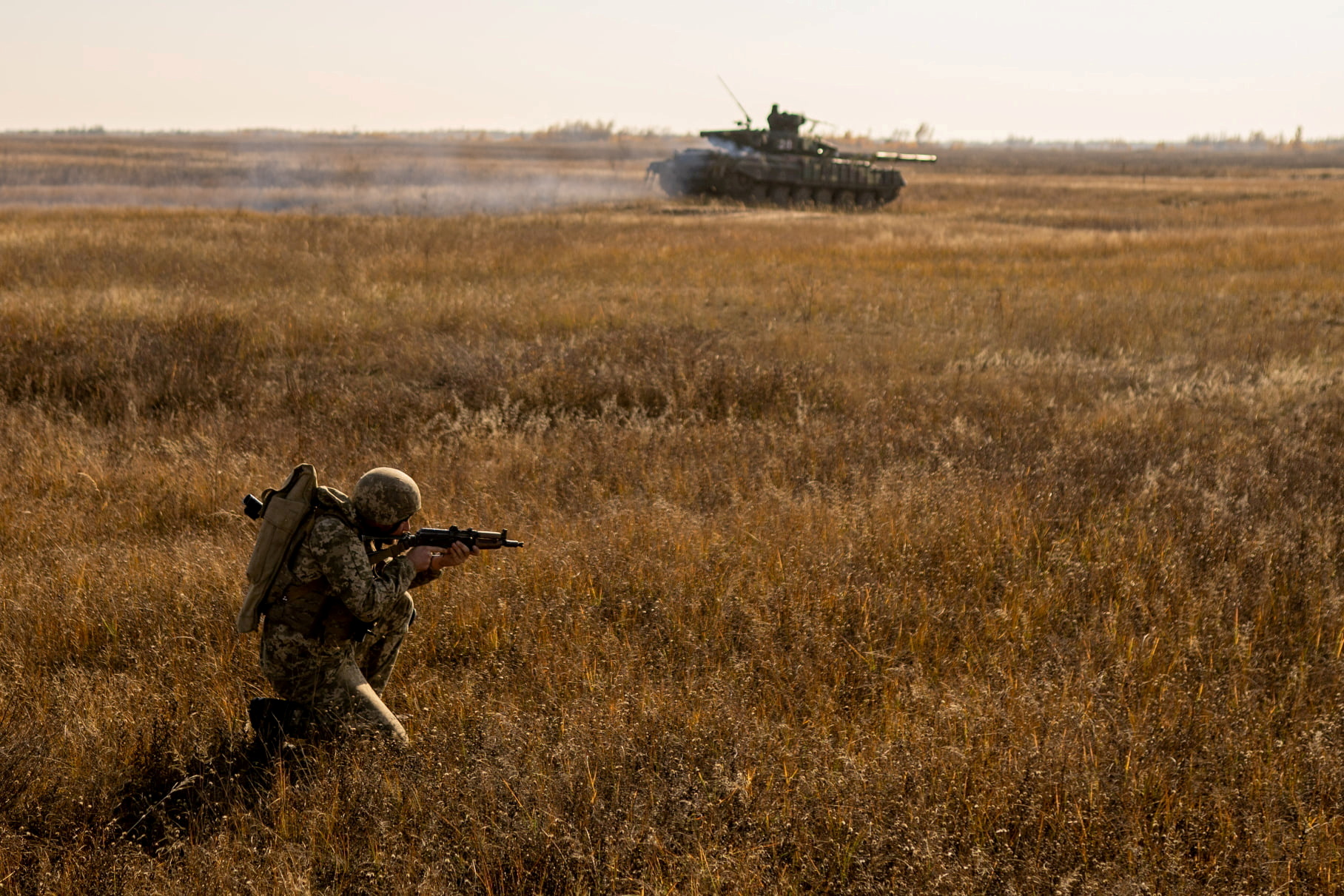
A serviceman of the Ukrainian Armed Forces takes part in military drills
at a training ground near the border with Russian-annexed Crimea in
Kherson region, Ukraine, in this handout picture released by the General
Staff of the Armed Forces of Ukraine press service November 17, 2021. via REUTERS
The
volatile situation is not Russia's fault but that of NATO and the
United States daring Russia to take another step further to claim its
historical patrimony. From the Baltic to the Black Sea competition for
influence amidst a threat of an emerging potential for military conflict
is seething. Russian long-range nuclear bombers flew patrols repeatedly
near the border of the European Union with Poland. Leaving Western
intelligence warning the Kremlin could be planing groundwork for another
invasion of Ukraine.
Last
month Mr. Putin made clear his use of the Russian military to bring the
West to a respectful attitude toward Russian interests in the region,
and succeeding. It is now known in the Western halls of power that
Russia is serious it will defend its 'red lines'; NATO has no business
being present near its borders. The Belarusian gambit of creating
friction by massing Syrian refugees on the border with Poland as
punishment for the EU's interference in the after-effects of the Belarus
election is generally viewed as another irritation engineered by Mr.
Putin. Ditto the energy crunch in supplying natural gas to Western
Europe.
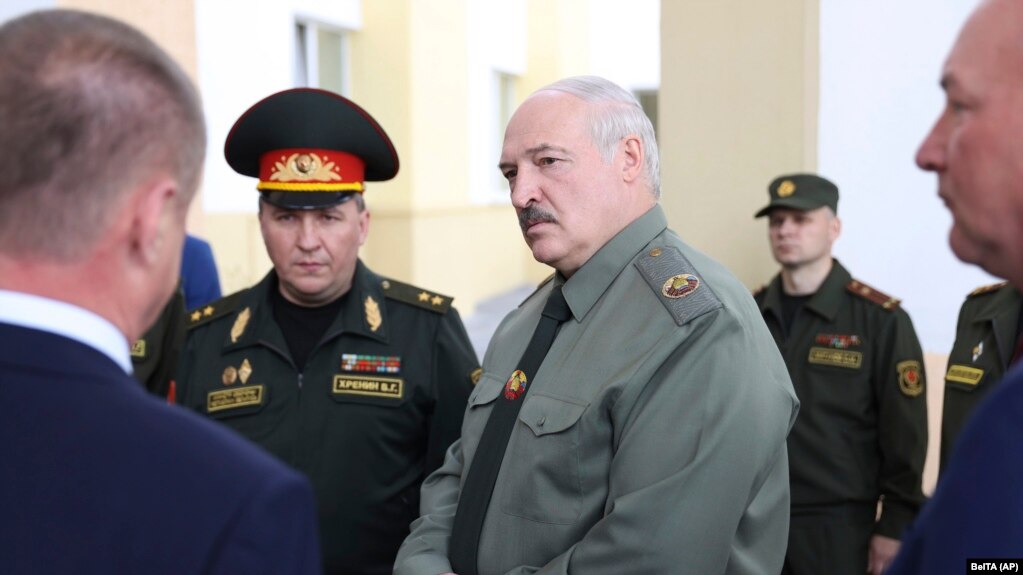
Belarusian
President Alyaksandr Lukashenka (center) attends a meeting on
territorial defense issues in the town of Shklov in June with Defense
Minister Viktar Khrenin (left).
Despite
repelling challenges to his presidency from opposition groups,
imprisoning those whose campaigns prove too inconvenient as an
alternative to assassination or forcing others into exile, Mr. Putin
rests easy in an approval rating above 60 percent, making him
indisputably a more popular leader than most Western-based leaders.
Russia may be suffering a dreadful COVID toll, but the
United Russia party saw victory in its September parliamentary
elections, and Mr. Putin has established himself as President-for-life.
Changing the country's constitution proved so popular that other
dictators have followed suit.
It
is, however, the possibility that the West will continue its incursion,
expanding a military presence in post-Soviet Eastern Europe where
Latvia, Estonia and Lithuania have become NATO members satisfied with
their bonus of hosting Western troops; too close for Mr. Putin's
comfort. In September the Kremlin stated that the "broadening of NATO infrastructure on Ukrainian territory" would
cross one of Russia's red lines. Recent military activity by the U.S.
and its NATO allies in the Black Sea region near Ukraine has served to
further infuriate Russia.
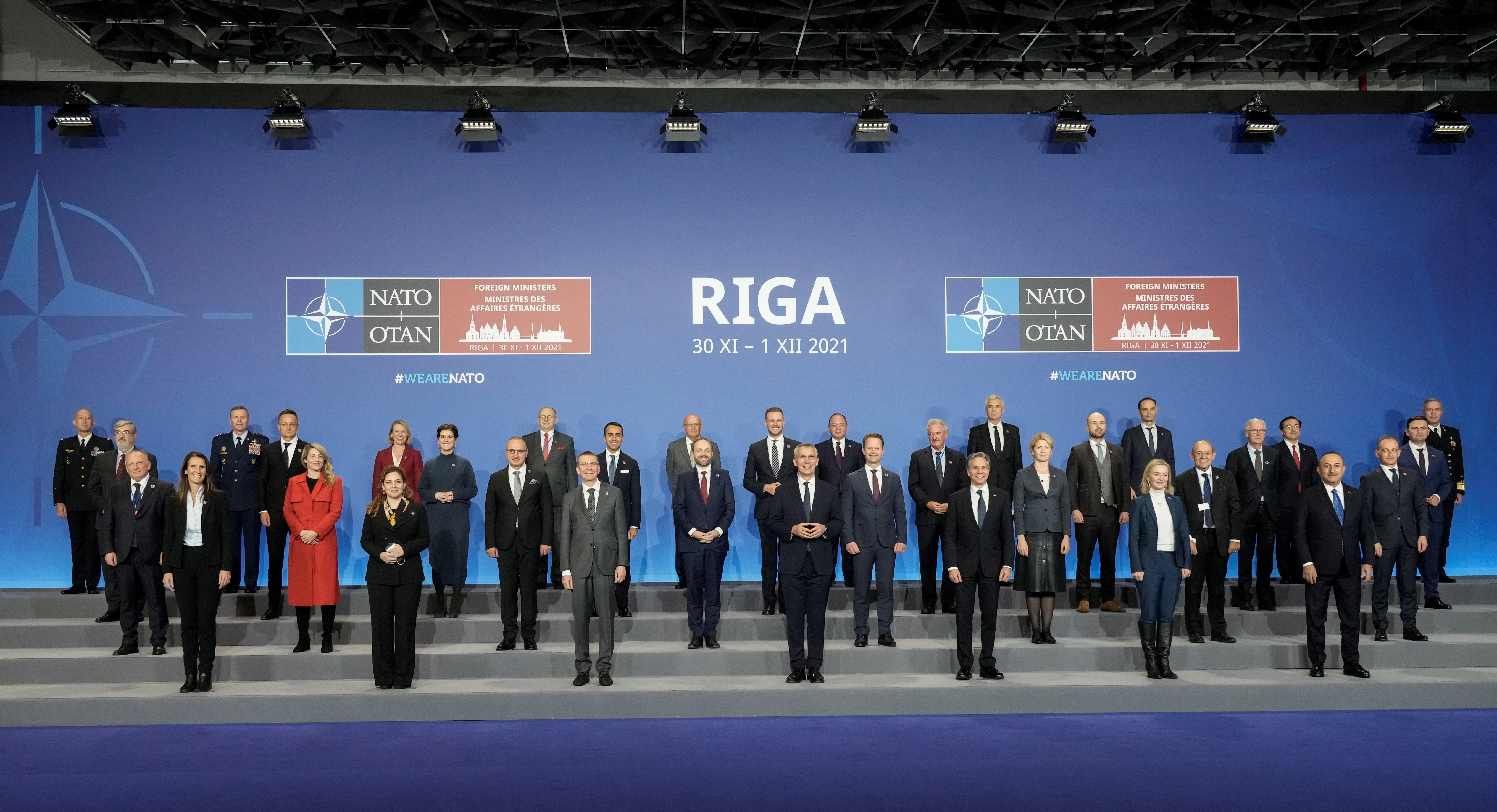
NATO Secretary General Jens Stoltenberg poses with foreign ministers for
a family photo during a NATO Foreign Ministers summit in Riga, Latvia
November 30, 2021. REUTERS/Ints Kalnins
"President Putin has come to the conclusion that normal diplomatic channels, means, forms and methods are not working."
"The situation is, potentially, a rather bad one."
Dmitri Trenin, head, Carnegie Moscow Center think tank
"This is the biggest issue facing the world today in my view, I think in the view of our prime minister, and our team." "Yes, there is terrorism. Vladimir Putin is behaving like a terrorist." "But the buck stops in Ukraine; there is absolutely no scenario going into the future that leads to peace and security for this world, that leads to prosperity in Europe globally that does not include a full international effort to give Ukraine the tools it needs to drive Russian forces from their borders and to secure its borders for good." Canadian Immigration Minister Chris Alexander
CP/Adrian Wyld, AP/Pavel GolovkinImmigration Minister Chris Alexander's February speech sparked a diplomatic tiff with the Russian embassy.
Well, the speech was, after all, geared to his audience, of Ukrainian Canadians. Yes, there is immediate urgency in the volatile and deadly events unfolding in the Middle East, where the lives of hundreds of thousands of people have been lost in Syria, in Iraq, in the iniquitous blood-letting atrocity-laden murder-sprees of both the Syrian Baathist regime and Islamic State of Iraq and al-Sham. But there is also Russia's aggression in Ukraine, and its support of Syria and of Iran.
Mr. Alexander did give the conflicts in Syria and Iraq their due, but his ire on this occasion, for this special audience, was reserved for Russia, and its President; Vladimir Putin, in particular. His words did not go unnoticed, all the more so since a video of his speech surfaced on the Internet and the Russian Embassy in Ottawa decided to respond. The YouTube video got an answer on Twitter: "Sounds like Orwellian 'five minutes of hate'. Hardly the artwork of diplomacy", tweeted the Russian embassy. Touche...!
And it isn't only Canada versus Russia that has surface of late. Britain, with its hate-on for Russian skulduggery in assassinations on British soil, has London and Moscow cat-calling one another, and this time Moscow has a point; focusing on Argentina's claim to the Malvinas, which colonial Britain that taken as its own Falklands, installing Britons to make it their home, and fighting wars with Argentina over its possession; refusing to take part in a diplomatic mission to agree to a resolution to the impasse.
Britain has decided to beef up its military presence in the Falklands much to Argentina's alarm and discomfort. In response to Russia's cozying up to Argentina, following the Iranian lead, one supposes. Both have been ostracized of late; Iran for its nuclear ambitions, Russia for its hegemonic aggression of Ukraine, and the sanctions that have been imposed on each have gone far in biting their economies, so they're looking where they can for 'economies' that will aid them in accommodating themselves to their new realities.
A Rapier missile, similar to that deployed on the FalklandsPhoto: PO[Phot]Lewis.S.J./Crown Copyright
Said David Cameron: "The assurance that I can give the Falkland
Islands is that we will always be there for them, we will always defend
them." They are all of British heritage, after all, so far from home, rubbing cheeks with Argentina geographically, since logically it should be an Argentinian possession, as the country claims. Since they're all British-speakers, and they voted overwhelmingly in a referendum to remain British, seeking Britain's aid in fending off Argentinian overtures, there's a certain resemblance there to Moscow claiming it cannot ignore the pleas of Russian speakers in Ukraine.
Britain condemns the Crimean annexation, and sneeringly speaks of the referendum that took place there giving moral authorization, as Moscow claims, for that annexation, as a "fig leaf" for Putin's "land grab". The Russian embassy in Britain had this to say: "In its rhetoric Foreign Office applies one logic to the referendum in the Maldives/Falklands, and a different one to the case of Crimea". And truth to tell, they've got a case in point there.
An internationally beleaguered Russia is pushing back. For weeks pro-Kremlin news sources and Russian members of the Duma have been denouncing as pure hypocrisy Britain's "colonial occupation" of the Islands, the "Crimea of the Atlantic", while Alexei Pushkov, head of the committee of international affairs in the Duma has written on Twitter: "Information for London: Crimea has immeasurably more reason to be a part of Russia than the Falkland Islands to be part of the U.K."
Ouch! But ain't it the unvarnished truth?!
"The Malvinas has always belonged to Argentina, the same way that
Crimea also belonged to the Soviet Union until it was given to Ukraine." Argentine President Cristina de Kirchner
This represents a general opinion site for its author. It also offers a space for the author to record her experiences and perceptions,both personal and public. This is rendered obvious by the content contained in the blog, but the space is here inviting me to write. And so I do.