"China Will Be The Enemy
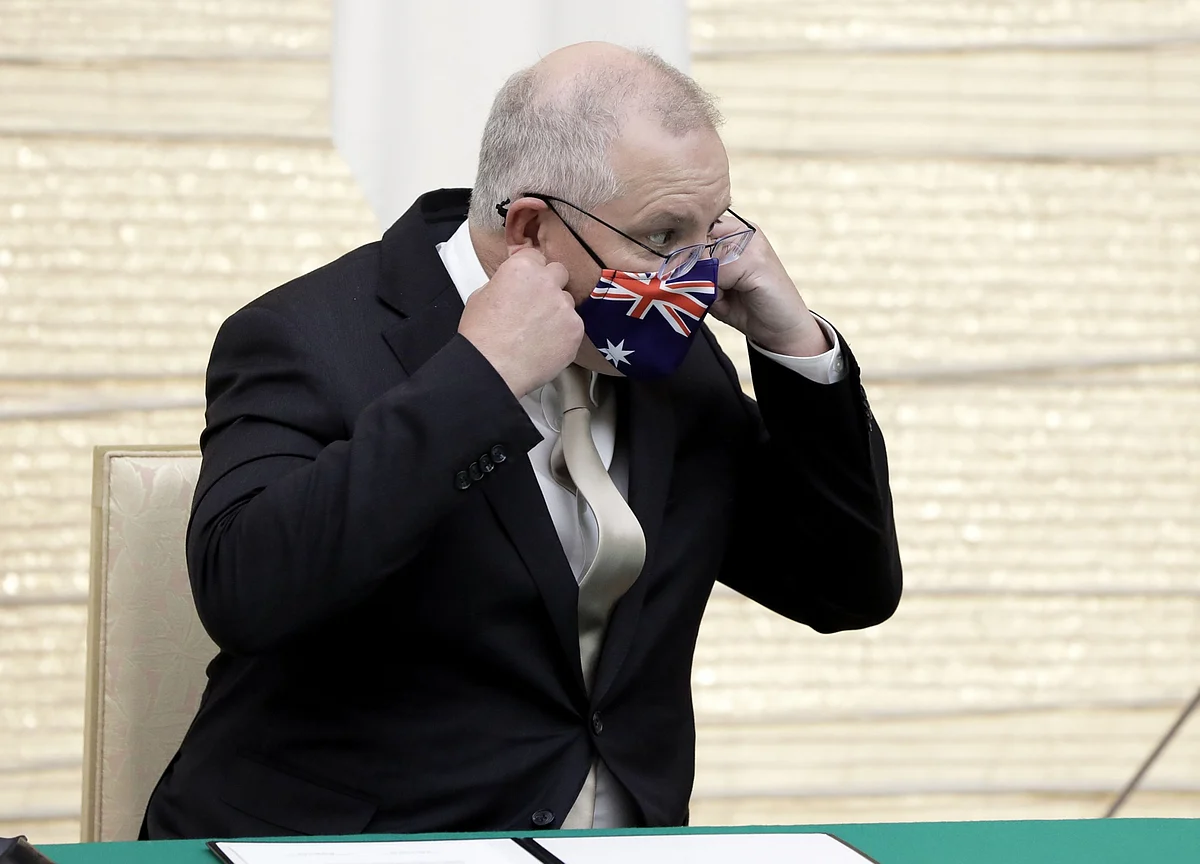 |
| Australia's PM Scott Morrison, Bloomberg |
"We won't be compromising on the fact that we'll set what our foreign investment laws are, or how we build our 5G telecommunications networks, or how we run our systems ... that are protecting against any interference.""We will always set our own laws and our own rules according to our national interests -- not at the behest of any other nation, whether that's the U.S. or China or anyone else."Australian Prime Minister Scott Morrison
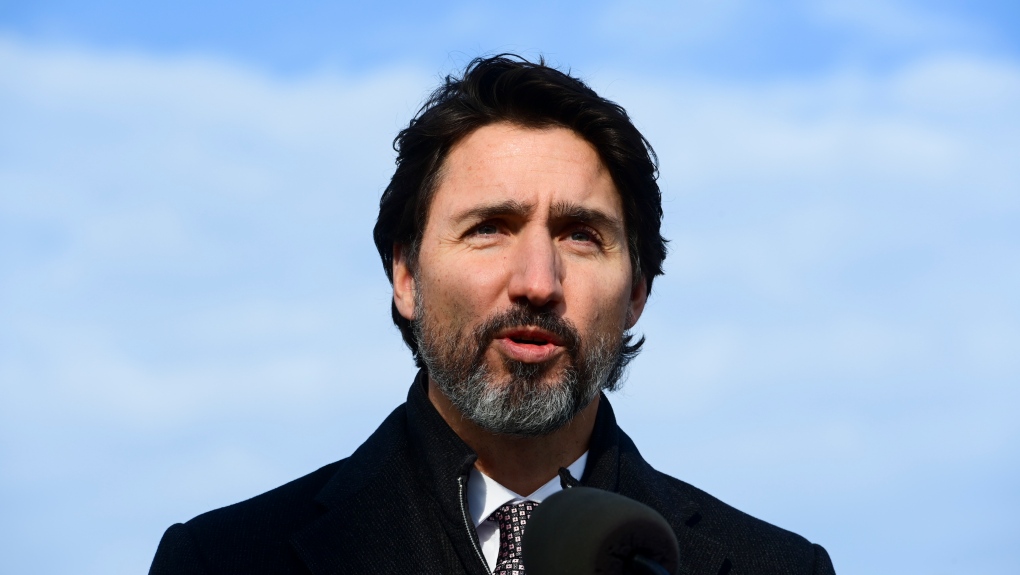 |
| Prime Minister Justin Trudeau CP/Sean Kilpatrick |
"Do I regret that Canada followed its laws? Do I regret that Canada lived up to a long-standing extradition treaty with our closest ally? Absolutely not.""Canada is a country of the rule of law. And obeying those laws can't just be when it's convenient or when it's easy. If you're a country of the rule of law, if you're a country of values, you need to stick up for those. And that's exactly what we're doing.""In the face of pressure and increasingly coercive moves by one of the world's great powers, I think that really highlights at which point we need to be working together as allies, as neighbours, as friends, as countries.""Very few countries could stand up on its own to a superpower, to a great power. But working together in alignment, we can make sure there is a recognition that the path that China is choosing to take right now is probably not going to be as effective -- even for them -- as they think it will."Canadian Prime Minister Justin Trudeau
"[The government must] make a decision on Huawei's involvement in Canada's 5G network within 30 days [and] develop a robust plan, as Australia has done, to combat China's growing foreign operations here in Canada and its increasing intimidation of Canadians living in Canada [within 30 days]."House of Commons Opposition Conservatives"We are aware that China is, and will remain, an important commercial partner for Canada.""China is also a significant source of tourists and students to Canada, and brings economic and enriching social benefits across our nation."Foreign Minister Francois-Philippe Champagne
 |
| Sing4DemocracyHK protest outside the Court of Final Appeal in Hong Kong (Anthony Wallace/AFP/Getty Images) |
Australia
and Canada have displeased China mightily. China awaits both countries
to come to their senses and that would entail sincerely apologizing to
Beijing for their intransigent wrong-headed views on China regarding
many issues, inclusive of Hong Kong, Uighurs, Huawei, Chinese
benevolence, Chinese cyber espionage, copyright infringement, and above
all, COVID-19. Beijing's release this week of a list of 14 grievances
with Australia put matters out in the open down under when a Chinese
official spoke on record to an Australian reporter: "China is angry. If you make China the enemy, China will be the enemy."
According
to Australian sources the list of grievances includes instigating an
investigation in the United Nations regarding the spread of COVID-19 at
the turn of 2020, cancelling Chinese student visas as a COVID-aversion
safety measure, blocking Chinese investments in Australia, leading
international focus on violation of human rights by China and the
banning of Huawei from contributing to the Australian 5G
telecommunications network upgrade. All hostile actions guaranteed to
poison relations between China and Australia; the latter the aggressor,
the former the victim.
Australia's
Prime Minister made it abundantly clear that Australia's sovereign
decisions are not up for discussion much less explanation or apology to
the world's number one natural resources-hoarder, trade colossus, and
cybertheft expert. Australia puts its words into action and lives with
the consequences, unwilling to be bullied and coerced into pleasing or
pleading with the Chinese Communist Party for concessions and
forgiveness.
 |
Canada's
Prime Minister enjoys grabbing the limelight as a victim whose defence
of justice and the rule of law has occasioned Beijing's wrath and
imprisoned two innocent Canadians for the past two years, charged with
threatening China's security, in retaliation for the detention of Meng
Wanzhou, CFO of Huawei, on a U.S. extradition request. Canada has
appealed to other APEC nations to support Canada in a joint rejection of
Chinese bullying in the hopes that Xi Jinping would be confronted at
this weekend's G20 Saudi-hosted virtual gathering.
But
is Canada prepared to go it alone, to stand up for its sovereign
rights as its Prime Minister boasted? It remains the only Five Eyes
intelligence-sharing nation to leave open the question of whether Huawei
will be included in Canada's 5G telecommunications upgrade, fearful of
Beijing's explosive wrath, whereas Australia, New Zealand, the United
Kingdom and the United States have all clearly stated their positions to
shut out Huawei citing obvious security reasons.
Canada,
on the other hand, saw fit to award a standing offer for conveyor-style
X-ray machines to Nuctech, a Beijing based company partially owned by
the Chinese government, once operated by the sun of the former General
Secretary of the Chinese Communist Party. Canadian, American and British
companies all competed for the standing offer, but it was Nuctech who
won the tender including delivery, installation, operator training and
software training at Canadian embassies located world-wide.
It
was only when a national newspaper broke the news of the contract that
the federal government committed to a review once the contract was
exposed, and ultimately decided not to buy Xray machines for Canadian
embassies from the controversial Chinese firm. But it turns out that the
Canadian Border Services Agency had already bought and installed
Nuctech X-ray machines:
"We
have a number of mitigating interventions that we put in place around
this technology. One of the first ones is obviously to keep it
disconnected from our networks and from any Government of Canada
networks ... the second is (anyone) affiliated with any of our suppliers
would be screened through security processes and would be escorted on
site if they were present in our facilities", explained the vice-president of the CBSA;s intelligence and enforcement branch.
Why
go through all this rigamarole necessitated by the use of the machines
to begin with? To do otherwise, it would seem, would be to offend
Beijing. Who could easily retaliate as they have done with holding two
Canadians they've charged with espionage as hostages to force the
release of the Huawei executive. China also flexed its trade muscles
when it refused Canadian pork exports and canola products, both
commodities that enjoyed a heavy trade prior to the Huawei affair.
 |
| Cong Peiwu, China's ambassador Canada (Justin Tang/CP |
All
of this in light of Canada's Communications Security Establishment's
Canadian Centre for Cyber Security releasing a new report in which
Russia, North Korea, Iran and China are listed as cybersecurity threats
to Canada. An earlier report by the National Security and Intelligence Committee of Parliamentarians pointed out that China and Russia are using their diaspora, undercover agents and
groups based on Canadian campuses as part of "significant and sustained"
foreign interference campaigns in Canada, according to a redacted
intelligence report.
"The committee believes that these states target Canada for a variety of reasons, but all seek to exploit the openness of our society and penetrate our fundamental institutions to meet their objectives.""They target ethnocultural communities, seek to corrupt the political process, manipulate the media, and attempt to curate debate on post-secondary campuses.""Each of these activities poses a significant risk to the rights and freedoms of Canadians and to the country's sovereignty: they are a clear threat to the security of Canada."
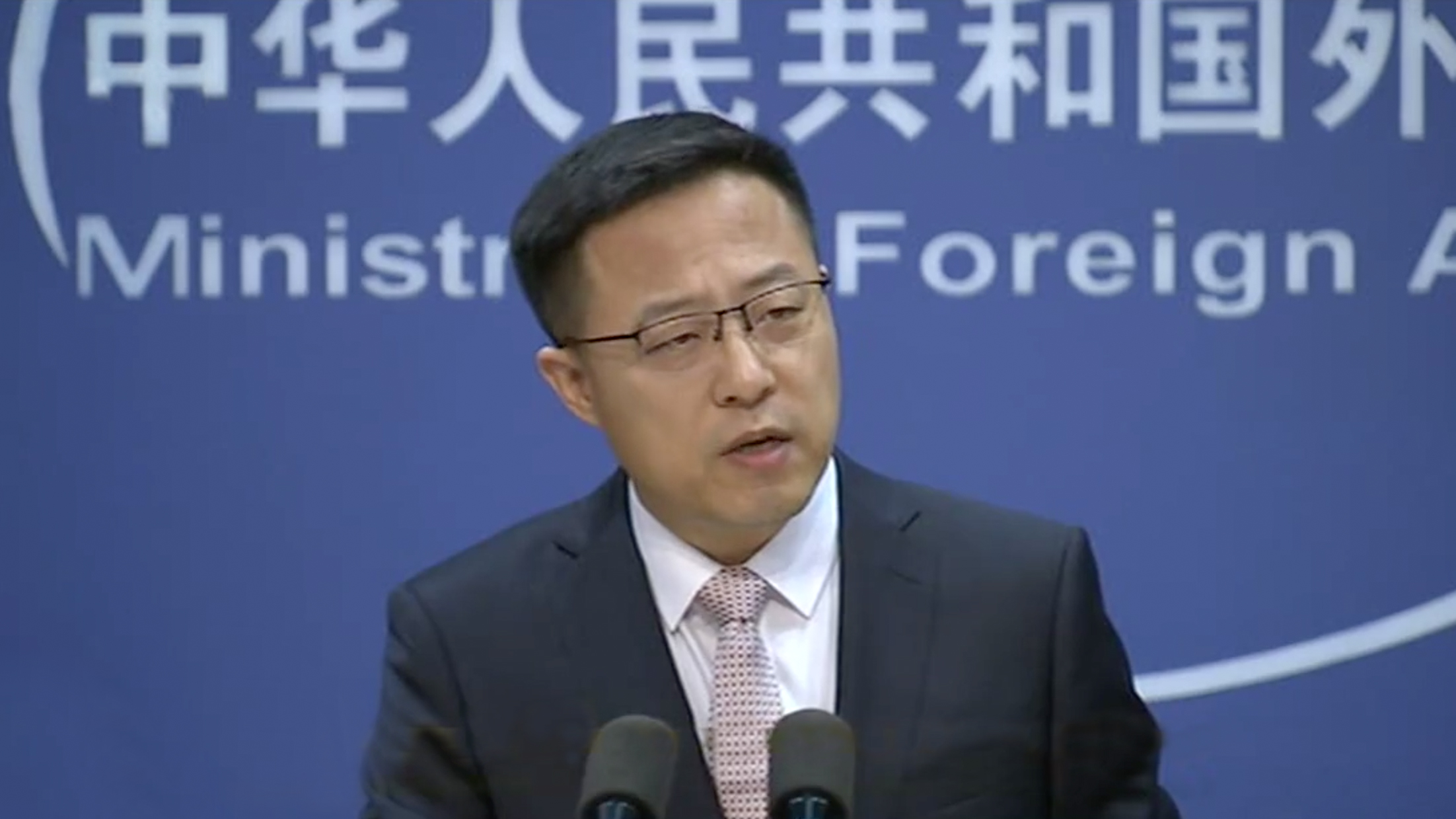
"[This] so-called genocide [is] a rumour and a farce fabricated by some anti-Chinese forces to slander China.""Its groundless statement [committee report] is full of lies and disinformation. {Parliamentarians would do well to] avoid doing any further damage to China-Canada relations.""This is blatant interference in China's internal affairs and reflects those Canadian individuals' ignorance and prejudice. China firmly deplores and rejects that.""[The installations are] vocational training and education centres [where religious] extremists [are educated in the] national common spoken and written language, legal knowledge, vocational skills and de-radicalization.""The aim is to eliminate the root cause of terrorism and extremism."Zhao Lijian, spokesperson, Chinese foreign ministry
 |
| In this photo, a guard tower and barbed wire fence surround a detention facility in the Kunshan Industrial Park in Artux in western China's Xinjiang region. (Ng Han Guan/AP Photo) |
Labels: Australia, Bullying, Canada, China, Hong Kong, Huawei, Human Rights, Trade, Uighurs
posted by Pieface @ Monday, November 23, 2020