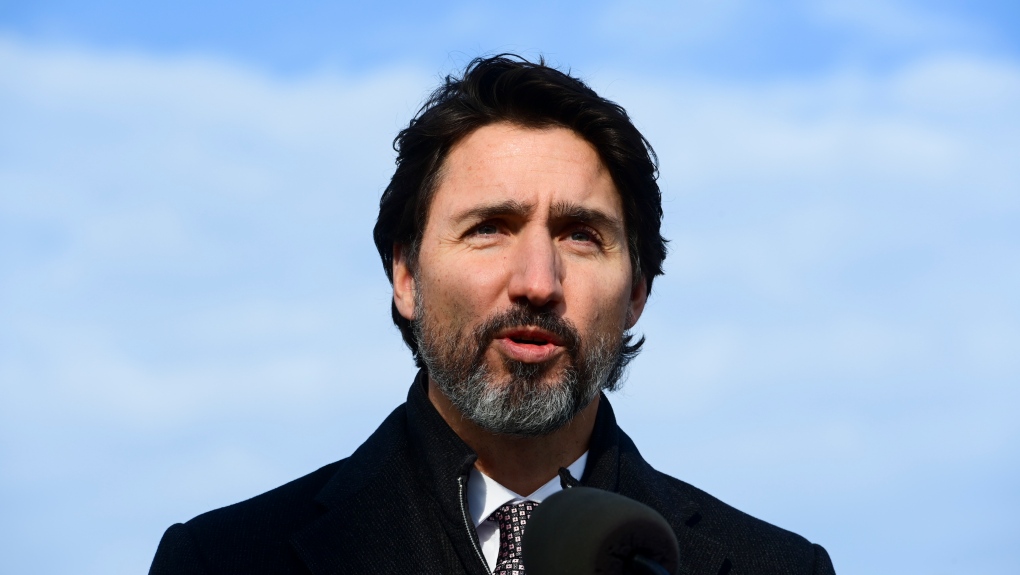
The Most Controversial President in U.S. History's Ambassador to Canada
"He
said, 'What do you want to do?" I said, 'I think I see myself as your
ambassador to Canada'. He had kind of a quizzical look ... and he says
'I like that, I like that idea'."
"I'm
not only Dutch, I'm Frisian, which they call the most stubborn and
blunt group -- and the Dutch pride themselves on being blunt. [That] is
pretty valuable as a diplomat ..."
"I
don't think [Canadian officials] leave the meeting saying 'What was he
trying to tell us? Do you think Trump is really serious about tariffs'?"
Pete Hoekstra, U.S. Ambassador to Canada
"For the first time, it appears that the American ambassador's audience in everything he says publicly is the president."
"He is very likely making his boss happy, while he makes the rest of us uneasy."
"He's not from central casting."
Flavio Volpe, president, Automotive Parts Manufacturing Association, Canada
"He was just a brilliant guy and a can-do guy who just wanted to get things done."
"He is an original thinker. He's not conventional at all in so far as policies or in terms of ideology."
"He thought outside the box, which I really admired."
Steve Emerson, Investigative Project on Terrorism
U.S.
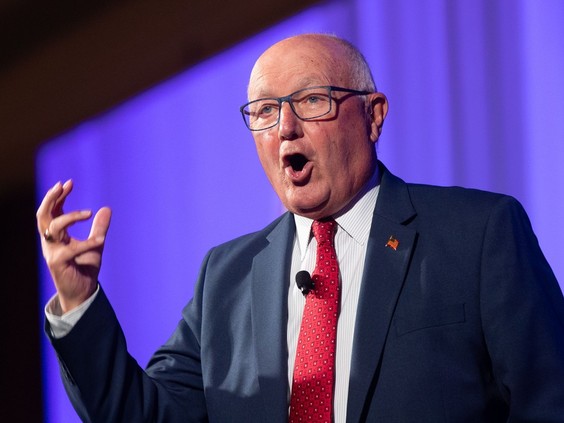
Ambassador to Canada Pete Hoekstra speaks before taking part in a
discussion on Canada-U.S. relations with Colin Robertson, a fellow with
the Canadian Global Affairs Institute, during the Global Business Forum
in Banff, Alberta on Sept. 25, 2025. Photo by Brent Calver/Postmedia /Brent Calver/Postmedia
The
man has been labelled 'contentious' and 'pugnacious'; he certainly
speaks his mind in a manner that is unreflective of the position he
holds as a senior diplomat, though he doesn't come from the professional
diplomatic corps, but rather, like his boss, from the business world.
And he is, if anything, a true-red Republican Trump loyalist. Although
he has some family ties with Canada, of relatives living in the country,
and some memories in his dim background of visiting Canada, he appears
to know little-to-nothing about the Canadian spirit.
In
the sense, that is, that he can fathom broad offense taken by Canadians
when the American president he represents and champions insults the
country by suggesting it become the 51st state. A 'term of endearment'
was his reading of the suggestion, baffled that any offence could be
taken. Surely not; more likely taking his cue of making light of the
assault on Canadian sovereignty as though to deliberately minimize the
spurning reaction of a people whose dignity as a nation has been made
light of.
He
is said to be a genial man in person, and no doubt he is. So is
President Donald J. Trump when he wants to be, which is to say when
everything goes his way. The supreme confidence instilled by holding the
position of the most politically powerful man in the world would
doubtless make many people immune to criticism, but not Trump and not,
Mr. Hoekstra, on Trump's behalf. Criticize Mr. Trump and you have the
supreme audacity to find fault with the great United States of America.
"Dear Canada: beware. Hoekstra deserves to be treated as a hostile guest",
proclaimed the website of Common Dreams. The ambassador, 72 years of
age, was born in Groningen, a northern city in the Netherlands. His
family brought him to the United States when he was three years old
through emigration. He earned an MBA in Michigan and entered the
business world to become vice-president of marketing at an office
furniture manufacturer before he turned to the political arena and
election in 1992 to the House of Representatives, as a conservative
Republican.
He
opposed abortion rights, same-sex marriage, gay adoption, gun control
and federal employee paid parental leave; the very essence of Democratic
liberal values. He chaired the House of Representatives intelligence
committee from 2004-2007. As think tank pundit, author and diplomat he
seems the perfect representative in Canada to reflect the current
administration. His continued warning of "radical Islam", and that schools in America were used "to indoctrinate our children with Marxist ideology" mark him as controversial but fairly accurate. Since 9/11 he has devoted "almost all of my time" to intelligence, stating the "greatest threat" to the U.S. is the rise of "radical Jihad, radical Islamists".
At his Senate confirmation hearing last year he stated "I recognize Canada's long-standing friendship, our deep economic ties and our strong military alliance", as he spoke of Mr. Trump's priorities as "freer, fairer trade".
Canadians, along with much of the world might take issue with that last
statement. Canada in particular with the imposition of 35 percent
tariffs on goods not covered by the CUSMA agreement. The tariffs on
aluminum, steel, copper and lumber are particularly onerous and
resented.
"You
do not come into America and start running political ads --
government-funded political ads -- and expect that there will be no
consequences or reaction", he sternly admonished the
Province of Ontario's trade representative over a series of
well-publicized media spots highlighting former President Ronald
Reagan's statements rejecting tariffs as completely unnecessary, as a
gentle chide to President Trump's triumph of shocking tariffs and
incentives to Canada-based manufacturers to leave Canada and set up
manufacturing in the U.S. to unburden themselves of the weight of
tariffs.
"Chaos in the Netherlands. There are cars being burned. There are politicians that are being burned."
"With the influx of the Islamic community ... there are no-go zones in the Netherlands. All right?"
"There
are no-go zones in France ... There are no-go zones in Britain as well,
but they are tearing the Dutch apart politically."
Pete Hoekstra, Muslim Migration into Europe: Eurabia Come True? 2015 panel discussion
Somali-born,
Dutch-American writer of note, Ayaan Hirsi Ali, herself a former
politician and a bellwether of the kind of furtive jihad practised by
the Muslim Brotherhood, would agree with every word of each caution
issuing from the mouth of this unusual ambassador whose ideas of
diplomacy are rather unconventional. Canada may yet learn much from this
frank man of experience whose provocative conservative values counter
much of the touchy-feely progressive-liberal standards of its own
current government.
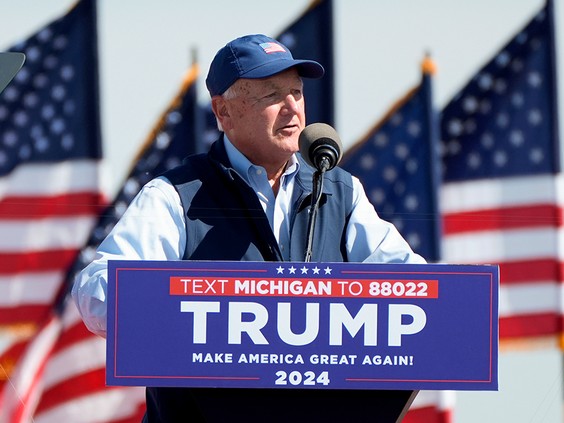
Pete Hoekstra, then Michigan Republican Party chairman, speaks at a Donald Trump campaign rally in Freeland, Mich., May 1, 2024.Photo by Paul Sancya/AP, File
"He's got to walk a tightrope. If he tries to inject too much rationality into the discussion, he gets zapped by Trump."
"I'm not going out of my way to defend him, but I feel a bit of sympathy for the predicament he's in."
"I'm sure when he showed up in Ottawa he didn't think he'd become the most controversial U.S. ambassador in history."
David Haglund, international relations professor, Queen's University
"Now it's clear, Vance's speech in Munich and the many tweets of President Trump have become official doctrine of the United States, and we must act accordingly."
"[Europe must understand that postwar alliances] have changed [ and to be read to] protect ourselves not only against our adversaries, but also against the allies who challenge us."
"What we cannot accept is this threat of interference in Europe's political life."
"The United States cannot replace European citizens in choosing which are the right parties and which are the wrong parties."
European Council President Antonio Costa
"There is a growing recognition that their strategy did not work."
"It's becoming clearer that, obviously, it's expressed by the Trump administration, but there seems to be a bigger MAGA sort of world view in which Europe is identified as Public Enemy No. 1."
Nathalie Tocci, director, Institute for International Affairs, Rome
"On the question of Europe and President
Trump's comments, what I see is a strong Europe, united behind Ukraine
and united behind our longstanding values of freedom and democracy."
"And I will always stand up for those values and those freedoms."
British Prime Minister Keir Starmer
U.S. President Donald Trump shakes hands with Russian President Vladimir
Putin before a joint news conference following their meeting at Joint
Base Elmendorf-Richardson in Anchorage, Alaska, U.S., August 15, 2025. (Sputnik/Gavriil Grigorov/Pool via REUTERS )
Continental Europe has been losing share of global GDP—down from 25 percent in 1990 to 14 percent today—partly owing to national and transnational regulations that undermine creativity and industriousness. But this economic decline is eclipsed by the real and more stark prospect of civilizational erasure. The larger issues facing Europe include activities of the European Union and other transnational bodies that undermine political liberty and sovereignty, migration policies that are transforming the continent and creating strife, censorship of free speech and suppression of political opposition, cratering birthrates, and loss of national identities and self-confidence. Should present trends continue, the continent will be unrecognizable in 20 years or less. As such, it is far from obvious whether certain European countries will have economies and militaries strong enough to remain reliable allies. Many of these nations are currently doubling down on their present path. We want Europe to remain European, to regain its civilizational self-confidence, and to abandon its failed focus on regulatory suffocation. This lack of self-confidence is most evident in Europe’s relationship with Russia. European allies enjoy a significant hard power advantage over Russia by almost every measure, save nuclear weapons. As a result of Russia’s war in Ukraine, European relations with Russia are now deeply attenuated, and many Europeans regard Russia as an existential threat. Managing European relations with Russia will require significant U.S. diplomatic engagement, both to reestablish conditions of strategic stability across the Eurasian landmass, and to mitigate the risk of conflict between Russia and European states. It is a core interest of the United States to negotiate an expeditious cessation of hostilities in Ukraine, in order to stabilize European economies, prevent unintended escalation or expansion of the war, and reestablish strategic stability with Russia, as well as to enable the post-hostilities reconstruction of Ukraine to enable its survival as a viable state.
National Security Strategy of the United States of America, November 2025
Across the pond, European leaders are furiously debating the new American national security strategy, in particular that portion that focuses on Europe and consigns it to a fast-fade into past history, berating it for not paying sufficient attention to its immigration policies and positing that Europe is on its way to losing all it holds dear, its history, culture, values. Yet, since America is so besotted with Europe it still hopes it can 'regain its civilizational self-confidence', so there is yet hope for poor, degraded, fumbling and weak Europe.
The offending document, according to European officials, has made formal policy from the Trump administration's critiques of European democracies. In very particular, Europe has been no help to the White House in its selfless bid to stop the war in Ukraine. A Ukraine, by Mr. Trump's reckoning that deserves to forfeit great chunks of its territory because it was too weak to defend itself from the territorial imperative of a strong neighbour, attached to a man whom Mr. Trump admires.
If Europe, much less the world at large, does not yet know that Donald J. Trump, president of the great United States of America has a keen admiration for strongmen, then perhaps there is no hope for any nation or nations that haven't yet grasped that they must counter a force of the nature of a man who sees much to admire in autocrats, dictators, even terrorists. Say, for example, President Trump's accommodation with such global menaces as Russia's Vladimir Putin, North Korea's Kim Jong Un, Turkey's Recep Tayyip Erdogan, Qatar's Tamim bin Hamad Al Thani and Syria's new president Ahmed al-Sharaa (a 'nice' young man).
Alluding disparagingly to the presence of malign Middle East actors in Europe who have immigrated, migrated, refugee'd themselves throughout France, Britain and Germany to dilute and imperil by sheer force of numbers in their genteel jihad of citizen-occupation as the death knell of Europe proceeds, President Trump conveniently overlooks the very fact that the United States of America has a more-than ample presence of the same in a stealth yet observable quotient, where even some infamously virulent anti-American Somalis and Palestinians have been voted into Congress.
It is the stinging rejection of European powers to the U.S. 'peace plan' for Ukraine that generates much of the current umbrage by the American president to Europe, which has made its way into the national security strategy, alongside the disregard that exudes from some key members of the Trump administration who have little but contempt for their European counterparts. Understandably, Ukraine rejects outright the brilliant plan brought to him courtesy of Mr. Trump, to demean himself and his nation by handing over territory to a rapacious enemy.
Strangely enough, Europe, fearing Vladimir Putin's greedy eye, has no wish to be party to rewarding him for his invasion of a neighbour, by supporting the 'peace plan', which is, after all, a complete repudiation of Ukraine's human rights and international right to sovereign protection. Downplaying NATO, and forcing the defence alliance to exclude Ukraine in the future, sternly advising that there be no NATO presence to guarantee a post-peace security for Ukraine, is in actual fact, Vladimir Putin's terms to end its vicious war, along with an insistence on Ukraine agreeing on reducing its military and armaments.
Then there are strictly financial/economic considerations; Europe has no 'right' to fine powerful and intrusive social media giants; after all, who do they think they are to interfere with American reach and profit? The American technology industry is answerable only to the United States, not to the European Union, and if Europe doesn't believe Mr. Trump, then Elon Musk's voice should surely make them tremble as he recommends their abolition.
Europe, still in a state of disbelief over Vice-President JD Vance's February speech at the Munich Security Conference -- accusing governments in Europe of censoring political opponents, the far right in particular through the restriction of hate speech, and they created 'horrors' through the acceptance of too many immigrants -- recognize that earlier attack as a forerunner of the new national security document. Injury after penalty, following on the surprise imposition of punitive tariffs in trade with the U.S. A U.S. at war with its own Democratic opposition party, fully invested itself in far-right ideology.
British Prime Minister Keir Starmer, Ukrainian President Volodymyr
Zelenskyy, French President Emmanuel Macron and German Chancellor
Friedrich Merz chat outside 10 Downing Street following a meeting, in
London on Dec. 8. (Adrian Dennis/Pool/Reuters)
"[The U.S. strategy describes the continent as] the only world region apparently in which democracy is under threat [and] buys into a narrative [on Russia, which has blamed Europeans for its war in Ukraine]."
"The whole thing is completely, I mean, off the bender."
"We highly appreciate the proactive stance of the new Canadian government in promoting the improvement and development of bilateral relations."
"Cooperation between the two countries in trade, energy, and cultural
exchanges has yielded fruitful results, and has brought tangible benefits
to the people of both nations."
"Looking ahead, China and Canada should translate the important consensus reached by our leaders into concrete actions and work together to steer our relations back to healthy, stable, and sustainable path."
Yang Wanming, president, Chinese People's Association for Friendship with Foreign countries
"[While the world is going through] a period of profound global upheaval, an era shaped by shifting geopolitics and economic volatility, within this uncertainty, there is also opportunity."
"This is one of our most consequential trading relations."
"[Canada is committed to working with China] as we look to address trade challenges and advance cooperation to shape a forward-looking economic relationship."
"[We] can help China simultaneously meet its growing energy needs and climate goals." Canadian ambassador to China Jennifer May
Prime Minister Mark Carney shakes hands with Chinese President Xi
Jinping at the start of a meeting in Gyeongju, South Korea, on Oct. 31. (Adrian Wyld/The Canadian Press)
As the Canadian Liberal government wrestles with the trade and political relations problems the second iteration of a Donald Trump presidency in Washington has brought to the fore, the search for new international trade partners has seen Canada finding it suddenly expedient to warm relations with the People's Republic of China, after an interval of frosty relations. The reasons for which have been many and compelling. Not the least of which, but the most recent as it were, Beijing's interference in Canadian politics during elections.
There have been other recent issues; the arrest and detention and imprisonment of two Canadians in China known as the 'two Michaels' (Michael Kovrig and Michael Spavor) in 2018, held for several years in extremely rough conditions as purported spies. This was an illustration of Beijing's 'hostage-diplomacy' in retaliation to the arrest of Huawai's chief financial officer Meng Wanzhou on a U.S. warrant, for extradition to the U.S. to stand trial on criminal charges. Other Canadians faced charges related to drugs, leading to death sentences.
Chinese cyber threats in Canada, the regime's threats against Chinese Canadians, its infiltration of academia, along with wholesale thefts of sensitive government and private industry initiatives, the most notorious of which was Nortel where former Chinese national employees lifted sensitive internal documents taken to China enabling groups like Huawai to profit from a successful global enterprise whose operations were repeated in China leading to the collapse of the Canadian firm.
Xiangguo Qiu wears a biocontainment suit while working in the
containment lab at the National Microbiology Lab (NML) in Winnipeg. Qiu,
her biologist husband Keding Cheng, and her students were escorted out
of the NML in July 2019. Qiu and Cheng were fired in January 2021. The
RCMP is still investigating a possible 'policy breach' reported by the
Public Health Agency of Canada. (CBC)
Another operation of industrial espionage took place at the Winnipeg-based National Microbiology Laboratory linked to the Canadian Science Centre for Human and Animal Health, when two Chinese nationals employed at the facility, Dr. Xiangguo Oju and Keding Cheng, her husband, illegally sent vials of infectious materials back to China in 2019; they and their Chinese students were escorted out of the lab, on suspicion of stealth of scientific data which ended up at the Wuhan Institute of Virology.
Relations between Canada and China under Liberal-led governments in Canada have always flourished. Former Prime Minister Jean Chretien led countless trade missions to China, and on his retirement from government working for a prestigious Canadian law firm, became their point man for China through his many high-level government contacts. Under former Prime Minister Justin Trudeau relations were on-again, off-again, with his government yearning to restore trade relations despite setbacks.
The current leader of the Liberal Party of Canada and now current prime minister, Mark Carney, whose business background with Brookfield Asset Management Ltd. has warm, profitable relations with China has now once again reinstated relations with China. Mr. Carney has accepted an invitation by Beijing to visit China at "a mutually convenient time", for the purpose of strengthening bilateral ties; read that trade issues of immense importance to Canada, although for China these are fungible trade issues.
Prime
Minister Mark Carney has committed to tackling ‘irritants’ with Chinese
President XI Jinping as the two countries had their first formal
leader-to-leader contact since 2017. Carney was also invited by Xi for a
state visit. Still from video/CBC
The Canadian embassy in Beijing arranged a reception to mark the 55th anniversary of the founding of diplomatic ties between Canada and China, co-hosted by the Chinese People's Association for Friendship with Foreign Countries, a state-linked organization. At a meeting last month in the Republic of Korea, the two leaders, Prime Minister Carney and President Xi Jinping congenially agreed to reopen warming talks toward improved relations.
That meeting during the Asia-Pacific Economic Economic Leaders' Meeting in Gyeongju marked the first meeting between Canadian and Chinese leaders since 2017. The leaders "agreed that their meeting marked a turning point in the bilateral relationship", with both leaders directing their officials to work toward resolving outstanding trade issues, primarily seafood, canola and electric vehicles. They spoke as well of clean and conventional energy, climate change, manufacturing and international finance.
Even with strained relations, China is Canada's second-largest trading partner after the United States. China is the second-largest source of imports, second-largest export market. A thaw in relations between the two countries will certainly benefit Canada. In the same token, China's human rights record with respect to the Uyghurs...Canada went so far as to pass a motion in the House of Commons condemning the People's Republic of China for 'genocide' against its Uyghur population.
China takes advantage of both Canadian products and expertise, including education, financial services and sustainable infrastructure for clean conventional energy. Beijing is also interested in increasing energy resources such as oil and gas, from Canada. For China, it is Canadian raw materials and its abundance of natural mineral resources that draws its interest. For Canada it is finished products that come from China that form the bulk of its imports.
"Fifty-five years [since former Prime Minister Pierre Elliot Trudeau opened Canada up to China] is a milestone that invites us to reflect on our history, what we have achieved together, and how we navigated deeply complex and changing times."
"I want to be very clear that we are here to build this relationship and to build it strong."
Jennifer May, Canadian ambassador to China
China
controls the world's largest reserves of rare earth elements, and now
it's tightening its grip. China's export
restrictions are giving it powerful leverage over the United States and U.S. President Donald Trump is determined to catch up.
Images provided by Getty Images, The Canadian Press and Reuters.
The Canada/China Contortion Conundrum and the United States
"We are in a uniquely complicated spot."
"We are being borne along a current with very few options. So the idea that we can craft a way forward easily is wrong."
"They
don't see it in Chinese thinking as an oppressive thing, they just see
themselves in more benign terms as the leading civilization in the
world, and that they ought to have an important say in the affairs of
the world and even a dominant position."
"But it's not a Nazi-like military conquest of the world."
Gordon Houlden, director, China Institute, University of Alberta
"It's been said that China doesn't have allies, it has markets."
"I
attribute the Cold War spirit and the Cold War stresses, in largest
part to China's actions, as well as the tone of their 'wolf warrior
diplomacy', which isn't very diplomatic."
Margaret
McCuiag-Johnston senior fellow, University of Ottawa, former member,
Canada-China Joint Committee on Science and Technology
"It will require much more thought, it will require much more management of foreign policy."
"That
will be difficult for everybody. It'll be particularly difficult for
Canada because we haven't put much thought into our foreign policy for a
long time, and we're going to pay a price in terms of the learning
curve that we have to go up."
"That's
the first step [Beijing releasing detained Canadians Michael Kovrig and
Michael Spavor] when I talked about China's assault on our sovereignty
and our autonomy."
"It's
sapping the will, it causes countries to feel that it's just
impossible, it's too much work. And that was never Canada's approach in
the past, but I worry that we've succumbed to that to a certain extent."
David Mulroney former Canadian ambassador to China 2009-2012
The U.S. Senate passed a bill aimed at competing with China on
economic and other fronts. It wants clarity on U.S. strategy for working
with allies. (Jason Lee/Reuters illustration)
U.S.
legislation titled the Innovation and Competition Act, a 1,445-page
bill is set to lay the groundwork for broad strategy on the part of
America to enfeeble Beijing's plan to raise the country globally as a
colossus of commerce, a guide to the world's perplexed over China's
increasingly aggressive stance as the ultimate world-leading power. The
Act identifies strategic industries where the recommendation is for the
U.S. to ramp public support for quantum computing, advanced
semiconductors and pharmaceuticals to continue to reflect America's
preeminent global role.
It
also proposes more substantial protections for America's share of
critical minerals, expansion of research spending with an aim to
strengthen cyber defence capabilities as primary objectives, among
others. That same act places Canada in a role in sections of
legislation; plans deeply consequential that will rework and reshape
Canadian foreign policy for some time to come. This, as American
officials spur forward on a protracted conflict with China for global
supremacy; an issue observers refer to as the new Cold War.
That
Cold War is in active engagement between the two giants on a number of
fronts including cyber warfare, military expansionism, technological
research, culture, infrastructure, and intellectual property. All areas
incidentally, which in one way or another Beijing has stealthily
intruded upon in the process enriching itself with the results of its
cyber-scrutiny otherwise known as stealth-theft. There is little
question that Canada's traditional neighbourly ties with the United
States will inform its inclusion in the U.S.-led agenda dividing China
and the U.S. where trade and national security are issues of huge
importance./China impedes both at will; one as punishment the other as
threat.
The
links between Canada and the U.S. are historically strong and
steadfast, culturally and politically. with the U.S. Canada's largest
trading partner. An agreement between the two neighbours was signed to
establish new supply chains for critical minerals and rare earths as
defence against China's zeal in gaining rights and overwhelming
ownership to both. Canada has been lax in deciding whether, like all
other members of the Five Eyes intelligence group, it will shut Huawei
out of its 5G upgrade.
On the surface the U.S. legislation is clear enough with its plans to uphold a "shared vision of democracy", maintaining the "rules based international order established after WWII", which China flouts with impunity. The loosening of export regimes between the two neighbours, protecting "critical defence-related technology",
establishing open and transparent planning on infrastructure,
co-operating on Arctic defence and energy connectivity, combating
"industrial espionage" and deepening intelligence sharing "particularly in 5G telecommunications technology", all favour more secure ties.
And
all specifically point at China's infamously notorious penchant for
surveillance, espionage and hunger to acquire by foul means the
intelligence and secrets of other countries. "We are in the midst of a fundamental debate about the future and direction of our world",
stated U.S.President Biden in a public statement earlier in the year in
response to a more bellicose, authoritarian China guided by President
Xi Jinping who seized the temptation to step in where the influence of
the United States has waned as it withdrew from various stations of
U.S.-guided support across the world.
The
Communist Party of China is invested in aggressively redressing its
"century of humiliation" when the Western world advanced far beyond the
capabilities that China brought to bear from the mid-1800s to mid-1900, a
situation humiliating to a once-powerful nation. It focuses on a goal
of re-asserting its proper place in the world as a leading nation whose
influence and power can be challenged by no others, even as it
challenges with the assurance of entitlement the lone global super-power
as a has-been entity.
Implacably,
President Xi awaits each opportunity with the patience of an ancient
cultural tradition of self-assurance renewed. His mantra of "socialism with Chinese characteristics"
has served him and his country well in a few short decades that has
literally pulled the country from its bootstraps up, in economic
advantage leading to its ambitious Belt and Road initiative expanding
travel, trade and telecommunications links with Europe and Asia.
While
bidding for economic supremacy since it joined the World Trade
Organization, China has undermined multilateral institutions and the
international rule of law. At one time President Xi in conversation with
then-President Obama assured there was no intention to militarize the
disputed islands he had built in the South China Sea that he had
illegally preempted as China's sovereign right. They were soon enough
militarized, the purpose for which they had been established.
Multilateral
institutions have been slowly succumbing to Chinese power plans where
international settlements and diplomatic and industrial guidelines are
set. Chinese nationals occupy leadership positions in some 40 United
Nations institutions for engineering, maritime law, health, finance,
atomic energy and dozens of other areas. A situation that would make
even a cynic cringe over future implications where Chinese positions at
the International Telecommunications Union, UN Industrial Development
Organization, Food and Agriculture Association renders massive leverage
to China.
Totalitarianism in China is Complete and Utter Control
"Hong
Kong's democratic leadership has been arrested en masse,and recently
citizens found they were no longer able to access certain websites."
"Under
the National Security Law, the government can force websites to remove
any information that could 'endanger national security'."
"Schoolbooks
are being edited and teachers' roles circumscribed. It is possible that
Hong Kong could see even more repression as the regime uses its tools
of surveillance to quash any thought of independence."
"In
the ultimate measure of extraterritorial control, the National Security
Law provides that any person who speaks out against the Chinese regime
anywhere in the world can be extradited and prosecuted in China."
Margaret McCuaig-Johnston, Senior Fellow, Institute of Science, Society and Policy, University of Ottawa
The Chinese Communist Party is increasingly dominated by one man, Xi
Jinping, whose power is stronger than any leader since Mao.
Lintao Zhang / Staff / Getty Images
Beijing
recently named two Danish politicians in an extradition request; their
crime? aiding a former Hong Kong legislator in his asylum search in
Denmark. That Denmark has never signed an extradition agreement with
China is fortuitous both for the Danish politicians and for Denmark
itself since there are no legal obligations to impel them to respond to
China. On the other hand there are many countries which did sign such an
extradition agreement never realizing that a complication such as the
National Security Law would ever trouble them.
There
are, however other avenues that Beijing can take to compel people to
bend to its will and in this regard the Chinese diaspora is particularly
vulnerable, no matter where they have emigrated to. They can be
threatened that harm will come to their relatives still living in China
to coerce them from criticizing the regime they left behind. Their
relatives become virtual hostages to the diaspora -- Chinese citizens of
other countries being forced to act with great circumspection to avoid
payback.
Under
Xi Jinping, Beijing has turned sharp left from authoritarian to
totalitarian with a cult of leader-worship in full display. The Chinese
Communist Party no longer indulges in any pretense to appease the
sensibilities of the international community that it continues to
approach the democritization of its political agenda. China's embrace of
capitalism did not, after all, lead it toward a form of Chinese
democracy; its growing influence in the international community, its
status as a trade and technology giant have given it free rein to remove
the facade of moderation as it moved steadily toward dictatorship.
Photo: NICOLAS ASFOURI/AFP/Getty Images
According to The Economist's
2019 Democracy Index, the current regression away from any semblance of
democracy resulted in a fall of 23 places in ranking in one year. A
situation that now places China near the bottom, below Iran at 153 out
of 167 countries. It isn't complicated to recognize totalitarian rule; a
sole political party ranks as the leading indicator. Added to which is
intolerance of varying opinions and the control of its citizens' lives,
along with manipulation of the system of justice.
Citizens
are monitored by its Social Credit System through WeChat and Weibo
through the use of algorithms identifying those who are bold enough to
mention June 4 or May 35, code for the Tiananmen Square massacre or
referencing Winnie the Pooh, with a gait similar to President Xi's own.
There are subtle identifiers that single out 'social deviants', as
simple as late-loan payments, acquiring traffic violations to earn poor
social credit scores. As a result of which people can find themselves
unemployed or lacking the right to send their offspring to a good
school.
New Chinese facial recognition technology can identify faces with masks. Source Hauyon's Website CSIS
Large
demographics cannot gain permission to travel either within the country
or abroad as punishment for low social credit scores, and citizens
become careful in their exercise of the social weal as it is seen in
China, to avoid appearing on the blacklists, becoming skilled in
self-censorship. Domestic and foreign companies are compelled to submit
to the Corporate Social Credit System, since failure to comply with
regulations or speaking ill against government policies will ensure no
access to grants, procurement contracts, land, or lower taxes.
Should
employees or suppliers themselves gain poor scores, the company itself
is punished. These credit systems are set to be further firmed up with
party committees in every company prepared to ensure corporate decisions
take care with their obligations to advance the interests of the
Communist Party. Each citizen is obliged to study on an app that takes
note when the users are scrolling too quickly to properly mentally
ingest the information through the guiding ideology, Xi Jinping Thought,
a three-volume publication.
Visitors being filmed by a security camera with facial recognition technology. Source: Photo by NICOLAS ASFOURI/AFP via Getty Images.
Typically,
totalitarian regimes are intolerant of religions; in plain evidence in
Tibet and Xinjiang where incarceration for 're-education' purposes to
achieve 'harmony' and dampen 'splittism' is the overarching goal of
control of people's thoughts, aspirations and loyalties. Voice pattern
telephone surveillance, forced labour and mass sterilization are all
part of the extensive program of brain-washing to achieve CCP loyalty in
the People's Republic of China.
When
Turkic Muslim Uyghurs are released from re-education to return home, a
young Han man or woman is assigned to mandatorily live with them to
monitor that the family speaks Mandarin exclusively, and does not revert
to its former religious practices. In this 'family program' package the
Han handlers are also encouraged to marry Uyghurs in a long-term
strategy of thinning the genetic stream as well as the
cultural-religious landscape.
Persecution
of Chinese Christians continues, with churches seeing their crosses
torn down, and where Xi's photo and Xi Jinping Thought are given
prominent place in sanctuaries while senior clerical appointments must
be approved by the Party. Officially unapproved covert House churches,
when their presence is discovered are routinely shuttered, their clergy
incarcerated.
Those
Chinese citizens oblivious or uncaring of the backlash they will incur,
speak out on such issues as free speech, environmental degradation,
expropriation without compensation at their peril, known to having been
subjected to daily interrogations while seated in a metal tiger chair
with wrists and ankles in vices in freezing environments. Websites are
shut down in their hundreds of thousands in response to 'inappropriate'
content, exemplified by criticism of President Xi and his party.
While
the novel coronavirus was unleashed globally after emerging in Wuhan,
China, with the result that the world economy suffered overwhelming
losses in 2020, China's economy grew 2.3 percent in that same year even
as every other major economy suffered dreadful recessions. China is now
on track to supplant the United States as the world's foremost economy,
within a decade. When Beijing faces criticism from abroad it takes
immediate punishing steps.
Australia
had the unmitigated gall to ban Huawei in 2018 from its 5G upgrade, and
more recently called for an international inquiry into the origins of
the COVID-19 pandemic. In the process by enraging Beijing, trade
barriers abruptly appeared and Australia lost roughly $3 billion in
commodity sales to China in 2020. Canadian canola shippers too were
targeted by Beijing following the house arrest of Meng Wanzhou, CFO of
Huawei, on a U.S. extradition request.
'Practical'
business interests are now calling on their governments to avoid
unnecessarily alienating the trade giant that China is. At the centre of
the most dynamic region in the world, China is a sought-after trade and
investment source. The fear is that failure to 'constructively' engage
with Beijing on its very own terms will result in long-term harm to
other nations' business interests. And so, nations wedded to the concept
of protection of human rights are prepared to set those concerns aside
for the greater interests of securing prosperity linked to Chinese
business opportunities.
"This action stems from China's military-civil fusion doctrine and evidence of activities between SMIC [Semi-conductor Manufacturing International Corp.] and entities of concern in the Chinese military industrial complex."
"[Other affected Chinese entities include those] that enable human rights abuses, entities that supported the militarization and unlawful maritime claims in the South China Sea, entities that acquired U.S.-origin items in support of the People's Liberation Army's programs, and entities and persons that engaged in the theft of U.S. trade secrets."
U.S. Department of Commerce
The DJI Phantom 3 Standard drone.
David Paul Morris | Bloomberg | Getty Images
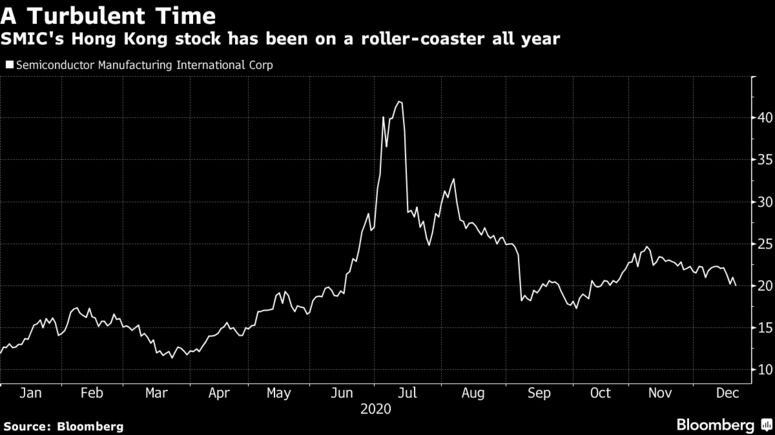
The government of the United States through its Commerce Department has taken the giant step of blacklisting drone maker SZY, DJI Technology Co., and over sixty additional Chinese companies "to protect U.S. national security". The decisive move was confirmed by Commerce Secretary Wilbur Ross, reported by Reuters. The instant effect was to see shares in SMIC, China's elite chipmaker slide 5.2 percent in Hong Kong on the news release.
"There's plenty in the open press about how DJI has been part of the surveillance state and overall suppression within China", a senior Commerce official clarified in support of the decision. The newly banned companies are majority Chinese. They will now be added to a list denying them access to American technology, from software to circuitry, joining Huawei Technologies Co. heading up the list of proscribed Chinese companies linked with the Chinese military complex.
Tension between the globe's two largest economies clashing on issues such as trade all the way to the pandemic have seen Huawei and SMIC caught in the web of disgruntled trade relations. The fact that these huge enterprises are linked to the People's Liberation Army, and to the leadership of the Chinese Communist Party does not endear them to Washington. Nor does their tradition of leaching off U.S. technology alongside their penchant for cybertheft of property rights and srong-arming U.S. companies for access to the Chinese market only on surrendering critical classified data.
The announcement need not have come as a surprise to anyone involved in the situation, much less economists, political junkies and the general public, since it was widely anticipated that President Donald Trump would move to level sanctions against China's national technological champions prior to leaving office on January 20. The American expansive use of sanctions against Chinese companies was predictably characterized by Chinese Foreign Minister Wang Yi as "unacceptable".
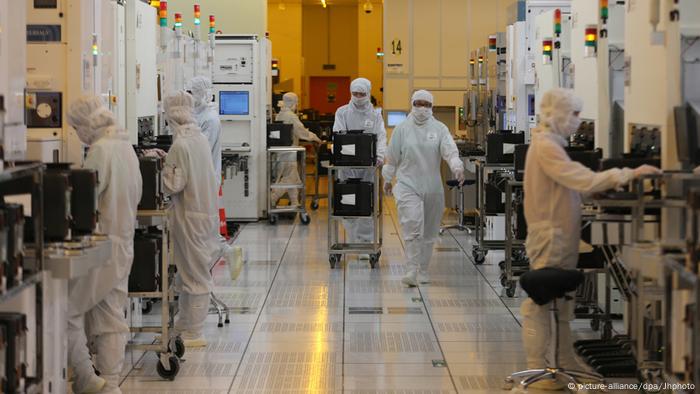
In a video address to the Asia Society on Friday, Foreign Minister Wang called on the U.S. to put a stop to "overstretching the notion of national securitry" as well as "the arbitrary suppression of Chinese companies". SMIC, a supplier to Qualcomm Inc. and Broadcom Inc. based in Shanghai, is central to Beijing's plans to build a world-class semiconductor industry in an effort to release itself from reliance on U.S. technology.
For its part, Washington views China's rise as a giant in technology and trade, and its clear ambitions to dominate spheres of technology, as a direct geopolitical threat, worthy of blacklisting. Which in clear trade and sanctions language threatens to cripple SMIC's longer-term aspirations through deprivation of crucial gear. For American companies exporting items to SMIC to produce 10-nanometre or greater advanced chips, license applications will now face "presumption of denial", even as items to produce chips more advanced than 10-nanometre are to be reviewed on a case-by-case basis.
As for any companies intending o export parts produced outside of the U.S. to SMIC, certain restrictions depending on how much of their technologies are of U.S.-origin will come into play, with Washington talking to "like-minded governments" about a unified approach to the Chinese chipmaker, according to senior Commerce officials, declining to give additional details identifying which governments the U.S. is conferring with and the potential implications on non-U.S. companies like ASMI Holding NV and Tokyo Electron Ltd. both of which also supply equipment to China for producing advanced chips.
"[I was given a mandate that included an overall objective of
restoring relations between Canada and China, one caveat and three key priorities]. First and
foremost, secure the release of Michael Kovrig and Michael Spavor and
get clemency for Robert Schellenberg. That is core. That's a priority.
Second, promote and protect human rights."
"[The third priority is to deepen person-to-person relationships
between Chinese and Canadian people at all levels, including government, the arts, business and
universities, and caveat is that those efforts must be
made in keeping with] international rules and principles that provide
predictability and security."
"We're angry. We're very angry because of our people that had
been taken. China is very angry as well, furious. We're both furious."
"The first conversation I had there was probably
one of the most unpleasant conversations I've ever had. I mean, the
shaking and anger from there, and we were also … It wasn't a
conversation."
"We're never going to be singing from the same hymn book. We did not have any formal communications, it was a lot of
informal, we now have very good formal relations. We have real
discussions where we can argue and debate."
"We're saying you need to be careful on the Chinese side because we are a high quality, safe food supplier."
"From a financial point of view, I think it was [former Liberal
deputy prime minister] John Manley who said, 'This is the stupidest
economic decision I could ever make in my life'. [His
history of business dealings with China and the suggestions
by Democracy Watch and others that those dealings put him in a conflict
of interest]. I did it
for public service. I want to help. I feel I can help the country."
Canadian Ambassador to China, Dominic Barton ... House of Commons committee on Canada-China relations
"The
military and diplomats were at odds over the People's Liberation Army
training program [and diplomats were concerned the decision to cancel
the exercise] might aggravate Beijing."
CBC report
"Unfortunately, Canada is no stranger to the complex influence game McKinsey plays with China."
"Before
becoming Canada's ambassador to China, Dominic Barton went from serving
on the advisory board of the China Development Bank to running
McKinsey's global operations."
Senator Marco Rubio, chair, Senate intelligence committee, United States
The
Government of Justin Trudeau is as Liberal as it's possible to be. He,
and his government are following in the footsteps of Canada's previous
Liberal government headed by then-Prime Minister Jean Chretien who,
while prime minister primed relations between himself personally and
China's business establishment, using his public service office as a
springboard to groom personal relations with influential Chinese
government officials and business elite. Mr. Chretien led large trade
missions to China influencing his future as a private citizen joining a
prestigious law firm and using his contacts to enlarge business contacts
with China.
It
was, after all, Pierre Elliott Trudeau, Justin's father who as Liberal
prime minister in the '70s opened relations with China to begin with. It
was likely an influence on son Justin who has spoken admiringly of
China's 'basic dictatorship' that can turn on a dime. Well yes,
dictatorships specialize in such manner. When Dominic Barton was
selected last year as Canadian ambassador to China, that choice had a
clear agenda for the Liberals; to mend broken fences at any cost, for
much depended on it. That 'much' would be enhanced trade opportunities
and investment, not strengthening Canada's sovereignty by any means.
Hostages Spavor and Kovrig, Xi, Trudeau
This,
of course, was in the wake of Canada having arrested Huawei
Communications' CFO on an extradition warrant by the U.S. Which launched
a dire situation of hostage diplomacy in direct reaction by Beijing,
furious at the detention of Meng Wanzhou. And nor did the arbitrary
arrests of Canadian citizens Michael Spavor and Michael Kovrig on
espionage charges end Beijing's lash-back; three other Canadians were
sentenced to death on charges of drug smuggling, and agricultural
product shipments to China from Canada were halted.
Canada
has paid dearly for spiking Beijing's regard for a docile, biddable
country that raised no protest over Chinese-Canadian citizens being
harassed in Canada and threatened over their support for Hong Kong
democracy, nor the infiltration by Chinese espionage agents into every
sphere of Canadian life from politics to academia, along with the
stealth action of cybertheft and purloining Canadian industrial and
scientific formulae. Yet despite all of this, Canada felt it appropriate
to invite members of the People's Liberation Army to Canada to be
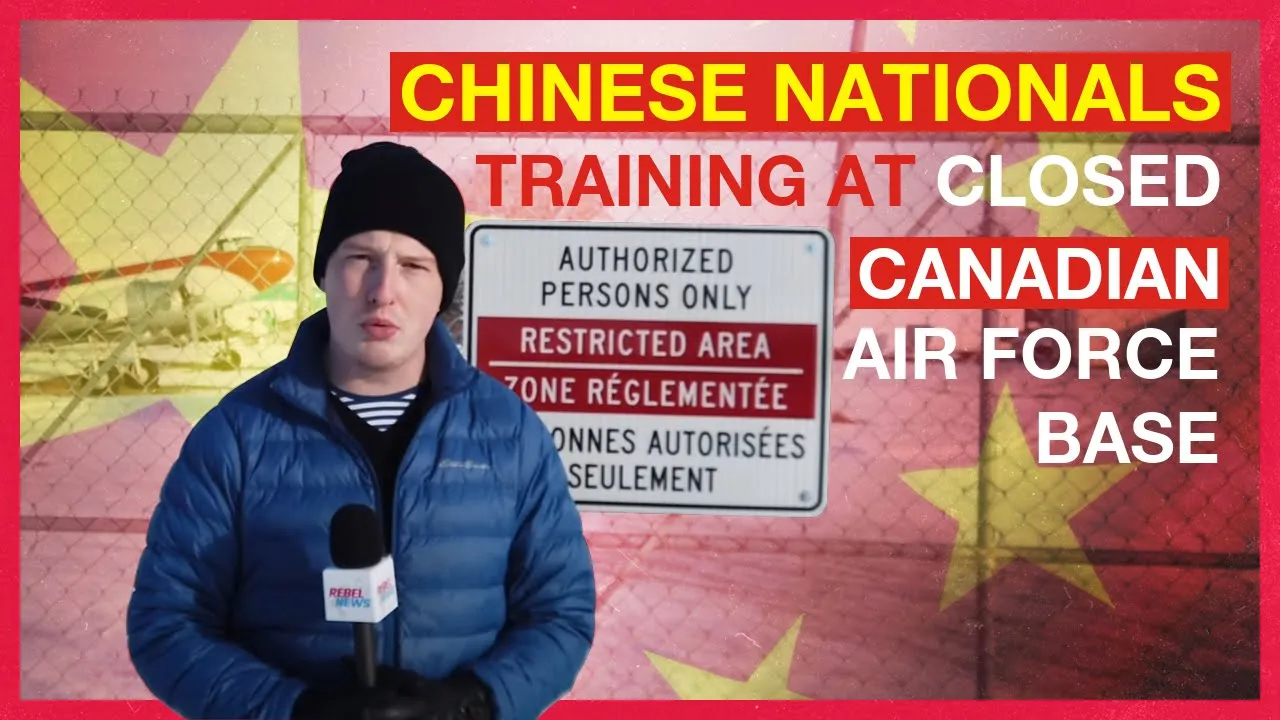
trained in winter warfare. And the more recent revelation that Chinese
pilots are training on Canadian aircraft at a closed air force base in
Ontario.
It
was the head of the Canadian military, General Jonathan Vance who
decided to disinvite Chinese troops for cold-weather military training
in Ontario. His concern revolved around national security. Much to the
displeasure of the Canadian diplomatic corps whose memoranda back and
forth to the prime minister's office revealed concerns related to
offending Beijing.
China
has and continues to punish Canada for its 'abuse' of international
law, as China claims, even while in fact, in detaining Meng the rule of
law was upheld through an extradition treaty between Canada and the
United States, and due judicial process is ongoing, with Ms.Meng
permitted to live in her two Vancouver mansions on bail while awaiting
extradition, whereas the Canadian prisoners in China languish in
solitary confinement, under harsh duress and constant interrogation,
without access to lawyers and limited interventions by Canadian consular
staff.
In
the House of Commons on November 18, the opposition Conservatives
tabled a motion for the Trudeau government to decide finally whether to
ban Huawei from Canada's 5G upgrade as other members of the Five Eyes
intelligence group (United States, United Kingdom, New Zealand, Australia, Canada) have
long since done. They also demanded that the government institute
measures to halt China's agents from their intimidation of Canadians
both in Canada and in Hong Kong.
Ambassador
Barton's assertion that Beijing would be cognizant of the quality and
abundance of food crops from Canada and be compelled to reverse its
ruinous contract breaches costing Canadian farmers billions of dollars
in lost revenues, is out-of-this-world ridiculous; those crops are
fungible; Beijing can access them elsewhere in the world, in particular
from another nation it is busily harassing, Australia. In the United
States a warning was issued to western governments that business with
McKinsey is fraught with danger because of its alignment with the
Chinese Communist Party ruling elite.
The
Liberals ignored Conservative queries regarding the need to have Barton
disclose his Chinese client lists in 2019 on his appointment as
ambassador to China. Citing McKinsey client confidentiality, the demand
was evaded although Barton had to place his investments into a blind
trust. That McKinsey conducts business with 22 of China's 100 largest
state-owned enterprises was revealed by the New York Times.
McKinsey has aided in raising the stature of the CCP regime. As a
frontman for the Liberal government and the China-boosters in Canada,
Barton was the perfect candidate.
And
his supporters are people of huge influence, including former prime
minister Jean Chretien, the Desmarais family, Power Corporation (into which Mr. Chretien's daughter married)
and the Canada China Business Council chaired by Chretien grandson
Olivier Demarais. The connections read like a Liberal-Quebec who's who
of business elites because that's what it all is, hungry for business
with China at any cost, that cost a sell-out of Canada in exchange for
trade and business and investment with China.
Human rights abuses are of no concern to this crowd, their focus is entirely on business and profit. "The weight of the world is shifting and has shifted toward Asia, so we need to do more in China",
Ambassador Barton recently stated in a speech he delivered at the China
Institute at the University of Alberta, urging government emphasize
more robust business with China.
Chinese Hostage Diplomacy, Canada's Meek Capitulation
"In my view, if the alliance was strong, the next time China embarked on hostage diplomacy, they would understand they have to change the way they do business."
Guy Sainte-Jacques, former Canadian ambassador to Beijing
"We will continue to challenge China when it comes to human rights being violated ... and cooperate on global challenges like climate change, because there is no easy path forward without China."
Canadian Foreign Minister Francois-Philippe Champagne
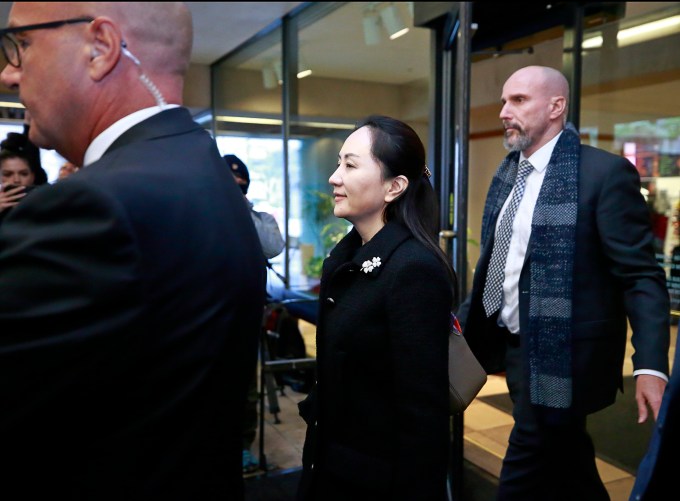
Huawei Technologies Chief Financial Officer
Meng Wanzhou is escorted by her security personnel as she leaves court
during a break for lunch on the first day of her extradition trial on
January 20, 2020 in Vancouver, Canada. (Photo by Jeff Vinnick/Getty
Images
With the enforced detention on charges of espionage of two Canadians, Michael Kovrig and Michael Spavor, an ex-diplomat and entrepreneur respectively running into two years' imprisonment as a ploy by Beijing to force Canada into releasing Huawei's CFO, held in Canada under an extradition warrant issued by the United States, China and Canada have been at a stand-off in relations with Beijing imposing restrictions on commodity imports from Canada, and Canada reciprocating by attempting subtle pacification.
At the same time, urging its fellow democracies to place diplomatic pressure on Beijing to release the two Canadians, and resisting Beijing's efforts to force the release of Meng Wanzhou who flits from one to the other of her two Vancouver luxury mansions which she is confined to, awaiting extradition proceedings. A multilateral effort has been launched by Canada to address China's 'hostage diplomacy' that has fated two other Canadians with death sentences, accused of drug smuggling.
A former Canadian ambassador to Beijing speaks of the arbitrary detention discussions as an opportunity for collegial countries to impose automatic sanctions that all signatory nations would apply when China or any other country advanced their cause whatever it might happen to be, through taking hostages, to be released once their goal has been achieved.
The U.S., U.K., Germany, Australia, France, Denmark, Estonia, Latvia, Lithuania and Spain have all spoken out publicly condemning the detention of Kovrig and Spavor, and it is likely they would form the backbone along with Canada of any new alliance on arbitrary detention. Certainly the Canadian public has a fresher view of their country's relations with the Asian giant.
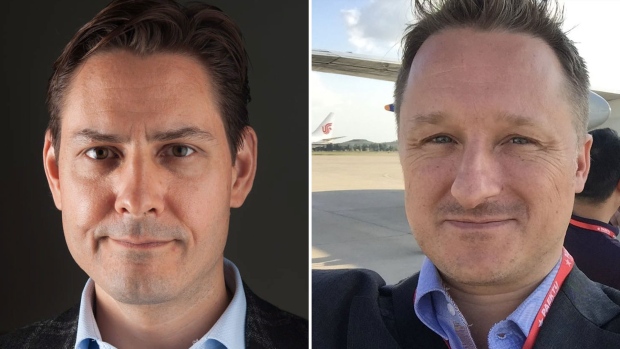
Michael Kovrig (left) and Michael Spavor (right) are seen in this composite image. One of Canada's most controversial ex-ambassadors to China says he
repeatedly tried to improve the living conditions of Michael Kovrig and
Michael Spavor after their imprisonment in the People's Republic almost
two years ago.
A newly released poll by the Asia Pacific Foundation reveals that impressions by the Canadian public of China are at an all-time low since 2010 when the same questions were asked, eliciting the response currently that Beijing's economic sweep of the world represents a threat not an opportunity as was once viewed. There are rumours that Canada is considering a pivot away from China, where once it viewed a free trade deal with the trade colossus as an achievably rewarding goal.
Minister Champagne's opinion was stated at the opening of a proposed new committee, stating the obvious, that relations with China are "complex and multi-imensional" with China "increasingly prepared to throw its weight around", so that like-minded countries have a need to defend themselves and uphold a rules-based international order. At the same time Canada is cautious about the risk of further offending Beijing and the cost inherent in so doing.
Trade looms large in the positives seen in Canada-China relations, as does the financial reward accruing to Canada through continued Chinese tourism in Canada and Chinese students studying in Canadian universities, to the point of being willing to overlook China's subversive interference in Canadian society, politics and the educational system, much less the crisis that has developed with the two detained Canadians languishing in a Chinese prison.
"To those who are seduced by this one-dimensional view [of resorting to the same 'tough talk' with China as Beijing's ambassadors have been indulging in with respect to Canada], I say this: While it is easy to be tough, let's consider to be smart", said Canada's Foreign Affairs Minister Champagne. While he thinks it is 'smart', critics of Canada's position vis-a-vis China's bullying would replace that with 'mealy-mouthed'.
But par for the course for a country that hasn't the courage of its presumed convictions.
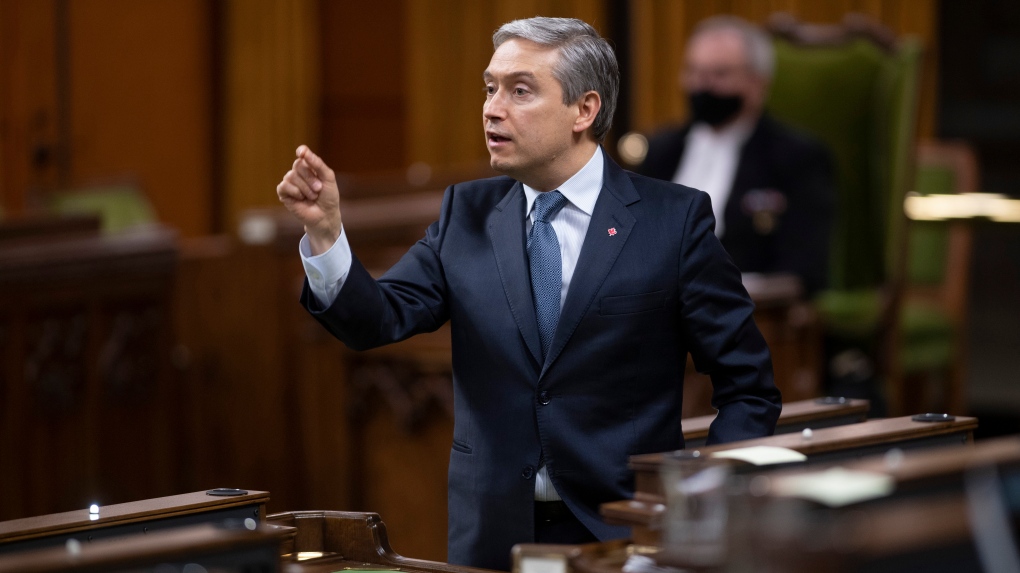
Foreign Affairs Minister Francois-Philippe Champagne responds to a
question during Question Period in the House of Commons Monday November
23, 2020 in Ottawa. (THE CANADIAN PRESS / Adrian Wyld)
"We
won't be compromising on the fact that we'll set what our foreign
investment laws are, or how we build our 5G telecommunications networks,
or how we run our systems ... that are protecting against any
interference."
"We
will always set our own laws and our own rules according to our
national interests -- not at the behest of any other nation, whether
that's the U.S. or China or anyone else."
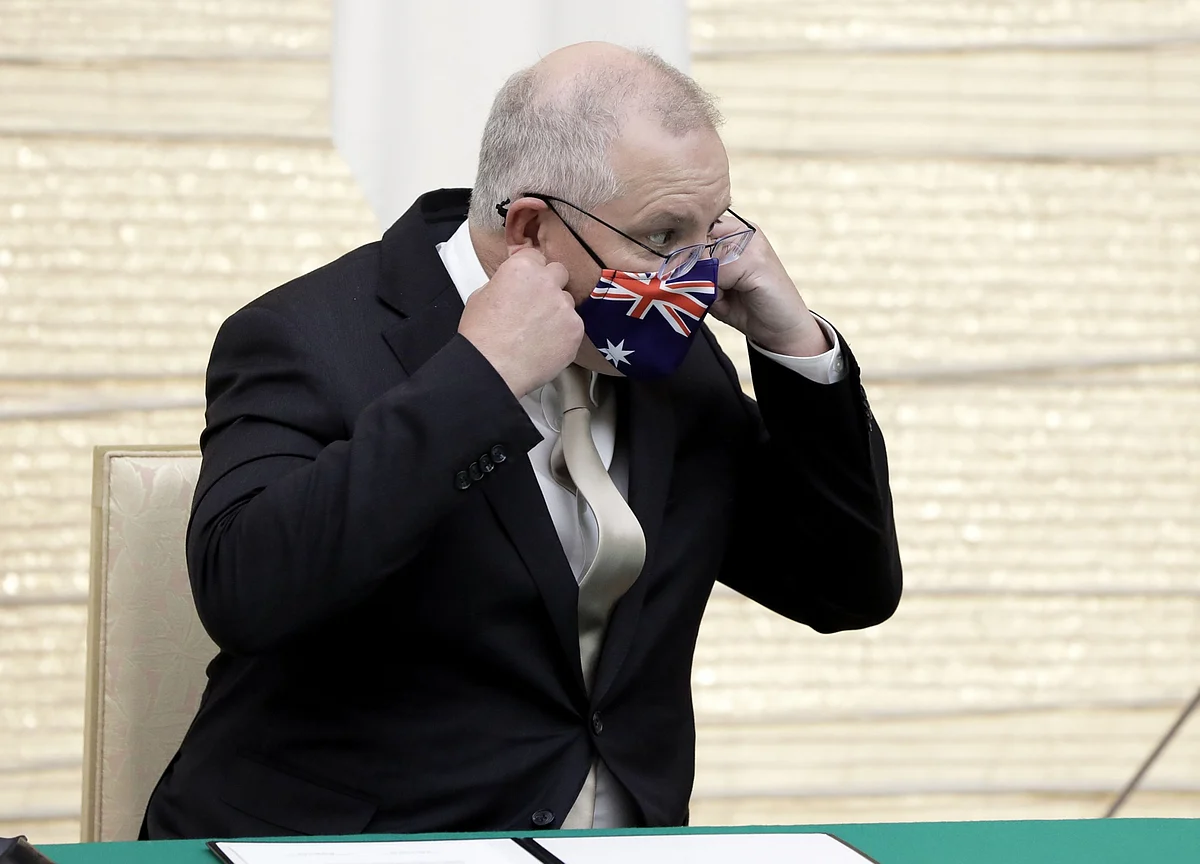
Australian Prime Minister Scott Morrison
Prime Minister Justin Trudeau CP/Sean
Kilpatrick
"Do
I regret that Canada followed its laws? Do I regret that Canada lived
up to a long-standing extradition treaty with our closest ally?
Absolutely not."
"Canada
is a country of the rule of law. And obeying those laws can't just be
when it's convenient or when it's easy. If you're a country of the rule
of law, if you're a country of values, you need to stick up for those.
And that's exactly what we're doing."
"In
the face of pressure and increasingly coercive moves by one of the
world's great powers, I think that really highlights at which point we
need to be working together as allies, as neighbours, as friends, as
countries."
"Very
few countries could stand up on its own to a superpower, to a great
power. But working together in alignment, we can make sure there is a
recognition that the path that China is choosing to take right now is
probably not going to be as effective -- even for them -- as they think
it will."
Canadian Prime Minister Justin Trudeau
"[The
government must] make a decision on Huawei's involvement in Canada's 5G
network within 30 days [and] develop a robust plan, as Australia has
done, to combat China's growing foreign operations here in Canada and
its increasing intimidation of Canadians living in Canada [within 30
days]."
House of Commons Opposition Conservatives
"We are aware that China is, and will remain, an important commercial partner for Canada."
"China
is also a significant source of tourists and students to Canada, and
brings economic and enriching social benefits across our nation."
Foreign Minister Francois-Philippe Champagne
Sing4DemocracyHK protest outside the Court of Final Appeal in Hong Kong (Anthony Wallace/AFP/Getty Images)
Australia
and Canada have displeased China mightily. China awaits both countries
to come to their senses and that would entail sincerely apologizing to
Beijing for their intransigent wrong-headed views on China regarding
many issues, inclusive of Hong Kong, Uighurs, Huawei, Chinese
benevolence, Chinese cyber espionage, copyright infringement, and above
all, COVID-19. Beijing's release this week of a list of 14 grievances
with Australia put matters out in the open down under when a Chinese
official spoke on record to an Australian reporter: "China is angry. If you make China the enemy, China will be the enemy."
According
to Australian sources the list of grievances includes instigating an
investigation in the United Nations regarding the spread of COVID-19 at
the turn of 2020, cancelling Chinese student visas as a COVID-aversion
safety measure, blocking Chinese investments in Australia, leading
international focus on violation of human rights by China and the
banning of Huawei from contributing to the Australian 5G
telecommunications network upgrade. All hostile actions guaranteed to
poison relations between China and Australia; the latter the aggressor,
the former the victim.
Australia's
Prime Minister made it abundantly clear that Australia's sovereign
decisions are not up for discussion much less explanation or apology to
the world's number one natural resources-hoarder, trade colossus, and
cybertheft expert. Australia puts its words into action and lives with
the consequences, unwilling to be bullied and coerced into pleasing or
pleading with the Chinese Communist Party for concessions and
forgiveness.
G20 Leaders photo, Riyadh on Friday.Getty Images
Canada's
Prime Minister enjoys grabbing the limelight as a victim whose defence
of justice and the rule of law has occasioned Beijing's wrath and
imprisoned two innocent Canadians for the past two years, charged with
threatening China's security, in retaliation for the detention of Meng
Wanzhou, CFO of Huawei, on a U.S. extradition request. Canada has
appealed to other APEC nations to support Canada in a joint rejection of
Chinese bullying in the hopes that Xi Jinping would be confronted at
this weekend's G20 Saudi-hosted virtual gathering.
But
is Canada prepared to go it alone, to stand up for its sovereign
rights as its Prime Minister boasted? It remains the only Five Eyes
intelligence-sharing nation to leave open the question of whether Huawei
will be included in Canada's 5G telecommunications upgrade, fearful of
Beijing's explosive wrath, whereas Australia, New Zealand, the United
Kingdom and the United States have all clearly stated their positions to
shut out Huawei citing obvious security reasons.
Canada,
on the other hand, saw fit to award a standing offer for conveyor-style
X-ray machines to Nuctech, a Beijing based company partially owned by
the Chinese government, once operated by the sun of the former General
Secretary of the Chinese Communist Party. Canadian, American and British
companies all competed for the standing offer, but it was Nuctech who
won the tender including delivery, installation, operator training and
software training at Canadian embassies located world-wide.
It
was only when a national newspaper broke the news of the contract that
the federal government committed to a review once the contract was
exposed, and ultimately decided not to buy Xray machines for Canadian
embassies from the controversial Chinese firm. But it turns out that the
Canadian Border Services Agency had already bought and installed
Nuctech X-ray machines:
"We
have a number of mitigating interventions that we put in place around
this technology. One of the first ones is obviously to keep it
disconnected from our networks and from any Government of Canada
networks ... the second is (anyone) affiliated with any of our suppliers
would be screened through security processes and would be escorted on
site if they were present in our facilities", explained the vice-president of the CBSA;s intelligence and enforcement branch.
Why
go through all this rigamarole necessitated by the use of the machines
to begin with? To do otherwise, it would seem, would be to offend
Beijing. Who could easily retaliate as they have done with holding two
Canadians they've charged with espionage as hostages to force the
release of the Huawei executive. China also flexed its trade muscles
when it refused Canadian pork exports and canola products, both
commodities that enjoyed a heavy trade prior to the Huawei affair.
All
of this in light of Canada's Communications Security Establishment's
Canadian Centre for Cyber Security releasing a new report in which
Russia, North Korea, Iran and China are listed as cybersecurity threats
to Canada. An earlier report by the National Security and Intelligence Committee of Parliamentarians pointed out that China and Russia are using their diaspora, undercover agents and
groups based on Canadian campuses as part of "significant and sustained"
foreign interference campaigns in Canada, according to a redacted
intelligence report.
"The committee believes that these states target Canada for a
variety of reasons, but all seek to exploit the openness of our society
and penetrate our fundamental institutions to meet their objectives."
"They
target ethnocultural communities, seek to corrupt the political
process, manipulate the media, and attempt to curate debate on
post-secondary campuses."
"Each of these activities poses a significant
risk to the rights and freedoms of Canadians and to the country's
sovereignty: they are a clear threat to the security of Canada."
"[This] so-called genocide [is] a rumour and a farce
fabricated by some anti-Chinese forces to slander China."
"Its
groundless statement [committee report] is full of lies and
disinformation. {Parliamentarians would do well to] avoid doing any
further damage to China-Canada relations."
"This is blatant
interference in China's internal affairs and reflects those Canadian
individuals' ignorance and prejudice. China firmly deplores and rejects
that."
"[The installations are] vocational training and education
centres [where religious] extremists [are educated in the] national
common spoken and written language, legal knowledge, vocational skills
and de-radicalization."
"The aim is to eliminate the root cause of terrorism and extremism."
Zhao Lijian, spokesperson, Chinese foreign ministry
In this photo, a guard tower and
barbed wire fence surround a detention facility in the Kunshan
Industrial Park in Artux in western China's Xinjiang region. (Ng Han Guan/AP Photo)
This represents a general opinion site for its author. It also offers a space for the author to record her experiences and perceptions,both personal and public. This is rendered obvious by the content contained in the blog, but the space is here inviting me to write. And so I do.