Tribal Nationalism Afire
Now that's a bombshell of unexpected proportions. Pierre Karl Peladeau
surrendering to his tribal conscience telling him that he must step
forward to align himself with the left, the unions he has always
upbraided and derided, and those of ideological inclinations he has
never found much sympathy for. Suddenly, he sympathizes. He thinks, he
has said, of his children, and wants them to feel comfort bathing in the
security of tribal nationalism.
 |
| Parti Quebecois leader Pauline
Marois and Pierre Karl Peladeau greet supporters as they arrive in
Saint Jerome, Que., to announce Peladeau as PQ candidate for that riding
on day five of the Quebec provincial election campaign. THE CANADIAN
PRESS/Graham Hughes |
Politics,
philosophy, economics, none of that motivates people so much as
tribalism does. And usually when we think 'tribe' or 'clan', we think if
primitive emotions, of groups of people living in profoundly
dysfunctional environments, surrounded perhaps by other tribal groups
threatening each the other's peace and security. Well, it seems the
Quebecois express fears and frustrations that put them in direct lineage
with, for example, Palestinians.
No wonder there is
such sympathy among the French in Canada with the 'plight' of the
Palestinians. The reality of Israel, a Jewish state in a Muslim
territory engendered the furious hatred of Palestinians who feel they
have been disenfranchised from their birthright by an upstart group of
intruders forcing themselves on to a geography that doesn't want them.
Israel has Fatah/Hamas hungering for its swift demise.
Quebec
views the conquering English armies of a time long past as illegitimate
overseers of a far more extraordinarily exceptional culture, language
and heritage than their own. The influence of the majority
English-speakers in Confederation represent a cultural-linguistic threat
to French Canadians whose heritage is more dear than any investment in a
nation comprised of both 'founding' nations plus those whom the
presence of Europeans displaced, along with the continuing influx of
immigrants.
Little wonder the current Government of Canada
feels such affinity for the State of Israel, willing to defend it in
hostile circles that generally sympathize hugely with the "Palestinian
cause", prepared to think of Israel as an 'oppressor, apartheid' state,
because that fits the narrative they prefer. It is an inherited burden that Canada recognizes well.
Quebec, within Canada, needed the Bloc Quebecois and the Parti
Quebecois to lead them out of the wilderness of captivity within a
union of French and English, where the quality of French expression and
culture is never adequately appreciated, when francophones
are expected to comport themselves no differently in an integrated
society as any other language-come-lately through the kind of mass
emigration that made Canada what it is today.
Francophones
have never been particularly shy in the last half-century to complain
about their status within Canada. And Anglophones have never been
particularly loathe to cut them slack, to attempt all measures at their
disposal whether convenient or not, to appease and impress the French in
Canada with the esteem in which they are held as an integral and truly
impressive portion of the whole. It is never enough.
No amount of accommodation, deal-making or cozying
up and promises have ever sufficed to soothe Quebec's hurt feelings
dating back to the battle of the Plains of Abraham. They must become a
Republic, a sovereign political, national entity, for that is their
destiny in emulation of France from whence they came. Negotiations to
improve relations, to convince Quebec that its value within
Confederation is incalculable fall on deaf ears.
The
power of grieving tribal nationalism transcends all matters of
practicality, of loyalty, of usefulness to both parties' future
aspirations as a unified and mutually-supporting tandem; Quebec/Rest of
Canada. The visceral nature of Quebec's ongoing, defiant, entitled
rejection of confederation, its feverish forays toward secession
surmount all considerations.
Quebec will not be
appeased, it will not be placated, for there is nothing Canada can do to
persuade francophone separatists that they have anything to gain by
bargaining 'in good faith' with their Anglophone counterparts. And the
more that is surrendered to Quebec's demands, the greater those demands
accelerate, one querulous insistence after another to ensure that all
regard Quebec as 'special', more entitled than any other sum of the
parts of the whole.
 |
www.yalibnan.com
“israeli palestinian peace negotiations”
|
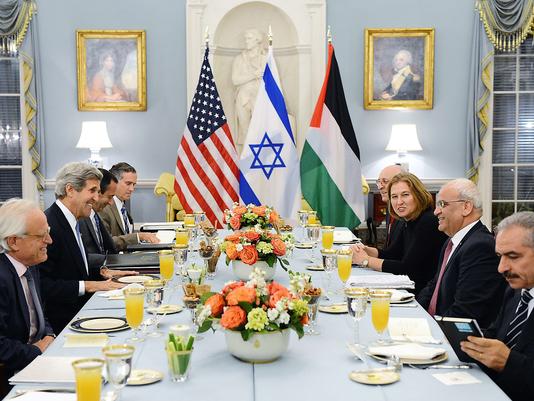
Just
as Israel negotiates year in, year out, time after time with the
aggrieved Palestinians, revelling in grief in their refugee status that
cannot, will not be reversed until such time as Israel dissolves itself
in remorse, leaving the geography for Palestinians to flood back to
recapture history as they want it, frozen pre-1948,
so too does Quebec anticipate that Canada and Canadians will eventually
tire of struggling to appease Quebec, and wave it on to separation.
Labels: Canada, Conflict, French, Israel, Negotiations, Palestinians, Quebec
Sad and Sordid Similarities
In the Palestinian Territories
there is an active war with its neighbour, Israel. Not a military war,
but a war of minds. Palestinians are captured in a net of unforgiving,
unrelenting resentment that fuels their sense of victimhood and hatred against Israel. This is a deliberate, institutionalized policy of Fatah, every bit as much as it is of Hamas, rival political-ideological foes, each representing themselves as the true champions of the Palestinian 'cause'.
The
Palestinian cause could readily be solved, which is to say its wish to
be recognized as a sovereign state could become reality. But it comes at
a price. To accomplish that goal it must be prepared to sit down at the
bargaining table with its neighbour, to negotiate terms and conditions
to establish a lasting, reliable and honourable state of peace between
the two. The land to be shared; one portion allocated to Israel, the
other to the Palestinians.
Hamas
simply scorns the very idea of Israel having any legitimacy whatever in
the Middle East, and certainly not on land which they deem to have been
accredited to Arab rule, by the Palestinians who came to the area
primarily from Jordan and Egypt. The two solitudes represented by the
West Bank and Gaza are representative of the different culture and
heritage obtaining in Jordan and Egypt, informing the current culture of
both Territories.
What they do have in common is that
both Territories' peoples are taught from an early age that the
formation of the State of Israel was a tragedy, a catastrophe of
monumental proportions for the Palestinians; their land and their right
to autonomy within the land, although traditionally denied them by
Jordan and Egypt, was horribly infringed upon by Jews who stole the land
from under the rightful owners.
This is a story
without end, just as the 'refugee' syndrome that the Palestinians clasp
dear to their hearts is a tragedy without end. It might end only with
the departure of the Jewish State in a Muslim-dominated geography, one
that was wholly consecrated to Islam, until the upstart Jews made their
mark. The heritage of Judaism, and the reality that Jews have always
lived in the neighbourhood is denied unequivocally. And the Palestinian
Authority has no intention of recognizing Israel as a Jewish state.
As
such it would have to surrender its demand that the Palestinians living
in what is now Israel, along with their countless descendants, must all
be allowed to return to what was once theirs to reclaim it in
perpetuity. Without that agreement which in effect would destroy the
intention and nature of the State as one while not limited to Jews only,
is meant to reflect the Judaic presence as a majority, legitimizing it
as a Jewish state, would be accomplished.
School texts
are written for the express purpose of emphasizing the criminal
illegitimacy of Israel, occupying Palestinian heritage, a heritage that
had its questionable presence in the modern era, alongside that of the
original Palestinians, Jews who had lived there for millennia.
Children are taught of the blessings inherent in 'resistance', in the
restoration of Palestinian pride, honour and belonging. They are taught
hostility toward the occupiers.
And children become
adults deeply steeped in the pathology of suspicion, hatred and revenge,
creating a population functionally incapable of living in peace and
harmony with those next door. A situation that makes it just about
impossible for the two sides - Arab and Jew - to sit down together with
confidence and trust that each will be prepared to make reciprocal
sacrifices to satisfy the needs of the other so that an effective
settlement for peace can be reached.
Who might imagine
that a somewhat similar situation exists in Canada? For it does. Quebec
speaks of itself as a nation. Its institutions are called national
institutions, not provincial ones. French-Canadian schoolchildren are
not taught the history of Canada. They are taught the history of Quebec,
outside and without Canada. They are led to believe that they are in
essence, living within a nation, just as Canada itself is a nation, but
without Quebec.
The words "Canada" and "Canadian" are
despised, incendiary nomenclatures within Quebec French-Canadian
circles. This is a matter of politics, of culture, of pride, of
determination. And, hugely, resentment. And it is not necessarily
traditional, but it is reflective of the second half of the 20th Century
attitudes in the province. School texts teach Quebec history, inclusive
of the existence of Front de Liberation du Quebec.
The FLQ
was a terrorist group. They focused attention on themselves, on their
radical separatist purpose and their violent conflict with the federal
government by setting bombs, by the violence of their language and their
threats, and by their abduction of those whom they felt were
symbolically responsible for the purported suffering of the French under
English rule. Canada may be officially bilingual, but despite
legislation to the contrary, Quebec is officially unilingual.
History texts speak of the FLQ-murdered Pierre Laporte
as an incident where the man was "found dead", and no elaboration
given, no mention of murder, no explanation that those responsible were
convicted in a court of law of murder. The French language must be
protected at any cost from the malign presence of English, and students
are to be taught all about "the Quebec space", but there is no mention
of a corresponding "Canadian space" for balance.
All
school texts teach about Bill 101, in protection of the French language
in Quebec, and the need to repress English, to diminish its influence,
to give it little official status. There is never any mention that
French is protected as an official language across Canada. The day that
all Canadians celebrate as "Canada Day" is simply referred to in Quebec
as "July 1". Students are exposed to a history chapter with a unit
titled
"Must we celebrate July 1?"
It concludes by asking the student:
"Last year, did you celebrate on July 1? Why?" July 1 in Canada appears to be Quebec's version of the Palestinian Nakba calamity, a day of mourning.
Labels: Canada, Conflict, Controversy, Education, Fatah, French, Hamas, Heritage, Human Relations, Israel, Judaism, Palestinians, Quebec


