"It is Slow, Meticulous and Can be an Extremely Deadly Process"
"We
haven't seen big movements [since the U.S. bombing in June]. Maybe a
car or a truck [but] not bulldozers digging things out."
"[The
cylinders are] not very big [and] not specially protected [though it is
possible that some] decoys [have been placed among them to confuse and
impede anyone trying to remove them]."
"[While
not privy to any military decisions] what I can say is that this
considerable amount of material ... is highly contaminant, so there
could be some contamination if there was a direct hit on it."
Rafael Mariano Grossi, director general, IAEA
"[To
get to the buried Isfahan stockpile], you have to get excavation
equipment, break through the concrete and lead shield [and any other
protective covering], and then you somehow have to get to the bottom of
this silo and remove the containers full of nuclear material and fly
them out."
Anonymous expert
"There's a lot of risks associated with it. This is a very high order of complexity. There likely will be casualties."
"But this is the problem set for U.S. Special Operations forces. It's what we do."
"We have people who are specifically trained to go into these types of environments."
"[The
best way to recover the material would be following a ceasefire and
accompanied by IAEA personnel.] But if you have to fight your way in [it
could be feasible]."
Retired General Joseph Votel, U.S. Central Command/U.S. Special Operations Command
U.S.
President Donald Trump appears to be mulling over the possibility of
monitoring or retrieving highly enriched uranium believed to be buried
at the Iranian nuclear sites attacked by the U.S. last year at Isfahan. "Intense satellite surveillance" could help to monitor the location of the nuclear material. Should the plan be to seize Iran's uranium it "would be one of, if not the largest, most complicated special operations in history" in the opinion of former deputy assistant secretary of defence, retired CIA and Marine officer, Mick Mulroy. "It's a major risk to the force."
"It's the job of the Pentagon to make preparations in order to give the commander-in-chief maximum optionality."
"It does not mean the president has made a decision."
White House spokesperson Karoline Leavitt
Iran,
according to the International Atomic Energy Agency, has stockpiled
some 970 pounds of uranium enriched to 60 percent; short of
weapons-grade level. A nuclear facility outside Isfahan holds over half
of that total stored in tunnels over 300 feet deep. Satellite imagery
from early June analyzed by the Institute for Science and International
Security show a large flatbed truck carrying 18 blue barrels toward the
southern entrance of the Isfahan facility. The barrels, it was
conjectured, contained highly enriched uranium cylinders moved for
storage within the tunnel mere days prior to Israel and the U.S.
launching airstrikes on Iranian targets.
The
logistics of an operation of recovery of those barrels are
extraordinarily complex; to begin with, striking Iranian defences and
equipment to clear a safe passage for ground troops to fly hundreds of
miles into the country to establish a defence perimeter at the
facilities. The Army's 82nd Airborne and Rangers parachuting to seize
the ground within range of enemy artillery, missiles and drones.
Engineers might build an airstrip to bring in supplies and equipment
airdropped from cargo aircraft; operations vulnerable to enemy fire.
A
large number of support troops -- mechanics, drivers, refuellers and
others would be required to work 24-7 with food and water resupplied
constantly. Nuclear specialists would be on site to assess risks and
supervise the removal of uranium. The need to blast through rock and
enter the storage area would be a yard-by-yard process for commandos to
enter an unknown facility. Saws and blow torches would be needed to
breach the area, possibly the Army Delta Force or Navy SEALS, to pass
underground facility obstacles.
South tunnel entrance of the Isfahan underground complex near the Isfahan Nuclear Technology Center, Iran. (Bulletin / Google Earth)
Commandos
geared with protective uniforms and rebreathers, carrying radioactive
detection sensors while shooters covered them. Anything shot at, that
might explode or cut through, could hit dangerous material. Radioactive
exposure requires arduous and repeated decontamination of personnel and
equipment. "It is slow, meticulous and can be an extremely deadly process",
stated a former operator. Troops, equipment and nuclear material would
be exposed to possible attacks by Iranians through the exfiltration
process as personnel are airlifted through enemy airspace.
An Iranian woman walks past a view of Tehran's research reactor in Tehran. Morteza Nikoubazl/Getty
"The
fact that Iran is the only non-nuclear-weapon State in the world that
is producing and accumulating uranium enriched to 60 percent remains a
matter of serious concern, which has drawn international attention given
the potential proliferation implications."
"[The
IAEA cannot] ignore the potential proliferation implications [and it is
not in a] position to provide assurance that Iran's nuclear program is
exclusively peaceful."
International Atomic Energy Agency
"The Iranian regime is the most destabilizing force in the Middle East and the largest state sponsor of terrorism in the world."
"A nuclear-armed Iran would pose a grave threat to global security and U.S. national security."
"Allowing Iran to obtain nuclear weapons is an outcome that must never be allowed."
"This military escalation was ordered unilaterally, without Congressional authorization or meaningful consultation."
"There are important Constitutional implications that must be addressed going forward."
New Jersey Democrat Senator Cory Booker
"Presidents
of both [U.S. political parties] have deployed U.S. forces and ordered
the use of military force, without congressional authorization, on
numerous occasions."
"Over
the last two decades, Congress has acquiesced more and more to uses of
military force by presidents of both parties without congressional
approval and with little congressional oversight."
Adjunct senior fellow for international and national security law, Council on Foreign Relations, John Bellinger
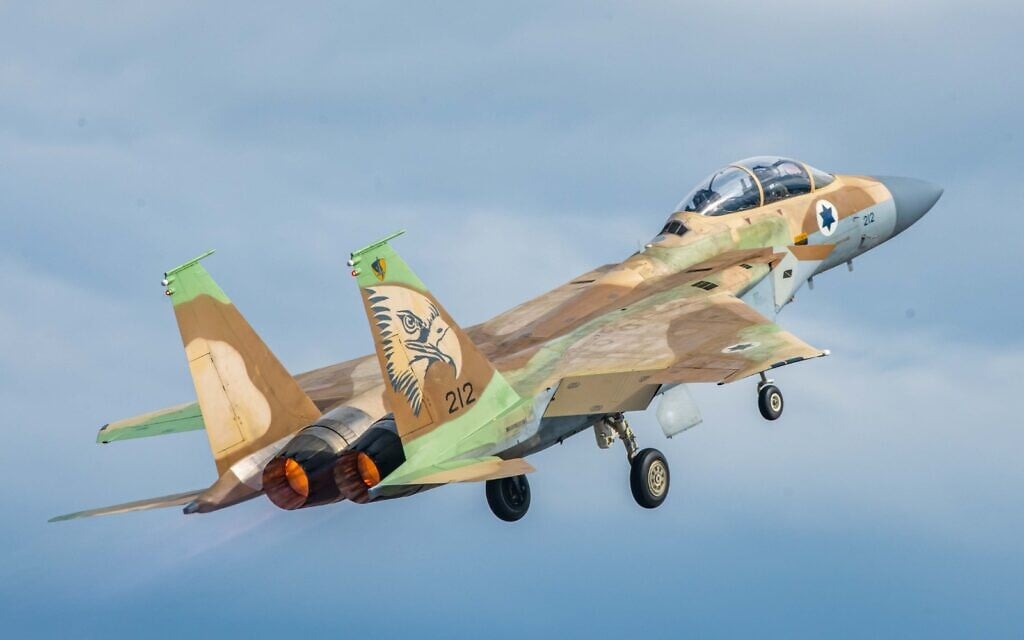
An Israeli Air Force fighter jets takes off for strikes in Iran, June 18, 2025. (Israel Defense Forces)
Three
Iranian nuclear facilities, Fordow, Isfahan and Natanz, were struck on
Saturday in preemptive assaults by the United States, which decided to
join Israel in its aerial bombardment of Iran's nuclear installations
with a view to prevent the Islamic Republic from succeeding in the
manufacture of atomic bombs to add to its ballistic missile arsenal in
its aspirations to produce warheads. Short-range ballistic missiles to
be used to destroy Israel, long-range missiles to strike the United
States; as threatened time and again.
According
to the International Atomic Energy Agency, the largest sponsor of world
terrorism is estimated to possess sufficient uranium to enable it to
create nine nuclear weapons after undertaking the short step to enrich
its uranium product from the current 60 percent to the required 90
percent enrichment. "Since
16 February 2021, the Agency has not been able to verify Iran's total
enriched uranium stockpile precisely on any given day", reads the IAEA's May report of verification and monitoring in Iran.
As
far as cooperating with the international inspection agency is
concerned, Iran has never been open and above-board with respect to its
nuclear plans and actual research and production practises. Inspectors
were withheld the opportunity to monitor heavy water production required
for the nuclear program; access to enrichment facilities were refused
for Natanz and Fordow; and centrifuge inspections or other
infrastructure were not allowed to proceed.
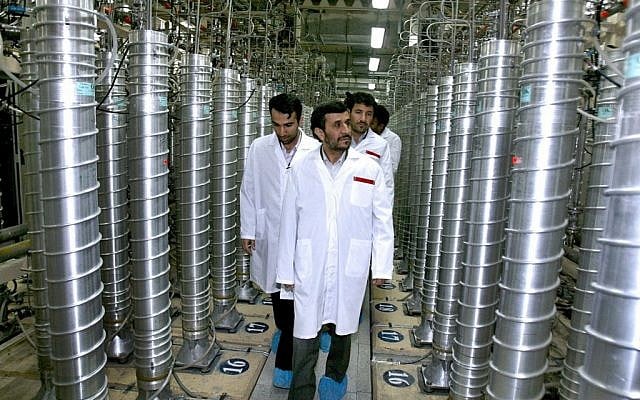
Then-Iranian President Mahmoud Ahmadinejad visits the Natanz Uranium Enrichment
Facility some 200 miles (322 kilometers) south of the capital Tehran,
Iran in 2008. (AP/Iranian President’s Office)
Iran
is a signatory to the Joint Comprehensive Plan of Action between it and
the United States, the United Kingdom, France, Russia, China and
Germany, agreed to in 2015. When the deal was signed then-U.S. President
Barack Obama, described the outcome as: "The historic deal which will prevent Iran from acquiring a nuclear weapon".
This was a deal that failed to include Iran's emerging technology in
the production of ballistic missiles, and one that completely
sidestepped its primary links to terrorist groups.
Since
that signing and the pledge inherent in its agreement a decade ago,
Iran has hindered inspectors, flouted a key point of limiting levels of
uranium enrichment to an agreed-upon 3.67 percent -- instead proceeding
with enrichment of uranium to 60 percent in direct violation of the
agreement. The Islamic Republic succeeded in amassing a stockpile of
408.6 kilograms of 60 percent uranium.
Figures
from the IAEA state that 42 kilograms of 60 percent enriched uranium
can produce one atomic bomb, enriched further to 90 percent. 408
kilograms therefore, represents a potential for nine weapons if further
enriched. A controversy has erupted in the wake of Saturday's
bunker-busting bombs aimed at penetrating the mountain fastness of the
Fordow facility. There is uncertainty over the extent to which Iran's
nuclear program was impacted.
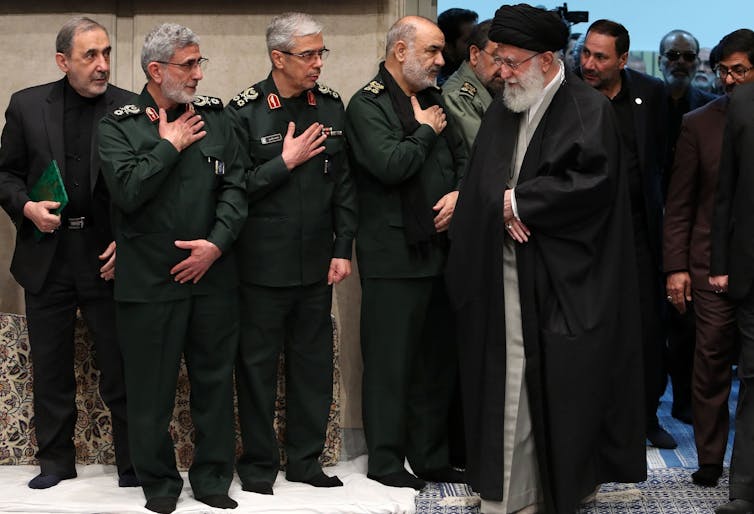
Iran's Supreme Leader Ali Khamenei and his military leaders face an enemy with superior military hardware.Anadolu via Getty Images
Iran
is unlikely to be entirely shut off from obtaining nuclear weapons in
months or years into the future. What the strikes accomplished was to
address the immediacy of the situation whereby prevention was required
to ensure atomic bombs, so close to completion on the horizon, was set
back for possibly a considerable amount of time. In that time, it would
be possible, even feasible, that the regime would fall, and with it the
Islamist ideology of acquiring weaponry of a striking calibre that could
result in catastrophic loss of human life.
Were
Iran to be left to its malign devices as it has been to the present
time -- prior to Israel's unleashing of an aerial campaign of precision
and determination to not only strike nuclear emplacements, but military
and IRGC bases, weapons caches, along with assassinations of key
government, military and scientific leading figures to send the program
into disarray while eliminating many of the figures deeply involved in
supporting nuclear weaponry development -- the production of nuclear
weapons was assessed to be mere weeks or months ahead.
Iran's
bad faith relationship with the nuclear inspectors, its hidden nuclear
sites, its stated intentions threatening the survival of an entire
country in the Middle East, naming other countries as enemies to be
dealt with harshly as "Death to America" portends,
made it a mandatory intervention of survival for at least two
countries, and likely more, inclusive of the majority-Sunni Arab
countries sharing the geography of the Middle East, which Iran's
Shi'ite-led 'axis of evil' was groomed to conquer.
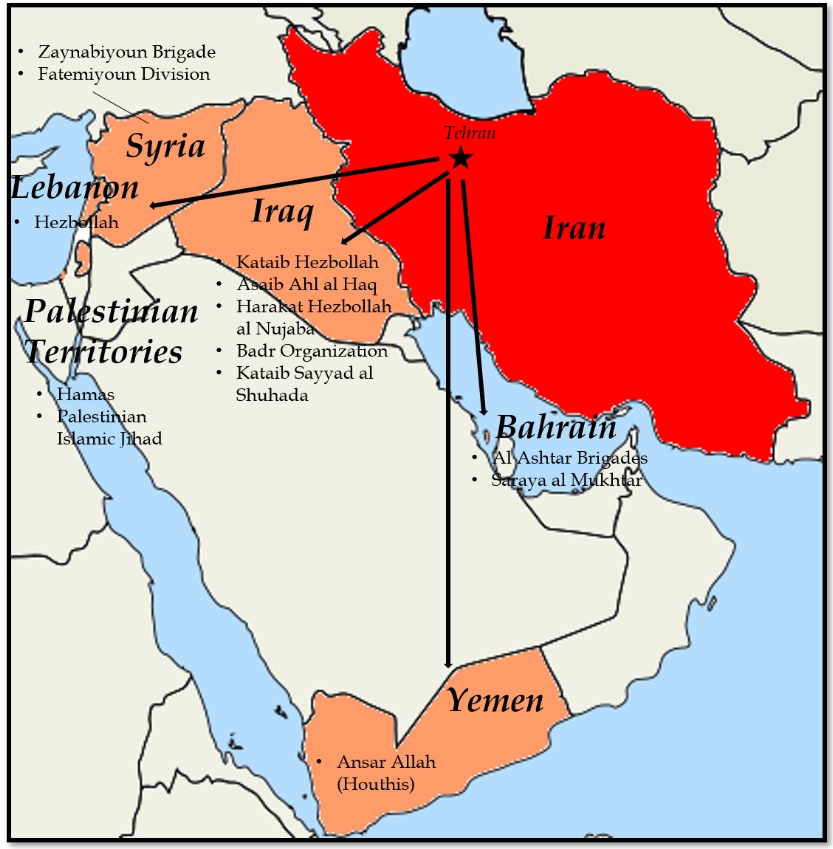
Iran
has furthermore, trained and armed terrorist groups like Hezbollah in
Lebanon, Hamas in Gaza, Houthis in Yemen, and Shiite militias in Iraq,
providing them with updated technologically advanced rockets. There are
no guarantees that Iran would withhold from its proxy terrorist groups
atomic weaponry that would make them infinitely more dangerously
effective at carrying out their directives from Iran to do its bidding
in attacking and annihilating the Jewish state. Jihad demands total
loyalty to the concept of killing non-believers as an obligation to
Islam.
Terrorist
groups in possession of nuclear weapons would represent a nightmare
scenario of helplessness for any targeted population living in fear and
trepidation of imminent attacks by terrorist groups for whom a massive
death toll would be viewed as a success in following through that
obligation to prove to Islam that the world stands in awe and suspense
over where and when the final blow from Islamist terror would strike in
its challenge of the non-Muslim democratic world.
The
decisions made by Israel and the United States in striking at Iran and
its threatening forces was long overdue in view of the simmering
antagonisms and terrorist attacks taking place throughout the world as
Islamist terror normalized its presence as a counter-weight in world
affairs to long-distant colonial rule and the supremacy of Western
thought, technology, laws and values in a world that Iran believes
belongs to Islam and its values and laws.
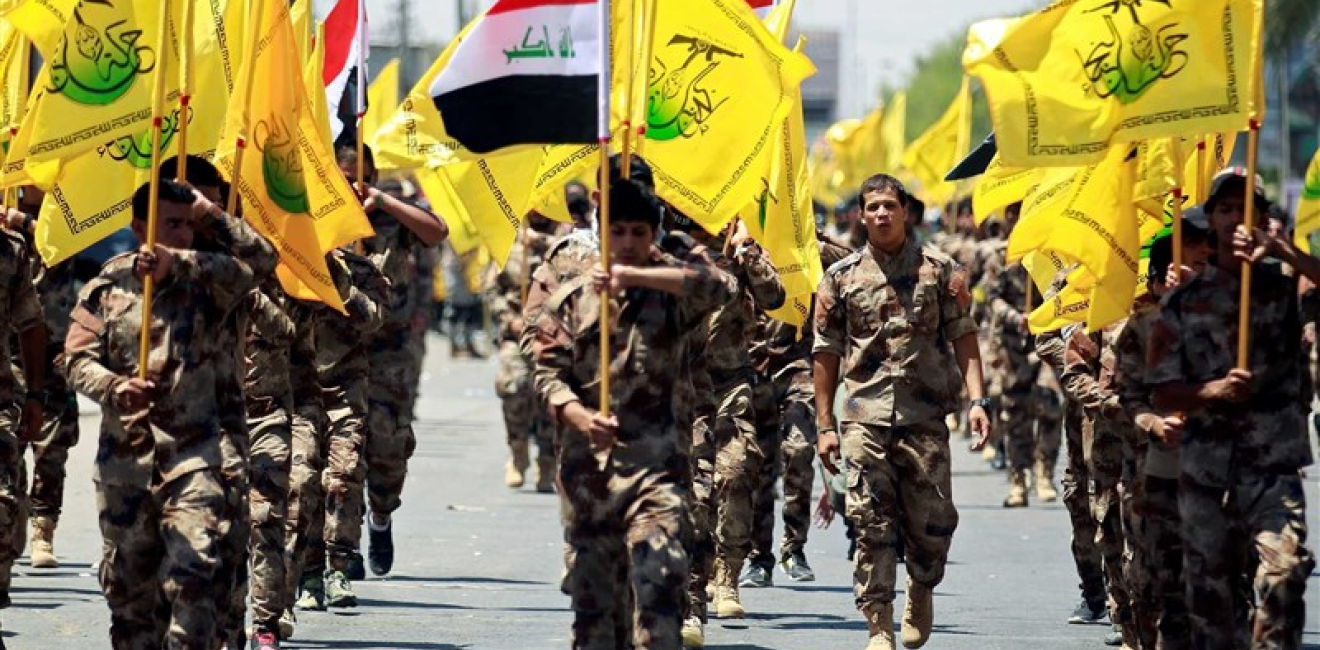
Harakat Hezbollah al Nujaba, an Iraqi militia trained by Iran's Revolutionary Guards Wilson Center
"Every morning we wake up and see that they have hit only residential homes."
"Our
forces don't shoot back because the 30km (19-mile) zone around the
power station is sacred. You don't want to shoot there. But the Russians
are terrorists. There's nothing sacred to them."
"It's meant to scare us, [Rockets have hit Nikopol every night since the middle of July]."
Local Businessman
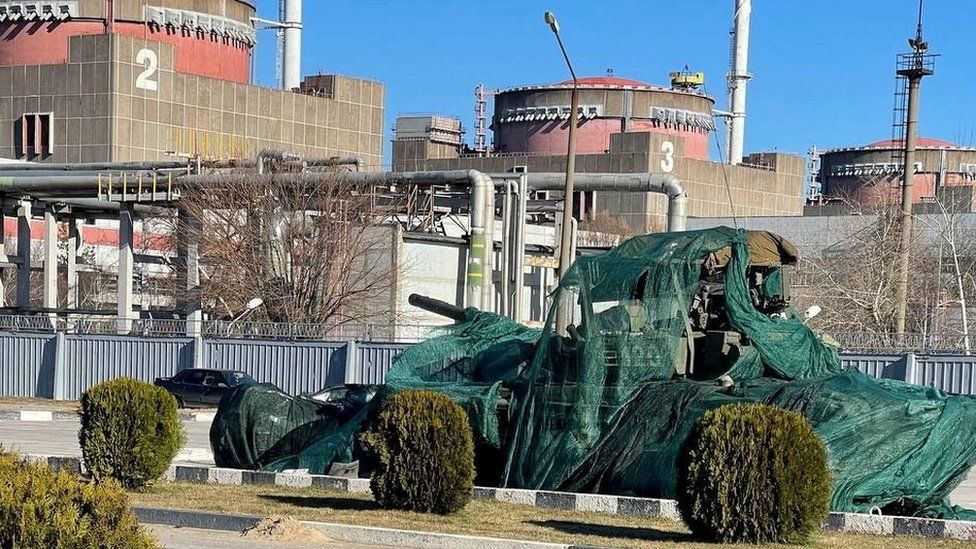
A covered Russian tank outside the Zaporizhzhia nuclear power plant on 4 August ENERGOATOM/Reuters
"As
the initiator and main instigator of the Ukrainian crisis, Washington,
while imposing unprecedented comprehensive sanctions on Russia,
continues to supply arms and military equipment to Ukraine."
"Their ultimate goal is to exhaust and crush Russia with a protracted war and the cudgel of sanctions."
Beijing Ambassador to Moscow Zhang Hanhui
"The cowardly Russians can't do anything more so they strike towns ignobly, hiding at the Zaporizhzhia atomic power station."
Andrei Yermak, chief of staff to President Volodymyr Zelenskyy
The
outliers of the United Nations Security Council in lock-step denial of
representing tyrannical governments coveting territory of neighbours and
exercising their ambitious penchant for bullying and threatening and
finally committing to a military advance to correct historical errors so
they can 'reclaim' a territorial prize by absorbing another sovereign
country's geography into their greater grasping fold. The mirror image
of Moscow's 'special military operation' to bring Ukraine kicking and
screaming back into the Soviet Union fold, is reflected in Beijing's
plan to violently disabuse Taiwan that it is a separate country.
Mutual
support for one another's irenic plans of absorption through violent
takeover enables them to give each other comfort. Russia's experience
with the West firmly clamping down on sanctions to fully impress on the
Kremlin that its actions assault international norms presents as an
example to Beijing, labouring under similar sanctions and for
aspirationally awaiting the opportunity when it too feels prepared to
launch an all-out conflict with Taiwan to achieve its goal of an
'individed China'
Ukraine
raises the alarm once again over the Russian military occupying the
Ukrainian nuclear power plant representing the largest such facility in
all of Europe, in a dangerously cavalier manner. Ranging from the
storage of explosives and military equipment in sensitive areas of the
nuclear plant, to recklessly firing off missiles from the plant's campus
at surrounding towns where Ukrainian military units are stationed in
the hope of driving out the Russian troops to reclaim the plant and its
security.
Moscow
for its part insists that the town Ukraine identifies as being targeted
by Russian troops from within the power plant's footprint, Marhanets,
claims that the Ukrainian military, stationed there, is using it as a
staging platform to send rockets to hit Russian soldiers at the
Zaporizhzhia plant. The alarm was raised in the West when the United
Nations atomic energy watchdog warned of a potential nuclear disaster
with the current situation, leading the Group of Seven leading
industrialized countries to tell Russia it must return the plant to
Ukraine.
This
was once the Group of Eight, but after Russian rebels began their
conflict in Ukraine's eastern province of the Donbas and Russia seized
Crimea in 2014, Vladimir Putin was disinvited and the group reverted to
its original members, as the Group of Seven. Ukraine's state nuclear
power company Enerhoatom, warns that Russian shelling has compromised
the plant, causing critical damage to two areas of the plant, creating
the potential for devastation.
Containers
with radioactive material might, they warn, also come under danger of
shelling. In its own defence, Russia resorts to its usual stance of
claiming to be acting responsibly, that it is Ukraine that is
responsible for any dangerous situations eventuating because of its
military's carelessness, repeating that Russian troops behave
responsibly and never target civilians.
Ukrainian
technicians remain at the plant, working to ensure whenever an
emergency arises they're present to use their expertise in safety and
security of the plant forestalling the possibility of a disaster.
Needless to say, they have no control over what Russian troops do. What
they do is shell surrounding towns from the relative safety of the
nuclear plant in the knowledge that Ukrainian troops cannot afford to
strike back and risk creating a more dangerous situation.
According
to Kyiv, roughly 500 Russian soldiers with heavy vehicles and weapons
remain at the plant where they are behaving responsibly, ensuring the
safety of the complex, as the Kremlin has it. The former's statement can
be guaranteed to be correct, the latter's, true to form is a risible
canard. Moscow and Vladimir Putin never uttered a lie they couldn't be
proud of.
"I am extremely concerned by the shelling yesterday at Europe’s largest
nuclear power plant, which underlines the very real risk of a nuclear
disaster that could threaten public health and the environment in
Ukraine and beyond."
"The IAEA has received information about this serious situation – the
latest in a long line of increasingly alarming reports from all sides."
?According to Ukraine, there has been no damage to the reactors
themselves and no radiological release. However, there is damage
elsewhere on the site.?
"Military action jeopardizing the safety and security of the
Zaporizhzya nuclear power plant is completely unacceptable and must be
avoided at all costs.?
"Any military firepower directed at or from the facility would amount
to playing with fire, with potentially catastrophic consequences."
"I strongly and urgently appeal to all parties to exercise the utmost
restraint in the vicinity of this important nuclear facility, with its
six reactors."
Director General of the International Atomic Energy Agency (IAEA), Rafael Mariano Grossi
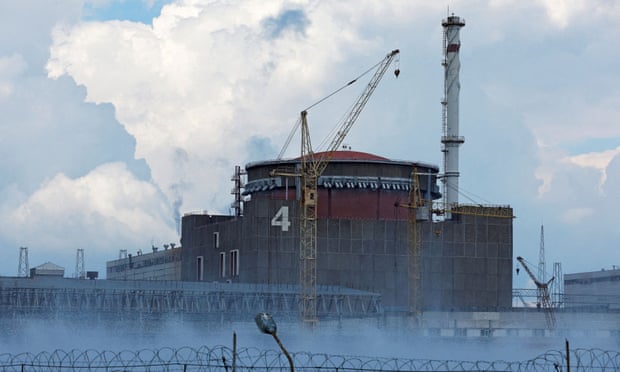
The Zaporizhzhia nuclear power plant outside the Russian-controlled city of Enerhodar, Ukraine.Photograph: Alexander Ermochenko/Reuters
"The agency’s overall assessment is that a range of activities relevant
to the development of a nuclear explosive device were conducted in Iran
prior to the end of 2003 as a coordinated effort, and some activities
took place after 2003." "The agency has no
credible indications of activities in Iran relevant to the development
of a nuclear explosive device after 2009." "The agency assesses that the extensive activities undertaken by Iran
since February 2012 at the particular location [Parchin] …undermined the agency’s
ability to conduct effective verification." International Atomic Energy Agency report
A Shahab-3 missile on display in Tehran in
2008. Iranian scientists are alleged to have worked on two secret
projects related to different technologies needed to design a nuclear
warhead, including a detonation system to fit inside the nose cone of
the Shahab.Credit
Hasan Sarbakhshian/Associated Press
"[The issue of nuclear weapons is now closed] Therefore, all measures over the past issues
have [been] completely concluded…and left behind." Iranian Deputy Foreign
Minister Abbas Araghchi
A five-month probe of Iran’s past activities concluded, the IAEA believes that the Islamic Republic of Iran operated a coordinated nuclear-weapons program until
2003. Some of those activities went on into 2009, concluded the UN atomic energy watchdog according to its preliminary report. The Agency found that the most recent work Iran had involved itself with on a weapon appeared to
be through the use of computer modeling in the development of components used in
an implosion device. That work done between 2005 and
2009.
"The modeling…has a number of possible applications, some
of which are exclusively for a nuclear explosive device", according to the report. As far as the Agency is now concerned, no credible indications were revealed of nuclear-weapons-related activities in Iran after 2009. On the other hand, the report added, Iran had failed to cooperate in providing information on some points and offered some
misleading responses.
United Nations General Assembly Hall -- Photo: Basil D Soufi
The investigation focused on the Parchin military base
south of Tehran where Iran is suspected to have
conducted tests related to a nuclear weapon. According to the Agency's understanding, Tehran
had a special chamber constructed at Parchin for the purpose of conducting containment tests
involving the detonation of over 150 pounds of high explosives.
Iran
explained the building away to the Agency as having the explicit purpose of storing chemicals and
producing explosives. An explanation rejected by a senior diplomat who said those materials would
have shown up in samples taken at Parchin this summer had that been the
case. The report stated they did not and drew the obvious enough conclusion that Iran’s explanation simply failed to fit the facts.
The Agency was quite clear in its report -- "Final Assessment of Past and Present Outstanding Issues Regarding Iran’s Nuclear Program" -- that Tehran had purposefully and with a view to deceit, sanitized the Parchin site in recent months. In addition, Tehran submitted no substantive responses to one quarter of the dozen specific questions or documents it was asked to clarify, leaving open the question of how much progress it had made in its nuclear program.
Despite repeated requests, the Agency was denied the opportunity to
interview the suspected head of Iran’s nuclear-weapons program, Mohsen Fakhrizadeh, along with a number of his elite lieutenants. Officials of IAEA both current and former felt that Iran’s nuclear-weapons program
was highly compartmentalized, making it essential to gain access to
officials throughout the overall process.
But officials briefed on the
agency’s probe stated Tehran's refusal to grant access to Mr. Fakhrizadeh
and most of the other top scientists, failed to comply with the Agency's verification need.
According to Robert Einhorn, who worked on the U.S. negotiating team with Iran until
early 2013, now a senior foreign-policy fellow at the Brookings
Institution, although the report found no evidence of recent
weapons work by Iran, "it does not resolve the IAEA’s many questions and
concerns about Iran’s past activities."
The U.S. administration, on the other hand, appears to consider the issue closed, and is now prepared to lift all sanctions, enabling the Republic to anticipate that its oil revenues whose estimated value is $100-million will be released, with far more to come in the unsanctioned sale of oil, enabling Iran to ramp up its support to Hezbollah and Syria, and resume its place of 'supreme authority' in the Middle East and beyond.
This, despite that repeatedly, the IAEA appeared on the brink of rejecting Iranian arguments
that its experimentation was meant strictly for civilian purposes. For their part, the inspectors
found Iran’s nuclear program to be "suitable for the coordination of a range of activities relevant to
the development of a nuclear explosive device", and that its experiments
had "characteristics relevant to a nuclear explosive device."
"The International Atomic Energy Agency, within the framework of the safeguard agreement, is allowed to carry out conventional inspections of nuclear sites." "Access to military, security and sensitive non-nuclear sites, as well as documents and scientists, is forbidden." Bill before Iran's parliament, Tehran
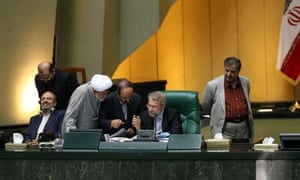
Iran’s parliament speaker, Ali Larijani, second right, speaks with members of parliament during a session in Tehran on Sunday.
Photograph: Sina Shiri/AFP/Getty Images
On Sunday, 199 Iranian lawmakers of the total 213 present at the Iranian majlis voted in favour of a bill demanding the complete lifting of all sanctions against Iran as part of any final nuclear accord that Iran will agree to in its negotiations with the members of the permanent Security Council of the United Nations; China, Russia, United States, Britain, France - and a sixth negotiating partner, Germany. The European Union chief has been deeply involved in the negotiations as well.
Iranian Parliament/Majlis
Iran has been recalcitrant, and considers suspicion harboured by the international community with respect to its nuclear intentions to be insultingly intrusive to its sovereign entitlements, and has made no secret of its resentment. Grand Ayatollah Khamenei has stated time and again his profound suspicion of the the plot against Iran's entitlement led by the 'Great Satan'. Voting to ban access to military sites, some of the lawmakers supporting the new bill chanted "Death to America".
This endearing and sincerely peaceful diplomacy that Iran, the world's foremost terrorist-sponsoring country evinces cannot fail to bring a warm blush of appreciation to the heart and soul of any who doubt its good-natured expressions in support of world stability. Should it be ratified, the bill is seen as a possible complication in the finalization of the 30 June deadline agreement to reach a final accord.
That accord is heavy on Iran's responsibility to restrain its eagerness to obtain nuclear weapons; in exchange for a slowdown in enrichment of uranium and a pledge to honour its agreement to back down somewhat on its plans to aggressively impose itself on the Middle East as a nuclear-armed power to be accorded all the respect and distance that the explicit threat entails, a gradual lifting of sanctions is promised.
Iran's nuclear negotiators point out in their inimitable sweet-mannered efforts to satisfy the demands of a concerned international community that it has already agreed to grant United Nations International Atomic Energy Agency inspectors "managed access" to military sites under strict control and specific circumstances; as though to impress upon unreasonable aggressors how compliant they are; the "managed access", "strict control", and "specific circumstances" notwithstanding.
Ayatollah Ali Khamenei rejects the very impudence of the proposal of Iranian scientists interviewed by IAEA inspectors, while the U.S. State Department reiterates its non-negotiable contention that inspections remain a key component of any final agreement. Little wonder the U.S. is characterized as the Great Satan. It remains to be seen, however, whether America will turn in its horns for a more conciliatory approach by an administration increasingly presenting itself as amenable to caving in to pressure.
One can only hope that the P5+1 negotiators, fed up as they may be by Iranian expertise in manipulation and beaming obfuscation, will recall that the Republican Guard is in full charge of the military's nuclear program, and it doesn't blink in the face of any kind of opposition.
A satellite image of Iran's Parchin military complex, where IAEA inspectors have been refused access. Photo: Twitter
The International Atomic Energy Agency (IAEA) has for the first time
publicly refused an Iranian offer to inspect a suspected nuclear site at
Marivan, an area near the border with Iraq.
In 2012, the IAEA believed that Marivan was the location of
high-explosive experiments linked to setting off a nuclear charge.
However, those concerns were not borne out and the Agency shifted its
attention to Parchin, a military complex south-east of Tehran.
Diplomats have said that Iran first suggested a visit to Marivan
instead of Parchin two years ago and the agency has repeatedly refused
any tradeoff, AP reported.
But Thursday appeared to be the first time it did so publicly,
possibly reflecting exasperation with the lack of progress in its probe
since its first attempts more than a decade ago.
The probe is separate from newly extended talks between Iran and six
world powers meant to reduce Iran’s technical capacity to make nuclear
weapons, AP said. However, its failure would throw hopes of a deal at
the talks into doubt because the U.S. says an agreement can be reached
only if the IAEA is satisfied with the probe and its final results.
The latest dispute with the Iranian regime comes just as IAEA chief
Yukiya Amano asked key members of the organization to provide $5.7
million in extra funding. Amano said the extra cash is needed if the
IAEA is to continue monitoring a preliminary deal that temporarily
restrains Iran’s nuclear programs as negotiators work on a longer-term
agreement. Both the UK and the US have agreed to assist, Reuters reported,
quoting Laura Kennedy, the U.S. Ambassador to the IAEA, saying “We
would like to announce our intent to make an additional extra-budgetary
contribution.” In an interview with CNN last month, Amano stated that “Iran is not fully cooperating with the Agency to clarify the information that may have military aspects.”
The IAEA chief added, “Another problem is that Iran is not allowing
us to implement a more powerful verification tool which is called an
‘Additional Protocol.’ Agreement was not reached.”
Amano will have received scant comfort from the comments yesterday of
State Department spokeswoman Jen Psaki that the public was “just going
to have to trust” that Iran wasn’t in violation of the November 2013
Joint Plan of Action (JPOA) agreement, despite a UN report claiming that
the regime had violated international sanctions by acquiring materials
for its Arak nuclear facility.
After the failure of negotiators to reach an agreement on the nuclear
program by last November 24, new talks have been scheduled in Geneva
next week. Those discussions on December 17 will be preceded by two days
of bilateral talks between the US and Iran, the official Iranian Mehr News Agency reported.
Iran still not backing up nuclear claims: watchdog
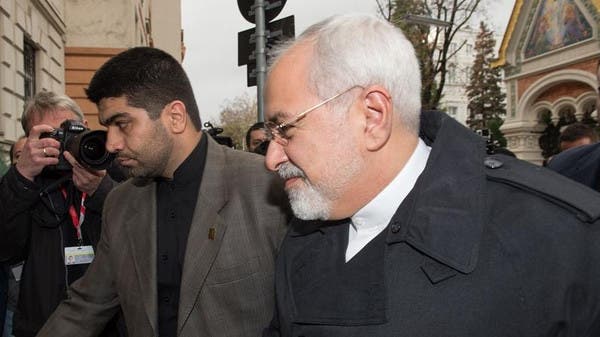
The Iranian Foreign Minister Mohammad Javad Zarif (R) arrives for
lunch with the Vice President of the European Commission at the Iranian
Embassy during the P5+1 talks with Iran in Vienna on November 18, 2014.
(AFP)
Al Arabiya News with Reuters
Thursday, 20 November 2014
The head of the U.N. nuclear agency said on Thursday that Iran had
failed to provide explanations about suspected atomic bomb research, as a
deadline looms for a comprehensive deal between Iran and six world
powers to end the long-running controversy.
Iran is currently
holding negotiations with the United States, France, Germany, Britain,
Russia and China in Vienna, in a push to reach an agreement by the Nov.
24 deadline.
The final deal is intended to set limits on Iran’s
nuclear program in return for an end to international sanctions on the
country.
Western officials say Iran must stop stonewalling the
International Atomic Energy Agency’s (IAEA) 12-year-old investigation
into allegations that Iran may have worked on designing an atomic bomb.
However, IAEA director general Yukiya Amano made clear the agency was still far from satisfied.
“Iran
has not provided any explanations that enable the agency to clarify the
outstanding practical measures,” he told a meeting of the U.N. agency’s
35-nation board of governors.
He was referring to two steps that
Iran had agreed to carry out by late August, by providing information
to the IAEA concerning allegations of explosives tests and other
activity that could be used to develop nuclear bombs.
“I call
upon Iran to increase its cooperation with the agency and to provide
timely access to all relevant information, documentation, sites,
material and personnel,” Amano said.
Iran denies any intention of seeking atomic weapons, saying its nuclear program is aimed at generating electricity.
(With Reuters)
Last Update: Thursday, 20 November 2014 KSA 14:51 - GMT 11:51
Iranian Opposition Reveals Nuke Weapon Research at Secret Site
Resistance movement claims sensitive research of nuclear weapons continues, has been moved to secret Tehran location.
By Ari Yashar
First Publish: 10/8/2014, 2:16 PM
Iranian nuclear facility (file)
Reuters
As Iran continues negotiations with world powers on its nuclear
program ahead of a November 24 deadline, members of an Iranian
opposition movement revealed Wednesday that the Islamic regime is
continuing its nuclear weapon research at a secret location.
According to the Iranian resistance movement in exile Mujahedin-e Khalk, also known as MEK, Tehran is developing nuclear weapons after having relocated its research facilities to avoid detection, reports the Associated Press.
MEK cited unidentified Iranian government sources in saying that "in recent months" Iran's Organization of Defensive Information and Research (SPND) moved the most sensitive weapons research programs to a new Tehran location.
The opposition group named Mohsem Fakhrizadeh as being a Revolutionary Guard brigadier general who heads SPND.
When the US announced sanctions on SPND in August, the US named the group as being "primarily responsible for research in the field of nuclear weapons."
The revelation surfaces after reports on Monday said an explosion at the Parchin nuclear plant killed at least two, including an unnamed "nuclear expert."
When it finally released an official comment, Iran admitted
there was an "incident" at the plant and two people were "missing," but
refused to call the incident an explosion. The statement also claimed there was no nuclear work being done at the site.
However, the opposition Sahamnews outlet claimed the blast was so powerful it shattered windows some 15 kilometers away from the site. Iran
has refused to allow International Atomic Energy Agency (IAEA)
inspectors to access Parchin since 2005, and both opposition figures and
others have accused the regime of using the site to house an illegal nuclear weapons program.
Last month, Israel's Intelligence Minister Yuval Steinitz said he had "reliable information" that Parchin was being used for secret tests of technology that could be used only for detonating a nuclear weapon.
That assessment was backed by Prime Minister Binyamin Netanyahu, who in his recent tour of America told Fox News that Iran is "making bombs. That's what they're trying to do. That's what they're whole program is about, making bombs."
Regarding Iran's nuclear aspirations, Iranian Supreme Leader
Ayatollah Ali Khamenei back in January publicly revealed that the
negotiations with the US about Iran's nuclear program are merely a tactic to stall international pressure and gain time to continue nuclear development.
UN nuclear agency opted against sensitive Iran report, news report says
Reuters says an IAEA report on Iran's nuclear capabilities would have
shown more about the Islamic Republic's nuclear bomb research.
By
Fredrik Dahl and Louis Charbonneau, Reuters /
February 27, 2014
Iran's
Foreign Minister Mohammad Javad Zarif, right, waits next to Yukiya
Amano, Director General of the International Atomic Energy Agency, for
the start of a panel discussion at the 50th Security Conference on
security policy in Munich, Germany, Feb. 2, 2014. Frank Augstein/AP
Vienna/United Nations
The United Nations nuclear watchdog planned a major report on Iran that might have revealed more of its suspected atomic bomb research, but held off as Tehran's relations with the outside world thawed, sources familiar with the matter said.
Such a report - to have been prepared last year - would almost
certainly have angered Iran and complicated efforts to settle a
decade-old dispute over its atomic aspirations, moves which accelerated
after pragmatic President Hassan Rouhani took office in August.
There was no immediate comment from the IAEA. The sources said there
was no way of knowing what information collected by the agency since it
issued a landmark report on Iran in 2011 might have been incorporated in
the new document, although one said it could have added to worries
about Tehran's activities.
As relations rapidly improved, Iran struck an interim nuclear deal with six world powers in November which Israel denounced as an "historic mistake" as it did not require Tehran to dismantle its uranium enrichment sites.
One source said probably only Israel, which is believed to be the Middle East's
sole nuclear-armed state, would criticize the IAEA for not issuing a
new report in the present circumstances. Iran and the world powers hope
to reach a final settlement by July, when the interim accord expires,
although they acknowledge this will be an uphill task.
A decision
not to go ahead with the new document may raise questions about
information that the United Nations agency has gathered in the last two
years on what it calls the "possible military dimensions" (PMD) to
Iran's nuclear program. Tehran says the program is peaceful and denies
Western allegations that it is seeking to develop the capability to make
bombs.
The sources, who declined to be identified due to the
sensitivity of the issue, suggested the more recent material concerned
extra detail about alleged research and experiments that were covered in
the November 2011 report. A new report would probably have included
"updated information on PMD" which could have "reinforced the concern"
about Iran, one said.
The IAEA's dossier in November 2011
contained a trove of intelligence indicating past activity in Iran which
could be used for developing nuclear weapons, some of which it said
might still be continuing. Iran rejected the allegations.
It
helped Western powers to step up the sanctions pressure on Iran,
including a European Union oil embargo imposed in 2012, showing the
potential significance of a decision on whether to publish the IAEA's
findings.
Since then the agency has said it obtained more
information that backs up its analysis in the 2011 document, which
detailed allegations ranging from explosives testing to research on what
experts describe as an atomic bomb trigger.
Other issues it wants
Iran to address are alleged detonator development, computer modelling
to calculate nuclear explosive yields, and preparatory experimentation
that could be useful for any atomic test.
It says the "overall
credible" information in the 2011 dossier - contained in an annex to a
wider quarterly report - came from member states, believed to include
Western powers and Israel, as well as its own efforts.
One source
said it was believed that the Vienna-based IAEA had received more
information on suspicions of nuclear yield calculations, but it was not
known to what extent this would have made it into a new report on Iran.
"The
agency has obtained more information since November 2011 that has
further corroborated the analysis contained in that annex," it said on
Feb. 20 in a regular quarterly report on Iran's nuclear program.
It
has been investigating accusations for several years that Iran may have
coordinated efforts to process uranium, test explosives and revamp a
missile cone in a way suitable for a nuclear warhead. Iran says such
claims are baseless and forged.
The sources said that last year's
planned report would probably have amounted to a wider review of the
Iranian nuclear file, including PMD and other outstanding issues.
They
said the idea was raised internally when the IAEA's long-running
efforts to get Iran to cooperate with its investigation appeared
completely deadlock in mid-2013.
But with a new leadership in
Tehran trying to end its international isolation, Iran and the IAEA
agreed last November a step-by-step transparency pact to help allay
concerns about the atomic activities. This was sealed shortly before the
breakthrough deal between Tehran and the six powers - the United States, Russia, France, Germany, Britain and China.
In
follow-up talks on Feb 8-9, Iran agreed for the first time to address
one of many PMD issues in the 2011 report, regarding so-called exploding
bridge wire detonators, which can have both civilian and military
applications.
"While other experiments with possible military
dimensions must be addressed and soon, progress on the bridge wire
detonators issue would be an important first step toward resolving these
issues," said the Arms Control Association, a US research and advocacy
group, in a Feb. 26 analysis.
But it remains uncertain when and
how the IAEA will be able to look into more sensitive areas, including
long-sought access to the Parchin military base southeast of Tehran,
where it suspects explosives tests that could be used for nuclear bomb
development took place a decade ago, a charge Tehran denies.
The
IAEA inquiry is separate from, but still closely linked to, the wider
diplomacy to end the years of standoff over the nuclear programme that
has raised fears of a Middle East war.
THE IAEA'S "JOB"
The
interim agreement focused mainly on preventing Tehran obtaining nuclear
fissile material to assemble a future bomb, rather than on whether Iran
sought atom weapons technology in the past, which the IAEA is
investigating.
The 2011 report portrayed a concerted weapons
programme that was halted in 2003 - when Iran came under increased
Western pressure - but it also indicated that some activities may later
have resumed.
Western diplomats and nuclear experts say the IAEA
needs to complete its inquiry to establish what happened and to be able
to provide assurances that any "weaponisation" work - expertise to turn
fissile material into a functioning bomb - has ceased.
They say
clarifying this is also important in being able to quantify the time
Iran would need to dash for a nuclear weapon, if it ever decided to do
so.
But it is unclear to what extent it will form part of any
final settlement between Iran and the powers - which unlike the IAEA can
lift crippling sanctions on the major oil producer and therefore have
more leverage in dealing with Tehran.
"Some analysts have argued
incorrectly that issues like Parchin and alleged military dimensions do
not matter. According to their reasoning, these issues are in the past
and should be overlooked," the Institute for Science and International
Security, a US think-tank, said this week.
However, Peter Jenkins,
a former British ambassador to the IAEA, said Iran now appeared to be
in full compliance with its obligations under the nuclear
Non-Proliferation Treaty, and had "started to resolve residual ...
questions about past nuclear-related activities and to shed light on
future intentions."
A senior US official said that clearing up the issue of possible
military dimensions to Iran's nuclear program was "in the first
instance" the IAEA's task.
"The more that Iran can do to meet
their obligations with the IAEA, the better for the nuclear negotiating
process around a comprehensive agreement," the US official said on Feb.
17. But, "We don't want to do the job that belongs to the IAEA."
The visit to Tehran Monday, Nov. 11, by Yukiya Amano,
head of he Vienna-based International Atomic Energy Agency, was
intended to show him meeting supreme leader Ayatollah Ali Khamenei as a
signal that he approved of further efforts at an understanding to
overcome the impasse reached last week in Geneva. This is reported by debkafile’s intelligence sources.
The Iranian leader’s show of goodwill would have been used by the
Obama administration to persuade Israel, France and Saudi Arabia to stop
fighting the draft accord on Iran’s nuclear program that was tossed
out at the Six-Power negotiations with Iran last Saturday.
However, Khamenei’s brush-off for Amano put paid to that effort.
The White House failed in its initial search for an European leader
able to make an impression on the supreme leader and get him to sign off
on diplomacy for a nuclear deal. No volunteers willing to risk a snub
stepped forward.
Iran’s Foreign Minister Javad Zarif then promised the Americans that
if the IAEA chief came to Tehran, an audience with Khamenei would be set
up.
But from the moment Amano set foot in Tehran Monday until he left, no
one mentioned an audience. He was fobbed off with “a roadmap for
cooperation,” which he signed alongside the head of Iran’s atomic energy
commission Ali Akbar Salehi for a photo op.
This worthless piece of paper permitted IAEA visits to the uranium
mines at Garchin and the unfinished a heavy water plant in Arak, but
continued to withhold permission to inspect projects suspected of
clandestine work on developing a nuclear weapon – for instance, the
Parchin military complex, to which the IAEA has repeatedly been denied
access to check on suspicions of nuclear-related explosion tests of
warhead detonators.
A normally calm and collected official, Amano was so put out by the
disrespect shown him by Washington and Tehran that he went on record
Wednesday, Nov. 13 to remark pointedly that he had seen no changes in
Iran’s nuclear activities in the three months since the election of
Hassan Rouhani as president: Iran continued to enrich uranium up to the
20 percent level just as before, he stressed.
This dry comment exploded the optimistic assumption at the root of
the Obama administration’s soft policy on Iran, namely that Tehran had
assumed a new, moderate face, amenable as never before to talking
through a deal on its nuclear program.
The IAEA director lifted just a corner of the veil concealing Iran’s
clandestine nuclear activities. Not only had nothing changed, but
contrary to suggestions put about of a slowdown, uranium enrichment
continues apace at all levels, 3.5, 5, and 20 percent grade. And not one
centrifuge has been dismantled. Centrifuge production has indeed been
accelerated and the machines are being quickly installed at all the
enrichment plants. The new centridfuges are not yet spinning, but they
are standing ready to be switched on at any moment. Construction at Arak
has also been put on fast forward.
The Iranian regime therefore stands poised ready for “a freeze” on
its program for the sake of eased sanctions. But whether or not an
understanding is concluded through dialogue, its entire nuclear weapons
production machine is ready to go on full power at a moment’s notice.
The pushback against a nuclear deal between the six
powers and Iran in Geneva Friday, Nov. 8 had many partners. Europe,
Saudi Arabia, the Arab Emirates and Israel have bonded together against
the Obama administration’s plans to mend US fences with Tehran in
general and leave Iran with its nuclear components intact.
Secretary of State John Kerry landed in the United Arab Emirate Monday,
Nov. 11, for an effort to break up that bond and split up the broad
opposition to Barack Obama’s policy. “President Obama is a man of his
word,” Kerry declared. “He said in a speech before the UN that the US
will not allow Iran to have a nuclear weapon and this is our policy to
which we are committed. “
His assurance reminded his skeptical listeners of the credibility gap
between Obama’s red line against Bashar Assad’s use of chemical weapons
and his withdrawal from making good on that commitment by substituting a
questionable deal with Moscow for military action.
They are also familiar with the terms of the US-Iranian nuclear deal and reject it out of hand.
Holding Binyamin Netanyahu, France and Saudi Arabia responsible for
stalling the deal as the only “culprits” served two US administration
purposes:
1. Rather than taking on a broad international front, the administration
found it more convenient to focus on one of its members, Israel and its
prime minister, as the responsible party for holding up the first
concrete deal ever negotiated with Iran on its nuclear program.
2. Presenting Netanyahu as the party in the wrong and the cause of
Israel’s isolation gave his political opponents ammunition for
clobbering him.
Still, President Barack Obama and Secretary of State John Kerry show
no inclination to meet America’s allies’ widespread demands to tone down
their proposal, which essentially permits Iran to retain all the
components for assembling a nuclear bomb, while enjoying a generous
reward in sanctions relief for a six-month freeze.
debkafile’s
political sources report that in opposing this lopsided deal in Geneva,
Foreign Minister Laurent Fabius spoke on behalf of the other European
powers present, Germany and Britain.
Even Russian Foreign Minister Sergey Lavrov presented an unusually
low profile in Geneva, abstaining from words of support for the American
position. Speaking on condition of anonymity, members of the Russian
delegation agreed that the deal on the table was a bad one.
The front lining up against Obama’s bid for reconciliation with Iran,
including a nuclear deal, also includes Saudi Arabia and the Arab
Emirates, especially the UAE which has grown into a major economic and
financial power.
Sunday, Netanyahu hit back at his misrepresentation as the lone spoiler
by revealing his contacts with the European powers represented in Geneva
and his close cooperation with the Arabian Gulf, including Saudi
Arabia.
“The world should pay heed when Israel and the Arabs speak with one voice. It doesn’t happen that often,” he said.
debkafile’s
Washington sources admit that the group effort by Jerusalem, Paris and
Riyadh to defeat the Obama administration’s Iran policy was a
groundbreaker. One source noted that it had attained the unheard-of
level of coordinated Israeli-Arab-European teamwork for mobilizing
individual US congressmen and senators against the deal with Iran and in
favor of tighter sanctions.
Those sources also contradicted the administration’s claim that the
Iranians backed away first from the draft accord prepared for the Geneva
conference. They say the veto was ultimately slapped down by Kerry.
In urgent discussions in Washington on ways to salvage the nuclear
negotiations from the Geneva flop - while keeping Iran in play - fingers
were pointing at Undersecretary of State Wendy Sherman and EU foreign
executive Catherine Ashton, who chaired the meeting.
According to those sources, the two diplomats put the draft before
Iranian Foreign Minister Javad Zarif and allowed him to insert
amendments. When that was done, they called the foreign ministers of the
six powers and invited them to attend the signing ceremony.
Sherman and Ashton are quoted as telling them, “The cake is ready for putting in the oven to bake.”
Upon hearing this, the Secretary of State interrupted his talks in
Israel Friday, Nov. 8, and took off for Geneva, certain that the deal
with Iran was in the bag and would be signed that day.
He was aghast when he was shown the amended draft and understood that
there was no way to sell this deal to the Europeans, the Arabs or
Israel. He therefore applied the brakes to preparations for the signing
ceremony and ordered a return to the table.
Meanwhile, the Iranians are moving on, certain that a deal with the
powers is in the works. The UN nuclear watchdog (IAEA) director Yukiya
Amano Monday, Nov. 11, announced the signing of a joint statement with
Tehran. It opens the way for IAEA inspectors to visit the Arak
construction site of Iran’s controversial heavy water reactor and the
Gachin uranium mine. "The practical measures will be implemented in the
next three months, starting from today," Amano told a news conference
in Tehran, broadcast on state television.
This monitoring agreement was designed as a clause in the preliminary
accord that was stalled before it was signed in Geneva last Friday.
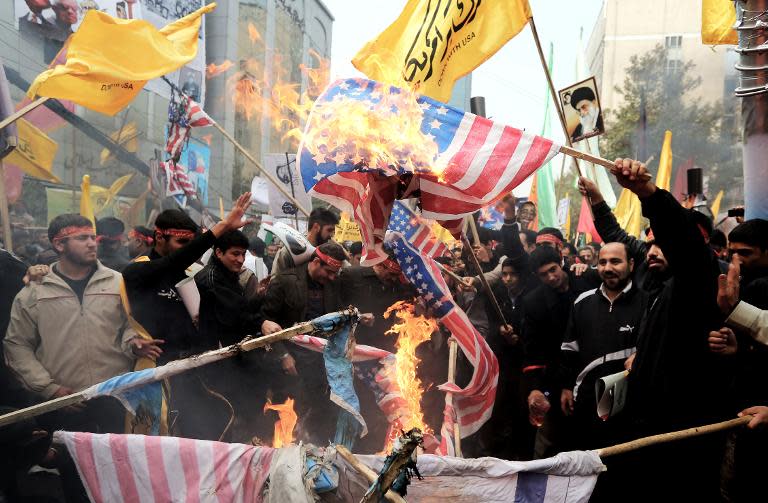
"Fighting the global arrogance and hostile policies of America is the symbol of our national solidarity." "It's not death to American people, but it's against a portion of Americans who support oppressive policies in the world. If we say 'death to America', it is death to megalomania. 'Death to America' means death to think-tanks that work for the destruction of nations." Saeed Jalili, Tehran
Ibrahim Noroozi / The Associated Press -- Iranian protesters burn an American flag during an anti-American rally in Tehran on Monday. An estimated 50,000 demonstrators packed the streets utside the former U.S. Embassy in the biggest anti-American rally in years.
That certainly goes a looong way to clearing up any misunderstanding about how the United States continues to be viewed in Iranian popular opinion, at least among those who continue their support of the Iranian Revolution with its penchant for repressing and oppressing political dissent, minority rights, gender-identification confusions, religious minorities, female empowerment, and any number of other irresponsible social irritants.
The Islamic Republic of Iran, needless to say, would never dream of oppressing, let alone threatening any other nation. Islam forbids it. Nor would it ever consider engaging in espionage, in provoking fear and revulsion among its neighbours as a result of its subtle threats to their longevity and security. As for training, supporting and calling upon the jihadist expertise of a non-state militia which they created as the Party of God, why what could be amiss in that direction?
The general Iranian loathing of the United States and American policies regarding its errant interference in matters Middle East, entirely justified its circumvention of the Vienna Convention. The Embassy of the United States of America in Tehran, after all, made a puppet of the Shaw of Iran, an oppressor of his people, bringing them unneeded education and health reforms as well as the liberation of women from the yoke of traditional misogyny, the cur. The 444-day siege holding 52 accused American diplomats hostage was just and liberating.
From the language spoken with the fond expression of Death to America! one might suspect with good reason that Mr. Jalili, a staunch insider with the confidence of Supreme Leader Ayatollah Ali Khamenei, was soundly tutored by George Orwell in doublespeak. This, bear in mind, is the man who was selected by the regime to speak on their behalf in the vital matter of nuclear technology; he is their top nuclear negotiator, where before he was merely a losing candidate for the presidency.
Iran's new president, Hassan Rowhani, the moderate who is a long-time revolutionary insider with the regime, and a former nuclear negotiator himself, who proved his stripes when he successfully soothed the anxiety of IAEA negotiators asking for time and understanding, then exulted in the success permitting the regime to proceed unmolested with its nuclear program, has undertaken a new slant in Iran-IAEA-UN-US relations. Cordial relations.
An appearance of willingness to negotiate reasonably. With pre-conditions of course. Where would the world be without pre-conditions on every issue imaginable when dealing with the Islamic countries of the Middle East? The pre-conditions appear by their very resolute defiance to negate any positive outcomes in negotiations since they insist on Iran's 'right' to nuclear 'energy', and to enrich uranium. Seemingly geared to vitiate proceedings, but no matter, no one appears to notice.
Mr. Jalili, the failed presidential candidate and now voice of reason on nuclear negotiations doesn't appear to find merit in President Rowhani's governing and 'appeasement of America' style, despite that Ayatollah Khamenei, expressing his own doubts, appears to want to give his new president enough rope to hang himself, and despite that Mr. Jalili has the confidence of the Supreme Leader. There is nothing quite straightforward about the Iranian agenda.
Other than to remove the current impediments to the Republic's drive to achieve its long-range goals of nuclear warheads assembly and longer-range ballistic missile perfection. Which would be made far more feasible if their finances and therefore the security of their position were more tenable with the removal of those noxious sanctions. To that end, the current experiment in determining whether the West is still susceptible to being gulled has been joined.
And despite the urgency of that trial, it is informing to see that the Republican Guard which directs Khamenei about as much as he does them, implacably refuses to surrender a main tenet token of the Revolution: "Death to America!" Just as implacably, it seems, President Barack Obama is determined to make nice with the Islamic Republic of Iran. To what end remains unclear.
So, it is Death to America! and while they're at it, the junior Satan as well.
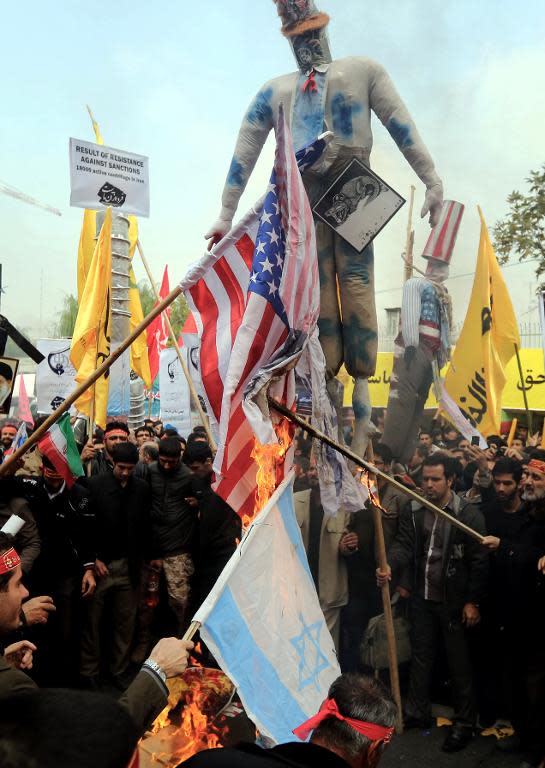
AFP Photo -- Burning American and Israeli flags; Iranian celebratory pastime
This represents a general opinion site for its author. It also offers a space for the author to record her experiences and perceptions,both personal and public. This is rendered obvious by the content contained in the blog, but the space is here inviting me to write. And so I do.