"The Liberal government had pledged to uphold higher standards after the terrible Saudi arms deal but instead it is selling to the worst and most repressive regime in Asia where the president brags about personally shooting drug users and throwing people out of helicopters." "How long will it be until the [Philippine] military is using the helicopters during executions?" Steve Staples, vice-president, Rideau Institute, Ottawa
"Given President Duterte's abysmal human rights record -- which Ottawa is no doubt aware of -- this raises troubling questions about the risk of the helicopters being equipped with weapons and of their use in human rights violations." "Although the helicopters are being supplied for military use, they are classified by the Canadian government as civilian and thus their export does not require special authorization." Cesar Jaramillo, executive director, Project Ploughshares
A Philippine Air Force chaplain blesses a newly-delivered Bell 412 helicopter during a christening ceremony in Manila in 2015.Jay Directo/AFP/Getty Images
In the Philippines, President Rodrigo Duterte is waging an unremitting war on drugs during which an estimated 12,000 people have died, targeted for extermination on the basis that they are identified by police death squads given direction by the president, as drug users and dealers. The international criticism that has arisen in the face of this violence has stung Duterte, but he snarls in defiance, telling his critics, from Pope Francis to other heads of government to go to hell.
But for this government now in Canada a sale of 16 combat helicopters worth $234-million, is a consideration of far greater importance than their potential to be used by a murderous regime, let alone a decision to use those helicopters against elements of his population. Prime Minister Justin Trudeau is fully invested in seeing that the Province of Quebec be given advantageous employment priority over any foreign entity, since the Bell 412 aircraft would be built in Mirabel, Quebec.
An earlier arrangement to sell light-armoured vehicles to Saudi Arabia that the previous government in Ottawa had signed off on, was minimized by Trudeau during the election campaign that brought the Liberals to power, when Trudeau characterized them as being merely 'jeeps'. The ruling Liberal government then proceeded with the deal and will continue to provide Saudi Arabia with the vehicles, while involved in a conflict in Yemen that is killing civilians by the droves in the poorest of the Arab countries, involved in a civil war.
The very same group, the Canadian Commercial Corporation, that had brokered the $15-billion Saudi sale of light-armoured vehicles, is involved in this current helicopter sale. But without the Government of Canada signing off on the deal, it would never be carried through. Last year, reports came through that another type of armoured vehicle accessed from a Canadian company, was being used on their own citizens by the Saudis.
Given the fact that government rules in Canada call for curbing shipments to countries having a "persistent record of serious violations of the human rights of their citizens", and with the knowledge that the Saudis are known for their disturbing human rights record, this decision by the government is inexplicable, other than to acknowledge that it is that hungry for trade opportunities it can manage to overlook any infringements of human rights.
According to Canada's foreign affairs body, Global Affairs Canada, the helicopters are slated for use in "disaster relief, search and rescue, passenger transport, and utility transport", which is a precious statement on their part. Once the sale is made and the goods transferred to foreign ownership the seller has no right whatever in insisting the product be used in any particular way, and not for use in a manner that would reflect poorly on the seller.
A more realistic response has issued from Philippines Major General Restituto Padilla, military chief of plans, who stated: "The helicopters will be used for the military's internal security operations", and those operations, understandably, will reflect any issues and uses that the Philippine Presidents orders.
And then there is another issue that has cropped up in similar vein; an end-of-year statement by Canada's Defence Minister Sajjit Harjit that Canada has signed a new defence agreement with the United Arab Emirates supporting further military cooperation and which "also means opening doors for Canadian industry in the region" of the Middle East, already embroiled in more than enough violence, without Canadian-produced armaments to add to the fray.
Norway's government, in contrast to Canada's, has decided to suspend its exports of weapons and ammunition to the UAE in recognition of concerns their equipment could be used in the Yemen civil war of which the UAE is part of the coalition led by Saudi Arabia, fighting Houthi Shiite forces. The international community is well aware that Saudi Arabia has been bombing civilian targets. And as though that isn't sufficient reason for Canada to abstain, Germany too has halted arms shipments to Saudi Arabia in reflection of its Yemen war involvement.
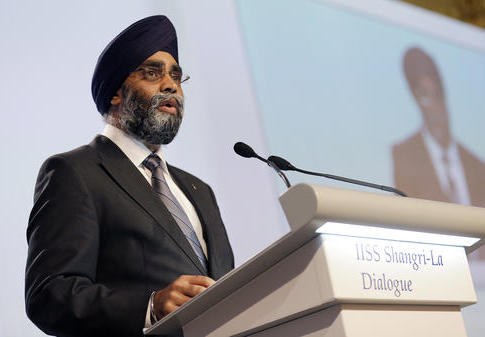
"This really is the most critical piece. Dialogue is extremely important. We need to make sure the tensions are reduced because it doesn't help anybody." "As a responsible partner in the world, Canada stands side by side with its NATO allies working to deter aggression and assure peace and stability in Europe." Harjit Sajjan, Canadian Minister of Defence
Canada’s Defense Minister Harjit Sajjan / AP
"Thank you, Canada. All four battalions for #NATO's east now have a lead nation." "Thanks also to GER, UK & US. Strong transatlantic commitment." Jens Stoltenberg, NATO secretary general
"As your ally and as your friend, let me say that we'll be more secure when every NATO member, including Canada, contributes its full share to our common security." "The world needs more Canada, NATO needs more Canada. We need you." U.S. President Barack Obama, addressing the Parliament of Canada, 30 June 2016
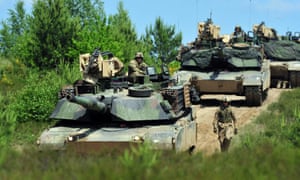
Preparations for Anaconda-2016 take place in Drawsko Pomorskie, north-western Poland.
Photograph: Marcin Bielecki/EPA
Russian President Vladimir Putin is not impressed, nor is he the least bit amused, even though he is the vector of the present situation where distrust and rancour exists at a near-historical level, re-visited from the Cold War thanks to his and the Kremlin's plans for the Russian Federation at the expense of the international sovereignty rights of eastern Europe, specifically the security of the former satellites of the USSR.
Russia's buildup of its arms in a massive renewal of state-of-the-art technologically advanced weapons systems, naval vessels, mechanized armoured vehicles, ballistic missiles and its nuclear arsenal sends a clear message of might and power and intent. The corresponding nervous tension aggravating the consciousness of Russia's neighbours have their basis in the reality of Russia's throwing its weight around in Georgia and Moldova, along with its little cyberattack treat thrown at Estonia.
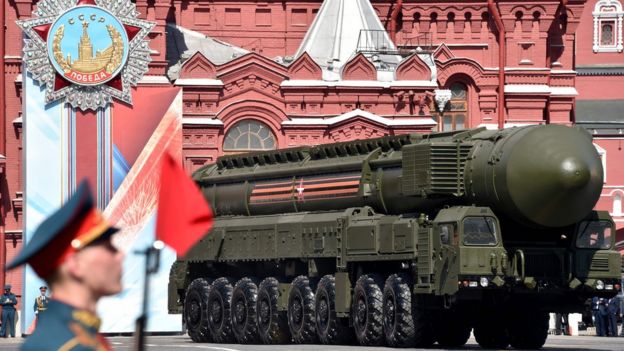
The RS-24 Yars missile can hit targets 11,000km (6,835 miles) away with four independent nuclear warheads AFP
But it is the stark reality of the Russian Federation awarding itself possession of the Crimean Peninsula, leaving Ukraine that much the poorer geographically, and its support in training and weaponizing the ethnic Russian rebels in eastern Ukraine, and with it the set-aside-temporarily intention to further expand Russian holdings in Ukraine that has eastern Europe on tenterhooks of fearful anticipation.
And since many of them are now NATO members, the threat is taken seriously, as seriously as Europe's response in sanctioning Russia and the G8 becoming the G7. Russia's grievance against its near-abroad being breached by NATO is understandable. When, during the Cold War period, Nikita Khruschev gambled and lost in the matter of installing nuclear sites in Cuba, it was the United States that was alarmed and adamant that the USSR had no business in its near abroad.
Under the circumstances, Canada had little option but to agree to NATO's request that it send a thousand-man-strong battalion to be part of the swift-response NATO strategy, to be stationed in Latvia. Russia's furious response that NATO's presence abuts its borders, along with the planned establishment of a missile defence system virtually 'next door' is more than understandable. And its rage is justified. But it has earned the situation it now faces.
The question is whether the world has earned that situation, to once again hover on the edge of a tinderbox of explosive action and response?
"If you have a Russian nuclear attack submarine wandering around the Med, you want to track it." Dmitry Gorenburg, Center for Naval Analysis, Washington
"We are not quite back in a Cold War. But I sure can see one from where we are standing." James G. Stavridis, former supreme allied commander, NATO
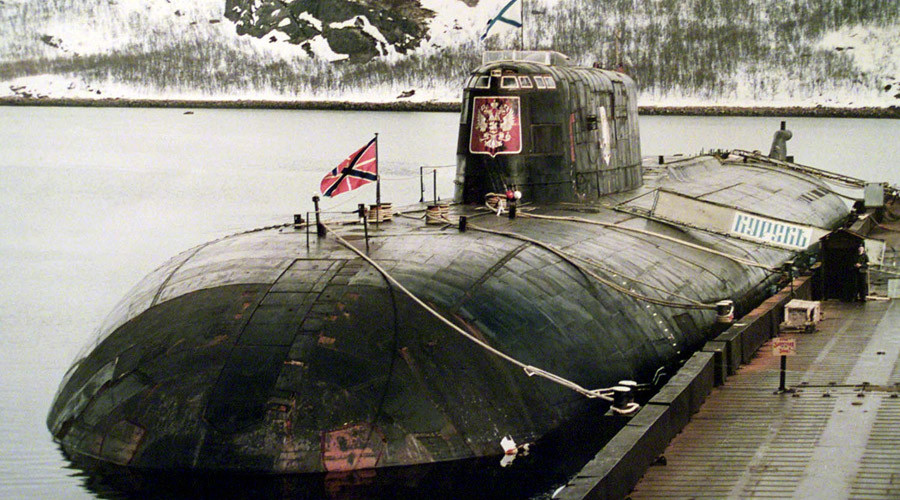
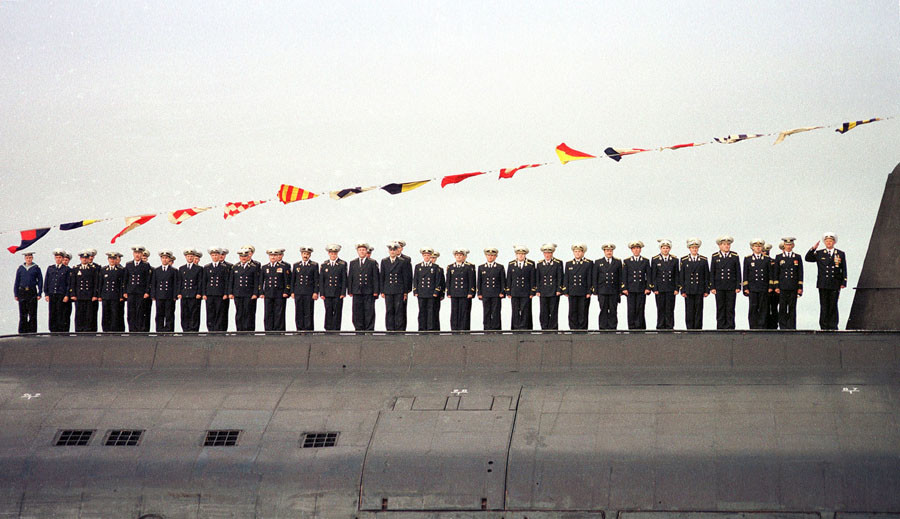
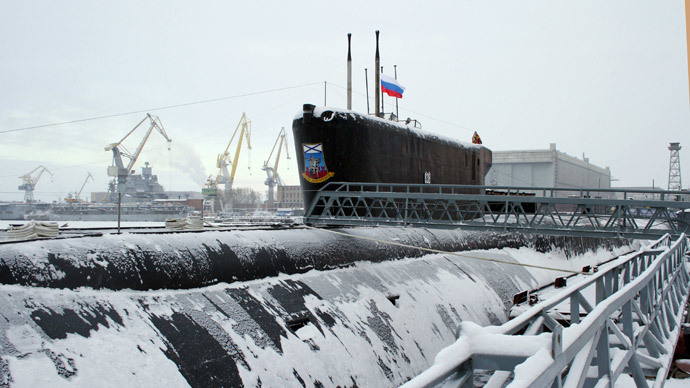
Now that the 2000 Russian Oscar-class nuclear submarine tragedy with the loss of life of all aboard is history followed by Russia's suspended submarine force action, a new era has dawned. Confidence has been restored in the Russian submarine fleet, the memory of the horror of the loss of 118 sailors and officers, most of whom were under 30 years of age, has dimmed in memory.
A new day has dawned, and Russia has a new fleet of attack submarines, all of which mean potential business if and when they are called upon. At the present time they prowl the coastlines of Scandinavia and Scotland, the Mediterranean Sea and the North Atlantic. And in so doing they are making Western military officials quite nervously perturbed. At their obvious aim to contest U.S. and NATO dominance of the dark deep.
The U.S. Navy's top commander, Admiral Mark Ferguson, has stated the intensity of those submarine patrols were up fifty percent over the past year. That statement relies on remarks by the Russian Navy chief, Admiral Viktor Chirkov. The Russian government has spent billions on new classes of diesel and nuclear-powered attack submarines, quieter and bristling with arms. This is a situation that obviously bespeaks a rivalry and military increase echoing the Cold War.
American military officials interpret Moscow's increase in its nuclear arsenal and cyberwarfare capabilities as an effort to prove indisputably Russia's importance on the world stage as a military power following on years of decline and retrenchment. And just as Moscow has used its view of American and NATO arms buildup to justify its own increased vigilance and presence, so too now is the U.S. Defense Department using the increased Russian patrols as reason for increased budgets for submarines and antisubmarine warfare.
A proposal of $8.1-billion over five years for "undersea capabilities" that would include nine new Virginia-class attack submarines to carry up to 40 Tomahawk cruise missiles has been fielded by the U.S. Defense Department. Russia currently boasts roughly 45 attack submarines; two dozen nuclear-powered, 20 diesel, designed to sink other submarines or ships, collect intelligence and conduct patrols.
According to Western naval analysts about half of that number are able to deploy though most remain close to home. The U.S. on the other hand, has 53 attack submarines, all nuclear-powered, along with four other nuclear-powered submarines carrying cruise missiles and Special Operations forces. A third of America's attack submarines are deployed at sea on patrol or in training; the balance are in maintenance status.
Technology is developing the capacity to monitor encrypted communications from those Russian submarines as well as new models of remotely controlled or autonomous vessels. Britain, Germany and Norway are procuring new submarines, reflecting their reaction to the Kremlin's show of force in the Baltic, Atlantic and Arctic. Concern is being expressed at the proximity of operation of Russian submarines and spy ships close to the undersea cables carrying global Internet communications.
This is inevitable, needless to say. It is human nature to view enviously what others have and see in them a threat of some kind; power status or military impetus. Each side regarding the other with suspicion; each side determined to match or outdo the other. National pride uppermost in mind. The end product being that the world is moved ever closer to the real risks of accidental catastrophe.
Armata 101. The new tank will weigh 48 tons and could hit
speeds of more than 50 miles per hour, according to a spec sheet
released by Russia's TASS news agency and translated by the U.S. Army's
Foreign Military Studies Office. The three-person tank will be able to
fire up to 12 rounds per minute from a 125 mm main gun that can fire
multiple types of munitions, including guided missiles, with a range
topping out at 8,000 meters. High-tech highlights include circular-view cameras, a heat sensor and the Afganit active protection complex, which reportedly uses radar to detect incoming threats and destroys them with a rocket.
The peaceful order of a peaceful world is once again assured by the latest news from Russia's Ministry of Defence. A new line of war machines has been developed by the Russian arms industry. The fruit of their efforts will be on proud display at the Red Square Victory Day parade scheduled for Saturday.
Nothing quite works to expand a nation's chest with unbridled pride as a display of mighty powerful war machines.
And Moscow will get its annual fix on Saturday with the display of the showcasing of the Koalitsiya-SV artillery system; the Bumerang armoured personnel carrier; the Kurganets 25 infantry fighting vehicle; and the Kornet D1, an anti-tank rocket system mounted on a Tigr, the Russian version of the American Humvee.
It remains to be seen whether the Tigr will be driven by civilians on the streets of Moscow, in prideful emulation of the U.S. civilian propensity to acquire Humvees and drive the beasts on regional roads and highways, signalling the might and the power of military equipment to entrance the imagination of non-military envy.
The T-14 Armata tank is semi-robotic, its turret previously covered in partial display to ensure that its full revelation will come as a complete surprise at the emerging robotic technology. Russian military experts crow that it has been designed to compete and outdistance the American Abrams tank, Britain's Challenger, and Germany's Leopard. Eclipsing nicely the West's supremacy in battlefield armour.
The fly in the triumphant Kremlin ointment, however, is whether the country's military-industrial complex will be capable of meeting a 2020 target of 2,300 tanks, in reflection of the ailing economy and low oil prices. But the parade must go on to celebrate Nazi Germany's defeat, and on May 9, it will with 16,000 marching troops, 194 vehicles and 143 military aircraft bruising the skies over Moscow.
"The indications are that they are returning home. They may well just want to tease us a little by having a look at the [NATO] exercise." "We will have to see what they do when they get up there. If they are outside territorial waters they are really within their rights to do whatever they want." British naval sources
They're popping up everywhere around the world, in the skies on the high seas, from Alaska to Australia, as though provoking speculation, and thumbing their proverbial noses at other nations' nervous responses to seeing Russian planes and warships where they might least be expected to be present. Japan has recently had the pleasure of scrambling to meet Russian planes. The Moscow Times two days ago reported that Japan's air force responded to Russian bombers over its northern skies hundreds of times in 2014.
United States Air Force / Wikicommons Japan Air Self Defense Force F-2A taxis down the runway.
And recently Britain's Armed Forces were also called out at opposite ends of the country this week to meet Russian warplanes while NATO exercises commenced in northern Scotland. Russian bombers near the Scottish coast were met by Royal Air Force Typhoons, and the British Navy was called on for the purpose of escorting a Russian warship through the English Channel.
A British Royal Air Force (RAF) 6
Squadron Typhoon (bottom) intercepting a Russian Bear aircraft in
international air space off the coast of BritainPhoto: RAF/EPA
The two-week-long North Atlantic Treaty Organization's Exercise Joint Warrior, observed as it is by Moscow's military experts, also had two unexpected guests whose presence launched two quick-reaction Typhoon jets from RAF Lossiemouth after Tupolev Tu-95 bear bombers left Norway airspace to approach British airspace near Scotland, to shadow the Russian bombers which then turned back northward.
"They often send some long-range aviation at the time of Joint Warrior (NATO exercises), and they haven't been here for a couple of months, so it's good to have them back", an airforce source said with equanimity, the usual British aplomb suitable for all occasions. The NATO exercises come complete with 55 warships and 70 aircraft representing 14 member nations taking part in submarine hunting training, mine clearing and amphibious landings.
A Russian destroyer and two support ships escorted through the English Channel by the Royal Navy completed the unexpected visits. The Udaloy-class destroyer Severomorsk, a tanker and a tug plowed through the waterway, then moved into the Atlantic to conduct their own drills. In the process delivering a not entirely-oblique message that spells out an 'anything you can do we can do better', type of alert, in case anyone wasn't noticing.
HMS Argyll, a Type 23 frigate, has been tasked to the escort of the Severomorsk through the North Sea to sail beyond Scotland, according to Navy sources. The convoy, according to the Russian Ministry of Defence, including the Severomorsk anti-submarine ship, a Dubna-class tanker, and the SB-406 rescue tug, entered the English Channel en route to northern Atlantic exercises.
HMS ArgyllHMS Argyll, a Type 23 frigate, will escort the Severomorsk through the
North Sea until she sails beyond Scotland, Navy sources said.
"[The Channel is a] legitimate shipping lane: Equally, these things aren't done by accident. Russia is trying to show it has got full spectrum capability warfare"
"It is not a prelude to war but it is a reminder that Russia likes to
remind us of - that it is a power to be reckoned with, not a fading
power, which might be closer to the reality" "It can tell us that with a degree of braggadocio." James Nixey, head, Russia and Eurasia Programme, Chatham House
"[Russia
is involved in the] penetration of the Ukrainian state intelligence
apparatus, through the SBU or Security Service of Ukraine by Russian
intelligence agencies including GRU (Russian military Intelligence), the
FSB (Federal Security Service) and the SVR (Foreign Intelligence
Service)." Roger McDermott: Brothers Disunited: Russia's Use of Military Power in Ukraine
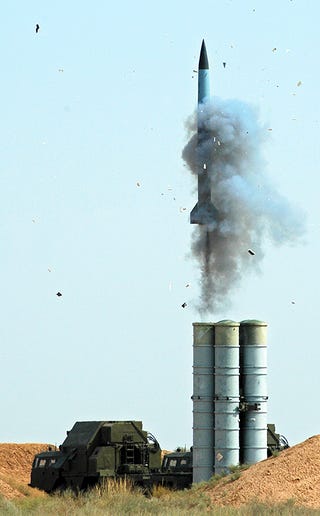
Russian S-300 missile system (Photo: AFP)
Ukrainians
sympathetic to Moscow are also believed to be intimately involved in
espionage inside or close to almost all Ukrainian military units,
alongside formal intelligence operatives. All areas relating to the
conflict -- inclusive of war training -- have been compromised by this
broad infiltration, resulting in far more difficulties impacting those
dedicated to aiding the Ukrainian perspective.
The
sheer extent and depth of the pervasiveness of Russian intelligence
operations within Ukraine has alerted Canada, which has been supplying
satellite imagery to the Kyiv-loyal military, leading to the suspicion
that that imagery data could be filtered directly through to Moscow.
Validating, some believe, Washington's reluctance to share its satellite
imagery with the Ukrainians; its unwillingness to have Russia discover
the full capabilities of American satellite function.
Russian
espionage has become a titanic headache for the Ukrainian military and
its government, apart from and above the threat in its totality of
Russia's malignant undermining of Ukrainian sovereignty and its
encouragement and practical assistance through arms provision, training,
and troops presence stealthily working to destroy Ukraine's economy,
political system and plans to distance itself as far as possible from
Russian influence.
Russians have been training the
ethnic Russian Ukrainian rebel forces for a year, teaching them tactics
and strategy, how to use advanced weapons systems inside eastern Ukraine
and in southern Russia. It was one of those lessons in the use of a
lethal aerial weapons system that went awry last year, taking down a
Malaysian passenger jet, to the horror of the world community. An
incident that both Russia and the rebels deny having had any part in,
evidence to the contrary.
The separatists can be fairly
certain that they don't face anywhere close to to a similar level of
penetration by Ukrainian intelligence, let alone eastern Ukrainians
loyal to Kyiv, for they have long since fled the scene of skirmishes and
deadly conflict. Russia has been responsible for triggering many key
battles while supplying and equipping the rebels; above all they had
committed to training the Ukrainian Russian-speakers long before NATO
decided to do the same in reverse.
Ukraine has been
begging its supporters and sympathizing nations to supply it with
advanced weaponry to match those the rebels are using supplied by
Russia. The response from those same Western nations has been
disappointing to Ukraine despite what it sees as its existential
urgency. For decades Ukraine itself has placed few resources into the
training or equipping of their forces with new, advanced gear.
The
collapse of the Soviet Union in 1991 placed its former satellites,
along with its former adversaries in a blissful fog of release from Cold
War tensions. No one, it seems, fully realized that the Cold War was
heating up again when Vladimir Putin waxed nostalgic about the past, and
sought to reinvigorate Russian pride in that vast near-abroad
collective known as the United Soviet Socialist Republic. His longing
for a return to world power status has driven him to spurn the
blandishments of western Europe to be satisfied with being a global
member-country.
He has his agenda, and nothing much
appears capable of diverting him from it. And slowly, Russia has been
rearming itself with the latest advances in powerful technological
armaments. And nor has it been loathe to sell those advanced weapons to
other rogue nations like itself. So while the nations belonging to NATO
sign on to aiding Ukraine as best they can through training efforts
while withholding serious weapons, their obvious support of Ukraine
against the belligerence of Russia is moving the world on an
uncomfortable and extremely dangerous trajectory.
Russia
has warned through Mr. Putin's statements, casual as they appeared at
the time, but loaded with menace, that he was prepared to use nuclear
weapons at the time that Crimea was annexed. An intervention to halt
that international crime of territorial looting might have seen Russia
raising the red flag of doom. That would have been a departure from the
mutually assured destruction that underpinned the understanding between
Russia and the U.S. during the Cold War.
This present era represents a frigid war in frozen suspension not leading, we can still hope, to a melt-down.
One way or another, Russia will have its revenge on the West in its showdown with Moscow over Ukraine and NATO's confidence-building presence in eastern Europe where Russia's neighbours are uneasily eyeing its presence too uncomfortably close with the annexation of Crimea and rumblings of its honour-bound obligation to 'protect' ethnic Russians living in other countries once part of the USSR. There are more than nine ways to skin a cat, and Russia isn't averse to skinning a skunk, either.
There is a natural affinity, one should suppose, between two outliers, Moscow and Tehran, and each with their grievances against the West (yes, Putin is somewhat more subtle than to mouth 'Death to America', but the thought process is similar) happy to deal with one another to the chagrin of those of its partners in the P5+1 (though Germany may be next) to enhance Iran's conflict capabilities rather than deplete them.
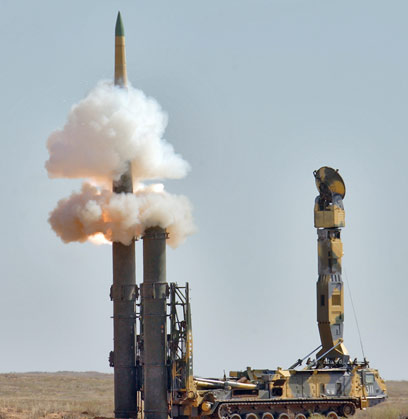
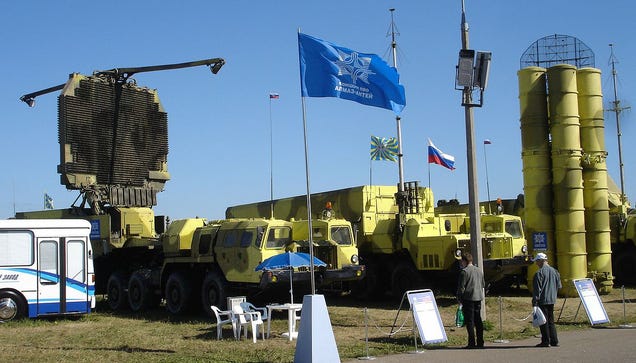
The decree that Vladimir Putin signed green-lighting shipments of its S-300 air defence missile systems to Iran, has certainly alarmed some in the international community, and it isn't hard to guess which country in particular is most alerted to how precisely this exchange will affect them. Gazeta.ru reports that Israel's President Benjamin Netanyahu wasted no time in informing President Putin that the sale of the missile systems to Iran will pose a direct danger to Israel.
It takes two to tango, and while Russia may feel that it can get to the West's nerve endings by expediting this sale whose contract has languished for years, Israel can complete the circle by selling advanced arms to Ukraine, in its battle with Moscow, even on credit. Wouldn't be too far-fetched after all, a dangerous tit earns a responsive tat. All very well for Russian Foreign Minister Sergey Lavrov to note that Moscow's commercial interests and reputation are involved.
And that "The S-300 is exclusively a defensive weapon, which can't serve offensive purposes and will not jeopardize the security of any country, including, of course, Israel." Even taken with a grain of salt, it's scant comfort. Deployed in numbers the system is capable of providing a hefty deterrent against air attack. Should Israel determine to attack Iran's nuclear facilities the S-300s would complicate matters enormously.
Israel must have felt more than enough anguish over the P5-1, U.S.-led agreement framework with Iran, emphasizing that the sanctions relief coupled with leaving Iran's nuclear program fairly intact will leave it free to proceed with its ultimate goal; the development of a nuclear weapon. "This is a direct result of the legitimacy that Iran obtained from the emerging nuclear deal", said Israeli cabinet minister Yuval Steinitz.
The initial framework agreement, he said, has legitimized Iran's plans, clearing the way for Russia to proceed with its delayed delivery of the missile systems. Iran obviously plans to utilize financial relief from the lifting of economic sanctions not to alleviate and improve living conditions of the Iranian people, suffering under the sanctions fallout and the straitened economy for years, but to buy arms and advance its nuclear ambitions.
Not to worry; in Tehran General Reza Talaceinik soothingly claims the Russian decision will help enormously to improve ties between Tehran and Moscow. And it isn't Moscow, after all, toward whom Iran will aim the S-300 missile system with its range of up to 200 kilometres and its capability of tracking down and striking multiple targets, representing one of the world's most powerful air defence weapons.
"I don't think anybody wants to get into a proxy war with Russia and that is not our objective here. Our objective is to change the behaviour of Russia." U.S. State Department spokeswoman
"We intend to mobilize the necessary number of people to bring the size of our army up to 100,000 people. It will be a voluntary mobilization." Alexander Zakharchenko, rebel leader, Donetsk
"The West needs to bolster deterrence in Ukraine by raising the risks and costs to Russia of any renewed major offensive." "That requires providing direct military assistance -- in far larger amounts than provided to date and including lethal defensive arms." U.S. independent advisory report
An elderly Ukrainian man is helped by a
Ukrainian Army soldier and a citizen during a evacuation of civilians
in Debaltseve, in the Donetsk regionPhoto: AFP/Getty Images
Russian troops and tanks continue to move from across the border into Ukraine supporting the separatists in eastern Ukraine, disdaining the signed ceasefire agreement, now in shreds. As for the general mobilization declared by rebel leader Zakharchenko; there can be little doubt that the 100,000-person voluntary mobilization will be anything but. The voluntary element has long since joined the rebels; to gain additional recruits a fair bit of aggressive nudging will be engaged.
The envisioned new motorized rifle brigades, an artillery and a tank brigade to materialize by spring to give the striking initiative to the rebel militias will be realized as a result of involuntary conscription, not voluntary mobilization. But in the language of violent rebellion, semantics are simply tools of propaganda and expediency.
The serious fighting between the separatists and Ukrainian troops has been roiling eastern Ukraine, with roughly 50 people dying over the weekend. President Putin is a long way from wobbling on his spurring on the rebels to Russia's geographic advantage, sanctions or not. The sanctions alone without the impact of the enhanced Saudi oil production initiative that has pulled the wheels out from under Moscow's oil-cart would have achieved little.
Russian resolve appears to have strengthened, if anything, because Russians don't like to be pushed around; they're accustomed to doing the pushing. Now the report assembled by a who's who of U.S. administration elites and supported by actors like Secretary of State John Kerry, Gen. Martin Dempsey, Defence Secretary Chuck Hagel, and even Susan Rice, visualize strengthening Kyiv's hand.
General Breedlove, NATO's military commander, is all for support to Kyiv by providing arms and equipment to Ukraine's underarmed military. The U.S. is urged through the report to hand over to the Ukrainians anti-tank weapons to match Russian armoured vehicles. Since most of Kyiv's anti-tank stock date from the Soviet era, and about 70% of the weapons are almost unusable, Petro Poroshenko's continual appeals for weaponry aid is understandable
With Russia continuing to back the rebels, Ukraine finds itself hard put to sustain east Ukraine while still grappling with the loss of Crimea, and its tenuous hold on a geography that has defaulted in the Luhansk and Donetsk regions to the combined forces of secessionists and Russian military holidayers.
Will others follow suit, should the U.S. decide to take the plunge and indirectly challenge Russia? Not likely; neither Britain nor Germany appear poised to render to Ukraine lethal weapons, but remain wedded to non-lethal support.
"Germany will not send Ukraine any deadly, lethal weapons, as I
said yesterday. We are focusing on a
diplomatic solution and the foreign ministers have made clear that if
the situation gets even worse ... then it will be necessary to work on
further sanctions", Chancellor Merkel made clear.
"The
West needs to bolster deterrence in Ukraine by raising the risks and
costs to Russia of any renewed major offensive. That
requires providing direct military assistance — in far larger amounts
than provided to date and including lethal defensive arms." Independent U.S. report urging billions in defences to Ukraine
"Although
our focus remains on pursuing a solution through diplomatic means, we
are always evaluating other options that will help create space for a
negotiated solution to the crisis." Bernadette Meehan, spokeswoman, National Security Council
"A comprehensive approach is warranted, and we agree that defensive
equipment and weapons should be part of that discussion." Pentagon
official
"One
of the best ways to deter Russia from supporting the rebels in taking
more territory and stepping up the conflict is to increase the cost that
the Russians or their surrogates would incur."
"Providing
the Ukrainians with something that can stop an armored assault and that
puts at risk Russia or Russian-backed forces that are in armored
vehicles, I think, is the most important aspect of this [report]." Michèle
A. Flournoy, former senior Pentagon official
Ukrainian soldiers in the
Donetsk region. In an independent report to be issued Monday, eight
former senior American officials urge that the United States send
defensive arms and equipment to Ukraine. Credit
Manu Brabo/Agence France-Presse — Getty Images
The report, issued by a coalition comprised of the Atlantic Council, the Brookings Institution and the Chicago Council on Global Affairs, was prepared along with Strobe Talbott, Clinton administration deputy secretary of State; Charles F. Wald, retired Air Force general, one-time deputy commander of the U.S. European Command; Jan M. Lodal, former Pentagon official; two former U.S. ambassadors to Ukraine, John Herbst and Steven Piper.
The recommendation runs counter to the White House caution leading to limits on American assistance to Ukraine, providing "non-lethal" items, such as body armour, night-vision goggles, first-aid kits and engineering equipment. The report, however, is based on the seeming failure of the imposed economic sanctions to provide sufficient bite to the Kremlin to dissuade Russia from providing heavy weapons and military assistance to the secessionists in eastern Ukraine.
The independent report now urges the U.S. to commit to sending $3-billion-worth of defensive arms and equipment, including anti-armour missiles, reconnaissance drones, armoured Humvees and radar able to determine enemy rocket location and artillery fire. Others who helped in the report preparation include James G. Stravridis, retired general who once served as top NATO military commander and Ivo Daalder, the U.S. ambassador to NATO in Mr. Obama's first term in office.
Russia has chosen to ship heavy weapons in support of the separatist agenda in eastern Ukraine; T-80 and T-72 tanks, multiple-launch rocket systems, artillery and armored personnel carriers, out-weaponizing the Ukrainian military. NATO estimates that around a thousand Russian military and intelligence personnel now support the separatist offensive, though Ukrainian officials put that estimate much higher. Without that Russian involvement the rebels would never have been able to capture the Donetsk airport and to forge on to Debaltseve.
In the last four months alone, the separatists have taken about 193 square miles of added territory, according to NATO. The Minsk agreement has been effectively nullified at the choice of Moscow.
"General Breedlove has repeatedly stated that he supports the pursuit of a diplomatic solution as well as considering practical means of support to the government of Ukraine in its struggle against Russian-backed separatists", spokesman Capt. Gregory Hicks of the Navy noted.
The report pointed out that enemy rocket and artillery attacks represent the causality of 70 percent of the Ukrainian military's casualties, making the point that radars capable of pinpointing rocket and artillery fire locations would be critical to halting those casualties. At the same time, it was suggested that Russian military casualties be highlighted, to inform the Russian population that their soldiers are covertly engaged in an undeclared war, despite Moscow's protests to the contrary.
Because of the separatists' use of antiaircraft missiles, thanks again to Russian military generosity, the Ukrainian military has been forced to halt flights over eastern Ukraine; the supply of reconnaissance drones by the U.S. would be of added inestimable value to the Ukrainian military. Military communications equipment of a kind that Russian intelligence could not intercept, and the transfer of armoured Humvees and field hospitals were also urged upon the Obama administration for consideration.
Should the United States take the initiative, based on the report's recommendations, it seems highly probable that Poland, the Baltic States, Canada and Britain would step up their practical commitment to Ukraine's defence and begin to provide similar defensive weapons to turn the tide toward ensuring Ukraine's sovereign integrity.
"[Russia could use nuclear weapons should aggression] threaten the very existence [of the Russian state]." "...A buildup of NATO military potential and its empowerment with global functions implemented in violation of international law, the expansion of NATO's military infrastructure to the Russian borders [has been placed at the top of perceived military threats to Russia." New 29-page Russian military doctrine
Alexei Druzhinin / Presidential Press Service / RIA Novosti Russian President Vladimir Putin, centre, heads the Security Council in Moscow's Kremlin on Friday.
"Any steps taken by NATO to ensure the security of its members are clearly defensive in nature, proportionate and in compliance with international law." "In fact, it is Russia's actions, including currently in Ukraine, which are breaking international law and undermining European security." Oana Lungescu, NATO spokeswoman
Is this, then, truly the new Cold War? When not so very long ago the West sighed with relief that Cold War tensions had dissolved with the dissolution of the Soviet Union, the world seemed to fall into the blissful relaxation that no longer would the globe be embroiled in large multi-nation wars for in this new era of post-Communist goodwill, who would want to pursue another large-scale conflict?
Well, how wrong we were. There will always be someone to come along whose self-delusion and paranoia combine to wreak havoc on the scale of fomenting troubles of monumental proportions through their personal lens on the fitness of national ambition combined with a strong hold on power, supported by a population fed a nationalistic propaganda line held with great devotion to altered history.
Moscow convinced itself it still has historical entitlements. And under President Vladimir Putin, the Kremlin decided that the Crimean Peninsula was wasted on Ukraine which had no heritage right to it in any event, despite its legal and territorial rights. And much has flowed from there, with Moscow's vituperative slanders on the world stage against Kyiv and the mercenary, illegal and threatening actions of the European Union and NATO, setting Ukraine against its natural mentoring neighbour.
The outcome of which, due to the fears of the Baltic States shuddering in the shadow of a newly-aggressive Russian nationalistic imperialism is the installation of a rapid response team of NATO members responding to the threats straight out of the bear's mouth about nuclear weapons. But though it has been Vladimir Putin who reminds his perceived enemies that Russia has nuclear weapons, it is his adversaries that he blames for threatening to use those weapons.
And while Vladimir Putin has signed a new protocol of self-defense, characterizing NATO as his nation's top military threat -- even while himself threatening he would not hesitate to use the expensive new hardware at his military disposal of conventional weapons, without ruling out the use of Russia's stockpile of nuclear weapons should the need arise -- it is NATO which represents the threat to world peace.
AFP Photo / Natalia Kolesnikova
The new doctrine, while maintaining provisions of the previous edition of 2010, states that Russia could use nuclear weapons in retaliation to the use of nuclear or other weapons of mass destruction threatening Russia or its allies. Didn't mutually assured destruction that prevailed as a tacit understanding that the realization of what would result from a nuclear strike restrained the U.S. and the USSR from using those weapons in the past?
Resurrecting the heated passions of ideological challenges with threats to use all means at a military's disposal does not quite reflect a temperature of a country interested in living in peace with its neighbours. In early December, Russia airlifted its Iskander missiles to the Kaliningrad exclave bordering NATO members Poland and Lithuania for drills; a demonstration of readiness for crisis. Those missiles, capable of hitting targets up to 480 kilometres distant could be permanently stationed there, Russia threatens, to balance the U.S.-led NATO missile defence plans.
Russia's military test-fired the RS-24 Yars intercontinental ballistic missile from the Plesetsk launch pad in Northwestern Russia on Friday. Russia is playing hardball. And plenty of military drills, in case anyone fails to notice which way the wind is blustering. Where Western nations had cut back on their military spending, including now the belt-tightened United States, Russia, now teetering on the brink of bankruptcy has for years steadily built up its military might to reflect state-of-the-art technology.
And now that the stage is set with all the siege mentality military equipment in place to break out of a siege and prepare 'defensive' action against threats, the new doctrine states for the first time that Russia could make use of precision weapons "as part of strategic deterrent measures", without being any more specific, just leaving that vague and dissonant threat hanging on the air, as it were, of concerned neighbours.
Military modernization has emboldened Russia to its re-dedication of its vision of itself as a potent world power, one that will brook no nonsense, let alone interference from outside sources when it feels like throwing its regional weight around. And when foreign military forces appear on the territory of Russia's neighbours where the threat is clear enough: "political and military pressure" on Russia, that level of response is seen to be mandated.
"The Islamic State is far more advanced in using the full range of media
to advance its ideology than any previous movement. The group has sophistication and strategic
communications that we haven't seen before." "The countermeasures are obviously ones designed to be recommended on an
international level. The report [UN Security Council report] doesn't talk about military operations,
doesn't talk about aid, doesn't talk about dealing with Syrian rebels
or how to aid Iraq, and these are all areas where a UN report wouldn't
get into detail. It's not for the kind of military
measures the U.S. and its allies are caught up in." "When you talk about degrading or destroying the Islamic State, if you
can't address the broader problem of extremism and violence in the
region, then getting rid of one movement to have it replaced by another
is scarcely going to be a positive step." * Anthony Cordesman, chair in strategy, Center for Strategic and International Studies
Islamic State of Iraq and Al Sham -- Photo: Associated Press
"What the report hammers home is that these guys — the Islamic State
certainly and al Nusra to a smaller extent — are better resourced than
adversaries we've faced in the past. They have a little
more meat on the bones." "They are not so vulnerable that we can squeeze one asset and they'll fold. Their portfolio is diversified enough." * llan Berman, vice-president, American Foreign Policy Council
According to Colleen Curry writing for VICE News online and interpreting the UN report, the Islamic State of Iraq and Al Sham is profiting from their various enterprises at a staggering rate. Earning from their Iraq- and Syrian-seized oil fields a veritable harvest of funding. From fields located within the broad sweep of their Islamic State between $850,000 and $1.6-million each and every day from fields around Mosul alone. The crude transported through pipelines and helpful tankers to receiving countries such as Turkey where the black market receives roughly 47,000 barrels per day coming in at $18 to $35 each barrel.
Diversification of activities and assets means just that; reliant not only on purloined oil revenues but from the time-honoured ploy of belligerent assertiveness where the bullying occupying powers-that-be extort protection money or 'taxation' within the uneasy confines of conquered territories revenues to the value of "several million" each month from local businesses. And then there are the profits to be realized with the sale or priceless looted objects to unscrupulous buyers/collectors of museum-looted antiquities; those taken from territories in their thrall and from pillaging archaeological sites.
And nor lest we overlook yet another source of pain and grief to some and triumphant exploitation to others, the ransom payouts from those countries in Europe, excluding Britain, willing to pay millions to bring their nationals back home -- out of the misery that abduction and incarceration complete with torture and starvation, privation and ill health -- compassion benefiting their captors enormously. Those, like the United States and United Kingdom, unwilling to do business with terrorist jihadis can view videos instead for entertainment; first those videos where their nationals plead for their lives in vain, then the following ones demonstrating just how pleasurable it is for their captors to send their victims to their makers.
The report makes detailed mention of the serendipity of demoralized and terrorized state militias abandoning their posts, leaving behind the enormous cache of latest-technology weapons for the enterprising Islamic State jihadis, a treasure-trove of armoured vehicles, missiles, explosives and all manner of other conflict-geared weaponry dear to the hearts of men-at-war: assault rifles, machine guns, man-portable air defense systems, field and anti-aircraft guns, missiles, rockets, rocket launchers, artillery, aircraft, tanks and high-mobility multi-purpose military vehicles. No need to rub an Alladin's lamp to have their dearest wishes fulfilled.
The improvised explosive devices so dear to the hearts of the Taliban fanatics in Pakistan and Afghanistan have undergone various interpretations. No lack of enterprise and innovation when conflict-happy warriors of Islam, anxious to become martyrs congregate in a part of the world distinguished most particularly for its tribal, sectarian and just plain bad-tempered pathologies of rage, revenge-hatred and vengeance-blood-letting. Since Islamist states themselves espouse traditional conventions of capital punishment by beheading miscreants whose unspeakable crimes such as abandoning Islam or slandering their ruling sheikhs/royalty, Islamic State's disposal of those who are of no use to them is entirely credible.
Then-Prime Minister Jean Chretien,
studying the popular polls, stated in 2005 that Canada would not
participate in the United States' ballistic missile defence program.
This was a hugely popular decision on the part of the government,
reflecting the majority opinion of Canadians who shrank at the very
notion of 'weaponizing space'. The United States was puzzled by the
decision, but then they were accustomed to Canada riding the free ferry.
Strangely
enough up until that final decision Canada had indicated its interest
in taking part and was in fact participating through agreeing that
warning information collected through the North American Aerospace
Defense Command (NORAD), be utilized in Ballistic Missile Defence. So
Canada was the spoiler, the outlier, the sardonic onlooker agreeing in
the potential of BMD but strategically and ethically it just wasn't on the Canadian playbill.
2013 Aegis photo / US Navy
Scooting
forward a decade, and viewing the volatile insanity of the world gone
berserk from North Africa to Asia, the Middle East to Eastern Europe,
suddenly BMD
as a defensive measure looks fairly appropriate. Even if the
much-vaunted potential hasn't lived up to the initial public relations
enthusiasm. Intervention success rate was nothing to write home about.
But it was, assuredly, better than nothing at all.
It
is a system intended to offer protection against a limited ballistic
missile attack by a state like North Korea, or like Iran, partners in
both nuclear architecture and ballistics delivery. It's hard to say
which of the two regimes is more threatening; the delusional lunacy of
North Korea, or the cold calculation of the Islamic Republic of Iran. As
far apart as they appear rooted in their ideology, they do have a
common goal and they share their technical research expertise.
The
program doesn't militarize space. It barely manages to fend off
experimental attacks, but the intention is there to perfect the system,
and should Canada decide, after all, to throw in its lot, there is a
good possibility that advanced Canadian technical expertise could lead
to improvement in the success rate of stopping missiles as they enter
our airspace.
First SM3 Launch US Navy
The Standing Senate Committee on National Security and Defence feels the time has arrived for the reassessment of Canada's BMD
policy. Time to set aside Chretien's cynical manipulation of the
electorate for a realistic look at Canada's self-protection needs.
Sanctimony aside, there's national pride in acknowledging that the free
ride incumbent on sharing a continent with the United States has its
perquisites, but also its responsibilities.
NATO has fully embraced BMD
within its New Strategic Concept. Australia, South Korea and Japan have
agreed to participate in the eventual global network of regional BMD systems. Should Canada continue its rejectionist
stance, it would be embracing self-delusion bordering on a penchant for
masochism. The contradiction of Canada's explicit support for NATO
allies protected by BMD but not Canada is rather absurd.
Hearing
from The Deputy Commander of NORAD, Lieutenant General Alain Parent,
the committee learned that Canada should not assume its territory will
be under default protection within the existing American BMD system for it is optimized to protect American territory and the U.S. military command that operates it.
USNORTHCOM is legally contracted to respect this prioritization. With Canada not a full BMD participant, when critical decision-making takes place on how to handle an incoming missile NORAD's binational command hands the decision making over to USNORTHCOM,
co-located with NORAD, commanded by the very same general officer who
when the decision must be made favours the signatory U.S.
"[Tanks observed in Ukraine]...do not bear markings or camouflage paint like those used by the Ukrainian military. In fact, they do not have markings at all, which is reminiscent of tactics used by Russian elements that were involved in destabilizing Crimea." NATO statement "[Rebels held the tanks, but it was] improper to ask [where they came from]." Denis Pushilin, Donetsk People's Republic
"[Rebels] cynically and treacherously [using anti-aircraft and heavy-machine-guns shot down the Ukrainian plane and its personnel...sympathy to families of the dead] for their tragic and irreparable loss." Ukrainian defence ministry
An armed pro-Russian separatist stands guard at the site of the crash
of the Il-76 Ukrainian army transport plane in Luhansk on June 14, 2014.
Pro-Russian separatists shot down the transport plane with an
anti-aircraft missile as it came in to land early on Saturday. (Shamil
Zhumatov/Reuters)
Troops and 49 crew of a Ukrainian military transport plane are dead, in a major escalation in the conflict between estranged Russian-speaking rebels and the government, on Saturday, June 14. The aircraft was shot down, according to Alexei Toporov, spokesman for the 'Luhansk People's Republic', when the Ukrainian "occupiers" ignored an ultimatum that the Luhansk People's Republic issued them to abandon the Luhansk airport.
The rebels were merely asserting their sovereign right to protect their territory.
Luhansk, close to the Russian border, represents an area where separatist insurgents have seized government buildings and declared their independence in the wake of disputed referendums, ostensibly granting them the authorization of popular opinion, to move into Russia's orbit with the annexation of the region in emulation of Moscow's warm embrace of the Crimean peninsula.
What is good enough for Crimea is seen to be the inevitable future of Luhansk region.
Russia, needless to say, is innocent in all of this; they have neither agitated, encouraged, nor given promises of any kind to the rebels.
Moscow simply looks on, perturbed at the violent reactions of the government of Ukraine, doing harm to Russian speakers whom Moscow has declared their intention to protect. No third column has entered Ukraine from across the Russian border, no underground activity to persuade Russian-speaking Ukrainians that their interests will be advanced within the Russian federation.
When newly-elected Ukrainian President Petro Poroshenko met with Russian President Vladimir Putin, it was a meeting between old acquaintances who know one another fairly well in circumstances straitened by underhanded, covert aggression by the latter, and firm rejection and objections on the part of the former.
Mr. Poroshenko is willing to restore working relations with Russia, but on Ukrainian best-interests terms, not as a supplicant.
In clearly stating his informed opinion that the Kremlin has been training and arming the rebels, and insisting that such vicious provocations be halted immediately, Mr. Poroshenko has experienced what he no doubt anticipated; the protestations of a blank wall of innocence of any such provocations.
Mr. Poroshenko has been left with little option but to draw away from further one-on-one high-level contact with his Russian counterpart who has also been receiving his due condemnation from the U.S. Secretary of State.
A pro-Russian fighter takes position at a
checkpoint just outside Slovyansk, eastern Ukraine, in early June.
Ukraine has accused Russia of supplying pro-Russian separatists within
the country with some military gear. Russia denies the accusations.
(Andrei Petrov/The Associated Press)
The new Ukrainian president called for his country's national security council to attend an emergency meeting, while declaring Sunday a day of national mourning for the deadliest single incident yet experienced in its Russian-inspired-and-directed armed insurgency.
President Poroshenko had stern words for the head of the country's SBU security service, speaking of "omissions" in measures taken to protect military aircraft from such deadly attacks. "A detailed analysis of the reasons", has been demanded along with the possibility that top-level personnel changes are imminent.
In Kyiv, hundreds of protesters bombarded the Russian Embassy with eggs, overturning parked cars with diplomatic plates, signage nearby characterizing their rage with the phrase: "Russia is a killer."
"Based on our observations, this is not a functioning aircraft carrier; it's a large barge built to look like an aircraft carrier. We're not sure what Iran hopes to gain by building this. If it is a big propaganda piece, to what end?" Cmdr. Jason Salata, spokesman, US. Navy Fifth Fleet, Bahrain
"It is not surprising that Iranian military forces might use a variety of tactics -- including military deception tactics -- to strategically communicate and possibly demonstrate their resolve in the region." U.S. Official
"The system is often too opaque to understand who hatched this idea and whether it was endorsed at the highest levels." Karim Sadjadpour, Iran expert, Carnegie Endowment for International Peace
Satellite
imagery shows a vessel resembling an American Nimitz-class aircraft
carrier -- like this USS Dwight D. Eisenhower seen near Cairo, Egypt, on
June 13, 2013 -- being constructed near Bandar Abbas (AFP/File)
Really? Puzzlement? That an obviously non-authentic piece of military equipment is being built, and for what purpose is beyond reckoning? Child's play, but difficult to discern by serious-minded military and intelligence minds. Propaganda, yes, there's a hint, and it's more than a hint. It's an entertainment ploy to amuse and enthuse the Iranian electorate, to infuse them with patriotic zeal for the Islamist government to continue its pursuit of nuclear technology.
To defeat the fascist Americans, intent on dominating and subduing Iranian ambitions to demonstrate that they are a great power whom the United States has overlooked the need to respect and honour. To persuade ordinary Iranians that their sacrifices imposed upon them through international sanctions led by the Great Satan were not for nothing; it was their duty as loyal Iranians to support their government in its refusal to come to heel at the command of the United States.
The mock-up of the U.S. nuclear-powered aircraft carrier will feature largely in an impressive theatrical show of Iranian military prowess overcoming the best and fiercest destructive elements of American naval and air power. The travesty of a foreign country seeking to oppress an Islamic nation of such historical fame and blameless presence within the international community cannot go unanswered. Grim amusement for the Ayatollahs.
The aircraft carrier USS Abraham Lincoln transits the Arabian Sea Dec. 5, 2010, while conducting flight operations. (U.S. Department of Defense)
Iran's answer will be the film coming to Internet sources world-wide, bringing America to its knees when the forces of mercy and goodness exemplified by the Islamic Republic of Iran will overcome the evil plans of the world's perennial bully, as the Great Satan gets its comeuppance. And then, it will be on to the Little Satan, whose presence in the Middle East is an abomination to Islam.
The pro-Iranian Palestinian Jihad Islami terror group
rained Wednesday, March 12 a heavy, continuous missile barrage against
Israel, just two days after the Israeli presentation in Eilat of the
illicit cargo of Iranian arms destined for terrorists aboard the Klos C,
which Israeli commandos captured on the Red Sea last week. The
presentation included 60 M302 short-range missiles made in Syria and
flown to Iran for shipment to Gaza and Sinai via Sudan.
The Jihad Islami took advantage of the heavy cloud and rain over the
region, conditions which impede Israeli air force action, to release a
heavy barrage of Qassam and Grad rockets against Israeli towns and
villages. By nightfall, at least 50 rockets had been fired at the towns
of Sderot and Netivot and the regions of Shear Hanegev, Eshkol and Bnei
Shimon.
Iron Dome missile interceptors were activated against the barrage. No
casualties or damage have been so far reported. Red alert signals sent
hundreds of thousands of citizens running for shelter. debkafile’s
military sources note that the Palestinian Jihad Islami operates under
the direct command of the Iranian Al Qods Brigades commander Gen. Qassem
Soleimani, who was given charge by Tehran last month of Middle East
areas of conflict in which Iran has an interest, including the
Palestinian-Israeli sector. His modus operandi is known to be never to
let an Israeli strike against Iran or any of its allies go unanswered.
The massive rocket attack from the Gaza Strip is seen his payback for
Israel’s interception of the Iranian missile ship, just as Iran’s
Lebanese proxy, Hizballah, may be expected to hit back for Israel’s
aerial bombardment of its missiles on the Syrian-Lebanese border and
more attacks to come from Gaza.
IDF Intelligence says Iranian Revolutionary Guards are furiously investigating how attempt to smuggle arms went awry.
By Gil Ronen
First Publish: 3/6/2014, 6:10 PM
Naval Commando raid.
Flash 90
One day after IDF Navy commandos stopped
a ship carrying missiles from Iran to Hamas, IDF intelligence officials
estimate that the seizure of the ship before it reached its target has
led to fury in the Iranian National Guard, headed by the Al Quds force,
and to an investigation into what went wrong.
The Israeli defense establishment believes that Iranian activity along the so-called “southern route” will be halted for the next few months, but that it is quite possible that Iran will continue to make every effort to transport weapons to terror groups through other routes.
A senior IDF officer said that there is tension between Iranian
president Hassan Rouhani, and the Quds Force commander, Kassem Sulimani.
The tension stems from Rouhani's strenuous objections to actions of
this type, and the fact that he places internal issues at the top of his
agenda. The officer said that Rouhani and Foreign Minister Mohammed
Javad Zarif, they may harm efforts to reach an agreement with the West
on Iran's nuclear program.
Asked about US involvement in the commando attack, the officer said
that the US was informed of the relevant details ahead of the raid, but
did not take an active part in collecting information that led up to it.
A senior naval officer said that “all of the possible ways” to stop
the weapons smuggling to Gaza were considered before a decision was made
to use the naval option.
"The main difficulty was locating the ship at sea at a distance of
thousands of miles,” he explained. “It was like finding a needle in a
haystack. We also took into account the danger of being discovered and
the great distance from Israel's shores.”
The officer added that the IDF took into account “extreme scenarios,”
including “a ship with explosives, exploding terrorists, including
booby-traps on board, and for that reason, we were accompanied by
experts in bomb disposal and a great variety of combat fighters and
tools of various kinds, including two missile ships, a helicopter, and
fast and efficient ships.”
As for the timing and location of the operation, the officer said
that various factors were taken into account, including the height of
the waves, “We were concerned that the ship's crew would think that we
were pirates, and that is why we identified ourselves from the outset as
the IDF, and when the captain looked right and left, he saw two Navy
missile ships, including additional vessels – and it was a show of force
he could not resist, and therefore the boarding of the ship was quiet.”
The officer said that the Turkish captain and the rest of the crew did not know that there were weapons on board.
UN nuclear agency opted against sensitive Iran report, news report says
Reuters says an IAEA report on Iran's nuclear capabilities would have
shown more about the Islamic Republic's nuclear bomb research.
By
Fredrik Dahl and Louis Charbonneau, Reuters /
February 27, 2014
Iran's
Foreign Minister Mohammad Javad Zarif, right, waits next to Yukiya
Amano, Director General of the International Atomic Energy Agency, for
the start of a panel discussion at the 50th Security Conference on
security policy in Munich, Germany, Feb. 2, 2014. Frank Augstein/AP
Vienna/United Nations
The United Nations nuclear watchdog planned a major report on Iran that might have revealed more of its suspected atomic bomb research, but held off as Tehran's relations with the outside world thawed, sources familiar with the matter said.
Such a report - to have been prepared last year - would almost
certainly have angered Iran and complicated efforts to settle a
decade-old dispute over its atomic aspirations, moves which accelerated
after pragmatic President Hassan Rouhani took office in August.
There was no immediate comment from the IAEA. The sources said there
was no way of knowing what information collected by the agency since it
issued a landmark report on Iran in 2011 might have been incorporated in
the new document, although one said it could have added to worries
about Tehran's activities.
As relations rapidly improved, Iran struck an interim nuclear deal with six world powers in November which Israel denounced as an "historic mistake" as it did not require Tehran to dismantle its uranium enrichment sites.
One source said probably only Israel, which is believed to be the Middle East's
sole nuclear-armed state, would criticize the IAEA for not issuing a
new report in the present circumstances. Iran and the world powers hope
to reach a final settlement by July, when the interim accord expires,
although they acknowledge this will be an uphill task.
A decision
not to go ahead with the new document may raise questions about
information that the United Nations agency has gathered in the last two
years on what it calls the "possible military dimensions" (PMD) to
Iran's nuclear program. Tehran says the program is peaceful and denies
Western allegations that it is seeking to develop the capability to make
bombs.
The sources, who declined to be identified due to the
sensitivity of the issue, suggested the more recent material concerned
extra detail about alleged research and experiments that were covered in
the November 2011 report. A new report would probably have included
"updated information on PMD" which could have "reinforced the concern"
about Iran, one said.
The IAEA's dossier in November 2011
contained a trove of intelligence indicating past activity in Iran which
could be used for developing nuclear weapons, some of which it said
might still be continuing. Iran rejected the allegations.
It
helped Western powers to step up the sanctions pressure on Iran,
including a European Union oil embargo imposed in 2012, showing the
potential significance of a decision on whether to publish the IAEA's
findings.
Since then the agency has said it obtained more
information that backs up its analysis in the 2011 document, which
detailed allegations ranging from explosives testing to research on what
experts describe as an atomic bomb trigger.
Other issues it wants
Iran to address are alleged detonator development, computer modelling
to calculate nuclear explosive yields, and preparatory experimentation
that could be useful for any atomic test.
It says the "overall
credible" information in the 2011 dossier - contained in an annex to a
wider quarterly report - came from member states, believed to include
Western powers and Israel, as well as its own efforts.
One source
said it was believed that the Vienna-based IAEA had received more
information on suspicions of nuclear yield calculations, but it was not
known to what extent this would have made it into a new report on Iran.
"The
agency has obtained more information since November 2011 that has
further corroborated the analysis contained in that annex," it said on
Feb. 20 in a regular quarterly report on Iran's nuclear program.
It
has been investigating accusations for several years that Iran may have
coordinated efforts to process uranium, test explosives and revamp a
missile cone in a way suitable for a nuclear warhead. Iran says such
claims are baseless and forged.
The sources said that last year's
planned report would probably have amounted to a wider review of the
Iranian nuclear file, including PMD and other outstanding issues.
They
said the idea was raised internally when the IAEA's long-running
efforts to get Iran to cooperate with its investigation appeared
completely deadlock in mid-2013.
But with a new leadership in
Tehran trying to end its international isolation, Iran and the IAEA
agreed last November a step-by-step transparency pact to help allay
concerns about the atomic activities. This was sealed shortly before the
breakthrough deal between Tehran and the six powers - the United States, Russia, France, Germany, Britain and China.
In
follow-up talks on Feb 8-9, Iran agreed for the first time to address
one of many PMD issues in the 2011 report, regarding so-called exploding
bridge wire detonators, which can have both civilian and military
applications.
"While other experiments with possible military
dimensions must be addressed and soon, progress on the bridge wire
detonators issue would be an important first step toward resolving these
issues," said the Arms Control Association, a US research and advocacy
group, in a Feb. 26 analysis.
But it remains uncertain when and
how the IAEA will be able to look into more sensitive areas, including
long-sought access to the Parchin military base southeast of Tehran,
where it suspects explosives tests that could be used for nuclear bomb
development took place a decade ago, a charge Tehran denies.
The
IAEA inquiry is separate from, but still closely linked to, the wider
diplomacy to end the years of standoff over the nuclear programme that
has raised fears of a Middle East war.
THE IAEA'S "JOB"
The
interim agreement focused mainly on preventing Tehran obtaining nuclear
fissile material to assemble a future bomb, rather than on whether Iran
sought atom weapons technology in the past, which the IAEA is
investigating.
The 2011 report portrayed a concerted weapons
programme that was halted in 2003 - when Iran came under increased
Western pressure - but it also indicated that some activities may later
have resumed.
Western diplomats and nuclear experts say the IAEA
needs to complete its inquiry to establish what happened and to be able
to provide assurances that any "weaponisation" work - expertise to turn
fissile material into a functioning bomb - has ceased.
They say
clarifying this is also important in being able to quantify the time
Iran would need to dash for a nuclear weapon, if it ever decided to do
so.
But it is unclear to what extent it will form part of any
final settlement between Iran and the powers - which unlike the IAEA can
lift crippling sanctions on the major oil producer and therefore have
more leverage in dealing with Tehran.
"Some analysts have argued
incorrectly that issues like Parchin and alleged military dimensions do
not matter. According to their reasoning, these issues are in the past
and should be overlooked," the Institute for Science and International
Security, a US think-tank, said this week.
However, Peter Jenkins,
a former British ambassador to the IAEA, said Iran now appeared to be
in full compliance with its obligations under the nuclear
Non-Proliferation Treaty, and had "started to resolve residual ...
questions about past nuclear-related activities and to shed light on
future intentions."
A senior US official said that clearing up the issue of possible
military dimensions to Iran's nuclear program was "in the first
instance" the IAEA's task.
"The more that Iran can do to meet
their obligations with the IAEA, the better for the nuclear negotiating
process around a comprehensive agreement," the US official said on Feb.
17. But, "We don't want to do the job that belongs to the IAEA."
This represents a general opinion site for its author. It also offers a space for the author to record her experiences and perceptions,both personal and public. This is rendered obvious by the content contained in the blog, but the space is here inviting me to write. And so I do.