Polarized Confrontation No Blueprint for Peace
"Western countries led by the United States have implemented all-around containment, encirclement and suppression of China, which has brought unprecedented grave challenges to our nation's development."
"[In the face of this situation, China must] remain calm, maintain concentration, strive for progress while maintaining stability, take active actions, unite as one, and dare to fight."
Chinese President Xi Jinping
"[Washington's China policy has] entirely deviated from the rational and sound track."
"If the United States does not hit the brake, but continues to speed down the wrong path, no amount of guardrails can prevent derailing and there surely will be conflict and confrontation."
"Such competition is a reckless gamble, with the stakes being the fundamental interests of the two peoples and even the future of humanity."
Chinese Foreign Minister Qin Gang
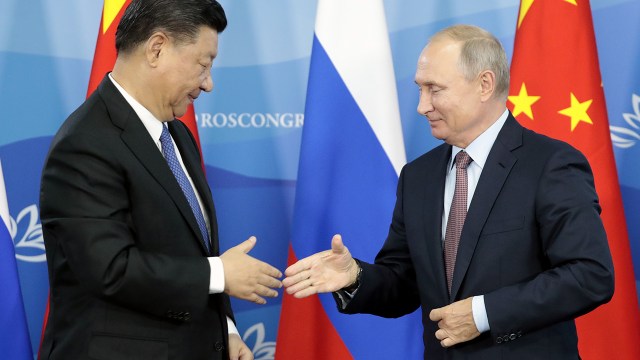 |
| Russian President Vladimir Putin shakes hands with Chinese President Xi
Jinping during the Eastern Economic Forum in Russia in September 2018.
(Sergei Chirikov/AFP via Getty Images |
Verbal histrionics are a Chinese specialty. Aggravating vocabulary to stress Beijing's displeasure with the actions and attitudes that clearly poke fingers where they don't belong, irritating the Politboro members of the Chinese Communist Party. Indignities to Chinese self-regard are not to be taken lightly. Western governments are forever 'following the wrong path', and are in dire need of recognizing the 'errors of their ways'.
Predicting a world war to arise out of conflicting ideals and public confrontations over ideology and interference in one another's stratagems and actions clearly send Beijing into convulsions of rage. That the championing of south-east Asian nations, geographic neighbours of China by the world's sole superpower acts like a door-stopper in Beijing's hasty plans to consolidate its air, sea and land grabs sends it into an apoplexy of transparent threats.
But Beijing is not alone in this situation. While the U.S. steadfastly cautions Beijing on its plans for 'reunification' to absorb a sovereign Taiwan, a similar situation plays out with Russia in Ukraine. Moscow too claims that the West, NATO and the United States in particular have grimly and with malign intention 'implemented all-around containment, encirclement and suppression' to bring Russia to its knees and destroy it. When all it is doing is exercising its regional rights as a hegemonic nation.
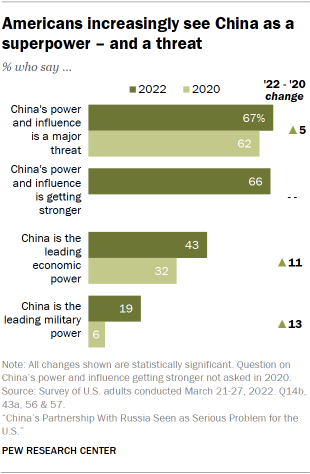
While Moscow and Beijing accuse NATO, the United States, The European Union et al of colluding against them, they in turn collude to challenge the territorial, sovereign and human rights entitlements in a free world of countries with no wish to be forcibly placed under the rule of totalitarian states for whom territorial expansion is an imperative they cannot resist at any cost. It is also conceivable that the enmities expressed are diversionary tactics in part, aimed at their homegrown audiences.
In China, on the sidelines of the annual legislature meeting when the country's leaders set out their economic and political priorities for the year to come, China's foreign minister warned that Beijing and Washington, polarized beyond tolerable limits, are on the verge of a violent confrontation. And this impending danger is none of China's fault, but rather that of an aggressive, imperialist, racist United States of America.
The United States is interfering in China's internal affairs, a situation that is beyond intolerable. Which is how countries like Australia, Canada, and others feel about Beijing's interference in their internal affairs. In, for example, a Chinese law that compels all Chinese companies and individuals whether they are located in China or are expatriates living elsewhere with citizenship in other countries, to cooperate with Beijing's intelligence services. Chinese living abroad are under threat when they demur and declare their allegiance to their new countries.
And nor are other countries left to their own lawful internal rule without China sending out its probing listening and cyber0intelligence projects to pry open the secrets of foreign governments, corporations, universities, research institutes to avail itself of data and intelligence to enhance its edge in surveillance, technology, scientific studies. Beijing has opened what passes for unauthorized police stations in other countries. Its manufacture of popularly-sold communication devices hold software responsive to China's search for intelligence.
Above all, what has the West and China's neighbours on tenterhooks of anticipation and concern is its expansive political and economic goals, including the potential for a breakout of war over Taiwan. Beijing's influence campaign under its Belt and Road initiative, installing its new Silk Road in places as diverse as Africa, Europe, Latin America and the Middle East, is a covert model for influence, trade, surveillance and power. Along with the economic impetus of Chinese investment.
"Despite China’s opposition, the US passed and signed into law the
National Defense Authorization Act for Fiscal Year 2023, which contains
negative content concerning China. China deplores and firmly opposes
this US move, and has made serious démarches to the US"."This Act,
in total disregard of facts, hypes up the “China threat” narrative,
blatantly interferes in China’s internal affairs, and attacks and
discredits the Communist Party of China (CPC). This is a serious
political provocation against China. The leadership of the CPC is the
choice of history and the people. The Chinese people are clear-eyed
about the US’s ill intention of suppressing and containing China’s
development and thwarting the Chinese nation’s rejuvenation. Attempts to
drive a wedge between the Chinese people and the CPC will not succeed."
"This
Act also contains a large number of negative provisions on Taiwan which
seriously violate the one-China principle and the stipulations in the
three China-US Joint Communiqués. This sends a gravely wrong signal to
“Taiwan independence” separatist forces and severely affects peace and
stability across the Taiwan Strait. Taiwan is China’s Taiwan. No
external interference in China’s internal affairs will be tolerated. The
US needs to stop seeking to use Taiwan to contain China, stop fudging,
distorting and hollowing out the one-China principle, and stop moving
even further down the wrong and dangerous path."
"We urge the US to
earnestly follow through on the important common understandings reached
between the two presidents in Bali, abandon the Cold-War and zero-sum
mentality and ideological bias, adopt an objective and rational view of
China’s development and China-US relations, and not to implement the
negative China-related sections in the Act. China will take strong and
resolute measures to firmly safeguard its sovereignty, security and
development interests." Ministry of Foreign Affairs of the People's Republic of China
 |
Three months after the Biden-Xi summit, the two sides’ divergent framings of the bilateral relationship are hindering progress. Carnegie Endowment for International Peace
|
Labels: China, Confrontation, Ideologies, Interference, Russia, Threats, United States
Exploiting Lebanon
"There should be international efforts to help Lebanon, not to impose anything on it." "It is not humane to exploit the pain and suffering of the people for political goals." Mohammed Javad Zarif, Iranian foreign minister, Beirut
 |
| The explosion at a Beirut Port warehouse tore out a crater 200 metres across that filled with seawater.(AP: Hussein Malla) |
"Hezbollah possesses a military force, according to an estimate by the
Janes Information Group, of 25,000 full-time fighters, along with
20,000-30,000 reservists. The official army, the Lebanese Armed Forces,
has 72,000 personnel, but it is riven with sectarian division. Thus,
Hezbollah has an armed capacity in Lebanon superior to all competitors,
including the army of the nominal state."
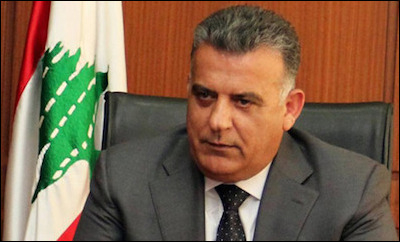 Gen. Abbas Ibrahim, head of the General Directorate of General Security (GSDG), is a close Hezbollah ally. |
"But it is at the unseen level that the power of the Hezbollah deep
state is at its most profound. The head of the country's most powerful
security organ, the General Directorate of General Security (GSDG), is
General Abbas Ibrahim. Ibrahim is a close ally of Hezbollah. This is no
great secret in Lebanon. Ibrahim is close to, and appears regularly in
public with, Wafiq Safa, the head of Hezbollah's security apparatus.
Safa, meanwhile, as described by Lebanese Druze leader Walid Jumblatt
with admirable simplicity, "decides what the army and security forces
can do." Jonathan Spyer, Middle East Forum
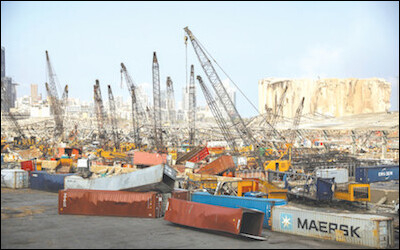 |
| Hezbollah power structure in Lebanon's ports. (Reuters) |
Hezbollah is the de facto controller of Lebanon. And the Islamic Republic of Iran controls Hezbollah. The al-Quds division of the Islamic Revolutionary Guard Corps formed the Party of God, instilled in it a death cult, and trained and incited it to become a leading terrorist group with an especial focus on the destruction of the state of Israel. The close to 3,000 tons of volatile, explosive ammonium nitrate was stored in a Beirut port warehouse for the express purpose of stockpiling it for future use as an explosive, irrespective of its original, aborted destination via a rustbucket Russian ship moored at the port with its crew. A crew that knew very well the destructive capacity of the material and conveyed that to port authorities.
The same port authorities who repeatedly petitioned government agencies to remove and secure the stockpile, away from public, populated areas of the city. Those warnings were studiously ignored for six years, and those same port authorities are now being judicially questioned after having been arrested by the now-caretaker government of Lebanon, hoping to find a culprit that will lead them to an outside source they claim they suspect had tampered with the ammonium nitrate. The government authorities also rejected an international enquiry into the explosions, though one will proceed with the aid of the FBI.
 |
Wickipedia
|
Syria, Iran and Hezbollah have destroyed Lebanon. Their interference in the unstable country with its sectarian, ethnic, tribal and clan complexities has ensured that the old system of cooperative government will never again be possible, where Christians, Druze, Sunni and Shia all had an institutionalized hand in running the government until a civil war broke out, complicated by the presence of Palestinians led by Yasser Arafat leading violent forays into Israel compelling the IDF to enter and succeed eventually in having the militants expelled.
To have Iran, at this juncture, complain that other countries are interfering in Lebanese affairs is the ultimate in absurd irony, but it is typical of what can be expected from the Persian Shiite nation that has been busy roiling the majority Arab Sunni countries of the Middle East with the threat of its ambitions. In effect, the Republic of Iran was the architect of the government that just fell.
And Iran's support of Syrian President Bashar al-Assad's campaign of unmerciful vengeance on Syria's Sunni citizens who rebelled against the Shiite Alawite rule that left them without rights equal to that of the Alawites has done a fine job of destroying Syria as well, thanks to Hezbollah's assistance and Russia's decision to intervene in exchange for a Mediterranean deep sea port and an Russian airbase in Syria.
France and the United States have been busy themselves in Lebanon (In the mid-1980s they formed part of a UN peace corps in Lebanon), post-disaster, in diplomatic efforts urging Lebanon to extirpate the corruption infecting its body politic in favour of enacting long-delayed reforms should it wish to attract foreign financial assistance to aid it in exiting its disastrous financial dilemma at the very time it also struggles against COVID, and coping with a million Syrian refugees on its soil. The presence of Hezbollah, Iran's proxy, as a destabilizing force in the country has ensured that wealthy Gulf states withhold investing in Lebanon.
 |
| The force of the blast destroyed buildings in the port district and shattered windows across the city.(AP: Hassan Ammar) |
The angry protests that have highlighted ordinary Lebanese disaffection with their government, disgust with Hezbollah, desperation over the country's financial failures, high unemployment and growing destitution, succeeded in having the government step down after a number of its ministers left the government over the very same issues. "We can't live like this. The West has to pressure our leaders to save us" Lyaam Ghanem, a Beirut pharmacist appealed.
Even while Iran's Foreign Minister Zarif stated that Tehran is prepared alongside private Iranian companies to help in rebuilding and rehabilitating Lebanon's electricity sector. Something that Iranians themselves would be rather upset to know about, given Iran's quite similar financial situation, and its own citizens' disapproval and protests against the ruling mullahs and the power of the Revolutionary Guard Corps which owns so many of the country's most important industries.
 |
| Anti-government protesters burn a barricade next to a wall installed by
security forces to block access to the Parliament after the explosion.(AP: Felipe Dana) |
Labels: Hezbollah, Instability, Interference, Iran, Lebanon
Lighting Up The Night Sky
"Reflections from the sun in the hours after sunset and before sunrise make them appear as slow-moving dots in the night sky."
"They can be detrimental to the sensitive capabilities of large ground-based astronomical telescopes."
American Astronomical Society
"Sats [satellites] will be in darkness when stars are visible. We'll make sure Starlink has no material effect on discoveries in astronomy."
"[I've sent a note to the Starlink team about] albedo reduction [minimizing the proportion of light reflected from the spacecraft]."
Elon Musk
"Our concern is just how bright they might be."
"We will have to learn how to operate our electronics to detect weak cosmic signals in the presence of satellite signals at other frequencies that will be millions of times stronger."
Harvey Liszt, spectrum manager, National Radio Astronomy Observatory, Charlottesville, Va.
"[The legal arena] is really the Wild West [and] international space law doesn't really deal with this use of outer space at all."
"Darkness and the inspiration that the natural night sky brings to humanity has resulted in great works of art, literature, and music."
"The prospect of losing all that is the prospect of severing a key tie between humanity and the natural world."
John Barentine, public policy director, International Dark Sky Association
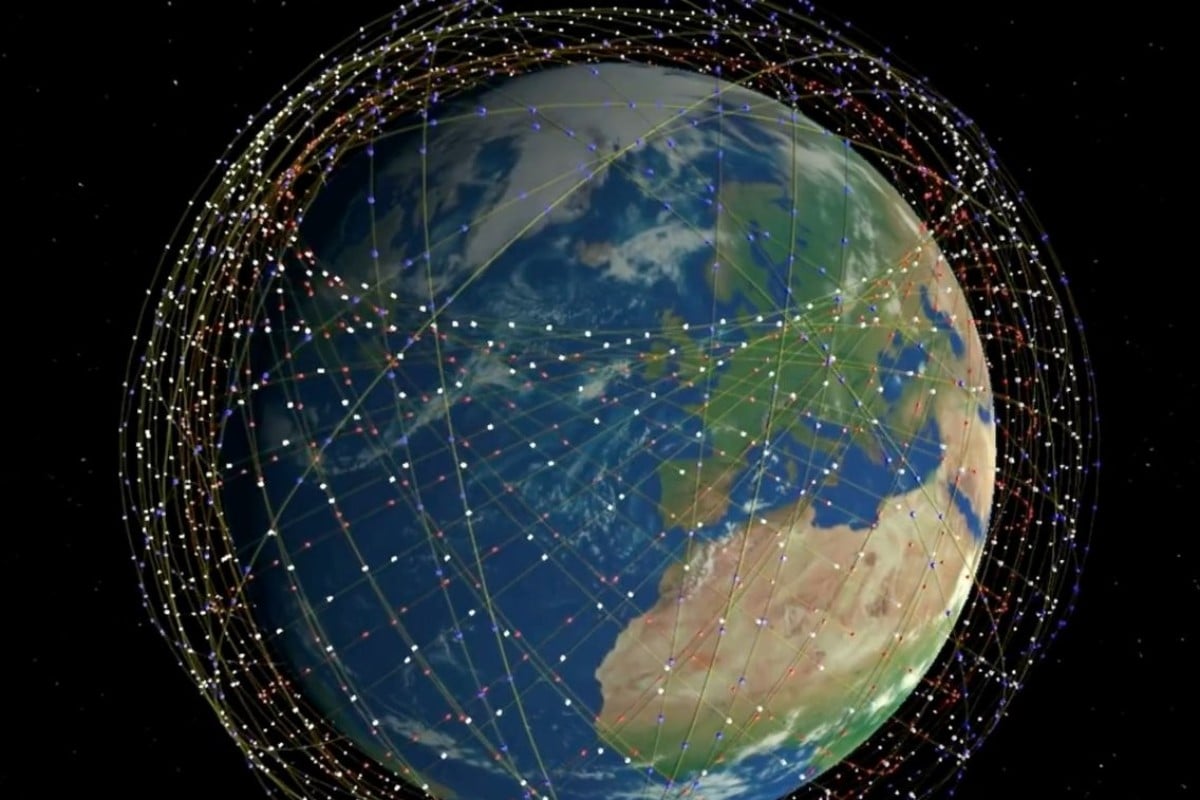 |
| This illustration of Starlink, a fleet or constellation of
internet-providing satellites designed by SpaceX, shows roughly 4,400
satellites of the project’s first phase deployed in three different
orbital “shells”. Photo: University College London |
Telescopes trained on the night sky in Flagstaff, Arizona from the Lowell Observatory, captured streaks of sunlight reflections marring their view of far-off star systems, giving astronomers new concerns over the spoliation effect of a growing number of communications satellite being planned for the lower Earth atmosphere, particularly given close to 12,000 of the Starlink fleet set to shine brightly, certain to interfere with research dependent on visual observations of distant galaxies and nearby asteroids.
Not only are these new satellites poised to arrive in great numbers, more than doubling the current five thousand satellites circling the Earth at present, but they are designed to fly at a lower level than most traditional such craft.
"We just happened to be pointed in the right direction, and Starlink flew right through it", stated Jeffrey Hall, director Lowell Observatory. Signalling for Hall,
"this is potentially a problem".
The Starlink fleet has received authorization to launch 11,943 satellites; the obvious leader in a total of close to 13,000 low-Earth orbit satellites approved by the Federal Communications Commission, coordinating trajectories and radio-frequency use. As though that's not enough, the Musk Space Exploration Technologies Corp. is to be joined by Amazon.com's Jeff Bezos' 3,236 Internet-beaming satellites into low-Earth orbit.
Minimal lag-time for data to bounce between ground and the spacecraft through the lower trajectories, thus overcoming signal lethargy limiting Internet-from space schemes of traditional communications satellites, older craft parked 22,000 miles (36,000 kilometres) above Earth, an altitude allowing them to appear to hover. Low-Earth orbit on the other hand sees altitudes of just 112 to 1,200 miles -- with satellites racing the globe to remain aloft, orbits completed in about 90 minutes.
To achieve widespread coverage of the globe, a multitude of satellites is required. In low-Earth orbit currently, there are 2,338 satellites according to a database set by the Union of Concerned Scientists. NASA itself totalled 4,972 satellites in its payload counts, both active and defunct. A mere 1,628 stars are visible to the unaided human eye, registered at the fifth magnitude of a brightness scale scientists use. Greater numbers could be yielded with exceptional eyesight, total darkness -- absent light pollution.
Astronomers are now studying the extent of the problem -- though once moved into planned higher orbits the satellites may appear less bright, visibility possibly varying with the seasons; the assurance that their altitude means they will remain away from the Earth's shadow, staying in sunlight even after dusk, for longer summer periods than in the winter months. Reliance on the nonvisible spectrum by astronomers using radio telescopes may also be affected, with a need to adjust to low-orbiting satellites filling the sky.
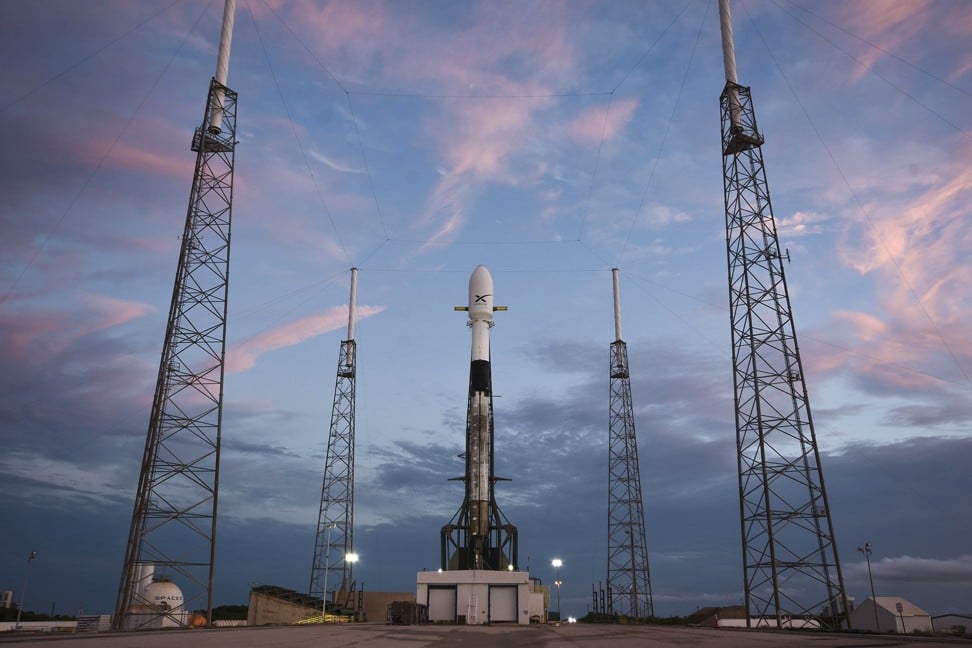 |
| A Falcon 9 SpaceX rocket is shown here a day before the scheduled launch
of 60 Starlink satellites from Space Launch Complex 40 at Cape
Canaveral Air Force Station in Florida. Photo: Agence France-Presse |
Labels: Astronomy, Communications, Interference, Light, Research, Satellites


