Iran, Intransigent and Triumphant
Iran, Intransigent and Triumphant
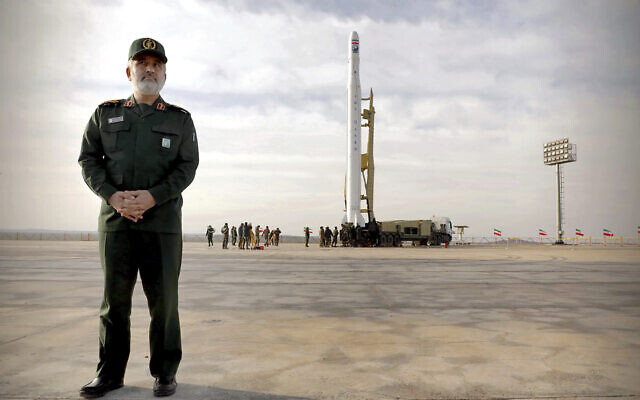 |
| Gen. Amir Ali Hajizadeh, the head of the Revolutionary Guard’s aerospace
division stands in front of an Iranian rocket carrying a satellite in
an undisclosed site believed to be in Iran’s Semnan province, on April
22, 2020. (Sepahnews via AP) |
"The
intended research objectives of this launch were achieved. this was
done as a preliminary launch ... God willing, we will have an
operational launch soon."
"By
developing our capacity to launch satellites, in the near future
satellites with a wide range of applications ... will be placed into
orbit."
Ahmad Hosseini, spokesman, Iranian Space Agency
"These activities are all the more regrettable as they come at a time
when we are making progress in the nuclear negotiations in Vienna.".
"We call on Iran not to launch further ballistic missiles designed to be
capable of carrying nuclear weapons, including space launchers."
French foreign ministry
 |
| Iranian satellite carrier rocket “Simorgh” is launched in an unknown
location in Iran, in this picture obtained on December 30, 2021.
Ministry of Defense of Iran/WANA (West Asia News Agency)/Handout via
REUTERS |
France's
plea to the Iranian Ayatollas and the IRCG will most certainly not
persuade the Islamist theocracy to abandon their ambitious plans for the
future of the Islamic Republic to mark out its territory in space, to
launch satellites to look down on what its challengers are up to, to
assess the military preparedness of its enemies, to threaten those whom
Iran feels has no right to their very existence in a geographic area
hostile to the presence of the territorial integrity of a non-Muslim
country.
Harsh
sanctions imposed on Iran for its well-known plans to achieve success
in nuclear weaponry to accompany its ever-evolving arsenal of
technically advanced ballistic missiles appear to have done nothing to
extinguish its passion to be armed with the most fearsome of mass
weaponry. Iran has amply demonstrated it has the wherewithal to supply
its military proxies in Lebanon, Yemen, Syria, Iraq and Gaza with
weapons, but remains shy of finances to ensure its own population can
live with ample fuel and food.
Like
North Korea, Iran has its priorities and fending for its peoples'
comfort in food security is not one of them. Their ambitions remain set
on securing weapons of mass destruction to instill fear in the minds of
their adversaries, and to gain respect-through-intimidation to ensure
that others think twice before provoking their ire by criticism and
challenges. Like North Korea, which has exchanged formulas, methodology
and technicians with Iran, formal discussions brought to a bargaining
table by the international community to persuade Iran to surrender its
nuclear ambitions are destined to fail.
Three
'research' devices were launched into space with the use of a satellite
launch from the Imam Khomeini Space Center in Northern Iran at dawn on
Thursday. During the time of the original 2015 nuclear agreement meant
to slow down Iran's nuclear program where it promised to stop enriching
uranium to a grade level useful for the creation of a nuclear device,
Iran prosecuted conflict in Yemen and in Syria, threatened Arab Sunni
Muslim nations, vowed to eliminate Israel, provided Hezbollah and Hamas
and the Houthis with advanced rocketry, and sneered at the gullibility
of the West.
Indirect
U.S.0Iran talks on the nuclear issue are ongoing, but even the most
oblivious optimist cannot believe that anything positive can be
achieved, other than buy Iran more time to perfect its rocketry and
approach nuclear bomb technology to secure an arsenal of their own.
Iranian state television showed footage of the firing of the launch
vehicle, a Simorgh (Phoenix) satellite carrier rocket which
launched the three research devices at an altitude of 470 km and a speed
of 7,350 meters per second.
 |
| Image taken from footage aired by Iranian state television shows a
rocket that Iran announced it launched on Thursday, Dec. 30, 2021.
(Iranian state television via AP) |
Labels: Ballistic Rocketry, Iran, Middle East, Nuclear Agreement, Satellites, Terrorist, Threats, United States
Zealous Musk and Jealous Beijing -- Sharing Space In Space?
 |
| The
image of Musk and his Chinese doppelganger was posted beneath a tweet
from Musk claiming that he will pay 11 billion USD in taxes this year. |
Elon Musk enjoys great popularity among young Chinese, in China. He has
also invested a great deal in China. Unfortunately, the great
admiration he enjoys as a role model for innovative, bold gestures and a
startling imagination with an enduring belief that there is nothing,
absolutely nothing that he cannot achieve on the strength of the force
of his character, his vision and enterprise, is not universally beloved
in China. Oh, the Chinese Communist Party respects his enterprise and
ability to make money for himself and his enterprises, but they have
certain reservations about anyone -- just ask Jack Ma -- who thinks too
big for their britches.

And no one individual can possibly challenge the supremacy of the
Chinese State and its enterprises. Including Beijing's claim to shooting
for the stars. Starting modestly with a space station of its own. So
when a world-class entrepreneur like Elon Musk displays a gusto for
outmaneuvering and out-satelliting the most technically advanced, ardent
of nations in space exploration he was guaranteed to raise the hackles
of the CCP. All the more so that he is a certified American
strategist-capitalist-innovator.
Not
that this far-reaching technical-whizz-kid hasn't raised the hackles of
other non-state groups, such as scientists in the field of astronomy
and astro-physics who depend on their ability to read the stars, as it
were, though the grace of dark skies enabling powerful telescopes to
reach far into the deepest recesses of the universe, back in time and
space to analyze the beginning of all that exists, but will be hampered
by Musk's plans to string satellites in a wide net impeding the course
of astronomical investigation by lighting up the skies.
Now,
however, Beijing accuses Elon Musk of "space warfare" in close
encounters of a different kind, where some satellites launched as part
of his groundbreaking global internet initiative experienced a near-miss
with China's recently-launched space station. Starlink Internet
Services, a division of the Musk Space-X aerospace company, saw some of
its satellites involved in two "close encounters" with China's space
station in July and October.
China subsequently submitted a document to the United Nations apace agency: "For safety reasons, the China Space Station implemented preventive collision avoidance control",
China reported on the website of the United Nations Office for Outer
Space Affairs. Now that's awfully serious; it's obvious that a collision
of any dimension has the potential to end badly. Remember not so long
ago when China insisted it had the right to send up rockets directed to
destroy some of its old space junk still in circulation?
And
the United States and European Space Agency were concerned over the
detritus not only having the potential to intersect with their
communication satellites but their space missions as well, including the
international space station, where astronauts were actually forced to
take evasive action when a piece of a destroyed Chinese weather
satellite was headed toward it?
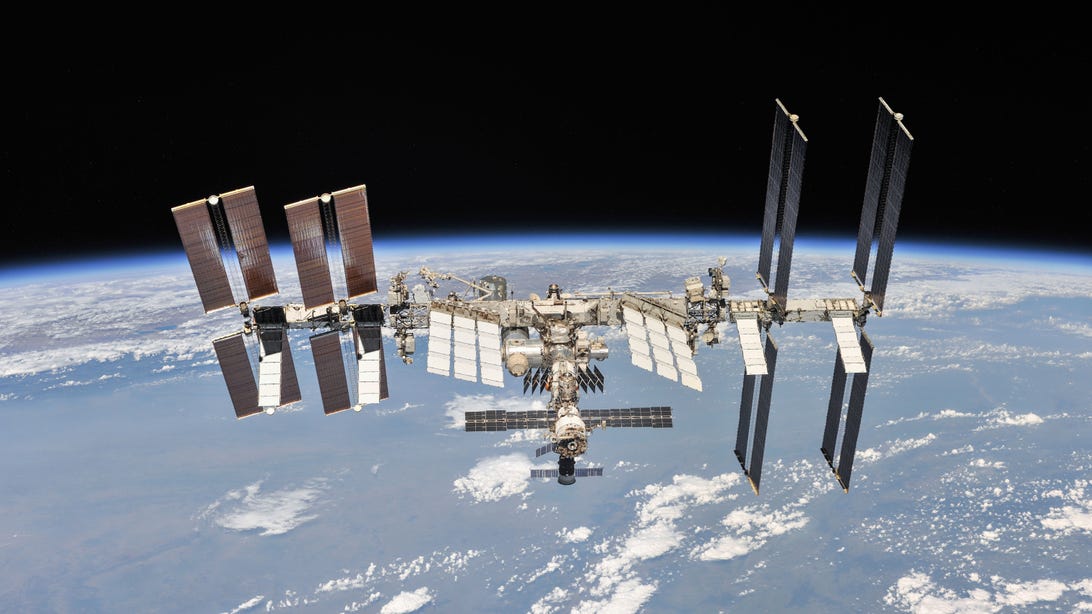 |
The ISS is a big target for space debris, but it's no sitting duck NASA
|
.China
launched Tianhe, the largest of its three modules which will make up
its space station, in April. The end of 2022 will see the completion of
the space station following four crewed missions meant to build on the
initial module. Scientists urge space-travelling governments to share
data to reduce risk of catastrophic space collisions in view of close to
30,000 satellites and other debris orbiting Earth. Close to 1,900
satellites have been deployed by Space X alone in service to its
Starlink broadband network, meant to blanket the world with universal
internet coverage.
According to China's state-operated tabloid Global Times, the satellites, 42,000 thousand of which Musk plans to orbit could be "used to detect China's space perception capabilities and test whether China can accurately grasp their actions". The paper wrote: "The
aerospace industry is currently concerned about the military
application of Starlink satellite because after the deployment of more
than 40,000 satellites, the normal launch of other countries will be
affected."
Musk may just run into problems
making his world-wide high-speed internet connectivity viable; planning
to ask China for permission to build antenna dishes or ground links on
its territory to send and receive data from the Starlink spacecraft
initially, China saw that plan as interfering with its censored internet
network, the "Great Firewall", blocking access to websites like google,
YouTube, Twitter, Facebook and international media. How else might it
succeed in ensuring its 1.4 billion population is shielded from
criticism against its communist leaders?

The
Chinese division of Tesla last month, also owned by Musk, announced
that Starlink would not launch services in China. All Tesla cars and
charging stations would use network services provided by Chinese
operators with all data maintained within the country. This, the result
of China forcing foreign companies to retain all records collected from
Chinese consumers within the country. Tesla in China employs quite a lot
of Chinese workers.
"What
will happen to Tesla in China, if some day Starlink's low-orbit
satellites collide with our country's low-orbit satellites or other
spacecraft", worried one Chinese, writing on Weibo.
What, indeed?! After all, China appears to feel entitled to viewing
space as its personal jurisdiction and it is very jealous of its
reputation and sovereignty. And Musk feels that nothing is beyond his
enterprising spirit to accomplish as a private, non-state investor in
space.
Labels: Challenges, China, Communication, Elon Musk, Enterprise, Potential Collisions, Satellites, Space Station
Lighting Up The Night Sky
"Reflections from the sun in the hours after sunset and before sunrise make them appear as slow-moving dots in the night sky."
"They can be detrimental to the sensitive capabilities of large ground-based astronomical telescopes."
American Astronomical Society
"Sats [satellites] will be in darkness when stars are visible. We'll make sure Starlink has no material effect on discoveries in astronomy."
"[I've sent a note to the Starlink team about] albedo reduction [minimizing the proportion of light reflected from the spacecraft]."
Elon Musk
"Our concern is just how bright they might be."
"We will have to learn how to operate our electronics to detect weak cosmic signals in the presence of satellite signals at other frequencies that will be millions of times stronger."
Harvey Liszt, spectrum manager, National Radio Astronomy Observatory, Charlottesville, Va.
"[The legal arena] is really the Wild West [and] international space law doesn't really deal with this use of outer space at all."
"Darkness and the inspiration that the natural night sky brings to humanity has resulted in great works of art, literature, and music."
"The prospect of losing all that is the prospect of severing a key tie between humanity and the natural world."
John Barentine, public policy director, International Dark Sky Association
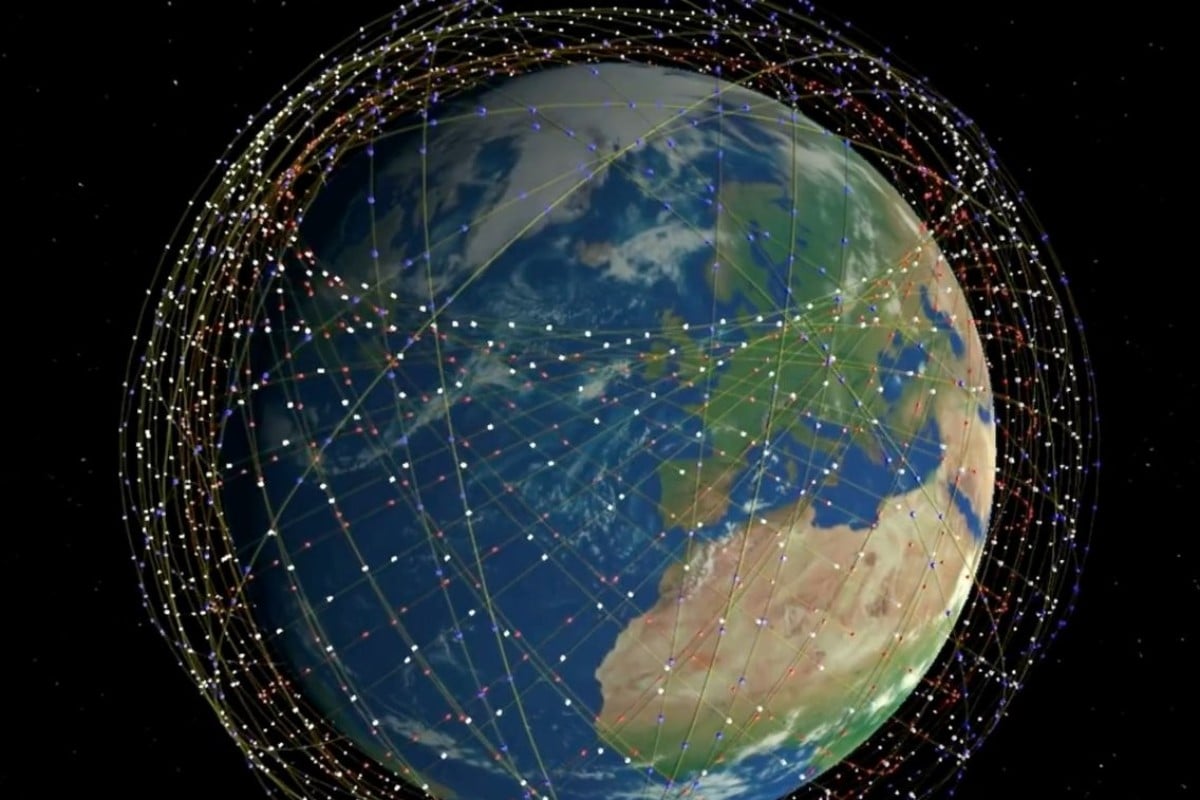 |
| This illustration of Starlink, a fleet or constellation of
internet-providing satellites designed by SpaceX, shows roughly 4,400
satellites of the project’s first phase deployed in three different
orbital “shells”. Photo: University College London |
Telescopes trained on the night sky in Flagstaff, Arizona from the Lowell Observatory, captured streaks of sunlight reflections marring their view of far-off star systems, giving astronomers new concerns over the spoliation effect of a growing number of communications satellite being planned for the lower Earth atmosphere, particularly given close to 12,000 of the Starlink fleet set to shine brightly, certain to interfere with research dependent on visual observations of distant galaxies and nearby asteroids.
Not only are these new satellites poised to arrive in great numbers, more than doubling the current five thousand satellites circling the Earth at present, but they are designed to fly at a lower level than most traditional such craft.
"We just happened to be pointed in the right direction, and Starlink flew right through it", stated Jeffrey Hall, director Lowell Observatory. Signalling for Hall,
"this is potentially a problem".
The Starlink fleet has received authorization to launch 11,943 satellites; the obvious leader in a total of close to 13,000 low-Earth orbit satellites approved by the Federal Communications Commission, coordinating trajectories and radio-frequency use. As though that's not enough, the Musk Space Exploration Technologies Corp. is to be joined by Amazon.com's Jeff Bezos' 3,236 Internet-beaming satellites into low-Earth orbit.
Minimal lag-time for data to bounce between ground and the spacecraft through the lower trajectories, thus overcoming signal lethargy limiting Internet-from space schemes of traditional communications satellites, older craft parked 22,000 miles (36,000 kilometres) above Earth, an altitude allowing them to appear to hover. Low-Earth orbit on the other hand sees altitudes of just 112 to 1,200 miles -- with satellites racing the globe to remain aloft, orbits completed in about 90 minutes.
To achieve widespread coverage of the globe, a multitude of satellites is required. In low-Earth orbit currently, there are 2,338 satellites according to a database set by the Union of Concerned Scientists. NASA itself totalled 4,972 satellites in its payload counts, both active and defunct. A mere 1,628 stars are visible to the unaided human eye, registered at the fifth magnitude of a brightness scale scientists use. Greater numbers could be yielded with exceptional eyesight, total darkness -- absent light pollution.
Astronomers are now studying the extent of the problem -- though once moved into planned higher orbits the satellites may appear less bright, visibility possibly varying with the seasons; the assurance that their altitude means they will remain away from the Earth's shadow, staying in sunlight even after dusk, for longer summer periods than in the winter months. Reliance on the nonvisible spectrum by astronomers using radio telescopes may also be affected, with a need to adjust to low-orbiting satellites filling the sky.
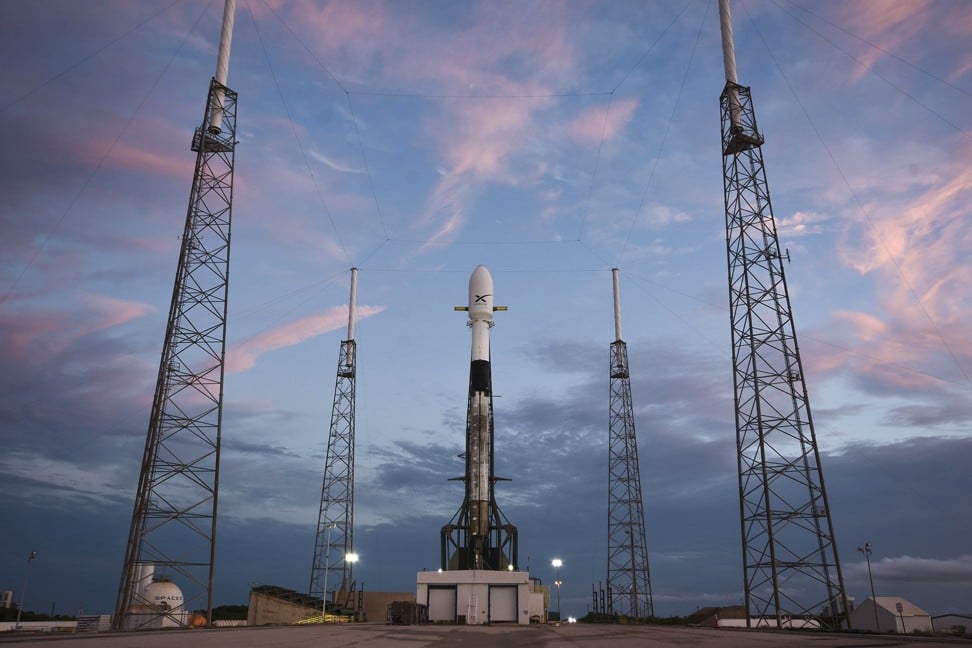 |
| A Falcon 9 SpaceX rocket is shown here a day before the scheduled launch
of 60 Starlink satellites from Space Launch Complex 40 at Cape
Canaveral Air Force Station in Florida. Photo: Agence France-Presse |
Labels: Astronomy, Communications, Interference, Light, Research, Satellites