Sunday, October 01, 2023

And The Solution to the Scourge of Drug Addiction Is .... ?


"We are regularly seeing and hearing in our practices that diverted hydromorphone is causing harm to both adults and children."
"We call on the government to ensure that all hydromorphone prescribed to people with opioid addiction is provided in a supervised fashion or that funding be ceased for the current harmful practice."
"[The] Unsupervised Free Government Funded Hydromorphone [is] causing further harm to our communities by increasing the total amount of opioids on the streets and providing essentially unlimited amounts of opioids to vulnerable people with addiction."
"As a result of this practice, we are witnessing new patients suffering from opioid addiction, and additional unnecessary overdoses and death."
Open letter to government of Canada from 17 addiction specialists
https://www.reuters.com/investigates/special-report/assets/baby-opioids-pennsylvania/overview-video.jpg?v=322416211117
A Reuters investigation found 110 examples of children whose mothers used opioids during pregnancy and who later died preventable deaths after they were sent home from the hospital. A federal law meant to protect those children has largely been ignored by states across America.
 
"What is killing people is an increasingly toxic and unpredictable drug supply... The idea in giving people an alternative to that, that is predictable."
"It's not as if our field is in disarray, in disagreement around sort of the more conventional treatment of addictions."
"This is a very specific item which has a lot of controversy associated with it."
Dr. Paxton Bach, co-medical director, B.C. Centre on Substance Use, addiction medicine physician, St.Paul's Hospital, Vancouver

A person injects an opioid at a Vancouver clinic.
A group of addiction physicians called on the Liberal government to ensure that safe-supply drugs are either not provided entirely, or if they continue to be provided for drug-addicted people, it be in a supervised manner. This, given accounts of people addicted to drugs visiting safe-supply outlets that provide them with free hydromorphone to ensure they have an alternative to the vastly more preferred street-acquired illegal fentanyl which has been implicated in an epidemic of drug overdoses.

The problem has become that those receiving the hydromorphone use it as leverage on street markets by selling it to others and using the profit they gain by so doing, to acquire the more desired fentanyl, thus entirely negating the purpose of the safe supply function, and in the process making more drugs available on the street. Hydromorphone availability has been cited as the cause of inciting more youth to become addicted to drugs, among other untoward consequences.

The pharmaceutical-grade hydromorphone made easily available through the street clinics as a method of reducing drug overdoses from heroin or fentanyl has backfired, the government-funded program of ten pilot projects in British Columbia, Ontario and New Brunswick has simply created a wider and more complicated system of drug use. Despite that a report in the Harm Reduction Journal in June of 2023 concluded enrolment in safer-supply programs leads to "fewer overdoses and overdose-related deaths, reduced drug-related harms, and improved health and social outcomes".

Angelica Richardson McKenney feeds her daughter Lynndaya in December 2012. The snapshot was taken the day before McKenney, high on a trio of drugs, fell asleep on top of Lynndaya and suffocated her. REUTERS/Handout
 
Not, however, in the opinion of critics claiming the programs have led to a number of other problems being created. The letter's authors argue that research of safer supply is "methodologically weak" and the program should be reformed or altogether cancelled. Author of the letter, Dr. Rob Cooper, spoke of a patient receiving safe supply treatment: "She's now dead. She was selling the hydromorphone she was getting and she was buying fentanyl. The problem here is there's no safety measures protecting that person or the public."

Founder of he ACT Addictions Clinic chain in Ontario, Dr. Clement Sun, a signatory to the letter, explains the situation is "almost like we're getting back to the days ... that the source of the drug is not from the illegal dealer [but] is from these safe clinics", resembling how over-prescribed OxyContin fuelled the opioid crisis.

"I'm not against them trying to help addicts, because that's what my job is. But this way, it is reckless", added Dr. Sun. Drug users receive their safer supply drugs, then turn around on the streets and sell them. The "diversion" money is "commonly used to purchase more potent opioids such as fentanyl. There is widespread evidence that this is occurring", the letter adds. In addition to which they argue that the diverted hydromorphine is "creating more children with addiction in our Junior High and High Schools".

Data out of British Columbia indicates hydromorphone to be present in five percent of the opioid deaths that took place in the province. In comparison to fentanyl, which was seen to be present in 88 percent. Dr. Sun believes these deaths might not yet be showing up in statistics. "They're not seeing it, because they're selling it to the kids and they haven't overdosed yet", he stated. "We're not talking about people dying. We're talking about the fact that you're spreading a medication that's addictive and being the supplier to the dealers, to the people who are selling it."

Drs. Cooper and Sun suggest that people who want the pharmaceutical grade opioids could be instructed they must be taken under supervision at a 24-hour pharmacy, while Dr. Bach agreed there are ways that such prescribing could be improved, yet a countrywide reform that addresses all concerns is unlikely to be developed. "I don't think there is going to be any one solution that is universally appropriate. But there is lots of opportunity to be thoughtful about this", he concluded.

https://static01.nyt.com/images/2022/07/26/science/00opioids-vancouver1/00opioids-vancouver1-superJumbo.jpg?quality=75&auto=webp
Credit...Jackie Dives for The New York Times


Labels: , , , , , ,

Wednesday, June 21, 2023

Canada, Safe and Secure

"I think policy makers and decision-makers need to realize that there are some very strong sentiments being expressed on these issues [involuntary addiction treatment, criminal charge bail, decriminalization of drugs]."
"We're seeing large percentages of people saying things are getting worse."
"I think there was a perception, correct or not, that safe injection sites would lead to a solution, and those problems are instead amplified probably ten-fold from where they were. So there's this frustration of, 'What else can we do. This isn't working'."
Andrew Enns, executive vice-present, Leger Marketing
https://smartcdn.gprod.postmedia.digital/nationalpost/wp-content/uploads/2023/06/JUSTICE1.png?quality=90&strip=all&w=1128&type=webp&sig=5e68fgveLAfNR1Kis3VdzQ
 
Little wonder Canadians are fed up. Inflation is raging, the cost of consumer goods sky-high, additional taxes on energy linked to the Trudeau government's environmentalist agenda has sent the price of gas at the fuel pumps soaring, homelessness is a growing concern, and more people than ever before are turning to food banks. Canada's once-proud universal health care system has been gutted; wait times for surgery, for access to medical specialists have become dangerously inadequate. The 911 emergency system is collapsing, ambulances are increasingly late responding to calls, and so are police.

But the latest poll by Leger Marketing looked at other acute concerns of Canadians; that of growing crime rates, of growing addiction rates and consequent deaths from overdosing. Fixes that governments have been relying on have proven to be failures. Leaving the public frustrated and angry. And those sentiments of failed government actions in addressing these societal problems were emphasized on the latest poll.

The status quo is unacceptable and the response of governments has been inadequate to say the least. Canadian public opinion was found through this latest poll to be completely opposite government priorities channelled through programs that have proven to be worthless. The issues of bail, involuntary addiction treatment, and the decriminalization of drugs in a desperate attempt to ease the growing problems in society are topmost in people's minds behind the cost of living.

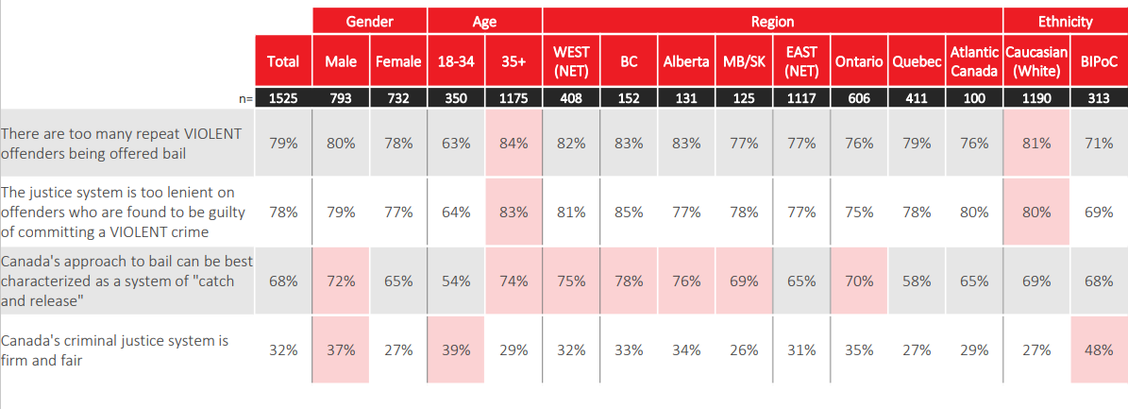
A clear majority of poll respondents agree the Canadian justice system is mishandling bail, too lenient on violent criminals. Example: the statement "there are too many repeat violent offenders being offered bail" had the agreement of 79 percent of the surveyed. The statement "the justice system is too lenient on offenders who are found to be guilt of committing a violent crime" was endorsed by 79 percent. While less than 32 percent agreed that Canada had a "firm and fair" system of justice.

On the issue of strengthening bail, solid agreement was seen, with 82 percent of Western Canadians, 77 percent of Eastern Canadians, 80 percent of men, 78 percent of women, 81 percent of white Canadians and 71 percent of BIPOC (Black, Indigenous, People of Colour) Canadians, reporting that too many violet offenders were given bail. General agreement was seen on the viewpoint that Canada's top priorities on criminal justice should be "violent crime", "illegal firearm possession" and "drug and substance abuse".
 
https://smartcdn.gprod.postmedia.digital/nationalpost/wp-content/uploads/2023/06/POLL2.png?quality=90&strip=all&w=1128&type=webp&sig=izSlvFJ_Yl8M7N159JTNlw
 
A course has been adopted in Canada of setting aside law enforcement from the equation of drug addiction, prioritizing harm reduction policies with the like of safe consumption sites. Included was British Columbia's experiment in decriminalizing personal use quantities of hard drugs like heroin and cocaine. Canadians indicated a more nuanced view of how Canada's climbing rates of fatal overdose could be addressed.

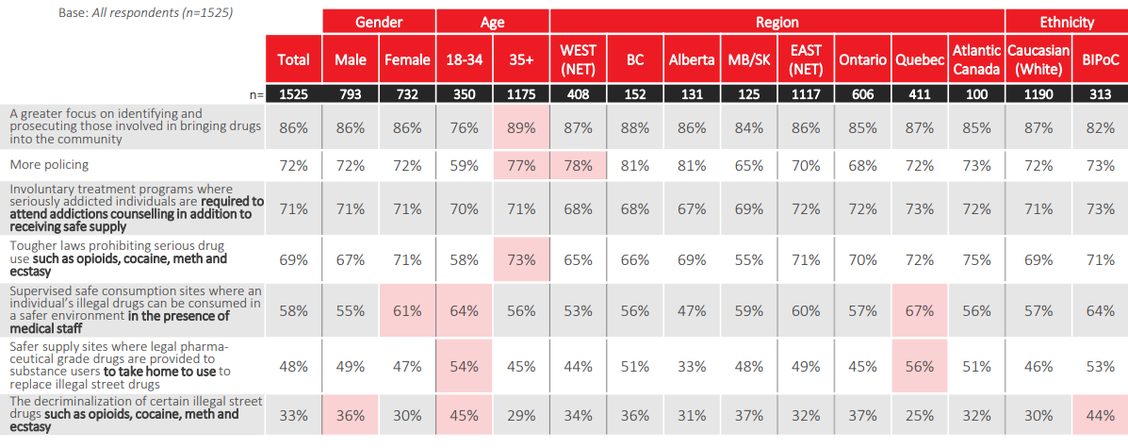
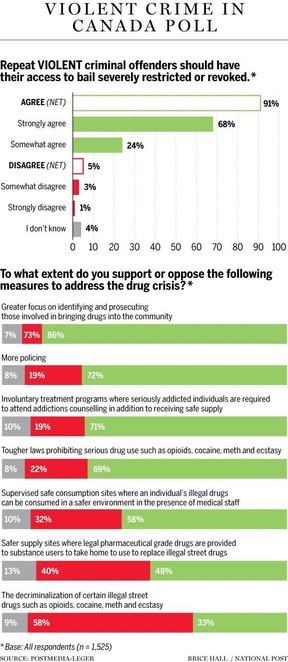
Major support was expressed (58 percent) for "supervised safe consumption sites", yet almost all respondents wanted to have drug dealers prosecuted and chronic addicts to be mandated to the necessity of treatment. Over 7 in ten respondents opted for "more policing" on drugs, the highest being expressed (at 81 percent) in British Columbia, the recognized epicentre of the overdose crisis. Asked should Canada focus on "identifying and prosecuting those involved in bringing drugs into the community", 86 percent agreed.

"There was one [safe consumption site] when we came into office in 2015, now there are dozens and dozens and dozens across the country and they are saving lives significantly", boasted Prime Minister Justin Trudeau. He slammed it as "unfortunate" and "anti-science" when Alberta began the pursuit of a treatment-centered approach to address its overdose crisis. His boast is  a hollow sham; lethal overdoses, in the face of 'dozens and dozens' of 'safe injection' sites, are on a pronounced upward curve. Moreover, the 'safe' opioids handed out at the sites are leaking onto the streets.

Although involuntary treatment for chronic addicts has been denounced as extreme by the Canadian political and public health establishment, it was endorsed by 71 percent of poll respondents who agreed "involuntary treatment programs where seriously addicted individuals are required to attend addiction counselling in addition to receiving safe supply", sounded like a solution. 
 
A graphic showing poll results
 
As for the criminal justice system reflected by government policy, opinion polls find majority support for capital punishment which since the 1970s was officially abolished in Canada. Incarceration and detention issues have hardened in the wake of recent murders and assaults committed by suspects either on bail or recent early releases from prison. Random fatal stabbings by people on parole for similar random attacks infuriate the public. 

The fatal shooting of an Ontario Provincial Police constable by a repeat violent offender on bail, prompted a letter co-signed by all 13 Canadian premiers urging the federal government to reform bail (the Trudeau government had loosened bail issues after the previous Conservative-led government had tightened them) and take steps to get violent criminals "off the streets"

Canadian bail policies were described as a system of "catch and release" by over two-thirds of poll respondents, with white respondents at 69 percent and non-white respondents, 68 percent. If offenders keep committing crimes while on bail, in the opinion of the survey respondents, stop giving them bail. 92 percent of poll respondents endorsed the statement "repeat violent criminal offenders should have their access to bail severely restricted or revoked".

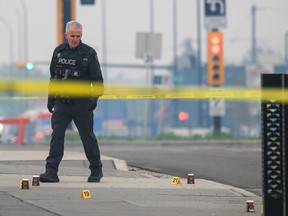
A police officer at a crime scene


Labels: , , , , ,

Monday, February 06, 2023

Toronto The Good


"I feel like a TTC [Toronto Transit Commission] ambassador. The city needs to do something for the homeless and the shelters."
"I've felt the increase of police in the last two weeks. Probably every hour I see a cop going by at every station I play at. Great. That's better than nothing."
"In my personal opinion they did this too late. They waited for all of these horrific incidents to happen before they acted on it. They should have acted on this ten years ago."
"People are freaking out. They don't want to take the subways. A lot of people don't want to ride it because of all those incidents."
Leo Zhang, cellist, 25-year experience as a subway busker, Toronto 

"I also want, as Chief of Police, to remind people that we live in a safe city."
Myron Demkiw

"I know many people who use the TC, the passengers, are anxious and even scared and they must know that we are doing everything we can that will be helpful to address their concerns."
Toronto Mayor John Tory
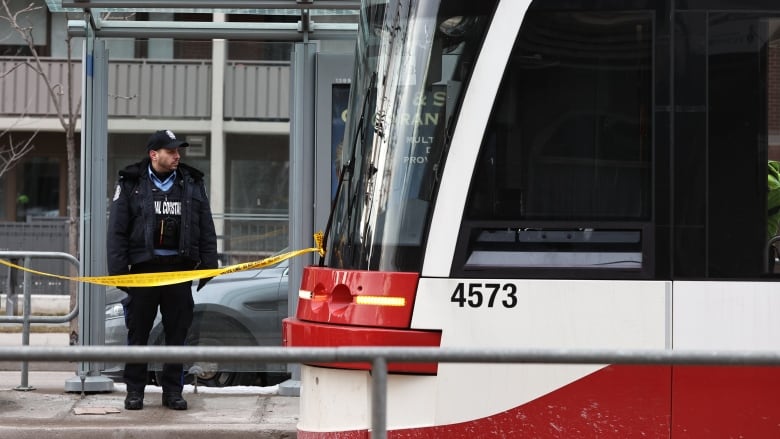
A woman in her 20s has been stabbed multiple times on a Toronto streetcar on Tuesday, Jan. 24, 2023. A suspect was arrested and the victim taken to hospital with what police say are “life altering” injuries.
Toronto's police chief says upwards of 80 police officers will be in place throughout the TTC every day in an effort to enhance public safety. (Evan Mitsui/CBC)
 
Toronto is gripped in an aura of public fear over the state of growing insecurity, random attacks on unsuspecting people, and sudden deaths occurring in an ever-growing metropolis, the largest city in Canada, where new immigrants settle in with older generations of immigrants and their offspring hailing from countries all over the world. Minority groups representing ethnic, religious, cultural and geographical migrants, refugees and immigrants from everywhere. There are more foreign languages spoken in Toronto than any other North American community.

Much of the public violence seems now to have gravitated to the city's extensive subway system, odd, spontaneous attacks on people going about their business. Some committed by another community, that of the homeless who find respite and haven from the cold in subway stations. Many of them suffering from mental illness, drug addiction, resentment against a society that looks past their homeless plight. Toronto's mayor, its chief of police and others in municipal authority have reason to be concerned. This is not the Toronto of yore.

Social media is abuzz over this new Toronto. Expressions of disbelief over the dangers inherent in venturing onto the subway system that carries millions of people to daily destinations all over the sprawling city. "Arm the TTC workers", one comment; "It's no longer Florida man, now it's Toronto man because every day on the TTC you be fighting for your life"; comments of trepidation and fear, stoking a broad undercurrent of panic.
"These recent incidents at the TTC, impacting both our employees and customers, are incredibly worrisome to me and the entire TTC organization."
"We know the TTC really is a microcosm of what's happening around the city right now and we recognize that there is a bigger society and systemic issue at play here and that these issues are complex, and the solutions aren't always easy."
TTC CEO Rick Leary
ATU Local 113 president Marvin Alfred says that while extra police patrols will help keep Toronto transit a safe place for employees and passengers, that alone will not solve the true cause of the problems they face.
 
The TTC Authority forced buskers to leave its property as a result of pandemic restrictions. Their absence saw homeless people filling the vacuum. Now, post-pandemic, riders have returned and so have the musicians, and the homeless balk at leaving. And dangerous incidents keep occurring. Like the woman who died after being set on fire on a bus. Another woman knifed to death. Outside a station a man shot dead. People shoved onto the tracks. Passengers and staff stabbed, slashed, punched, chased, robbed, threatened and swarmed.

With the recent meeting of authorities, the announcement of another 80 police officers tasked with high-visibility TTC patrols. TTC supervisors to be more visible; cameras added; Streets to Homes workers brought in. Another $50 million added to the $1.36 billion police budget. Why the subway system? Because they are gathering places. Ordinary people launching themselves off to work during work rush-hours, rubbing elbows with poverty and privilege, racism, aggression, entitlement, anxiety and fear.

Toronto, the massive Ontario people-hub, has many problems that are common to all other areas of the nation, but exacerbated by size and population level. Endemic poverty, a frail economic outlook, expensive housing, rising cost-of-living costs, an opioid crisis, mental health issues, rising crime rate, and a universal health system struggling to meet the needs of the population, brought to its knees by the influx of severe health issues courtesy of the coronavirus pandemic.
"If it drifts up for a few years, I don't know that's need for panic [slight rise in major crime]. I think you've got to think carefully about what is happening and what's going on."
"Most people aren't going to do something criminal right in front of a police officer, but you might have just pushed it elsewhere. Hot-spot policing tends to just relocate things. It's not addressing the problem."
"You need long-term thinking about how you keep society safe generally. You need to fund prevention programs really well and the thing is, you're not going to see results from these things within an election cycle."
"There is no political gain for doing this, so no one wants to. They can't claim credit for it in their election cycle. But if you shove money at police or change a law, then it is something you can point to, and people momentarily feel safe."
"You need to care about violence even in years of decline. You can't just not care and leave it and then suddenly care."
"The fear is real. But how can it not be? Every day you're being told of everything that happened on a TTC ground across the city."
"There have been warning signs for years."
Jane Sprott, professor of criminology, Toronto Metropolitan University
A grey police SUV is parked in front of a red and white streetcar with police tape on it.
The Toronto Transit Commission announced late Friday that additional management staff will be "highly visible" and rotate through the subway network during peak service hours. (Arlyn McAdorey/The Canadian Press)


Labels: , , , ,

Follow @rheytah Tweet