"It's very intriguing. I wake up thinking about it every day."
"Why do bats have this immune response that's so different from ours and so different from other mammals."
Arinjay Bannerjee, researcher, Toronto
"Rather than trying to reinvent the wheel, we could learn from what evolution has developed in a bat where the outcome is not disease but it's something that enables survival upon infection with a particular virus."
"If we figure that out, then maybe we can apply the same principles and modulate the immune response in humans."
Judith Mandl, cellular immunologist, McGill University, Montreal
Dr.Bannerjee is an expert in bat virology, with experience in isolating dangerous pathogens -- who has studied how bats interact with viruses such as the virus causing Middle East respiratory syndrome, one of many coronaviruses harboured by mammals. We know bats as vectors of deadly viruses -- hosts of an older MERS version, which took the zoonotic role of leaping from animal to human.
Bats are suspected of acting as a viral reservoir of the Ebola virus, hosts for Hendra, Nipah and Marburg viruses each of which can be lethal in humans. The animals, on the other hand, appear not be harmed by these viruses they host and scientists would dearly like to know why that is and how it comes about. Many suspect the key to the mystery lies in the bat's immune system's special features that spark responses to viral invasion quite at variance from what happens when a human immune system reacts.
Viruses that live in wildlife are seen to cause little harm to their natural hosts. It is when they make that leap from animal host to human as a zoonotic that the problem arise,s for while the animals may have developed a long evolutionary history with these viruses, humans lack that and the human immune response may often go haywire, over-responding to the presence of a invasive foreign threat, causing a massive and destructive inflammation effect often ending up destroying internal organs, leading to death.
Assorted water birds carry various strains of influenza A -- and pigs host hepatitis E, as examples, without discernible harm to themselves. Similarly when bats become virus-infected they don't become ill. "They can remain in good health and display no discernible signs of disease", Raina Plowright, infectious-disease ecologist and wildlife veterinarian at Montana State University in Bozeman, notes.
Animals appear to have developed disease tolerance in their immune system, limiting damage to the host, accommodating itself to the low-level presence of a pathogen. Studies focus on one or a few species of bats out of the total 1,300 bat species, and studies recently undertaken suggest that immune system tolerance reflects how bats interact with many of the viruses they carry. Mounting a speedy but nuanced offensive that halts the virus from viral multiplication.
At the same time, and crucially, the immune system diminishes the activity of immune foot soldiers to prevent a massive inflammatory response capable of producing far more harm to the host than would the virus itself. Some bat species appear to be possessed of a number of genes to produce interferons. The Egyptian fruit bat naturally hosts Marburg virus and has 46 interferon-producing genes -- as compared to the 20 that humans possess.
Since interferons interfere with viral replications, this is a critical advantage for the bats -- as it would be for humans possessing a greater number of such genes. The critical issue is that out-of-control inflammation reflects a common threat in severe illnesses from viruses. People infected with deadly filoviruses such as Ebola see a wholesale bombardment of inflammation-causing molecules which in turn spur failure of multiple organs resulting in septic shocklike syndrome.
Called a cytokine storm, the dire condition was found in people who reacted badly with SARS, a condition that sees many of the most ill patients with COVID-19 suffer, and die. Bats "really seem to throttle inflammation", evolutionary biologist Emma Teeling of University College Dublin states, herself co-funder of a major effort to explore bat genomes.
"This is a very big moment. There's nothing else like this machine in the world." "We are very interested in understanding how the first very basic cell formed on the early Earth four billion years ago." "Nobody knows, but I think that's what we have; a very solid proposal that this is potentially the mechanism." "The molecules started to form cell-like structures and they started to incorporate genetic material just by themselves. It's amazing." Maikel Rheinstadter, biophysics professor, lead investigator, Origins of Life Laboratory, McMaster University, Hamilton
Professors Maikel Reinstadter, right, and Ralph Pudritz pose
for a photo with the planet simulator in the origins of life lab at
McMaster University in Hamilton, Ont., Wednesday, Oct. 3, 2018. Peter Power/The Canadian Press
In 2012, Professor Rheinstadter, with Ralph Pudritz, a theoretical astrophysicist and Yingfu Li, a biochemist, made an application to the Canadian Foundation for Innovation for research funding with a proposal submitted describing their research looking for the origins of life. That proposal appeared for consideration just as NASA started revealing discovery of exoplanets where it was assumed that conditions might exist to support life, resulting in public interest surging, leading to the team's request for funding being approved. How serendipitous is that?
They then went about trying to find some company that could construct a simulator that would help to advance their work. Most companies they approached stated flat out that what they were looking for -- a planet simulator -- simply could not be built, only perhaps visualized. And then a company located in Kitchener, Ontario, decided to take on the project and the machine, after years of waiting was finally operational, allowing the researchers to mimic early Earth's 'seasons'.
They started off with a summer season within a volcanic environment, very hot during the day and cooling down at night, with occasional days of rain and periodic flooding. Within the simulator's chamber elements of the "primordial soup" were present, consistent with the chemicals and minerals that were in place during the early days of Earth's birth. That soup was comprised of inorganic salts, clays, lipid molecules and nucleotides at various concentrations.
While the lab's work is yet in its infant stages the planet simulator's results have excited great suspense. With the caveat that anything that has been done must be replicated to have any kind of scientific value. The simulator is roughly the size of a microwave, with the capacity to control temperature, humidity, pressure, atmosphere and radiation levels such as Earthly conditions at any historical point would have reflected. Moreover it has the capability of creating conditions reflective of any other planet.
Its purpose now is to test a theory suggesting life on Earth began in warm little ponds in response to meteorites splashing into them some four billion years ago. In recreating those conditions to determine whether cellular life can be created and evolve, that theory first thought by Charles Darwin, then expanded by Carl Sagan in the 1990s would have the effect of negating another theory suggesting the building blocks of life resulted through vents in the Earth's crust at the bottom of the ocean.
The researchers say their simulator has created proto-cells, not alive since the genetic material in the cells will still have to replicate itself and create proteins, but significant results withal. The lab experiments have resulted from Dr. Pudritz and graduate student Ben K.D. Pearce's calculations last year that meteorites bombarded Earth, delivering the building blocks of life which bonded to become ribonucleic acid; the basis for the genetic code.
"It's exciting times", Dr. Pudritz stated of the research the team at McMaster is currently testing. Scientists from the Max Planck Institute for Astronomy in Germany, Harvard University and the University of California, Santa Cruz are now expressing interest in joining the lab's experiments in determining the origins of life on Earth. The California professor who re-pioneered work on the warm ponds theory, David Dreamer, is impressed: "It's marvellous. They'll be able to do experiments no one else can."
"This was our second tagging attempt in Canadian waters." "To our knowledge, this is the first time that an archival satellite tag or any type of satellite tag has been applied to a white shark while in Canada, although we have had information from tags applied in the U.S. that have come to Canadian waters previous to this." "We will have to wait patiently, but when the tag does pop off, we'll be able to analyze its depth and temperature use relative to some ocean current modelling that's been done, to look at both where it was in Canada as well as how it was behaving, how close it was to the coast, as well as what its behaviour might have been." "There have been more sightings of whites up in around Canada. There's more tagging effort as well and so there's been more tag detections." "But there's been no population size estimate for white sharks in the North Atlantic, so it's unknown whether this represents substantial population increase." "We would have information on things like swimming speed and those types of questions." Heather Bowlby, researcher, Bedford Institute of Oceanography, Halifax
A great white shark was tagged in the waters off southwest Nova Scotia last week. (Department of Fisheries and Oceans)
"We started having bait being taken from us." "Nathan was the one who actually seen [sic] this splashing and white water all over the place --- and so we went racing over there and that's when we pretty much got our confirmation that it had been a white shark. He had taken the bait, bit the line off, and was swimming around the red float for a bit and then left." "[Nathan] had come back to check a bucket to give it a shake for a drift, and when he went back and looked over the side, mister man was looking at him. So it was quite a little fright that he had." "There was one time where the fish tail came up and whacked the side of the boat. It's amazing the adrenalin that will start going through your body once everything starts happening." Art Gaetan, skipper, charter boat, Eastern Passage
Tag information will assist in understanding great white shark movements.
andythirlwell/Getty Images/iStockphoto
The purpose of tagging the lone great white shark, a juvenile predator seen off the coast of Nova Scotia, was to improve scientific understanding of this particular beast's movements off Canada. Tagging would provide an information assist to understand where white sharks move while in Canadian waters, informing recovery and protection efforts. This is a critical issue since white sharks are listed as endangered in the Canadian Species At Risk Act.
Anticipating that data collected from the archival tag will not be available for nine months, a gestationary period where eventually the tag will pop off the shark and float to the surface. When it does, it will transmit the vital information to a satellite. It was important that minimal interaction with the shark take place while the tagging was going on. It did so swiftly, in the water for minimal impact on the beast's behaviour in hopes of being able to "get the best information possible."
It is entirely possible, according to Dr. Bowlby, that greater numbers of white sharks are moving into Canadian waters. While working at the Bedford Institute of Oceanography in a team of three researchers, she often collaborates with other organizations equally interested in the welfare of the species. The team held off naming the white shark caught last week which they estimated to be about twenty years old. Naming was withheld until the completion of a photo identification catalogue in development in the United States where photos of its dorsal fin had been sent to determine whether it has already been named.
An American group, Ocearch, is now operating in Nova Scotia on shark research with the intention of tagging mature females to track them to a birthing site. Ocearch tagged a celebrity great white shark named Hilton who was tracked off Cape Breton on Saturday. Hilton has its own Twitter feed with close to 45,000 followers. Did he but know!
For the first time in Atlantic Canadian waters, scientists have
successfully tagged a great white shark. Hilton the great white shark is
shown being tagged in March of 2017 in Hilton Head, S.C. Hilton has
travelled from the Gulf of Mexico in the spring to the coast of Nova
Scotia this summer. - Contributed
"I am afraid that violent economic centrifuge is operating on human beings who are already very far from equal in raw ability, if not spiritual worth. Whatever you may think of the value of IQ tests, it is surely relevant to a conversation about equality that as many as 16% of our species have an IQ below 85, while about 2% have an IQ above 130,. The harder you shake the pack, the easier it will be for some cornflakes to get to the top." "And for one reason or another -- boardroom greed or, as I am assured, the natural and God-given talent of boardroom inhabitants -- the income gap between the top cornflakes and the bottom cornflakes is getting wider than ever. I stress: I don't believe that economic equality is possible; indeed, some measure of inequality is essential for the spirit of envy and keeping up with the Joneses that is, like greed, a valuable spur to economic activity." Boris Johnson, Mayor, London, England
The truth is, simply put, the morally elevating statement raised to the pinnacle of devotion to equality and in referred to hallowed in hushed tones as an "immortal declaration: that "all men are created equal" is all too often misunderstood. The American Declaration of Independence is a lovely document of high-minded assurance, but it is one that states simply that all men are equal under the law of the land and that they are free to engage in their pursuit of life, liberty and happiness, but there are no assurances that any of these aspirations will be achieved.
Nor does it mean that all of humankind is created with an equal endowment of genetic traits that would result in an even distribution of intelligence and capability among all persons. It is undeniable that within any society there are dullards incapable of grasping simple concepts, and there is the large middling group of individuals able to fend for themselves adequately, while beyond them exist those endowed with what might be considered more than their share of grey matter, enabling them to rise to the top of any society through their sense of curiosity, inventiveness and competence.
That rise does not necessarily result in people who assume power and more than their share of the goods of the world being outstanding citizens as human beings; many obviously are not, but they were capable of achieving office and riches by whatever means they employed, using their superior capabilities to attain what they set out to do. But to admit in polite company that we have more than our share of village dolts, and too few individuals interested in the world around them is to risk being labelled as indulging in "unpleasant elitism".
Mr. Johnson's speech which he addressed to the British Centre for Policy Studies as part of the Margaret Thatcher Lecture series, was as much and perhaps more, a cheering chorus for a free market economy and capitalism opening up the global economy to benefit as wide a range of populations as possible. Socialism and Communism were contrary ideologies attempting to counter capitalism and the end result was failure.
Individuals with disparate levels of intelligence and capabilities were to be treated as equal in the workforce, and they received, whether they were successful or failed at their enterprises, equal recompense. A kind of one-for-all and all-for-one. It didn't work. It is engrained in human nature that one is rewarded for the level of effort put into an economic-deriving activity. Those who were rewarded despite their lack of effort were complacently accepting, those who saw scant reward for prodigious effort were demoralized and stopped making the effort.
And lecturing them all, encouraging them on to perform and prove the thesis behind Marxism were the party faithful who used their hypocritical cunning -- in fact typical human behaviour -- to live in a manner nowhere near resembling that of the uncompetitive, unrewarding, dismal life of toil and scant self-respect they imposed on the great unwashed. To pave the way and ensure that no nuisance protests upset the apple cart as it was pulling into the town square, the intellectuals, the wealthy and the professionals were simply expunged from the scene.
There are two telling results from the experiment that took millions of lives and failed so spectacularly, an experiment in human and market manipulation that went gratingly against the grain that has been instilled in human nature from time immemorial. The Soviet Union eventually imploded. In North Korea, the old Marxist system prevails, the result being a grim police state, a shuttered kingdom as it were, an enforced misery of unfulfilled lives and malnutrition being the hallmarks, along with nuclear belligerence.
In China, North Korea's mentor-state, the elite were somewhat more discerning, but then they also had the burden of brutally manipulating infinitely greater numbers of people. The Chinese bureaucracy of Marxist ideology experimented just as the Soviet Union did, exhorting and exploiting their human capital and despite the deaths of millions of disposable people, who understood they must adore their tyrants or risk even greater numbers of people sacrificed to the prickly demands of their tormentors, finally surrendered to reality.
The dissolution of the Soviet Union led the remaining leadership to understand the depth of their dictatorial failure in a wholesale human-nature-manipulation experiment. Which hasn't stopped the current leadership from exerting a brutal autocracy that might be recognized as a kissing cousin to the former totalitarian rule; bullying and threatening and generally endearing itself to its former satellites who shudder uncontrollably at the very idea of having to resume that old union, frantically aligning themselves toward the West to fend off Eastern overtures.
China has recognized, just as Russia has, the advances to be made in the financial sphere through the relaxation of the old Communist ideals and the embrace of global capitalism. Their version is capitalism no matter the cause; unfettered and regulated only by the urge to grow itself into a giant of greedy entitlement, little different in fact from what is practised where the capitalist template was invented. And they have succeeded, perhaps beyond their wildest expectations. Hungering for even greater control of world trade.
Black Friday is becoming a universal event, to be celebrated not merely annually; but far more frequently. Capitalism makes a small percentage of those whose responding to its higher orders exemplifying success, rogues of immense wealth, social standing and power. Among them all or at least most of them there is a niggling sense of embarrassment at their own success. And this is the wretched little emotion that breeds philanthropy.
Apart from governments exerting the power of the state to exact a toll on such untold wealth in the manner of taxes so that a certain amount of those winnings can be redistributed at the state's will as it sees fit, grudging respect, as Mr. Johnson would have it, should be spared for the wealthy and no small amount of admiration at their success; they have earned it, in essence. By their determination, their enterprise, their capability, their intelligent manoeuvring.
"When Margaret Thatcher came to power in 1979, they faced a top marginal tax rate of 98%, and the top 1% of earners contributed 11% of the government's total revenues from income tax. Today, when taxes have been cut substantially, the top 1% contributes almost 30% of income tax, and indeed the top 0.1% -- just 29,000 people -- contribute fully 14% of all taxation." "That is an awful lot of schools and roads and hospitals that are being paid for by the super-rich. So why, I asked, innocently, are they so despicable in the eyes of all decent British people? Surely they should be hailed, like the Stakhanovites of Stalin's Russia, who half-killed themselves, in the name of the people, by mining record tonnages of coal?"
Envy, jealousy, two of the nastier emotions that humans are given to expressing when confronted by the good fortune of those who have managed to advance their aspirations into reality by sheer intent to succeed. But of course Mr. Johnson, a highly intelligent man and an accomplished one as well, knows that very well. Mr. Johnson is more than capable of not only describing and understanding a situation, and pointing out to others how that situation arose and why it should be accepted. But he also -- a rarity -- is able to offer a solution to those who begrudge others their earnings.
"It seems to me therefore that though it would be wrong to persecute the rich, and madness to try and stifle wealth creation, and futile to try to stamp out inequality, that we should only tolerate this wealth gap on two conditions: one, that we help those who genuinely cannot compete; and two, that we provide opportunity for those who can."
"I am sorry that my actions hurt people. I'm sorry that they hurt the United States. At the time of my decision, as you know, I was dealing with a lot of issues, issues that are ongoing and continue to affect me. "Although a considerable difficulty in my life, these issues are not an excuse for my actions. I understood what I was doing and the decisions I made. However, I did not fully appreciate the broader effects of my actions. Those factors are clear to me now." U.S. Private Bradley Manning
Not his fault, poor young man. He was struggling with his sexual identity. A situation made far more complex by US military law that wanted to know nothing about the sexual orientation of its military members. Clearly the fault lies with society, with the confusion that it foists upon those considered not mainstream-gendered, and with a military apparatus that preferred not to complicate already complex relations between administration and human relations.
And then again, there is always childhood trauma to go back to; a mother who was raising a son while in a constant alcoholic stupor, and the very real possibility his "negative" personality traits represented a hallmark of fetal alcohol syndrome and Asperger's syndrome. That fairly well targets a full spectrum of social disadvantage and inherited misery. So, really -- not his fault.
The vulnerable state of this young man's persona came head-to-head with the "hyper-masculine" atmosphere prevailing in the military. His gender-identity disorder came full circle; a woman trapped in a man's body. And nowhere to turn. No release from pent-up confused emotions, no relief from the pressure, no one to confide to, nowhere to hide.
But it was within his capabilities, given his position, to take what others hid and reveal them. That might be construed as personal revenge against a system that made a mockery of the man uncertain of his malehood, feeling that nature and nurture had conspired to turn him inside out and upside down and spit him out a miserable hybrid whom society would despise.
Releasing diplomatic cables, war-zone logs and videos represented to someone who now claims to fully understand what he constructed in a monstrous lapse of intelligent judgement, a blueprint for emotional release, getting back at the system and at the society that made him something he was not and would not accept just what he was
He would prefer, at this juncture, not to be sentenced for life in prison, for the very thought of such a dread ending to a life deserving of some kind of break after serving a quarter of a century as a confused and vulnerable being, he would appreciate an life-saving alternative. Yes, he still disagrees about the choices his government made and the war its military fought.
But he realizes now that other alternatives were open to him, less spectacular and certainly far less punishing both to the country and to himself, as hapless victim of circumstances beyond his paltry control. He would like, please, to be permitted to attend college. Which would give him the opportunity to become a more "productive member of society".
In any event, his commanding officers should bear the brunt of responsibility for what poor Bradley Manning committed in betraying the trust of his country. Their oversight of the mentally-distressed young man should have yielded the realization that he was in no condition to be trusted and to be entrusted with the vital data he was permitted to manipulate.
Observably, intra-tribal violence, clan conflicts, and high rates of social crime are far more common on the African Continent, and in the Middle East than elsewhere in the world. Africa, that vast continent of ongoing strife and disaffected interaction between competing and warring tribes, never seems to be able to modulate the high-pitched level of its discontent. Most of Africa remains undeveloped in fundamental social welfare, science and technology, manufacturing and general living standards.
They seem forever to teeter on the edge of dysfunctionality.
The Middle East is little different, and until the discovery of a plenitude of fossil fuels sitting under the sands of the Gulf States and Saudi Arabia, just waiting to be dredged up above ground and refined for the purpose of hauling Europe and North America into the 20th Century through their establishment of negotiated extraction with those oil-rich sheikdoms and kingdoms now wealthy beyond imagination but without those natural resources as backward and stuck in poverty as Africans.
The world of Islam, in general, seemed destined to simply remain mired in the past, satisfied with a religion that demanded much of the faithful -- the wholesale surrender of personal choice and individuality that serves as a damper to any kind of social, public, scientific, technical, artistic advances following on a too-brief period of brilliant artistic achievement and scholarship. Oil revenues served to grease the spokes of the wheel that turned backwardness into the power of wealth.
That aside, nothing appears to have changed in either place to pacify and civilize the tense-set emotions and lavish passions of inhabitants of either the Middle East or Africa to live in some semblance of harmony with their neighbours. The issues of territorial advantage, to amend nature's oversight in lack of sufficient water for agricultural production and a shortage of arable land enough to share with everyone persisted.
Now, some anthropological-social-environmental answers appear to have presented themselves to a team of researchers. Who point to the collapse of the Mayan civilization as an example of humankind's inability to persevere, make practical choices, live in peace with one another, invent ways that a critical lack of nature's fundamentals could be compensated for with good planning, as a prime example.
We are being warned: as the world upon which we live and depend becomes steadily warmer with climate change, temperamental humans will become ever more edgy, confrontational, demanding and ill-tempered. Is that a surprise to anyone? Famously, don't tempers fray and doesn't patience ebb when we are hot and bothered? A question hovers: does critically cold weather exact a different, more worrying-type, absent regression/aggression reaction from us?
Aggressive acts like the commission of violent crimes and the waging of wars are set to become more frequent, more predictable, as a result of each added degree of warmth to test human resilience and fortitude, study results warn. Sixty studies related to historical collapses of past empires, recent wars, violent crime rates and lab simulations testing police responses during tense moments when they tend to make use of force, were analyzed.
Extreme weather -- either very hot or dry -- results in increased violence. "When the weather gets bad, we tend to be more willing to hurt other people", remarked University of California, Berkeley economist, Solomon Hsiang, lead author of the study which was published online by the journal Science. Heat turns us into social cranks. These were not social behaviourists but a team of economists who put together a formula predicting risk of violence increasing with extreme weather.
No word on whether opposite extremes -- insufferable, freezing cold, hail, ice storms -- impacts in similar ways. In war-torn parts of equatorial Africa, the study concludes, every added degree Celsius or so increases the likelihood of conflict between various groups by a whopping 11% to 14%. A formula worked out for the United States claims that for every increase of 3-degrees Celsius, violent crime rises between 2% to 4%.
A clear disparity in incidence and type of crime/violent reaction. Which still leaves a question: do some societies marking entire continents remain more susceptible to these external influences to visceral emotions and reactions than others who live in societies which have long since adapted to a more pacific lifestyle over time, and thus present as less likely to regress to a more primal mode of behaviour?
Temperatures in much of North America and Eurasia are likely to increase by the aforesaid amounts by roughly the year 2065 through the influence of carbon dioxide pollution increases -- according to a separate study also published in Science. The Intergovernmental Panel on Climate Change will address the issue of impacts on war when considering the impacts of global warming when it updates their worldwide study.
Or so we are academically informed.
Cooling tempers?: Chinese crowd a pool at a water park in Suining, in Sichuan province, during a heat wave July 27. | AFP-JIJI
No rise in cancer rates after Fukushima disaster - UN
BBC News online - 31 May 2013
The Fukushima nuclear plant was crippled by the deadly earthquake and tsunami on 11 March 2011
Cancer rates are not expected to rise as a result of the Fukushima nuclear disaster in Japan, UN scientists say.
The evacuation of thousands of people shortly after the
accident in 2011 sharply lowered their exposure to radiation, a draft
report concluded.
The World Health Organisation has said local residents have a slightly higher risk of developing certain cancers.
Reactors at the Fukushima nuclear plant were crippled by an earthquake and tsunami that killed some 19,000 people.
It was the world's worst nuclear incident since Chernobyl in 1986.
The findings of the draft report were presented by the UN
Scientific Committee on the Effects of Atomic Radiation (Unscear) in the
Austrian capital, Vienna.
Committee member Wolfgang Weiss said the decision by the
Japanese authorities to evacuate large numbers of people had proved to
be the right one.
"If that had not been the case, we might have seen the cancer
rates rising and other health problems emerging over the next several
decades," he added.
Unscear's report also stated that "no radiation-related
deaths have been observed among nearly 25,000 workers involved at the
accident site".
Studies after Chernobyl linked cases of thyroid cancer to
radioactive iodine that contaminated milk. But Mr Weiss said that had
not been the case in Japan.
The report was prepared by 80 scientists from 18 countries and will be published in full later this year.
The findings contradicted a report published by the WHO in
February, which said the risk of cancer for those living near the
nuclear plant had risen.
Justin Sullivan/Getty Images“This
thing called a war on cancer … has been an utter failure with
metastatic cancers,” estimates John-Peter Bradford, 70, author of a book
about his own experiences as a patient. “We have to try different
things, and we have to try them differently.”
The side effects John-Peter
Bradford endured four years ago as he underwent radiation therapy and
surgery for throat cancer were, he says, “barbaric.” Still, the potent
treatment worked, eradicating the tumour and saving his life.
As his family confronts the shock of another, more advanced
malignancy today, however, the Ottawa management consultant is
agonizingly aware that many cancers remain incurable, despite 40 years
of hugely expensive research into the disease and how to treat it.
“This thing called a war on cancer … has been an utter failure with
metastatic cancers,” estimates Mr. Bradford, 70, author of a book about
his own experiences as a patient. “We have to try different things, and
we have to try them differently.”
National Post GraphicsClick here to see up to date data on cancer rates in Canada
His sobering view is not exactly embraced by the disease’s most
public face: cancer charities and hospitals, which still confidently
promise to “outrun cancer,” while exhorting donors to walk, cycle or
even play road hockey “for the cure.”
Yet some scientists believe the quest for an antidote to the world’s
number-one health risk is indeed being lost, even as research costs
surge well past $100-billion.
Though the per-capita cancer mortality has fallen, the total number
of deaths continues to soar, as the rate of new cases also climbs. Jim
Watson, the Nobel-winning discoverer of DNA’s double-helix structure,
caused a minor sensation recently by arguing that curing most metastatic
cancers — cancers that spread in the body — remains more daunting than
ever, while researchers pursue scientific dead ends.
Lamenting a “conservative” research establishment that he suggested
is reluctant to take scientific risks, he urged scientists to follow
new, unexplored, yet more promising directions.
Of all the much-hyped and pricey new cancer drugs entering the market
— the most tangible results of so much research — a few have worked
wonders, but the benefits in many cases are minimal, some doctors
complain, with serious side effects downplayed.
“It’s been a very, very chaotic process of looking for cancer cures,
and it’s not been tremendously successful,” said Jack Siemiatycki, a
prominent cancer epidemiologist at the University of Montreal, who
suggested that there is little co-ordination among the myriad cancer
labs and clinics. “There have been successes, but it’s a modest success
story.”
Michael Pollak, an oncologist and internationally recognized
treatment researcher across town at McGill University, maintains that
cancer science has, in fact, made great strides in the last 40 years.
But even he admits that well-meaning scientists often leave patients
with an exaggerated sense of their achievements.
“The researchers are always announcing fantastic progress and
breakthroughs — and the patients are still getting sick and dying,” said
Dr. Pollak. “The people who are announcing cancer breakthroughs, I’d
like them to walk through the cancer ward. … You see all these thin and
kind of desperate patients.”
The “spectacular” volume of knowledge accumulated about the disease
is one of science’s great accomplishments, said Dr. Ian Tannock, an
oncologist and researcher at Toronto’s Princess Margaret Hospital. Asked
about his cancer centre’s own slogan “conquer cancer in our lifetime,”
though, Dr. Tannock is more cautious. He said he doesn’t believe that
widespread cures will come in his or his children’s time on earth,
foreseeing a series of small advances, but no dramatic breakthroughs.
The results of modern cancer research are typically measured from the
date in 1971 when Richard Nixon, then U.S. president, launched what was
dubbed the war on cancer, with many likening it at the time to
America’s triumphant drive to put a man on the moon. And the massive
dollars assigned by the U.S. since have been mirrored on a smaller scale
in other countries, including Canada.
Yet that era’s great expectations were hopelessly naive, argues Dr.
Benjamin Neel, head of the Ontario Cancer Institute and an American
whose medical training began in the same era.
Launching a war on cancer in 1971 “would be sort of like Kennedy
trying to put a man on the moon in the 1600s,” he said. “We had no
fundamental understanding of the disease.”
Since then, though, scientists have managed to draw a detailed map of
how cancer works, identifying genetic anomalies that allow cells to
multiply uncontrollably and resist the natural death that comes to
normal cells. Dr. Neel calls it a springboard of knowledge that should
lead to something closer to cures for even the most stubborn cases,
sometime down the road.
“I don’t think there has been a single better, more efficient
expenditure of public money,” he said of the research into the science
behind cancer. “Far from being embarrassed, we should be trumpeting
those successes.”
In the U.S. alone, the National Cancer Institute (NCI) — created by
the Nixon administration more than 40 years ago to help fight the war —
has doled out close to $100-billion in funding, with hundreds of
millions more raised and spent by cancer charities and hospital
foundations.
The numbers in Canada are smaller, even when put on a per-capita
basis, but still impressive. Total cancer-research spending here in 2009
was $545-million, according to the Canadian Cancer Research Alliance,
with the biggest chunk ($132-million) coming from the Canadian
Institutes of Health Research, this country’s counterpart to the NCI.
More than 60% of the cancer money goes to work on biology and
treatments. By comparison, a recent study put total spending on research
into cardiovascular disease — Canada’s next-biggest killer — at under
$100-million, a fifth as much.
Despite definite patches of hope, though, the statistics remain grim,
with an estimated 186,000 Canadians newly diagnosed with the disease in
2012 and 75,000 deaths. Even after the effect of an ageing population
is filtered out, data show the rate of new cases per capita has been
rising, albeit slightly, now at 456 cancer patients per 100,000 people.
While the overall number of deaths is 50% higher than two decades
ago, the good news is that the mortality rate per capita — again after
removing the effects of a greying population — has dropped to 184 per
100,000, from 243.
But here’s the catch: Much of that reduced lethality, is due
primarily to one thing, and it has nothing to do with medical
breakthroughs but, rather, the precipitous drop in the smoking rate that
prevented legions of people from even getting sick with cancer in the
first place.
“I think the most important cancer research of the 20th century by
far was the discovery of the smoking association,” said Dr. Siemiatycki.
“It wiped out one-third of cancer.”
An American Cancer Society study last year suggested that overall
cancer mortality would barely have shrunk at all after the early 1990s
if not for the huge societal shift away from tobacco.
Dr. Deirdre Meldrum, Dr. Roger H. Johnson, Mr. Vivek Nandakumar/ Arizona State UniversityThree-dimensional
images of a cell as it progresses from a normal cell to an invasive
cancer. From left to right: normal cell, metaplastic cell, dysplastic
cell, invasive cancer cell.
For some patients struck with certain cancers, it’s true that the
prognosis is decidedly better now than four decades ago. Childhood
leukemia, a virtual death sentence in the 1960s, now has an 80% survival
rate; Hodgkin’s disease is all but curable, while some of the major
adult cancers, like breast and prostate, can be successfully treated
now, if caught early enough.
Still, many advances have come through better screening programs —
improved mammography for breast cancer that can detect a tumour while
it’s still small — and better use of the same tried and true treatments
of surgery, radiation and chemotherapy, with the latter two attacking
cancerous and healthy cells almost indiscriminately.
“We still tend to treat cancer today with, in some cases, many of the
same tools we used 40 years ago,” said Sian Bevan, research director of
the Canadian Cancer Society.
Those traditional treatments, honed over the decades to reduce the
damage to normal tissue, were what saved Mr. Bradford. Yet they still
come at a heavy cost. He lost his sense of taste and can no longer
create saliva. Much of his throat was removed.
In a recent book lamenting the limited progress against cancer,
Margaret Cuomo, a New York radiologist, also notes that radiation can
actually cause more malignancy later in life, citing the case of Robin
Roberts, the Good Morning America host, whose 2012 public bout with
cancer may have been triggered by treatment for a breast tumour five
years earlier.
The drive in drug development now is to narrowly target the genetic
mutations that give cancer cells their deadly characteristics, ideally
avoiding widespread harm to healthy cells. There are certainly some
success stories.
For the one-fifth of breast-cancer patients who have the HER2
protein, the drug Herceptin, in combination with surgery and
chemotherapy, has helped make the disease virtually curable when found
early enough, said Dr. Tannock.
Gleevac, another targeted drug, has “completely transformed” chronic
myelogenous leukemia from a certain death sentence to usually
survivable, said Christine Williams, research vice- president at the
Canadian Cancer Society.
Bruce Dickinson of St. Catharines, Ont., who suffers from
myelofibrosis, a rare blood cancer, credits the fact he is still alive
today to the new drug Jakavi, which has stabilized his
fast-deteriorating health. But the 60-year-old relies on manufacturer
Novartis to provide it free, on a humanitarian basis, since the $7,500
monthly price is almost four times the income he and his wife receive
from disability benefits.
The agency that assesses oncology medications for the provinces,
recently recommended the drug be covered under government plans, but
only if the price was cut to make it more cost-effective, noting that
Jakavi’s ability to extend life remains uncertain.
Along with such breakthroughs, meanwhile, have come a slew of new,
targeted treatments with less glorious results. Many are approved based
on extending patients’ lives by just weeks beyond existing treatment
courses, or not at all, and, as Dr. Tannock and colleagues have shown in
a series of recent studies, they often feature serious side effects
that come to light well after hitting the market.
And their price tags are typically sky high. A group of oncologists
at New York’s Sloan-Kettering Cancer Center recently refused to
prescribe Zaltrap for late-stage colorectal cancer, noting in a New York
Times op-ed piece that its $11,000 monthly cost was twice that of an
older drug, Avastin. Yet both had the same, modest effect, extending
survival by 1.4 months on average.
But even Avastin itself is “a great disappointment” in treating
cancer, in Dr. Tannock’s estimation, despite being the world’s
ninth-highest-selling drug in 2012, raking in $6-billion in sales,
bolstered by extensive, mostly positive media coverage.
Those extra few weeks or months afforded by new drugs, while seeming
insignificant from a distance, can be important to patients, stressed
Dr. Bevan at the Cancer Society. On the other hand, some are surprised
by the modest benefits after hearing of great breakthroughs, said Dr.
Pollack.
“If you’re a patient, six months is appreciated, but it’s not exactly what they had in mind,” he said. “They want a cure.”
Tyler Anderson/National PostDr.
Ian Tannock, senior cancer researcher at Princess Margaret Hospital,
poses for a portrait in Toronto, Ontario, March 7, 2013.
On a February day in 1956, surgeon Evarts Graham handed a chest X-ray
to a colleague, not mentioning its origin. The verdict? Metastatic
cancer, inoperable.
The image, as it turned out, was of Graham’s own chest.
“The trouble is, that I smoked for 50 years,” he wrote to a friend.
Dr. Graham’s death two weeks later was tragically ironic. As
documented by oncologist Siddhartha Mukherjee in his book The Emperor of
All Maladies, the American physician had earlier spearheaded one of the
seminal studies showing a powerful link between smoking and lung
cancer.
The impact of that discovery still resonates, as critics like Sholom
Glouberman, founder of the Patients’ Association of Canada, argue for
much more work on the prevention of cancer, despite an image less sexy
than that of seeking a cure to the devastating disease.
A new drug with minimal life-extending abilities will earn extensive
publicity, noted Dr. Eva Grunfeld, a University of Toronto
family-medicine professor.
However, she said, “you don’t get much fanfare” about the
cancer-related benefits of losing weight, though evidence indicates
obesity not only makes getting the disease more likely, but curtails
survival once someone has it.
“The most effective way of stopping cancer is to work at the prevention end,” said Mr. Glouberman.
Jack Siemiatycki, a University of Montreal epidemiologist, argues
that an urgent priority is finding more causes. If someone developed a
drug that had the same impact on cancer incidence and deaths as has
plummeting smoking rates — which has been almost entirely responsible
for the drop in cancer mortality since the 1990s — the researcher would
undoubtedly win the Nobel Prize, he said.
Yet he has calculated that just 1% of research funding now goes to
identifying new carcinogens, while the number of Canadian
epidemiologists doing that kind of research could fit in a small room.
And most of them are at, or near, retirement age.
Such research often begins with large “observational” studies — such
as the recent Interphone project that looked for a link between
cellphone use and brain tumours — followed, when evidence of an
association emerges, by more exacting trials.
No cause will turn out to be nearly as important as smoking did,
Prof. Siemiatycki acknowledged. Research since, however, has uncovered
the connection between human papilloma virus and cervical cancer —
leading to the first vaccine that can prevent cancer — as well as the
risks of sunlight, indoor-tanning beds, asbestos, radon gas and alcohol.
Still, knowing the contributing factors of cancer does not always
lead to concrete action, notes Dr. Benjamin Neel, head of the Ontario
Cancer Institute.
About 17% of Canadians still smoke, obesity is epidemic and indoor tanning remains a $1-billion industry.
Of course, trying to defeat cancer at the molecular level is a
challenge like few others in medical science, despite a history of
laboratory discoveries — from Frederick Banting’s insulin to Fleming’s
penicillin — that were able to vastly transform the treatment of other
illnesses.
It has turned out, for starters, that cancer is actually as many as
300 different diseases, with qualities that make them uniquely difficult
to eradicate. Disease-causing bacteria, by contrast, are foreign
invaders whose biology is sufficiently different from normal human cells
that it is possible to kill them without harming the patient, noted Dr.
Pollak. Cancer cells — a case of the body’s own internal biology gone
awry — are so similar to normal cells, that most of the weapons that
obliterate them also endanger healthy tissue, he said.
Plus, cancer patients have as many as 100 million cancerous cells,
and each one must be dispatched to prevent the disease roaring back,
much like a few neglected weeds multiplying on a front lawn. “The prize
[in oncology] for almost succeeding is not that large,” said Dr. Pollak.
The challenge has proven all but insurmountable when cancer spreads
beyond its initial site, Dr. Watson points out in his recent article in
the journal Open Biology.
Once metastasized, the major adult cancers remain incurable; the new,
targeted drugs “only temporarily hold back the fatal ravages” of lung,
colon and breast tumours that have spread, he wrote.
He advocates shifting money away from developing therapies designed
to stop genetic triggers for specific cancers, and toward uncovering
ones that attack features common to various malignancies. Potential
targets include a protein called Myc, which he said may be an essential
feature in many incurable cancers.
He complained, though, that researchers, rather than trying to “aim
big,” are assaulting the disease on a “never-frantic, largely five-day
working week.” The biggest obstacle to progress, Dr. Watson added, is
“inherently conservative research establishments” averse to
experimenting with innovative ideas.
Dr. Pollak recounted how Dr. Watson, the field’s elder statesman,
visited him recently in Montreal and essentially argued for inventive
research that, while quite likely to fail, has a shot at producing truly
transformative results.
The McGill professor said he agreed there should be more of that kind
of high-risk, high-yield science in the mix. Funding bodies meting out
limited dollars tend to discourage scientific gambles, though, rewarding
those who propose building incrementally on previous findings, rather
than bolting off in new directions, he said.
The competition between labs to achieve some sought-after goal first,
while healthy in many respects, also risks leading to duplication of
effort and secrecy that may not aid the greater good, said Dr. Pollak.
Dr. Neel said Dr. Watson is right that individual targeted cancer
therapies will have limited impact on their own, but predicted the
future of treatment will involve using several types of drugs that
attack different aspects of a cancer, much as chemotherapy is employed
now.
And Dr. Watson does not have an entirely spotless record as a
scientific prophet. He predicted in 1998 that new drugs that curbed
blood flow to tumours would result in a cancer cure within two years;
once tested on humans, the medications had only minor benefits.
But if science is making only tentative steps toward overcoming
cancer’s worst cases, fundraising campaigns continue to offer a far more
reassuring vision, signalling to potential donors that conquest is
imminent. “Cancer can be beaten … conquer cancer … end cancer … a future
without breast cancer” are among the hopeful messages. No one doubts
the importance of generating research dollars, but some critics question
the marketing approach.
“They have no right to talk about [curing cancer],” said Sholom
Glouberman, founder of the Patients’ Association of Canada. “I think
it’s more than a bit misleading.”
Dr. Neel maintains that it’s possible that within two decades that
significant treatments will emerge even for those now-incurable,
metastatic cancers, though he predicts the end will come via a series of
small victories: “with a whimper, not a bang.”
In his Pulitzer-winning book, The Emperor of all Maladies, oncologist
Siddhartha Mukherjee is generally optimistic about the fight against
cancer, but disavows the notion that a penicillin-like cure is imminent —
or might ever come.
“Much of the battle will remain the same: the relentlessness, the
inventiveness, the resilience, the queasy pivoting between defeatism and
hope … the arrogance and the hubris.”
As his family again struggles with cancer, Mr. Bradford is
understandably more blunt, calling on science to emerge from its
“bubble” and recognize that it needs to aggressively pursue new ideas.
“Is the war on cancer going too slowly?” he said. “I’d say it’s like
Afghanistan. There’s no way to win the way they’re doing it now.”
"Leaving
Earth is our destiny. The moon is only a way-station to Mars. I see
millions of people there eventually, arriving in waves every two years
when the planets are aligned." "Mars does not have any life, unless it's subterranean, so by terraforming
it (creating habitable zones on the surface) we are improving it. And I
think property rights, as we understand them here, are an essential
part of the process." "I
want to go. It may be a one-way trip for many ... for the initial
groups of engineers and scientists. I can imagine living there until I
die at 80 --- or whatever. But there is also a lot of work to be done
here on Earth, too" Elon Musk, South African-born computer tycoon: PayPal
Well,
Mr. Musk envisions a Brave New World transforming an old companion
planet of Earth's, a piece of planetary real estate that he figures is
close enough and approachable enough and manageable enough to present as
a new home for himself and for any other curious, enterprising
explorer-adventurers who would welcome the opportunity to shake the dust
of Earth and welcome that of the Red Planet.
Curiously
enough, he has a limited imagination when it comes to his own
longevity. Instead of a companion-piece in futuristic scientific and
biological engineering he bypasses the potential in cryogenetic engineering or cryopreservation
which might not be available during his lifetime, while he obviously
feels that he and/or any others of like mind could be transported to a
new living environment before the possible advent of teletransportation.
If cryogenetic
biological engineering or some alternate method of prolonging animal
lifespans could be achieved, then Mr. Musk would have the best of all
possible worlds, one imagines. But he is obviously focusing on funding
and engineering one thing at a time; the building of spaceships meant to
take human beings from Planet Earth to Planet Mars, an awaiting and
available future homesteading operation within our planetary system.
As it is, his business, SpaceX,
has embarked on a successful collaboration with NASA, a fortuitous
business deal linking a funding-depleted government agency with private
enterprise, handsomely funded through a source called the Internet which
also exists in Outer Space to a significant degree. Who, two decades
ago, might have imagined the kind of ease of mass communication that is
today so pedestrian that it links the Globe?
His is
certainly not the only enterprising space-oriented business in town.
Having demonstrated to NASA that private enterprise is capable of
producing forward models of those government-funded agencies struggled
with, at greater cost and fewer alternatives to the distractions of
politics, this new private-enterprise technology has its rivals.
Sir Richard Branson with his tourist spaceship test flights; Jeff Bezos
of Amazon, building rockets in Texas, and the founders of Google who
see huge profit in mining asteroids. Strategizing and diversifying into
the stratosphere.
SpaceX
employs almost two thousand engineers to refine the 60-metre Falcon 9
rocket, topped with a partially reusable cargo-carrying Dragon capsule. SpaceX
has handily stepped into the huge hole in capability and production
left by government cut-backs, to deliver cargo to the orbiting
Russian/U.S. space station. And in anticipation of the not-too-distant
future with individuals opting to become the new settlers in space,
millions are being spent to outfit the Dragon for passenger-conveyance.
SpaceX Dragon and the Earth on CRS-2Credit: NASA TVThis
amazing view captures SpaceX's Dragon space capsule with the Earth in
the background as flight controllers in NASA's Mission Control in
Houston remotely operate the International Space Station's robotic arm
to dock the capsule on March 3, 2013. The Dragon spacecraft is carrying
cargo for NASA under the CRS-2 mission.
New
milestones to be met for the United States with its advanced
technologies and brilliant minds. One country among an emerging field of
countries vying to establish their own presence beyond Earth's
atmosphere and orbit. India plans to land on the moon, Iran has claims
to have launched its own nascent program and China is intent on building
a space station of its own.
Genius is not confined to
the Western world; it is shared out equally among nations of the world,
irrespective of their politics and even the potential threats they pose
to world stability within and between nations.
"We have seen some very sophisticated hacking attempts to get into our
databases trying to get our rocket designs -- military-class hacking." "It is hard to trace it back definitively to the source but there are markers that point to China." Military-industrial
espionage seems always to point to China. And with good enough reason.
The knock-off capital of world production, there are no trade or
political secrets that China does not attempt to breach to benefit its
own future. But that's quite another, whole, very long story of a
grasping, malicious giant.
Elon
Musk believes ten or twenty years will prove his point of the
accessibility and usefulness of settlements on Mars, benefiting
humankind, ripe and ready to leave the cradle of its foundation.
In
most North American and European communities municipalities entreat
their populations to recycle. And most people respond, assiduously
separating plastics and papers to exclude them from normal household
waste, setting them aside in special collection containers to be
recycled by the municipality. Thus keeping landfills from absorbing
items that can be repurposed and reused. And in the process making
everyone feel a little better about the tremendous amounts of waste that
we humans produce.
On the other hand, research has
shown that less than half of the 280 million tonnes of plastic produced
globally on an annual basis ends up being recycled. Nor does it
necessarily end up in a landfill site. A good proportion winds up as
debris, scattered on land and on the seas, presenting as a hazard
threatening both humans and wildlife, according to ecologists Chelsea
Rochman, University of California and Mark Anthony Browne, at the U.S.
National Centre for Ecological Analysis and Synthesis.
Five
of their colleagues from Japan, Europe and the US. co-signed an
industry-critical commentary published in the current issue of the
journal Nature. Half of the world's marine animals, and
one-fifth of its seabirds risk becoming entangled in plastic wrappers
bottles and bags, some of which can also be eaten, harming them
internally. By 2050, they argue, so many billions of tonnes of plastic
can be tossed that 2.75-billion garbage trucks could wrap around the
planet 800 times, end to end.
The United
Nations-sponsored Convention on Biological Diversity last year reported
that all sea turtle species and 45% of marine mammal species, along with
21% of seabirds are susceptible to harm by eating or becoming entangled
in plastic waste. Plastic degrading into small pieces get into
creatures' stomachs, while 'microplastic' along with some of their
chemical components invade cells and tissues.
"Pesticides
and organic pollutants such as polychlorinated biphenyls are
consistently found on plastic waste at harmful concentrations 100 times
those found in sediments and one million times those occurring in sea
water. We believe that manufacturers of plastic, along with the food and
textile industries that rely heavily on it, should have to prove that
their products and packaging are safe", insist the researchers.
The
four most problematical plastics -- PVC, polystyrene, polyurethane and
polycarbonate -- that together represent 30% of global production are
made of "potentially toxic materials", used in construction (water
pipes); food packaging, furniture and electronics. The researchers
would like to see regulation imposed representing a "closed-loop
system", where all such plastics are reused and recycled.
A spokesperson at the American Chemistry Council, Washington, says there is agreement among the manufacturers of plastic, "that litter doesn't belong in our oceans, waterways or any part of our natural environment." However, he also stated
"the suggestions by the commenters in the journal Nature are neither
justified nor helpful. Plastics makers agree more research is needed".
How much more research will satisfy the producers of plastics, regulatory agencies and consumers?
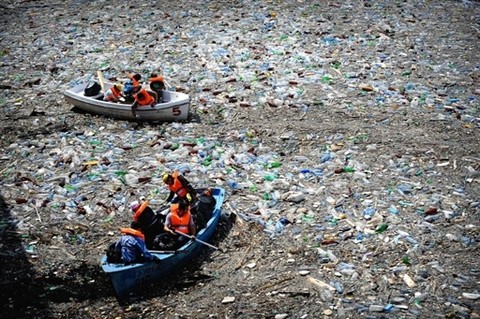
BULGARIA, Krichim : Volunteers try to clear a dam which is
filled with discarded plastic bottles and other garbage,
blocking Vacha Dam, near the town of Krichim on April 25, 2009. AFP
PHOTO / DIMITAR DILKOFF
In
most North American and European communities municipalities entreat
their populations to recycle. And most people respond, assiduously
separating plastics and papers to exclude them from normal household
waste, setting them aside in special collection containers to be
recycled by the municipality. Thus keeping landfills from absorbing
items that can be repurposed and reused. And in the process making
everyone feel a little better about the tremendous amounts of waste that
we humans produce.
On the other hand, research has
shown that less than half of the 280 million tonnes of plastic produced
globally on an annual basis ends up being recycled. Nor does it
necessarily end up in a landfill site. A good proportion winds up as
debris, scattered on land and on the seas, presenting as a hazard
threatening both humans and wildlife, according to ecologists Chelsea
Rochman, University of California and Mark Anthony Browne, at the U.S.
National Centre for Ecological Analysis and Synthesis.
Five
of their colleagues from Japan, Europe and the US. co-signed an
industry-critical commentary published in the current issue of the
journal Nature. Half of the world's marine animals, and
one-fifth of its seabirds risk becoming entangled in plastic wrappers
bottles and bags, some of which can also be eaten, harming them
internally. By 2050, they argue, so many billions of tonnes of plastic
can be tossed that 2.75-billion garbage trucks could wrap around the
planet 800 times, end to end.
The United
Nations-sponsored Convention on Biological Diversity last year reported
that all sea turtle species and 45% of marine mammal species, along with
21% of seabirds are susceptible to harm by eating or becoming entangled
in plastic waste. Plastic degrading into small pieces get into
creatures' stomachs, while 'microplastic' along with some of their
chemical components invade cells and tissues.
"Pesticides
and organic pollutants such as polychlorinated biphenyls are
consistently found on plastic waste at harmful concentrations 100 times
those found in sediments and one million times those occurring in sea
water. We believe that manufacturers of plastic, along with the food and
textile industries that rely heavily on it, should have to prove that
their products and packaging are safe", insist the researchers.
The
four most problematical plastics -- PVC, polystyrene, polyurethane and
polycarbonate -- that together represent 30% of global production are
made of "potentially toxic materials", used in construction (water
pipes); food packaging, furniture and electronics. The researchers
would like to see regulation imposed representing a "closed-loop
system", where all such plastics are reused and recycled.
A spokesperson at the American Chemistry Council, Washington, says there is agreement among the manufacturers of plastic, "that litter doesn't belong in our oceans, waterways or any part of our natural environment." However, he also stated
"the suggestions by the commenters in the journal Nature are neither
justified nor helpful. Plastics makers agree more research is needed".
How much more research will satisfy the producers of plastics, regulatory agencies and consumers?
BULGARIA, Krichim : Volunteers try to clear a dam which is
filled with discarded plastic bottles and other garbage,
blocking Vacha Dam, near the town of Krichim on April 25, 2009. AFP
PHOTO / DIMITAR DILKOFF
From cancer treatments to new devices to gene
therapy, a look at six medical innovations that are poised to transform
the way we fight disease
Reporter Ron Winslow talks to WSJ weekend
Review editor Gary Rosen about astonishing medical advances that are
finally moving from research and prototypes to practical treatments.
In our era of
instant gratification, the world of medicine seems like an outlier. The
path from a promising discovery to an effective treatment often takes a
decade or more.
But from that process—of fits and
starts, progress and setbacks and finally more progress—grow the
insights and advances that change the course of medicine.
A decade ago, the completion of the
Human Genome Project sparked optimism that cures for debilitating
diseases were just around the corner. Cures still generally elude us,
but now the ability to map human DNA cheaply and quickly is yielding a
torrent of data about the genetic drivers of disease—and a steady stream
of patients who are benefiting from the knowledge. On other fronts,
technology is putting more power in the hands of patients, and
researchers are learning to combat disorders by harnessing the body's
own ability to heal and grow.
Foundation Medicine
A test developed by Foundation
Medicine Inc. analyzes tumor DNA to help find targeted treatment options
for patients with cancer.
Advances
bring other challenges, including how to pay for them. Meanwhile, the
complex biology that stymies gains for some patients sets goals for new
advances. Here are six of today's potentially transformative trends.
Growing a Heart
Surgeons at
Boston Children's Hospital have developed a way to help children born
with half a heart to essentially grow a whole one—by marshaling the
body's natural capacity to heal and develop. About 1,000 babies are born in the U.S.
each year with a condition called hypoplastic left-heart syndrome, the
result of a genetic anomaly that leaves them without a functioning left
ventricle, the heart's main pumping chamber. Without a surgical repair,
the defect is almost always fatal.
Jennifer S. Altman for The Wall Street Journal
A new surgical strategy helped 9-year-old Alexa Rand's body to essentially grow half a heart into a whole one.
The
standard treatment is a series of three open-heart operations to reroute
circulation so that the right ventricle can take over pumping blood to
the body's organs and extremities. But the right ventricle "is meant to
handle low-pressure blood flow to the lungs," says Sitaram Emani, the
surgeon heading the effort on the new approach. "Now you're asking it to
do the work of a high-pressure system and to do that work for many
years. Eventually it fails." That's one reason why 30% of patients or
more don't survive to adulthood.
Dr. Emani and his colleagues devised a
complex strategy to open obstructed valves and repair other
malformations to direct blood flow to the left ventricle instead of away
from it. That triggers biological processes that promote the heart's
growth.
Last month, after using the approach on
34 carefully selected patients over the past decade, the doctors
reported in the Journal of the American College of Cardiology that 12
now have two working ventricles. One of them, 9-year-old Alexa Rand of
Kings Park, N.Y., whose treatments began in utero, is thriving. She
sings, dances and surprises doctors with how long she can walk on a
treadmill, says her mother, Rosamaria Rand.
The main drawback: The strategy
requires one more surgical procedure, on average, and significantly more
days in the hospital than the conventional surgery. The hope is, Dr.
Emani says, that the long-term benefits will outweigh the extra hospital
time.
—Ron Winslow
DNA Sequencing for Routine Checkups
At
a genetics conference in November, Oxford Nanopore Technologies
unveiled the first of a generation of tiny DNA sequencing devices that
many predict will eventually be as ubiquitous as cellphones—it's already
the size of one.
Since the first sequencing of the human
genome was completed in 2003 at a price tag of over $2 billion, the
speed, price and accuracy of the technology have all improved. Illumina Inc.
ILMN-1.19%
has dropped its price for individual readouts to $5,000; earlier this
year, Life Technologies introduced a sequencer it says can map the human
genome for $1,000. The smallest machine is now desktop-size.
But
nanopore sequencing devices, which are designed to be even smaller and
more affordable, could speed efforts to make gene sequencing a routine
part of a visit to the doctor's office. DNA molecules are exceedingly
long and complicated; that makes them hard to read. Nanopore technology
measures changes in the molecules' electrical current as the DNA is
threaded in a single strand through tiny holes called "nanopores"
created in a membrane.
So far, U.K.-based Oxford has released
the results of sequencing a virus genome with this technique. The
company hasn't provided data, however, showing that the sequencers can
analyze the much larger human genome. A spokeswoman for Oxford says the
company is working hard toward being able to sell devices, including one
that is expected to cost under $1,000, though it doesn't yet have a
launch date.
Amit Meller—an associate professor at Boston University,
a scientific adviser at Oxford and the co-founder of Noblegen
Biosciences—is at work on another nanopore device that he says would use
fluorescent signals to read the DNA information. His company is still a
number of years away from a prototype, but Dr. Meller says the goal is
to speed up sequencing even more—with results in a few hours, not the
current weeks or days, at a cost of less than $100.
—Amy Dockser Marcus
Matching a Tumor to a Drug
Our
growing understanding of the workings of the human genome is posing a
new challenge: How to use that data to change the course of disease.
Consider cancer. As seen through a gene-sequencing machine, some cancers
can appear as at least a dozen different genetic diseases, some of
which have been shown to respond uniquely to a specific drug. But how do
cancer doctors quickly match a patient's tumor with a drug that targets
it?
One answer is a
test developed by Foundation Medicine Inc., a Cambridge, Mass., startup
whose scientific founders include one of the leaders of the Human
Genome Project. The test, officially launched last June, enables doctors
to test a tumor sample for 280 different genetic mutations suspected of
driving tumor growth.
This changes "everything in terms of
how we approach patients with cancer," says David Spigel, director of
lung-cancer research at the Sarah Cannon Research Institute in
Nashville, Tenn. He used the test in one patient with advanced disease
and few apparent options. She turned out positive for an alteration in a
gene targeted by several drugs currently in development. She was signed
up for one of the studies. A short time later, "she's like a new
person," he says. "She's off pain medicines. She gained her weight
back."
Michael Pellini, Foundation's chief executive officer,
says that more than 600 oncologists have requested the test, which lists
for $5,800. So far, he says, about 70% of cases have turned up a
mutation that is potentially targeted by a drug on the market or in a
clinical trial.
In one recent case, Dr. Pellini says, a
sample from a woman with advanced pancreatic cancer yielded a response
for "her2," an alteration associated with a certain form of breast
cancer. She was treated and her cancer responded to the breast-cancer
drug Herceptin. Few oncologists would think to look for her2 in a
patient with pancreatic cancer, he says.
—Ron Winslow
Letting Your Body Fight Cancer
Few advances in cancer care are generating more enthusiasm than harnessing the power of the immune system to fight the disease.
Tom Stutz is one reason why. Last April, the 72-year-old
retired lawyer was confined to a wheelchair, struggling for every
breath, and required help with simple tasks such as eating, all because
of a previously diagnosed skin cancer that had spread to his lungs and
liver. "I was ready to check out, to be honest," he says.
That month, he began taking an
experimental drug known as MK3475. Six weeks later, he started feeling
better. Today, Mr. Stutz has jettisoned the wheelchair and regularly
walks a 3.5-mile loop near his home in Los Angeles. "I feel terrific,"
says Mr. Stutz, who learned after a checkup in the fall that his tumors
had shrunk by about 65% so far.
For decades, cancer researchers have
wondered why the immune system typically doesn't treat tumor cells as
invaders and target them. Part of the mystery was recently solved:
Tumors protect themselves by hijacking the body's natural brake for the
immune system.
MK3475, being developed by Merck &
Co., is among a new category of drugs that release the brake, unleashing
an army of immune cells to hunt down the cancer. A recent report from a
trial in which Mr. Stutz participated said that of 85 patients who took
the drug, 51% saw their tumors significantly shrink; in eight cases,
the tumors couldn't be detected on imaging tests.
Still, not everyone was helped. And
unleashing the immune system can put normal cells in harm's way: In
studies of MK3745 and similar drugs, some patients developed serious
side effects related to immune-system response, including a small number
who died.
But interest in the approach is strong. Bristol-Myers Squibb Corp.'s
BMY-0.75%
drug Yervoy, approved by the Food and Drug Administration in 2011, is
the first of its kind to reach the market. The company has others in
development. GlaxoSmithKlineGSK.LN-0.22%
PLC and AstraZeneca's
AZN.LN-0.46%
MedImmune are among others exploring ways to activate the immune system against cancer.
One
reason for the excitement is that most "solid" tumors—colon, lung,
breast, prostate—use the same or a similar mechanism to hide from the
immune system. Obstructing that mechanism may have a broad impact across
a variety of malignancies.
—Ron Winslow
Health in the Palm of Your Hand
There's
a good chance that you already own one of the most ubiquitous
health-care innovations: a smartphone. Last month, the FDA cleared a new
iPhone add-on that lets doctors take an electrocardiogram just about
anywhere. Other smartphone apps help radiologists read medical images
and allow patients to track moles for signs of skin cancer.
"I see the smartphone as one piece of
how we're going to try to get health costs under control," says David
Albert, the Oklahoma City-based inventor of the just-approved AliveCor
electrocardiogram application.
At $199, AliveCor consists of a case
that snaps onto the iPhone, with electrodes on the back. It reads heart
rhythms and relays the recording to an iPhone app, allowing physicians
to read the data. Dr. Albert says a $99 version should be available soon
that will let patients capture their own heart data, documenting
sometimes-fleeting arrhythmias when they feel symptoms or tracking the
success of lifestyle changes at curbing heart troubles.
Doctors say that mainstream EKG
machines provide more information but the iPhone version is sufficient
for many diagnostic needs. "When I go to [the] clinic, I use it in place
of an EKG all the time," says Leslie Saxon, chief of the University of
Southern California's heart-rhythm department, which has conducted
research using AliveCor's device.
The FDA has cleared a handful of apps,
beginning with an iPad and iPhone-based medical imaging reader in 2011.
The smartphone lets us "bring health care into the home," says Erik
Douglas, CEO of CellScope. His company is developing an iPhone-based
otoscope that would allow parents to upload images of their children's
inner ears when they show signs of infections, with the aim of avoiding
unnecessary doctors visits.
—Christopher Weaver
Rejigging Your Genes
After
years of controversy, gene therapy is poised to become a viable option
for a variety of often life-threatening medical conditions, especially
those resulting from a single defective gene. Last month, the European
Union approved Glybera for treatment of a rare genetic disease, making
it the first gene-therapy medicine approved in the Western world. The
approval comes amid a flurry of research showing broader promise for the
approach in a range of disorders, from a rare form of blindness to
hemophilia to heart failure.
Though outright cures are still
elusive, gene therapy "is beginning to emerge as a meaningful clinical"
strategy, says Stephen J. Russell, director of molecular medicine at the
Mayo Clinic in Rochester, Minn.
Gene therapy's tantalizing attraction
is that a single treatment has the potential to cure lethal diseases by
enabling normal genes to take over for defective ones. The treatment
involves loading a functional gene onto a fragment of a deactivated
virus that transports the gene to a cell's nucleus, where it is intended
to take over.
The idea suffered major setbacks in
1999 when a U.S. teenager died in a gene-therapy trial and again soon
after when several children in Europe developed leukemia after receiving
gene therapy. The episodes prompted criticism that
researchers had moved too quickly. Scientists returned to the
laboratory, hoping to develop better delivery vehicles and to improve
both the safety and efficacy of the treatments.
Bluebird Bio, a Cambridge, Mass.,
gene-therapy startup, expects to launch studies next year for two rare
genetic diseases: childhood adrenoleukodystrophy, or ALD, an inherited
and lethal neurological disorder; and beta thallasemia, which causes the
destruction of red blood cells and leads to life-threatening anemia.
Its technique involves extracting a patient's own bone-marrow cells,
isolating certain stem cells, and delivering the gene therapy before
returning the cells to the body.
Four boys in Paris with ALD have been
successfully treated, says Nick Leschly, Bluebird's president and chief
executive officer, including two treated nearly six years ago. They are
now in their teens and would otherwise likely have died before age 10,
he says.
Other gene-therapy efforts include Novartis SA's
NOVN.VX-0.43%
partnership with the University of Pennsylvania on a treatment for
cancer, GlaxoSmithKline's alliance with Italian scientists for a range
of disorders, and Celedon Corp.'s clinical trial of a gene therapy in
patients with advanced heart failure.
—Ron Winslow
A version of this article appeared December
29, 2012, on page C2 in the U.S. edition of The Wall Street Journal,
with the headline: No Headline Available.
This represents a general opinion site for its author. It also offers a space for the author to record her experiences and perceptions,both personal and public. This is rendered obvious by the content contained in the blog, but the space is here inviting me to write. And so I do.


/arc-anglerfish-tgam-prod-tgam.s3.amazonaws.com/public/3CKXFATNNRA7NFOLZFRFWNBXPE.jpg)