"In a project run by the University of Hong Kong's Weiboscope centre and the University of Toronto's Citizen Lab, analysts have amassed a compendium of Chinese social media content that has been censored this year due to its association with unauthorized memories of the 89 Democracy Movement." "So far, the project has identified 3,237 key words that provoke deletion. During the first four months of this year, the project identified more than 700,000 posts the censors have deleted from Weibo." Terry Glavin, Journalist, author, China-watcher
No one knows who the man was in this
iconic photograph taken on June 5, 1989, the day after the Tiananmen
Square massacre in Beijing, in which thousands of peaceful protesters
were killed by Chinese troops. It's quite likely he doesn't even know
he's famous, if he's still alive, writes Terry Glavin. Jeff Widener/AP
Weibo, of course, is China's very own Twitter, an approved and state-controlled Chinese social media site that the Communist government is free to manipulate as it will. To allow or to disallow mention of very particular events, for example. As particular as the 1989 uprisings, for example, that took place in over 300 Chinese cities over a period of two months, where millions of Chinese came out to protest over their lack of freedoms.
In the West, the enduring memory of Tienanmen Square recalls one courageous Chinese man's stance before a line of military tanks. This confrontation between a lone man and mechanical beasts occurred the day following a mass atrocity when the military crushed the last of the protests. The mass murder of thousands of protesting citizens effectively ended the protests that saw an unbelievable million people assemble daily and peacefully at Tienanmen Square.
Documentary evidence has the death toll report from the Chinese Red Cross at 2,700, while a British diplomatic cable reported the death toll as being over 10,000. The true numbers may never be revealed. British ambassador Sir Alan Donald, fed confidential information by a senior Chinese government source, cabled an account to London mentioning children bayoneted to death, armoured personnel carriers driving over civilians, hundreds of students mowed down in machine-gun fire.
But while this is an enduring memory in the West it is barely noted in China itself where at the time and ever since, news media failed to carry news of the events under government order. June 4, 1989 the military confrontation and bloodshed at Tiananmen Square is not very well known by Chinese citizens; its details are hazy and no one discusses the event. On social media platforms like Sina Weibo and Baidu any possible allusion to the date is immediately scrubbed.
And when the anniversary date rolls around police go into action to round up 1980s activists in a "stability maintenance" operation that has become a yearly staple to ensure that harmony prevails alongside ignorance. In the run-up to the 30th anniversary of the event, dozens of students in Beijing have gone missing from university campuses, taken into custody by the Ministry of State Security.
The photo for the Tiananmen Square Protests Wikipedia page. In April, China blocked the website in all available languages.Creative Commons
Foreign news websites are unavailable in China. The Wikimedia Foundation and its Wikipedia reference site is now strictly off limits in China, all languages included. This is the country that maintains a strict control of all media and news sites throughout its vast domain. A country that takes huge pride in its communications giant Huawei, partnering internationally to national communications systems updating in the 21st Century and beyond.
A company that has been pressed by well-founded suspicion that its technology includes methods whereby state secrets, technology, military, commercial secrets can be funnelled through to China in its never-ending cyber-espionage focus. Beijing's National Intelligence law states that "any organization or citizen shall support, assist and co-operate with the state intelligence work in accordance with the law"; making it mandatory by law that all Chinese, corporate and individual, work in tandem with and service to the nation's intelligence services.
Huawei, however, states that "no law in China requires any company to install mandatory backdoors in its equipment", and that never would Huawei assist in anything that would bring harm to any country in the world which uses its equipment. In Canada, the statement looks like this: "Huawei Canada has, and we will continue, to act to protect our employees, our customers and our investments", even while the CFO, daughter of Huawei's founder, is held under house arrest awaiting extradition to the U.S. on a charge of misleading U.S. financial institutions relating to Iran sanctions.
To which Beijing has responded by arresting two Canadians, charging them with espionage, and sentencing another Canadian to death for drug smuggling, while warning Canada that should it be decided not to use Huawei in its 5G upgrades, there will be hell to pay. Even Canadian soy products, long an agricultural industry staple imported for Chinese domestic use, has suddenly been found to be contaminated, and disallowed entry to China.
"People
of Venezuela, the end of usurpation has arrived. At this moment, I am
with the main military units of our armed forces, starting the final
phase of Operation Liberty." "People
of Venezuela, we will go to the street with the armed forces to
continue taking the streets until we consolidate the end of usurpation,
which is already irreversible." "The
armed forces have taken the right decision. With the support of the
Venezuelan people and the backing of our constitution they are on the
right side of history." Venezuelan opposition leader and declared President, Juan Guaido
"Steel nerves." "I
have talked to commanders in all the regions of the country and they've
manifested their total loyalty to the People, the Constitution, and the
Homeland." "I call for maximum popular mobilization to ensure the victory of peace." "We will win!" Nicholas Maduro, contested Venezuelan president "If
Guaido and Lopez fail to split the military and rally top brass to
their cause, then a big question is what happens to them personally, and
to the opposition cause more broadly." "They could end up tonight in jail or worse. They are taking a huge leap today." Shannon O'Neil, Venezuela expert, Council on Foreign Relations
Venezuelan opposition leader Juan Guaidó greets
supporters in Caracas, Venezuela, Tuesday. He took to the streets with a
small contingent of armed troops and called for the military to rise up
and oust President Nicolás Maduro.
Fernando Llano/AP
Opposition leader and head of Venezuela's national assembly Juan Guaido,
who has declared himself the true president of the country, and whose
claim has been supported by neighbouring countries along with an
estimated 50 other national heads of state worldwide launched a
military-backed challenge to reigning Nicolas Maduro. He has called on
Venezuelans to take to the streets in mass popular demonstrations
against Maduro.
Those majority members of the military who remain loyal to the socialist
Chavista government have responded with rubber bullets and tear gas.
Local hospitals have been busy in response. A video captured an armoured
vehicle in Caracas running into a crowd of protesters and people were
being detained, taken away on motorcycles by military personnel. "Operation Liberty" has drawn the attention of the world community. "There is no other way out of this",
Hamilton Mourao, vice-president of Brazil noted, other than that either
opposition leader Guaido and the Venezuelan Defence Minister Vladimir
Padrino Lopez would "be prisoners" or Maduro "would be leaving".
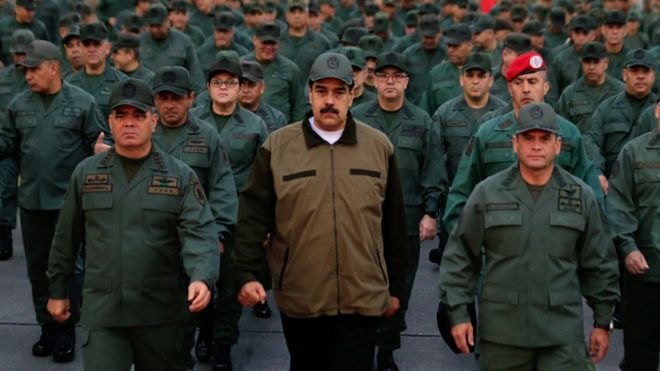
Surrounded by armed men in military uniforms, Guaido urged other troops
to join Operation Liberty, to enable the opposition to force Maduro
from power.
Leopoldo Lopez, Guaido's political mentor, the opposition leader placed
under house arrest had, with the help of the military personnel guarding
him, escaped to stand beside Guaido, a powerful support from a popular
opposition figure. "I want to tell the Venezuelan people: This is the moment to take to the streets and accompany these patriotic soldiers", he announced, even while Maduro claimed the military was loyal to him.
An anti-government protester walks near a bus that was
set on fire by other protesters during clashes between rebel and
loyalist soldiers in Caracas, Venezuela, on Tuesday.
Fernando Llano/AP
Cuba has denied American claims that it has dispatched 20,000 of its own
military to Venezuela in aid of Maduro, instead it said the 20,000
figure was correct, but they were all Cuban medical personnel. And if
so, they'll have their work cut out for them in hospitals where
equipment has failed and basic drugs and items as elemental as bandages
and anaesthetics are in critically short supply.
Moscow has warned Washington to stop meddling in Venezuela's affairs. "This is our hemisphere. It's not where the Russians should be interfering. this was a mistake on their part",
responded national security adviser John Bolton, raising the potential
of sanctions. The Kremlin responded by accusing America of supporting an
attempted "coup", that Washington's interference represented a "gross violation of international law".
At the street gatherings mostly young men armed themselves with
makeshift shields and tossed rocks at state security forces. It was
expected that Guaido's stirring cries to the populace would result in a
number of high-ranking defections to ultimately loosen Maduro's grip on
power, while some analysts predicted Maduro would emerge more
emboldened, even as the chief of Venezuela's intelligence agency broke
ranks, while others remained with Maduro.
According to John Bolton, Venezuela's defence minister, the chief
justice of the Supreme Court and head of the presidential guard were
preparing to usher the peaceful transfer of power to Guaido; none of
those defections, however, took place. Leopoldo Lopez took refuge in the
Spanish embassy, along with his family. A number of Venezuelan troops
applied for asylum in the Brazilian embassy.
A rumour circulated that Maduro planned to leave the country, that an
airplane had been in readiness on the tarmac, but that Russia convinced
him to remain. The Russian foreign ministry characterized the rumour as "absolute disinformation and fake news", something that Russia knows a great deal about.
The armed forces did not appear to heed Mr Guaidó's call to defect EPA
"The United States is pre-positioning relief items -- including food, nutritional supplements, hygiene kits and medical supplies -- in Colombia so they are available to reach those most in need in Venezuela, as soon as possible." U.S.official
"We are absolutely ready to resist if the government does not allow the aid to enter." "The people will not hesitate to take to the streets and even take up arms if we have to." "There is no doubt they will deploy the army, but they are on our side. They won't fire on their own people." Unay Bayona, chef, youth worker, Urena, Venezuela
"These guys [colectivo, armed militia with the government] say they're promoting socialism, but they're only interested in violence and making money." "They will definitely be ready for any trouble that comes." Kiki, 40, Urena, Venezuela (last name withheld for fear of reprisal)
"This government is full of lies and corruption. Look what they've done to the economy." "It's the workers who suffer most, but we are ready to fight back." Jorge Gonzalez, 63, production line worker "This is aid we desperately need. People are dying here." "We're ready to defend the town again and remove whatever they have on that bridge." Lucero Varela, activist, Women in White, Urena
Trucks with humanitarian aid meant to be driven into Venezuela are stopped at the Colombian border, between Cucuta, Colombia and Urena, Venezuela. Access into Venezuela has been denied, though Venezuela's opposition leaders have vowed the relief supplies will be brought into the country. In the meanwhile, semi-trailers loaded with boxed emergency food and medicine sit, waiting. Opposition leader Juan Guaido asked for international assistance for his country wracked with shortages of the most basic goods and foodstuffs.
Human rights activists stand at the gated entrance to the Tienditas International Bridge on the Colombian side, demanding that contested President Nicolas Maduro remove the fuel tanker and shipping containers the Venezuelan military placed blocking the millions in U.S.-funded relief supplies meant for desperate civilians in Venezuela. Residents in Urena claim to be prepared to themselves turn on the security forces if they continue to refuse entry to the relief supplies with its sixty tonnes of food and medicine.
Urena, a border town known for its production of jeans is also the town where most of those factories are silent, empty of workers, symbolic of the economic decline and hyperinflation in Venezuela. Venezuelans come to Urena from elsewhere all over the country to do their shopping across the border in Colombia where food and products are still affordable and stores are well stocked. According to the IMF, inflation in Venezuela is headed toward 10 million percent this year.
Should the blockade remain impassable, it will give Maduro proof that his troops remain loyal to him. If the aid manages to enter Venezuela it will serve as an admission that legitimizes the authority that Guaido, supported by over 40 countries, claims to be vested in him as head of the National Assembly, negating the irregular election outcome that saw Maduro re-invested to the power of the presidency.
In Venezuela's capital, long lines form outside pharmacies by people hoping that among the dwindling supplies of medicines they will be able to obtain the life-affirming medications they or their relatives require to deal with chronic conditions and illnesses. "This is a criminal act" Javier Rondon asserted of the regime blocking international aid, waiting himself for an antibiotic for his five year-old daughter's lung infection. Jose Betancourt, 70, waited for an anti-inflammatory medication.
In Urena, a carton of 30 eggs comes at a price of 14,000 bolivars, a kilogram of cheese, 20,000 bolivars where the monthly miminum wage is 18,000 bolivars. Luis Escobar now living in Colombia after fleeing Venezuela explained his wife has advanced breast cancer, unable to obtain treatment in Venezuela so by the time they saw a doctor in Colombia her cancer had progressed. "I am here because, unfortunately, my wife is going to die. But today I am here for Venezuelans who are suffering the same as my wife. The world has to know about this."
An aerial view of the Tienditas Bridge, on the border between Cucuta,
Colombia and Tachira, Venezuela, after it was blocked with containers.
This represents a general opinion site for its author. It also offers a space for the author to record her experiences and perceptions,both personal and public. This is rendered obvious by the content contained in the blog, but the space is here inviting me to write. And so I do.