Providing Evidence of Violent Repression by Government a Criminal Offence in Tanzania
"The killings were pre-planned to target regions that are known to be
politically active, those that are critics of the ruling party. "
"Following people to their homes and killing them amounts to a massacre."
Tanganyika Law Society President Boniface Mwabukusi
"People in the government are in shock... there's disbelief,"
"Nobody has the guts to talk... that's the sad part of it. But people do whisper."
"We really don't know what to do. Do we
want more demos? No, because the youth are going to be executed again."
"[Hassan's son, Abdul, has] a private militia and most of the people
believe that's the one involved in the abductions from the beginning."
"Why are you abducting a 20-year-old kid just because they criticized you? You're the president, for crying out loud!"
Government official, unnamed for protection
"There's a very, very tiny cabal who is informing and influencing the
president and running the country."
"It's unprecedented and very un-Tanzanian. [Everyone else] has been completely frozen out."
"The only explanation is deep-seated paranoia... and now it's out of control."
"[Those with power] know one tool... a very brutal, crude, authoritarian tool."
"What's clear is that Tanzania will never be the same again."
Former presidential adviser
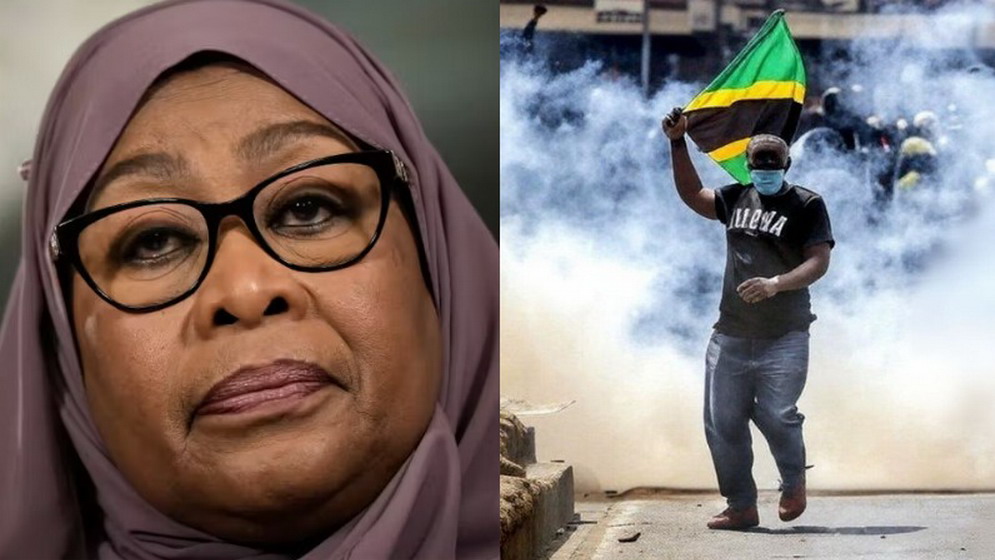
President Samia Suluhu Hassan was inaugurated on 3 November 2025 at
Chamwino, Dodoma, following her re-election with 97.66% of the vote.
Photo: Tanzaniainvest
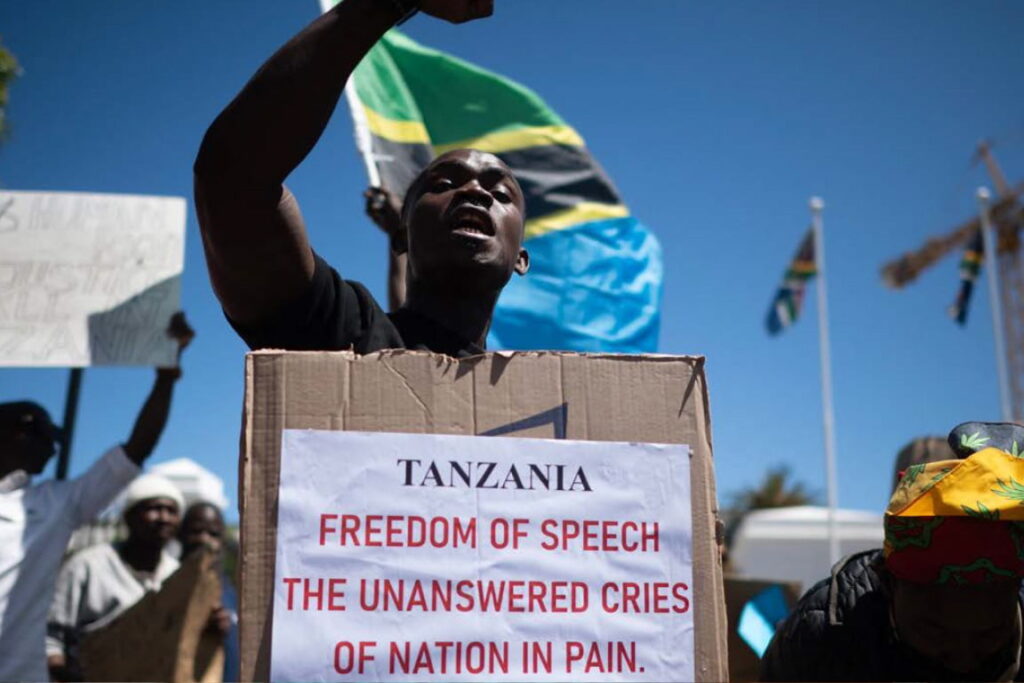
Hundreds
of young Tanzanian protesters have been massacred in the wake of the
country's recent election. They were out protesting at the behest of the
country's opposition party, reflecting a broad general consensus that
the vote that gave President Samia Suluhu Hassan a massive win was
rigged. In many areas of the country people were unable to cast their
ballots. Internet had been shut down. Some candidates had been arrested
and imprisoned. The unrest and resistance against the outcome of the
election had spread across the country.
And
everywhere there have been reports of extrajudicial killings, not only
of those who have gone out to publicly and vehemently protest, but
people who happen to be passersby caught in crossfires, or just people
going about their business shot by police; a report of a woman in her
car with her children having been shot dead, just one example. In other
instances police arriving at the home of those they pinpoint as
troublemakers, shot dead.
It
speedily became generally acknowledged that a small, vociferous and
threatening cabal around the president have taken control of government
reaction to what has amounted to a popular uprising in the making. Of a
population of around 70 million people, Tanzania is majority Christian,
with a large minority Muslim population. President Hassan is the
country's first Muslim president, purportedly elected on October 29 with
98 percent of the vote.
Tanzanian authorities are facing growing concern over killings during crackdowns on protests surrounding last week's election Still from video ABCNews
It
took no time at all for the protests against the election results, and
charges of repression to surface. The country's politicians are reputed
to be in shock over the violence that has ensued, with claims surfacing
that at least a thousand people have been killed. Many of those
politicians, while stunned with disbelief, are silent in the face of
what appears to be control grasped by hardliners in support of the new
president.
Bloody
images of the dead have appeared on social media; their ubiquity
spurring even wider protests. While President Samia Suluhu Hassan is now
officially Tanzania's new leader, the reality also is that key
opposition leaders were either disqualified from running or were
incarcerated, keeping them out of contention. Protests were speedily
crushed while communication was cut off, given a five-day Internet
blackout.
The United Nations human rights head Volker Turk announced on Tuesday that: "There
are ... disturbing reports that security forces have been seen removing
bodies from streets and hospitals and taking them to undisclosed
locations in an apparent attempt to conceal evidence".
Demonstrations in Dar es Salaam. Photo: Vellum
A
Tanzanian government senior official, fearing for his life, should his
name be attached to any explanatory revelations given to the Western
press, spoke on condition that his name be withheld. He spoke of two
suspected sites of mass graves located near Dar es Salaam, and at Kondo
and Mabwepande. The levers of power and repression appears to be in
total control of a group supporting President Hassan, confirmed those in
government willing to speak under cover.
Eyewitnesses
came forward discreetly to describe their experiences in seeing people
shot at point-blank range by police and armed men otherwise
unidentified. A bystander was shot in the head by a soldier on election
day in Dar es Salaam. Three people were lined up and shot "five or six times" in the legs by police the following day, one of the eyewitnesses said, unburdening himself of a nightmare experience.
Independence
day, on December 9 has been highlighted by the country's political
opposition for country-wide protests. President Hassan's son Abdul
Halim Hafidh Ameir, her private secretary Waziri Salum, head of the
intelligence service Suleiman Abubakar Mombo, and a member of the East
African parliament, Angela Kizigha, comprise the principals surrounding
and supporting the president, according to discreet government
sources.
Funeral for an opposition youth leader killed during election protestsAFP
"There is extreme fear for everyone."
"If it wasn’t for the massive efforts of brave activists sending videos
to us, and the people recording them on their phones, the world would
have no idea of the scale of the killings."
Kenyan activist Mwanse Ahmed
"Avoid sharing images or videos that are disturbing or demeaning to
someone’s dignity."
"Memorial
is a special organization with its own ideology. We combine what's
called relevant human rights activities with historical studies and
comprehending the historical path of Russia in the 20th century."
"It seems that such a union does not please someone in the Russian leadership."
Oleg Orlov, Memorial board member
"The
decision ...confirmed that the history of political terror ... does not
remain an academic theme for Russia of interest for just specialists
but an acute problem for modern Russia."
"Our country needs an honest and scrupulous reflection on its Soviet past."
"Memorial is the need for Russia's citizens to know the truth. Nobody will succeed in 'liquidating' this need."
Memorial statement
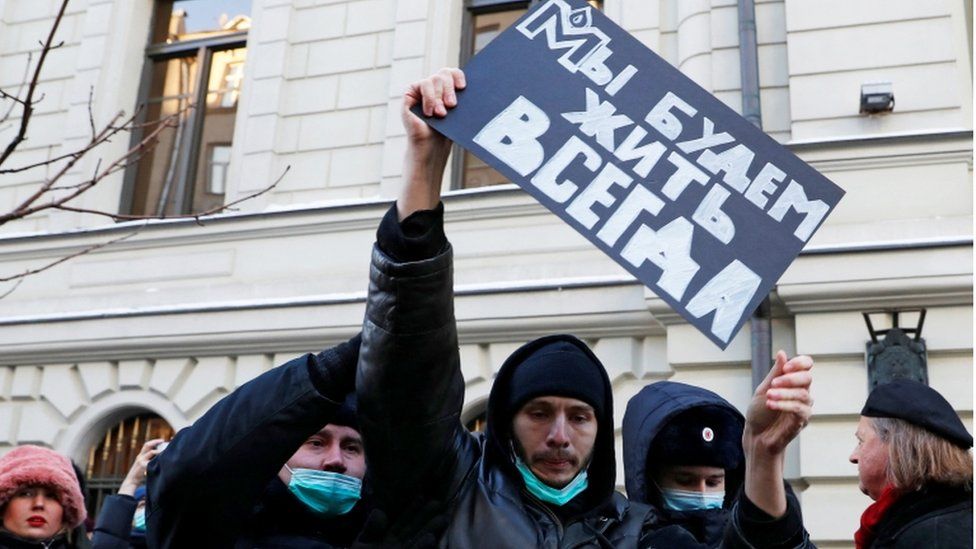
Supporters hold placards saying "we will live forever" with Memorial's flame symbol above the Russian word "we" Reuters
The
Supreme Court of Russia has found the country's most seasoned human
rights group, Memorial International, to have offended the country's
dignity and pride in its past. The group has been ordered to disband.
Critics within Russia of the Kremlin, of its policies, of its crackdown
on dissenting voices, and above all, of its president-for-life, disturb
the peace and serenity that Moscow enjoys in the capable hands of its
new czar who aspires to return Russia to its former glory days.
The
order for Memorial International to cease and desist, to fold up and be
no more, more or less caps a few successful years of silencing and
setting aside critics of the regime. As explained by Moscow, it owes the
nation protection from those involved in extremism, who plan to do harm
and destabilize Russia, with the considerable encouragement, incitement
to violence, and funding from abroad. Clearly, foreign agencies are at
the heart of nefarious plots to unseat the government and the Kremlin
will not stand for it.
Memorial's
mission is to document and to remind the nation of what Josef Stalin
wrought in his "Great Terror", when those inconvenient to and critical
of his brutal regime were sacrificed to the altar of Communism. The mass
killings of intellectuals, Bolshevik officials, political officials,
members of the military, writers, ethnic minorities, scientists,
writers, foreigners and peasant land-owners. Along with any other groups
Stalin conceived of as saboteurs.
The
number of dead during the great purge has been variously estimated to
be between three-quarters of a million, to two million people, while
political prisoners numbered around a million, sent to the Gulags, as
Stalin's reign consolidated its position by eliminating challengers and
suspected challengers. Since Vladimir Putin ascended to power and
changed the constitution to allow him to reign in perpetuity, he has
imprisoned critics, assassinated others, a silencing mechanism hugely
relied upon for its finality, however clumsily undertaken.
He
has banned political groups critical of his administration, and
imprisoned their leaders on implausible charges. He has taken to
emulating Stalin's purges to silence his critics. And he seems
determined to restore the reputation of the USSR as a force for good,
both for Russia and for its satellite states. Memorial was established
during the period of 'glasnost' introduced to Russia by then-president
Mikhail Gorbachev, determined to modernize Russia and move it away from a
closed state.
Addressing
the court, a state prosecutor stated that Memorial had promoted a
'false image' of the USSR as 'a terrorist state', besmirching its proud
memory during the Second World War. "Someone" was paying Memorial for
such treachery, he averred. Subsequently, Memorial was found to have
broken a controversial law on foreign agents by repeatedly failing to
use a disclaimer in its materials and its website relating to receiving
foreign funds.
This,
despite that Memorial is quite openly frank that it receives funding
from abroad, where its website lists funding from Poland, Germany,
Canada and the Czech Republic. The U.S. ambassador to Russia, John
Sullivan, spoke of the court order as "a blatant and tragic attempt to suppress freedom of expression and erase history". Memorial had been co-established by nuclear physicist and Nobel laureate Andrei Sakharov.
It
had recently challenged the repression of critics, publishing lists of
people it considers to be political prisoners. In 2015, Russian
authorities had placed Memorial on an official list of "foreign agents",
burdening it with restrictions on its activities. The Memorial Human
Rights Centre and Memorial International were accused of violating the
foreign agent law.
Memorial
International, according to prosecutors, breached regulations through
failing to mark all its publications, including posts on social media
with the distinguishing label. They also accused the group of condoning
terrorism and extremism. According to President Putin, Memorial had
defended organizations that Russia labels extremist and terrorist; its
list of victims of Soviet-era repression included Nazi collaborators.
Wuhan, COVID-19 : What Is Beijing So Anxious to Hide?
"[Zhang's
case] raises serious concerns about media freedom in China [a British diplomat attempted to attend her trial but was not allowed
access]."
"[Zhang] is one of at least 47 journalists currently in detention in China. The
whereabouts of other citizen journalists -- including Chen Qiushi and
Fang Bin -- is unknown."
"[China should] release all those detained
for their reporting."
British Embassy, Beijing
Zhang suffered from dizziness and headaches, and was “physically fragile.”
“When I met her days ago, her hands were tied to the waist and a nasogastric tube was inserted in her nose."
Zhang Keke, Zhang lawyer
"She said when I visited her [last week], 'If they give me a heavy sentence then I will refuse food until the very end'."
"She thinks she will die in prison."
"It's an extreme method of protesting against this society and this environment."
Ren Quanniu, Zhang lawyer
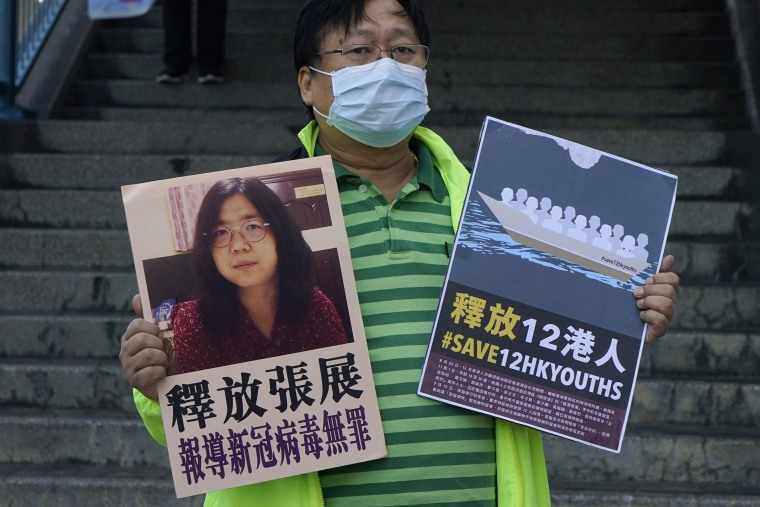
A
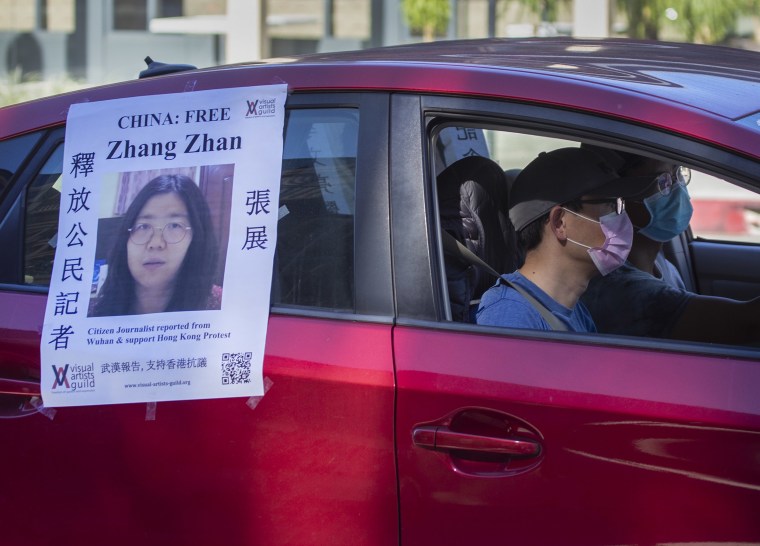
pro-democracy activist holds placards with the picture of Chinese
citizen journalist Zhang Zhan outside the Chinese central government's
liaison office, in Hong Kong on Monday. Kin Cheung / AP
"We raised her case with the authorities throughout 2020 as an example of the excessive clampdown on freedom of expression linked to COVID-19, and continue to call for her release."
United Nations human rights office
During December Chinese authorities have detained more activists and journalists "without providing any credible information to suggest that these individuals have committed legally recognizable offences", according to Human Rights Watch. They are, without exception, as far as Beijing is concerned, guilty as charged. Charged with whatever crime comes handily to mind. Guilty of reporting the Chinese Communist Party's penchant for silencing critics and putting a firm hold on reporting realities on the ground in China the authorities wish to keep under wraps.
Withholding news and information valuable to the public at large is one of the ways that the ruling CCP is able to retain firm control of the county; what the population doesn't know cannot arouse them to protest, inconveniencing the government authorities who hold the key to news dissemination and who determine what is newsworthy and what is not. News, for example, of a new respiratory malady and serious cases of a pneumonia-like illness that mysteriously took peoples' lives, obviously one of those items to be withheld from public view.
Citizen-journalist Zhang Zhan, 37, saw fit to disseminate news she felt would be of interest to people and whom she felt should have access to the news, since it impinged directly on their future well-being. Government secrecy doesn't sit too well in the opinion of those dedicated to showcasing news being withheld by government auspices. And so a jail sentence of four years was in order for Zhang Zhan for her outrageous impudence in thinking she was above the 'law'. And the law was that no news was to be reported out of Wuhan in 2020.
Yet the intrepid reporter took it upon herself to file a searing series of uncensored reports of the early stages of the novel coronavirus puzzling area doctors and then frightening them to the extent that they took to surreptitiously sending out heads-ups to their colleagues. At the present time, though a young woman, Ms. Zhang's health is not too robust; she gets about in a wheelchair. It's the result of being force-fed throughout her hunger strike from June to the present.
A
car follows a funeral caravan with poster of Zhang Zhan, a Chinese
citizen journalist who criticised the Chinese government's handling of
the coronavirus crisis and is being held in a Shanghai prison. Allen J. Schaben / Getty Images
Detained in May, she began her hunger strike in late June and since then has been subjected to force-feeding through a nasal tube. Arms pinned back to her sides so she is unable to pull the feeding tube out, according to her lawyers. Found guilty of 'picking quarrels and provoking trouble' at the conclusion of a brief hearing. She has a law degree though she is not practising at present. She decided to travel from Shanghai to Wuhan in early February, curious to see for herself what was happening there.
After which, what was happening was being chronicled with the aim of informing the public of the chaos she discovered in the early stages of the contamination and what life was like for Wuhan residents. She posted her reports and livestreamed on WeChat, Facebook and Twitter. Evidence of crematoriums operating at midnight in a desperate effort to keep up with the dying was one item she thought worthy of reaching the public.
She thought it important to report on the harassment by authorities of family members of victims. And the detention of other citizen journalists. And then she disappeared herself, in mid-May. She must have known this would be inevitable. A determined, courageous young woman who would not be told what she could and should not report. Seeing it as her duty to the public to inform them. Herself outraged by the stealth and secrecy and incompetence.
Several Wuhan doctors had been punished by authorities for revealing what they witnessed in their hospitals. They were "rumour mongering", according to authorities. And had to recant. But they alerted friends and colleagues of a mysterious pneumonia that had begun circulating in the city. One such doctor, Li Wenliang, died of COVID-19, and became a celebrated hero, a face and a name around which citizens could gather their outrage.
The
Shanghai Pudong New District People’s Court, where the citizen
journalist Zhang Zhan was sentenced after reporting on the early days of
the pandemic. Credit...Leo Ramirez/Agence France-Presse — Getty Images
"I believe they wanted to search our conversations and messages for clues to the murder of Javier [Valdez, prominent investigative reporter], but we are absolutely against this." "Nothing obtained illegally should be used in an investigation, and especially not from those who are involved professionally and emotionally to the victim." "A change in government does not mean there will be a change in the context of impunity or aggressions against journalists." "If there is no change to the impunity, the murder of journalists will continue." Ismael Bojorquz, founder, news director, Rio Doce
"These infection attempts are reckless, and probably indefensible." "Where was the internal oversight? And where was NSO's oversight?" John Scott-Railton, researcher, Citizen Lab
"We do not tolerate misuse of our products against civil rights activists, journalists or any innocent person." "If there is suspicion of misuse, we investigate it and take the appropriate actions, including suspending or terminating a contract." Statement, NSO Group, Israeli cyber arms dealer
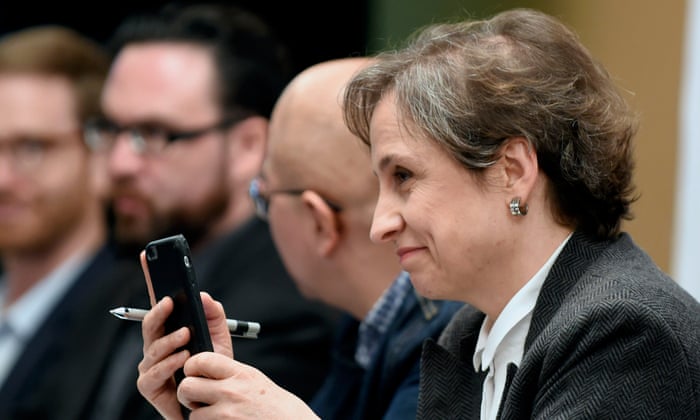
Mexican journalist Carmen Aristegui holds her mobile phone during a
journalists’ press conference in Mexico City (2017) about the
software.
Photograph: Alfredo Estrella/AFP/Getty Images
It's a grim situation. Mexico's journalist community is under fire, threatened, and spied upon, and journalists are being murdered. When Javier Valdez, working in the employ of Rio Doce -- a Mexican news organization that refuses to be intimidated by government or organized crime in its investigative reportage -- was murdered it took no time at all for the news source's news director Andres Villareal and its founder Mr. Bojorquez to receive a text message that Valdez's killers had been detained.
Both news men were suspicious and ignored the text message. They refused to click on the links. Operating one of the few independent news groups in the country dedicated to uncovering stories on organized crime, exposing the country's network of crime and corruption, they knew very well how vulnerable they were. Frequent recipients of threats emanating from organized crime syndicates, but also suspicious that government agents were involved.
Data, in fact, demonstrated that public officials are themselves responsible for the majority of attacks on journalists. Since Pena Nieto took office as president in late 2012, over 47 Mexican journalists have been killed. Fifteen of those murders took place in the wake of Mr. Valdez's death in May of 2017, according to information available from Article 19, a journalist protection group. It was government spyware to which Mr. Bojorquez had become alerted.
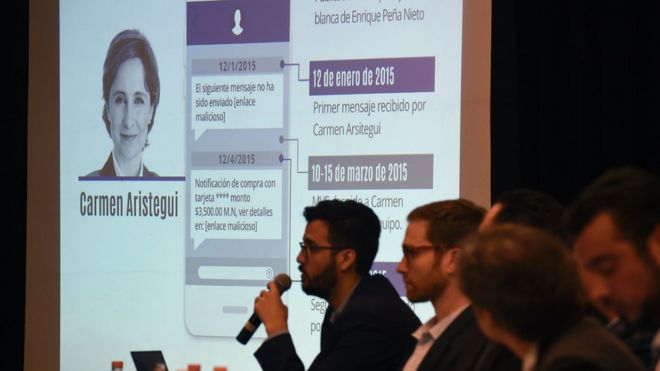
The Citizen Lab at the Munk School, at University of Toronto alerted them to the existence of the spyware and what it was capable of. The text messages that the two newsmen were so suspicious of were infected with spyware labelled Pegasus, purchased by the Mexican government from an Israeli cyber arms dealer, the NSO Group, according to a Citizen Lab forensic analysis. A click on the links embedded in the message would infect the cellphones with spyware.
That spyware is sufficiently powerful to break through encrypted messaging, monitor emails and remotely activate the camera and microphone of any cellphone it successfully infected. It became obvious to the two newsmen that someone was intent on spying on Mr. Valdez's colleagues immediately following his death and they suspected the government of Mexico.
The surveillance technology in the possession of Mexican authorities was being illegally used, beginning with the administration of President Enrique Pena Nieto. The spyware was bought with the strict proviso that it would be used only for the purpose of targeting terrorists and criminals. Despite which, in the last year-and-a-half, the Citizen Lab confirmed close to two dozen questionable targets which included some of Mexico's most prominent journalists, human rights lawyers and anticorruption activists.
At news of the surveillance, the Mexican government denounced the spying, opening an investigation into it. Since then, no one has been identified, arrested, much less punished. Mexico's authorities had been embarrassed by the revelations of spying. They had attempted to hack doctors and activists promoting sugary drinks taxes. The latest targeting of Mr. Valdez's colleagues led the government to state it was committed to the pursuit of any charges should evidence emerge.
Unsurprisingly, none has. But there is now a newly-elected government taking the place of the old one through a wave of popular support at the ballot box. It remains to be seen whether journalists' status will undergo any change; whether their targeting and abuse and state over-reach will subside. But time will tell.
"Espionage in Mexico has become an effective mechanism for intimidating
human rights defenders, activists and journalists." "It makes it possible to control the
flow of information as well as [allowing] abuses of power." Journalist group statement
Journalist Carmen Aristegui is among those allegedly targeted by the government Getty Images
The arrests came close to the one-year anniversary of an enormous scandal that was predicted to bring down Erdogan, who
was the prime minister then. In that operation, politicians,
businessmen, the sons of three of Erdogan’s ministers and others in
Erdogan’s inner circle were accused by police of corruption.
At the time, Erdogan responded by firing thousands of police
officers, police chiefs and members of the judiciary and his government
survived. Opposition figures said that the latest series of arrests were
the second stage in routing out supporters of Gulen, a powerful imam living in exile in the U.S.
The raids were predicted on December 10 by a now-famous Twitter
account run by “Fuat Avni,” whose identity remains a mystery. In his
tweets, Avni predicted that a number of journalists, including Ekrem
Dumanli, the editor in-chief of the pro-Gulen English language
newspaper Zaman.
Rumors mounted that the raid would take place on December 14. In
anticipation, employees and supporters of the paper gathered outside the
newspaper’s headquarters in Istanbul. Police initially arrived at 7:15
am at which time they were repulsed by the crowd.
With shouts of "The free press cannot be silenced," Dumanli made an
impassioned speech to the crowd, challenging police to arrest him, which
was precisely what the police were doing to the chairman of a TV group
in another location in Istanbul.
Dumanli tweeted
a picture of himself in his office, with the comment, "Officers
[forced] back because of democratic reaction of my friends. I am at my
place and wait."
Speaking to reporters immediately before police came to arrest him,
Hidayet Karaca, head of the Samanyolu TV, said, "This is a shameful
sight for Turkey. Sadly in 21st century Turkey this is the treatment
they dish out to a media group with tens of television and radio
stations, internet media and magazines."
In inside Zaman’s offices,
a live YouTube feed was set up to record the events and intimidate
police. Reporters tweeted in real time about the police raids and sent
out the link to the live feed. At 2 pm, the police returned,
successfully entered the building and arrested Dumanli. "Let those who
have committed a crime be scared," Dumanli said as he was led away by
the police. "We are not scared."
In a show of solidarity, Dumanli was visited by three former parliamentarians who were deputies in Erdogan’s AK party before he was arrested. In addition, thousands gathered in front of the Caglayan
courthouse in İstanbul in support of those taken by police. Barriers
set up by police blocked entrance to the courthouse while hundreds of
officers and two water cannons stood by.
In addition to several police vehicles that were stationed around the
Zaman daily's headquarters, a police helicopter hovered over the
building when the police came to detain Dumanli.
In all, by the end of the day, 31-32 arrest warrants had been issued
with 11 people detained in raids across Turkey. Those arrested have been
charged with forming and directing an armed terrorist organization and
trying to seize control of the state.
Istanbul's Deputy Public Prosecutor Orhan Kapici refused to disclose
whether or not Gulen was on the list of those slated for arrest.
"Media freedom, due process and judicial independence are key
elements in every healthy democracy and are enshrined in the Turkish
constitution," she said. "As Turkey's friend and ally, we urge the
Turkish authorities to ensure their actions do not violate these core
values and Turkey's own democratic foundations."
The European Union, to which Turkey aspires to become a member, issued a sharply worded statement through its Foreign Policy Chief Federica Mogherini and its Enlargement Commissioner Johannes Hahn which read in part: "The police raids and arrests of a
number of journalists and media representatives in Turkey today are
incompatible with the freedom of media, which is a core principle of
democracy. This operation goes against the European values and standards
Turkey aspires to be part of."
The arrests have been condemned by
European journalists and advocates of press freedom. Speaking shortly
before the arrests, based on the rumors of the impending round-up of
Erdogan's opponents, William Horsley, international director of the
Centre for Freedom of the Media and media freedom representative of the Association of European Journalists, gave a statement to the Zaman.
"The Association of European Journalists protests in the strongest
terms against the unlawful intimidation by state officials of
journalists and other free voices in Turkey, arbitrary arrests and
imprisonment, backdoor pressures on media bosses, and unacceptable smear
campaigns against those who seek to expose corruption and official
abuses," Horsley said.
Joel Simon, the executive director of the Committee to Protect
Journalists, tweeted, “We are greatly alarmed by reports of mass
detentions of journalists in #Turkey this morning.”
Turkey imprisons more journalists per year
than any other country in the world, including Iran (which ranks as
second). Erkan Ipekci, a leading Turkish journalist said, “Since 2009,
some 183 journalists have ended up in prison, 63 of whom are still in
jail. Since then, we have begun to feel ever more the effects of
amendments to anti-terrorism laws and those to the criminal code
introduced in 2005 with European support.''
Ipekci was
the winner of the International Reporter of the Year Award, which is
given annually by the National Union of Italian Reporters for his work
defending imprisoned Turkish journalists.
A new criminal code was ostensibly introduced by the Turkish
government, in order to meet European standards necessary for Turkey to
be accepted into the European Union. However, secularists and
journalists feared Erdogan would use some of the regulations to favor
Islamists and suppress free speech by journalists.
Indeed,
at the time, journalists saw their phones tapped and accusations of
“terrorism” made after publication of articles covering activities not
to the liking of Erdogan’s Islamist government.
Turkey’s Islamist-controlled government, led by President Recep Tayyip Erdogan, passed a new regulation which significantly increases the power of the justice minister over the country’s highest judicial body, the Supreme Council of Judges and Prosecutors.
This news comes on the heels of sweeping arrests Erdogan ordered of journalists critical of his rule.
Posts in judiciary bodies in Turkey have traditionally been filled
with supporters of Erdogan's rival, Fethullah Gulen, a powerful Turkish imam living in exile in the U.S.
The new law mandates that the justice
minister will now preside over the Supreme Council and set the agenda,
time and date of the body’s General Assembly, whose function is to elect
the members of the Supreme Court of Appeals and the Council of State.
In addition, as part of the justice minister’s increased powers, all the
elected members to these bodies must be approved by the justice
minister.
The justice minister will also now have the sole power to release
statements to the media regarding the meetings of the Supreme Council.
In other developments, a high court overturned a regulation
instituted by the government in the wake of the corruption scandal that
broke one year ago. At the time, key government figures and businessmen
were accused of graft, allegations that had the potential to bring down
Erdogan’s government.
Hence, a regulation was passed which required police chiefs to notify
their superiors of any investigation begun by prosecutors, essentially
allowing the government to control the investigation of any individual, according to Turkish lawyer Melik Bayat.
Previously, once an investigation was initiated, the police involved
in the probe would work with the prosecutor, essentially acting as
“judiciary police” under the purview of the judiciary branch of
government.
The new regulation – enacted just four days after the December 17,
2013 graft probe become public -- put the power of the investigation
into the executive branch, which legal experts described as a violation
of both existing laws and the Constitution.
“From
now on, if there is another graft investigation targeting the
government, the provincial police chief will have to inform his
superiors from the very beginning. There is no other example of this in
the world,” said retired public prosecutor Gultekin Avcı.
Now, one year later, the Supreme Council decided that the new regulation was indeed illegal.
Khodorkovsky arrives in Germany after Putin pardon
BBC News online -- 20 December 2013
The BBC's Oleg Boldyrev says some analysts believe
Mr Khodorkovsky's release is a "sign of nervousness" in Moscow ahead of
the Winter Olympics
Russian
ex-tycoon Mikhail Khodorkovsky has arrived in Germany, hours after
being pardoned by President Vladimir Putin and freed from a decade in
jail.
Russian prison officials said Mr Khodorkovsky, 50, had requested travel papers to see his sick mother there.
Mr Khodorkovsky's father told AP he and his wife were still
in Moscow but were planning to fly to Germany, where she has been
treated in the past.
Mr Putin earlier said he had signed the pardon on "the principles of humanity".
Mr Khodorkovsky, the former head of the now defunct oil giant
Yukos and once Russia's richest man, had been jailed for tax evasion
and theft after funding opposition parties.
Mr Khodorkovsky left the penal colony where he was being held,
in the Karelia region of north-western Russia, early on Friday
afternoon.
Mikhail Khodorkovsky timeline
1980s - Sets up computer software business
1987 - Founds Menatep bank
1995 - Buys Yukos for $350m, with Menatep assuming $2bn in debt
2003 - Arrested for tax evasion, embezzlement and fraud
2005 - Jailed for eight years (running 2003-11)
2007 - Yukos declared bankrupt
Dec 2010 - Convicted of embezzlement and money laundering, jailed for 13 years (2003-16)
Dec 2012 - Sentence cut by two years, release date 2014
Dec 2013 - Freed from jail after presidential pardon
Russia's Federal Penal Service,
quoted by news agency Interfax, said: "In the course of his release,
Khodorkovsky asked for a passport for foreign travel. His request was
met.
"Once he was released from prison, he left for Germany, where his mother is undergoing treatment.
"We stress that the flight took place at his request and his exit documents were processed at his personal request."
The German foreign ministry later confirmed that Mr
Khodorkovsky had landed at Schoenefeld airport in Berlin, after the
German embassy in Moscow had facilitated his departure from Russia.
A representative of the German foreign ministry was at the airport to meet him.
Mr Khodorkovsky reportedly flew on a private jet from St Petersburg.
The Associated Press (AP) quoted a spokesperson for the
energy consulting firm, OBO Bettermann, as saying that former German
foreign minister Hans-Dietrich Genscher had asked the company to provide
a plane.
Mr Khodorkovsky's mother, Marina, 79, has been treated in Germany before.
Penal Colony 7 at the village of Segezha, near the Finnish border, where Mr Khodorkovsky was held
Mr Putin said he had signed the pardon on "the principles of humanity"
However, Mr Khodorkovsky's father, Boris, told AP that he and
his wife were still in Moscow and were planning to fly to Germany on
Saturday.
Reuters quoted Mr Khodorkovsky's mother as saying she was waiting in Moscow and would leave Russia to see him if necessary.
Mr Khodorkovsky was jailed after being convicted of stealing oil and laundering money in 2010.
He had been in prison since 2003 when he was arrested and
later convicted on charges of tax evasion. He was due to be released
next August.
The presidential pardon came after Russian MPs on Wednesday backed a wide-ranging amnesty for at least 20,000 prisoners.
Mr Putin confirmed it would apply to the two members of punk
band Pussy Riot still in prison and Greenpeace activists detained for
their protest at a Russian oil rig in the Arctic.
Analysts say Mr Putin may be trying to ease international
criticism of Russia's human rights record ahead of February's Winter
Olympics in Sochi.
This represents a general opinion site for its author. It also offers a space for the author to record her experiences and perceptions,both personal and public. This is rendered obvious by the content contained in the blog, but the space is here inviting me to write. And so I do.