Wuhan, COVID-19 : What Is Beijing So Anxious to Hide?
"[Zhang's
case] raises serious concerns about media freedom in China [a British diplomat attempted to attend her trial but was not allowed
access]."
"[Zhang] is one of at least 47 journalists currently in detention in China. The
whereabouts of other citizen journalists -- including Chen Qiushi and
Fang Bin -- is unknown."
"[China should] release all those detained
for their reporting."
British Embassy, Beijing
Zhang suffered from dizziness and headaches, and was “physically fragile.”
“When I met her days ago, her hands were tied to the waist and a nasogastric tube was inserted in her nose."
Zhang Keke, Zhang lawyer
"She said when I visited her [last week], 'If they give me a heavy sentence then I will refuse food until the very end'."
"She thinks she will die in prison."
"It's an extreme method of protesting against this society and this environment."
Ren Quanniu, Zhang lawyer
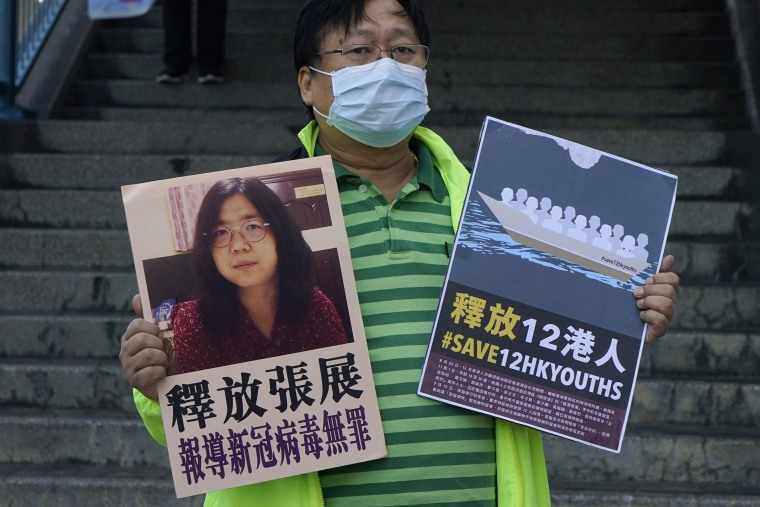
A
pro-democracy activist holds placards with the picture of Chinese
citizen journalist Zhang Zhan outside the Chinese central government's
liaison office, in Hong Kong on Monday. Kin Cheung / AP
"We raised her case with the authorities throughout 2020 as an example of the excessive clampdown on freedom of expression linked to COVID-19, and continue to call for her release."
United Nations human rights office
During December Chinese authorities have detained more activists and journalists "without providing any credible information to suggest that these individuals have committed legally recognizable offences", according to Human Rights Watch. They are, without exception, as far as Beijing is concerned, guilty as charged. Charged with whatever crime comes handily to mind. Guilty of reporting the Chinese Communist Party's penchant for silencing critics and putting a firm hold on reporting realities on the ground in China the authorities wish to keep under wraps.
Withholding news and information valuable to the public at large is one of the ways that the ruling CCP is able to retain firm control of the county; what the population doesn't know cannot arouse them to protest, inconveniencing the government authorities who hold the key to news dissemination and who determine what is newsworthy and what is not. News, for example, of a new respiratory malady and serious cases of a pneumonia-like illness that mysteriously took peoples' lives, obviously one of those items to be withheld from public view.
Citizen-journalist Zhang Zhan, 37, saw fit to disseminate news she felt would be of interest to people and whom she felt should have access to the news, since it impinged directly on their future well-being. Government secrecy doesn't sit too well in the opinion of those dedicated to showcasing news being withheld by government auspices. And so a jail sentence of four years was in order for Zhang Zhan for her outrageous impudence in thinking she was above the 'law'. And the law was that no news was to be reported out of Wuhan in 2020.
Yet the intrepid reporter took it upon herself to file a searing series of uncensored reports of the early stages of the novel coronavirus puzzling area doctors and then frightening them to the extent that they took to surreptitiously sending out heads-ups to their colleagues. At the present time, though a young woman, Ms. Zhang's health is not too robust; she gets about in a wheelchair. It's the result of being force-fed throughout her hunger strike from June to the present.
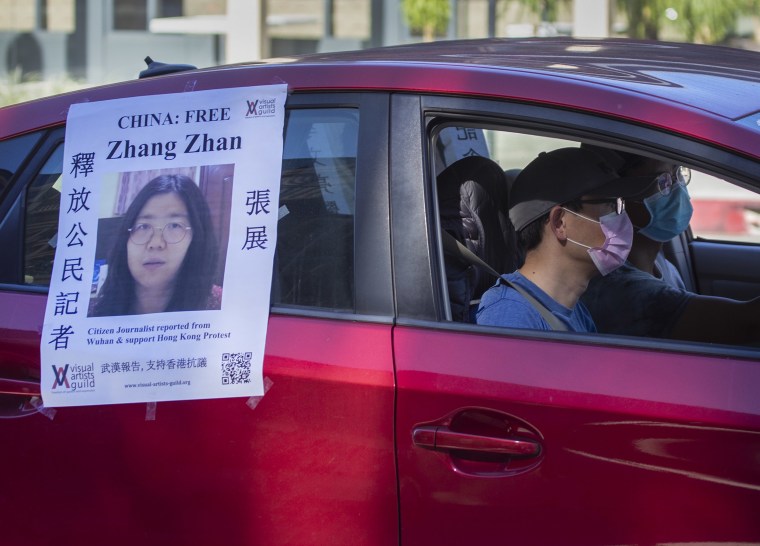
A
car follows a funeral caravan with poster of Zhang Zhan, a Chinese
citizen journalist who criticised the Chinese government's handling of
the coronavirus crisis and is being held in a Shanghai prison. Allen J. Schaben / Getty Images
Detained in May, she began her hunger strike in late June and since then has been subjected to force-feeding through a nasal tube. Arms pinned back to her sides so she is unable to pull the feeding tube out, according to her lawyers. Found guilty of 'picking quarrels and provoking trouble' at the conclusion of a brief hearing. She has a law degree though she is not practising at present. She decided to travel from Shanghai to Wuhan in early February, curious to see for herself what was happening there.
After which, what was happening was being chronicled with the aim of informing the public of the chaos she discovered in the early stages of the contamination and what life was like for Wuhan residents. She posted her reports and livestreamed on WeChat, Facebook and Twitter. Evidence of crematoriums operating at midnight in a desperate effort to keep up with the dying was one item she thought worthy of reaching the public.
She thought it important to report on the harassment by authorities of family members of victims. And the detention of other citizen journalists. And then she disappeared herself, in mid-May. She must have known this would be inevitable. A determined, courageous young woman who would not be told what she could and should not report. Seeing it as her duty to the public to inform them. Herself outraged by the stealth and secrecy and incompetence.
Several Wuhan doctors had been punished by authorities for revealing what they witnessed in their hospitals. They were "rumour mongering", according to authorities. And had to recant. But they alerted friends and colleagues of a mysterious pneumonia that had begun circulating in the city. One such doctor, Li Wenliang, died of COVID-19, and became a celebrated hero, a face and a name around which citizens could gather their outrage.
The
Shanghai Pudong New District People’s Court, where the citizen
journalist Zhang Zhan was sentenced after reporting on the early days of
the pandemic. Credit...Leo Ramirez/Agence France-Presse — Getty Images
"Most scientists studying the origins of COVID-19
have concluded that the SARS-CoV-2 virus probably evolved naturally and
infected humans via incidental contact with a wild or domesticated
animal. But a few persistent voices, including respected microbiologist
and biosafety advocate Richard Ebright, PhD, continue to highlight
circumstantial evidence suggesting that SARS-CoV-2 escaped from a
biohazard laboratory in Wuhan, China. Such an escape might have occurred
via accidental infection of a lab worker who came into contact with the
isolated virus, an infected lab animal, or animal waste.
For now, we cannot definitively rule out either origin story—a lab
accident or a natural animal-to-human transmission. Determining the
origins of this pandemic is unlikely to help current efforts to treat
and cure the disease. It could, however, be an important determinant for
efforts to prevent future outbreaks."
"Most arguments in favor of the lab accident theory are based on
geography. Wuhan, the site of COVID-19’s first reported cases in late
2019, is also home to two of China’s most advanced biological
laboratories. The Wuhan Institute of Virology (WIV) has come under
special scrutiny because it hosts China’s only biosafety level 4 lab
facilities."
"Ebright, a former Howard Hughes Medical Institute investigator and
current laboratory director at Rutgers University, is the most prominent
scientist espousing the possibility of a lab escape. He raised biosafety concerns
about WIV when it opened in 2017, as did Tim Trevan, founder of CHROME
Biosafety and Biosecurity Consulting. Ebright has long opposed the
expansion of preventative research into dangerous pathogens, and he
views the possible lab escape of SARS-CoV-2 as strong support for that
position."
Genetic Engineering & Biotechnology News
"It
certainly couldn't have been Wuhan ... surely another person brought it
in. Or surely it came from some other product brought from outside."
"There were just certain conditions for it to appear here."
Chen, wet-market vendor, Wuhan, China
"The
first cluster of cases was there, so at least it would be of interest
to find out the origin of those and put forward a few hypotheses, like
whether it's more likely from the wild animals or perhaps points to a
human super-spreader."
Jin Dong-Yan, professor of virology, University of Hong Kong
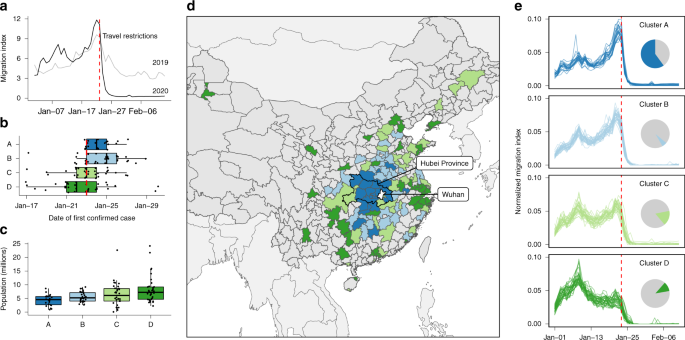
"There is new evidence to show that China locked down all domestic
traffic internally by end January 2020 but pushed to open foreign travel
till end March. Data from Tom Tom traffic index, a traffic location
site that covers 416 cities across 57 countries show that as a result of
this strategy, China, intentionally or otherwise, was able to lockdown
its cities unknown to the world. While this reduced the spread of the
Corona virus within China, China’s aggressive foreign travel policy lead
to a virus explosion worldwide."
Sandip Sen, The Economic Times, April 30, 2020
"
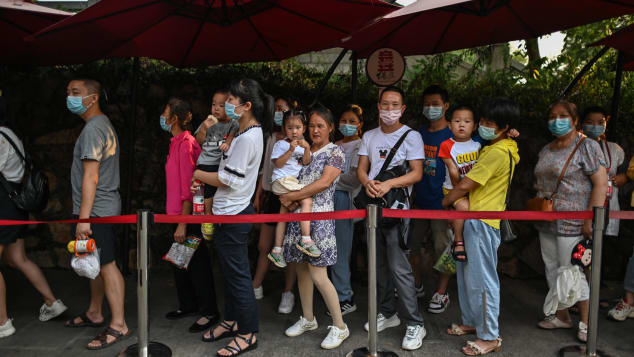
Tourists wearing face masks line up outside the Yellow Crane Tower in Wuhan, China on September 3.
HECTOR RETAMAL/AFP/AFP via Getty Images
The
Huanan Seafood Wholesale Market in Wuhan, China where vendors set up
their wares in small stalls was a popular place for individuals to shop
as well as local restaurant owners who would start their day by passing
through the market to pick up fresh-caught fish and bring it back to
their restaurants to begin the day's menu preparations. Most Asian
cities have such live markets, Tokyo, Japan has a large celebrated
market, Ueno district's Koromon market, where crowds of shoppers
converge on the market to sample live fish. These markets are part of
the food culture, a part of daily shopping life.
On
December 31, 2019, four cases of a mysterious type of pneumonia
appeared at local Wuhan hospitals and were linked to the Huanan market
and overnight it was no longer open for business, taking shoppers by
surprise the following morning. A month later, the city went into a
strict 76-day lockdown on hours' notice, barring people from leaving
their homes. A severely restrictive move that represented the start of a
hugely successful gambit to control the new virus's spread. Hubei
Province itself was border-shuttered to the rest of China.
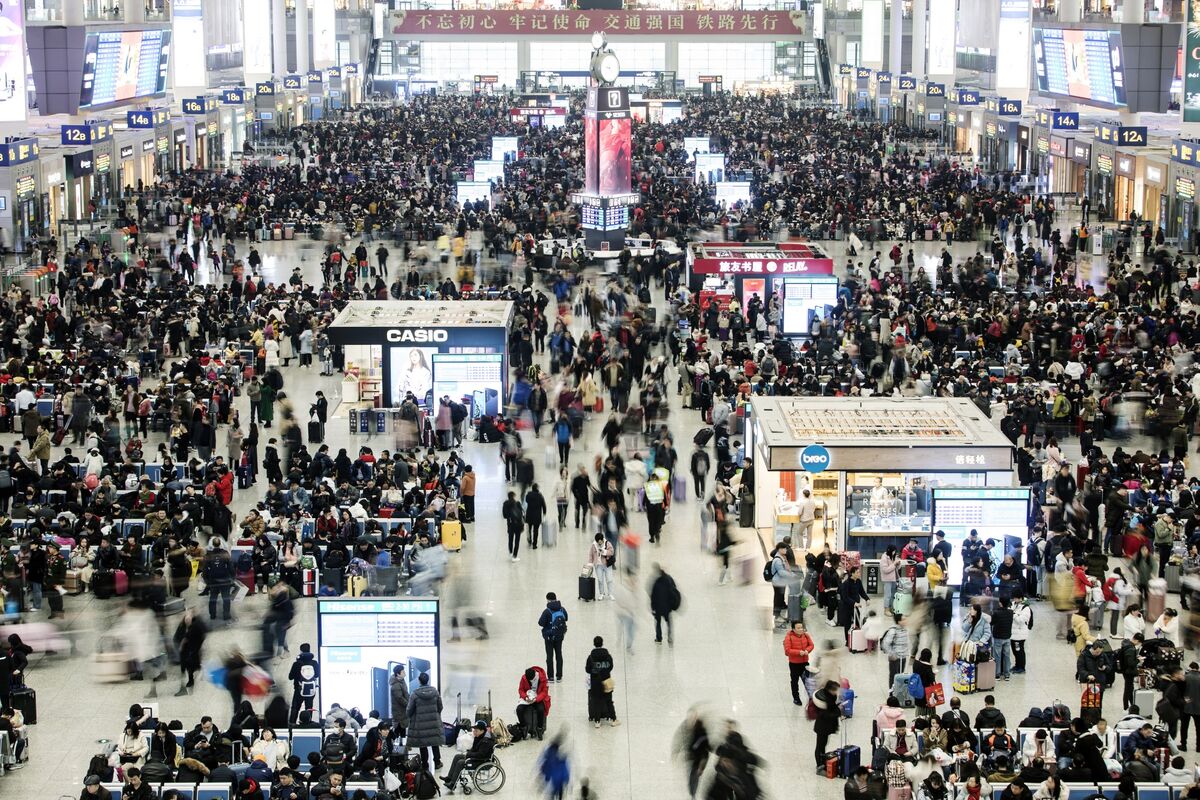
Travelers walk through the main hall of the Hongqiao Railway Station in Shanghai on Jan. 18.Photographer: Qilai Shen/Bloomberg
On
the other hand, China kept its national borders open so Chinese could
celebrate the Lunar New Year as usual, and the population spread out in
its customary holiday travel pattern as millions of Chinese travelled
back to their home cities and provinces in a tradition as important to
the Chinese as Christmas is to Westerners. A massive human migration
takes place as individuals travel back to
their hometowns. People in China are estimated to make close to 3
billion trips over the 40-day travel period, or Chunyun, of the Lunar
New Year holiday. It's estimated that 5 million people left Wuhan, the
epicentre of the pandemic before the travel ban of January 23, 2020. An estimated million Chinese went abroad, to Europe and elsewhere during that period.
The
disease spread rapidly throughout China and to neighbouring countries.
Despite the aberration of the massive migration for the Lunar New Year
celebrations, China and its neighbours then cracked down on their
populations, enacting draconian social distancing laws and total
lockdowns. Their success in bringing the internal spread of the disease
following a massive infection rate in China which led to hastily built
hospitals to handle the load and patients being isolated in massive
temporary quarters with cots lined up one after another in proximity to
one another, did succeed in eventually quelling the massive outbreak.
Which
then spread to Europe, devastating the continent which is now grappling
in desperation with its second and third waves of the domineering
recurring nightmare. Globally, over one-and-a-half million people have
died of the effects of SARS-CoV-2. Initially, Beijing had bristled at
the global community's attempts to close their borders to Chinese
visitors, claiming the move was clearly racist in nature; even the World
Health Organization supported China's umbrage, chiding the rest of the
world for their reaction. The United States now hosts a ravaging beast
of a pandemic.
When
both Beijing and the WHO came under criticism, particularly from the
U.S. administration, both bridled and responded they had each acted with
alacrity to stem the tide of the viral contagion, acting with due
respect and regard to public safety globally. China took further umbrage
when the virus was referred to as the China virus, and the WHO came up
with a neutral designation for the scourge. To their credit, Chinese
scientists released to the world at large the genetic sequence of the
virus, enabling scientists elsewhere to get on with research to find a
vaccine against the virus.
In
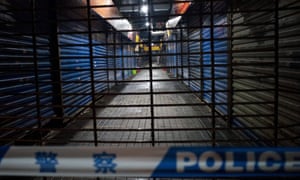
Wuhan, the city is once again 'normal'. But the wet market remains
closed, the stalls shuttered. The origin of the virus remains a topic of
fierce political and scientific enquiry. Beijing circulated the claim
that the virus originated elsewhere, in Spain or Italy, and was then
brought to China where it surfaced to appear as the origins of the
virus. Residents of Wuhan certainly don't believe the virus really
originated there, but was brought to the city by travellers. When a
second wave erupted in China, a strain of the virus brought back by
Chinese returning from trips abroad again, it gave impetus to the notion
that the virus originated abroad.
Beijing
and the United States continue to spar with one another along with
other countries, accused by China of bias against the Chinese. Even yet,
a team of World Health Organization experts has still to visit Wuhan to
gather information. Origin-tracing efforts, warn health authorities in
China and elsewhere, could take years and in the end inconclusive
results may be yielded. More recently Chinese diplomats and state media
claim their belief the market was not the origin of the virus but the
victim of the disease, which originated somewhere other than China.
According
to experts the market is critical to any investigation, unlikely to be
dismantled even though the bulk of the research would rely on samples
sored immediately following the outbreak. Access to the market area is
heavily restricted. The bustling building with its hundreds of stalls
sectioned off into areas for red meat, for seafood, and for vegetables
is now quiet and abandoned. Local government has placed traditional
Chinese paintings over the semi-permanent blue barricades the area is
encircled by. Wooden boards line the interior stalls and windows.
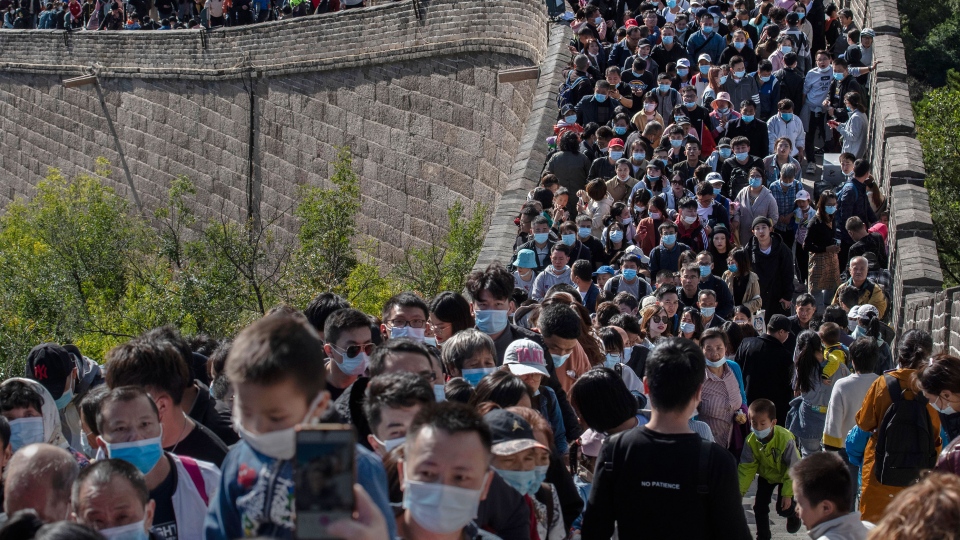
Chinese tourists crowd together on the Badaling section of the Great
Wall of China in Beijing on October 4, 2020. (Kevin Frayer/Getty Images)
"A report issued by a Shanghai-based online travel agency said people from over 100 Chinese cities had booked to
travel to nearly 500 destinations across over 90 countries and regions."
"Thailand, Japan, Indonesia and Singapore are among the most popular
destinations while Nordic countries, the United Arab Emirates and Spain
have seen the fastest growth of Chinese visitors".
"Traveling schedules covering cultural sites or winter sports that can
be enjoyed by a big family are the most popular choices, indicating
that Chinese are willing to enjoy high-quality travel experiences."
"Lvmama, another Shanghai-based online travel agency, said in its
latest report that more convenient transport, easier visa application
procedures and Chinese people's upgrading demand for leisure were major
factors in China's booming outbound tourism."
"In 2018, 140 million Chinese traveled outbound, marking a
year-on-year increase by 13.5 percent, according to the China Tourism
Academy."
XinhuaNet, December 13, 2019
Wuhan
has not reported any new locally transmitted cases of COVID-19 since
May. A local restaurateur speaks of the market's closure and public
panic over the safety of imported seafood, increasing the cost of
ingredient procurement substantially. Above the empty, closured market,
shops reopened in June selling optometry equipment and eye-ware. Guards
at the upper entrance to the market take temperatures, warning that no
videos or photos may be taken inside the building. "Maybe
some people have some bad feelings about it, but now it's just an empty
building ... who feels anxious about an empty building?" a shop assistant remarked.
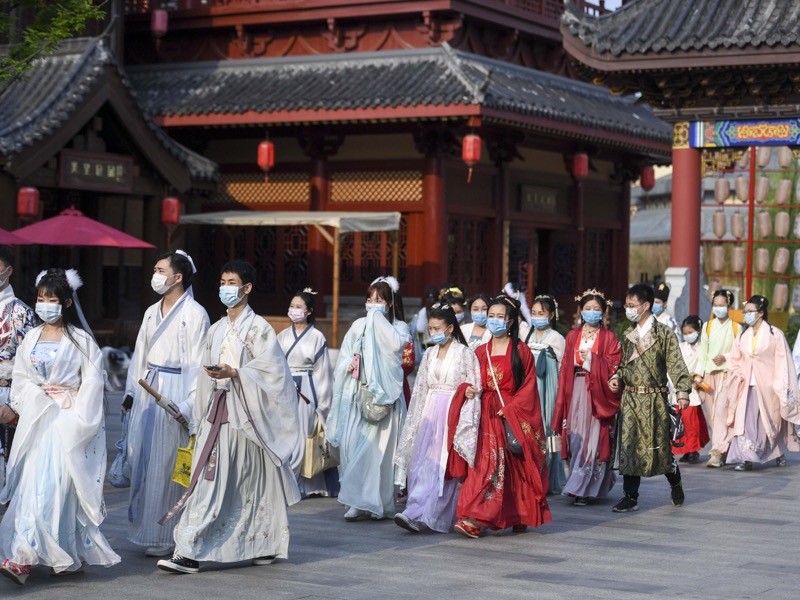
People at a heritage theme park in Hunan province in China, wear face masks and traditional dress.Credit: Yang Huafeng/China News Service/Getty
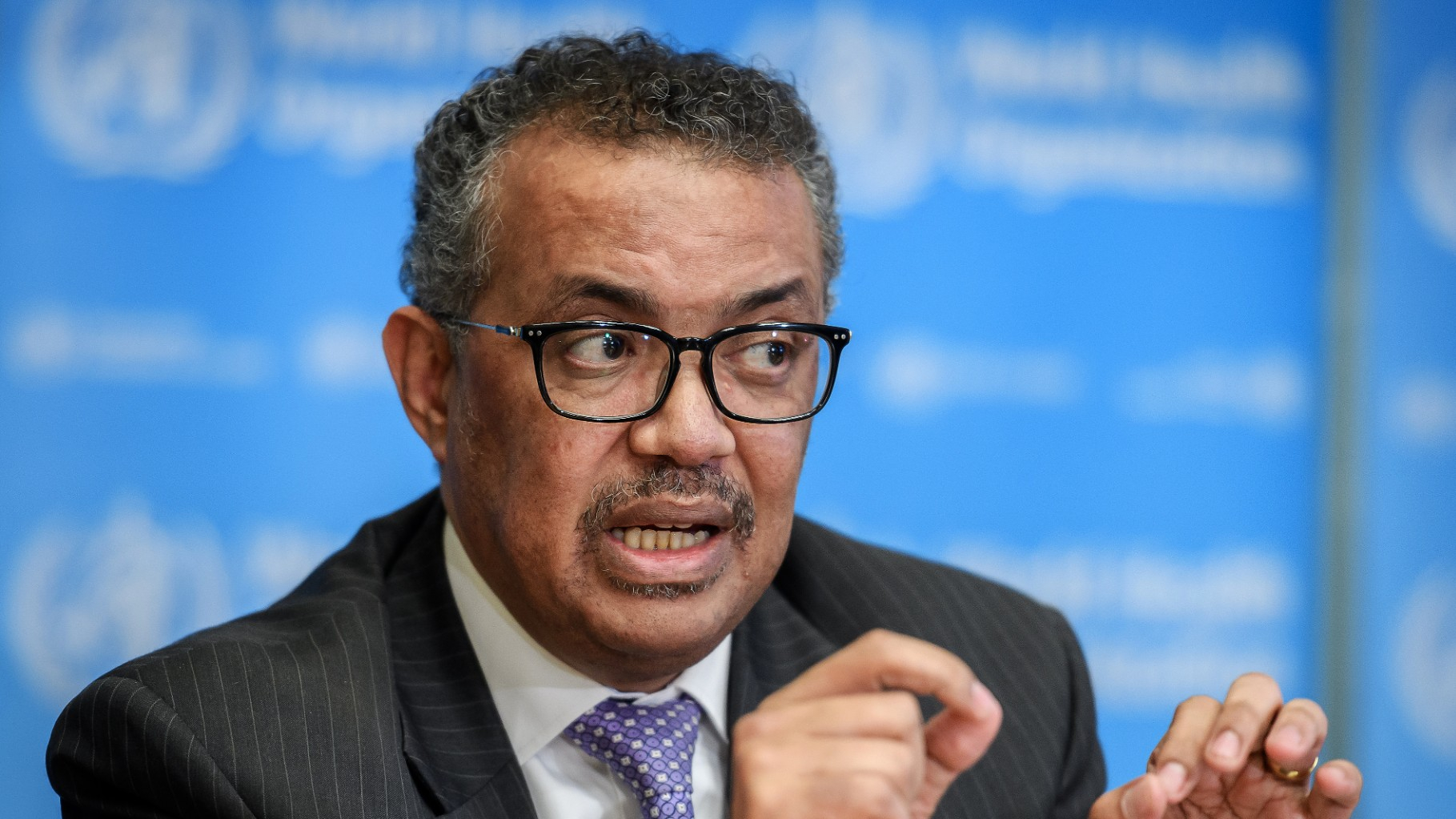
Tedros Adhanom Ghebreyesus, director-general of the WHO, /AFP
"We all hope to have a number of effective vaccines that can help prevent people from infection. However, there's no silver bullet at the moment -- and there might never be one."
"By wearing a mask, you're sending a powerful message to those around you that we're all in this together. Wear a mask when appropriate. Keep your physical distance from others and avoid crowded places. Observe coughing etiquette, clear your hands frequently and you'll be protecting yourself and others."
"The message to people and governments is clear: Do it all."
"Over the past week, we've seen several countries that appeared as though they were past the worst now contending with fresh spikes in cases."
"There are concerns that we may not have a vaccine that may work, or its protection could be for just a few months, not more. But until we finish the clinical trials, we will not know."
Dr.Tedros Adhanom Ghebreyesus, director general, World Health Organization
"[In some states with moderate case counts, experts are seeing] that same insidious increase in percent positive that we had seen and pointed out ... in states like Tennessee, Kentucky, Ohio, Minnesota and others."
"[States with high coronavirus case counts should reconsider imposing lockdown restrictions, as an imperative to reach a low baseline before the emergence of the fall flu season]."
Dr.Anthony Fauci, infectious disease expert, United States
"We're doing our very best. Sorry, Manila", President Rodrigo Duterte said in response to the number of cases breaching 100,000 as he reintroduced a "modified enhanced community quarantine", for the capital and its outlying areas to restrict non-essential businesses while permitting people to leave their homes only for work or to buy food. On Sunday, the Philippines recorded 5,032 additional infections, representing the country's largest single-day increase for a total of 2,104 deaths.
In Iran, new data has emerged suggesting the number of deaths recorded by the government stood at 42,000 until July 20, as opposed to the total of 14,405 deaths released in a report by the health ministry. The same data showed 451,024 cases, close to doubling the 278,827 officially reported. BBC Persian had obtained the documents even while a resurgence was reported by the health minister. In rejecting the BBC report a health ministry spokesman claimed foreign media relied on anonymous sources and unscientific methodology for their own political purposes.
Dr. Tedros, speaking from the Geneva headquarters of the World Health Organization, issued his warning in response to the over 18 million cases of COVID-19 recorded world-wide, of which the United States, Brazil and India continued to report new infections in ongoing high numbers. Australia and Vietnam are also reporting a resurgence of cases, requiring a return to lockdown conditions. The death toll globally stands at a grim 688,080.
Leading Mr. Tedros to urge countries to continue testing, isolating and treating patients while tracing and quarantining their contacts. Melbourne, Australia closed all non-essential businesses in re-instituting lockdown measures in wake of a recorded 429 new cases and 13 deaths overnight on Monday. In the United States, Dr.Fauci emphasized how crucial it is that the outbreak be contained before the arrival of autumn when influenza numbers have the potential to spike alongside COVID-19.
He cautioned as well that though young children don't become seriously ill from COVID-19, they may still become infected and spread the virus in the community. As people begin to assemble indoors when cooler weather arrives with the fall, the risk of contagion steadily increases. Countries with high transmission rates, including Brazil and India, need to be prepared for the future, according to the WHO's head of emergencies. "The way out is long and requires a sustained commitment", reminded Dr.Mike Ryan.
And then, the interesting news that a WHO-led team comprised of Chinese and international experts is to be set up for the purpose of studying the SARS-CoV-2 virus's origins in the city of Wuhan.
"The
Chinese Communist Party sees itself as engaged in a global competition
over the narrative surrounding COVID-19, its origins and government
responses." "The disinformation, the conspiracy theory peddling and the wild and unsubstantiated accusations are prime examples." We
have not seen the last Li Wenliang. The question his case raises is
whether the next Li Wenliang will even have the opportunity to send that
first message." Julian Gewirtz, The Harvard Academy for International and Area Studies
"People of the world have all witnessed that it is under the leadership
of the CPC [Communist Party of China] that the Chinese people achieved
independence, freedom and liberation and made enormous progress in
national development." "It
is also under the leadership of the CPC that the Chinese national
united as one and speedily fought against COVID-19, buying precious time
for the global response." Chinese Embassy, Ottawa
A doctor examines a patient who is infected by the coronavirus at a hospital in Wuhan in China's central Hubei province.
STR/AFP via Getty Images
A University of Toronto Internet watchdog, The Citizen Lab,
had reported the blocking of key words by a Chinese livestreaming
platform in late December, related to the coronavirus outbreak.
Following that, a broader censorship followed. And Wuhan, the epicentre
of the novel coronavirus outbreak in China, was sealed into
military-style lockdown on January 23. Its eleven million people were
virtually prisoners in their own homes, as the frightening new virus
leading to pneumonia and death for many, swept through the city and the
region.
To the world's misfortune, that lockdown came too late. China's attempts
to shield knowledge of the new coronavirus from the outside world led
it to ignore the impending disaster, to allow millions of Wuhan
residents to fan out from the city during the Chinese New Year in the
customary tradition of returning home to visit with family. Those
visitors took with them an alarming infectious rate, not only within
China, but to the world outside as well.
In Canada, the first case of COVID-19 emerged a mere three days later,
on January 25 when a traveller who had been to Wuhan returned to Canada.
More latterly, a Chinese foreign ministry spokesman, Lijian Zhao, has
used the specious auspices of a Montreal-based, conspiracy-theory group
called Centre for Research on Globalization to 'legitimize' its
contention that COVID-19 did not emerge in China, at all. It was
deliberately brought by U.S. soldiers last November to Wuhan with the
intention of initiating a vicious viral war.
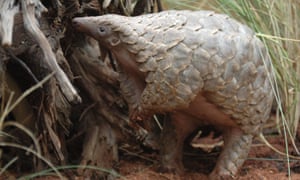
A pangolin, mammal thought a possible intermediate host for the coronavirus.
This conspiracy-pushing group that honours decrepit versions of 9/11
that not Islamist terrorists but the CIA conspired to destroy the World
Trade Centers, delighted Mr.Lijian in its take on the Wuhan virus, who
then tweeted "It might be US army who brought the epidemic to Wuhan. Be transparent!"
Beijing followed up by recent suggestions the virus could have
originated in Italy. And now Beijing is ennobling the doctor they first
criminalized, who was arrested after alerting his colleagues about a
mysterious new type of pneumonia showing up in Wuhan hospitals.
And while China receives praise from the World Health Organization over
its self-described timely and efficient halt to the spread of the novel
coronavirus, the U.S. is shaping up as an epicentre of the viral
contamination, following Italy's and Spain's ongoing crisis in trying to
control the runaway contagion. This new virus is a close cousin of
SARS, so much so it is classified as SARS/cov-2. SARS, another
high-death-rate virus which originated in a Chinese wet-market, did not
have the astonishing infectious impetus of COVID-19.
With the emergence of the novel coronavirus and patients admitted to
hospital with a mystery pneumonia, health care workers wee infected,
among them eight doctors, including ophthalmologist Li Wenliang, all who
were brought in by police to be accused of spreading false rumours, and
forced to humbly recant. Li contracted the virus and died of it in
February. When, eventually officials made public acknowledgement of the
virus they claimed it was not serious. Which led to a holiday banquet
attended by 40,000 people taking place in Wuhan on January 13, and the
rest is history.
Between the banquet and the millions of holiday-goers leaving Wuhan the
explosion of infection began globally. Live wild game sold at 'wet'
markets spawned over the years various zoonotic transmissions from
animal host to human victim. This was just another one, with an
explosive spread, and a deadly message. Beijing has been busy crafting a
new version of events; not only that the virus originated elsewhere,
but that Chinese authorities took immediate remedial action to counter
its spread.
A worker in a protective suit at the closed seafood market in Wuhan,
Hubei Province, China, January 10, 2020. The seafood market is linked to
the outbreak of the pneumonia caused by the new strain of coronavirus. (Stringer/Reuters)
This represents a general opinion site for its author. It also offers a space for the author to record her experiences and perceptions,both personal and public. This is rendered obvious by the content contained in the blog, but the space is here inviting me to write. And so I do.