"There were so many bodies in so many different places." "They couldn't hide all the death." Mohammed Lalmia, 20, Rohingya farmer
"The Myanmar government will not deny any human rights violations and
will investigate if there is strong evidence. And if there are human
rights violations after an investigation, prosecutors will take actions
according to the law."
"[In regard to Gu Dar Pyin village], the preliminary result of the examination has proven that AP's report is wrong," Government of Myanmar statement
"There were dead bodies everywhere, bones and body parts, all
decomposing, so I couldn't tell which one was my husband. " "I was weeping while I was there. I was crying loudly, 'Where did you
go? Where did you go?"' "I have lost everything." Rohima Khatu, 45, Rohingya Muslim refugee, Bangladesh refugee camp
This combination of May 26, 2017, left, and Dec.
20, 2017, satellite images provided by DigitalGlobe show the village of
Gu Dar Pyin, Myanmar before and after destruction. The Associated Press
has confirmed more than five previously unreported mass graves in the
village through multiple interviews with more than two dozen survivors
in Bangladesh refugee camps and through time-stamped cellphone videos.
The Myanmar government regularly claims massacres like Gu Dar Pyin never
happened, and has acknowledged only one mass grave containing 10
“terrorists” in the village of Inn Din. (DigitalGlobe via AP)
No outside agency is able to approach Gu Dar Pyin, in Myanmar's western Rakhine state. It is where villagers who survived a military attack on their village describe what occurred there. There is nothing left of the village; all the homes have been reduced to ash. There are hastily-dug 'graves', large holes in the ground into which bodies were pitched. Some are mass graves, others, smaller and shallower hold only several corpses apiece. Many of the corpses' faces were destroyed by acid, defying identification. The clothes they wear, however, can be recognized.
Associated Press has interviewed the villagers now occupying space in the bare haven of the refugee camps that Bangladesh hosts. Most of the interviewed villagers describe three large mass graves at the northern entrance to Gu Dar Pyin. It was where, close to the main road, soldiers herded together and killed many of the Rohingya from the village.
According to survivors, the military planned the attack on August 27 and attempted to screen the slaughter. They arrived armed with rifles, knives, rocket launchers and grenades. Bringing with them as well, shovels to dig the pits they hurled the bodies into, and acid to burn faces and hands to make them unidentifiable. Days previous to the attack, said villagers, soldiers were observed with a dozen large acid containers at a market in a nearby village.
Several hundred soldiers moved into Gu Dar Pyin from a Buddhist village to the south, firing weapons as they entered the village. Those who could react ran swiftly toward the north or to a river to the east, according to the testimony of 37-year-old Mohammad Sha, a farmer and shop owner. She had concealed herself in a grove of coconut trees close to the river along with over a hundred others and witnessed soldiers searching Muslim homes.
From neighbouring villages, dozens of Buddhists partly covering their faces with scarves, took possession of items from the homes before they were torched, loading them into pushcarts and taking them away to their own village, their actions observed by the hidden villagers. Those who hadn't fled were summarily shot by the soldiers, while another group of soldiers came in from the north to encircle the village, trapping those whom they could.
Buddhists from surrounding villages were seen to move through Gu Dar Pyin, using knives to cut the throats of injured Rohingha, according to survivors. They worked alongside the soldiers to toss small children and the elderly into the fires. "People were screaming, crying, pleading for their lives, but the soldiers just shot continuously", Mohammad Rayes, 23, a schoolteacher who had climbed a tree and witnessed the events, stated.
For days afterward, Rohingya from the surrounding area made their way stealthily into Gu Dar Pyin to rescue any they could, who had been left for dead. Thousands remained hidden deep within the jungle, where infants and toddlers died from lack of food and water. A day later, Gu Dar Pyin was completely put to the torch.
Rohingya Muslim refugee Mohammad Karim, 26, centre, shows a
mobile video of Gu Dar Pyin's massacre to other refugees in Kutupalong
refugee camp, Bangladesh, on Jan. 14. (Manish Swarup/Associated Press)
"Then they shot the men and boys. I saw them kill my husband and son. I was screaming." "They took my baby and cut his throat." "One soldier held me down, and another raped me." Dilbar Begum, Tula Toli, Myanmar
"I saw everything." "My father was the best man in the world. We were a good team." Noor Kalima, ten, Southeast Bangladesh
"I was trying to hide my baby under my scarf, but they saw her leg. They grabbed my baby by the leg and threw her onto the fire." "When I fall asleep, I look for my baby. I wake up screaming." "They killed my family members, and they killed my world. When I tell my story, I feel terrible, and afterward I go cry to myself. But we need justice, and maybe this will help." Hasina Begum, 21, Southeast Bangladesh
"I was unconscious, so I don't know what they did to me." "I want to tell the whole world my story. I want to tell what happens in Myanmar." Shafika Begum, 15, Southeast Bangladesh
Rahima, 15, fled Myanmar in September. She
was gang-raped by soldiers, one of whom bit her cheek, leaving a scar.
“I don’t know why he bit me,” she said. “There are many things I don’t
understand.”Credit
Tomas Munita for The New York Times
All of the women who recounted the horrors they had survived came from one small village in Myanmar called Tula Toli. They are among the survivors of their village; no men, only women and children. They speak of witnessing the most obscene brutalities that human beings could ever visit on one another; soldiers of the Myanmar military brutalizing, raping, slaughtering the Burmese minority Rohingya. They are safe now, living tenuously in refugee camps in Bangladesh, a Muslim country that does not want them.
The denied ethnic cleansing that has taken place, is still taking place, has resulted in countless deaths and dislocations and hundreds of Rohingya villages burned to the ground, but not before individual homes were torchedm often women and children locked inside for good measure, representing, according to the U.S. Holocaust Memorial Museum along with a human rights group called Fortify Rights, "growing evidence of genocide". Myanmar rejects the presence of Muslims living for generations among its Buddhist population.
The intention was to return them to Bangladesh, the country where they originated generations ago. Burmese leader Daw Aung San Suu Kyi, Nobel Laureate, spoke of "a huge iceberg of misinformation" on what has been happening to the Rohingya. Citing the attacks by Rohingya militant groups on Burmese military encampments, the killing of members of the military and of Buddhist Burmese being the cause of the backlash, where the military were simply responding, seeking out the attackers, doing no harm to the ordinary civilian Rohingya who were themselves torching their own homes.
Women and children make up a
majority of Rohingya who have settled in camps in Bangladesh. Thousands
of Rohingya men were killed in Myanmar, while others may have stayed
behind to fight.Credit
Adam Dean for The New York Times
There is a kind of raw organization among the military of Myanmar in responding to the perceived threat of the existence of the Rohingya in a nation that despises them and wants to rid itself of their presence. Soldiers enter the villages, isolate the men from the women and children, lead the men away to their deaths if they aren't killed on the spot, then order the women into huts to rape and murder them along with their children. Commonly, the women and children are locked into the huts which are then set ablaze.
Some escape and take their still-living children with them. Young girls do not escape rape and attempted murder. An estimated 345 villages have been burned. According to Doctors Without Borders, an estimated 9,000 Rohingya, among them a thousand children, have been killed in devastatingly brutal attacks of gruesome savagery. While it remains guesswork how many women and girls have been raped, refugee camp doctors report an surge in pregnancies.
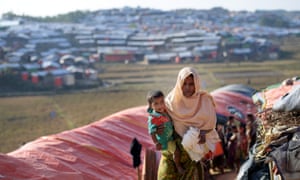
In the vast refugee camps in Bangladesh at the border with Myanmar, the Rohingya, shaken, traumatized, injured and ill, live in tents and shacks with inadequate food, water, toilets and medical care. Bangladesh will not permit aid organizations to teach Bengali, its national language, to the children, nor provide an education beyond primary school. China has proposed that the refugees be returned to Myanmar, meaning that the nation that has so viciously persecuted them can repeat the performance.
Kutupalong, in Bangladesh, is
the world’s largest refugee settlement, part of a network of camps that
has taken in more than 655,000 Rohingya from Myanmar since August.Credit
Adam Dean for The New York Times
"These women were claiming they were raped, but look at their appearances -- do you think they are that attractive to be raped?" Rakhine [Burma] minister for border affairs, Phone Tint
"What we uncovered was staggering, in terms of the numbers of people who reported a family member had died as a result of violence, and the horrific ways in which they said they were killed or severely injured." "The numbers of deaths are likely to be an underestimation, because we have not surveyed all refugee settlements in Bangladesh and because the surveys don't account for families that never made it out of Myanmar." "We heard reports of entire families who perished after they were locked inside their homes and set on fire." "With very few independent aid groups able to access Rakhine, we fear for the fate of Rohingya people who are still there. The signing of an agreement between the governments of Myanmar and Bangladesh over the return of refugees is premature. Rohingya should not be forced to return, and their safety and rights need to be guaranteed before any such plans can be seriously considered." Sidney Wong, Medecins Sans Frontieres
A Rohingya woman and child walk through the Jamtoli refugee camp in
Bangladesh. More than 640,000 Rohingya people have fled Myanmar.
Photograph: Tracey Nearmy/AAP
When we think Buddhist, we think the Dalai Llama, who preaches peace, thoughtfulness, kindness, respect and who urges humankind to make the choice to consider well of one another. A man of quiet diplomacy and humour, who most certainly finds no humour in the fact that Buddhist-majority Myanmar (Burma) has gone berserk over the presence of minority Muslims in their midst. There are other minority ethnic and religious groups in Myanmar who live among the Burmese Buddhists, but it seems only the Muslims are so loathed and feared.
In a sense, perhaps that is not entirely surprising. From Al-Shabaab to Islamic State, Boko Haram to the Taliban, Hezbollah to Hamas and al-Qaeda, the sectarian violence continually erupting in the Middle East between Sunni and Shiite, the incidents of Muslims living in Europe and North America who have taken Islam to the extremes of violent jihad, slaughtering non-Muslims for the sake of the Koranic injunction to engage in jihad, the non-Muslim world has good reason to view Islam and its faithful with a certain level of suspicion.
In Myanmar there is no social stigma in being accused of "Islamophobia"; that kind of reverse psychology is effective only in socially-conscious leftist circles of liberal democracies wallowing in the guilt of overplayed responsibility for colonialism. The Rohingya, originally squeezed out of Bangladesh, one of the poorest of Muslim countries, found a haven for themselves across the border in Burma, but it was not to last. Though they accommodated themselves there for generations, living under less than ideal conditions, they were evidently an improvement over Bangladesh.
Bangladesh has no wish to accept the 600,000 Rohingya who were forced to flee the campaign of ethnic/religious slaughter and rape and the torching of entire villages, leaving people nowhere to return to. If some of the lavish wealth wasted by oil-rich Middle East countries were shared with Bangladesh alleviating a degree of its poverty perhaps it would have the effect of welcoming the Rohingya back to the country, but Bangladesh hasn't the wherewithal to establish permanent places for the returned Rohingya.
Sending them back to Myanmar where they are scorned and detested and where they face ongoing discrimination even if the current military campaign to decimate their numbers, degrade and humiliate them, violate their women and victimize their children is put to a halt, there is still no solution to the situation that currently prevails where a genuine humanitarian crisis is still unfolding and there is no remedy for what these people have suffered and lost.
Myanmar security forces deliberately targeted the Rohingya in mass atrocities. The military explained that it was simply engaged in driving out the terrorists, Rohingya militias who had attacked a number of army bases, killing Burmese soldiers in the process, and which sparked this latest campaign of slaughter and rape, upgrading the tormented lives the Rohingya are usually exposed to in a country that doesn't want them and conspires to expunge them from their territory.
"We thank the Lord Buddha for this [the growing absence of Rohingya in Rakhine state]." "They stole our land, our food and our water. We will never accept them [Myanmar Rohingya] back." Thu Min Gala, 57, Abbot, Damarama Monastery, Sittwe, Rakhine state, Myanmar
There is no case of the [Burmese] military killing Muslin civilians." "Muslim people killed their own Muslim people." Dr. Win Myat Aye, Myanmar social welfare minister, National League for Democracy
A crying Rohingya girl fleeing ongoing violence
Muslim Burmese, the Rohingya, have lived for generations in Burma, now called Myanmar. It is likely that they arrived in the country from neighbouring Bangladesh at some time in the past. But for most Rohingya, Rakhine province in Myanmar has been their home for as long as they can recall. Their presence has been barely tolerated; hostility from their Buddhist neighbours, from the general population which is majority Buddhist has meant that the Rohingya have lived as a persecuted minority. When the military took power in 1962 their citizenship was revoked, leaving them stateless.
Militant insurgent groups from within the Rohingya population reacted to their state of persecuted statelessness by attacking a number of military bases, where the Rohingya guerrillas killed Burmese soldiers and some civilians; a well co-ordinated attack against their persecutors whose satisfaction was short-lived when the government ordered the military to cleanse Rohingya villages of the militias. Of course everyone who lived in the villages was identified with the militias.
The Burmese military along with mobs of civilians backed by security forces entered Rohingya villages, setting them on fire. Children were injured, women raped and 'insurgents' killed when ethnic Rakhine Buddhists marched into the villages holding sharpened bamboos and machetes, soldiers escorting them. The outcome of which was the villagers fleeing in panic for their lives, children in tow, marching for miles to eventually reach the border with Bangladesh and ending up in sprawling refugee camps.
The Buddhist abbot, relieved at the absence of the Rohingya Muslims who had no business being in Myanmar, deplored that they were overwhelming the local Buddhist population. Over 600,000 Rakhine Muslim Rohingya have now made their way across the river separating the two countries since last August, driven by fear and persecution. The campaign of killing, rape and arson led by the Myanmar army has been very efficient in achieving its goal of persuasion.
In Myanmar there is general agreement expressed by government officials, religious leaders and local human-rights activists that the Rohingya do not and have never belonged in Myanmar. The government of Myanmar has blocked access to Rohingya by aid agencies in Myanmar, an estimated 120,000 of whom remain in camps in central Rakhine with tens of thousands more Rohingya living in the north of the country.
Speaking a Bengali dialect, physically distinct from other ethnic groups in Myanmar, tensions between ethnic Rakhine Buddhists and the Rohingya were amplified during the Second World War when the Rakhine sided with Japan and the Rohingya with Britain. Referred to as Bengalis to denote their Bangladeshi heritage, the public at large uses a more derogatory word to describe all Muslims living in Myanmar, who represent about 4 percent of the population.
Community leaders throughout the state of Rakhine have warned the population not to break the blockade for aid to the Rohingya. In one township women activists went out of their way to actively prevent aid groups delivering assistance to an internment camp. A Rakhine trishaw driver took it upon himself to deliver food to a Rohingya camp, to earn badly needed money. The driver's wife was forced by a crowd into a monastery where she was beaten, her hair cropped, then forced to wear a sign stating she was a "national traitor".
As for her husband, he was unrepentant, despite the punishment meted out to his wife. "They are human. They need to eat, just like us", he said. And Burmese authorities finally seem to agree; they are permitting the UN Food Agency to resume delivering aid to the Rohingya.
Ye Aung Thu, AFP file picture | Soldiers and rescue workers unload food
aid from a military airplane in Sittwe airport in Myanmar's Rakhine
state
"[...There is] a deeply disturbing pattern to the violence and ensuing large movements of an ethnic group from their homes." "Displacement appeared to have continued with reports of the burning of Muslim villages, as well as looting and acts of intimidation." "[Rohingya] are outnumbered by Rakhine communities, some of whom have engaged in violent acts of vigilantism against their Muslim neighbours." "It is imperative that United Nations agencies and our non-governmental partners be granted immediate and safe access to all affected communities." "[This represents] the world's fastest developing refugee emergency and a humanitarian and human rights nightmare." "[The crisis] has generated multiple implications for neighbouring states and the larger region, including the risk of intercommunal strife." U.N. Secretary-General Antonio Guterres
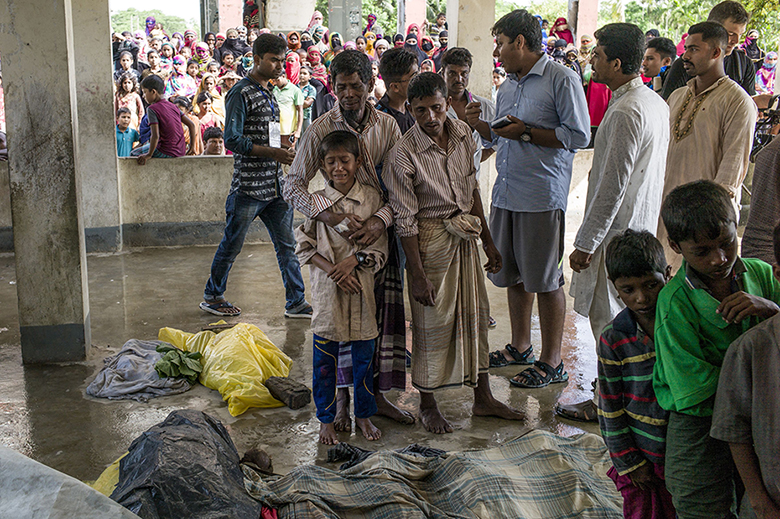
Rohingya refugees mourn beside the bodies of relatives who died when a boat capsized. (Fred Dufour/AFP/Getty Images)
From Saudi Arabia to Indonesia, there are murmurings of unrest. Not, mind, efforts to extract the Burmese Rohingya fleeing deadly persecution out of Myanmar and into Saudi Arabia, Indonesia, Malaysia, or Turkey, for example, but stirrings of jihad, of groups to pledge their part in the restoration of Muslim honour and commitment to come to the aid of fellow Muslims in dire straits. It is the breath of life to Islamofascist terror groups, yet another call to arms in defense of Islam against the unbelievers.
That fear, of a swell of vengeance-seeking Islamist jihadis coursing their way toward Myanmar and engulfing the region in a reactive war of revenge to redeem Islam, has Mr. Guterres quaking in his UN boots that another brutal dysfunction similar to those afflicting the Middle East is on the cusp of erupting. Because a Buddhist society feels umbrage at the abrasive presence of Muslims in their midst, identifying them as intruders who had long ago settled, uninvited in Burma, and eager to return them to neighbouring Bangladesh.
Alternatively a tiny proportion of the untold wealth of the Persian Gulf oil-rich states could conceivably be on offer to penurious Bangladesh to enable it to house and feed and welcome the desperate Rohingya fleeing death in Myanmar. But no, the Muslim world seethes with rage but will not part with any of its wealth even to bolster the strained capability of another Muslim country less fortunate than they are; so much for the munificence of Islamic charity. Of course the UN will not ask pointedly that Muslim wealth rescue Muslim refugees.
It is the fear of radicalization, of criminals and human traffickers moving in to take advantage of this dread situation of almost a half-million desperate people fleeing the violence that threatens them that offers sleepless nights to Secretary-General Guterres in prosecuting to the best of his ability a charge implicit in the authority vested in him, representing a flawed and failed world body that is the United Nations, whose purpose is to unify and to strive toward humanitarian equality.
The appeal to the UN Security Council to exert its own authority to persuade Myanmar authorities to allow "unfettered access" for humanitarian aid to reach the refugees, and to make possible "the safe, voluntary, dignified and sustainable return" of those Rohingya whose fear for ed them to seek refuge across the border into Bangladesh, is unlikely to accomplish much. And in a reprise of the mass exodus of the underprivileged Muslim hordes from North Africa and the Middle East flooding Europe and dying at sea, so too are the fleeing Rohingya vulnerable to the very same threats.
As for Bangladesh, it has already absorbed hundreds of thousands of Rohingya who had arrived years before and still languish in refugee camps. Camps now burgeoning with the excess of newly-arrived refugees for whom there is no more room, forcing them to camp out with no protection from the elements anywhere they can find space, in fields, by the sides of roads, and begging for food.
The United Nations has called for financial support from its members in the amount of $77 million, of which under half has been received, to enable it and its partners in humanitarian assistance to answer to the needs of these people. But even that original estimate has changed; "the scale of the emergency has far surpassed initial projections and the needs are being revised" upward, stated UN deputy spokesman Farhan Haq of "the largest mass refugee movement in the region in decades".
"If the government mishandles the situation ... it could create conditions for radicalizing sections of the Rohingya population that jihadist groups might exploit for their own agendas. To avoid that risk requires a moderated military response, well-crafted political strategy and closer cooperation and intelligence sharing with Myanmar's neighbours and the ASEAN [Association of Southeast Asian Nations] bloc." International Crisis Group commissioned report on Rohingya situation in Myanmar
"The savage treatment meted out to our Muslim brothers shall not pass without punishment." "The government of Myanmar shall be made to taste what our Muslim brothers have tasted." Al-Qaeda statement, SITE Intelligence group
"Unless concerted action led by the government and aided by all sectors of the government and society -- is taken soon, we risk the return of another cycle of violence and radicalization." former UN Secretary-General Kofi Annan
"We are not jihadists. Our status as a recognized ethnic group within Myanmar must be restored." "As long as our demands are not met, resistance will continue and, if unfulfilled, those demands will be upgraded to another level." Abdullah, leader, Arakan Rohingya Salvation Army [ARSA]
"We have already let the world know that we don't have Rohingya in our country. Bengalis in Rakhine state are not Myanmar citizens and they are just people who come and stay in the country." Aung Hlaing, Defence Minister, Myanmar
Rohingya refugees settling in Cox’s Bazar near the Myanmar border, Bangladesh.
Photograph: Noor Alam for the Guardian
The urging for a political strategy to avoid radicalizing the Rohingya minority in Myanmar warned of what was to come, and more, but like all commissioned reports -- this one by Burma's de facto leader, Suu Kyi herself asked to be carried out -- it was received and set aside. The Rohingya have for years suffered massive discrimination; under military rule their citizenship was revoked. The Burmese majority Buddhists have belied their thoughtfully gentle religion by visiting violence on the Rohingya, despised as an unwanted ethnic and religious group which should return to Bangladesh which itself, though a Muslim country, has no wish to absorb them.
Stateless and violated, hunted and miserable, 400,000 of the one-million-strong Myanmar Rohingha have fled over the border from the country where they have lived for generations to Bangladesh to find the squalid refugee camps there already full, forcing the refugees, desperate for food, shelter and medical attention, to set up flimsy shelters at the sides of roads and beg for food. Bangladesh has its own agenda; to force Myanmar to reabsorb the Rohingya. While in Bangladesh the Rohingya will not be permitted to exit the territory set aside for them.
For several years Aung San Suu Kyi has been non-reactive as both the military and the general Burmese population have wreaked havoc in Rohingya villages in Rakhine state, assaulting and killing the minority Muslims, driving them to desperation. In the years prior to the present situation tens of thousands of Rohingya have fled Burma to cross into Bangladesh. The newest arrivals swell those numbers, numbers for which Bangladesh is unprepared, as a country mired in poverty.
In 2015, 65,000 Rohingya were exiled into Bangladesh in escaping massacres that were carried out, while tens of thousands were placed in concentration camps within Burma. Malaysian Prime Minister Najib Razak spoke of a possible genocide, calling for international intervention, while the UN Security Council received pleas to intervene, and did nothing. The Indonesian Islamic Defenders Front called for volunteers for jihad in Myanmar in defense of the Rohingya. "Real action is needed, not just statements and condemnations", stated President Joko Widodo.
Mohsen Rezaee, a Khomeinist lawmaker, formerly commander of the Islamic Revolutionary Guard Corps in Iran called for a multinational Islamic army, the "Army of the Prophet" to march into Myanmar in rescue of the Rohingya against the brutalities of the Myanmar military and government. When ARSA finally attacked 30 police and army posts several weeks earlier in Rakhine state, killing a dozen Burmese Buddhists, Burmese soldier burned down Rohingya homes, destroying villages and an estimated thousand people were killed.
Myanmar authorities speak of complete justification in setting their military against the Rohingya, distinguishing them all as terrorists and that Myanmar is fighting an existential war, that the carnage inflicted on the Rohingya is only what they deserve, and the nation has a right to defend itself from terrorists. It is pro forma to speak of ARSA as a "terrorist" group, illegal to use the word "Rohingya"; they are to be spoken of as "Bengalis".
Bangladesh plans to restrict the movement of Rohingya who have fled Myanmar AFP
"Because Myanmar has refused access to human rights investigators, the current situation cannot yet be fully assessed, but the situation seems a textbook example of ethnic cleansing." Zeif Ra'ad Al Hussein, UN high commissioner for human rights
"When we were about to have our meal, the kalars [Muslims] entered our village and started burning our houses. They were holding machetes and spears and started shouting, 'We will shower with the Hindus' blood'." "So we ran away from our houses. If there are Muslims, the problems will never end, but if kalars are not here anymore, it will be more peaceful." Hazuli, minority Hindu Burmese citizen
"They burned their own houses and ran away." "We
didn't see who actually burned them because we had to take care of the
security for our outpost. ... But when the houses were burned, Bengalis
were the only ones in the village." Aung Kyaw Moe, Buddhist villager
"[It was the Rohingya themselves setting their homes ablaze. I even tried to stop them." "I told them not to do that, but it seemed like they wanted to." Abbott of Buddhist monastery, Zawtika, Rakhine state
In this image made from video, fires occur in
Gawdu Zara village, northern Rakhine state, Myanmar, Thursday, Sept. 7,
2017. Journalists saw new fires burning Thursday in the village that had
been abandoned by Rohingya Muslims, and where pages from the Quran were
seen ripped and left on the ground. (AP Photo)
An estimated 313,000 Rohingya villagers have now fled the violence taking place in Rakhine state. The minority Muslim population, denied citizenship, and derided as Bangladeshis in all probability fled that poverty-stricken country across the border into Myanmar generations ago. Doubtless Bangladesh was glad to see them go; it certainly now is not welcoming them back; though, faced with a humanitarian crisis, for the time being it is forced to accommodate their presence in desperation.
In the village where the monastery abbot informed reporters that the Rohingya themselves destroyed their homes in fiery blazes, a man by the name of Maung Maung Htwe showed he photographs he had captured on his mobile phone. In the photos, clearly identifiable as individuals several people are seen torching houses. As it happened, the photos were clear enough for the journalists to recognize Hindus they had seen being sheltered in a school nearby, displaced Hindus claiming their homes had been torched by Muslims.
The government of Myanmar has been informing the world that it has been the Rohingya that have been responsible for burning their villages in norther Rakhine. They also attacked majority Buddhists and minority Hindus in a spree of unaccountable violence. Unaccountable since the government has no idea why people who are traditionally held in contempt, persecuted, and their generations unrecognized with citizenship, should react against the violence visited on them.
Nothing new about Rohingya villagers being tormented by the military, their homes burned to the ground, however.
Accusing Nobel Laureate Aung San Suu Kyi of overseeing "textbook ethnic cleansing" has not moved her one iota. Even the Dalai Lama saw fit to voice his concerns by criticizing Buddhist attacks on the Rohingya Muslims of Myanmar. Who are derogatorily called Bengalis by the military and by their neighbours, to distinguish them from all others and remind themselves that they originated in Bangladesh.
Expressing the intention to protect their ethnic minority, Rohingya insurgents had started this latest outbreak on August 25, attacking military posts and killing Burmese, leading to a violent crackdown to cleanse the area of terrorists, all-inclusive of all Rohingya civilians, the stateless people whom no one wants, not the Burmese, not the Bangladeshis. The minority Hindus have been given state protection denied the Rohingya.
Clearly, all three groups, Buddhist, Hindu and Muslim have no intention of living in harmony amongst themselves.
The woman shown in the photographs setting fire to the thatched roof of houses in the Rohingya village emptied of its residents was captured in the act of doing what they claimed the Rohingya were responsible for. She it was who described the plight of the Hindus who were attacked by Muslims and she was only returning the compliment, this mother of six who resents so heartily the presence of Muslims among Hindus.
These violent confrontations, the victimhood and the hatred, the slanders and the attacks do not represent a sudden change of relationships between former neighbours. What they demonstrate is the history of disparate tribal, ethnic and religious groups with their intolerance and resentment toward one another and their willingness to use violence to express their determination to rid themselves of people they have no use for.
This is a universal human dilemma of inhumanity toward others unlike oneself.
"It may not be landmines, but I know there have been isolated cases of Myanmar soldiers planting explosives three to four days ago." Lt. Col. S.M. Ariful Islam, commanding officer, Bangladesh border guard, Teknaf
"All indications point to the Myanmar security forces deliberately targeting locations that Rohingya refugees use as crossing points." "This is a cruel and callous way of adding to the misery of people fleeing a systematic campaign of persecution." Tirana Hassan, Amnesty International official
"ARSA strongly encourages all concerned humanitarian actors to resume
their humanitarian assistance to all victims of the humanitarian crisis,
irrespective of ethnic or religious background during the ceasefire
period." Statement, Arakan, Rohingya Salvation Army
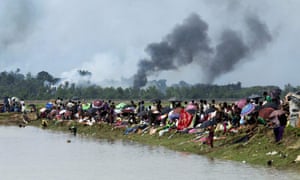
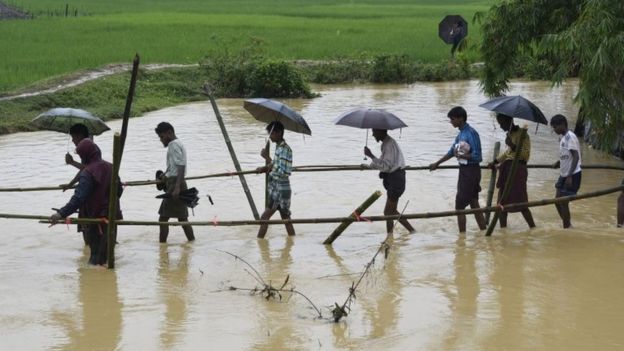
Nearly 300,000 Rohingya have fled to neighbouring Bangladesh [Danish Siddiqui/Reuters]
The spiral of violence resulting from the Rohingya minority's Arakan Salvation Army attacking several army posts and killing a fair number of Burmese, leading the Myanmar military to set out on a 'terrorist-cleansing' mission that has turned into a generalized rout of the Rohingya in their traditional towns and villages in Rakhine State, had its genesis in the ongoing desperate plight of the minority Rohingya Muslims living amidst Buddhist Burmese resenting their presence and terrorizing them.
With the military burning down homes in the villages they've vacated of residents by threats and violence, and the Rohingya of all ages now homeless in their hundreds of thousands, desperately attempting to escape death and mutilation, the Arakan Rohingya Salvation Army in desperation for the plight of their people proposed a month-long truce to give some relief to their civilian brethren facing starvation and disease, along with statelessness.
A proposal spurned directly out of hand by the Burmese military while the head of government, Nobel Peace Prize Laureate, Aung San Suu Kyi remains mute in the face of the atrocities visited on a minority lacking champions other than the ARSA. And since a spokesman for her government stated that Myanmar had no intention of negotiating with "terrorists", there is no relief in sight for the men, women and children who continue to flee in fear, risking perilous sea crossings into Bangladesh or alternately stepping on explosives planted on the border by the Myanmar military.
The refugees, traumatized, starving, injured and helpless describe soldiers shooting at them, and committing arson attacks on villages. This, aside from laying anti-personnel landmines to ensure that if any Rohingya that have crossed into Bangladesh plan to return to Myanmar they cannot do so in safety. North Korea, Syria and Myanmar are known to openly use anti-personnel landmines, according to Amnesty International, a weapon outlawed through an international treaty, in 1997.
The "targeted use of landmines" in a narrow stretch of the border between Rakhine State and Bangladesh, representing a crossing area for fleeing Rohingya represents yet another strike in the roster of indications that, as the United Nations claims, Myanmar is guilty of ethnic cleansing, indulging in ridding itself of the presence of a minority group that has lived for generations in Burma, always under duress, despised and violated.
"We can't expect her to change the whole county in one-and-a-half years, but we expect a strong human rights-based approach." Ma Thida, medical doctor, international human rights awards recipient, Myanmar
"She [Aung San Suu Kyi] may shake hands with the military across a table, but under it they are kicking her." Thant Thaw Kaung, executive director, Myanmar Book Aid and Preservation Foundation
(Bernat Armangue / Associated Press) A Rohingya child is carried on a sling while his family walk through rice fields after crossing the border into Bangladesh.
In miserable refugee camps in Myanmar and Bangladesh, 320,000 Rohingya, uprooted from their homes in towns and villages in Rakhine province, live in squalor and utter privation. Of Myanmar's population of a million Rohingya, one thousand have been killed in the last little while in an orgy of violence. Security forces and Buddhist religious zealots have brutalized the minority Rohingya in western Myanmar who have lived there for generations, under duress of contempt from the majority Burmese.
In the years that Nobel Peace Laureate Aung San Suu Kyi defied the military junta she had the attention and admiration of the world as a staunch fighter for human rights. Now ostensibly liberated from the oppression of the military junta and following a democratic election, she was elevated to the leadership of her nation and enjoys tremendous popularity among the populace who view her as their liberator.
Her fifteen years living under house arrest only emphasized her resilience and her resolve to see freedom returned to her country. There are those, however, who express their profound disappointment in this redoubtable warrior for justice who appears on the face of current events to have somehow lost her way. Those who supported her heroic stand against the oppressive military who did all in their power to suppress the pro-democracy movement she was so symbolic of now have their doubts.
(K. M. Asad / AFP/Getty Images) Rohingya refugees shelter under tarps at a refugee camp near Teknaf, Bangladesh.
Now, there is international criticism of this symbol of democracy and human rights and freedoms. The situation of the Burmese Rohingya has been deteriorating for years. Even with the removal of the military, the Rohingya continued to be targeted, and attacked by other Burmese as a foreign element originally from Bangladesh though they've lived in peace, albeit not harmoniously for many generations in eastern Myanmar.
A humanitarian crisis has unfolded in the last few weeks after new waves of violence erupted. Militants among the Rohingya, in retaliation for police brutality against the Rohingya, attacked a police station killing a number of police and taking the lives of a number of (twelve and 77 respectively) Buddhist civilians in revenge attacks. Which brought a predictable response of police action, 'clearing out' towns and villages of terrorists, in the process burning down homes in those towns and villages and ordering their residents to move on or be killed.
It has been weeks of unlimited violence, and as in the past, Suu Kyi said nothing until finally blaming fake news and a misinformation campaign responsible for blowing up out of all proportions the results of a nation attempting to secure itself and its people from terrorist activities. The UN speaks of a crisis where over 125,000 Rohingya have been banished into Bangladesh, suffering atrocities on the way to their escape.
A Rohingya family fleeing Myanmar crosses a creek of the Naf river to
reach the border with Bangladesh. (Bernat Armangue / Associated Press)
She is the ultimate authority in the nation, through her singular mandate as government leader, senior in influence and prestige to the president. According to her critics, her popular mandate proffers on her the authority to challenge the military which continues to wield power under the screen of civil leadership.
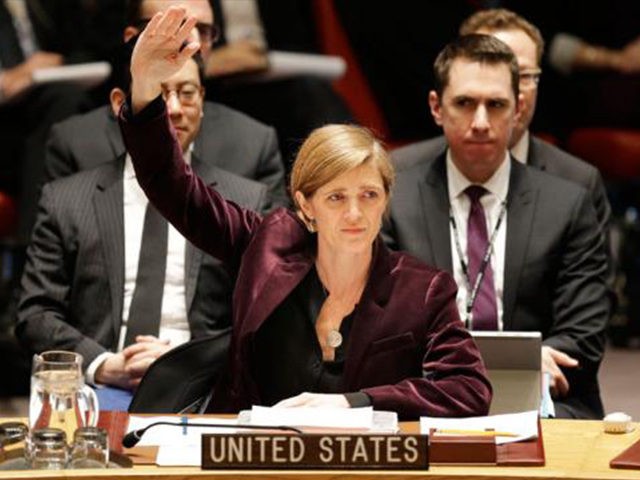
The United Nations, the United States and Competing Religious Warfare
"There are
two situations in the world that should shame [Samantha] Power [U.S. Ambassador to the United Nations], the anti-genocide
activist. The first, and less obvious one, is Burma. The Obama
administration cites this country as one of its foreign-policy
successes, because the ruling junta took steps toward liberalization in
return for lifting some sanctions against it. But then everybody seems
to have forgotten about it, and in doing so forgot about the Rohingya,
an ethnic Muslim minority currently being subjected to an unmistakable
genocide—among the clearest examples ever to emerge in real time. This
is genocide on Power’s watch, and we don’t hear a peep about it." Seth Mandel, Commentary
"Earth to Samantha: 500,000 Arabs died in Syria. Do you really think
the problem in the Middle East is Jews building extra bedrooms in
communities in Beit-El?" "You couldn’t pass even one United Nations Security Council Resolution
condemning Russia, Syria, and Iran for the slaughter in Syria. But you
passed this motion condemning peace-loving Jews who live in the ancient
Biblical lands of Judea and Samaria?" "As someone who has dedicated much of his public life to fighting
genocide, I was once honored to support Samantha’s nomination to the UN
post, even while others were outraged, because she was one of the
world’s foremost voices against mass murder. That was prior to entering
the Obama administration, and adopting a policy of humiliating silence
as Iran threatened genocide against Israel and actual genocides were
carried out in parts of Africa and the Middle East." Rabbi Shmuley Boteach, Breitbart
AP Photo
"Some [Rohingya] were shot, some were killed with a blade. Wherever they [Myanmar military] could find people, they were killing them." Jannatul Mawa, 25, Kyet Yoepin, Myanmar
"They grouped the women together and brought them to one place." "The ones they liked they raped." Noor Ankis, 25, Kutupalong Camp, Bangladesh
"I feel no peace." "They killed my father and mother. What is left for me in this world?" Sufayat Ullah, 20, village of Pwint Phyu Chaung, Myanmar
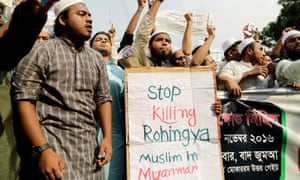
A protest rally in Dhaka, Bangladesh, on Friday against attacks on Rohingyas in Myanmar.
Photograph: Abir Abdullah/EPA
“She [Aung San Suu Kyi] is obviously very reluctant to criticize the military, because she
fears that any sort of antagonism towards it could prompt it to assert
itself more forcefully." "If the
military felt that it was losing power to the civilian government,
because that government is criticizing it and trying to reign it in,
then it might try and reassert its supremacy." "You do have a very difficult relationship between the civilian
government and the military, but at the moment, the civilian government
is playing into the hands of the military." Francis Wade, writer, Myanmar observer, Time contributor
The plight of the Rohingya who originally, historically fled discrimination and poverty in Bangladesh, crossing the river that separates that impoverished Muslim country into the Buddhist nation of Myanmar only to face discrimination and poverty there as well, has been fraught with fears of genocidal intention in the last five years, as animosity to their presence has slowly built to a crescendo. The brutal military regime that ruled Myanmar for so long is no longer a factor. The Nobel Peace Prize Laureate who had been under house arrest for many years was released.
She had been recognized for her fight for human rights. And she is now the leader of Myanmar. And the international community has felt perplexed as Aung San Suu Kyi has appeared unmoved by the brutal attacks against Myanmar's Rohingya population. She appears to have done nothing to alleviate their desperate situation. Instead, the military has embarked upon a renewed mission against the Rohingya. Their tale is that they carry orders for a counterinsurgency.
The military campaign is one dispatched by Myanmar's government which believes it must disarm militant groups that have risen among the radicalized Rohingya in response to their desperate straits in the Burmese nation. The refugees that have fled Myanmar to cross the Naf River into Bangladesh to find haven in refugee camps there, tell stories of villages in Rakhine State where rampaging soldiers shoot at random, set homes on fire with rocket launchers and rape girls and women.
Myanmar's government appointed a commission to examine the situation while defending its military, denying allegations from abroad that genocide was taking place in the villages where Western journalists and human rights investigators have been denied entry. Rohingyas, according to the official line, have been fire-bombing their own houses. The military attacks were precipitated by three border posts in Rakhine State coming under attack, killing nine police officers. A Rohingya insurgency group stands accused.
Thus far, 65,000 Rohingya have fled into Bangladesh, according to the International Organization for Migration. "They started coming in like the tide. They were a mess", commented a Rohingya refugee managing the Leda refugee camp at the border with Myanmar. Nazir Ahmed, imam of a mosque in Bangladesh, said that Rohingya, furious over a generation of discrimination, organized themselves to become a militant force, but its proportions and threat have been over-emphasized by Myanmar.
The International Crisis Group focused on the group, claiming them to be financed and organized by emigres living in Saudi Arabia. Saudi Arabia's very particular brand of Wahhabist Islam is, in very fact, responsible largely for the ascent of Salafist Sunni jihadists, from al-Qaeda to Islamic State. And Islam itself represents an ideology of conquest, from its origins to its current aspirations, tirelessly exhorting the faithful to commit themselves to Islam's destiny -- to surmount all other religions in full domination of the world order.
A reality and a curse the world will be grappling with for a long time. There are many victims of this unending struggle for Islamist primacy, none more numerous than Muslims themselves.
Anik Rahman/NurPhoto/Sipa USA A
patrol of Bangladeshi Border Guards attempts to prevent Rohingya
refugees from crossing into Bangladesh from Burma, on the banks of the
Naf River, near Cox’s Bazar, Bangladesh, on Nov. 22, 2016
This represents a general opinion site for its author. It also offers a space for the author to record her experiences and perceptions,both personal and public. This is rendered obvious by the content contained in the blog, but the space is here inviting me to write. And so I do.





![Nearly 300,000 Rohingya have fled to neighbouring Bangladesh [Danish Siddiqui/Reuters]](http://www.aljazeera.com/mritems/imagecache/mbdxxlarge/mritems/Images/2017/9/9/54ab69072a894ef09c1074e69d587c62_18.jpg "ARSA fighters declare truce amid Rohingya crisis")