Beijing's Global Strategy for Preeminence in Science, Technology and Academia
"China
not only seeks influence at an institutional level but will also target
individual academics who focus on China, seeking to ensure that they
act in the CCP's best interests either through professional inducements
or, if that doesn't work, by intimidation."
"China
appears prepared to use levers, such as research funding and travel
opportunities, to cultivate relationships with academics, and to
encourage them to change their research direction or course content in
line with CCP objectives."
"Pressure
is exerted on institutions, academics and students to prevent
engagement with topics that harm the positive narrative presented by the
Chinese Communist Party."
"Once
established in academic institutions, these students are in a position
to identify and exfiltrate valuable information, data and intellectual
property back to China."
"In
its quest for economic advantage, China often acts in plain sight --
directing, funding and collaborating on academic research for its own
ends."
British Parliament Intelligence and Security Committee
"China
has been aggressive in its interference activities ... It has been
particularly effective at using its money and influence to penetrate or
buy academia in order to ensure its international narrative is advanced
and criticism suppressed."
"This is particularly acute when it involves the so-called ‘Five
Poisons’ [Taiwanese independence, Tibetan independence, Xinjiang
separatists, the Chinese democracy movement and the Falun Gong]."
Julian Lewis, Committee Chair
"You say something they don't like, they deny you a visa."
"The
student bodies are infiltrated. We know there are meetings through the
middle of the night and the following morning some Chinese students can
get rung up by somebody at the cultural and education section of the
embassy to ask them: Why did you say that? Why did you do that?"
Professor Steve Tsang, School for Oriental and African Studies
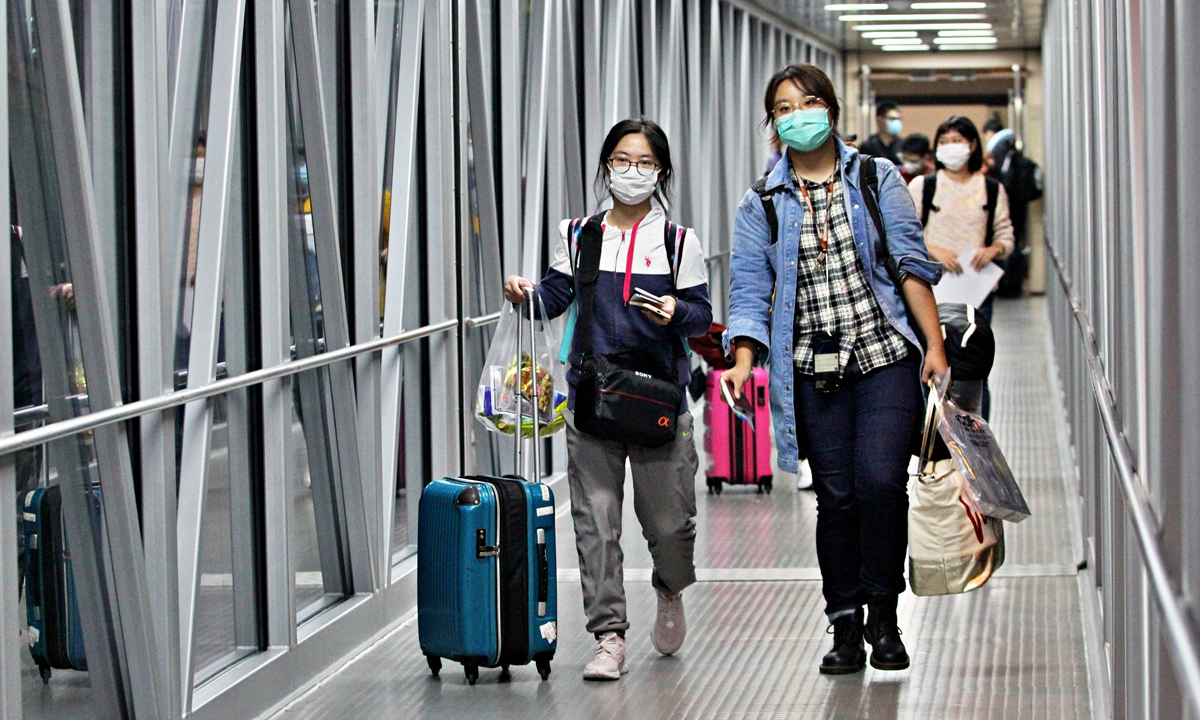
Two
students walk through Chongqing Jiangbei International Airport to catch
a chartered flight to Manchester in the UK. The plane
will take 74 Chinese students to the UK. Photo: VCG
Evidence
has been revealed of Chinese officials approaching academic lecturers
in Britain, to promise them "professional inducements" in the form of
research funding and travel opportunities, as part of the manner in
which British universities had been "bought" by the Chinese Communist
Party. The British Parliament's intelligence and security committee
through their extensive investigation produced a 200-page report
revealing details of Beijing's concentrated program to inveigle itself
into British academia.
Beijing
seeks out a prominent place in the global field of science and
invention, seeking influence worldwide as a driver of both through a
scheme of interdependence which links into its 21st century role as the
world's production source of consumer products of every description and
dimension. In the UK the report points out that its universities were "turning a blind eye to the risk"
in becoming reliant on China for financial support. The University of
Surrey accepted a $13-million donation from Huawei to find its 5G6G
Innovation Centre.
Chinese
state authorities are also evidently intimidating British academics and
students by a Beijing directive to infiltrate and purloin research to
benefit the People's Liberation Army. One witness interview of Professor
Steve Tsang revealed that within six months of accepting his new status
within the School for Oriental and African Studies, a political
councillor from the Chinese embassy offered him anything he would like,
for his 'cooperation'. "It is as blatant as that", he reported.
Access to visas is also being used as leverage, affirmed by Professor Tsang. "If
you are an academic and specializing in China, and your entire academic
life is focused on China, the threat of not being permitted to travel
to the country of your academic focus becomes a very powerful threat."
Years previously it was revealed that scientists at leading
universities, including Cambridge, Edinburgh and Manchester, worked on
projects with researchers at China's nuclear weapons research
institution.
Dozens
of scientific papers were published by British academics working
alongside scientists from a Chinese institution on an American sanctions
list, reflecting its research into developing Beijing's nuclear
arsenal. Investigative journalism at The Telegraph
uncovered that situation. There are over 90 Chinese Students and
Scholars Associations (CSSAs) working out of the U.K. -- partially
financed by the Chinese embassy -- monitoring the activities of Chinese
students. A situation the committee recognized as resulting in a "culture of fear and suspicion among Chinese students in the U.K."
The
largest overseas contingent of students on study visas in U.K.
universities -- over 120,000 -- are Chinese students. A number greater
than in the rest of Europe combined. Five times as many students are
sent by China to the United Kingdom, as compared to the country that
comes in second for its students studying abroad; India. In Canada, a
similar situation prevails, with 60,000 student visas issued at last
count, down substantially from the year before which stood at 90,000, as
Chinese relations with Canada sour.
The Glasgow CSSA incited flash mobs to confront Hong Kong demonstrations.
"There is Chinese embassy involvement in these demonstrations ... They
surrounded us in a circle, waving Chinese flags, singing the national
anthem and being hostile", one Hong Kong student
narrated. The Joint Intelligence Committee chairman spoke of
intimidation examples the Chinese authorities use: "sometimes
with the vice-chancellor getting a phone call, sometimes at student
body level, to try to discourage universities from allowing speakers on
issues like Tibet or Xinjiang".
Beijing
exploits research programs at British universities for the benefit of
the Chinese military. The People's Liberation Army, according to the
Australian Strategic Policy Institute, sent approximately 500 military
scientists to U.K. academic institutions in the decade up to 2017.
"Once established in academic institutions, these students are in a
position to identify and exfiltrate valuable information, data and
intellectual property back to China", the committee pointed out.
People walk across a street near a large screen promoting the Chinese People's Liberation Army in Beijing Andy Wong/The Associated Press
"Beijing is using a 'workaround
strategy' for postgraduate researchers to study cutting-edge technology
at Canadian and U.S. universities after Washington began denying visas
for some Chinese students on the grounds that they might steal
intellectual property with military uses, according to a Canadian
Security Intelligence Service report."
"The
Dec. 21, 2021, report, labelled secret ... said the strategy sends some scholarship students to Canada from
the People’s Republic of China (PRC) with the aim of gaining access to
critical high tech."
"The
Chinese government’s game plan includes training these Chinese citizens
on how to avoid drawing too much attention when studying abroad."
"The
CSIS report lays out how China is using students to obtain technology
that could be of benefit to the Chinese military, such as quantum
computing, big data and artificial intelligence. The report was shared
across key government departments and with the CIA, FBI and Britain’s
domestic intelligence service, M15, as well as Australian and New
Zealand authorities."
The Globe and Mail, Toronto
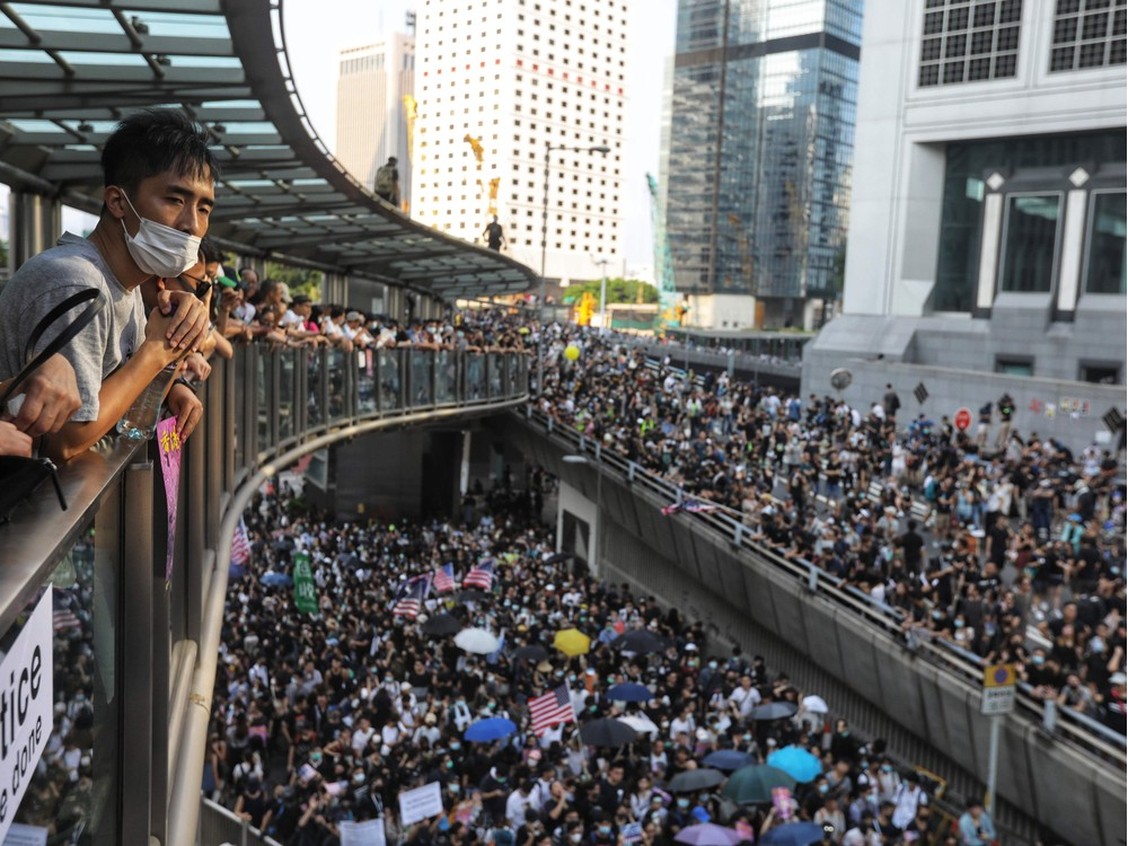
Protesters march from Chater Garden to the U.S. consulate in Hong Kong on September 8, 2019.Photo by VIVEK PRAKASH /AFP/Getty Images
Military Training for Ukraine's Ultra-Nationalists
Training Ukrainian Neo-Nazis
"The
Ukrainian military's failure to check Centuria activities suggests a
level of tolerance on its part for the apparent proliferation of
far-right ideology and influence within the Armed Forces of Ukraine."
George Washington University study
"[We
support] right patriots, nationalists, conservatives and Christians
currently defending the streets of Kyiv from perverts from the LGBT
movement and their left-liberal sympathizers."
Centuria statement
"The
Department of National Defence and the Canadian Armed Forces are
strongly opposed to the glorification of Nazism and all forms of racism,
racial discrimination, xenophobia, intolerance and extremism."
Lt.-Cmdr.Julie McDonald, spokeswoman, Canadian Armed Forces
"Clearly Canada has a responsibility when it comes to who it trains."
"It's
not good enough just to leave it to the Ukrainians. The end result is
the fact that Canadian troops may have trained Ukrainian Neo-Nazis."
Bernie Farber, head, Canadian Anti-Hate Network
A
new report from an American university says far-right extremists in
Ukraine’s military have bragged they received training from the Canadian
Forces and other NATO nations.Photo by ANATOLII STEPANOV /GETTY
A
newly-released study from an institute within George Washington
University in Washington, D.C tracked social media accounts of the
Centuria far-right group, revealing that the extremists brag of having
received military training from the Canadian Forces, along with other
NATO-aligned national militaries. The study documented members of the
Ukrainian military giving Nazi salutes, promoting white nationalism, and
giving praise to members of Nazi SS units.
Active
since 2018 at the Hetman Petro Sahaidachny National Army Academy, the
far-right group has ensconced itself in the country's military through
the country's premier education institute, which is also a major hub for
assistance from western military sources in the country, Canada
included, according to the report from George Washington University's
Institute for European, Russian and Eurasian Studies.
Through
social media, members of Centuria revealed their training from the
Canadian military along with participation in military exercises with
Canada. Centuria organizers informed their following that their members
served as officers in Ukraine's military, and "have
succeeded in establishing co-operation with foreign colleagues from
such countries as France, the United Kingdom, Canada, the United States,
Germany and Poland", reports the Institute.
At
the United Kingdom's royal Military Academy Sandhurst, one group member
graduated in 2020 after receiving officer training, while another
Centuria member in 2019 attended the German Army Officer Academy in
Dresden. Centuria publicly supported a rally held by Ukrainian far-right
groups in countering the "Kyiv Pride" LGBTQ event.
The
National Army Academy, in communication with the university researchers
denied Centuria operated within its ranks, noting it has no tolerance
for extremism in denial of the report's photographs of NAA cadets giving
Nazi salutes and promoting far-right materials. The United Jewish
Community of Ukraine accused a NAA cadet of acting as a firearms
instructor for a far-right group, and of spreading viral anti-Semitic
propaganda.
Lt.-Cmdr
McDonald of the Canadian Forces explained that it doesn't perform
background checks on those assigned to train with its forces from
abroad; its expectation is that Ukraine would check its own security
forces' allegiances. Should Canadian military personnel, on the other
hand, view first-hand any evidence of extremism,they would refuse
training for those involved. They do not actively search out signs of
support for far-right causes.
The
university researchers were informed by Ukraine's Ministry of Defence
that neither does it screen those entering the military or military
cadets for extremist views and ties, stating concerns about Centuria
were baseless; there was no such organization. In 2015 when Canada as
part of NATO facing down Russian expansionism in Ukraine, sent troops to
the area, concerns relating to such training were raised when Canadian
military leaders discussed how they might avoid training extremists.
They
decided to stipulate that only Ukrainian National Guard and army units
would be trained not including any of the ad hoc militias that had
appeared at that time in the country. One Canadian Member of Parliament
had warned of the integration of far-right groups into the military and
that being the case it would be difficult to identify extremists with a
view to eliminating their presence during training sessions.
The
ultra-nationalist Azov Battalion movement with its links to the far
right and Neo Nazis was the subject in 2018 of the U.S. Congress banning
the use of U.S. funds to provide arms, training and other aid to them.
At the same time, Centuria has firm ties to the Azov movement.
A
new report from an American university says far-right extremists in
Ukraine’s military have bragged they received training from the Canadian
Forces and other NATO nations.Photo by ANATOLII STEPANOV /AFP/Getty Images
The Moral of the Story: Beware, Take Care, Be Wise
"The
Government of Canada [should] demonstrate stronger leadership on the
issue of procurement and national security, including at the highest
echelons -- the Prime Minister, ministers and senior officials."
"[Government
should] prohibit Chinese state-owned enterprises, partial state-owned
enterprises, including companies receiving undisclosed government
subsidies, and technology companies from obtaining federal contracts
related to information technology or security equipment or services."
"[The
Privy Council Office should look] to develop, implement and oversee a
policy to direct all government departments and agencies to review
current contracts with China related to information technology or
security equipment or services."
"The
Committee heard that the federal government should not always choose a
supplier based mostly on the lowest price when evaluating bids for
security equipment."
"Where circumstances warrant, it should put greater emphasis on national security risks."
"Throughout
its study, the Committee became concerned that federal departments and
agencies did not collaborate to assess potential threats to Canada's
national security when the government was procuring a replacement of
security screening equipment in Canadian embassies."
"The Committee recognizes that closer collaboration among federal departments and agencies is required."
House of Commons Government Operations Committee
Government
procurement infamously selected a Chinese company's X-ray machines to
be installed at all Canadian missions abroad until the absurdity of
awarding such a contract to a Chinese company was highlighted by an
investigative journalist, in the wake of Beijing arresting and charging
two Canadians with espionage and imprisoning them on those trumped-up
charges in an effort to apply pressure to have Canada release Huawei's
CFO who had been detained by the RCMP at a stopover in Vancouver
honouring an extradition request by the U.S.Department of Justice.
Relations
with China have since descended to their lowest pitch, with Beijing
threatening repercussions should Canada decide not to permit Huawei to
take part in Canada's 5Gupgrade as the rest of the members of the Five Eyes group (an integrated, collaborative intelligence-sharing between members, U.S., Britain, Australia, New Zealand and Canada) have
done. Even under those strained relations, the Liberal government still
decided to proceed in partnering with CanSino, a Chinese
pharmacological company to joint-produce a vaccine for SARS-CoV-2, which
Beijing chose to cancel unilaterally.
The
Liberal government under Prime Minister Justin Trudeau, tutored and
mentored by former Prime Minister Jean Chretien, hungered for a free
trade deal between Canada and China. Canadian corporations headquartered
in Quebec see such a free trade agreement with China as a profitable
venture, sitting on the Canada-China Business Council continuing to
promote business with China despite Beijing's hostility and threats.
Canada's
government under the Liberals refuses to take China's cybertheft
proclivities, political and academic infiltration and influence-peddling
seriously. It is only very recently that in public fora, Justin Trudeau
has stated Canada's opposition to China as a growing threat to the
world order in its focus on control, power, monopolistic trade,
influence and its soft power working hand-in-glove with its hard power.
Investing in vital infrastructure loans to developing countries while
threatening Taiwan, Hong Kong, and abusing the human rights of Tibetans,
Christians and Uyghurs.
Now,
a parliamentary committee has released a report calling on the federal
government to place greater consideration on issues such as national
security in tendering contracts and favouring bids by Chinese companies,
all of which must, by Chinese law, answer to Beijing's call. Apart from
the fact that many are state-owned corporations. The concerns expressed
go across party lines since the committee is comprised of Liberal,
Conservative, Bloc Quebecois and NDP members.
Government
officials testified before the committee, along with experts on China
and national security. The committee reviewed a threat assessment from
the Department of Foreign Affairs, describing the Chinese company
selected to install and service its security equipment on contract to
the Canadian government with the company in question characterized as "a Chinese state-owned enterprise with direct connections to the People's Liberation Army and the Chinese Communist Party".
The
X-ray machines were not considered a security risk since their use was
in a publicly accessible area, unconnected to embassy computer networks.
The committee was informed however, by an official with the
government's Centre for Cyber Security, that this view of X-ray machines
was outdated; they now typically come equipped with hard drives and USB
ports potentially useful to hostile actors "with malicious intent". And that certainly describes Beijing's attitude toward Canada.
The
report released by the committee found no effective government strategy
in place to manage security risks revolving around China and federal
procurement. Stronger security measures were recommended, to focus on
screening companies and employees who install and maintain equipment in
sensitive federal facilities such as embassies. There is room for
improvement at flagging potential security threats.
"We are being introduced in a very rough way to a new world where the
rules of the road are decided by the strongest."
"We've always said in Canada that we
needed a foreign policy that built on the international rules and
regulations… but China is starting to play rogue."
Paul Heinbecker, former Canadian ambassador to Germany, representative to the United Nations
"Relations between the two countries
can't be reset until the two Michaels [Spavor/.Kovrig] are set free. Once that happens,
relations should be reset in a different way."
"China is capable of acting
aggressively against Canada. China is not our friend and we should stop
treating it as though it is. We should form a relationship with China
based on mutual needs."
"We should treat China with respect but always
protect our own interests and push back when necessary. We also need to
find allies who will help us retain our sovereignty in a world where
China is trying to encroach on it."
Former Canadian ambassador to China David Mulroney (2009 to 2012)
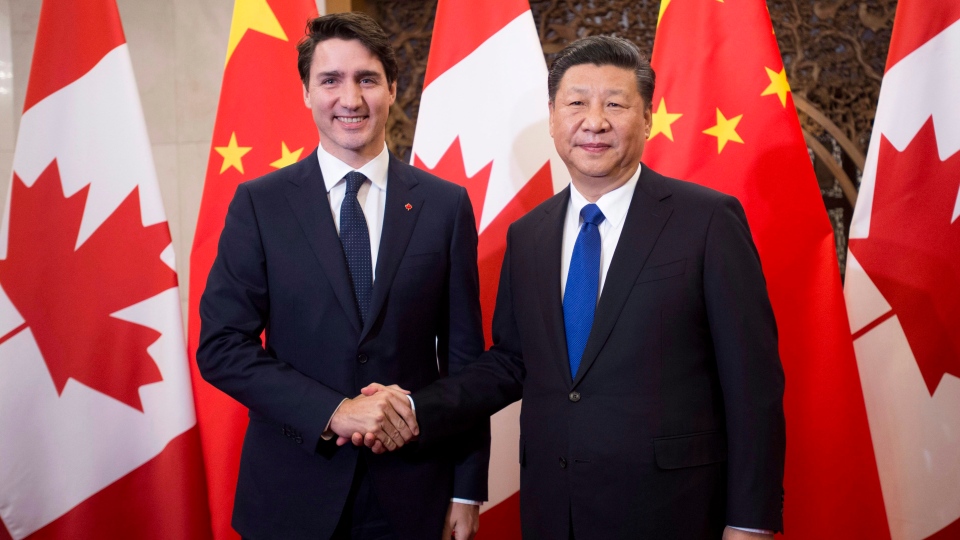
China's
President Xi Jinping and Canada's Prime Minister Justin Trudeau are
shown at the Group of 20 summit in Osaka, Japan on June 29, 2019 (KAZUHIRO NOGI/AFP via Getty Images)
"United Front work has taken on a level of significance not seen since the years before 1949." "[China]
is increasingly able to use its soft -power 'magic weapons' to help
influence the decision making of foreign governments and societies." Marie Brady, political scientist, University of Canterbury, New Zealand
"Overseas
Chinese [should] remember the call from the Party and the people,
spread China's voice, support the country's development, safeguard
national interests." Chinese President Xi Jinping
"An
organization that once had another purpose has gradually been taken
over to serve China's national interest. Where United Front work becomes
problematic is when it's engaging persons of Chinese origin who have
Canadian citizenship ... to serve the interests of the motherland, when
in fact the motherland should be Canada." Charles Burton, political scientist, Brock University, Ontario
"I have heard of Chinese influence over community newspapers." "[But]
I think the Canadian Chinese community is remarkably resilient and
diverse, and for the most part immune to blandishments from the Chinese
government." Jeremy Paltiel, China specialist, Carleton University
"I think there is definitely an attempt to influence domestic public opinion here." "But from what I can see, the extent of success here is rather limited." Lynette Ong, professor, China expert University of Toronto
"Our
executive committee's background is a combination of Canada, mainland
China, Taiwan and Chinese from other Asian countries." "Support
for China is not and will not be a focus ... Our primary focus is to
support the Chinese community and to promote Chinese culture in
Niagara." Li Yu, former president, Niagara Chinese Cultural Association
"A
lot of people don't think of the long arm of influence of China in
Canada, because they're under the influence, to put it mildly." "Outsiders
like me, who is a Hong Kong immigrant ... we see very clearly that this
is a United Front effort, a very subtle, soft-power kind of advance
into Canadian society." Cheuk Kwan, head, Toronto Association for Democracy in China
Chinese police are seen patrolling in front of the Canadian Embassy in
Beijing last month. A new book, Claws of the Panda, argues that the
Chinese Communist Party has spent decades manipulating Canadians.(GREG BAKER/AFP/GETTY IMAGES)
Canada is comprised of many immigrant populations; it is the defining
identity of the country, multi-cultural in origin. Immigrants from
Ukraine, Greece, Poland, Germany, Japan, Sri Lanka, Vietnam, China,
India, the United States, Scotland, Ireland, Britain, France; wherever
in the world they come from, including Jews from all over the world,
escaping oppression and finding a haven in a Canada that has, in the
latter half of the 20th Century forward, extended equality of
opportunity and security to all its citizens.
Unsurprisingly, people migrating from other countries find comfort in
the fact that their original cohabitants have arrived in numbers to form
communities in their new country of habitation. They form clubs and
build churches reflecting their own religious commitment and the
cultures they left behind, to support one another in their adjustment to
their new reality. And even long afterward once they have acclimated
socially and culturally, their original congregations remain of
importance to them.
In some instances, like the Turkish population in Germany, the
government in the original homeland takes on an 'ownership' attitude,
viewing their expatriates as a demographic abroad they can continue to
manipulate and have control over, to the extent of demanding from their
new homeland government especial privileges for their own. Recep Tayyip
Erdogan and Russia's Vladimir Putin are especially given to these
unwanted and unwarranted interferences in other countries, the latter
with Ukraine.
And, it seems, China has made inroads in Canada by surreptitious means,
to retain influence among its once-time citizens, now resident in and
citizens of Canada, and to extend that influence to non-Chinese by
offering to install and pay for programs that have benefit to China, and
ostensibly to Canada. The Confucius Institute is one such organ which
Communist China uses to extend a friendly hand, persuading Canadian
universities and schools of the bonus it offers in teaching Mandarin and
Chinese culture.
The Toronto Chinese Canadian Association once put on a banquet to bid
farewell to the Chinese vice-consul who persuaded local Chinese to
support the Confucius Institute. Now, Confucius is entrenched at three
school boards in the region and on nine university and college campuses
across the country, its funding very much appreciated by those
institutions. Chinese state-aligned corporations have made large
investments in Canadian industry. Suspicions are rampant not only in
Canada but in other western countries that China's friendly helpfulness
comes at a price.
Chinese intelligence services and Chinese technological giants are known
for their industrial infiltration and military espionage escapades.
Under President Xi, a "massive expansion" of China's soft power has
emerged, much of it within the auspices of the United Front Work
Department, an offshoot of the Chinese Communist party, which forges
links with officials in foreign missions to influence the Chinese
diaspora.
Prime Minister Justin Trudeau, at a fundraiser held on Nov. 7,2016 at the West Vancouver mansion of B.C. developer Miaofei Pan.
Foreign and Overseas Chinese Affairs Office of the Wenzhou People’s Government
Infiltration for the sake of befriending foreign political and economic
elites, with the aim of promoting Beijing's agenda all helps in
expanding a China-centric economic bloc. A goal of the United Front is
to advance opinions on issues such as acquisition by Chinese companies
of Canadian natural resources and technology. The decision Canada has
yet to make about Huawei's involvement building Canada's 5G telecom
network a critical issue at hand.
Huawei's close ties to the Chinese state makes accusations of corporate
espionage logical, enough so that the U.S., Great Britain, Australia and
New Zealand have all backed off allowing Huawei to take part in their
5G trials, leaving Canada the only member of the Five Eyes intelligence
sharing alliance to not yet having decided to leave Huawei out. Which
has led China's ambassador to Canada to issue none-too subtle threats of
'repercussions' that might accrue.
Such 'repercussions are already being seen by Canada in China's fury at
the arrest on December 1st in Vancouver of Huwei's chief financial
officer on an extradition warrant issued by the U.S. justice system
which led China to arrest two Canadian businessmen and commit another
Canadian to death for drug smuggling out of China. Canada under this
Liberal government has been ingratiating itself with China in the search
for a free trade deal and in its zeal to have a seat at the revolving
UN Security Council.
There are 211 accredited 'diplomats' from China in Canada at the various
Chinese missions. The U.S. with ten times the population and with huge
trade between China and the United States, rates a comparative fewer 276
accredited representatives of China, while the United Kingdom has 38.
Of that 211 in Canada, it would be interesting to know how many are
accredited in China's intelligence apparatus and outreach to Canada's
very large Chinese diaspora.
Canada's recently removed Ambassador to China, John McCallum boasted in
an interview with Chinese foreign and domestic reporters to which major
Canadian news outlets were not invited, that his sons were married to
Chinese women. While he was a backbencher, he was the recipient of
$73,000 worth of trips to China paid for by pro-Beijing business groups
and the Chinese government.
His ill-considered reassurances of the welfare of Huawei's Meng
Wanzhou's bid to escape extradition to the U.S. which forced Justin
Trudeau's hand in firing him, has given aid and comfort to China and
stoked the furnace of concern over the fate of Canadians arrested in
China in furious retaliation against Canadian law honouring a commitment
with its neighbour on extradition.
"McCallum was merely stating the truth when he observed that Meng has a
strong case against extradition, which he rightly said was politically
motivated." "Although what he said is 100 per
cent true, his words seem to have fallen on deaf ears at home. Those who
had attacked McCallum should feel ashamed of themselves... the
political mess that Ottawa is floundering in could get a lot worse if it
chooses to accede to the U.S. request for Meng’s extradition despite
the problems with the case that McCallum, among others, has pointed
out." China Daily
John
McCallum, Canada's former ambassador to China, arrives at a
fund-raising event at a Chinese restaurant in Vancouver, B.C on Jan. 25,
2018.
"This didn't all of a sudden pop up in the last six months. They have been contemplating external attacks ever since the group moved into Syria in 2012." Michael Flynn, retired U.S. Army lieutenant general
"It's a factory over there. They are doing everything possible to strike France, or else Europe." Reda Hame, 29, French computer technician, ISIL inductee
With his French passport and his experience in information technology he was a prized catch for the Islamist jihadis dedicating themselves to terrorizing Europe. His introduction to jihadi-style training techniques, once he had successfully reached Syria from Paris through Turkey, seemed fairly abrupt, basically how to fire an assault rifle, given a grenade and told to practise tossing it at an improvised human silhouette.
That brief course in guerrilla warfare was his introduction to becoming a successful inductee in inspired terrorism. His Islamic State handler drove him back to the Turkish border with advice to be selective so he could target as many civilians in one fell swoop as possible, on his way to becoming a shaheed. No doubt their parting was unsentimental but optimistic; something along the lines of 'bye for now, see you in Paradise'. A wink and a thumbs-up and off they went, their separate ways.
Reda Hame was game, and he wasn't the only one dispatched at that time. It seems that ISIL was thinking ahead, testing the waters, as it were before full commitment to carry off terror on a more grand scale. First it meant to test the awareness and capability of European intelligence in weighing their response to isolated, randomized small events before embarking on the serious fireworks. A string of foreigners who had been invested with terror tactics were spirited back into Europe.
When Reda Hame's venture into martyrdom went awry and he was instead arrested, his interrogation resulted in some fairly interesting background facts. Back in the early days of 2014 there were indeed random events occurring of jihad attacks in Europe, all of them testing the focus of intelligence agencies. Who reacted by discounting each plot with the educated opinion that they all were what they appeared to be; random, isolated and unlinked to any group action.
In retrospect, the man who ran the Defense Intelligence Agency from 2012 to 2014 now sees the linkage. Reda Hame represented one of an estimated 21 operatives who returned with their abbreviated training back to Europe. They were to embark on a spree of killing. And once the official reaction to what they were engaged in was assessed the serious action was to ensue with the intention of killing hundreds of people in Paris, Brussels and onward - precisely what occurred.
They were among the many pawns that Abaaoud was positioning across the Continent.
Too late, European officials discovered that Mr. Hame's handler was Abdelhamid Abaaoud who specialized in selecting and training fighters to bring off plots in Europe, and who later catered the Paris attack. On January 3, 2014, Greek police stopped a taxi in a town close to the Turkish border where Ibrahim Boudina, a 32-year-old French citizen was returning from Syria. His luggage was fascinating; a French document titled How to Make Artisanal Bombs in the Name of Allah, and a cache of 1,400 euros.
Since no warrant existed for his arrest in Europe he was free to go. But he was on France's watch list as part of a 22-man cell radicalized at a mosque in Cannes. His friends were wiretapped along with his relatives by French officials at this point. And the police managed to arrest him in February of 2014. In the building housing the family's apartment near Cannes, a utility closet held Red Bull soda cans brimming with triacetone triperoxide explosive.
The police set up a perimeter around the family’s apartment near Cannes, arresting Boudina on Feb. 11, 2014. 24News.ca
Eventually the Syria-trained ISIL operatives, mostly French and Belgian citizens, were arrested in Italy, Spain, Belgium, France, Greece, Turkey and Lebanon. Their plans were to attack Jewish businesses, police stations and other crowded venues. Attempts were made to open fire on packed train cars and church congregations and most failed. But as the arrests were made, the connection with ISIL was not.
One of the more notorious events was that of Mehdi Nemmouche, returning from Syria via Frankfurt, making his way to Brussels. And there on May 4, 2014, he opened fire at the Jewish Museum of Belgium, killing four people. Police discovered a video where he claimed responsibility for the attack. A flag bearing the words "Islamic State of Iraq and the Levant" appeared on the video. Leading Belgium's deputy prosecutor to dismiss an connections.
"He probably acted alone", Ine Van Wymersch, assuredly informed reporters, at the time.
This represents a general opinion site for its author. It also offers a space for the author to record her experiences and perceptions,both personal and public. This is rendered obvious by the content contained in the blog, but the space is here inviting me to write. And so I do.
:format(jpeg)/cloudfront-us-east-1.images.arcpublishing.com/tgam/3ZOFFONMUBN55JJCRQVYLEUDGY.jpg)



/https://www.thestar.com/content/dam/thestar/uploads/2019/01/25/getimagecontent00xbcnlo-0.jpg)
/arc-anglerfish-tgam-prod-tgam.s3.amazonaws.com/public/WCSMMYVBORHTFCHUFDEABBI5FI.JPG)

/arc-anglerfish-tgam-prod-tgam.s3.amazonaws.com/public/HBEDH7WYDZB5LG6WFD5GFS3DVQ.JPG)


