Saturday, January 29, 2022

Russia: "Main Issue", "Secondary Issues"

Russia: "Main Issue", "Secondary Issues"

"As far as this document goes, there is a reaction that allows us to hope for a start of a serious discussion but on secondary issues."
" There is no positive reaction to the main issue."
Russian Foreign Minister, Sergey Lavrov

"There is a scope for dialogue."
"[President Putin would analyze the response in full before any further move]. It would be foolish to expect an answer as early as next week."
Dmitry Peskov, spokesman, for Vladimir Putin

"It's always very sensitive when it's about children. It creates a lot of tension and stress for the parents, for the whole society."
"It ties up law enforcement services It's easier to make a mistake when the constant tension makes everyone tired."
"It is [meant to] destabilize and demoralize the population."
Alina Prolova, deputy head, Ukraine Center of Defense Strategies think tank, former deputy defence minister of Ukraine

A morning at a school in Kiev.  Oleksander Shcherbyn, Ukrainian police demining unit

 
At strategic loggerheads, both sides -- in the debate over whether or not the long build-up of Russian troops and military equipment on the border with  Ukraine is meant to intimidate in the short term, and prepare for an invasion in the longer term -- digging in their heels. While Moscow claims it is prepared for "serious conversations" to defuse the Ukraine crisis, the U.S. and NATO have proposed areas of co-operation on a wider scale.

To an objective observer, defusing Moscow's concern over American and NATO missile silos defensive sites in Europe which Russia views as having hostile intent toward it,  and has led Moscow to denounce U.S. and NATO intentions as militarily malicious, would rank high. Certainly more so than Vladimir Putin's ultimatum to NATO that it must withdraw its members' forces from eastern Europe, and it must never allow Ukraine entry to the military alliance.

But the disposition of Ukraine as a fully sovereign nation entitled by international law to decide its own fate and alliances looms with greater importance to Mr. Putin who views Ukraine as a geographic, cultural, social and political part of Greater Russia. Washington has proposed vital cooperation in areas that should be of great concern to both political adversaries; reviving arms control treaties, limiting military exercises; granting Moscow access to NATO sites in Europe for observational purposes.
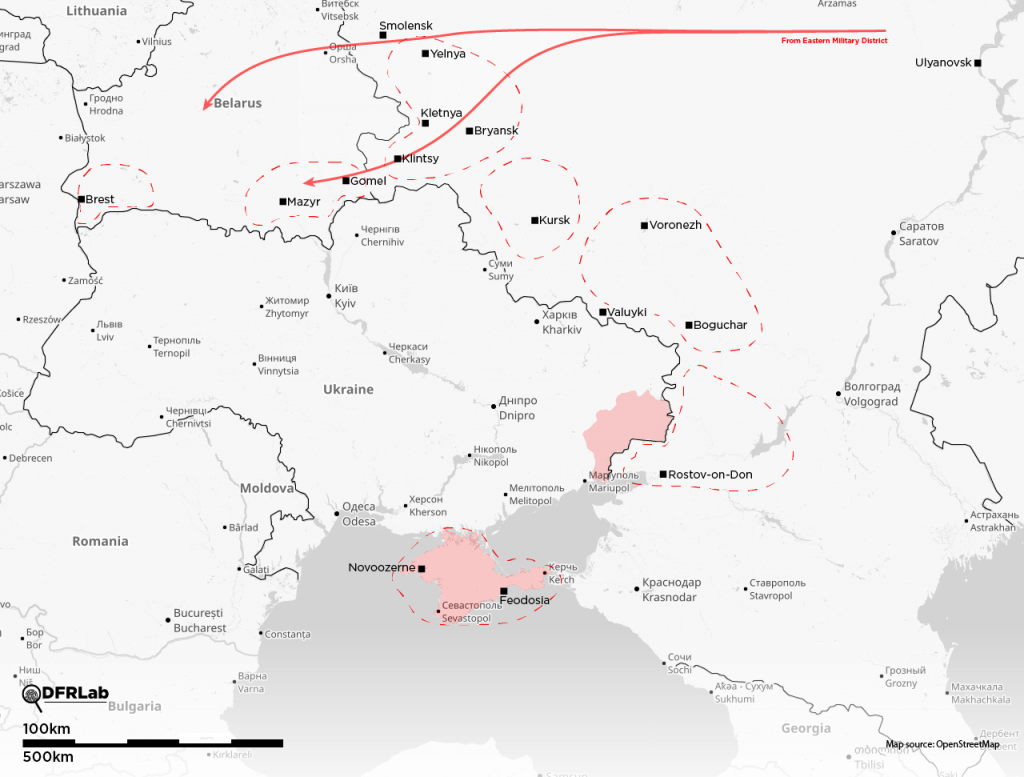
 
The DFRLab uses social media monitoring and geolocation techniques to identify the presence of Russian forces deployed along Russia’s border with Ukraine. Those forces are now present in Belarus as well. (Source: Michael Sheldon/DFRLab/OpenStreetMap)
 
This is what Moscow refers to as "secondary issues". Its determination to possess command of Ukraine transcends the issues that are intended to make the world a safer place. So misdirected its priorities as to bemuse any rational mind. Instead, cyber attacks, threatening rhetoric, scheduling war games with nations bordering Ukraine that are firmly in Russia's political orbit continue to fray the sense of national security that sustains Ukraine.

And in Kyiv a Ukrainian bomb disposal expert is teaching students at a school in the capital all about explosives and what to be aware of. The training was organized by law enforcement following a series of hoax bomb alerts that forced the evacuation of schools in the city along with others, including the cities of Kharkiv, Lviv and Zaporizhzhia. These are threats targeting schoolchildren with fear-mongering that point directly to Russia in its hybrid war.

"The purpose of Russian special services is obvious -- to put additional pressure on Ukraine, sow anxiety and panic among the public", explained Ukraine's Security Service which had recorded over 300 bomb threats so far this year alone in comparison to 1,100 that took place during the entire 2021 year. Russian officials, on the other hand, blame Ukraine for similar bomb hoaxes, forcing Russian schools, shopping centres and kindergartens to evacuate tens of thousands.

It is difficult to credit mature societies, responsible governments resorting to such tactics meant to intimidate, strike fear, and demoralize another society. Striking at the very heart of any civilized society by targeting the most vulnerable in the population; its children. Ukraine's Center of Defense Strategies think-tank concentrates on what it speaks of as the main threat it faces; "a hybrid invasion" comprised of more cyber attacks, disinformation, and bomb threats aimed at schools, subway systems, administrative offices and other civil and official infrastructures.

Leaving Kyiv to hold emergency bomb drills for children. Where bomb experts explain that a small, unassuming-looking device is capable of holding a kilogram of explosives with enough power to kill anyone standing within five metres, wounding others up to 15 metres' distance. Classes shown video clips of explosions along with explosive devices meant to appear as though they're a box of chocolates or a mobile phone case.
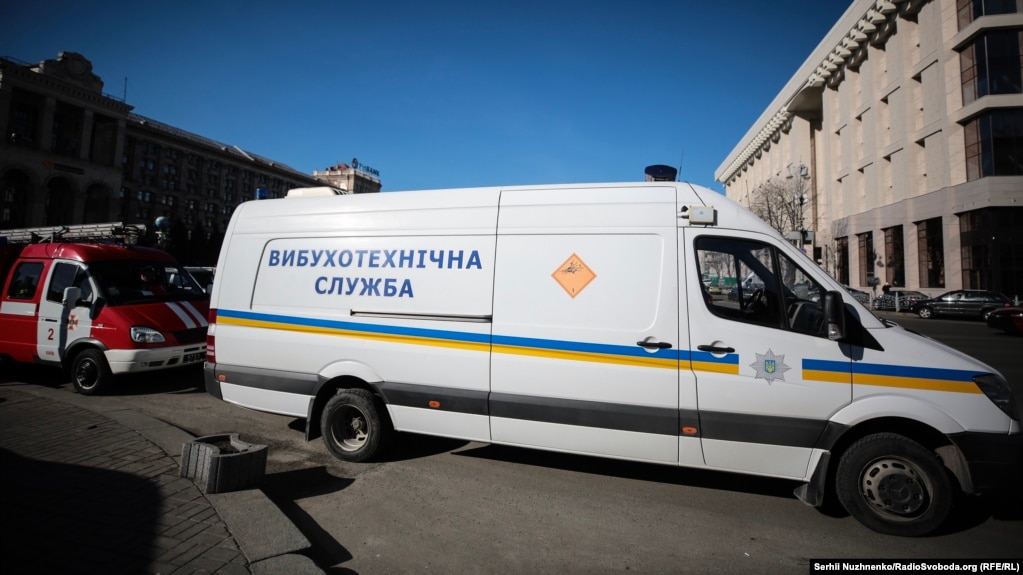
Hundreds of Ukrainian schools have had to be evacuated since the start of the year amid a spate of fake bomb threats that Kyiv blames on Russia.


Labels: , , , , , , , , ,

Monday, November 22, 2021

"Brazen" Chinese Spying

"Governments continue to spy on each other, but spying now has a much further reach, including into our universities and businesses."
"It is not inherently improper for countries to try to influence each other, but we can never allow national security to be compromised."
"The activities of those hidden relationships where public figures are encouraged to push another country's interests, hack-and-leak  operations, covert surveillance and organized online trolling..."
"We in the U.K. will no longer tolerate the brazen way we have seen our national security subject to such activities. Our upcoming legislation will represent the biggest counter state threats legislation in decades."
Priti Patel British Home Secretary
china

UK Home Secretary Patel Accuses 'brazen' China For Spying On Universities: Report  AP

Taking a page out of Australia's book in defence of national security and the values of their political system in enacting a law that would prohibit 'corrupt, coercive or covert interference' in Australian politics, the U.K. knows full well what a rough track it has in future relations with a trade colossus that expresses its displeasure at criticism aimed at it from any quarter for any reason in vicious trade exchange interruptions and diplomatic hostage-taking, ahead. Beijing has failed to 'notice' that other nations do take notice at its constant interference in their national affairs.

China's installation of the Chinese Communist Party's major foreign interference arm, the United Front Work Department, has fomented and encouraged underhanded, covert and aggressive push-back by Chinese Mainland residents of other countries who have taken citizenship with their countries of adoption. It is past time that Britain publicly acknowledged that China spies on British businesses and universities; they've done so for decades, purloining any intelligence of value to Chinese interests.

To counter these espionage threats through an ever-bolder Chinese strategy of taking advantage of other nations' advances in academia, science, technology and business, the U.K.'s official secrets laws are to be modernized in view of new spying threats and online trolling in efforts to destabilize and steal secrets. In a speech to the Heritage Foundation in Washington, she warned her audience, "espionage is evolving" and she held no compunction in naming Russia, China and Iran.
 
Chinese state-linked hackers were behind a computer hack involving 250,000 Microsoft Exchange servers accessing email accounts, acquiring data, and deploying malware. The U.K. plans to hold China to account through a bilateral agreement setting out acceptable behaviour in cyberspace with China. "In December 2018, the U.K. and 14 other countries called out China's Ministry of State Security for breaching the agreement", she stated.
 
She spoke of 31 terror plots having been foiled since 2017 and social media firms' plans to extend end-to-end encryption where neither the platform operator nor law enforcement could see the content of messages "jeopardizes the good work that has gone before". Freedom of speech, she warned, did not include the right to incite terrorism and "reasonable" people should be able to rely on police to track and tackle terrorist or child abuse content.


Labels: , , , , , ,

Tuesday, April 13, 2021

"Terrorism" Outrage in Tehran

"The question is: what caused it - a cyber-attack or a physical act of sabotage, like a bomb?"
"The speculation of cyber-attack comes because Natanz is Ground Zero for cyber-war - the place where the world's first real cyber-attack took place a decade ago." 
"Most events called cyber-attacks are not really attacks in the physical sense - they are thefts of data. But Stuxnet - the name given to the incident that targeted Iran's nuclear programme over a decade ago - is not just one of the few exceptions but arguably also the first demonstration of what such a cyber-attack looks like."
"In that case, computer codes caused real-word damage by interfering with the centrifuge controllers to spin them out of control (and even relaying false messages back to those monitoring them so they would not worry until it was too late). The result was what sounded like a slow-motion explosion as centrifuges crashed into each other. It was an incredibly sophisticated and targeted operation, run jointly by the US and Israel and developed over a period of years."
Gordon Corera, Security correspondent, BBC   
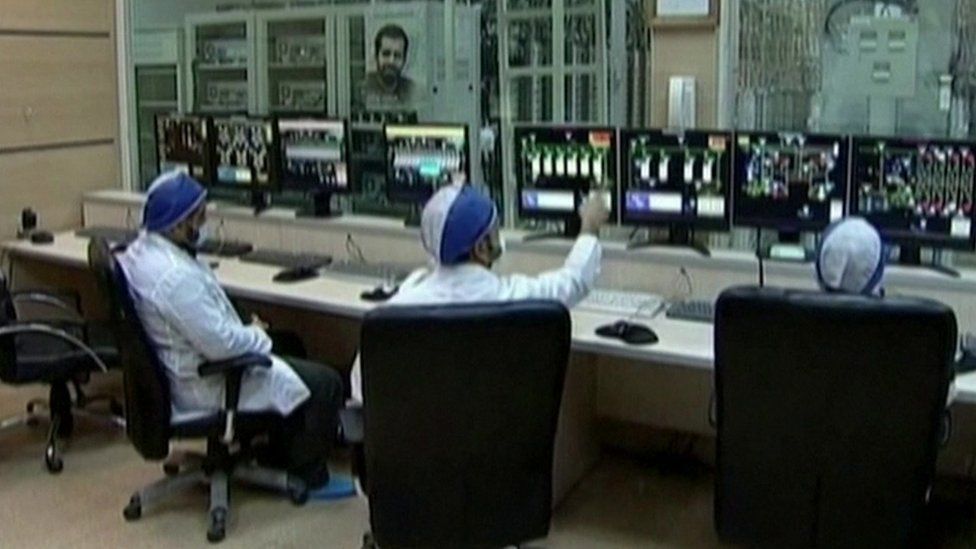
Workers at Natanz nuclear facility
Within hours of Iran proudly announcing the launch of its latest centrifuges, a power blackout damaged some of the precious machines at its site in Natanz.

Iranian authorities are furious. Yet another attack against their peaceful intentions to become nuclear-sufficient. Life is so unfair. "Terrorists" targeted the underground-secreted, bunker installation at Iran's  Natanz nuclear facility; an obvious act of "nuclear terrorist". This is the contorted reasoning for which Tehran's Ayatollahs and its Islamic Revolutionary Guard Corps is famous. As sponsors of terrorism, the godfathers of terrorist groups with whom Tehran conspires to wreak atrocities abroad, spread a network of like-minded Islamists globally, threaten the stability of the Middle East and its Sunni neighbours, warn Israel repeatedly of Iran's intention to destroy it, the Islamic Republic is a sterling world citizen.

Placing the blame on the state of Israel for infiltrating Iran's inner circles through intelligence agencies recruiting disaffected Iranians working underground to destabilize the Iranian Republic, human intelligence resources working hand-in-glove with Israeli intelligence has been able, time and again to demonstrate its capabilities in interfering with the internationally proscribed nuclear program that Tehran is determined to succeed with. Elimination of the IRCG's top general was ascribed to Israel even though it was a planned American operation. The targeting of a number of top Iranian nuclear scientists is considered to be a result of Israel's advanced technology enabling it to extinguish those lives.

But it might easily have been the work of disaffected Iranians, longing for the opportunity to free the country of the control of its Shi'ite Islamist fundamentalists whose agenda is to create a vice-grip on the Sunni Arab states by forming a dedicated extremist military clique prepared to dominate the Middle East and destroy the Jewish state. Previous Iranian President Mahmoud Ahmadinejad stood before the general assembly of the United Nations voicing Iran's intention to destroy Israel, and there were no formal repercussions forthcoming when one member of the UN baldly stated its intention to eliminate another. 

The Islamic Republic of Iran fits all the metrics of 'terrorism', from its control and direction of Lebanon-based Shiite terrorist militia Hezbollah, to its support of Hamas in the Gaza Strip, and that of the Houthis in Yemen. The alliance it has formed with Iraq, Syria, Qatar and Lebanon pits the two main branches of Islam, Sunni and Shi'ite against one another in a bitterly violent upheaval of sectarian hatred. Iran is directly involved in the mass murder of Yemenite and Syrian civilians through the directed influence of the al-Quds division of the IRGC. 

Banks of centrifuges at Iran's Natanz nuclear plant
Banks of centrifuges at the Natanz nuclear plant    Reuters

All of this is well enough established and yet the European Union spearheads a return to the nuclear agreement that gave practical assent to Iran's ongoing nuclear program, now re-joined by the new U.S. administration. With or without the nuclear agreement in force, Iran stealthily and steadily proceeded with its verboten nuclear enrichment. The International Atomic Energy Agency discovered through its limited inspections ample evidence that the IRGC detonated atomic devices surreptitiously, but of course for strictly 'peaceful' purposes.

Israel has warned time and again of its existential concerns over a country dedicated to terrorism which has directly threatened its security by plainly stating repeatedly its intention to wipe Israel from the map of the Middle East, that it will not tolerate nuclear weapons in the hands of a country as violently belligerent as Iran. Technological advances in the accuracy and range of ballistic missiles which can have one purpose only beyond conventional warfare, to carry nuclear warheads would be aimed directly at Israel. Possession of those nuclear weapons will play a fundamental role in ensuring that the Arab Muslim nations of the Middle East must take especial care in dealing with a viciously controlling Iran.

So now that, yet again, Iran accuses Israel of 'nuclear terrorism', reserving the 'right' to take active action against the 'perpetrators', the world has been put on notice that more drama is set to ensue courtesy of the Islamic Republic. The 'problem' with the electrical distribution grid of the Natanz site that 'caused an incident' as a result of a cyber attack -- popularly attributed to Israel's Mossad, its external intelligence-and-action arm -- in actual fact, caused more than an 'incident'. Expectations are that the damage that ensued with this carefully constructed cyber attack will set back Iran's nuclear ambitions for close to a year. 

Germany, whose historical record with Jewry represents a colossal milestone in hideous genocide has a shameful soft spot for doing business with Iran, and deplores this act of sabotage as being 'unhelpful', while not recommending out of the goodness of its love for the state of Israel and its Jewish heritage anything remotely 'helpful' in possibly restraining a terrorist regime from carrying out its promised agenda of launching another Holocaust.

"While condemning this despicable move, Iran emphasizes the need for the international community and the International Atomic Energy Agency to deal with this nuclear terrorism and reserves the right to take action against the perpetrators."
Iranian nuclear chief Ali Akbar Salehi
The international community, the United Nations and its various bodies and committees choose not to react when Iran threatens the destruction of Israel, but Iran has full expectations and the chutzpah to go with it, that there will be global condemnation aimed at Israel for interrupting the methodology by which Iran plans to annihilate the Jewish state. The timing of the cyber attack can be viewed as a message, from Israel to all those who tolerate Iran's terrorism with implacable cynicism, that Israel has no intention of sitting back complacently while Tehran builds the wherewithal for its destruction.

"The fight against Iran's nuclearization ... is a massive task", commented Prime Minister Benjamin Netanyahu on the occasion of a ceremony with the Israeli military and intelligence chiefs to mark the 73rd anniversary upcoming of the founding of the State of Israel. Tehran's strictly peaceful nuclear program last year saw a fire break out at the facility; eliciting another claim by Iran of an attempt to sabotage the country's nuclear ambitions. 

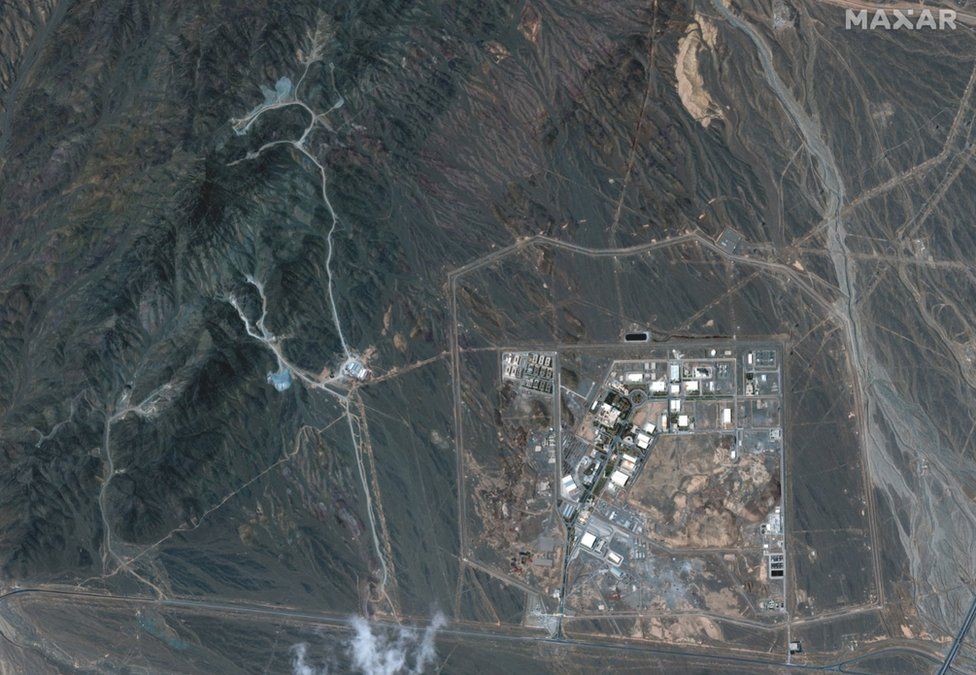
Satellite image showing Iran's Natanz uranium enrichment facility (5 April 2021)
Natanz is an uranium enrichment facility about 250km south of the Iranian capital Tehran   Maxar Technologies


Labels: , , , ,

Follow @rheytah Tweet