Iran, Intransigent and Triumphant
Iran, Intransigent and Triumphant
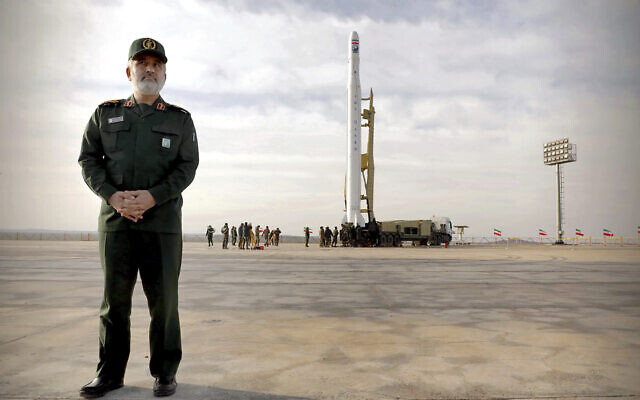 |
| Gen. Amir Ali Hajizadeh, the head of the Revolutionary Guard’s aerospace
division stands in front of an Iranian rocket carrying a satellite in
an undisclosed site believed to be in Iran’s Semnan province, on April
22, 2020. (Sepahnews via AP) |
"The
intended research objectives of this launch were achieved. this was
done as a preliminary launch ... God willing, we will have an
operational launch soon."
"By
developing our capacity to launch satellites, in the near future
satellites with a wide range of applications ... will be placed into
orbit."
Ahmad Hosseini, spokesman, Iranian Space Agency
"These activities are all the more regrettable as they come at a time
when we are making progress in the nuclear negotiations in Vienna.".
"We call on Iran not to launch further ballistic missiles designed to be
capable of carrying nuclear weapons, including space launchers."
French foreign ministry
 |
| Iranian satellite carrier rocket “Simorgh” is launched in an unknown
location in Iran, in this picture obtained on December 30, 2021.
Ministry of Defense of Iran/WANA (West Asia News Agency)/Handout via
REUTERS |
France's
plea to the Iranian Ayatollas and the IRCG will most certainly not
persuade the Islamist theocracy to abandon their ambitious plans for the
future of the Islamic Republic to mark out its territory in space, to
launch satellites to look down on what its challengers are up to, to
assess the military preparedness of its enemies, to threaten those whom
Iran feels has no right to their very existence in a geographic area
hostile to the presence of the territorial integrity of a non-Muslim
country.
Harsh
sanctions imposed on Iran for its well-known plans to achieve success
in nuclear weaponry to accompany its ever-evolving arsenal of
technically advanced ballistic missiles appear to have done nothing to
extinguish its passion to be armed with the most fearsome of mass
weaponry. Iran has amply demonstrated it has the wherewithal to supply
its military proxies in Lebanon, Yemen, Syria, Iraq and Gaza with
weapons, but remains shy of finances to ensure its own population can
live with ample fuel and food.
Like
North Korea, Iran has its priorities and fending for its peoples'
comfort in food security is not one of them. Their ambitions remain set
on securing weapons of mass destruction to instill fear in the minds of
their adversaries, and to gain respect-through-intimidation to ensure
that others think twice before provoking their ire by criticism and
challenges. Like North Korea, which has exchanged formulas, methodology
and technicians with Iran, formal discussions brought to a bargaining
table by the international community to persuade Iran to surrender its
nuclear ambitions are destined to fail.
Three
'research' devices were launched into space with the use of a satellite
launch from the Imam Khomeini Space Center in Northern Iran at dawn on
Thursday. During the time of the original 2015 nuclear agreement meant
to slow down Iran's nuclear program where it promised to stop enriching
uranium to a grade level useful for the creation of a nuclear device,
Iran prosecuted conflict in Yemen and in Syria, threatened Arab Sunni
Muslim nations, vowed to eliminate Israel, provided Hezbollah and Hamas
and the Houthis with advanced rocketry, and sneered at the gullibility
of the West.
Indirect
U.S.0Iran talks on the nuclear issue are ongoing, but even the most
oblivious optimist cannot believe that anything positive can be
achieved, other than buy Iran more time to perfect its rocketry and
approach nuclear bomb technology to secure an arsenal of their own.
Iranian state television showed footage of the firing of the launch
vehicle, a Simorgh (Phoenix) satellite carrier rocket which
launched the three research devices at an altitude of 470 km and a speed
of 7,350 meters per second.
 |
| Image taken from footage aired by Iranian state television shows a
rocket that Iran announced it launched on Thursday, Dec. 30, 2021.
(Iranian state television via AP) |
Labels: Ballistic Rocketry, Iran, Middle East, Nuclear Agreement, Satellites, Terrorist, Threats, United States
It is not the failure of the
Saudi Arabia and Qatar to "step up" that will foment extremism in the
Middle East; rather, it is they who are fomenting it. They must step
down, not "up." It is these states' sponsorship of jihadists and other
extremists that brings about the turmoil and the bloodshed.
Many journalists, instead of letting facts speak for themselves,
frequently seem partial to making idealistic predictions and sweeping
statements about the Middle East. Although no newspaper or government
predicted the "Arab Spring," once it happened, much of the media
declared that an era of prosperity, equality and democracy was about to
transform the Middle East into a modern region with modern aspirations.
The Guardian, in fact, was so desperate to justify its
original support for the "Arab Spring" that it recently produced a
straight-faced editorial in which it claimed that Egyptian President
Morsi's power-grab against the judiciary was a necessary act to
guarantee Egypt's democratic aspirations.
The latest journalist to pick up the wrong end of the stick is Tim Montgomerie, who recently penned an
opinion piece for
The Times, entitled "The Arab world must act – or face disaster." Montgomerie claims:
Unless the Gulf states stump up their share of aid, the refugee problem will fuel extremism across the region.
The governments that need to step up to the plate are the region's
rich oil powers, including Saudi Arabia and Qatar … David Cameron fears
that a failure to answer calls for help from the moderate Syrian
opposition will mean extremist elements will become increasingly
dominant. The process of radicalisation of the anti-Assad forces is
already well under way
If they don't get aid inside Syria soon, a refugee crisis of enormous
scale will not just cause widespread human misery, it will fuel
extremism in Jordan, Lebanon and throughout the region. A very great
deal is at stake.
It seems to have escaped Montgomerie's attention that the leading
funders of "extremist elements" within Syria are Saudi Arabia and Qatar –
the very two countries he calls upon to "step up" and provide a
solution.
Once the possibility of unrest in the Gulf started to die down last
year, the Saudi Arabian government began, as described by Joshua Jacobs
of the Institute for Gulf Affairs, to "unchain their clerical soft
power."
State-controlled Saudi television regularly features pro-jihadist
clerics. Sheikh Adnan al-Arour, for example, is a Syrian Salafist who
calls for holy war against the Assad regime. He receives prime-time
coverage on Saudi television. "Extremist elements" in Syria, such as the
Supporters of Allah Brigade, have declared their allegiance to this
Saudi-supported preacher.
Saudi Arabia, threatened by Iranian hegemony, is keen to dethrone the
Iran-backed Assad and replace him with a Sunni-friendly regime. Their
weapon of choice seems to be
state-managed jihad.
Qatar is now the chief backer of the Muslim Brotherhood -- from Cairo and Gaza to the Brotherhood fighters in Syria.
Al Jazeera, the influential media station owned by the Qatari Government, has
assigned
its Syria desk to Ahmed Ibrahim, the brother of Anas al-Abdah, a member
of the Muslim Brotherhood-dominated Syrian National Council. Al Jazeera
has, unsurprisingly,
produced a number of puff pieces about the anti-regime Islamists in Syria.
According to reports, it is the jihadists within Syria who are receiving the bulk of the weapons sent from Saudi and Qatar. The
Independent
notes that the extremist jihadist group, Jabhat al-Nusra -- declared a
terrorist group by the United States in December 2012, and which claims
to be an ally of al-Qaeda -- has become one of the most able fighting
forces precisely thanks to the vast supplies of money and arms sent from
Saudi Arabia and Qatar.
It is not the failure of these two Gulf States to "step up" that will
foment extremism in the Middle East; rather, it is they who are
fomenting it. They must step down, not up. It is these states'
sponsorship of jihadists and other extremists that brings about the
turmoil and the bloodshed.
Montgomerie is not only a columnist for the
Times, he is also
considered one of the most influential conservatives in Britain. His
columns are regarded as an expression of government policy, albeit more
candid than the official line.
If I were a jihadist, I would feel extremely comfortable right now.
If I were a secular Syrian fighting against despotism, I would feel very
alone. If I were Tim Montgomerie, I would stop talking.
Labels: Conflict, Islamism, Qatar, Revolution, Saudi Arabia, Syria, Terrorist