Canada’s misleading denial that it nominated Iran to UN body addressing women’s rights & terror prevention UN Watch
"There
have been incorrect reports on social media about Canada’s position on
the nomination of Iran to the United Nations Economic and Social Council
Committee for Programme and Coordination – an advisory body with no
decision-making role. Iran
was nominated as part of the Asia-Pacific Group."
"Canada is not a member
of the group and did not endorse or vote for this nomination. There was
no vote, as per established procedures."
"Canada does not support Iran
for positions of influence within the United Nations. We will continue
to actively work with partners to counter Iranian candidacies."
Global Affairs, Canada
"Canada’s foreign ministry made a misleading statement
on X.com to mask the fact it allowed the nomination
of the Islamic Republic of Iran to a UN committee that addresses
critical issues including women’s rights and terrorism prevention —
failing to object as the US did, and as Canada and EU states have done in the past."
"The
fact is that Canada, as a member of the 54-nation UN Economic and
Social Council, participated in the consensus nomination of the Islamic
Republic of Iran to the UN Committee for Programme and Coordination on
April 8, 2026."
"This committee deals with budget priorities and
program coordination on critical issues, and will meet soon, May 14-21,
to address women’s rights, human rights, and terrorism prevention."
"At
a minimum, Canada should have taken the floor to object that it is
wrong to nominate a regime that only months ago massacred thousands of
protesters, and that brutally oppresses women, tortures political
prisoners, and systematically violates basic human rights."
"This
is exactly what the United States did in that meeting. It was the only
country that formally objected and disassociated itself from the
consensus decision, citing Iran’s appalling record on women’s rights.
Canada
and other Western democracies, however, remained silent and allowed the
consensus to pass in ECOSOC, a body of which Canada is a member."
UN Watch
"The United States disassociates from consensus on the nomination of Iran to the Committee on Program and Co-ordination."
"The
regime threatens its neighbours and has for decades infringed on the
Iranian people's ability to exercise their basic human rights."
"Due
to these and other concerns, we believe Iran is unfit to serve on a
body advising member states on program and budgetary matters."
U.S. Ambassador Dan Negrea
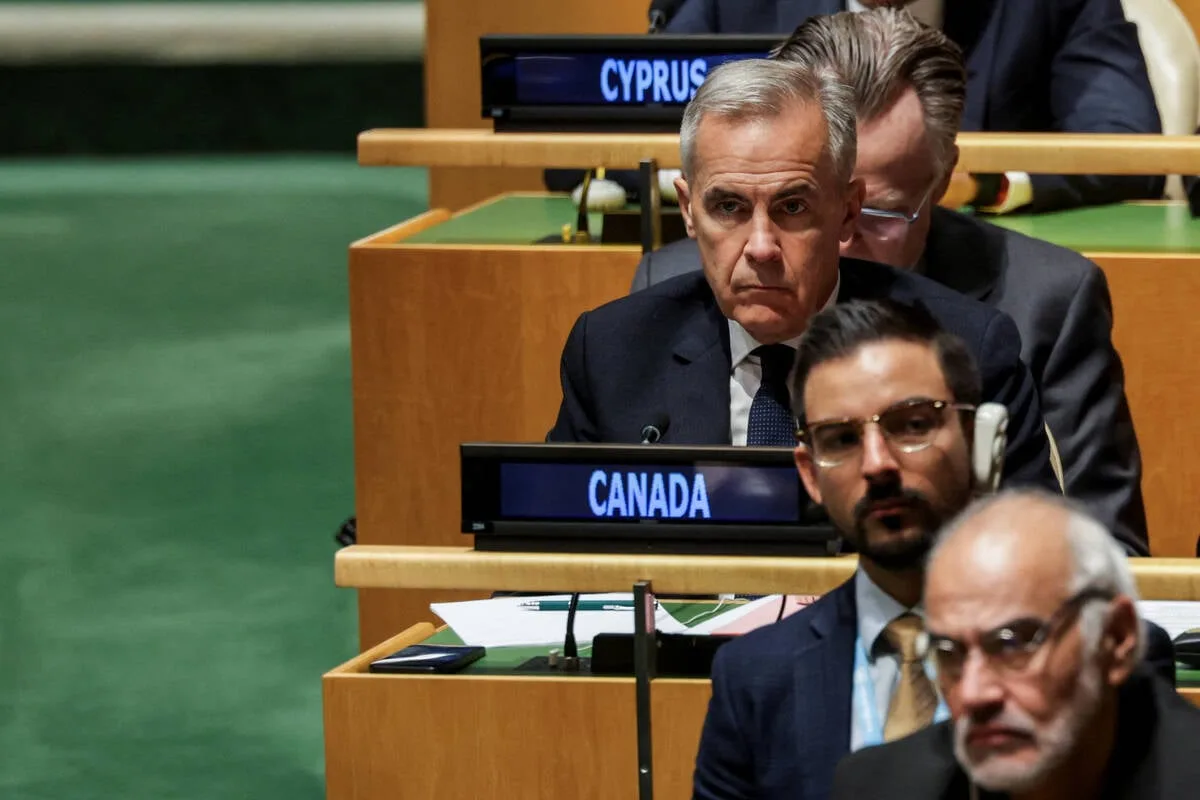
The Security Council chamber at the United Nation in New York City.Photo by Spencer Platt /Getty Images
Canada
obligingly assisted in the approval of a motion for the Islamic
Republic of Iran -- that would be the Iranian regime that just a few
months earlier responded to nation-wide protests against the regime by
dispatching police, the IRGC and Basij to violently disband the protests
by all and any means, leading to the killing of an estimated 30,000
Iranians and the arrests and death sentences of untold numbers of
'enemies of the Islamic Republic' -- to a position on the UN's Committee
for Program and Coordination.
Iranian-Canadians
who desperately wish for the Ayatollah-led, Islamic Revolutionary Guard
Corps-enforced Republic to fall, and yearn for the freedom from
oppression that would mean for their families in Iran, would have
reacted to the news of this incredible betrayal with disbelief. While at
the same time, the infiltrated members of the regime and the IRGC that
have made a home for themselves in Canada would have beamed with
pleasure. Just as Hamas has on occasion congratulated the ruling Liberal
government for some of its decisions, now the Iranian regime was given
the same opportunity.
Officially,
for internal consumption, the Liberal government of prime minister Mark
Carney denied any such reports; that they did no such thing. The actual
facts belie that assertion. Canada gave aid and comfort to a regime
under the duress of a conflict brought by the State of Israel and the
U.S. military launching an aerial war on the regime, its military, the
IRGC, their weapons depots and rocket launchers and nuclear sites. While
the Iranian regime presents a distinct danger with its nuclear
ambitions and its sponsorship of terrorist groups to the world at large
and the Middle East in particular, Canada's government calls for a
ceasefire so the regime can survive.
Canada's
decision at the April 8 meeting of the UN Economic and Social Council
enables Iran to have an advisory and oversight role on programs as
diverse as gender equality and terrorism prevention, as well as
'peaceful uses of outer space'. Global Affairs Canada's insistence that
Canada's role in the event has been misunderstood, is an evasive and
shameful tactic in a bid to shield the government from the shame and
blame it most certainly deserves for betraying the most elemental
foundations of human rights against tyrannical rule.
Official
video from the UN Economic and Social Council, most recently chaired by
Bob Rae, Canada's ambassador to the UN, showed an official chairing a
plenary session of the council where the Islamic Republic of Iran was
included on a list of countries set to be appointed to a three-year term
on the Committee for Program and Co-ordination. With no objections from
the representatives of the assembled countries, the officiating
individual bangs a gavel and declares: "It is so decided".
And
Canada helped in that decision; not a word of doubt expressed of the
inappropriateness of a corrupt, terror-promoting, nation known for
persecuting its own people -- much less its violence visited upon
Iranian women who dare to oppose strictures placed upon their most basic
of human rights -- sitting on such a committee from Canada.
Screenshot from a UN live stream showing the
precise moment that a plenary session of the UN Economic and Social
Council approved the nomination of the Islamic Republic of Iran to a UN
oversight committee. Photo by UN
"We are two Saudi sisters who fled from Saudi Arabia seeking asylum.Yet, the family and the Saudi government have suspended our passports and now we are trapped in Georgia country. We need your help please." "We want your protection. We want a country that welcomes us and protects our rights." "We fled oppression from our family because the laws in Saudi Arabia [are] too weak to protect us. We are seeking the UNHCR protection in order to be taken to a safe country." Maha al-Subaie, 28, Wafa al-Subaie, 25
Maha and Wafa al-Subaie appealed for help Wednesday after fleeing Saudi Arbia, the latest runaways from the ultra-conservative kingdom to use social media to seek asylum. Twitter
In Saudi Arabia women are protesting the Kingdom's system of oppression of women under Wahhabi sharia laws. A baker's dozen of rights activist shave been detained, some of them for up to a year, for campaigning against the Saudi guardianship system. Their efforts to create shelters for women runaways have gained them notoriety as much for stating that current shelters operate similarly to detention centres as for insisting that women know what's best for women.
In January 18-year-old Rahaf Mohammed al-Qunun barricaded herself at an airport hotel in her room in Bangkok. She had fled her Saudi family during a family trip to Kuwait. And her pleas on social media brought instant global attention and sympathy. That reaction saw UNHCR responding with alacrity to grant her recognition as an asylum seeker. A flurry of media activity and behind-the-scenes diplomacy took place and she was finally given haven to begin a new life in Canada.
Her success has spurred other Saudi women to make similar attempts to escape the confines of the Kingdom and the stifling oppressive control of sharia, supported by parents whose idea of daughterly fidelity is to obey father, brother, uncle, male cousins, to never venture outside the home other than in the company of a male guardian, to be properly attired head to foot, to require male permission to travel, to marry, to obtain a passport, to open a bank account.
The two Saudi sisters sought initial haven in Georgia, claiming to be in danger, their lives threatened should they be forcibly returned to Saudi Arabia. Their father and brothers are looking for them in Georgia, goes their desperate appeal. Saudis require no visa to enter Georgia, using the country as a transit point to elsewhere where women escape abusive male relatives, claiming few choices are available to them in Saudi Arabia.
Where women are considered fugitives fleeing abusive relationships; when they are caught are forced into restrictive shelters where they are placed under pressure to reconcile with abusers or be detained on charges of disobedience. The male guardianship laws triumph. In one post, the sisters show themselves with faces bare, hair uncovered, restrictively taboo in Saudi Arabia.
They want, they said in the post, for the world to "remember us", should something untoward occur to them. Their case is being monitored by the UNHCR which has not yet committed to any course of action. As a party to the 1951 Refugee Convention, where people requesting international protection in a country have access to asylum procedures, Georgia is held to the convention and UNHCR provides legal representation.
"Sometimes the women who come here ran away from a desperate situation with no luggage whatsoever, so we provide everything." Sonia Mhamdi, office of the Ministry of Women, Family and Children, Gafsa, Tunisia
"The new law is innovative because before, when the woman was abused and forgave the abuser, he would not be punished by law." "Now even if the woman forgives him, he will face the law and he will be accountable." Amor Yahyaoui, general inspector, Ministry of Justice
"The women in the center provided me with legal assistance and also psychological support." "I know my rights, but I need support to be sure that my children will remain safe in the process and benefit from at least some help." "[She withdrew her battery complaints] because I didn't want my children to be without their father." "[After her husband began beating their oldest child] I just could not take it any more." Sihem Ben Romdhane, Gafsa, Tunisia
"Women and men come every day to the court for marriage issues and to ask for child support and women do not hesitate to complain about their violent husbands." "It's not taboo anymore." Mohamed Khlefi, Gafsa court public prosecutor
The Tunisian government is taking substantial measures against anti-women violence. [AFP]
Date of publication:
25 February,
2018
According to 2016 statistics, 60 percent of Tunisian women were exposed to domestic violence, a figure released by the Ministry of Women, Family and children, supported by studies from NGOs suggesting the actual number of women victimized by family violence to be even higher. Fifty percent of Tunisian women have stated that at least once in their lives they had experienced violent aggression in a public space.
Tunisia has been regarded as representing the most socially advanced of Arab countries for women's rights being upheld. Polygamy was altogether abolished in 1956, the year after independence. Women have long been able to gain custody of their children, along with the right to divorce. Despite which violence in domestic settings victimizes a large proportion of Tunisian women. They are discriminated against within society as they are in most Muslim societies.
Because these are Muslim societies where the Koran instructs men how they may treat women who are recalcitrant and urges men to beat such women with discretion, and at the same time warns that women are not independent of their husbands, must accede to them in all matters, and may not at any time deny their husbands sexual relations, else face due punishment. Multiple wives are not uncommon in Muslim countries.
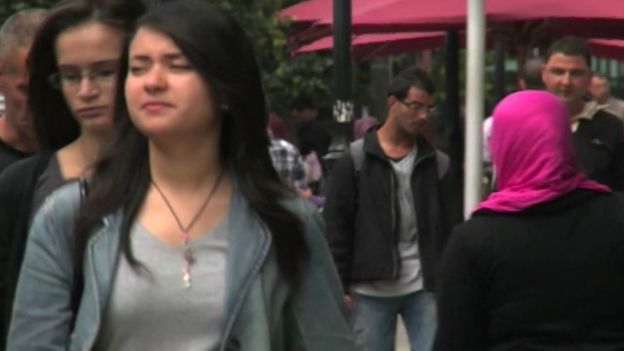
The view on Avenue Habib Bourguiba of women wearing a variety of styles is a rare sight in the Arab world
In Tunisia, however, a law passed a year ago that outlaws violent acts against women, and recommended that new shelters and other facilities whose purpose is to protect women be opened. Funded by the European Union, seven shelters operate throughout Tunisia, not an excess of havens in a nation where an estimated 60 percent of women are victims of domestic violence. Domestic rape is now outlawed. Moreover a rapist is now barred from the expedient of marrying his victim to minimize his sentence.
Should police fail to receive a woman's abuse complaint with the seriousness it calls for, he could himself face jail time. Under the new legislation, if the victim drops the charges, the investigation must continue. Many women, after lodging an official complaint, withdraw it when they are informed their husband will go to jail, and the abuse simply carries on, the wife loathe to carry through. If a police officer now makes an effort to have a woman change her mind about bringing charges, he will himself be charged.
Any witness of violence against women who fails to report it may be prosecuted, as well. Two years in prison is the punishment for sexual harassment. Domestic-violence-specific courts and judges dedicated to sitting in judgement in cases of domestic violence, along with special police units, led mostly by women all represent new initiatives in an effort to reduce the numbers of women who face violence in their lives.
They won't take inspiration on women's liberation from Wonder Woman, though; it's been banned in Tunisia.
Tunisia's new law could lead to a cultural revolution for Muslim women across the Arab world, human rights organisations hope Getty
"Over the past twenty-five years, progress has been made through, for example, legislation prohibiting discrimination based on sex with respect to inheritance and citizenship, laws that guarantee equality within the family and laws that address domestic violence." "However, while progress has been significant, discriminatory constitutional and legislative provisions remain in place in many countries, leaving women without protection or legal basis to claim their rights." "Where adequate sanitation facilities are lacking, for example, concerns over safety and menstrual hygiene management may keep girls away from school or compromise their learning experience." United Nations report
Women Poorer And Hungrier Than Men Across The World, UN Report
The latest United Nations report on Turning Promises Into Action: Gender Equality in the 2040 Agenda for Sustainable Development recites a universal litany of hindrances and lack of opportunities and the will to empower women to access equality matching men's progress has been produced, its details more than adequately outlining areas where women are disadvantaged in life, failing to advance their aspirations into the future.
Global benchmarks for progress as for example eliminating extreme poverty and hunger and having all children attend school were laid out in several global benchmarks included in the 2030 Agenda for Sustainable Development. Some targets have seen significant progress but this study focused on women specifically and how well they are progressing, finding in its final analysis an abysmal result. In virtually every category appraised women fare worse than men.
According to the conclusions of the newly-released report, 122 women aged 25 to 34 live in extreme poverty for every 100 men within that age group also living in poverty. Women living in poor households hovers at about 12.8 percent while for men the figure is 12.3 percent, a disparity which results in roughly five million more women than men who are struggling to exist. It is more difficult for women than for men to escape poverty since women have less opportunities to access employment and economic opportunities.
Laws in some countries make it less than possible for women to inherit wealth, own land and have access to credit. When women do find employment they are frequently paid less than men performing work of equal value. Women face shorter working hours for payment since they also must look after child-rearing, housework and the preparation of family meals. Where food insecurity prevails in two-thirds of all countries women are most vulnerable.
The greatest challenges facing women is in sub-Saharan Africa where low-income women are especially vulnerable. Surprisingly enough, a like situation prevails in the United States as well, representing the sole developed country where the rate of maternal death is on the increase. One in five women and girls aged 15 to 49 report experiencing physical or sexual violence by an intimate partner in the past year.
On the positive side, more women attend school than previously and many remain in school longer. Across the globe, 90.8 percent of primary school-age girls were enrolled in school in 2015 in comparison with 82.2 percent in 2000, and for boys those figures were 91.9 percent of primary school-age boys were enrolled in 2015. Despite which, 15 million girls will never see the opportunity to learn to read or to write.
In Africa in particular, all these drawbacks represent an acute challenge, where 48.1 percent of adolescent girls are not able to attend school, along with 25.7 percent of girls of primary-school age. The numbers are 43.6 percent and 21.7 percent respectively, for boys.
Education
Women make up more than two-thirds of the world's 796 million illiterate people.
According to global statistics, just 39 percent of rural girls
attend secondary school. This is far fewer than rural boys (45 percent),
urban girls (59 percent) and urban boys (60 percent).
Every additional year of primary school increases girls'
eventual wages by 10-20 percent. It also encourages them to marry later
and have fewer children, and leaves them less vulnerable to violence.
While progress has been made in reducing the gender gap in urban
primary school enrolment, data from 42 countries shows that rural girls
are twice as likely as urban girls to be out of school.
In Pakistan a half-kilometre increase in the distance to school
will decrease girls' enrolment by 20 percent. In Egypt, Indonesia and
several African countries, building local schools in rural communities
increased girls' enrolment.
In Cambodia, 48 percent of rural women are illiterate compared to 14 percent of rural men.
Rural women's deficits in education have long-term implications
for family well-being and poverty reduction. Vast improvements have been
seen in the mortality rates of children less than 5 years old since
1990, but rural rates are usually much higher than urban ones.
Data from 68 countries indicates that a woman's education is a key factor in determining a child's survival.
Children of mothers with no education in the Latin American and
Caribbean region are 3.1 times more likely to die than those with
mothers who have secondary or tertiary education, and 1.6 more likely to
die that those whose mothers have primary-level education.
This represents a general opinion site for its author. It also offers a space for the author to record her experiences and perceptions,both personal and public. This is rendered obvious by the content contained in the blog, but the space is here inviting me to write. And so I do.