"We will continue to work with the relevant authorities and we will work vigorously within FIFA in order to root out any misconduct, to regain your trust and ensure that football worldwide is free from wrongdoing." (pre-election) "This gives
me now the time because I was said to be responsible with what's
happened. I take the responsibility and we have to build up now a better
image of FIFA and I know how to do it."
"It
was a very difficult congress due to the circumstances of these tragic
events on Wednesday and Thursday in Zurich and what the media said
around the world about FIFA."
"I
was identified to be responsible for what has happened. I take the
responsibility and we have to build up a better image of FIFA and I know
how to do it." (post-election)
Sepp Blatter, FIFA president
"[We are] fully committed to creating a culture that promotes the highest standards of ethics and compliance and we expect the same from our partners." Adidas, FIFA sponsor
Seven FIFA officials arrested, with charges against nine officials of FIFA along with five corporate executives, all charged with racketeering, wire fraud and money laundering conspiracies connected to 24 years of entitled corruption, in the process enriching themselves beyond imagination. Swiss prosecutors have announced that criminal proceedings are to proceed into FIFA's awarding of the 2018 World Cup to Russia, and the 2022 World Cup to Qatar.
The proceedings, needless to say represent "another case of illegal extraterritorial implementation of American law", according to Russia's outraged Foreign Ministry, representing a country the 2018 Cup was granted, over the U.S. bid. This brings sour grapes to a new level. Major Sponsors such as Coca-Cola, Visa and Adidas are aghast; they had no idea, NO IDEA, that their brand was involved, however innocently with corrupted malfeasance on such a grand scale.
They will rethink their sponsorship. Perhaps.
The European soccer body UEFA, had called on FIFA to postpone the Friday presidential vote since "the image of football as a whole" had been tarnished (!!surprise!!); perhaps a time-out might be useful at this juncture. They must not have realized that the inestimable Sepp Blatter at age 79, has lost none of his marbles, and certainly none of the gratitude of the South American and Asian soccer bodies whose vote for his continued presidency carried his day.
For he is the 'president of everybody', particularly those everybodies whom his generosity profited.
The fix was in, but the truth is out. The former chief of Britain's 2018 World Cup bid spoke before a parliamentary committee describing how FIFA officials demanded million-dollar payouts in exchange for votes. As for former FIFA executive Nicolas Leoz, he had all the filthy lucre he was happy to claim; what he wanted instead was a knighthood. When the English official responded it wouldn't be possible, he understood that neither would the games in 2018 be possible for Britain.
Mr. Leoz was one of the 14 FIFA men arrested in Zurich on Wednesday to answer for the American charges of racketeering and other offences. There are so many offensive offences casually overlooked as business as usual, that had it not been for the outlandishly inexplicable-but-for-bribes decision to grant the 2022 World Cup venue to Qatar, no such firestorm of 'we've-had-it' would have broken out into the world of the most popular sport going.
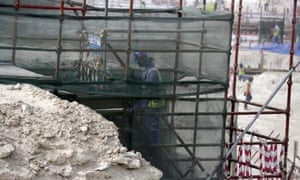
Qatar, a tiny country with no history of, let alone interest in football? A summer games choice in overheated Qatar? No football stadiums in Qatar ... no problem. Except for the thousands of imported slave labourers from poverty-stricken countries like Bangladesh, Nepal, India, Sri Lanka, labouring under intensively subpar conditions considered dangerous in any other part of the world, with reports of one death among the indentured workers every two days.
A foreign worker climbs scaffolding at the Al-Wakra stadium being built for the 2022 World Cup, in Doha.
Photograph: Maya Alleruzzo/AP
Qatar, the country that gave the world Al Jazeera, will be hosting the 2022 World Cup and is busy preparing for that event of huge global sport proportions. It is an enormous project requiring the building of impressive infrastructure to host the event. Eight to a dozen state-of-the-art stadiums are to be built in the process. Qatar is an immensely wealthy state, an oil Sheikdom (Monarchy) of only about 280,000 citizens.
Doha Port Stadium in Doha. To be built. Expected capacity: 44,950Photograph: Qatar 2022 Bid Committee
In such oil-rich Gulf States like Qatar which boasts the world's third largest oil reserves, it is not the scant citizenry of the country who do menial, physical work for cash compensation, but an imported work force from impoverished countries whose citizens travel to Qatar to earn whatever they can at low wages and no workplace safety or security guarantees, let alone human-rights expectations.
In a world top-heavy with oil-rich tyrannies the indigent poor of the world migrate for crumbs.
Qatar relies on its 2.4-million migrant workers to ensure that the infrastructure for the World Cup will be in place and on time. Workers come from countries like India, Pakistan, the Philippines and elsewhere in the east where jobs are scarce though impoverished, indigent families must somehow be fed. Labourers live in cramped, squalid conditions in Qatar. They earn a pittance and are at the mercy of those who employ them.
Qatar employs a system of employment whereby workers' passports are confiscated to be held by their employers, and at the same time exit visas are withheld. Workers are thus effectively held as prisoners to the labour system; unable to leave, unable to retake possession of their passports, unable to procure the documentation required to enable them to depart a country which feasts on their blood and sinew.
In the past year, no fewer than 194 Nepalese migrant workers have perished from the results of what has been termed "sudden cardiac death", caused by physical duress; overwork in dreadful working conditions and extreme heat. While the Nepalese embassy in Qatar says 400 workers have died since 2010 working on World Cup projects, India has reported that 500 of its own have died since 2012 in Qatar as well.
The general secretary of the International Trade Union Confederation claims that at current rates, four thousand people will meet their deaths in producing the physical wherewithal of presenting the 2022 World Cup to the international community. According to a March ITUC report, 1,200 migrants have died in the four years since Qatar was awarded the World Cup -- or, conversely, bought the World Cup.
But FIFA president Sepp Blatter has no issues with stating "There is not one single doubt that the World Cup will be organized in Qatar". Yet both FIFA and Qatar are not entirely ignorant of what the world looking in from the outside is now realizing through investigative journalism revealing the crisis of humanity that is playing out in Qatar with the building of the World Cup features.
Britain's The Guardian had been investigating the crisis and reports that proposed alterations in working conditions for Qatar's virtual slave army should not be considered a reality until it is seen that changes actually are introduced and followed. Interesting that it is a British newspaper that follows the trajectory of Qatar's World Cup construction, and not Al Jazeera. But then, the first order of a hound is not to bite the hand that feeds it.
"Promises to fully review sponsorship and exit permits in the long term don't help workers on the ground. The government has been announcing a law on domestic workers' rights since 2008 but we still haven't seen it", said James Lynch of Amnesty International.
Pakistani Christians held protests following the Peshawar attacks
Pakistan -- A double bombing at a historic Christian church in northwestern
Pakistan has killed at least 75 people. The bomber struck as hundreds of
worshipers walked out of church toward a food distribution area on the
lawn outside. The attack is one of the deadliest to target Pakistan’s Christian
minority in years. No group has claimed responsibility for the attack,
but it is widely assumed to be the work of a militant Muslim group.
Kenya -- Kenya's
President Uhuru Kenyatta says the country is united and strong in
adversity after a deadly attack on a Nairobi shopping centre on
Saturday. The Kenyan Red Cross says 68 people are now confirmed dead, after the bodies of nine hostages were recovered on Sunday. Between 10 and 15 attackers - thought to be militants from the Somali al-Shabab movement - are still inside. Some civilians are still trapped, either as hostages or in hiding.
Iraq -- Two bombs hidden inside air conditioners exploded Friday in a Sunni mosque packed with worshippers north of Baghdad, killing at least 18 people in the latest in a string of attacks in Iraq. Iraq is weathering its worst bout of violence in half a decade. Attacks have risen significantly since April, intensifying fears the country is slipping back toward the widespread bloodshed and sectarian fighting that marked the years following the 2003 US-led invasion. Over 4,000 people were killed between April and August. Another 396 have been killed so far in September, according to the UN and Associated Press.
Syria --
UN experts began their inspections a week after the attack
Afghanistan -- Insurgents killed 18 Afghan policemen and wounded 13 in an ambush this week in a remote northern part of the country. The ambush took place Wednesday in the Surduj district of Badakshan province. The Taliban claimed responsibility after the attack. The ministry statement also said 47 insurgents were killed in the same area during a police operation earlier in the week. Attacks with high casualty figures are increasingly common as insurgents escalate their campaign against government forces across Afghanistan.
Yemen -- Under a heavy fog, al-Qaeda fighters disguised in military uniforms launched car bomb attacks on three security and military posts in southern Yemen Friday, killing 38 soldiers in the group's biggest attack in the country since last year. The co-ordinated attacks point to how al-Qaeda is exploiting the continued weakness of Yemen's military to rally back here as the group's branches across the region grow more assertive. Last month the US temporarily closed 19 diplomatic missions in the Middle East and North Africa after intelligence agencies intercepted a message between al-Qaeda leader Ayman al-Zawahri and Nasser al-Wahishi, head of the Yemen branch, al-Qaeda in the Arabian Peninsula.
Paris -- a French appeals court has convicted a woman and her brother of "justifying a crime" after her toddler son, named Jihad, went to preschool in the Avignon suburb of Sorgues in a T-shirt bearing the words "I am a bomb" and "Jihad: Born on Sept.22". Bouchra Bagour, 35, was fined $2,790 and handed a one-month suspended prison sentence while her brother Zayed, 29, received a $5,570 fine and received a two-month suspended sentence in southeastern Nimes on Friday.
Nigeria -- A shootout between Islamic extremists and Nigerian security forces rocked this capital (Abuja) Friday. It was the first violence from Boko Haram in the city this year and highlights Nigeria's continuing security problems from the extremists. The gunfight occurred as officials were recovering bodies in Benisheik, northern Nigeria, where 143 civilians were killed Tuesday by suspected Boko Haram fighters. Such incidents challenge the Nigerian military's insistence it is winning the war against the extremists since a state of emergency was declared May 14 Boko Haram wants to enforce strict shariah law throughout Nigeria, Africa's most populous nation of more than 160 million people is almost equally divided between Muslims and Christians. The group is blamed for violent attacks that have killed nearly 2,000 since 2011.
Lebanon -- Al-Qaeda militias fought street battles against Kurdish gunmen in northern Syria Friday, but reached a ceasefire with mainstream Western-backed rebels after fierce fighting near the Turkish border. The infighting, which ended with al-Qaeda's takeover of a border town of Azaz, was some of the worst in months between forces seeking to bring down President Bashar al-Assad and threatened to further fragment an opposition movement outgunned by the regime. Syria's main Western-backed opposition group the Free Syrian Army, condemned the Islamic State in Iraq & the Levant, the al-Qaeda offshoot that overran Azaz.
Egypt -- North Sinai has been witnessing heightened clashes between militants
and security forces since the ouster of former president Mohamed Morsi
leaving tens killed and injured on both sides.
Meanwhile, on 19 September, police backed by military forces stormed
Giza's Kerdasa town, an Islamist stronghold, to capture suspects of the
14 August deadly attack on the town's police station which had resulted
in the brutal killing of 11 policemen.
United States -- A U.S. army veteran accused of fighting alongside an al-Qaeda-affiliated group of Syrian rebels has been released from jail following a secret plea deal. Eric Harroun, 31, had been charged with providing material support to a terrorist group and faced up to life in prison. But under a plea agreement entered Thursday in U.S. District Court in Alexandria, Virgina, Harroun pleaded guilty to an obscure law regulating export of munitions. He was sentenced to time served.
A. U.S. judge is siding with the Navy in its refusal to release some records a bout the 2011 burial at sea of terrorist leader Osama bin Laden. U.S. District Court Judge Richard Leon this week turned down a bid by Judicial Watch, a conservative watchdog group, to get the records under the Freedom of Information Act. The Navy provided some documents to Judicial Watch but included several blacked-out sections. Leon ruled that the redactions were "proper and necessary" to prevent disclosure of sensitive operational details and to provide national security.
The Cleveland man accused of holding three women captive in his home for more than a decade pleaded not guilty Wednesday on an expanded indictment charging him with 512 counts of kidnapping and 446 counts of rape, among other crimes. The charges returned Friday by a grand jury against Ariel Castro expanded on a 329-count indictment filed earlier that covered only part of the time frame of the alleged crimes. He previously pleaded not guilty to that indictment. Castro, 53, has been jailed since his May 6 arrest.
Packs of young people rampaged through Hollywood, knocked down people and stole cellphones and other items before a police sweep halted the marauding and arrested a dozen people, police said Wednesday. Calls began coming in at around 8:30 p.m. Tuesday that youths were robbing people and stealing T-shirts and other goods from businesses, mainly on Hollywood Boulevard. Fifteen to 20 young men and women were "attacking victims and taking property. Some people may have been knocked down or punched". No serious injuries were reported. As many as 40 people may have been involved splitting into smaller groups and reforming as they robbed people. It was believed the youths took advantage of a redeployment of police to Los Angeles' Crenshaw District where violence had broken out the previous night over the acquittal of George Zimmerman in the shooting death of unarmed black teenager Trayvon Martin.
China:
A Chinese whistleblower who spent his free time embarrassing communist party officials by posting pictures of their luxury cars on the Internet, has been blinded with acid and had two of his fingers hacked off. Li Jianxin, 47, is in hospital after being attacked earlier this month. His car was rammed from behind and he was allegedly taken by three men to a remote industrial park in the southern city of Huizhou, where they doused him with acid and hacked at him with knives. A woman in a worker's dormitory nearby found Li lying on the ground in a pool of blood. Li had posted dozens of reports of corruption on a popular local Internet forum.
Pakistan:
A prominent Pakistani Taliban commander has written a letter to a teenage girl shot in the head by the group, expressing regrets that he didn't warn her before the assassination attempt that propelled her activism to the international stage. The letter from Adnan Rasheed, however, didn't apologize for the October attack that left Malala Yousafzai gravely wounded. Rasheeed, who has close relations with Taliban leaders, only said that he found the shooting "shocking" and wished it hadn't happened. Rasheed said he would leave it up to God to decide whether the outspoken activist for girls' education should have been targeted. "You have said in your speech yesterday that pen is mightier than sword. So they attacked you for your sword not for your books or school."
Bono
famously extolled the virtues of charity. Particularly governments
extending tax dollars to offer alms to the poor countries of the world.
He and former Canadian Prime Minister Paul Martin got on famously
together, one of those utterly charming mutual admiration societies, an
exclusive little quorum of two.
And while Bono
exhorted generosity from the wealthy governments to the impoverished
ones, he took very good care to have his millions invested in a tax
haven abroad, keeping his fortune safe from the improvidence of paying
those oh-so-inconvenient taxes in Ireland.
When Paul
Martin was Finance Minister in the Chretien-era government he could
have, but did not close tax loopholes for Canadian corporations such as
companies like Canadian Steamship Lines doing business in Barbados. A
tax haven for foreign companies enabling them to avoid paying their
country's taxes and wages.
And, some of CSL's subsidiaries registered in Barbados, paying almost zip taxes on profits. (What's more, Canada Steamship Lines had received $161-million in government contracts, grants and contributions from 1993 to 2004.) The excuse used is that this is done in the spirit of good business practice, and competitiveness.
The
U.K.-based Tax Justice Network estimates $21 to $32-trillion
representing financial wealth accrued to the world's richest people is
channelled through tax havens. That represents global tax losses of
roughly $200-billion annually through deliberately evasive action taken
to avoid paying taxes on the part of the filthy rich.
Careful husbanding of their riches is obviously the way to remain wealthy. Of
139 low-middle-income countries, offshore wealth of their richest
citizens and corporations represents a far greater amount than their
combined external debts.
As
well, due to the secrecy provisions of tax havens, the climate is right
for laundering crime proceeds. The UN Office on Drugs and Crime posits
an estimate of over $1-trillion of crime-related money - derived from
drug and arms smuggling, human trafficking and corruption - laundered
through this system. And interception is less than 1% by related authorities. In
a very successful effort to avoid regulations, shield themselves from
liability and lower or eliminate tax obligations, multinationals and
banking and financial institutions routinely make use of tax havens. To
get a picture of the scope of this immoral tax avoidance scheme, here's
some additional perspective: tax havens take in over two million
"international business corporations". Reports
out of the United Kingdom last year revealed Google, Amazon and
Starbucks paid little to no taxes to the national treasury in spite of
earning billions in profits in the British market. Officials from the
three companies admitted to shifting profits out of Britain into lower
tax jurisdictions, before a parliamentary investigation. Global
Financial Integrity project based in Washington estimated that between
1990 and 2008, $197-billion was swept out of the world's 48 poorest
countries due to crime, corruption and tax evasion. Trade mispricing by multinational companies led to tax revenue losses of $160-billion yearly to the world's 49 poorest countries. So much for ethical business practises and the righteous sanctimony of celebrities like Bono, and responsible world political leaders like Paul Martin and his ilk.
"The Industrial Revolution was a story of perhaps 100 million people, but this is a story about billions of people. For the first time in 140 years, the combined output of the developing world's three leading economies -- Brazil, China and India -- is about equal to the combined GDP of the long-standing industrial powers of the North -- Canada, France, Germany,Italy, United Kingdom and the United States." Khalid Malik, lead author of the UN's 2013 Human Development Report
The United Nations has released its 2013 Human Development Report, and its conclusions are that much has been successfully done through international co-operation to alleviate the great burden of poverty and hunger in the world. "Never in history have the living conditions and prospects of so many people changed so dramatically and so fast."
In countries like Bangladesh, Bhutan, Rwanda, Ghana, Tanzania and India whose endemic poverty among their millions of undernourished, underprivileged, underserved people is legendary, fortunes are changing. Slowly, people are finding employment, and though still impoverished by First World standards, there is a steadily rising lower middle class, and hunger is being alleviated, living conditions improving.
The conventionally wealthy, technologically advanced countries of the world, the traditional First World countries have, on the other hand, experienced some notable backsliding. Unemployment is up dramatically and it is growing, national economies are faltering, the large middle class is under duress and many of them are joining the ranks of the poverty-stricken, all as a result of the global financial meltdown of 2008.
Oxford University has issued a report of its own in a study of trends in extreme poverty prevailing in twenty-two of the world's poorest countries, where about two billion people live; a significant proportion of the world's population. Their Poverty and Human Development report comes to the conclusion that if current trends continue, the direst poverty in fully half of those 22 countries will be completely defeated within 20 years.
Despite all the protests around the activities of the World Bank and the International Monetary Fund to further open international markets, it is just that opening and the free trade that results from them that have helped the situation. State investments in literacy, and the emancipation of women in cultures that have traditionally been male dominated have done their part.
Rome conclave: Cardinals to begin voting for new Pope
BBC News online - 12 March 2013
Watch the cardinals proceed to the Sistine Chapel
Cardinals have entered the Vatican's Sistine Chapel, where they will begin voting to elect a new Pope.
The 115 cardinal-electors will be locked in the chapel after swearing an oath of secrecy.
They will vote four times daily until two-thirds can agree on a candidate.
The election was prompted by the surprise abdication of
Benedict XVI. There is no clear frontrunner to take over from him as
head of the Roman Catholic Church.
The 85-year-old Benedict stepped down last month saying he
was no longer strong enough to lead the Church, which is beset by
problems ranging from a worldwide scandal over child sex abuse to
allegations of corruption at the Vatican bank.
His resignation and the recent damage to the Church's
reputation make the choice of the cardinal-electors especially hard to
predict, the BBC's James Robbins in Rome says.
Conclave interactive video
Step inside our virtual Sistine Chapel as Philippa Thomas explains the process to elect a new Pope
They will weigh pressure for a
powerful manager to reform the Vatican against calls for a new Pope able
to inspire the faithful, our correspondent adds.
On Tuesday morning's, the cardinals attended a "Mass for the
Election of the Supreme Pontiff" in St Peter's Basilica. They filed in
wearing bright red vestments to the sound of Gregorian chanting.
In his homily, the Dean of the College of Cardinals, Cardinal
Angelo Sodano, praised the "brilliant pontificate" of Pope Benedict and
implored God to grant another "Good Shepherd" to lead the church.
He outlined the mission Catholics believe was given by Jesus
Christ to St Peter - the first Pope - emphasising love and sacrifice,
evangelisation and the unity of the church.
The BBC's Michael Hirst in Rome says the speech was more
measured in tone than the address given in 2005 by Cardinal Joseph
Ratzinger before he became Pope Benedict, which featured a fiery attack
on the "dictatorship of relativism".
A few hundred people watched the Mass from St Peter's Square on giant screens in thunderstorms and pouring rain.
At 16:30 local time (15:30 GMT), 115 cardinal-electors - all
under 80, as those over 80 are excluded - entered the Sistine Chapel for
the secret conclave to select Benedict's successor, chanting the
traditional Litany of the Saints.
Once they have taken an oath of secrecy, Msgr Guido Marini,
papal master of ceremonies, will call out the words "Extra omnes" -
"Everybody out" - and the chapel doors will be locked to outsiders.
On Tuesday morning several
cardinals took to Twitter to say goodbye to their followers before being
cut off from the outside world.
"Last tweet before the conclave: May Our Father hear and
answer with love and mercy all prayers and sacrifices offered for a
fruitful outcome," South African Cardinal Wilfrid Napier tweeted.
Jamming devices in the Sistine Chapel should block all
electronic communication and anyone tweeting would in any case risk
being excommunicated.
Benedict - now known as Pope emeritus - resigned on 28
February after eight years in office, citing ill health. He was the
first Pope in six centuries to do so.
As Cardinal Joseph Ratzinger in 2005, he was the marked
favourite ahead of the conclave and was elected pope after just four
rounds of voting.
The vote for his successor is expected to take much longer.
After 10 general congregations open to all cardinals,
regardless of age - at which 160 cardinals spoke of the issues facing
the Church and the qualities needed by its next leader - no clear
frontrunner has emerged.
"Last time around there was a man of stature, three or four
times that of any other cardinal," French Cardinal Philippe Barbarin
told reporters.
"That is not the case this time around. Therefore, the choice has to be made among one, two, three, four... a dozen candidates.
"We still don't really know anything. We will have to wait for the results of the first ballot."
New York Archbishop Cardinal Timothy Dolan told his priests there was hope that a new Pope could be chosen by Thursday.
Candidates named as contenders include Cardinal Angelo Scola
of Milan, Brazil's Odilo Scherer, and Cardinal Dolan himself - though he
told one interviewer anyone who thought he was in with a chance might
be "smoking marijuana".
Conclave in numbers
115 cardinal-electors
Two-thirds - or 77 - need to agree on papal candidate
Four votes per day, two in the morning and two in the evening
Chosen candidate will be 266th Pope
He will lead world's 1.2 billion Catholics
Once inside the Sistine Chapel,
cardinals will listen to a meditation by elderly Maltese Cardinal
Prosper Grech before holding a first vote, after which their ballot
papers will be burned.
The smoke that will drift out of the chapel's chimney early
in the evening is likely to be black - meaning no Pope has been elected.
From Wednesday, two votes will be held each morning and
afternoon - with ballots burned after each session - until one candidate
attains a two-thirds majority (77 votes).
Then the smoke will be white, meaning the 266th bishop of Rome will have been chosen.
THIRTEEN years ago, researchers at the United States Holocaust Memorial Museum
began the grim task of documenting all the ghettos, slave labor sites,
concentration camps and killing factories that the Nazis set up
throughout Europe.
What they have found so far has shocked even scholars steeped in the history of the Holocaust.
The researchers have cataloged some 42,500 Nazi ghettos and camps
throughout Europe, spanning German-controlled areas from France to
Russia and Germany itself, during Hitler’s reign of brutality from 1933 to 1945.
The figure is so staggering that even fellow Holocaust scholars had to
make sure they had heard it correctly when the lead researchers
previewed their findings at an academic forum in late January at the
German Historical Institute in Washington.
“The numbers are so much higher than what we originally thought,” Hartmut Berghoff, director of the institute, said in an interview after learning of the new data.
“We knew before how horrible life in the camps and ghettos was,” he said, “but the numbers are unbelievable.”
The documented camps include not only “killing centers” but also
thousands of forced labor camps, where prisoners manufactured war
supplies; prisoner-of-war camps; sites euphemistically named “care”
centers, where pregnant women were forced to have abortions or their
babies were killed after birth; and brothels, where women were coerced
into having sex with German military personnel.
Auschwitz and a handful of other concentration camps have come to
symbolize the Nazi killing machine in the public consciousness.
Likewise, the Nazi system for imprisoning Jewish families in hometown
ghettos has become associated with a single site — the Warsaw Ghetto,
famous for the 1943 uprising. But these sites, infamous though they are,
represent only a minuscule fraction of the entire German network, the
new research makes painfully clear.
The maps the researchers have created to identify the camps and ghettos
turn wide sections of wartime Europe into black clusters of death,
torture and slavery — centered in Germany and Poland, but reaching in all directions.
The lead editors on the project, Geoffrey Megargee and Martin Dean, estimate that 15 million to 20 million people died or were imprisoned in the sites that they have identified as part of a multivolume encyclopedia. (The Holocaust museum has published the first two, with five more planned by 2025.)
The existence of many individual camps and ghettos was previously known
only on a fragmented, region-by-region basis. But the researchers, using
data from some 400 contributors, have been documenting the entire scale
for the first time, studying where they were located, how they were
run, and what their purpose was.
The brutal experience of Henry Greenbaum, an 84-year-old Holocaust
survivor who lives outside Washington, typifies the wide range of Nazi
sites.
When Mr. Greenbaum, a volunteer at the Holocaust museum, tells visitors
today about his wartime odyssey, listeners inevitably focus on his
confinement of months at Auschwitz, the most notorious of all the camps.
But the images of the other camps where the Nazis imprisoned him are
ingrained in his memory as deeply as the concentration camp number —
A188991 — tattooed on his left forearm.
In an interview, he ticked off the locations in rapid fire, the details still vivid.
First came the Starachowice ghetto in his hometown in Poland, where the
Germans herded his family and other local Jews in 1940, when he was just
12.
Next came a slave labor camp with six-foot-high fences outside the town,
where he and a sister were moved while the rest of the family was sent
to die at Treblinka. After his regular work shift at a factory, the
Germans would force him and other prisoners to dig trenches that were
used for dumping the bodies of victims. He was sent to Auschwitz, then
removed to work at a chemical manufacturing plant in Poland known as
Buna Monowitz, where he and some 50 other prisoners who had been held at
the main camp at Auschwitz were taken to manufacture rubber and
synthetic oil. And last was another slave labor camp at Flossenbürg,
near the Czech border, where food was so scarce that the weight on his
5-foot-8-inch frame fell away to less than 100 pounds.
By the age of 17, Mr. Greenbaum had been enslaved in five camps in five
years, and was on his way to a sixth, when American soldiers freed him
in 1945. “Nobody even knows about these places,” Mr. Greenbaum said.
“Everything should be documented. That’s very important. We try to tell
the youngsters so that they know, and they’ll remember.”
The research could have legal implications as well by helping a small
number of survivors document their continuing claims over unpaid
insurance policies, looted property, seized land and other financial
matters.
“HOW many claims have been rejected because the victims were in a camp
that we didn’t even know about?” asked Sam Dubbin, a Florida lawyer who
represents a group of survivors who are seeking to bring claims against
European insurance companies.
Dr. Megargee, the lead researcher, said the project was changing the
understanding among Holocaust scholars of how the camps and ghettos
evolved.
As early as 1933, at the start of Hitler’s reign, the Third Reich
established about 110 camps specifically designed to imprison some
10,000 political opponents and others, the researchers found. As Germany
invaded and began occupying European neighbors, the use of camps and
ghettos was expanded to confine and sometimes kill not only Jews but
also homosexuals, Gypsies, Poles, Russians and many other ethnic groups
in Eastern Europe. The camps and ghettos varied enormously in their
mission, organization and size, depending on the Nazis’ needs, the
researchers have found.
The biggest site identified is the infamous Warsaw Ghetto, which held
about 500,000 people at its height. But as few as a dozen prisoners
worked at one of the smallest camps, the München-Schwabing site in
Germany. Small groups of prisoners were sent there from the Dachau
concentration camp under armed guard. They were reportedly whipped and
ordered to do manual labor at the home of a fervent Nazi patron known as
“Sister Pia,” cleaning her house, tending her garden and even building
children’s toys for her.
When the research began in 2000, Dr. Megargee said he expected to find
perhaps 7,000 Nazi camps and ghettos, based on postwar estimates. But
the numbers kept climbing — first to 11,500, then 20,000, then 30,000,
and now 42,500.
The numbers astound: 30,000 slave labor camps; 1,150 Jewish ghettos; 980
concentration camps; 1,000 prisoner-of-war camps; 500 brothels filled
with sex slaves; and thousands of other camps used for euthanizing the
elderly and infirm, performing forced abortions, “Germanizing” prisoners
or transporting victims to killing centers.
In Berlin alone, researchers have documented some 3,000 camps and so-called Jew houses, while Hamburg held 1,300 sites.
Dr. Dean, a co-researcher, said the findings left no doubt in his mind
that many German citizens, despite the frequent claims of ignorance
after the war, must have known about the widespread existence of the
Nazi camps at the time.
“You literally could not go anywhere in Germany without running into
forced labor camps, P.O.W. camps, concentration camps,” he said. “They
were everywhere.”
Eric Lichtblau is a reporter for The New York Times in Washington and
a visiting fellow at the United States Holocaust Memorial Museum.
***In Brussels, split-second timing and precise blueprints point to an insider-sponsored spectacular theft of diamonds valued at $50-millionto be routinely sent from Antwerp to Zurich on a flight from the Belgian city's high-security diamond district, as a searing security-failure embarrassment.
The bold theft has seen one of Europe's biggest diamond heists take place in the world capital of diamond-cutting. Despite 2,000 surveillance cameras, police monitoring and numerous identity controls in protection of its $200-million daily trade of rough and polished gems, skilled thieves managed to handily breach security.
Twenty minutes prior to Swiss Flight X789's departure at 8:05 p.m. two black cars with blue police lights flashing forced their way through an airport fence onto the tarmac speeding straight toward the armoured car which had just completed its transfer of diamonds to the waiting Fokker. The 29 passengers aboard heard nothing, saw nothing.
With stopwatch precision thieves opened the plane's hold, plucked out the parcels containing the gems, loaded them into the cars, and sped off, without firing a shot.
*** In Texas something of a miraculous - at the very least an extremely rare birth situation - occurred when Tressa Montalvo gave birth to two sets of identical twins within a minute of each other. The 36-year-old woman claimed she and her husband Manuel had planned the pregnancy, but without the use of fertility drugs. Giving birth on Valentine's day to four babies; such a birth is consider to represent one in 70-million chances.
*** A former official in the Moscow government, Evgeny Kharitonoiv, has been arrested and charged with organizing a rather grotesque kidnapping over an $80-million debt. A kidnapping which ended the life of Rolls-Royce-driving Mikhail Pakhomov, 37, a councillor in the city of Lipetsk situated 350 kilometres south of Moscow. Evidently Mr. Pakhomov's beaten-to-a-pulp body was discovered at the bottom of a cement-filled barrel, in a horrible settling of a deal-gone-dreadfully-wrong.
***South Korea's outgoing president's parting warning shot to North Korea is that it has pushed itself into a dim dark corner with its recent nuclear test. South Korea has pressed for tighter UN sanctions on North Korea since Pyongyang conducted its third nuclear test last week. North Korea has defended that underground blast with its more powerful, much smaller device, as an act of deterrence against U.S. hostility. And has, by the by, warned South Korea that its own end is near.
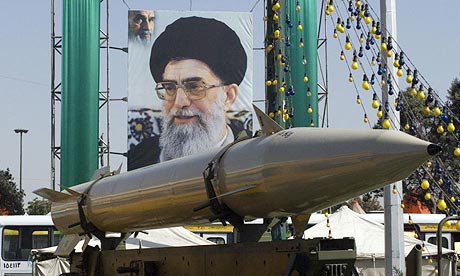
***Tehran is preparing to once again ease the concerns of the international community with respect to its nuclear-weapons-producing plans. While denying its uranium enrichment program and its joint North-Korea/Iran research and production of ever more powerful, longer-range ballistic missiles have any kind of military component to them which might threaten their enemies with being on the receiving end of nuclear-tipped missiles as a sign of their fond regard, Ayatollah Khamenei has asserted that no world power can stop Iran from producing nuclear weapons should it choose to.
A military parade in
Tehran passes a banner of Ayatollah Ali Khamenei. The supreme leader has
said Iran has no intention of developing nuclear weapopns. Photograph:
Hasan Sarbakhshian/AP
China enlists everyone from cops to cabbies to enforce orderly transition
China's ruling Communist Party opens a congress Thursday to usher in a
new group of leaders. Much about the meeting will be a reminder that
China remains an authoritarian state.
By
Tom Lasseter, McClatchy Newspapers/
November 7, 2012
A
paramilitary policeman stands guard in front of a screen displaying
propaganda slogans on Beijing's Tiananmen Square Nov. 6. Security has
been tightened around the square and the adjoining Great Hall of the
People as China opens its 18th Communist Party Congress.
David Gray/Reuters
Beijing
As the United States ends its political season, China’s is beginning, and Beijing
would like to keep things in order. That means red banner slogans
strung along roadsides, flurries of propaganda-as-news and, of course, a
police crackdown.
In the coming week, officials here will trumpet the 18th National Congress of the Chinese Communist Party as an event confirming that, as one state news item recently put it, “democracy with Chinese characteristics is improving.”
Much
about the meeting will be a reminder, however, that China remains an
authoritarian state that often requires a certain amount of willing
suspension of disbelief when it comes to public politics.
The
congress of 2,270 delegates is set to exercise “intraparty democracy”
in electing a new central committee for the party. After the congress,
which starts Thursday and expected to last a week, the new central
committee will convene a meeting at which the politburo and its standing
committee are chosen. The seven or nine standing committee members – the new total isn’t yet known – form the nucleus of ruling power in China.
A
small level of competition in voting is expected for full members of
the central committee, now just above 200 seats, and, though the
prospect seems slim, Reuters
cited unnamed sources Tuesday as saying that the same could be true for
the 25-person politburo as well. But the all-powerful standing
committee almost definitely has been determined through factional
jockeying behind closed doors.
And, as was the case for outgoing President and party General Secretary Hu Jintao, there’s no doubt that his replacement, Xi Jinping, will be elected the president of China next March by a second, rubber-stamping body, the National People’s Congress.
While
the beginning of the 18th Party Congress is fixed, no specific end date
has been published. In the preceding months, foreign reporters who were
trying to divine when the meetings would start had kept an eye out for
signs like canceled public events or particularly large floral
arrangements being erected in the capital.
The assembly and its once-a-decade transition in power will be in the Great Hall of the People, an immense structure that recalls the architecture of the now-defunct Soviet Union.
China’s authoritarianism falls short of the Soviet Union’s, but it brooks very little dissent.
A
story Monday by the Xinhua news wire reported that a senior security
official had recently been “inspecting a security ‘moat’ project created
in areas encircling Beijing for the congress’ smooth holding.” There
was apparently no water involved, just a lot of police.
The story quoted Zhou Yongkang,
a standing committee member who oversees domestic security, as urging
authorities in Beijing and surrounding regions to form a “solid defense
... thus creating a safe, orderly, auspicious, and peaceful environment
for the successful holding of the 18th National Congress.”
Amnesty International released a statement last week that gave an idea of what that might mean: More than 100 activists have been rounded up so far.
“The
police have placed dozens of activists under house arrest, forcibly
removed individuals from Beijing and have closed down the offices of
community groups in attempts to suppress peaceful dissent,” the group
said. “Scores of activists are believed to be held in ‘black jails’
across the country.... Hotels, hostels, basements of buildings and farm
centers have all been reportedly used as black jails.”
With the congress fast approaching, Beijing taxi drivers have been told to take off the window handles from their backseats.
They also were instructed to be on the lookout for passengers bearing
balloons or pingpong balls that could contain subversive political
messages.
During a recent cab ride past the Great Hall of the
People, a passenger asked the driver what would prevent someone from
hurling such forbidden objects from the front seat, where there were
power windows and no handles to remove.
U.S. slips out of top 10 most prosperous countries, while Canada keeps No. 6 ranking
Bloomberg News | Nov 5, 2012 2:32 PM ET | Last Updated: Nov 5, 2012 7:38 PM ET
ReutersThe U.S. fell to 12th position from
10th in the Legatum Institute’s annual prosperity index amid increased
doubts about the health of its economy and ability of politicians.
The U.S. slid from the top 10 most
prosperous nations for the first time in a league table which ranked
Canada sixth in the world for the second year in a row.
The U.S. fell to 12th position from 10th in the Legatum Institute’s
annual prosperity index amid increased doubts about the health of its
economy and ability of politicians. Norway, Denmark and Sweden were
declared the most prosperous in the index, published in London Monday.
With the presidential election just a week away, the research group
said the standing of the U.S. economy has deteriorated to beneath that
of 19 rivals. The report also showed that respect for the government has
fallen, fewer Americans perceive working hard gets you ahead, while
companies face higher startup costs and the export of high-technology
products is dropping.
“As the U.S. struggles to reclaim the building blocks of the American
Dream, now is a good time to consider who is best placed to lead the
country back to prosperity and compete with the more agile countries,”
Jeffrey Gedmin, the Legatum Institute’s president and chief executive
officer, said in a statement.
The six-year-old Legatum Prosperity Index is a study of wealth and
wellbeing in 142 countries, based on eight categories such as economic
strength, education and governance. Covering 96% of the world’s
population, it is an attempt to broaden measurement of a nation’s
economic health beyond indicators such as gross domestic product.
The Legatum Institute
is the public policy research arm of the Legatum Group, a Dubai-based
private investment group founded in 2006 by New Zealand billionaire
Christopher Chandler.
The report shows that even amid the worst financial crisis since the
Great Depression, global prosperity has increased across all regions in
the past four years, although the sense of safety and security is
decreasing amid tension in the Middle East and fear of crime in Latin
America.
Norway and Denmark retained the pole positions they held last year in
the overall prosperity measure, while Sweden leapfrogged Australia and
New Zealand into third. Canada, Finland, the Netherlands, Switzerland
and Ireland rounded out the top 10. The Central African Republic was
ranked bottom.
In
its sub-indexes, Legatum named Switzerland the strongest economy and
home to the best system of governance. Denmark is the most
entrepreneurial and New Zealand has the best education, while health is
best in Luxembourg and Iceland is the safest. Canadians enjoy the most
personal freedom and Norwegians have the greatest social capital.
With President Barack Obama and Republican challenger Mitt Romney
tussling for the White House, Legatum said the U.S. economy declined two
places from last year to 20th. It found that 89% of Americans believe
hard work produces results, up from 88% last year, and the government’s
approval rate dropped to 39% from 42%.
Plagued by the euro-area debt crisis, 24 out of 33 European nations
have witnessed a decline in their economic score since 2009, according
to Legatum. On the prosperity scale, Greece recorded the biggest drop in
2012, falling 10 places since 2009 to 49th. Spain held on to 23rd
place.
The U.K remained 13th, one place ahead of Germany, and Legatum
predicted it will overtake the U.S. by 2014 as it scores well for
entrepreneurship and governance. Nevertheless, the status of its economy
remains a weakness as it slid five places to 26th on that score and job
satisfaction is low.
In Asia, Hong Kong, Singapore and Taiwan all ranked in the top ten
for their economies and the top 20 overall. So-called tiger cub
economies Vietnam and Indonesia also rose. Indonesia experienced the
largest gain in prosperity of any country since 2009, jumping 26
positions to 63rd.
Switzerland, Norway and Singapore topped the economy sub- index,
which measures satisfaction with the economy and expectations for it,
the efficiency of the financial sector and foundations for growth. In a
gauge of entrepreneurship, Denmark ran ahead of Sweden and Finland for
the strength of innovation and access to opportunity.
Switzerland also topped the rankings for best government. It was
followed by New Zealand and Denmark in a measure determined by the
effectiveness and accountability of lawmakers, the fairness of
elections, the participation of people in the political process and rule
of law. The highest marks for education went to New Zealand, Australia
and Canada.
Luxembourg, the U.S. and Switzerland were graded the best for health
treatments and infrastructure as well as preventative care and
satisfaction with the service. Iceland, Norway and Finland topped the
chart for safety and security; Chad, Congo and Afghanistan ranked the
lowest on that index.
Canadians, New Zealanders and Australians enjoy the most freedom and
social tolerance, Legatum said. Norway, Denmark and Australia had the
highest scores for social capital as monitored by social cohesion and
family and community networks.
United States: Controversy over the "birther" movement hung over a meeting Tuesday between Mitt Romney and Donald Trump. Mr. Trump has again raised doubts about whether Mr. Obama was born in the United States. Mr. Romney has said he believes Mr. Obama was born in the United States, but he has drawn fire from Democrats for not distancing himself from Mr. Trump. National Post news services
London: The parents of six children killed in an arson attack on their home were arrested Tuesday on suspicion of murder. Mick Philpott, 55, and his wife Mairead, 31, were detained over the house fire in Derby, central England. The victims, whose ages ranged from 13 to 5, died after the fire, which police said was started with gasoline. Agence France-Presse
Cairo: Egypt's Islamist presidential candidate Mohammed Mursi sought Tuesday to reassure Coptic Christians and women, who fear a conservative Islamist in power could threaten their freedoms. "Our christian brothers, let's be clear, are national partners and have full rights like Muslims", he said. Mr. Mursi is to face Ahmed Shafik on June 16-17. Agence France-Presse
United States: A Texas teenager has been jailed for 24 hours and fined $100 because she missed school to work at two jobs to support her family. Diane Tran, 17, a straight-A student, breached the state's truancy law. "She goes from job to job from school", said Devin Hill, a classmate. An online campaign to support the teen has raised $28,000. The Daily Telegraph
Italy: The death toll stood at 17 with several people still missing, in the wake of the second deadly earthquake in nine days to strike a section of Italy that had not considered itself particularly quake-prone. One of the victims was a priest in the small town of San Felice Sul Panoro, who reportedly ran back to his church to retrieve a Madonna statue. Reuters
United States: The nude assailant who almost killed another man over the weekend by biting his face off was identified by Miami police. The aggressor, Rudy Eugene, 31, was shot dead by police who said he had devoured almost the entire face of his victim. The unidentified homeless man, who also was naked during the attack, remains hospitalized and fighting for his life. Police ordered Eugene to stop the assault, then fatally shot him when he continued to gnaw at the face of his victim. Reports suggested Eugene was likely under the influence of the synthetic stimulant "bath salts", which produces an often aggressive, chaotic experience for users, coupled with intense hallucinations. Agence France-Presse
Italy: When Facebook founder Mark Zuckerberg took his new wife to lunch during their Rome honeymoon he spent just $40 - and did not leave a tip. The owners of the kosher restaurant Nonna
Betta in the city's Jewish Ghetto were surprised when Mr. Zuckerberg, and Priscilla Chan walked away without leaving a gratuity. The Daily Telegraph
Britain: British MPs have suggested that calling someone "fatty" or "obese" should be considered a hate crime on a par with racism or homophobia. A report by an all-party parliamentary group on body image has recommended that the government investigate putting "appearance-based discrimination" on the same legal basis as race and sexual discrimination. The Daily Telegraph
Syria: Houla massacre: "When I regained consciousness I looked around and I found my daughters dead. One of them - her hand was cut off. My cousin and her four sons were killed. My sister and her six-week-old daughter were killed. I want someone to save us. Where can I go, where in the world is there anyone to protect us? What is the guilt of a six-week old child?" The Daily Telegraph
United Nations: Zimbabwe's tyrannical leader on whom there is a travel ban as part of sanctions relating to his oppressive rule that has ruined his country's economy, left its agricultural sector in tatters, his people on the cusp of starvation, fuelled crime, brought the country to a 95% unemployment rate with massive inflation and epidemic medical emergencies, has been named by the United Nations as its co-ambassador of its tourism branch.
Palestinian Territories, West Bank: Israel will hand over the remains of scores of Palestinians killed during anti-Israeli attacks. "There will be an official ceremony and funeral prayers", said Palestinian prisoner affairs minister Issa Qaraqaa. Among them are eight members of a seaborne squad which took over a Tel Aviv hotel in 1975 before being killed by Israeli commandos in a raid in which seven hostages were also killed. The return of the bodies was announced May 14 by Israeli Prime Minister Benjamin Netanyahu's office as "a gesture to President Abbas." Agence France-Presse
Thailand: A Thai court handed an 8-month suspended sentence to a website editor for failing to quickly remove posts deemed offensive to the monarch in a case that adds to growing debate over Thailand's royal censorship laws. The Bangkok Criminal Court ruled posts on the Prachatal news website were offensive to the royal family and its editor, Chiranuch Premchaiporn, failed to remove them promptly, as requested by the court. Thailand has some of the world's toughest laws to penalize insults against the king, queen and crown prince, but critics say the legislation is used to discredit activists and politicians opposed to the royalist establishment. Agence France-Presse
Russia: A Russian court jailed an activist Wednesday for 15 days after finding him guilty of spitting on a portrait of President Vladimir Putin. Magistrates in Cheboksary, about 680 kilometres south of Moscow, found Dmitry Karuyev guilty of minor hooliganism, after he "deliberately spat at a portrait of Vladimir Putin", according to the local advocacy group Shield and Sword. It posted the magistrate's court statement condemning the 20-year-old for "breaching public order, expressing clear disrespect for society", while taking part in a protest on the eve of Mr. Putin's inauguration as president on May7. Agence France-Presse
Poland: "When someone says 'Polish death camps', it is as if there were no Nazis, no German responsibility, as if there were no Hitler", Poland's Prime Minister Donald Tusk, said in strenuously objecting to President Barack Obama's speaking of "Polish death camps" in the Second World War, during a White House ceremony honouring a Polish resistance hero among the first to warn the Allies of the systematic slaughter of Jews in the Nazi concentration camps. "We cannot accept such words even if they are spoken by the leader of a friendly power ... since we expect diligence, care and respect from our friends on issues of such importance." The Daily Telegraph
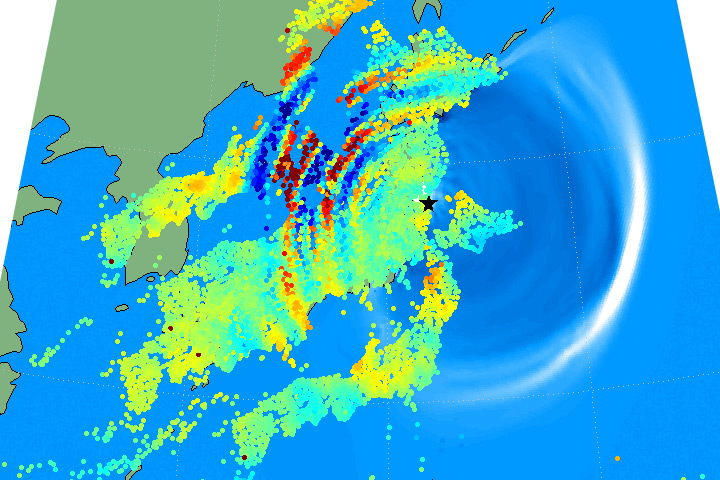
Washington: The massive earthquake and tsunami that hit Fukushima, Japan, last year wreaked havoc in the skies above as well, disturbing electrons in the upper atmosphere, the National Aeronautics and Space Administration reported. The waves of energy from the quake and tsunami that were so destructive on the ground reached into the ionosphere, a part of the upper atmosphere that stretches from about 80 to 805 kilometres above Earth's surface. Images released by NASA showed how the earthly disturbances from the March 11, 2011, quake and tsunami were echoed in the movement of electrons far aloft. Reuters
It's been a busy news time throughout the Globe. Plenty of things happening, from Democratic Republic of Congo to Islamic Republic of Iran. Our attention is riveted to the world's hot spots. With attention given over from time to time to the irrelevant but entertaining. The world loves nothing quite so much as gossip, the narrative of what's happening where it shouldn't be happening, and what we cannot do about it.
And so, if something alarming takes place, say, on the scale just about of the Fukushima nuclear reactor meltdowns - admittedly that came complete with impossible earthquake and monstrous tsunami for added horrific detail causing a huge loss of life and human and animal despair and displacement - but with no storyline about the accidental underwater explosions of nuclear devices, it can be kept relatively quiet.
For awhile, in any event. For someone, somewhere, with news sense quivering, will discover some wayward details and diligently searching for the devil's details will end up divulging what has occurred. Yet despite the story being publicly aired, there has been little reaction. Still, the event is notable for its hugely disruptive, destructive potential had disaster evolved from an incendiary excitation.
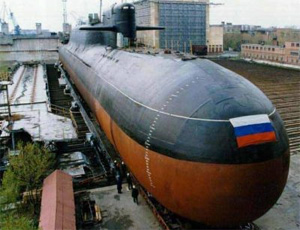
K-84 Yekaterinburg. Photo from submarine.id.ru
Russia came close to nuclear disaster in late December when a blaze engulfed a nuclear-powered submarine carrying atomic weapons, a leading Russian magazine reported, contradicting official assurances that it was not armed. Russian officials said at the time that all nuclear weapons aboard the Yekaterinburg nuclear submarine had been unloaded well before a fire engulfed the 167-metre vessel and there had been no risk of a radiation leak.
But the respected Vlast weekly magazine quoted several sources in the Russian navy as saying that throughout the fire on December 19 the submarine was carrying 16 R-29 intercontinental ballistic missiles, each armed with four nuclear warheads. Neither the Russian Defence Ministry nor the office of Deputy Prime Minister Dmitry Rogozin, who has responsibility for military matters, would immediately comment on the report.
Nuclear submarine fire left Russia on ‘brink of the biggest catastrophe since the time of Chernobyl’ in December: report
ReutersFeb 14, 2012 – 5:24 PM ET | Last Updated: Feb 14, 2012 6:02 PM ET
AFP/Getty Images
Crew trying to extinguish a fire on board the Russian nuclear submarine Yekaterinburg docked at the closed Roslyakovo military area of the port of Sveromorsk on Dec. 29.
Now there's an event that shook the world. Of course there was no one around at that time who witnessed it, to make a record of it, to express their astonishment and fear, to carry the legend forward through time and recorded history. On the other hand, there was a presence that took note of what occurred. And did pass on throughout the historical fossil record that something amiss had once taken shape on this Earth.
And that something resulted in a geological and paleontological record that is just now, 250,000 millions of years later, being recognized and investigated and parsed for posterity. Actually, posterity has taken care of it. For here we are, with all our scientific capability, an intelligent investigative, scientific race of animals with big brains and opposable thumbs, capable of visualizing through decipherable evidence, an historic event that wiped out almost all lifeforms on Earth.
We know so little of what occurred all that time ago, for we ourselves did not exist then. But what did occur possibly had the potential of such complete devastation that nothing might have survived and the opportunity for new life forms to become viable might also have been so impacted that we would never, over aeons of time, have resulted. There are many, no doubt, who claim the world would have been a better place without us.
Grim, forbidding, barren, with no discernible life forms. Is that better? Canada's High Arctic islands are presenting a record of ash deposits and fossils affirming the disappearance of living organisms coinciding with a vast period in the timeless past when in present-day Siberia, a massive volcanic eruption occurred. A group of science writers have published their study in the Geological Society of America Bulletin, explicating how it was that Earth "almost became a lifeless planet."
In “The Great Dying” 250 million years ago, the end came slowly The geology of Griesbach Creek in the Arctic tells an ancient tale of slow extinction. Credit and Larger Version
But when the cataclysmic upheaval occurred, its results were nowhere like immediate, or even gradual as we might imagine a collapse and dying-off taking place in a period of months, even years. The study issued by the National Science Foundation, the U.S. agency that funded the Arctic research, together with NASA and Canada's NSERC research council, demonstrate that "mass extinctions need not be sudden events".
The belief that noxious fall-out occasioned as a result of the Siberian volcanoes eruptions may indicate that mercury in the environment resulted in deadly oceanic acidification, contributing to the extinction that resulted, has arisen. It is called the Great Dying, a "runaway greenhouse event", resulting from the Siberian volcanoes.
New evidence from an Ellesmere Island fiord points to primitive sponges having disappeared from the fossil record fully 100,000 years before other known species extinctions as a result of those eruptions.
"We're not sure how long the greenhouse effect lasted, but it seems to have been tens or hundreds of thousands of years", according to University of Cincinnati geologist Thomas Algeo, co-author of the GSA Bulletin study. Extinction evidence previously studied from China and elsewhere seemed to lead to the conclusion that the mass die-off "was generally abrupt". And that conclusion is being re-written.
"Based on such observations, it has been widely inferred that the extinction was a globally synchronous event."
Like folk legends of the Biblical-era-described Flood. Something that occurred at a time when humans were present and passed on dim memory of that historical record, as a globally synchronous event. The dinosaurs before us haven't left us any messages writ on stone about what occurred when a massive space object is said to have impacted Earth wiping out most species as a result of the dust storm shutting out the sun.
Science, observation and speculation. Theories and suppositions. Intelligent analyses.
"Remembering that I'll be dead soon is the most important tool I've ever encountered to help me make the big choices in life. Your time is limited, so don't waste it living someone else's life."
The death of Steve Jobs has shocked the world. He was, after all, still a young man. He was also, clearly, an ingenious, industrious innovator. Unpretentious and completely absorbed in the challenges of emerging technology. Technology which his genius helped to shape. Revolutionizing the world of communications and entertainment in a way that impacted everywhere, everyone.
What inner demon motivates such people? When their focus is all-consuming and geared toward manifestly introducing new concepts and new realities to the world through technological innovation that few others could match. And those who could, could not match his fervour and the level of his dedication. He co-launched a technological empire, in Apple, now valued at $350-billion.
He does have his match, of course, in Bill Gates of Microsoft fame. Bill Gates and his wife Melissa have done, on another scale entirely, something that Steve Jobs never appears to have considered approaching; using his vast wealth to improve the world in other ways, unrelated to the advance of technology, but completely related to humanity's most elemental needs.
To each his own. Technology was his goal in life, its advancement, the capacity to go where none had imagined before him. Philanthropy clearly was not a motivating factor in what he attempted to achieve. He derived his excitement and satisfaction from forging new links and applying what he could foresee to forwarding those advances.
Unveiling, to loud exhalations of surprised applause, scintillating new technological devices to an avidly waiting world of consumers anxious not to miss out on the latest, the newest gadgetry gave him great pleasure, leading him to more of the same. He was the consummate consumer marketer.
Perhaps it was his personal history as a beloved adopted son of two lower-middle-class parents, understanding that his natural parents chose to surrender him as a newborn that shaped his vision of himself. It cannot have helped that his biological parents who had given him up for adoption when they were fellow university students later married and had another child.
The obvious love and care that his adoptive parents lavished on the young boy seems not to have satisfied something deep within him that rebelled against having been rejected initially. But his was an unorthodox mind, at a rebellious time in social history in any event.
His restlessness and avid curiosity about the world, and his fascination with technology combined, in any event, to produce a truly unique personality.
Steve Jobs
Labelled both "soft-spoken and gracious" and arrogant
Never met his estranged Syrian father
Denied paternity of his daughter for years
Dropped out of university, flirted with Buddhism
Visited India and came back with a shaved head
Dabbled in psychedelic drugs and primal scream therapy
The Nobel Prize Committee has been busy naming recipients for the yearly event. Perhaps they're not aware, not quite conscious of what they're doing in naming names and declaring prize-winners. They've fallen into a trap. It's that Jewish agenda at work again, to claim the podium on any and every occasion possible. For the final purpose, of course, of taking over the world.
Israeli scientist Daniel Shechtman won the 2011 Nobel Prize in Chemistry "for the discovery of quasicrystals," the Royal Swedish Academy of Sciences announced Wednesday. Dr.Shechtman is a professor at the Technion - Israel Institute of Technology. His discovery, which was made in 1982, has "fundamentally altered how chemists conceive of solid matter," according to the academy.
Ariel Schalit / AP
Israeli scientist Daniel Shechtman poses for photographers during a news conference at the Haifa Technion, Israel, Wednesday, Oct. 5, 2011. Shechtman won the 2011 Nobel Prize in chemistry on Wednesday for his discovery of quasicrystals, a mosaic-like chemical structure that researchers previously thought was impossible. (AP Photo/Ariel Schalit)
Three scientists who "revolutionised" understanding of how the body fights infection have shared this year's Nobel prize for medicine. Bruce Beutler, of the US, Jules Hoffmann from France and Ralph Steinman from Canada all shared the prize. Profs Beutler and Hoffman discovered how the body's first line of defence was activated. Prof Steinman discovered the dendritic cell, which helps defeat infection.
Ralph Steinman - a great scientist, an untimely death. Photo credit: Rockefeller University
As though that's not enough of a warning to those who are innocent of the true purpose of worldwise Jewry, yet another award has been announced. That of three astrophysicists whose remarkable discovery has given them, too, outstanding recognition. Joining the already crowded podium of prior-announced Nobel laureates over the years.
Three researchers behind the discovery that our Universe's expansion is accelerating have been awarded this year's Nobel prize for physics. Saul Perlmutter and Adam Riess of the US and Brian Schmidt of Australia will divide the prize.
At least 181 Jews and people of half- or three-quarters-Jewish ancestry have been awarded the Nobel Prize,1 accounting for 22% of all individual recipients worldwide between 1901 and 2010, and constituting 36% of all US recipients2 during the same period.3 In the research fields of Chemistry, Economics, Physics, and Physiology/Medicine, the corresponding world and US percentages are 26% and 39%, respectively. Among women laureates in the four research fields, the Jewish percentages (world and US) are 38% and 50%, respectively. Of organizations awarded the Nobel Peace Prize, 25% were founded principally by Jews or by people of half-Jewish descent. (Jews currently make up approximately 0.2% of the world's population and 2% of the US population.)
Chemistry (31 prize winners, 20% of world total, 27% of US total)
Economics (28 prize winners, 42% of world total, 55% of US total)
Literature (13 prize winners, 12% of world total, 27% of US total)
Peace (9 prize winners, 9% of world total, 10% of US total)4
Physics (47 prize winners, 25% of world total, 36% of US total)
This represents a general opinion site for its author. It also offers a space for the author to record her experiences and perceptions,both personal and public. This is rendered obvious by the content contained in the blog, but the space is here inviting me to write. And so I do.