Offending Nature, Endangering Humanity
"I'll never forget the moment Kohli left it up there.""I told him, 'You're making a huge mistake. this is going to go very badly. You have to bring that generator down.""You can't leave plutonium by a glacier feeding into the Ganges!""We were trained to do it fast [unloading seven radioactive fuel capsules powering an electric generator]. At the time, I didn't quite grasp the importance.""The Sherpas loved them. They put them in their tents. They snuggled up next to them [for warmth]."Jim McCarthy, lawyer, American rock climber"Maybe two or three people in the entire [Indian] government knew about this.""[The government's intense fear that China was going nuclear led it to acquiesce]. You see, we had just lost a war to China -- no, not just lost, we had been humiliated."R.K. Yadav, former Indian intelligence officer"I told them whoever is advising the C.I.A. is a stupid man."The C.I.A. kept us out of the picture. Their plan was foolish, their actions were foolish, whoever advised them was foolish.""The whole thing is a sad chapter in my life.""Even if the device doesn't explode, it is still out there, and that in itself creates a sense of fear."Captain M.S. Kohli, high-ranking Indian naval officer

"Come back quickly. Secure the equipment. Don't bring it down",
ordered Captain M.S. Kohli, monitoring a special mission from advance
base camp led by the C.I.A. with Indian collaboration, in 1965. They had
trudged up Nanda Devi carrying with them an antenna, cables and a
SNAP-19C portable generator designed in a top-secret lab, powered by
radioactive fuel. They planned to set up a surveillance device to spy on
China's mission control, for intelligence on their nuclear program.
The
23-kilogram, beachball-sized nuclear device would produce the
electricity to operate the device. The team of American and Indian
climbers had struggled their way up the mountainside in September, in a
howling wind, crampons clinging to the ice, a 600-meter drop below, just
before the onset of the dangerous winter storm season. Just as the
climbers meant to push for the summit over the razor-sharp edge, in
swept a blizzard bringing whiteout conditions.
"We were 99 percent dead [when the blizzard hit]. We had empty stomachs, no water, no food.""The snow was up to our thighs.""In a situation like that you can't carry an extra needle."Sonam Wangyal, Indian intelligence operative
 |
| Nanda Devi peak in India |
Captain
Kohli gave instructions to leave the generator behind to save the lives
of the climbers. They secured the gear on an ice ledge, tying it down
firmly, before descending down the mountain, fatigued and desperately
anxious to survive. The nuclear device they left behind contained close
to a third of the total amount of plutonium held in the Nagasaki atomic
bomb. And that was the last time anyone saw the abandoned generator
containing Pu-239, an isotope and larger amounts of Pu-238, a highly
radioactive fuel.
No
one outside those directly involved had any idea of this drama and how
it played out. Until the late 1970s when an investigative reporter dug
around for details and published his discovery. To the present, people
in India demand answers; high in the Himalayas villages in remote
settlements -- and environmentalists and politicians fear that the
nuclear device could slide into a stream of icy water and dump
radioactive material into the headwaters of the Ganges, the sacred
Indian river that hundreds of millions of people depend on.
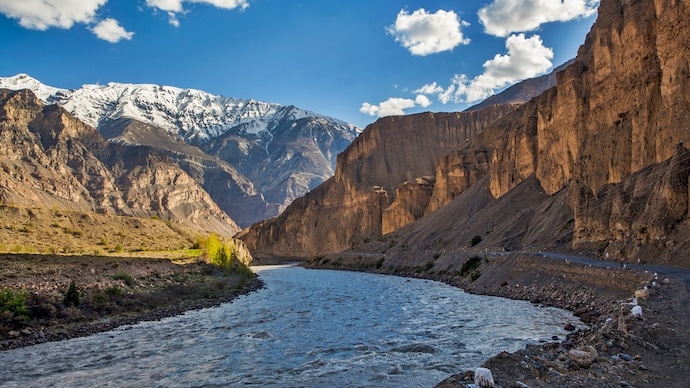 |
| The question remains How dangerous is the missing device? Could it poison the headwaters of the Ganges, one of the world’s largest rivers? India Today |
The
plan was to set up a secret sensor at the top of a mountain to
intercept radio signals from Chinese missile tests launched from the Lop
Nur testing grounds, some 1,500 kilometers away in Xinjiang. Nanda Devi
stands 7,815 meters in height; a mere handful of people had reached its
summit located within India, towering above the Chinese border; a
strategic location. In mid-September the American and Indian climbers
flew by helicopter to the foot of Nanda Devi, around, 4,570 meters
above sea level.
They
faced an ascent of over 3,000 vertical meters along a knife's-edge
ridgeline. A time shortage to carry out the mission before winter storms
led them to bypass acclimatizing, the result of which was altitude
sickness striking the climbers. The porters were all eager to carry the
plutonium capsules, for the warmth they generated. No one ever
explained to them what a deadly threat they represented. The climbers
themselves were never warned about the radioactive material.
Pushing
the abandoned generator into an ice cave, everything was tied down with
metal stakes and nylon rope. In spring of the following year Captain
Kohli and another C.I.A. team returned for the device. When they scaled
Nandi Devi there was no generator. The entire ledge of ice and rock was
no longer there, likely sheared away by a winter avalanche. Captain
Kohli organized search missions in following years using alpha counters
to measure for radiation, telescopes to scan the snow, infrared sensors
to pick up any heat and mine sweepers to detect metal. Nothing was
revealed.
Then
in February of 2021 a massive rock wedge broke from a mountain close by
Nanda Devi, unleashing a surge of water, mud, ice and more rock
thundering through the narrow Rishiganga gorge. Over 200 people were
killed in the landslide, many of them employed at a hydropower dam. The
water surge was so gigantic the dam was swept away. "It has to be that generator. What else can there be?"
stated Captain Kohli, noting the heat it generated to melt the ice
would allow it to sink deeper and deeper and cause geological
instability.
"The radioactive material is right there, inside the snow.""Once and for all, this device must be excavated and the fears put to rest."Satpal Maharaj, Uttarakhand tourism minister
 |
| Nanda Devi and Valley of Flowers National Parks in Uttarakhand, India, are UNESCO World Heritage Sites celebrated for their breathtaking natural beauty and biodiversity. |
Labels: Chinese Atomic Program, CIA Surveillance Plot, Indian Himalaya, Nanda Devi, Plutonium Powered Generator, Potential Danger
posted by Pieface @ Tuesday, December 30, 2025


 "Hundreds of trucks and trailers have been standing idle since October 11 near the busiest border crossing between Pakistan and Afghanistan, after deadly clashes resulted in suspension of trade")