China Concerns
"The Japanese government compiled a report on the South Pacific on May
17, affirming its targets of "maintaining and promoting environments
for realizing a free and open Indo-Pacific" and "ensuring the stability
and safety of the region."
"Free and open Indo-Pacific," an
expression frequently used by Japanese Prime Minister Shinzo Abe,
generally means the security of ocean routes from the Indian Ocean to
the Pacific through Southeast Asia. Stressing the importance of the rule
of law and freedom of navigation, the expression is aimed to check
China which is expanding its presence in the area."
"China
is sparking conflicts with countries around the South China Sea as it
builds artificial islands there as military outposts. The Japanese
government's report adopts the same expression out of concern that China
may resort to the same strategy in the South Pacific."
"China
envisions a line of defense from Japan's southern Ogasawara Islands to
Papua New Guinea via Guam and Saipan as its "second island chain"
strategy. An advisory organ to the U.S. Congress said in a report last
year that China is capable of rivaling the U.S. in air, sea and ground
forces in the island chain. In fact, China is expanding its military
influence to the South Pacific."
SUSUMU KURONUMA, Nikkei Asian Review
 |
| Japan Prime
Minister Shinzo Abe, center, poses with the leaders of Pacific island
countries in a photo session during their meeting in Iwaki, Fukushima
Prefecture, in May 2018. |
"Establishing a base in our neighbourhood would be a low-cost,
low-risk way for China to show off its growing military and diplomatic
reach and clout. Moreover, by ignoring the noisy complaints that would
surely emanate from Washington, Beijing would show that it is willing to
defy the United States."
"And it would send an unambiguous message to us here in Australia,
signalling Beijing’s rejection of our claims to our own sphere of
influence in the South Pacific, and sending a stark warning of China’s
reach and its capacity to punish us if we side too vociferously with the
US or Japan against it."
Hugh White, The Guardian
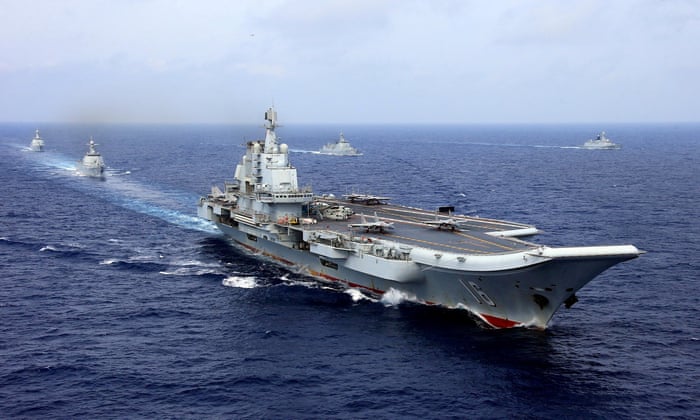 |
| China’s aircraft carrier Liaoning takes part in a military drill of
Chinese People’s Liberation Army navy in the western Pacific Ocean in
2018. Photograph: China Stringer Network/Reuters |
Australia and Japan, once bitter enemies, now recognize in one another partners in a quiet offensive against a rising China's ambitions to dominate the western Pacific. China's economic clout has bought it alliances in the Pacific through investments and loans and the gratitude of Pacific island nations. China's steadily growing fleet is next in size only to that of the United States, lacking but the power of the U.S. major fleet units. China's dominance is already on view; its ambitions clear, leaving its neighbours in a state of high anxiety.
Japan and Australia have a robust trading relationship through the 2015 Japan-Australia Partnership, Australia is now Japan's fourth-largest trading partner, Japan Australia's second-largest trading partner. And they both, of necessity and of geography, have a large trading relationship with China. But then, which country globally does not?
Now the two countries are looking at another area of cooperation, examining a formal partnership in building an architecture of security through military cooperation, hoping in the process to invite other Asian countries, perhaps even European nations to join them. In the absence of a U.S. ongoing commitment to counter the growth of China's military, its intentions and influence among Pacific Island nations, the two countries see the vital utility of working together purposefully.
The historic agreement whereby the U.S. has its protective alliance with New Zealand and Australia, and that which Japan has so long relied upon with the U.S. commitment to Japanese security have both been tipped slightly askew with statements emanating from the White House in the last few years. The U.S. pulled its surprise removal from the Trans-Pacific Partnership. And seemingly snap decisions upending generations of treaties and long-held security suppositions have grown an aura of uncertainty.
Both Japan and Australia are trying to prepare themselves psychologically as well as practically for the potential of a post-U.S. Pacific, an absence of balance against the rising power of China. Geopolitical rivalry, particularly that between Japan and China recalls the turn of the 20th Century when an aggressive Japan invaded Korea and China, neither able to withstand the onslaught of a militarily assertive nation hungry for power.
Now it is Japan that has been long quiescent, and China in the ascendancy. The Chinese Peoples Liberation Army Navy, the largest in the world in numbers of seagoing ships still does not compare to striking power of the U.S. Navy with its carrier battle groups and large nuclear submarine fleets, but it is inexorably catching up, to the concern of its neighbours, in particular Australia and Japan.
Their concern is that should the U.S. withdraw from the far Pacific not only Australia and Japan but South Korea, Vietnam, Singapore, the Philippines and other island nations will be challenged to push back against China, or simply resign themselves to the inevitable. Both Australia and Japan have their own considerable naval power; Australia with 31 major fleet units -- submarines, assault landing ships, frigates, destroyers. While Japan has the third largest navy in the world with 65 frigates, destroyers, submarines and other ships.
But a challenge to China's ambitions of total conquest? Doubtful.
 |
| Australia's then-Prime Minister Malcolm Turnbull, talks with his Japanese
counterpart Shinzo Abe during a meeting of Japan's National Security
Council at Abe's official residence in Tokyo. 2018. Picture: AP |

Labels: Alliance, Australia, China, Domination, Japan, Security, Trade
Changing Horses in Midstream
"Turkey must choose — does it want to remain a critical partner in the
most successful military alliance in history?"
"Or does it want to risk the security of that partnership by
making such reckless decisions that will undermine our alliance?"
David Satterfield, U.S. nominee ambassador to Turkey
"The Americans are confused. What we hear from the American Pentagon,
the State Department, is it [the S-400 sale] will create troubles and
reduce trust and cause sanctions. But the American president has said
nothing."
"If [U.S. President Donald] Trump says don't buy [the S-400
missiles] it will carry much more political weight.
However, as long as there is no statement from the American president,
there will probably be no return from this deal."
"I was speaking to American diplomats. I told them, 'It's America's
choice — do they want to hit Turkey with sanctions that will make an
unstable Turkey, that will destabilize the rest of the region'?"
Huseyin Bagci, international relations professor, Middle East Technical University, Ankara
"It's like a slow-motion car crash."
"It's even difficult now to call
Turkey and the U.S. allies, so I am not very optimistic about the
relationship."
Former senior Washington-Turkish diplomat Aydin Selcen
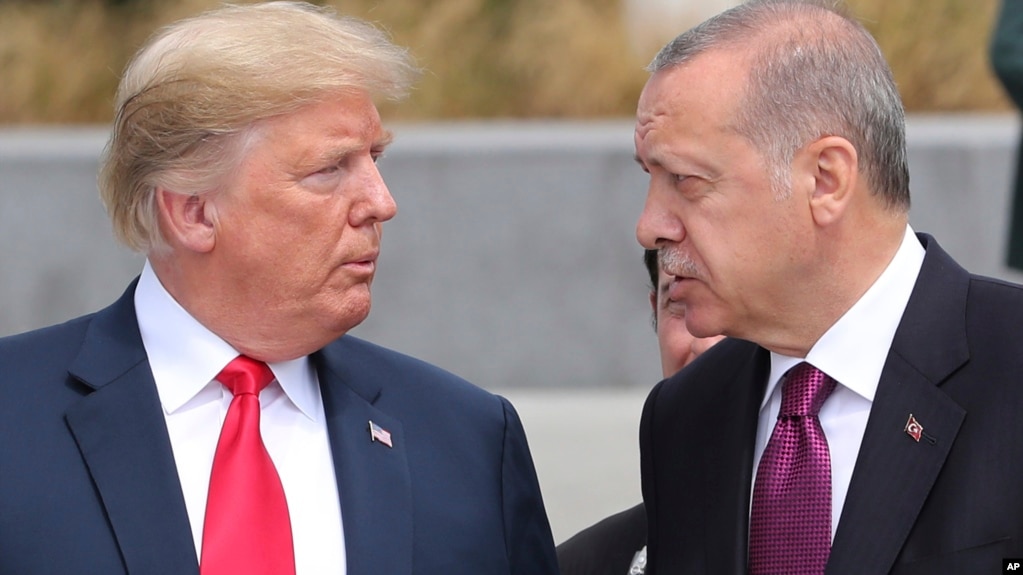 |
| President Donald Trump, left,
talks to Turkish President Recep Tayyip Erdogan, right, as they tour the
new NATO headquarters in Brussels, Belgium, July 11, 2018. |
Turkey's commitment to Russian S-400 anti-aircraft missiles has the U.S. claiming the missiles not to be compatible with the new F-35 Stealth fighter. Turkey has its commitments there, too as part of the F-35 consortium from its very beginning. The manufacture of F-35 parts in Turkey represents part of its role in the consortium, one that favours Turkey's industry and workforce. The first two of 100 aircraft has already been 'delivered' to Turkey, despite that they remain still in the United States.
The simple fact being that the technology of the two systems, the Russian S-400s and the F-35 will 'bleed' into each other with the Russians gaining invaluable insight into the capabilities in the underlying technology of the F-35s, and the U.S. feels, not without reason, that its advanced technologies must be shielded from Russia's advantaging themselves of what is the property of the U.S.
Therefore, delivery of Turkish-manufactured F-35 parts has been halted for the U.S. will not accept them.
The American military leaders have themselves urged the U.S. executive administration that the decision to sell the advanced fighter to Turkey must be cancelled. Other NATO nations also feel uneasy about Turkey's controversial decisions interpreting its position as a deliberate snub of NATO in favour of warming relations with Russia. To the extent that Turkey's lack of commitment to the group bespeaks its greater interest in forging firmer ties with NATO's perceived enemy.

Turkey, once considered to be geographically important to NATO, was thought of as representing a
"southern flank" to the Alliance, to bolster the northern shore of the Mediterranean, to contain the Soviet Union. Turkey's Incerlik Air Base on its southern shore, close to Syria, was another asset which remains for the time being a major U.S. and NATO base, holding hundreds of American tactical nuclear weapons.
But that was then, and this is now, and now Turkey is vastly different as a link between the Middle East and Europe, considered on the brink of Eastern Europe, a Muslim country of influence. At that time, a moderate democracy, Muslim-style, its free-enterprise system reflective of the West, a result of the post-Ottoman Empire, when Mustafa Kemal Ataturk turned it away from conservative Islam toward a simulacrum of a Western democracy, sharing Western values, with a free press and independent courts and representative government.
Turkey now is an Islamist nation, its Ataturk past slow dissolving back into its Ottoman Empire persona. Gone the free press and the independent judiciary in favour of full 'control' in the hands of Erdogan's Justice and Development Party headed by himself in perpetuity. Social repression, an ongoing war of attrition against its Kurdish population, now more accurately reflect Erdogan's new Turkey.
Recep Tayyip Erdogan is a firm supporter of the Muslim Brotherhood, violently disruptive group that came out of Egypt in the early 20th Century; the Salafist Islamist group supportive of jihad. As far as Erdogan is concerned, Hamas represents a responsible government in Gaza, and Israel is an aggressive tormentor of Palestinians.
"Christian" Europe seeks to undermine Muslim authority and Erdogan will not have it; the Empire will rise again under his rule.
 |
| Turkish President Recep Tayyip Erdogan and Russian President Vladimir
Putin attend a ceremony to mark the completion of the sea part of the
TurkStream gas pipeline in Istanbul on 19 November (AFP) |
Labels: Alliance, Incompatibility, NATO, Russia, United States
An Alliance Undiminished, Merely Blemished Through A Dark Lens
"No one any longer believes that Trump cares about the views or interests of the allies."
"It's broken."
Senior German official
"Two years of Mr. Trump, and a majority of French and Germans now trust Russia and China more than [they do] the United States."
Karl Kaiser, analyst, German-American relations
"It's very odd to talk of American leadership of the alliance when it's Trump who has caused the crisis."
"The Trump administration is seen by many Europeans as chiefly responsible for the tensions and the weakening of the West."
Marietje Schaake, Dutch member, European Parliament
"[For Europeans, the divide went] to the heart of how we view international relations and our national interest."
"We're small and understandably need partnership both inside Europe and outside, with NATO."
"We want to believe it will be fine again later because we have no alternative."
Nathalie Tocci, senior adviser, European foreign policy chief, Federica Mogherini
 |
| The 55th Munich Security Conference, in Munich, Germany, 15 February 2019. [EPA-EFE/RONALD WITTEK] |
U.S. President Donald Trump is no gift as a politician much less a head of government, let alone president of the most powerful nation on Earth, but he has made some decisions that make sense if you're an American; placing America first. Europe may have favoured his predecessor but Barack Obama as President of the United States withdrew his country from the place it had in world affairs just as much as his successor has done, but for different reasons.
Both may have stated they have the larger interests of their country at heart, but President Obama apologized for U.S. strategic interests while President Trump will never fault his country for leading as he wills it to.
Perhaps European leaders were more comfortable with Mr. Obama because he was malleable, prepared to bend and to listen and to exercise his will in tandem with that of his allies, although he had no compunction over jettisoning some of his country's allies when the mood took him. He could, however, be relied upon, to listen to and accede to the 'progressive' agenda of the EU.
And so the world-class problem of how to deal with the Islamic Republic of Iran's aggressive support for terrorism could be overlooked for the fiction of restraining its nuclear program.
Federica Mogherini's supine, simpering submission to the Ayatollahs of the Iranian Revolution make her a somewhat more unsavoury character in many respects than is Donald Trump whose many and manifest faults lie in other directions altogether. His decision to withdraw from the agreement with Iran and re-institute sanctions had made life very difficult for the eager European investors in Iranian oil.
Europe, so long dependent on U.S. muscle and armour for protection against the rapacious re-entry of the Russian Federation to the world power structure doesn't much care for America First.
There is little likelihood, despite Donald Trump's incessant loose words emanating from a distracted mind accustomed to grabbing impressions and certainties from questionable sources, not the least of which is his level of understanding of world affairs to begin with, that the trans-Atlantic alliance is in any trouble.
The strain that has been occasioned by Mr. Trump's sloppy analysis and errant conclusions aided by his propensity to blurt half-baked impressions for public disclosure hasn't helped, but brighter minds should be able to interpret them more cogently than he can express them.
The presence of over 40 American lawmakers at the annual security conference in Munich to assuage fears should have succeeded in doing so, even if their expressions were mostly those of faith from Democrats that the Republican administration of President Trump would be short-lived. This is one time that U.S. politics intersects neatly with European expectations in a commonality of detestation for one man and a collective fear of his unbridled, untutored impulses.
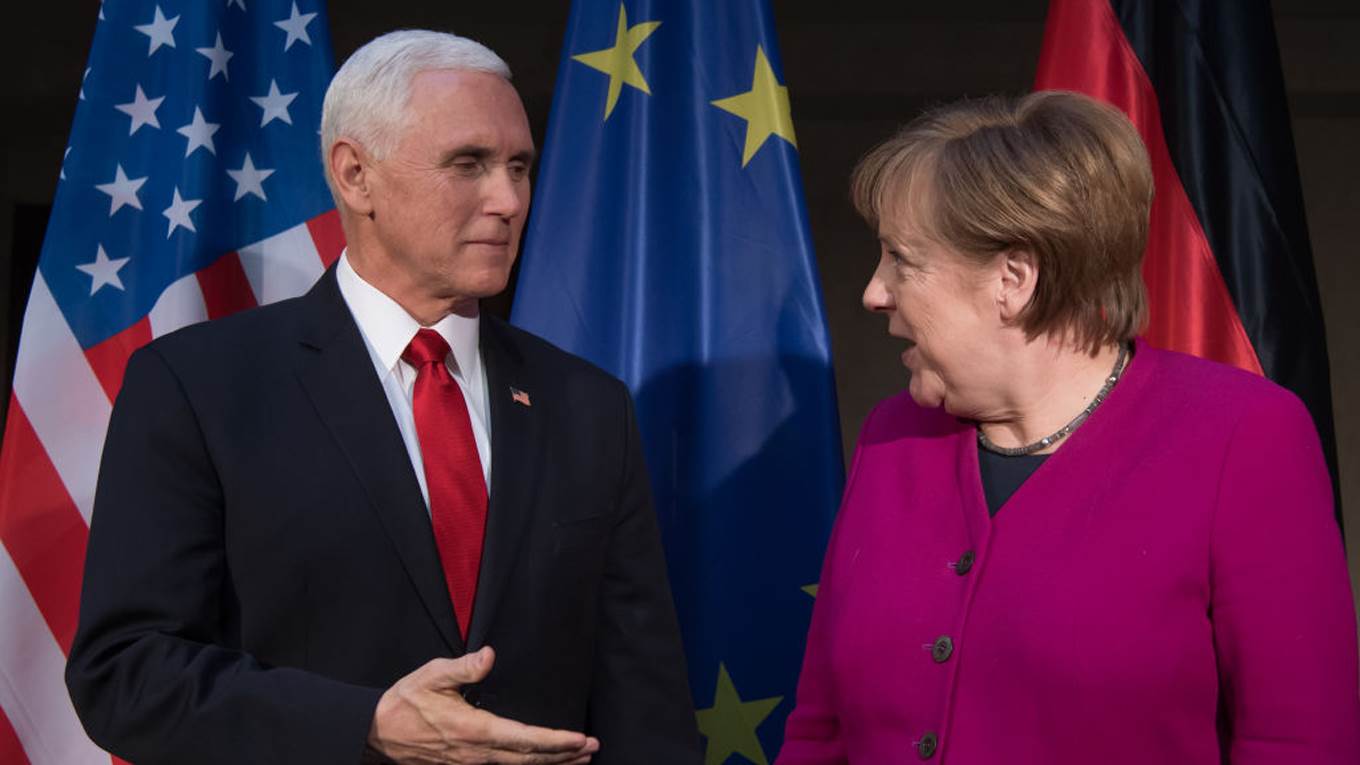
Vice-President Mike Pence, speaking at the event, following German Chancellor Angela Merkel, no champion of the U.S. president, predictably made no positive impression on the gathering with his exhortations to withdraw from the Iran nuclear deal. He's right, they're wrong, in viewing that agreement as tied to their security; it may be, but negatively.
Mr. Pence's point of view, self-interested as it is, was to praise his president and credit him with the restoration of American leadership which should perhaps have impressed his audience but failed to.
In this conference the two elephants in the room were China and Russia and their singular ambitions. Ambiguity in the Western alliance, claimed Jan Techau, director of the Europe Program at the German Marshall Fund in Berlin envisions a strategic vulnerability to the ambitions of Russia and China attuned to Europe's concern that a gap in reliance on American intervention has been created.
"When that protection goes, then this strategic space is up for grabs", he claimed moodily.
"In the post-Trump era, there is no return to the pre-Trump era. The status quo was Europe's security is guaranteed by the United States."
"That won't happen again."
Norbert Ropttgen, chairman, German Parliament, foreign relations committee
Labels: Alliance, China, Concerns, European Union, Russia, United States, Vulnerabilities


