Tuesday, May 16, 2023

Another Blighted Rescue of Quasi-Canadians

"There has been a loss of integrity in the Canadian immigration process."
"Most of these people have been living in Sudan for years."
"Sometimes they never really lived in Canada and don't speak English or French."
Unidentified insider source asking for anonymity 

"[Statistics  on the phenomenon known as] Canadians of convenience [during the Lebanon evacuation are not readily available."
"I don't know how common it is, but it's likely not negligible. We only tend to get a sense in cases like Lebanon and now Sudan."
Andrew Griffith, former director general, Immigration, Refugee and Citizenship Canada
Signs of a ceasefire in Sudan are scarce as the two warring factions have returned to fighting that has temporarily derailed rescue attempts for Canadians still trapped in the country.  CBC

Thousands of Lebanese-Canadian citizens were evacuated at Canadian government expense in 2006 during the war in Lebanon, to bring them back to safety in Canada. Most of whom, after the fact, turned out to be citizens in name only, who had acquired and maintained citizenship as a type of 'insurance' in case of emergencies. In this realm of convenience citizenship, Chinese Hong-Kongers represent another group from abroad who famously went to great lengths to acquire Canadian citizenship as a future haven should their lives in Hong Kong suddenly become 'complicated'.
 
For the Lebanese emergency, it cost $94 million for Canada to evacuate some 14,000 Canadians from Lebanon at war. Half that number returned to Lebanon when hostilities ceased. Now, in Africa there are sources suggesting there may be a repeat of this 'rescue' operation of 'citizens of convenience' in Sudan where a civil war has been unfolding. According to government figures, 550 people were flown out of Sudan to Kenya on Canadian evacuation flights.
 
Of that total, 175 were Canadian citizens or permanent residents. On flights organized earlier by other countries, another 210 Canadian citizens left. According to an individual familiar with the situation, it has emerged while the evacuees were being processed that as many as half of the 175 Canadian citizens and permanent residents happen to be refugees granted status in Canada who returned to Sudan, some continuing to claim welfare and child benefits.
 
Smoke rises from a stack atop a large multi-storey ship packed with people, under a pale blue sky.
A ferry transports some 1,900 evacuees across the Red Sea from Port Sudan to the Saudi King Faisal navy base in Jeddah, Saudi Arabia.  (Fayez Nureldine/AFP/Getty Images)

Some are refugees who are in the process of becoming Canadians, which means they should not have left the country to return to Sudan while the process has not yet been completed. All of the evacuees in Kenya were accommodated and cared for in hotels at Canada's expense. In the past five years, Canada accepted 2,120 refugee claims from Sudan; individuals who are accepted are given protection in Canada. If they return to their country of origin, however, they effectively relinquish refugee status.
 
Immigration, Refugees and Citizenship Canada had "no response to offer" when a spokesperson was approached for clarification on the matter. Nor could the government provide cost estimates of an operation involving the Canadian High Commissioner in Nairobi, the embassy in Cairo, Egypt, the embassy in Amman, Jordan, the consulate in Djibouti and 200 Canadian Forces on the ground in the region helping to expedite the 'rescue'. 
 
The Canadian portion of the relief effort has been described as "chaos" by sources in Africa. A C-130J Hercules transport aircraft left Jordan to head to Port Sudan on the Red Sea on a mission to retrieve stranded Canadians after the Wadi Seidna Air Base north of Khartoum was seen as too dangerous. According to a Forces spokesperson, Sudanese authorities reused to permit personnel to disembark, and the flight was forced to return to Jordan empty following a "diplomatic credentials mix-up".

After the fiasco in Lebanon, the-then Conservative government in Canada, instituted limitations on citizenship by descent, limiting it to one generation born outside Canada, revoking citizenship of thousands of Lebanese who obtained status through fraudulent means. Should it be established that some Sudanese evacuated to Nairobi have similarly cheated the system, they should have their citizenship invalidated.

Status can be revoked under the Canadian Citizenship Act, if it becomes clear that the person involved obtained citizenship by "false representation, fraud or knowingly concealing material circumstances". In Canada, refugee claimants must establish they have a subjective fear of persecution should they return to their home country. Those people who obtained Canadian citizenship for the purpose of escaping persecution in Sudan should not be in Sudan.

Canada has suspended its evacuation operation at a Khartoum airfield after a ceasefire unravelled and violence escalated, but Canadians are still stranded in Sudan and escape options are limited.   CBC


Labels: , , , , ,

Monday, February 14, 2022

High Alert in Eastern Europe

High Alert in Eastern Europe

"We're in a window when an invasion could begin at any time, and to be clear, that includes during the Olympics."
"Simply put, we continue to see very troubling signs of Russian escalation, including new forces arriving at the Ukrainian border."
U.S.Secretary of State Antony Blinken 

"I urge all Canadians in Ukraine to make the necessary arrangements to leave the country now."
"Our highest priority remains the safety and security of Canadians."
Canadian Foreign Affairs Minister Melanie Joly
 
"We are ready to continue results-oriented diplomacy that addresses the security concerns of the United States, Russia and Europe, consistent with our values and with the principle of reciprocity."
"We’ve continued to make that clear to Russia, in close coordination with our European allies and partners."
"We are also ready to respond decisively alongside those allies and partners should Russia choose to take military action."
White House National Security Adviser Jake Sullivan
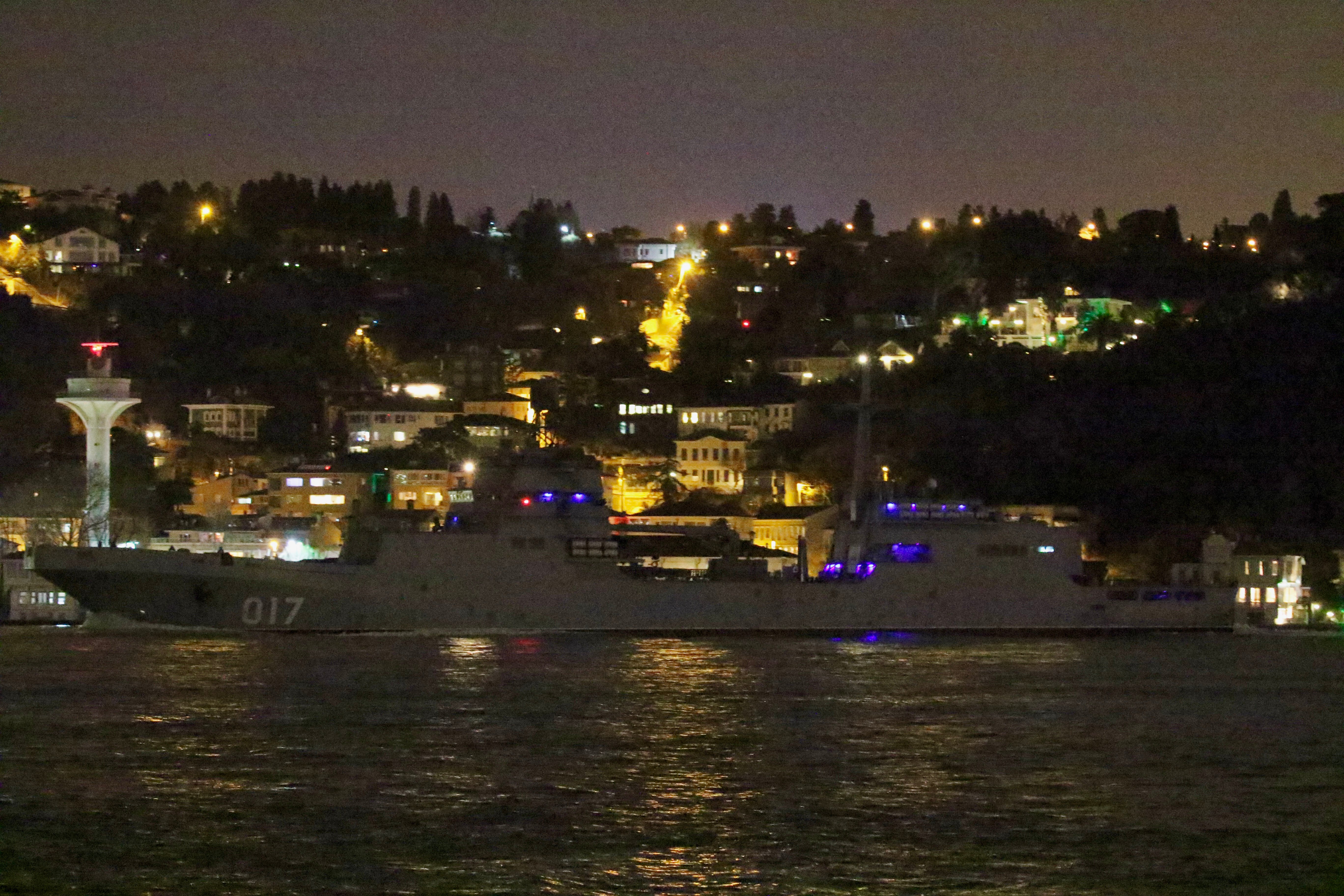
van Gren-class amphibious warship RTS Pyotr Morgunov (117) entering the Black Sea on Feb. 9, 2022. Photo by Yörük Işık‏ used with permission
 
Canada's Foreign Affairs department at the beginning of February 'asked' Canadians to avoid all travel to Ukraine "because of the ongoing Russian threats and the risk of armed conflict". Any Canadians already in Ukraine were urged to leave the country "while commercial means are still available". That message has undergone a stark change, the government now urgently calling all Canadians to immediately leave Ukraine. 
 
In effect, following the United States and United Kingdom reflecting fears of an imminent Russian invasion.

In the United States, officials warn that Russian President Vladimir Putin could launch an attack imminently on Ukraine. White House National Security Adviser Jake Sullivan Friday announced that Russia has sufficient forces gathered now to conduct a major military operation against Ukraine; that an assault was likely to begin "any day now".
 
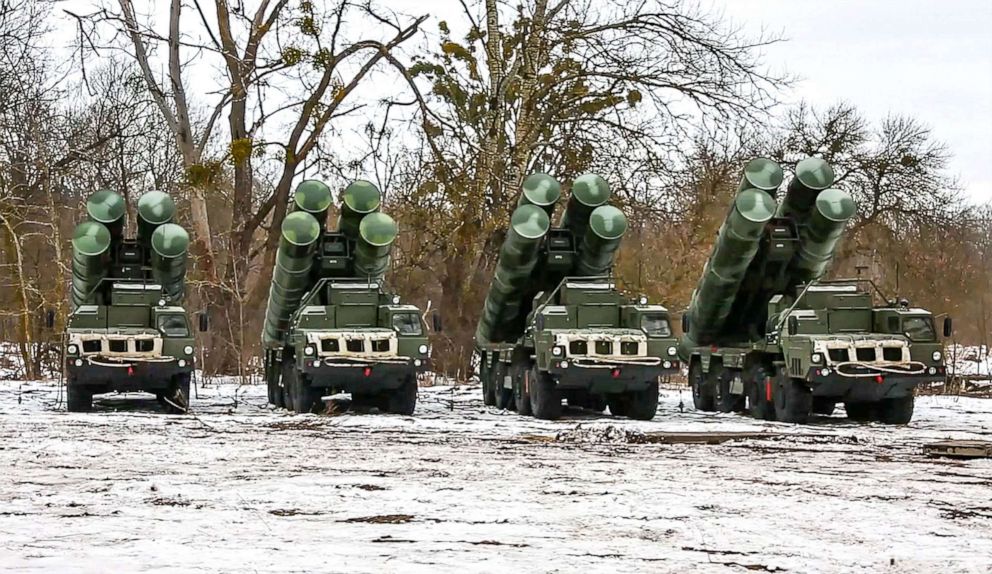
PHOTO: This handout video grab released by the Russian Defense Ministry on Feb. 9, 2022 shows combat crews of the S-400 air defense system taking up combat duty during joint exercises in Belarus.
Russian Defense Ministry/AFP via Getty Images
This handout video grab released by the Russian Defense Ministry on Feb. 9, 2022 shows combat crews of the S-400 air defense system taking up combat duty during joint exercises in Belarus.
 
Speaking at a White House briefing no specific evidence was given, but Mr. Sullivan cited U.S. Intelligence belief that President Putin could order an invasion prior to the Winter Olympics in Beijing concluding. He spoke of the possibility of a rapid assault on Kyiv and that any Americans remaining in Ukraine should leave within the next 24-48 hours. A Russian invasion could begin with an air assault after which departure would be extremely difficult.

It is as yet not clear whether Mr. Putin has given an order to initiate an invasion A private American company's commercial satellite images showed new Russian military deployments at several sites close to the Ukraine border. President Joe Biden in  his starkest warning, stated he would not send troops to rescue any American citizens who chose to remain in Ukraine, in the event of a Russian assault. "Things could go crazy quickly", he said.
A uniformed soldier stands with an assault rifle in front of a dozen others
Dozens of civilians have been joining Ukraine's army reserves in recent weeks.(AP: Efrem Lukatsky)
 
A remote meeting was held by Mr. Biden with the leaders of Britain, Canada, France, Germany, Poland and Romania, along with NATO's and the EU's heads. With alarm spreading, British Prime Minister Boris Johnson along with a handful of other nations urged its citizens to leave Ukraine immediately. American officials believe the crisis could be approaching a critical point. Rhetoric from Moscow appears to be more belligerent.

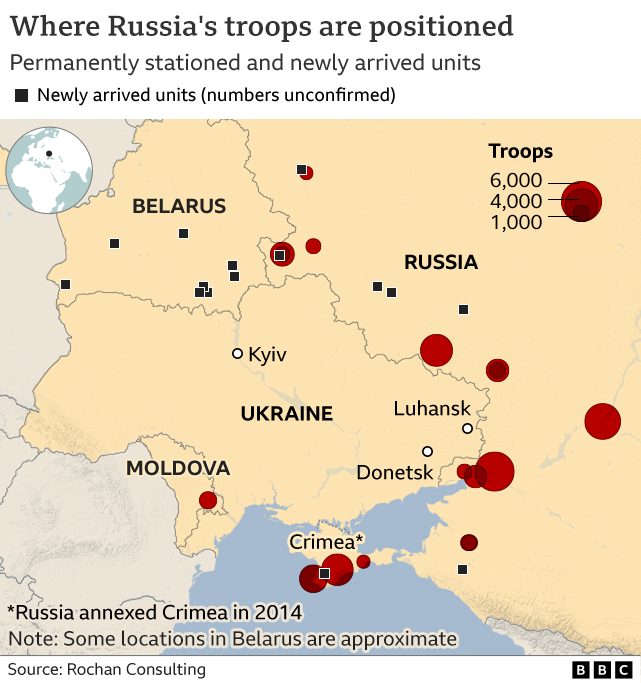
More Russian military equipment has been arriving in Belarus where Russa and its neighbour have been conducting joint military exercises and naval drills in the Black Sea. Six Russian warships are joining the fleet in the Black Sea. Japan, Latvia, Norway and the Netherland have informed their citizens they must immediately leave Ukraine. Israel is evacuating families of its embassy staff. 

Map shows where Russia's troops are positioned.


Labels: , , , , , ,

Saturday, November 20, 2021

Terrifying Flooding in British Columbia


These videos shared by Jordan Jongema to his Instagram detailed the devastation to his home in Yarrow and the conditions that stranded him and his dog Bowser on Monday overnight before crews rescued the pair.
These videos shared by Jordan Jongema to his Instagram detailed the devastation to his home in Yarrow and the conditions that stranded him and his dog Bowser on Monday overnight before crews rescued the pair. Photo by JORDAN JONGEMA / INSTAGRAM

Jordan Jongema
"Those ten hours were easily the most terrifying times I've ever experienced in my life."
"I had heard there were looters going around Yarrow to empty houses, so shame on me for staying just a few minutes too long to protect the place."
"As we were leaving, the water pooled over the road and it started like fountaining, like a stream. I could have been driving into a deeper pool so I just...went back to my house and we had to wait it out in there. And as time went by, it got worse and worse.”
"A massive wave of water started to rush [over the roadway and into his front yard]."
"By the time it was midnight, I was wading through the kitchen, swimming in the backyard up to my chest, trying to find any flotation devices. Pitch black and freezing cold water for hours."
"The fear of the pump station breaking and the Fraser River flowing through made me want to die. Bows and I lay on my bed with the water half-an-inch from covering it."
Jordan Jongema, B.C. flood victim, Yarrow, British Columbia
"I believe it was Coquitlam Fire or Coquitlam SAR, actually, went and got that dog right near the end of the [rescue] queue."
"He's a service dog and so the fellow was just over the moon."
"So it was really cool that they were able to pull that off. That was good customer service, definitely worth the risk."
Abbotsford Fire Chief Darren Lee
Bowser, a 120-pound Bernese mountain dog, is pictured in a rescue boat in the early hours of Tueday after he and his owner Jordan Jongema were rescued after flood waters breached his home and left the pair stranded.
Bowser, a 120-pound Bernese mountain dog, is pictured in a rescue boat in the early hours of Tuesday after he and his owner Jordan Jongema were rescued after flood waters breached his home and left the pair stranded. Photo by HANDOUT

British Columbia's Interior was  hit by a catastrophic rain event that started last Sunday with high winds and torrential rain. Between Sunday and Monday, more rain fell than normally would in a full month during the province's late fall rainy season. The local weatherman spoke of an 'atmospheric river' that drenched the province causing critical mudslides, rockfalls and floods leaving motorists stranded for 17 hours on highways between two road washouts. Rail lines were disrupted, bridges were washed out and so were highways.
 
Orders for evacuation went out for a number of places inundated by floods. Several hundred people stranded in their vehicles were airlifted by helicopter to safety. Farmers were desperately trying to lead their livestock to higher ground, many remaining behind on their farms despite orders to evacuate. The military was called in to provide logistical and rescue assistance. All of the province's many and varied rescue teams were tasked to endure unsafe conditions to rescue those trapped in flooded areas.
 
A person paddles a kayak past a submerged taxi after the major flood event in Abbotsford. More federal assistance is on its way to the province as reconstruction begins. (Ben Nelms/CBC)

Jordan Jongema was one of those trapped people. He and his dog Bowser, a 120-pound Bernese mountain dog, found themselves in a frightening impasse with rising flood waters. They were stranded when rising flood waters suddenly breached his home and property. He was in fact preparing to leave for safety from Yarrow where he lived, some 99 km east of Vancouver. He thought he had time to spare but was soon disabused of that reassurance. 
 
"A massive wave of water started to rush" over the road and into his front yard as he began pulling out of his driveway. With thoughts of his car being flipped by the debris-filled water he turned back, deciding that he and Bowser would stay where they were, safe at home while the water raged outside. Nature had other plans, as he soon discovered. The flood waters entered his house and by 1:00 a.m. reached up to his knees.

He thought about seeking respite from the rising waters on the roof of his house, but found himself struggling with trying to figure out how he might manage to get Bowser onto the roof. And then, an hour later, his phone battery died, leaving him feeling "emotionally butchered". He lay with Bowser on his bed, just minimally above the water level and no doubt imagining what might happen as the water kept inching up.

And then, at about 3:30 a.m., a boat sounded outside his window. He leaped to the window and shouted, shining a flashlight, hoping to attract the attention of whoever it was in the boat. As the rescuers in the boat edged close to the house, Jongema held Bowser up and shoved him out the window, then crawled himself out to the raft. One they reached dry land some kilometres distant, Jongema and Bowser were then driven to a safe site.

According to officials, eleven people in the vicinity that night were rescued overnight. Forty farmers chose to remain in the eastern portion of the Sumas Prairie, tending their properties and their livestock.

Farmers carry their livestock out of a flooded barn in Abbotsford. The city southeast of Vancouver is home to half of B.C.'s dairy farms and has been hit badly by the devastating floods. (Ben Nelms/CBC)

Labels: , , ,

Monday, May 10, 2021

COVID? It's Everywhere! Mount Everest!


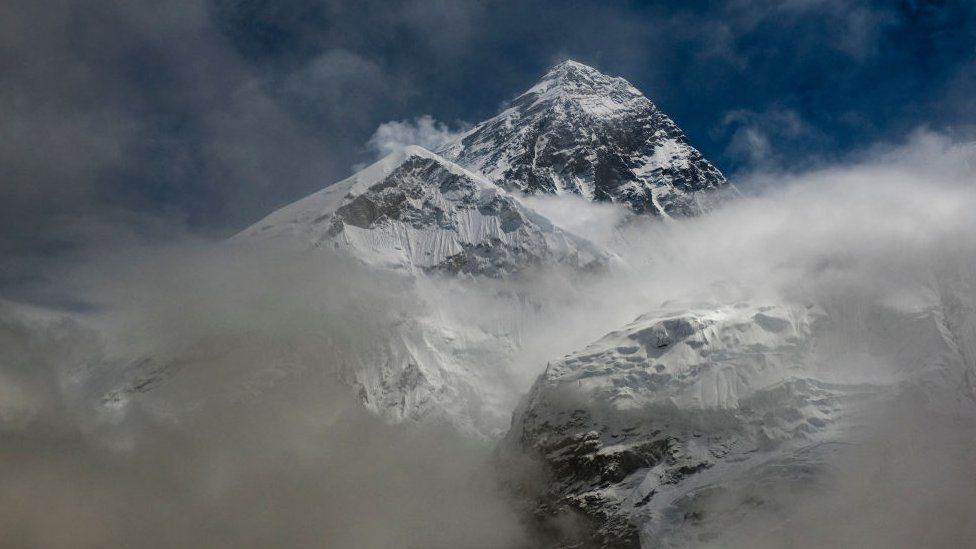
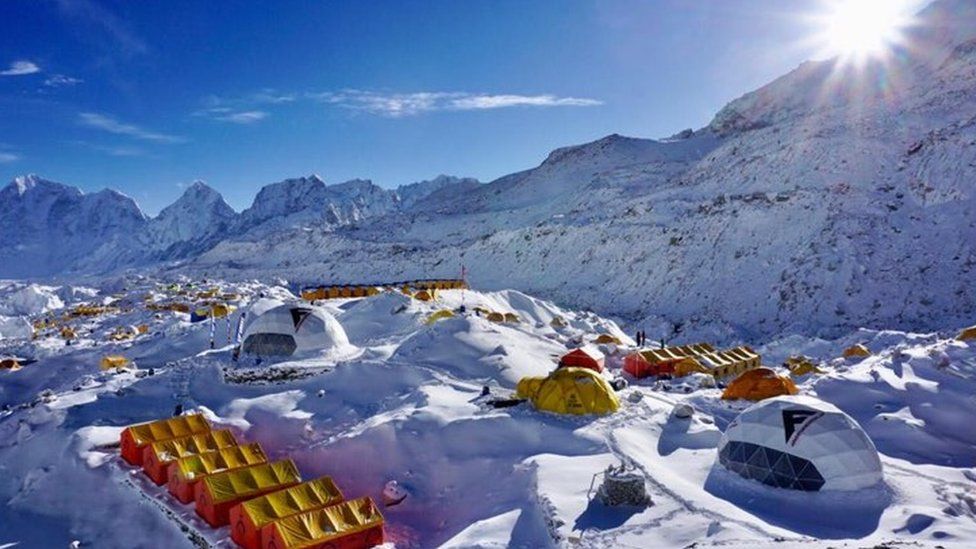
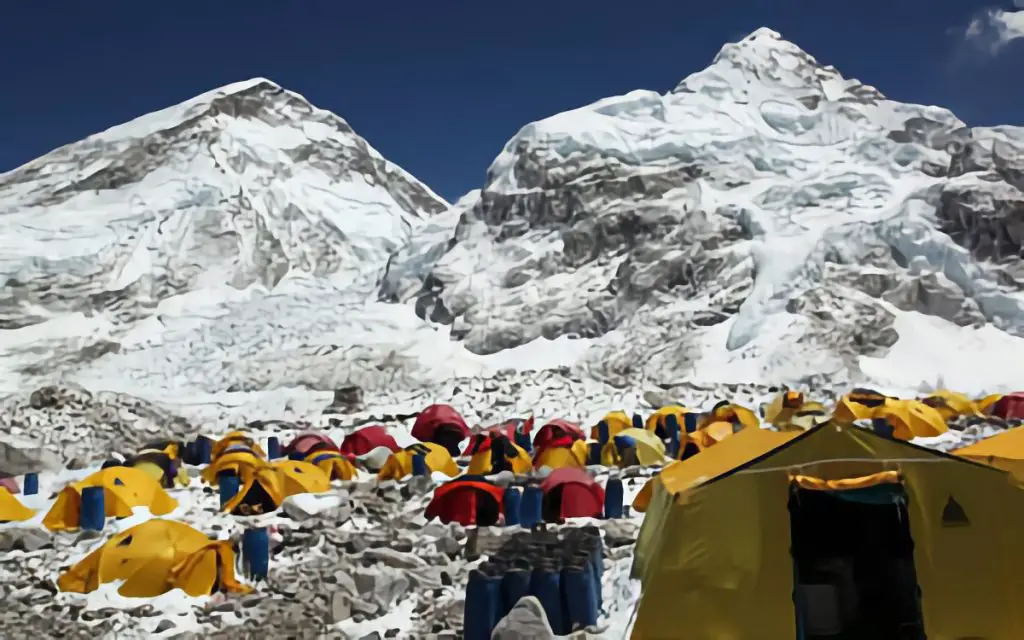
Mount Everest
Everest was closed to mountaineers last year due to the pandemic    Getty Images
"We don't have tests."
"And high altitude makes it difficult to identify COVID from cough and HAPE [high altitude pulmonary edema], which is common here."
"[There is a] dilemma [about whether to cancel the Everest climbing season]. Unventilated camps and camps close [to one another] make it easier to spread [COVID-19] here."
Dr. Prakash Karel, Everest base camp physician

"More than 30 people have already been evacuated to Kathmandu in helicopters with suspected pulmonary edema -- later found to be positive for the coronavirus."
Pawel Michalski, Polish climber

"I have taken a helicopter out of EBC [Everest base camp] back to Kathmandu after one day."
"Once I was in the hospital a COVID test confirmed I was positive and had pneumonia. I've spent four nights in the ICU."
"The COVID situation at EBC is a total s---storm. I had no clue what I was flying into."
Gina Marie Hans-Lee, evacuated climber

"The Nepal Government is still denying there is a COVID outbreak at Everest base camp, despite emerging evidence."
"Why is the government hiding the truth?"
"At camp I saw many sick people. At a gorakshep [small village, last stop on most treks to base camp] hotel, there were [a] few sick climbers isolating, as well."
"I found COVID is so common around the camp people. They took it so easily. One Sherpa told me, 'COVID is just like the flu."
Rojita Adhikari, positive-tested climber, April 19
Everest base camp this climbing season
Health officials have warned of rising numbers of Covid-19 cases at base camp     Lukas Furtenbach

Nepal, contiguously bordered with India, where a massive coronavirus wave has spread, has seen itself well on the way to becoming overwhelmed with the pathogen with an average of 6,700 cases reported daily up to May 5, representing an increase from 1,100 a mere two weeks earlier. While the country faces its steepest coronavirus wave yet encountered, it has decided to keep the main tourist attraction -- the Nepali side of Mount Everest -- open for business to foreigners hoping to climb the world's tallest mountain. 
 
The 2020 climbing season during the first introductory wave of the SARS-CoV-2 virus causing COVID-19 had been cancelled. Now, during the second COVID wave, turning out to be far more invasive, intense and worrying, a record number of expedition permits totalling 408 have been issued. Climbers and expedition leaders are left to work out for themselves methods of containing the spread of the virus amidst growing concerns of an outbreak of the coronavirus at the mountain.

The issue of safety on behalf of visiting climbers and locals alike has risen in the wake of multiple people being evacuated from base camp, later tested in hospital for the virus, and found positive. A negative coronavirus test is required by the Nepal Department of Tourism 72 hours prior to entering the country but the government removed a seven-day quarantine requirement in late March, in an effort to revive the country's tourism industry. 
 
At $20-billion, tourism contributes about eight percent of the country's GDP, with Everest expeditions alone contributing over $300 million to the economy in 2019. On the mountain there is no way for climbers to access tests, other than bringing along their own. The Everest base camp clinic has no laboratory permission to test for the virus, leaving guide companies to enact their own precautions.
 
Furtenbach Adventures, as an example, operates "flash expeditions", lasting three to four weeks rather than the classic nine-week trip. Providing climbers with hypoxic tents to help them become acclimated at home with high altitudes, a process normally requiring a four-week stay at base camp. Teams ranging in size from two to 29 members take other precautions during the expeditions, but despite all precautions late April saw the first case of coronavirus confirmed at base camp.
 
After which reports of multiple people testing positive followed. The first climber at base camp to test positive began feeling ill two days before reaching base camp but thought he was suffering from mountain sickness reflecting the high altitude. Mountain sickness can produce symptoms similar to those of COVID. He remained unaware of his true condition until tested three days later at a Kathmandu hospital.This year there is an estimated 1,200 climbers at base camp, making social distancing difficult.
 
Four coronavirus cases were identified by the Nepal Mountaineering Association; one local guide and three climbers. Those numbers are challenged for accuracy by mountaineers' own experiences. Some climbers who tested positive before or after leaving base camp insist that unreported cases remain. One physician working out of the Everest base camp clinic described to the Explorersweb blog, speaking anonymously, the situation at base camp, that "many people" were evacuated with coronavirus symptoms testing positive at the Kathmandu hospital.
 
"Many climbers are isolated in their tents at the moment. In Kathmandu, hospitals are not yet at full capacity, but ICUs are filling up quickly", he said. The base camp Everest ER spoke of a meeting between doctors and expedition leaders discussing managing respiratory illnesses, including "encouraging all to maintain their bubble/discouraging visits between camps, wearing masks even within their camps, sending any members with respiratory illness to see the doctors at Everest ER for further evaluation." 
Everest Base Camp
The Adventure Blog
"Normally there's a lot of socializing, events, base camp parties, and teams are visiting other teams and making new friends."
"We all used hypoxic tents at home, we sent them to the clients, and they simulate the oxygen level of higher altitude."
"My guess is there will be more cases. Everyone is concerned about a message coming from the Department of Tourism: 'You all have to go home.'"
"We would expect that the government [would be] confirming these cases, keeping everything transparent, maybe even sending a team to base camp to do a mass test which would find superspreaders."
"I think every operator would be happy to pay for this -- it would probably save the season, because there is the risk if there's more and more cases that [there] could be an early end to this season."
"Your whole body is already working on its limits, so catching COVID would be a real threat to your health and even to your life."
"If the weather's bad and someone's developing problems, evacuation without a helicopter would take days and it's very dangerous. So it would be a big problem if someone infected developed symptoms higher up the mountain."
"If there are more and more cases coming in [at base camp], the authorities in Nepal will have to do something. I think they tried to do the right thing, they tried to save the season. But maybe it's not the right thing."
Lukas Furtenbach, an expedition leader, Mera Peak, Everest
 
"We're getting emails from people on other teams, trying to decide whether to go home, because it seems clear that things are getting quite serious."
"I'm hearing from guides, Sherpas, and one of the helicopter companies about how many COVID rescues they're doing. I've had another major operator write me saying: 'You're so glad you didn't go.'"
"Every single person's respiratory system is struggling, and is working in overdrive, and it's that much more susceptible to upper respiratory illness [climbers face an intense physical battle with each step up the mountain]."
"You can't sleep at altitude, so you have this deep fatigue from days of not sleeping. You can't eat, because your digestive system is considered non-essential -- anything you put in your stomach, you become incredibly nauseous,"
"I think we'll start to see some climbers leaving because they just feel that they're on the wrong side of the moral question, with the Kathmandu outbreak being so strong. They're sitting there with thousands of bottles of oxygen."
Adrian Ballinger, an expedition leader who pulled out of the Everest climbing season over COVID-19 concerns.
Mount Everest
Climbers rejoiced when Nepal decided to reopen its side of Mount Everest this year, but reports suggest even the world's highest peak isn't safe from the spread of coronavirus. (Prakash Mathema/AFP/Getty Images)

Labels: , , , , ,

Follow @rheytah Tweet