Saturday, August 13, 2016

It's a Rainy Day in the Kingdom of Saudi Arabia ... but no Rainy Day Fund

"They don't give us any answers about our salaries."
"After they pay me my salary and benefits, I will go."
Mohammed Salahaldeen, Bangladeshi duct fabricator, Riyadh labour camp

"I already resigned from the company [Saudi Oger]. I am only waiting for my benefits. My end-of-service benefit is 45,000 riyals."
"If I don't take that back to Pakistan, I will have nothing."
Shahid Iqbal, 39-year-old Pakistani worker for Saudi company
Labourers work at the construction site of Riyadh Metro, Saudi Arabia December 21, 2015. Picture taken December 21, 2015. REUTERS/Faisal Al Nasser

Mr. Iqbal was forced to borrow money so his wife back in Pakistan could give birth. He then borrowed additional funds to enable him to make ends meet, over the eight month period for which this man who has worked almost 20 years for the same Saudi company, still awaits the pay owing to him.

The index in Saudi Arabia for building and construction has dropped 37 percent in the past year. Saudi Arabia, that fabulously wealthy oil kingdom, is in dire financial straits. How they will manage to continue paying for the war they're leading against the Shiite Houthi rebels in Yemen is anyone's guess. And presumably, they've made all the investments they meant to in building madrassas all over the world to induct young Muslims into Wahhabist Islamism.

At the present time there are tens of thousands of foreign workers in Saudi Arabia who come from Bangladesh, India, Sri Lanka, Pakistan and the Philippines to work and to send most of their earnings back to their countries of origin, to support their indigent families. Months ago there was a mass firing when 50,000 foreign workers were dismissed.

They now live in the labour camps, awaiting their pay so they can return home, having been dismissed from employment.

It is up to their employers to provide exit visas, not the Saudi Labour Ministry. And until and when the workers receive their pay so long overdue, exit visas may not be provided. This is one of those original 'catch-22' situations of impossible gravity and misery. Though the Saudi government has pledged to resolve these problems, they linger.

And those thousands of workers wait, for there is little else they can do. They wait in fetid, cramped barracks, sleeping eight to a tiny concrete room, sharing filthy toilets with feral cats in temperatures that soar to 50 c. The destitution of the labourers can be juidged in their garb, for they own only one set of clothing.

"They can't go to a hospital because they no longer have insurance. They have no money", explained Mohammed Khan, an Indian nurse looking after workers at the Oger camp, treating people with diabetes, hypertension and high cholesterol, sans medication. In 2014, Saudi Arabia was the world's second largest source of workers' remittances.

The Saudi government had barred temporarily the BinLadin Group from new contracts owing to one of its cranes collapsing in Mecca directly onto its largest mosque, where over 100 people were killed in the catastrophe. At a camp which was the original home of the Al Saud royal family, the company no longer provided food at the canteen for workers.

Indian national Nasser Abdul Manaf had to take his children out of school, no longer able to afford to educate them. Six months late on his family's rental apartment, the owner of the building is threatening to repossess his apartment, and the prospects for the family look dim, in Hyderabad, India. "They have nowhere to go. They will have to move onto the streets", said the 46-year-old father.

Saudi authorities have slashed state spending and in the process have delayed payment to contractors, in a reflection of the drop in oil prices. Private businesses long accustomed to relying on government spending to fuel their industrial growth, have nowhere to turn. The abandoned labourers haven't been paid in eight months.

The Saudi government awarded no contracts in the past three quarters, so construction contracts shrank by 65 percent from the same period a year ago. And abroad, Saudi princelings race through the streets of London, England, with their Lamborghinis, and buy up costly properties, living the life they have become accustomed to.

£1million road block: This fleet of five supercars caused major problems for drivers after they were left in the middle of a road in central Birmingham

Labels: , ,

Monday, November 23, 2015

Defunding Islamic State

"[How critical? About $3-billion flows into ISIL-controlled coffers annually] mainly derived from illicit proceeds from its occupation of territory [in Iraq and Syria but increasingly from] new and emerging technologies."
"ISIL has manipulated social media, physical and virtual social networks, encouraged donations and conducted a marketing campaign in a manner that is consistent with industry standards established by major crowdfunding companies."
Financial Action Task Force report

"If there was a global commitment, we would pull the plug on terrorist financing in a day, and [ISIL] would be incapacitated in a month because no terrorist organization is a financial island."
Christine Duhaime, terrorist financing expert, Vancouver

"In Mosul [northern Iraq] alone, the Islamic State has implemented taxes on a variety of commercial activities. [There is even a] protection tax (jizya) levied on non-Muslims."
"In total, the extortion/tax system imposed in areas under its control in Iraq and Syria could generate as much as $30-million per month for [ISIL]."
Jean-Charles Brisard/Damien Martinez, terrorism experts
Islamic State fighter on the march in Raqqa Photo: AP

There are two battlefields to be addressed in the war against Islamic State of Iraq and the Levant; one on the military side, the other on the financial side. One without the other will express an incomplete victory against the organization's wide operational territory. Terrorist financing is global; the stretch of Islamist jihad is as wide as the Internet can reach and that is universal.

Funding is steady and it's reaching Islamic State coffers through a wide variety of sources, not the least of which is 'donations' trickling in from just about every country in the Western world where Islam has made its signature presence. From among the masses of Muslims living peaceful lives in democratic countries of the West there is a relative handful who are complicit with the rise of Islamist jihad and they see themselves required to fund the global caliphate.

The money is gratefully received and it is used to massacre people innocent of any crime but their mere existence. There are other activities; extortion, theft, smuggling, human trafficking, kidnapping, fund-raising exploits hiding behind the shield of representing charitable enterprises. Al-Qaeda in Iraq was "self-sustaining", able to raise between $70-million and $200-million annually by 2006, according to U.S. government files.

Islamic State brings funding to a whole new level, leaving its predecessors in the dust of small-change in comparison. Many experienced military commanders who had served proudly with Saddam Hussein before 2003 are now in the controlling cadres of ISIL. They are well served by thousands of combatants who have the use of heavy weapons; artillery, armoured vehicles, tanks and other armaments, courtesy of the United States.

Those weapons, provided to the Iraqi armed forces and abandoned in their haste to remove themselves from the direct vicinity of Islamic State fighters, obviated the need to procure them through ISIL's financial resources; another economic benefit to the caliphate. There is no shortage of Kalashnikovs. A rocket launcher, over a dozen handguns, bulletproof vests, combat gear and allied military hardware was found in the possession of the Paris attackers, all ISIL comrades-at-war.

ISIL has the manpower and the funding it requires and as such the group "represents a new form of terrorist organization where funding is central and critical to its activities", according to an independent, inter-government body supported by Canada, the United States, Britain, France and other democracies with a horse in this race to destroy the potential represented by Islamic State's rise to power and its irresistible attraction to many Muslims living in the West.

Twitter has been an invaluable aid, attacting ISIL sympathizers, happy to contribute to ISIL's appeal. Alternatives to traditional banking and money-transfer systems embrace electronic crowd-funding actions from the democratic countries of the west. That's the easy targets; to stem the flow from those sources; not quite easy, but it can be done. As for the most lucrative sources of revenue; stolen assets such as oilfields and banks, that's another thing.

Localized funding sources like "taxes" are immune to being impeded as long as Islamic State is in control of territories it has gained over the past several years. But ISIL supporters in the West, and they are there and in ample numbers, should and can be cut off from raising or transferring funds directed toward terrorism under the guise of charitable donations. The most unfortunate transfer of funds are those instances when governments succumb under wraps to paying ransom for abducted citizens.

Funds directed to "terrorist hot spots" need more close scrutiny at the point of transfer; which is to say using routine banking services to transfer funds from client accounts in the West to accounts controlled by ISIL must be cut off. Wire transfers should be viewed with suspicion and time taken to verify their legitimacy -- or lack of. Governments must see the need to toughen up enforcement. Financial institutions should be working with intelligence authorities.

Much depends upon it.

Abu Rafiq -- ISIL resister, Raqqa

Labels: , , ,

Saturday, July 25, 2015

Originally published under the title, "Opening the 'Gates of Evil'."
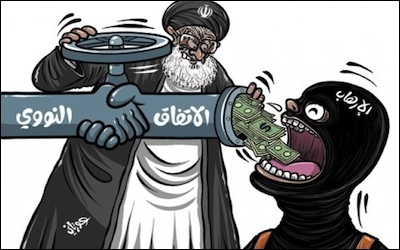
A cartoon in the Saudi daily Al-Watan shows Iran increasing its funding of "terrorism" after the nuclear agreement.
The response in the Arabic-speaking world to the conclusion of a deal between the P5+1 countries and the Islamic Republic of Iran over the latter's nuclear program has divided along familiar lines.
Among pro-Iranian elements, such as President Bashar Assad of Syria and Hezbollah leader Hassan Nasrallah, the news of the deal has, predictably, been met with jubilation. Assad described the agreement as a "historic achievement" and a "great victory."
Sunni Arab concerns have focused less on the terms of the deal than on its strategic implications.
Among Sunni elements opposed to the advance of Iran, concerns have focused less on the nuclear elements of the deal – that is, whether it will effectively halt Iran's march toward the bomb. Instead, attention has centered on the deal's implications for Iran's push for hegemony in the Middle East, and its interference in and subversion of regional states as part of this effort.
An editorial by Salman Aldosary, in the Saudi-owned Asharq al-Awsat newspaper, summed up these concerns in the following passage:
Western governments will be under great pressure to make the deal succeed and therefore turn a blind eye to many of Iran's destabilizing policies as well as Tehran's blatant interference in the domestic affairs of its neighbors. Moreover, the West will also have to neglect Tehran's support of extremist militias, such as Iraq's Popular Mobilization forces, also known as the Hashd al-Shaabi, that have gradually become almost part of Iraq's military. Iran has established a policy based on the equation of fighting terrorism with terrorism amid deafening silence from the West.
Saudi Arabia and the Gulf states can only welcome the nuclear deal, which in itself is supposed to close the gates of evil that Iran had opened in the region. However, the real concern is that the deal will open other gates of evil, gates which Iran mastered knocking at for years even while Western sanctions were still in place.
From this perspective a particularly notable and dismaying aspect of the deal is its removal of the Iranian Revolutionary Guards Corps and its Quds Force commander, Maj.-Gen. Qasem Soleimani, from the list of those subject to sanctions by the West.
The ending of sanctions will enable Iran to massively increase aid to its long list of regional clients and proxies.
The ending of sanctions on the IRGC, and more broadly the likely imminent freeing of up to $150 billion in frozen revenue, will enable Iran to massively increase its aid to its long list of regional clients and proxies. Iran today is heavily engaged in at least five conflict arenas in the region.

The Iranian creation and proxy Hezbollah in Lebanon is the dominant political and military force in that country. The organization depends on Iranian support, training and funding to maintain this position.

In Syria, beleaguered dictator and Iranian client Assad remains in control in the west and south largely because of Iranian support and assistance – up to $1 billion per month, according to some estimates. For as long as Assad remains, the war remains, allowing such monstrous entities as Islamic State and al-Qaida to flourish.

Iran's Revolutionary Guards are unmatched in clandestine and proxy warfare, having effectively created an alternative armed force for Assad when his own army became unreliable in 2012. This force, the National Defense Forces, has plugged the gap in manpower which is the regime's greatest vulnerability. But in addition, Iran has channeled others of its proxies, including Hezbollah, Iraqi Shi'ite militias, and lately increasing numbers of Afghan Hazara Shi'ite "volunteers," toward the Syrian battlefield.


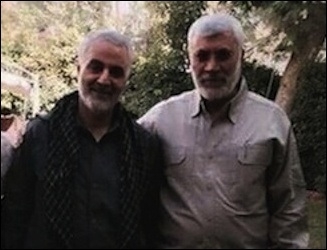
Iranian Quds Force commander Qasem Soleimani (left) with Iraqi militia leader Abu Mahdi al-Muhandis
In Iraq, the Iranian-supported Shi'ite militias of the Hashd al-Shaabi are playing the key role in defending Baghdad from the advance of Islamic State. These militias are trained and financed by the Revolutionary Guards and organized by Soleimani and his Iraqi right-hand man, Abu Mahdi al-Muhandis, also thought to be an IRGC member.

In Yemen, the Iranians are offering arms and support to the Ansar Allah, or Houthi rebels, who are engaged in a bloody insurgency against the government of President Abd Rabbo Mansour Hadi.

Among the Palestinians, Tehran operates Palestinian Islamic Jihad as a client/proxy organization, and is in the process of rebuilding relations with the Izzadin Kassam, the powerful military wing of Hamas.

All this costs money. In a pattern familiar to the experience of totalitarian regimes under sanctions in the past, Iran has preferred to safeguard monies for use in service of its regional ambitions, while allowing its population – other than those connected to the regime – to suffer the consequent shortages.

Still, in recent months, things weren't going so well. Assad has been losing ground to the Sunni rebels. Hezbollah has been hemorrhaging men in Syria. The Shi'ite militias were holding Islamic State in Iraq but not advancing. Saudi intervention was holding back further advances by the Houthis in Yemen. Hamas was looking poverty-stricken and beleaguered in its Gaza redoubt.

The sanctions, plus these many commitments, were bringing the Iranian regime close to an economic crisis that would have confronted the regime with the hard choice of lessening its regional interference or facing the consequences.

No longer. The deal over the nuclear program is set to enable Tehran to shore up its investments, providing more money and guns to all its friends across the Middle East, who will as a result grow stronger, bolder and more ambitious. This, from the point of view of the main powers in the Sunni Arab world, is the key fallout (so to speak) from the deal concluded in Vienna. IRGC "outreach" to Shi'ite minorities in Saudi Arabia and Kuwait, and to the Shi'ite majority in Bahrain, is also likely to increase as a result of the windfall.

Sunni Arab states and Israel will develop strategies independent of the US to stem the Iranian advance and turn it back.
It has been felt in recent years in Riyadh, Cairo, Amman and other Sunni Arab capitals that the United States is determined to withdraw from active involvement in the region, and in pursuit of this goal is currently pursuing a dangerous path of appeasement of Iran.

This impression is compounded not only by the stance toward the Iranian nuclear program but also by the US response to Iran's activities across the Middle East. In Iraq, the US appears to be acting in tandem with Iranian goals, with no apparent awareness of the problems in this regard. Similarly, in Lebanon the West is supporting and equipping the Lebanese Armed Forces, without understanding that the Lebanese state is largely a shell, within which Hezbollah is the living and directing force. In Syria, the US is pursuing a half-hearted campaign against Islamic State, while leaving the rest of the country to its internal dynamics.

The nuclear deal compounds and completes the picture. From the perspective of the Saudis and other Sunni Arabs, Iranian ruthlessness, clarity and advance combined with the flailing, retreating US regional policy now so much in evidence spell potential disaster.
The Sunni Arabs, along with Israel and other regional opponents of Iran, will now develop strategies independent of the US to stem this advance and turn it back. The outcome of that struggle will determine the fate of the Middle East.
Jonathan Spyer, a fellow at the Middle East Forum, is director of the Rubin Center for Research in International Affairs and the author of The Transforming Fire: The Rise of the Israel-Islamist Conflict (Continuum, 2011).

Labels: , , , , , , ,

Saturday, February 28, 2015

Financing The Ultimate Terror

"[The Islamic State represents] a new type of terrorist organization with unique funding streams."
"[We plan to] immediately review whether all [its] members have implemented measures to cut off terrorism-related financial flows."
"The report demonstrates that ISIL is essentially living off the  capital illicitly generated by the territory it occupies, primarily by looting banks, exploiting oilfields and robbing economic assets."
"ISIL can be stifled by frustrating its ability to generate funds from these activities and by preventing it from obtaining funds from other sources and activities."
Financial Action Task Force, Paris


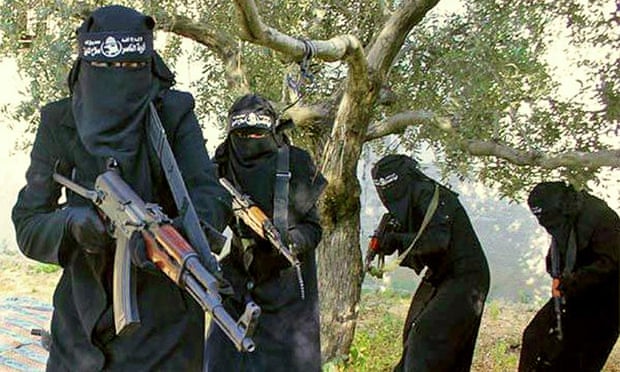
The all-female al-Khanssaa Brigade in Syria
The all-female al-Khanssaa Brigade in Syria. Photograph: unknown/Syriadeeply.org
Governments that are identified as failing to do their utmost to staunch the flow of cash to Islamic State have been given due notice that they will be pressured to take immediate remedial action by the global agency set up to represent the international community's dedication to fight terrorist financing and money laundering. All 36 of its members are required to freeze terrorists' assets and to ensure it is illegal within their jurisdictions to finance terrorists.

The Financial Action Task Force is preparing to "put pressure on any country that has failed to implement these measures". And what then of countries which are careful themselves to adhere to the agreed-upon measures, but which nonetheless maintain cheerfully close relations with other countries not part of the pact and therefore free to continue contributing to the well-being of Islamic State -- like Turkey, like Qatar?
Qatar’s Emir meets Obama in first visit to White House
US president Barack Obama and the Emir of Qatar Sheikh Tamim bin Hamad Al Thani smile while in the Oval Office at the White House on February 24, 2015. Larry Downing/ ٍReuters

Take, for example, President Obama's beyond-courteous display of friendliness with a country that is well known to promote the activities of terrorist groups, like funding Hamas, and Islamic State, yet the emir of Qatar is honoured at the White House. What does this say for American commitment to the global goal of stifling Islamic State through cutting off its funding? Mind, the U.S. and Qatar mutually befriend another terrorist group, the Muslim Brotherhood.

Since the warning was issued with the  specific purpose of warning Gulf states such as Qatar, which the US. itself has accused of failing to crack down on Islamic State financiers, the meeting at the White House three days earlier appears mystifying indeed. Is this an instance yet again of the Obama administration stating an unequivocal position, and then surrendering it at the earliest occasion?

Turkey is another member of the Financial Action Task Force. And it is well enough known the viral antipathy that President Erdogan has taken to President al-Assad's campaign against Syrian Sunnis who had protested their status of an oppressed majority under the Alawite minority regime. Turkey is also known to have financed Islamic State operations, as well as those of Hamas, and it permits itself to be used as an entry point for those jihadis eager to join the Islamic State in Syria.

The U.S. Treasury had calculated that Islamic State looted a half-billion dollars from state-owned banks in Mosul alone when it flooded the city with its militias as Mosul was left undefended by fleeing Iraqi troops. The oil refineries Islamic State 'caliphate' now operates, selling their production on the black market earns it another $100 million annually from the sale of oil and oil products.

And add in another $20 million for ransoms of Westerners; those that aren't horribly mutilated and slaughtered whose countries will bargain with terrorists for the release of their nationals, exempting Britain and America. And the sale of looted architectural and archaeological treasures in the West demanding huge amounts of cash in exchange for black market sales of artefacts that legitimate collectors and national museums refuse to touch.

The Islamic State must qualify as the best-funded terrorist group that history has ever seen. It has its state and non-state backers handsomely funding its atrocious activities and aspirations. And the mass looting it is involved in remains capable of gains advantaging its positioning in its long-range plans of occupying ever-large geographic areas of the Middle East, killing and destroying as it proceeds.

The indirect aid given it by those countries sworn to defeat the Islamic State and its purpose, along with the discreet direct aid advantages its course of action. A situation that all countries signing on to the global pledge should be aware of, yet the leading country that has dedicated resources and ostensibly is geared to defeat ISIS, has been hobnobbing with those countries funding it, instead of remonstrating and demanding compliance.

Labels: , , , , ,

Wednesday, January 28, 2015

Who Is Advising Putin Now?

Alexei Nikolsky/RIA Novosti/Kremlin/Reuters      Russian President Vladimir Putin (c.) chairs a meeting at the Kremlin in Moscow on Tuesday.

"In Russia, decision-making is the most obscure realm of all. This system is top secret. Nobody, not even top officials, know for sure who or what Putin is listening to."
"Anything anyone tells you about how Putin decides things is either disinformation, or error."
Alexander Dugin, right-wing scholar, founder of "Eurasian" school of political philosophy

"Putin meets with people based on the importance of the jobs they do."
"The Putin-era oligarchs had the mission to develop Russian business at home and abroad, with the purpose of strengthening Russia's integration with the global economy. That hasn't worked out at all, and as a result the relevance of those billionaires for Putin has fallen sharply. On the other hand, the importance of siloviki – security people – has grown amid the current challenges. So, he spends more time with them. It's a fact that the siloviki tend to be more anti-Western, and obviously this will influence his views."
"Of course we have no solid information about who Putin meets with and listens to. But Putin is known to be a good manager. He will move to restore the balance between the different groups that are close to him. He needs them to help formulate new policies to minimize the economic losses and neutralize the political trends that could threaten his power. He's a rational player, and he's very interested in his own political survival."
Nikolai Petrov, professor, Higher School of Economics, Moscow

Vladimir Rodionov/Presidential Press Service/RIA Novosti Kremlin/AP

The straitened economic position Russia founds itself in now with the double wallop of sanctions and the astonishingly low price per barrel of oil, has put a crimp in the Kremlin's plans to promote the Russian federation at the expense of its former satellites. The Sochi Winter Games, exquisitely planned by Vladimir Putin to dazzle the world community with its off-handed expense account and its ability to mount a world-class event outdoing even China's pride of presentation, was to have been the introduction to Russia's ambitious aspirations to claim its former status as a world power equal to the U.S.

Things went off the rails fairly swiftly when two events occurred; first the Islamic Republic of Iran's plans at nuclear attainment, aided and abetted by a more than willing Kremlin with Russian engineering know-how helping to build Iran's nuclear plants, creating a huge concern for the Gulf States and in particular Saudi Arabia, shuddering at the prospect of Shiite Iran aggressively presenting itself as the Aryan (Shiite) Muslim leader in the Arab (Sunni) Middle East. Iran seemed to be able to weather Western sanctions, but Saudi Arabia had a better plan and engineered cheap oil to really slug it to Iran.

The fallout of which is where Moscow finds itself at the present time, suffering under its own economic sanctions imposed by the West as a genteel but firm punishing admonition over its ambitious annexation of the Crimean Peninsula from Ukraine, and its covert support for the Ukrainian-Russian rebels who insist on joining the geography they claim with that of Russia, transferring land and allegiance from Kyiv to Moscow, to the delight of the Kremlin.

In choosing to target Vladimir Putin's closest friends and colleagues whom he had placed in a position to enrich themselves as powerful oligarchs whose loyalty to Mr. Putin was undisputed, the West reasoned that their displeasure at how they were targeted through sanctions creating a diminishment of their wealth, pressure would be placed upon the Russian president to curtail his territorial ambitions.

Instead, his resolve has been heightened, just as his popularity among the Russian people has soared at the spectacle of their president thumbing his nose at Western leaders pressuring Russia to stand down from its aggression against its neighbours. Russians view their president as a hero for resisting outside pressure and forging on with the intention of restoring Russia's past greatness as a world power, evidenced by the vast treasury spent on acquiring new military technology.

Those whose wealth has been dealt a blow by Western displeasure over Russia's expansionist imperialism have become resentful of their president's ambitions. The 21 most wealthy in the country have lost a collective $61-billion in the last yer alone as a result of the U.S. and European sanctions, according to the Bloomberg Billionaires Index. Political consultant Sergei Markov relates that businessmen who have been close to Mr. Putin are now "on the periphery". Russia's economic plight has been tremendously exacerbated by the low per-barrel world market price. Zap!

The core group that Vladimir Putin has now assembled around him has been altered, led by Security Council Secretary Nikolai Patrushev, Federal Security Service head Alexander Bortnikov, Foreign Intelligence Service chief Mikhail Fradkov, and Defence Minister Sergei Shoigu, if Mr. Markov is to be believed -- and why would he not be? Those who were tasked as ministers and state functionaries to counter the economic slowdown in the country have complained that their recommendations haven't been welcomed.

"It's a very difficult time for Putin. He's being criticized from both sides, the liberals and the hawks. Many people in the Kremlin believe Russia should adopt an even tougher stance", explained Olga Kryshtanovskaya, a sociologist who has noted the rise of the security services under President Putin. Although the Russian population supports Russia's involvement in Ukraine with the intensified fighting in Donetsk and Luhansk, the Moscow elite are alarmed about the political and financial costs.

Two former prominent government officials have called on Vladimir Putin to find an exit in the fighting. Russia must avoid "self-isolation" over Ukraine and keep the door open to cooperation with NATO and the U.S. according to Yevgeny Primakov, a former premier, foreign minister and spymaster. "We lost our country as a great power" without that collaboration, Mr. Primakov wrote last week in Rossiyskaya Gazeta.

Former finance minister Alexi Kudrin, a longtime Putin ally, who now sits on the president's Economic Council, last month claimed that Russia faces a "full-fledged" economic crisis if it fails to repair its damaged ties with the United States and Europe. But none of these concerns address the more signal problem devastating Russia's finances; its reliance on high oil prices per barrel to keep its ambitions afloat....

Labels: , , , , ,

Saturday, November 22, 2014

Gatestone Institute


Although outwardly more liberal than the Saudis, the Qataris have surpassed them as financiers of extremism and terrorism.
U.S. officials reckon that Qatar has now replaced Saudi Arabia as the source of the largest private donations to the Islamic State and other al-Qaeda affiliates.
Qatar, the world's wealthiest country per capita, also has the unsavory reputation for the mistreatment and effective slavery of much of its workforce.
Leaders of Western states threatened by jihadi advances are happy to sit down with the largest financiers of terrorism in the world, offer them help, take as much money as they can, and smile for the cameras.
There is a central weakness in the coalition against the Islamic State [IS] in Syria, as pointed out by Bryan Bender in the Boston Globe. There are 62 members of the coalition, some of which are Arab states: Saudi Arabia, the United Arab Emirates, Jordan, Bahrain, Iraq, and Qatar. The U.S., however, carries the greatest weight in the air campaign against the self-proclaimed Caliphate. America had carried out 3,589 sorties by August 8, its partners 8; between September 23 (when most partners joined in attacks) and November 3, U.S. sorties numbered a further 3,320, with 1,090 by other coalition members.

The U.S., therefore, flies over 75% of missions -- an indication of American intent? It's not quite that simple.

One of those partners, Qatar, seems to be committed to the mission in other ways. It hosts the largest U.S. military base in the Middle East, the regional headquarters of U.S. Central Command, and stations American and British aircraft and personnel at al-Udeid Air Base.
The U.S. Congress has authorized and appropriated many millions of dollars over the years in return for use and maintenance of this important base.[1]

Qatar is now prepared to pay in full for the U.S. military presence during the campaign in return for American protection.[2]
Except, as a recent headline in the New Republic put it: "Qatar Is a U.S. Ally. They Also Knowingly Abet Terrorism. What's Going On?" Other views are harsher: "Qatar's overall cooperation, however, is the worst in the region."

Qatar is one of the world's smallest states with a minuscule population. A Saudi prince once said that it is made up of "300 people and a TV Channel" (referring to Al Jazeera, based in the capital, Doha). Qatar has only 278,000 citizens and 1.5 million expatriates who make up 94% of the workforce. Qatar, the world's wealthiest country per capita, also has an unsavory reputation for the mistreatment and effective slavery of much of its workforce.

Qatar is also imprisoning Matthew and Grace Huang, an American couple sentenced to three years in prison on charges of child endangerment, for allegedly murdering their adopted daughter, Gloria, 8, even though she apparently had health issues prior to the adoption. The Huangs continue to protest their innocence, and claim that the Qataris do not understand how an Asian couple could adopt three children, who happen to be black, from Africa.

Given Qatar's economic and political clout, created by its sovereign wealth fund, its oil, and its ownership of the world's third largest natural gas reserves, Qatar plays a role on the world stage and does much to enhance its public image. In a bid for international kudos, the emirate acted to ensure the award of the soccer World Cup for 2022, only to find itself mired in controversy.

In other spheres, Qatar is the single largest donor to the Brookings Institution, a major U.S. think tank. Payments included $14.8 million after the former U.S. Ambassador to Israel, Martin Indyk, blamed Israel for the failure of the latest round of Israeli-Palestinian peace talks; and it has given money to many universities in the U.S. and Europe.[3] Qatar also hosts eight international university campuses near Doha (Virginia Commonwealth, Weill Cornell, Texas A&M, Carnegie Mellon, Georgetown, Northwestern, HEC Paris, University College London, Calgary), and finances the RAND Policy Trust. It owns expensive properties in London, the Barcelona Football Club, and dabbles in other areas worldwide.

While all this increases Qatar's influence, most of it seems to be for show, to present an amiable face to the world. Qatar is not all gleaming towers, bars for non-Muslims, and a modern approach to sexual relations. It remains the only other Wahhabi country in the world next to Saudi Arabia. The problem here is the Qatar paradox. Although outwardly more liberal than the Saudis, the Qataris have surpassed them as financiers of extremism and terrorism. As with its neighbor, it is traditional, devoted to a highly conservative form of Islam, and an underlying commitment to Islamic values.

Although praised for its liberalism in many areas, Freedom House reported in 2013 that "civil liberties and political rights are severely restricted for residents and citizens alike, foreign workers face especially repressive conditions." Aside from a short period between 1976 and 1988, Qatar has remained categorized as "Not Free" since 1972, and has a particularly bad reputation for its brutal treatment of poor foreign workers.

Although non-Muslims are free to worship there, Qatari law bans any form of proselytization or outward show of faith (such as crosses on churches). There are severe laws against homosexuality, adultery (technically a capital crime, with provisions for flogging and stoning), and public criticism of the regime. As of 2011, the Democracy Index describes Qatar as an "authoritarian regime" with a score of 3.18 out of ten, and it ranks 138th out of the 167 countries covered.

Nowhere is this tendency clearer than in Qatar's support for international networks of terrorist organizations. While U.S. planes bomb outposts of ISIS from their Qatar airbase, Qatar is reputed to be sending money to ISIS, Hamas, Libyan jihadists, and others. Of course, the Qataris deny this. Standing beside German Chancellor Angela Merkel on September 27, Qatar's Emir Tamim bin Hamad al-Thani declared that, "What is happening in Iraq and Syria is extremism and such organizations are partly financed from abroad, but Qatar has never supported and will never support terrorist organizations".

Clearly, al-Thani either knows little about the country he rules or is trying to put one over on the world. One is reminded of how, after Black September's 1973 murders of three diplomats (two American and one Belgian) in Khartoum, the PLO "privately... threatened reprisal if the Sudanese continued to hold them [the killers] or put them on trial," while publicly disavowing the killings.[4]

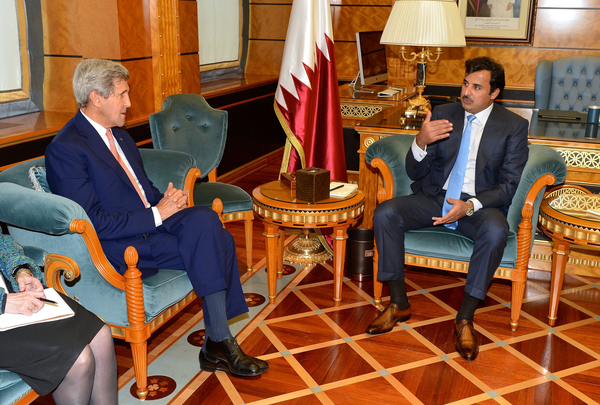
Qatar finances terrorists with one hand, while the other joins hands with the West. Above: U.S. Secretary of State John Kerry meets with Qatari Emir Tamim bin Hamad al-Thani in New York City on September 25, 2014. (Image source: U.S. State Department)

The fundamentalist anti-Semitic Islamic preacher, Shaykh Yusuf 'Abd Allah al-Qaradawi, regarded by many as the leading scholar of the Muslim Brotherhood, has been living in Qatar on and off since the 1960s, while preaching a fundamentalist and often pro-terrorist message there through his website, Islam Online, and his Shari'a and Life television show on Al Jazeera. The Qatari government has never sought to rein him in.

Qatar's major international charity, the Qatar Charitable Society (now simply Qatar Charity) has acted as a financier and agency for terrorist outfits in several countries. It has funded al-Qaeda in Chechnya, Mali and elsewhere, was a key player in the 1998 bombings of U.S. embassies in Kenya and Tanzania, and funded Syria's Ahfad al-Rasul Brigade. Qatar has also financed terrorists in northern Mali operations, including Ansar Dine, alleged to be linked to al-Qaeda in the Islamic Maghreb [North Africa]; and it retains contacts with (and no doubt still funds) al-Qaeda.

According to David Blair and Richard Spencer, writing for London's Daily Telegraph, four branches of the Qatari government handle relations with armed groups in Syria and Libya. These are the Foreign and Defense Ministries, the Intelligence Agency, and the personal office [al-Diwan al-Amiri], of the Emir, who, as we have seen, flatly denies financing terrorism. The Amiri Diwan, as in Kuwait, appears in the lists of government ministries and offices.[5] Of course, Qatar does nothing directly. It prefers to use middlemen and to permit private individuals to do the work for it. Large sums are passed to middlemen in Turkey (itself no stranger to support for terrorism), and this money is used for the purchase of weapons from other countries (notably Croatia). The weapons are then transferred to rebel groups in Syria. It has also been claimed that money owed to British companies operating in Qatar has been siphoned off to Islamic State. This may require some ingenious application of the dark arts of bookkeeping, but it does provide another means of evading condemnation of the state.

One of the most obvious examples of government support for jihadi groups is that the international base of the Gazan terrorist group Hamas has been located in Doha since 2012. Khaled Mashaal, Chairman of Hamas's Political Bureau, is reportedly living an opulent lifestyle in a five-star hotel in Doha. Qatar has given generously to Hamas. In October, Ma'mun Abu Shahla, the Palestinian Authority's Minister of Labor, stated that the government of Qatar had given $30 million to provide staff with their first salary payments in several months, a distribution of largesse that will give half of the former Hamas government employees in Gaza their unpaid wages. This payment was arranged with Qatar by Robert Serry, the UN special coordinator for the Middle East peace process, despite fears of a backlash from international donor countries, including the U.S., which considers Hamas a terrorist organization.

Apart from cash advances to terrorist entities, the Qatari government seems to be directly involved in other activities, notably the shipping of planeloads of arms to Libyan jihadists. These shipments include a C-17 cargo plane carrying weaponry to a militia loyal to a warlord who had fought alongside Osama bin Laden; arms supplies to the jihadist coalition that now controls Tripoli after the launch of Operation Libya Dawn, and some $3 billion and 70 planeloads of arms to rebel forces in Syria.

Private fundraisers who coordinate donations from individual or corporate donors in Qatar are never detained or subjected to restrictions in Qatar, a privilege that means the transfer of considerable sums to al-Qaeda, Islamic State, Hamas, Jabhat al-Nusra and other Syrian Islamist groups.

The U.S. Treasury has given details of terrorist financiers operating in Qatar. The best known is 'Abd al-Rahman al-Nu'aymi, an academic and businessman who is a key link between Qatari donors and al-Qaeda in Iraq, the predecessor of today's Islamic State. At one time, Nu'aymi transferred $2 million per month to the organization. He has also sent around $576,000 to Abu Khalid al-Suri, al-Qaeda's Syrian representative, and $250,000 to the Somali jihadist group, al-Shabaab.

The U.S. Treasury Department has sanctioned Nu'aymi and other Qatari financiers in recent years. U.S. officials reckon that Qatar has now replaced Saudi Arabia as the source of the largest private donations to Islamic State and other al-Qaeda affiliates. The Qatari government has taken no steps to detain or punish al-Nu'aymi or anyone else, even though Islamist politics are, in theory, illegal in Qatar.

British Prime Minister David Cameron was warned by many people, before his meeting with the Emir of Qatar, that he had to tackle the issue of Qatar's funding of terrorism. The two men met on October 29. Here is part of the official government news briefing on the meeting:
On international affairs, they discussed the role both countries are playing in the coalition to tackle ISIL, and the importance of all countries working to tackle extremism and support to terrorist organisations. The Prime Minister welcomed the recent legislation passed in Qatar to prevent terrorist funding and looked forward to the swift implementation of these new measures. They also agreed that both countries should do more to share information on groups of concern.
Need one add that among the matters discussed by these world leaders was Qatar's recent £20 billion investment in the U.K., and Cameron's offer of British expertise in construction to assist the Emirate in building the 2022 World Cup events? Money talks, and in supine Western countries just coming out of a major recession, it talks very loudly. Al-Thani walked away from his meeting with Cameron covered in glory for his country's supposed work to defeat Islamist terrorism worldwide.

Leaders of Western states threatened by jihadist advances are happy to sit down with the largest financiers of terrorism in the world, offer them help, take as much money as they can, and smile for the cameras. They then sell their publics for crumbs from oil-rich monarchs who watch, wreathed in smiles, as the West abases itself out of greed and a total lack of concern for the human rights issues that dog these sheikhdoms in almost everything they do. The Qataris have money, they have power and influence, and they have an abiding love for fundamentalist Islam. They know what they are doing and they wait for their day to come.
Denis MacEoin is a former lecturer in Arabic and Islamic Studies and a Distinguished Senior Fellow at the Gatestone Institute.

[1] Here is a short list of these payments: From FY2003 to FY2007, Congress authorized and appropriated $126 million for U.S. military construction activities in Qatar. The National Defense Authorization Act for Fiscal Year 2008 (P.L. 110-181) authorized $81.7 million in FY2008 spending to build new Air Force and Special Operations facilities in Qatar. The National Defense Authorization Act for Fiscal Year 2009 (P.L. 110-417) authorizes $69.6 million in FY2009 spending to build new Air Force and Special Operations facilities. The National Defense Authorization Act for Fiscal Year 2010 (P.L. 111-84) authorizes $117 million in FY2010 spending to build new Air Force recreational, dormitory, and other facilities at Al Udeid. The Administration's FY2011 military construction request for Qatar was $64.3 million, for Air Force facilities and a National Security Agency warehouse. The FY2012 request includes $37 million to continue the dormitory and recreation facility project. See "Congress Appropriations and Authorizations", in "Al-Udeid Air Base," Wikipedia.
[2] "Qatar says ready to pay 'in full' for US military presence: Amr Moussa," Press TV, 1 December 2012 (accompanied by many condemnation of Qatar for doing so).
[3] For some details about its donations to the UK, see Robin Simcox, "A Degree of Influence", London, The Centre for Social Cohesion, 2009.
[4] Joshua Muravchik, Making David into Goliath, New York, 2014, p. 49, citing David Korn.
[5] See also State of Qatar Ministry of Interior, "Ministries".

Labels: , , ,

Tuesday, November 18, 2014

Hamas, Inc.

Gazans suffer, while their leaders continue to pile up the loot

Hamas militants collect donations from Palestinian supporters, Gaza City, 2004. (Abid Katib/Getty Images)
The idea that hardline Hamas political leaders like Mousa Abu Marzook and Khaled Meshal who order violence in the name of jihad are also canny businessmen who have assembled financial empires that would be the envy of pinstriped businessmen in London, Paris, or New York may strike most readers as unfamiliar, or perhaps as a form of science fiction or propaganda. But in the Middle East, otherworldly religious or political rhetoric and earthly profits do not necessarily contradict each other. In fact, they often go hand in hand.

Nor is the combination of political and military roles with business empires unique to Hamas, or to other Islamist organizations. When I started my job as the Israeli Military Governor of Tyre district during the first Lebanese war and asked to meet with the local police chief, I was told, “He is available only during the morning hours. In the afternoons he takes care of his businesses.” “Businesses?” I wondered. “Yes,” said my informant, “he has a supermarket chain.”

During my two years in Lebanon I learned that almost every local office-holder and officer, whether in the public sector, police, or army, owned a private business. The police commander in question, for example, recommended that citizens who approach the police for help should purchase food from his private stores. Because Western values such as conflict of interests, transparency, and public efficiency are less recognized and less respected in this part of the world, most political leaders in the Middle East see public office as a route to making a fortune, and most of their constituents accept this behavior—with the hope of sharing in even a small part of the leader’s wealth.

In the West Bank and Gaza Strip, the situation is quite similar to the one I found in Lebanon. The race to obtain powerful positions in the Palestinian Authority began in 1994, with the implementation of the Oslo Accords. The government that emerged from that process looks more or less like that of most Arab regimes: It is centralized and corrupt, it lacks effectiveness, bribery plays a very important role in society, and nepotism is prevalent, with just few families or relatives benefiting from state monopolies on basic services and commodities.

The Palestinian Liberation Organization runs the PA through its main political party, Fatah, with a generous budget donated by the international community. Between 1995 and 2005 the PA, which had a population of 4 million people, has received $8 billion for building its industrial infrastructure to create jobs, improve its people’s lives, and establish public institutions. Unfortunately, none of those projects shows evidence of having been implemented. Most of the funds went to private pockets, and the rest helped PA leaders to recruit more militia members. Monopolies of oil, gas, food, cigarettes, and cell phones have been granted to the prime minister’s family and to a few government ministers and local security officers. Those who were deprived of their chance to feed at the public trough have not remained quiet. A year ago, Mohammad Dahlan who used to be a senior security Fatah officer in Gaza, filed an international lawsuit against President Abu-Mazen, claiming Abbas has stolen over $1 billion from the Palestinian budget.
* * *
Hamas, the Palestinian Islamic fundamentalist movement, which was established toward the end of 1987, did not share in the international largesse granted to the PA. The resistance movement promoted the liberation of Palestine by force and at the same time joined the global jihad, as other Muslim Brotherhood-affiliated organizations did. As a result, Hamas has developed its own fundraising mechanisms, mainly based on donations and contributions of Muslim believers and pilgrims from countries such as Saudi Arabia, Kuwait, and Qatar. Hamas’ vicious terrorist attacks that took place in the mid 1990s helped the organization gain more credit as the Palestinians’ chief defender and protector and surely enhanced its revenues, which mainly came in the form of direct cash contributions. The legitimate channel for receiving these funds was the Zakat box which exists in every single Waqf (sacred property) office in the West Bank and Gaza. The PA was not allowed to touch or interfere in these Islamic institutions except by using force.

By June 2007 after Hamas took over the GS through a violent coup, more significant amounts of money began to arrive from the same Islamic countries, reflecting the donors’ desire that Gaza should be run according to Islamic Shari’a law. A huge fundraising campaign was also launched in Western countries, mainly the United States and Europe, which raised hundreds of millions of dollars, which passed through the hands of Dr. Mousa Abu Marzook, the chair of the Hamas political bureau chair at that time. According to a Texas Federal court record from 2003, Abu Marzook was convicted of illegal funds transfer to every single district in the West Bank, from Jenin in the north to Hebron in the south. Beginning in the 1990s and during every fiscal year, he has transferred millions of dollars, claiming that these funds were for welfare and relief projects, while in fact they have been used to compensate suicide bombers’ families and to rehabilitate wounded and invalid terrorists. As a result of these large, repeated cash transfers, over many years, Abu Marzook also came to personally control large assets and investments, which according to my research total over $2 billion.

Hamas current chair Khaled Meshal began to control the movement’s funds right after the arrest of Abu Marzook in the United States in 1995. During the two years that Abu Marzook was behind barbed wire, Meshal was appointed as Hamas’ chair of political bureau, a position that put him in sole control of Hamas’ treasury. Until the release of Abu Marzook from prison in 1997, Meshal personally reached out to as many Arab and Muslim leaders as possible in order to enhance the organization’s budget.

During his time in Damascus, where he spent 13 years (1999 to 2012), Meshal established new funding channels, which have led to his accumulation of a fortune on a par with that of Abu Marzook. Most of Meshal’s capital has been invested in Egyptian and Gulf states banks, and some of them are involved in real-estate projects. Meshal owns Fadil, a real-estate firm located in Doha, Qatar, which recently built four residential towers, a 20-story mall and other sites, all of which are registered in the names of members of his family.

Another way to become rich in the Gaza strip after the 2007 coup—a method used mainly by Hamas field commanders (Ez A-din al Qassam Brigades)—was smuggling, which was accomplished through a network of tunnels built to evade Israeli and Egyptian border controls. Hamas PM Ismail Haniyeh and his ministers in Gaza took advantage of this economic tool and began to forcefully control it, exactly like the Mafia. From this time on, each Hamas district’s commander has profited from the networks in his own sector as though they were his own property, maintaining full control over goods and merchandise crossing through the district’s tunnels. Food products, meat and poultry, cement and concrete, furniture, oil, gasoline, and medical items were all subject to large taxes. A smuggled car’s tax, for example, was $1,000 plus 25 percent of its value while 100 to 200 cars were smuggled daily. The “importer” had to pay 75 shekels (around $20) for each ton of cement (400 tons a day), 120 shekels for each ton (2,000 pounds) of wood (500 tons a day), 2 shekels for each smuggled liter (2.64 gallons) of diesel fuel (6,000 liters a day), and 0.75 shekels for each liter of gas (6,000 liters a day). On the Egyptian side of the tunnel, the man responsible for the “project” was Khirat el-Shater, a prominent leader of the Muslim Brotherhood, who helped finance the establishment of the joint ventures and was a full partner for revenues.

Raed al Atar, a prominent Hamas leader from Rafah, has made tens of millions of dollars from this smuggling project. Al Atar has a special centralized way to control the flow of merchandise and funds through “his” tunnels, while taking care of every single item.

Palestinian economists estimate that the number of Palestinians who earned more than $1 million from the tunnels’ economy ranges from 1,000 to 1,200 individuals. However, the number of Gaza inhabitants who may be identified as “millionaires,” is about half that. We should remember also that almost $1 billion in cash has been smuggled through the tunnels annually, a part of which was deducted and paid to the district‘s commander as a sort of “income tax.” One more source of illegal income was the properties of former Gush Katif (former Israeli settlements in the Gaza Strip), whose lands were sold to Palestinian real-estate agencies and some directly to builders who were waiting to start new housing projects. The funds received by the buyers went into the private pockets of Hamas’ leaders.

Another income source in Gaza is Islamic fundraising. Hamas’ leaders have received huge amounts of donations and contributions from Iran, Qatar, Saudi Arabia, and from other Gulf States. These funds were donated in favor of the Muqawama, the Islamic resistance, whose aims are twofold: one, against Israel as a political enemy and the second, against the Shia Islam states as a religious enemy. Generally, the transfer of funds from Arab countries, unlike from European or U.S. donors, are hard to follow: Funds not designated for specific projects, and that came under the title of “general purposes,” were most likely confiscated by Hamas’ leaders.

From information that was released lately, Qatar has transferred in February 2013 to “Gaza Strip inhabitants” $250 million, most of which has not arrived to the region. Later, after Mohammad Morsi’s fall in Egypt, by July 2013 Qatar has transferred another amount of $350 million and later on another $100 million donation was received. In these cases, the money was received by Hamas Prime Minister Ismail Haniyeh. Originally a refugee from Al Shati refugee camp near Gaza, Haniyah today is worth at least $4 million—and some portion of the funds he received have been used to buy land and houses which are registered in the names of his family members. Other Hamas ministers and government officials have also received or have stolen money from the “public treasury” and built fancy houses or large businesses inside and outside Gaza.

Given the fact that much this information is visible to every resident of Gaza, who know exactly where and how the leaders of Hamas live, it is fair to ask why the public remains silent and indifferent. Pictures released during Protective Edge showed the contrast between luxurious the life led by Meshal and Abu Marzook and the lives of the impoverished people of Gaza. Yet it is very rare that a Palestinian leader is ever attacked from “inside the house”: According to Palestinian tradition, the leader suffers enough from the Israeli occupier, and therefore everyone should support the leader, resist, fight back, and move away from criticizing him, no matter what he does or doesn’t do. As a result, polls showed that over 60 percent of Gaza residents denounced corruption, but only a few of them were ready to take action. Another reason why public criticism may be rare is that the consequences can be severe: During Protective Edge, 20 people were shot in public in Gaza after summary trials in which they were accused of being “collaborators with the enemy.” Needless to say, the precise nature of their “collaboration” was murky. Gazans who did demonstrate against the Hamas leadership were also beaten, shot, and in some cases, executed. Corruption in the Palestinian territories still prevails.

Labels: , , ,

Saturday, April 05, 2014

Settling Accounts

"The previous leadership of the Interior Ministry and the Berkut (riot police) did everything possible to ensure that any investigations would be impossible. Clothes were burned, weapons discarded and documents destroyed."
Ukraine Interior Minister Arsen Avakov

"What was planned under the guise of an anti-terrorist operation, and which was in fact an operation of mass killing of people, took place under the immediate and direct leadership of former president Yanukovych."
Ukrainian Security Service chief Valentyn Nalyvaichenko
The anti-government protesters remain defiant, with one man telling Reuters: "They can come in their thousands, but we will not give in. ... We will stay until victory and will hold the Maidan until the end."
REUTERS/Konstantin Chernichkin
While ousted Ukrainian president, Viktor Yanukovych wrings his hands in anguish over his version of Vladimir Putin's betrayal of the trust that Mr. Yanukovych had placed in him, characterizing the annexation of Crimea as a "tragedy, a major tragedy", insisting that he plans to beseech the Russian president to reverse his orders and remove his troops from Crimea at his earnest bequest, he is himself being accused of ordering the killing of Ukrainian citizen-protesters.

This new accusation levelled by the interim authorities in Kyiv is being posed perhaps as a grand new discovery, but ask those who were in the Maidan, and the medical personnel who were feverishly attempting to save lives, and the presumption is not new, it was always held to be the case. Perhaps it's just that in the general aura of affliction and incapacity to physically resist the Russians, the temporary authority, flailing about to retrieve a sense of authority, will grasp at anything.

But the new leadership after examining the events representing months of antigovernment protests, feels justified in releasing its 'preliminary findings'. That the disgraced president ordered snipers to fire on protesters, and were aided in their task by Russian security agents called in by Mr. Yanukovych. No evidence was provided directly linking him to the bloodbath, but the sentiments most certainly were all his; a desperate play for survival.

Ukraine has dispatched sixteen of its senior officers to Bulgaria to take part in a NATO military exercise, taking place a few hundred kilometres from Crimea. Involved in the computer-simulated drills are over 700 troops from thirteen NATO members and partner nations. After all, if Russia could assembly 40,000 troops and armoured vehicles, planes and helicopters and artillery beside the Ukrainian border, what's to stop NATO from gathering a few resources beside the area newly claimed by Russia?

A new American bill has been signed into law to provide $1-billion in U.S. loan guarantees to Ukraine. Allied legislation sets out punishing actions to be undertaken against Russia in reflection of its annexation of Crimea. That will most certainly help Ukraine in its future relations with Russia which claims that it owes Gazprom $2.2-billion for gas. And with Prime Minister Dmitry Medvedev musing over whether Russia should press Ukraine for billions more it 'owes', Ukraine's finances look rather wan.

Another headache represented by its debt, and then news that Ukraine can anticipate a punishing new 70% increase for its gas supplies for the future. Russia has decided on the other hand that it no longer owes Ukraine billions for lease of the Black Sea ports for its fleet, since it now owns those ports, their infrastructure and all the military equipment, including navy vessels now bearing Russian flags. Has it occurred to Ukraine to invoice Russia for the privilege of running its gas supply pipeline through the country?

And when Ukraine has done that, another billing notice could be diplomatically channelled through to the Kremlin invoicing it for all of Ukraine's summarily occupied military posts, and all allied equipment, including said vessels, armoured cars, whatever Russia has taken possession of. After all, this is a civilized world, is it not, and any self-respecting, law-abiding state must recognize its obligation to uphold international laws protecting the possessions of sovereign entities...

Still, the Ukrainian authorities are really ticked off by Russia sending massive amounts of explosive devices, arms and crowd control devices by plane to Kyiv "to organize executions and the extermination of our protesters", which is not at all how a collegial neighbourly state should behave. Mr. Avakov spoke as well of evidence in hand that links former interior minister Vitali Zakharchenko in charge of police during the protests, to someone charged with coordinating hired thugs to beat and intimidate opposition activists.

So, all things considered, although Russia, which turned out after all not to be the kindly neighbour Ukraine always thought of it as being, it has no right to insist on payment of an amount Ukraine was expected to pay to Russia representing export duties. Since the duties, scrapped in exchange for a lease extension for the Russian Black Sea fleet in Crimea are no longer part of an exchange agreement in reflection of Russia owning the Crimean Peninsula, Ukraine can expect to be pressed for the duties.

At which time they must invoke their right for compensation of looted properties. And in that instance, Russia must of necessity end up owing Ukraine a huge whack of compensation, enough to enable Ukraine to refurbish its military equipment, and launch a military bid to contest Russian ownership of Crimea. Solutions abound.

Labels: , , , ,

Follow @rheytah Tweet