"We stand in grief with the families and loved ones of these extraordinary 'Dogface Soldiers' during this unimaginable time."
"But
the search isn't finished until everyone is home. Words cannot express
our gratitude to those still working around the clock during these
extensive search and recovery efforts and your unwavering commitment
not to rest until all are found."
"This past week has been devastating. Though we
have received some closure, the world is darker without them."
“This loss is simply devastating. We are wrapping our arms around the families and
loved ones of our Soldiers [during this difficult time]."
Commander Maj.-Gen. Christopher Norrie, 3rd Infantry Division
"It has been truly amazing and very humbling to watch the incredible
recovery team from different commands, countries and continents come
together and give everything to recover our Soldiers."
"Thank you, Lithuania, Poland, Estonia, the U.S. Navy and the Army Corps
of Engineers."
"We are forever grateful."
Lt. Gen. Charles
Costanza, commanding general, V Corps
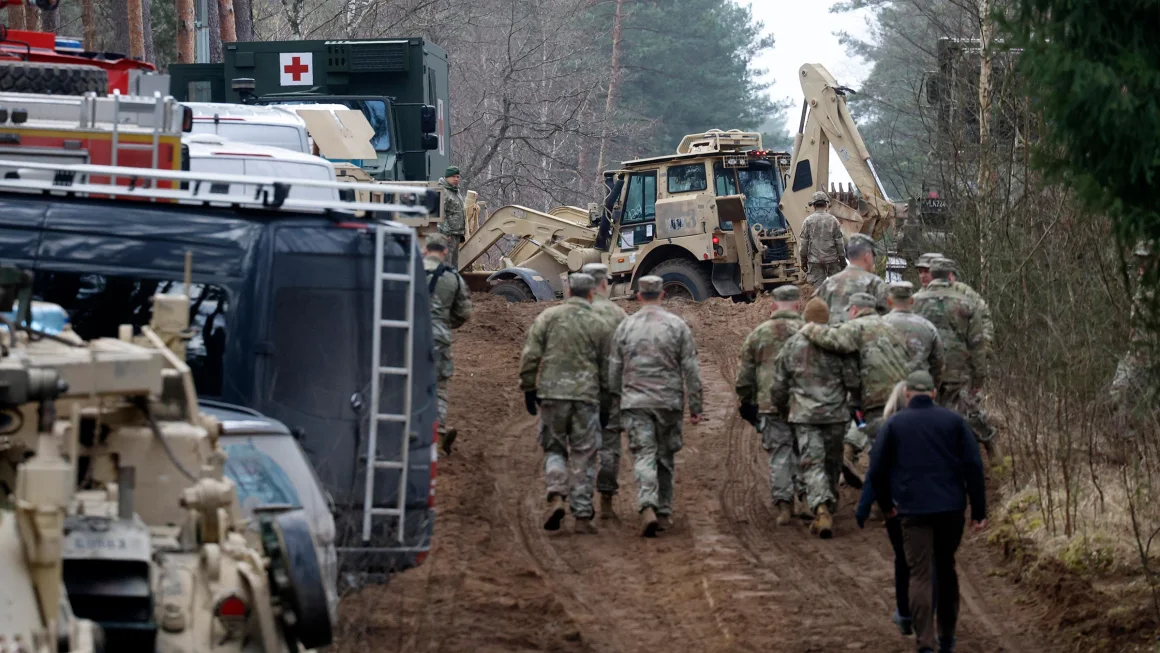
Military
personnel work at the site of a rescue operation for missing US soldiers
at Pabrade training ground, in Lithuania, on March 28. Petras Malukas/AFP/Getty Images
"Lithuania mourns together with the American nation."
"Please accept my
heartfelt condolences, as well as those of the Lithuanian people, to
you, the loved ones of those who lost their lives, and all the people of
the United States of America. "
"During this difficult time, our thoughts
and prayers are with you."
Lithuanian President Gitanas Nausėda
Under
NATO, to give reassurance to Eastern Europe, member-countries of the
military alliance were assigned to establish a Rapid Reaction Force as a
deterrent and a defence against Russian designs on its neighbours. With
a very real and demonstrated willingness to invade the borders of
neighbouring nations, the Russian Federation's ambitions of territorial
aggression and expansion gave birth to a renewed move by NATO to offer
protection to its members under duress of potential invasion.
Among
other member-nations the United States established a unit in Lithuania.
On March 25, an American armoured vehicle with four U.S. soldiers
aboard went astray in a marshy peat bog located at the huge General
Silvestras Zukauskas training ground nearby the town of Pabrade. A
search was undertaken and the location of the missing vehicle was found,
though no vehicle was in sight. The almost-70-ton behemoth had sunk
straight down, along with its personnel.
The U.S. Army search for four soldiers who went missing during a scheduled training exercise near Pabradė, Lithuania. U.S. Army
It
took six days in a massive effort by American, Polish and Lithuanian
armed forces to locate and dig the M88 Hercules vehicle out of the peat
bog. The search was widened when three of the missing men of the 1st
Armoured Brigade Combat Team, 3rd Infantry Division were found dead, and
a fourth body of the missing soldiers evaded the search teams. On a
tactical training exercise, the soldiers were reported, along with their
vehicle to be missing early on Tuesday.
The
thick forests and swampy terrain around Pabrade, some ten kilometres
west of the border with Belarus saw hundreds of Lithuanian and American
soldiers and other rescuers searching, engaged in a rescue mission. On
Wednesday the armoured vehicle's whereabouts was finally discovered,
submerged in 4-1/2 metres of swamp water.
Military
helicopters, fixed-wing aircraft, unmanned aerial systems and search
and rescue personnel were provided by the Lithuanian armed forces.
Excavators, sluice and slurry pumps were brought to the site, along with
other heavy construction equipment along with technical experts and
several hundred tons of gravel and earth, all to help with the recovery
mission.
American navy divers manoeuvred through thick layers of mud, clay and sediment "with zero visibility" to
finally reach the 63-ton vehicle on Sunday evening. There they
established several points where steel cables could be attached to
enable the work involved in lifting the vehicle. During the effort of
dragging the vehicle out of its submerged position, they began to lose
traction, requiring more heavy dozers to provide additional grip. Two
hours later the vehicle was pulled free of its ghastly grave.
Sgt.
Edvin F. Franco, 25, of Glendale, California, Sgt. Jose Duenez, Jr.,
25, of Joliet, Illinois and Pfc. Dante D. Taitano, 21, of Dededo, Guam. U.S. Army
The
navy dive team's work was not over. They then turned to searching the
area with the use of radar for the presence of the still-missing fourth
soldier. And his body was ultimately found, to join that of his other
three comrades, to be returned to the United States and to their
families, for burial.
An
undated photo of Staff Sgt. Troy S. Knutson-Collins, 28, of Battle
Creek, Michigan, who died in a training mission in Lithuania. U.S. Army
"I can’t say enough about the support our Lithuanian Allies have
provided us. We have leaned on them, and they, alongside our Polish and
Estonian Allies — and our own Sailors, Airmen and experts from the Corps
of Engineers — have enabled us to find and bring home our Soldiers."
"This is a tragic event, but it
reinforces what it means to have Allies and friends."
Gen. Christopher Donahue, commander of U.S. Army Europe and Africa
"This is like a nightmare." "This is all happening once again in the lifetime of survivors." "It has to be tearing their hearts out." Bernie Farber, former chief executive officer, Canadian Jewish Congress "[Such events as Ukraine's honouring of Nazi collaborators are] internal issues of Ukrainian politics." "[Israel's decision to condemn such parades is] counterproductive." Gennady Nadolenko, head, Ukraine diplomatic mission, Israel
"We
must challenge all those who distort the historical record on
governments, military units or organizations that fought with, supported
or sympathized with the Nazis during World War II." "This
includes government leaders who acquiesce in, or fail to condemn, a
process of Nazi glorification that amounts to Holocaust distortion." "Those who glorify the record of such organizations or units cannot dismiss criticism as 'fake news'." Michael Mostyn, CEO, B'nai Brith Canada
Veterans of the Latvian Legion, a force
that was commanded by the German Nazi Waffen SS during WWII, and their
sympathizers carry flowers as they walk to the Monument of Freedom in
Riga, Latvia on March 16, 2016 to commemorate a key 1944 battle in their
ultimately failed attempt to stem a Soviet advance. Jewish groups,
Moscow and some in Latvia's ethnic-Russian community see the parade as
glorifying Nazism because the Legion, founded in 1943, was commanded by
Germany's Waffen SS, the armed wing of the Nazi party's Schutzstaffel SS
(Protective Squadron). / AFP / afp / Ilmars ZnotinsILMARS ZNOTINS / AFP/Getty Images
For Jews around the world the 75th anniversary of the Soviet Red Army's
liberation of Poland's Auschwitz-Birkenau death camp where Nazi Germany
engineered the death of almost a million Jews, along with Roma, Soviet
POWs, Polish political dissenters, gays, the very thought that Latvians,
Lithuanians, Ukrainians and Poles would in the 21st Century, celebrate
their national heroes who were Nazi collaborators is unthinkable.
Yet the reality is that throughout Eastern Europe countries are
celebrating their nationals who collaborated with the Third Reich and
took active participation in the rounding up and murder of Jews.
Torchlight parades were held in a number of cities in Ukraine early this
month in honour of Stepan Bandera, a nationalist Ukrainian and Nazi
collaborator involved in the killing of thousands of Jews and Poles.
Despite which, Ukraine sponsors such events celebrating Nazi
collaborators with links to the Holocaust.
A school was named in Lithuania for Jonas Noreika whose own family
agrees was involved in the killing of Jews. A Ukrainian diplomat talked
about punishing "k----", while posing for photographs with a cake baked in the shape of Hitler's memoir Mein Kampf,
and blaming Jews for the Second World War. Once a minor kerfuffle
passed, when he was condemned by Jewish groups, he was reinstated to his
diplomatic position.
For the approximately 200 Canadian military trainers currently deployed
to Ukraine, it is likely that on the first of January they would have
witnessed a torch lit procession. Throughout Kiev and numerous other
towns in Western Ukraine, thousands of civilians took to the streets –
not to usher in the New Year – but to celebrate the 110th anniversary of
the birth of a man named Stepan Bandera. Scott Taylor, Canadian Military Magazine
Estonia, Latvia and Ukraine have all held parades in honour of those who
fought in Nazi SS units. The Latvian SS units who fought for the Nazis
in the Second World War were praised by Latvian Defence Minister Artis
Pabrike in December, who spoke of them as "the pride of the Latvian people and of the state".
One of the unit's officers, Viktors Arajs, participated in the murder
of 26,000 Jews with his unit. At a dinner party in Riga he entertained
guests with his method of killing Jewish babies.
Throwing the babies into the air, then shooting them would avoid any
ricochets that might occur if the babies were shot while lying on the
ground. Eastern European nations such as Latvia, Ukraine and Lithuania
are involved in rebuiilding their national identities, "rediscovering"
individuals from the 1940s to elevate them to the status of national
heroes, according to Holocaust researcher, Professor Per Anders Rudling.
Latvian Herbert Cukurs was a key member in the Arajs Kommando, known as the "Butcher of Riga".
In 2014, the Israeli government raised concerns relating to a musical
performed in Latvia celebrating his life, that of a Nazi war criminal
whom Holocaust survivors linked to the murder of Jews. Over 50 members
of the U.S. Congress in 2018 condemned Ukraine's efforts to glorify
leaders of the Ukrainian Insurgent Army, along with the 14th SS Galizien
Division, comprised of Ukrainian volunteers.
"It's particularly troubling that much of the Nazi glorification in Ukraine is government-supported",
the letter stated. Poland passed legislation to make it illegal to
accuse Poles of any complicity in the Holocaust when the simple reality
is that fascist Germany felt confident in placing a number of forced
labour and death camps in Poland, knowing there would be no popular
outcry from a country where antisemitism was well entrenched.
In Western Ukraine, thousands of civilians took to the streets to celebrate the 110th anniversary of the
birth of Nazi collaborator Stepan Bandera
Lithuania's pro-Nazi government had been involved in the rounding up and
murder of Jews, according to well-researched conclusions, yet a new law
is under consideration in Lithuania to declare that neither Lithuania
nor its leaders had ever participated in the Holocaust. Ukrainians, for
their part, push back against Israel's condemnation, insisting that
Stepan Bandera had never supported Nazi Germany, just as the Latvian
government claims the Latvian SS units hadn't fought in support of
Hitler, but to fight the Soviets.
News articles and research relating to Nazi collaborators have been
dismissed by officials in Latvia, Estonia, Ukraine and Lithuania,
claiming them to be the product of Russian disinformation campaigns
meant to cast their countries in a bad light. Canadian officials failed
to join Jewish groups condemning Latvian Defence Minister's Pabriks
praise of the Latvian SS and two months later, he met with Canadian
Minister of Defence Harjit Sajjan, while next month he returns to Ottawa
for a defence conference.
Chrystia Freeland, formerly Canada's Minister of Foreign Affairs and in
this new Liberal government named as deputy Prime Minister, is of
Ukrainian background. She has been banned from entry to Russia. Her
grandfather was a Ukrainian patriot who collaborated with Nazi Germany,
publishing a newspaper in Nazi-occupied Poland, supportive of the Third
Reich and rife with antisemitic tropes. The Ukrainian-Canadian community
has always denied that members of the 14th SS Galizien were Nazi
collaborators, many of whose members immigrated to Canada.
After Ukraine gained its independence
from the Soviet Union in 1991, their initial collaboration with the
Nazis and participation in the slaughter of Ukrainian Jews prevented
Bandera and Shukevych from being considered national role models.
However, much to the consternation of the Jews, and the Poles – whom
Bandera’s OUN also massacred in the thousands – over the past three
decades history in Ukraine has been revised.
At the time of the Maidan uprising in
2014, the spirit of Bandera was revived by the right wing,
ultra-nationalists, and, just five years later, his past crimes have
been whitewashed to the point where his date of birth is a national
holiday. Scott Taylor, Global-Politics,EU
"I hear people saying that what happened, and is still happening in Ukraine, was completely unexpected and unpredictable, that it was a kind of wake up call." "It actually was a wake-up call for many, but not the countries of our region. For years, Lithuania, Poland and other Baltic States [were called] Russophobes, unable to wake up from the dreams of old Soviet times and face new reality. The reality was that threats had no boundaries and were difficult to predict." "NATO in its essence is about the empathy, about sacrifice for the sake of your ally. Lithuania always took its share. We were in the Balkans, we were in Iraq, we led PRT in Afghanistan and stayed with our forces as a part of [Operation] Resolute Support. We are in Mali and we contributed to the French efforts in Central African Republic. We do support current efforts against ISIS and we will do our share in the future as well." "[At the summit in] Wales, we stated that NATO remains an essential source of stability in this unpredictable world. It is very important that the gap between acknowledging that fact and mobilizing our national and collective resources and political will to project that stability [doesn't] widen." Juozas Olekas, Lithuanian Defence Minister
Fighting in eastern Ukraine has worsened in recent days, despite the ceasefire plan agreed last September
Ukraine's President Petro Poroshenko has stated once again, this time at Davos, that his country has been invaded by Russian troops. Five thousand Russian troops, he stated, and 300 Russian tanks, shoring up the fighting ability of the rebels who, minus Moscow's interference in Ukraine's affairs, would long since have surrendered their mission to shift Ukrainian territory into the grasp of Russia's turning back the present into the past, recreating the USSR.
The American ambassador to the United Nations, Samantha Power, spoke of the new peace proposal put forward by President Vladimir Putin as little more than advancing his plans at military occupation. "The plan would seek to legitimize territorial gains made by separatists in September as well as Russian personnel and equipment on the territory of Ukraine", she said at a special meeting of the UN Security Council. "Let us pull the veil away from Putin's peace plan and call it for what it is; a Russian occupation plan."
The countries bordering Ukraine know very well what Russia's intense interest in acquiring new territory signifies for them. The Baltic states dread the implacable will of Moscow and Mr. Putin to renew old bonds and strengthen the Russian federation, creeping inexorably toward the union that collapsed with the fall of the USSR. They were indeed 'Russophobes' in recognition of their status under the old union, and have no wish whatever to repeat the experiment that failed so dramatically.
Lithuanian Defence Minister Juozas Olekas emphasized that countries like his own have acknowledged that the presumed and relied-upon world order based on territorial sovereignty can no longer be relied upon; something like aligning Russia with honour and respect for the nations that Moscow terms the 'near abroad', and fair game for once again pillaging. "Therefore we must re-evaluate our own assumptions about our security."
And ideally, he and the other nations that have become part of NATO, would most appreciate it were NATO to recognize those changes and alter their responsibilities to their member-nations accordingly. During the Russia-Georgia war in 2008 Mr Olekas recalls calling on fellow NATO colleagues to consider changing the manner in which they regarded the protection of territories of each member state singly. He recommended considering protecting NATO-member borders in their entirety. "I still believe this is an idea worth consideration. We need to rethink NATO's posture and command structure as it reflects the realities of the Cold War and economic downturn, rather than the new alliance after expanding and re-emerging threats we are facing."
Poland, Ukraine and Lithuania form joint military unit
BBC News online -- 21 September 2014
Soldiers from Poland and Lithuania took part in Nato-led military exercises in Ukraine earlier this month
Poland, Ukraine and Lithuania have agreed to set up joint military unit of several thousand soldiers.
Defence ministers from the three countries signed the deal on Friday.
Poland's defence ministry said the brigade would be based in
the eastern Polish city of Lublin but the soldiers would remain in their
home countries.
Poland and Lithuania are eager to bolster defences following
Russia's annexation of Ukraine's Crimean peninsula earlier this year.
Russia sent thousands of troops to the peninsula in March, eventually forcing Ukrainian soldiers to withdraw.
Shortly afterwards, pro-Russian separatists in Ukraine's eastern Donetsk and Luhansk regions declared their independence.
More than 3,000 people have died in fighting between Ukrainian government forces and separatists since April.
A spokesman for the Polish defence ministry said work to form
the joint unit with Ukraine and Lithuania first began in 2007, adding
that it would operate under the guidance of the UN, Nato and the EU.
The unit would participate in peacekeeping missions, the
spokesman added, but no details were given on any potential role in
Ukraine's conflict.
Defence ministers from Ukraine, Poland and Lithuania formed the long-awaited military pact in Warsaw
Earlier this week, soldiers from Poland and Lithuania joined
about 1,300 soldiers from 15 countries - including the US and other Nato
members - in military exercises in western Ukraine.
In response, Russia's Defence Minister Sergei Shoigu said it
must boost its forces in Crimea to counter the presence of Western
troops in Ukraine.
Also on Friday, Nato defence chiefs agreed to set up regional
centres in several Eastern European countries, during a meeting
Lithuania's capital Vilnius.
Lithuania's chief of defence Jonas Vytautas Zukas said the
"command-and-control" centres would be launched in Lithuania, Latvia,
Estonia, Poland and Romania and would each employ up to 120 military
personnel,
Meanwhile, Sweden said on Friday that it had lodged a
complaint with Russia's ambassador in Stockholm about two Russian
fighter planes entering Swedish airspace.
Swedish officials said the jets had briefly violated Swedish airspace on Wednesday near the eastern island of Oland.
In another diplomatic row, Lithuania said it had summoned
Russia's ambassador to Vilnius after a Lithuanian fishing vessel was
detained by Russian authorities earlier this week.
This represents a general opinion site for its author. It also offers a space for the author to record her experiences and perceptions,both personal and public. This is rendered obvious by the content contained in the blog, but the space is here inviting me to write. And so I do.