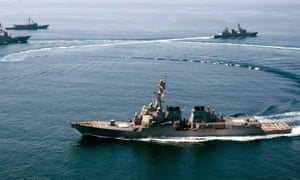
"The United States side should stop abusing international law, cease all dangerous and provocative behaviour, and strictly restrain the activities of front-line troops, which is the fundamental way to avoid accidents at sea and in the air."
"[U.S. warplane and warship activity] on China's doorstep [is the root cause of the problems between the two military powers]."
Beijing Defence Ministry spokesperson Wu Qian
"No member of the international community should be intimidated or coerced into giving up their rights and freedoms."
"The United states military flies, sails and operates anywhere international law allows."
U.S. Navy 7th Fleet news release
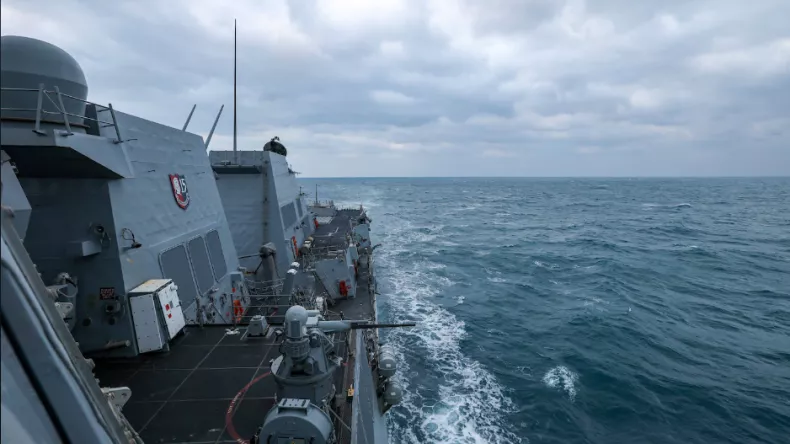
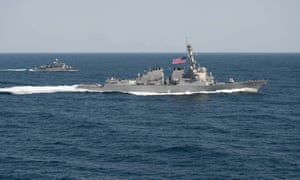
The USS John Finn (DDG
113), which transited the Taiwan Strait on January 24 in what the U.S.
calls a "freedom of navigation" operation. China's military responded by
condemning the U.S.'s "provocative acts."
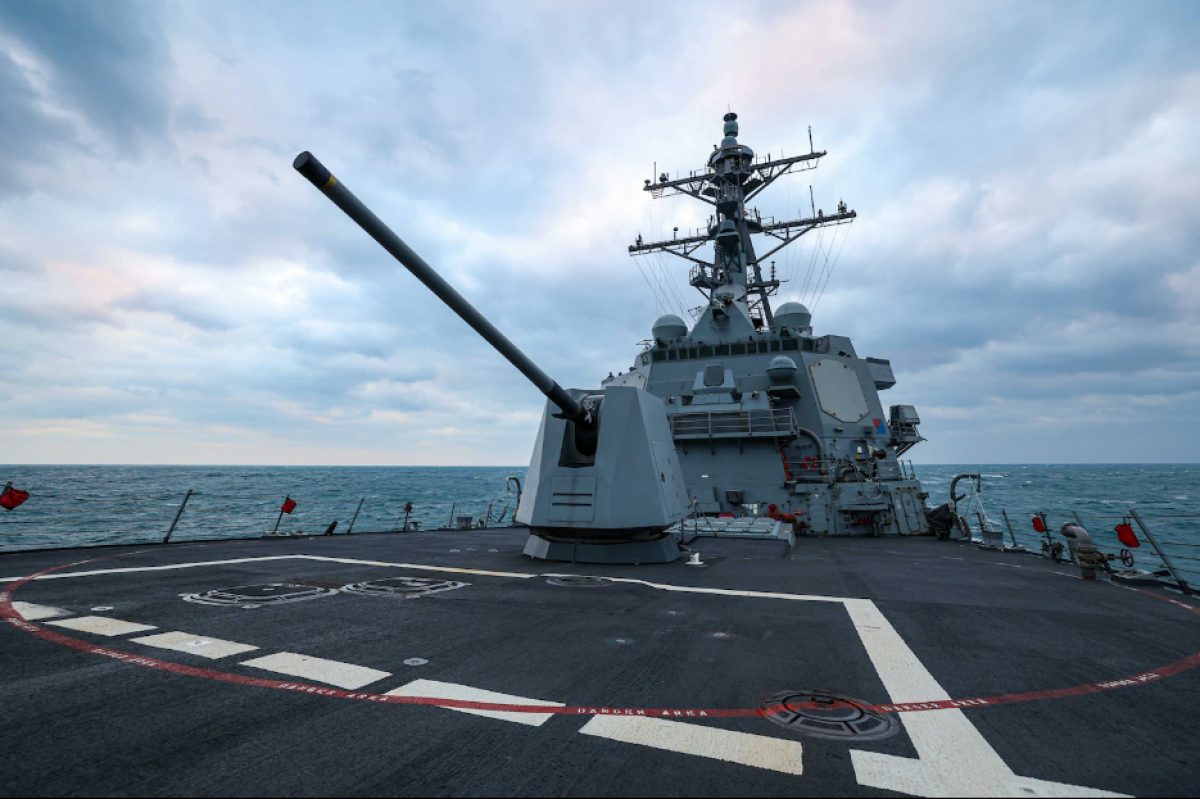
Once again China laid accusations against the United States of having violated international law through military manoeuvres in the western Pacific. The complaint arrived a day following the politically sensitive Taiwan Strait hosting an American naval destroyer sailing through. The USS John Finn sailed through the 160-kilometre-wide waterway separating China from Taiwan. The autonomous island that considers itself a sovereign entity defying Beijing's declaration that it is part of China.
In November of 2023 at a meeting that took place between Presidents Joe Biden and Xi Jinping in California, both agreed -- after a prolonged period of increasingly chilly diplomacy and sporadic accusations of imperilling peace through rhetorical challenges amplified by war games seen on each side as intimidation -- to warm the diplomatic climate by resuming military contacts.
The purpose of which was to manage the potential for an unintentional collision or other incident between the two that could occur while both sides patrol the waters in regional hotspots, including he Taiwan Strait and the South China Sea, which Beijing claims as its sole ownership, clashing with its neighbours -- resentful of their own traditional claims of extended sovereignty from their coastlines hijacked by China.
The United States is intent on demonstrating that the areas of the high seas should remain navigable as international waterways, leading to a clash of interests between the two. The United States sees its actions being in line with international laws guaranteeing freedom of navigation. Whereas China's rising prominence and power allows it to project military might into the western Pacific bringing it into conflict with the United States, whose military power in the region has long been dominant.
U.S. military activity is meant to deter China from launching any kind of attack on Taiwan, much less using its strength to enforce its territorial claims in its disputes with smaller neighbours such as the Philippines. Last year, as disputes over shoals and other outcroppings in the South China Sea flared, Chinese and Philippine ships clashed. China lays the blame on American support, citing joint patrols by the United States with the Philippines emboldening the latter to challenge China's regional dominance.
The USS John Finn (DDG
113), which transited the Taiwan Strait transit on January 24 in what
the U.S. calls a "freedom of navigation" operation. China's military
responded by condemning the U.S.'s "provocative acts."
"[Beijing may be a bit] miffed [at Washington at the
moment, especially after agreeing to restart military-to-military talks
in December]."
"Given that Beijing very likely believes that it extended the
olive branch by agreeing to reopen military-to-military communications
and other high-level exchanges, it might have perceived a lack of
reciprocity from the US."
"[US warships and warplanes regularly travel through and over the
waterway. In 2023, US Navy and Coast Guard ships and Navy reconnaissance
planes made 11 transits of the strait]."
Collin Koh, research fellow, S. Rajaratnam School of International Studies, Singapore
"On the issue of easing tensions in the South China Sea, it is very necessary for the big power concerned, namely the United States, to stop interfering and stop provoking."
"China’s
DF-26, an anti-ship missile tested and 'demonstrated'
by the People’s Liberation Army reportedly able to travel 2,000 miles
to destroy carriers, does present a credible threat to be taken
seriously. Yet much of the hype seems to leave out certain critical
comments made by senior U.S. Navy leaders and various adaptations the
modern Navy has made to respond to or 'counter' China’s often-discussed
A2/AD (anti-access/area denial) strategy."
"With a range of up to 2,500 miles and 4,000-pound payload, with
satellite targeting the DF-26 in theory could strike U.S. Navy warships
across the western Pacific Ocean. 'Even when launched from deeper inland
areas of China, the DF-26 has a range far-reaching enough to cover the
South China Sea', an unnamed military expert told Global Times in a report several years ago."
"However,
upon closer examination and careful reading of public comments from
senior Navy officials, there certainly seems to be room for debate on
this question. While certainly nobody questions the seriousness of a
threat of this kind, and clearly the Chinese weapons are taken
seriously, yet some of the threat language might accurately be assessed
as 'hype' given the steady stream of ongoing advances in layered Carrier
and Carrier Strike Group defenses."
Kris Osborn, Military Affairs Editor, 19FortyFive, President, Warrior Maven – Center for Military Modernization
DF-26
According
to boasts by Chinese scientists, the new hypersonic weapons China
possesses could destroy the newest aircraft carrier in the American
Navy. A research team on a war game software platform that China's
military uses, indicated Chinese forces sinking the USS Gerald R. Ford
carrier fleet with a volley of 24 hypersonic anti-ship missiles. A
report in the South China Morning Post claimed the results of the hypersonic strikes, made public for the first time in a May paper published by the Chinese-language Journal of Test and Management Technology.
Computer-generated
battle scenarios are often used by military planners to game out
strategies. However, they cannot be overly relied upon in real-life
conflict where terrain, weather and other unforeseen factors are capable
of disrupting weaponry, warn experts in the field. The strategic
scenario used a platform of an attack on American vessels that had
steamed toward an island claimed in the disputed South China Sea by
China.
Some
of the missiles in the three-wave attack, according to researchers,
were fired from as far distant as the Gobi Desert. The entire play
relies on a diplomatic confrontation over the waterway and its rich
resources that has escalated for years in a landscape of overlapping
territorial claims between regional nations and an increasingly
aggressive Beijing.
With
China determined to extend its reach by claiming and militarizing
islands, reefs and rocks, the United States Navy has accelerated its own
'freedom of navigation' patrols in universally recognized international
waters that Beijing claims as its own. China has been developing its
missile arsenal rapidly, including hypersonic technology, as a
reflection of its focus on building its naval capabilities.
The
Chinese military had three days earlier tested a new hypersonic
intermediate-range ballistic missile named the DF-27, according to a
leak of a top-secret report, by the U.S. Joint Chiefs of Staff
intelligence directorate, several months back. The DF-27, according to
the document, possessed a high probability of capacity to evade U.S.
ballistic missile defence, designed to boost Beijing's ability to strike
large parts of the Pacific. That would include the U.S. territory of
Guam, and its strategic military base.
China
last year deployed versions of the new missile capable of attacking
land targets and ships. Also revealed was that the DF-27 has increased
potential as a "carrier killer" vastly out-performing its predecessors.
Researchers from the North University of China in the latest war game,
concluded that almost every U.S. surface vessel was shattered by the
hypersonic attack and sank eventually.
USS Gerald R. Ford Aircraft Carrier (Photo by Matt Cardy/Getty Images)
"The Chinese authorities consider fishermen and fishing vessels important tools in expanding China's presence and the country's claims in the disputed waters." Zhang Hongzhou, Nanyang Technological University, Singapore
"It is our water. But if we don't fish there, how can we claim it is our territory?" Captain Chen Yuguo, Tanmen, Hainan
China has laid claim to 90 percent of the South China Sea. Its self-proclaimed territorial demarcation passes close to the shores of the Philippines, Malaysia, Brunei, Vietnam and the Natunas. None of which entities are too impressed by the close, persistent and insistent presence of the Asian giant determined to swallow territory at sea that they themselves claim in recognized maritime distance from their shores.
It makes sense that a maritime nation like China, with the world's largest population would also have an enormous fishing fleet. It makes sense that this enormous fishing fleet has, over time, virtually emptied that part of the South China Sea where Chinese fishing trawlers have traditionally plied their trade. That having been done, what to do with the fishing vessels other than to co-opt them into the larger maritime fleet China owns, and urge them to look a little further for their catch.
In waters claimed by other nearby maritime nations with and for their own fishing fleets and their naive impression that the waters off their shores are by international agreement under traditional maritime laws, theirs to be free with. But that was perhaps before China decided to deploy their own fishing fleet as an forward advance in their claims of territorial ownership of the vast sea that has suddenly become China's own.
Two members of the United Nations Security Council, Russia and China, both given to supporting positions that each takes, engaging in piracy; Moscow by co-opting the Crimean Peninsula from Ukraine, and Beijing by 'owning' the South China Sea and rather upsetting its neighbours in the process. Just as Moscow was placed under sanctions led by the United States and NATO, so is Beijing being confronted by American warships in a convincing display of international free passage.
Indonesia, Malaysia and Vietnam are somewhat less than impressed with the reality of Chinese fishermen with Chinese coast guard vessels in their wake, venturing huge distances from their shores to enter close to the shorelines of nations whose proximity to the surrounding waters are not contrived, but natural. Brute size and strength augmented by the authority of command equal maritime dominance.
Captain Chen has a costly satellite-navigation system supplied to him by the government of China. He states that it is his right to fish around the disputed Spratly Islands. It is where the catches are supremely improved over China's inshore waters, sadly depleted. About a hundred Chinese fishing boats accompanied by a Chinese coast guard vessel appeared off the shore of Malaysia, 800 nautical miles from China's Hainan.
A Chinese ship supplying fuel to Chinese fishing boats off the coast of Vietnam was seized by that country in early April. On March 20, Indonesian officials boarded a Chinese fishing vessel that turned up close to Indonesia's Natuna Islands. While an Indonesian vessel towed the boat to shore, a Chinese coast guard ship rammed the fishing boat, pushing it back into the South China Sea, forcing the Indonesians to release the tow line.
Not incidentally, China's expanding fish export industry is already the world's largest.
"The Chinese goal is not to pick a fight. Just the ability to
impose any kind of cost, to get any kind of vessel out there on site,
forces the Chinese to make a decision about how much they really want to
engage in a certain activity." Gregory B. Poling, director, Asia Maritime Transparency Initiative, Center for Strategic International Studies, Washington
"I can’t speak for another nation and how they might react to this. But I can tell you that there’s nothing offensive or provocative
with respect to any of the military capabilities that are permanently
based in the Asia-Pacific region or are going to be rotationally based
in the Pacific region." "What it signals is our commitment to our alliance
with the Philippines." U.S. State Department spokesman John Kirby
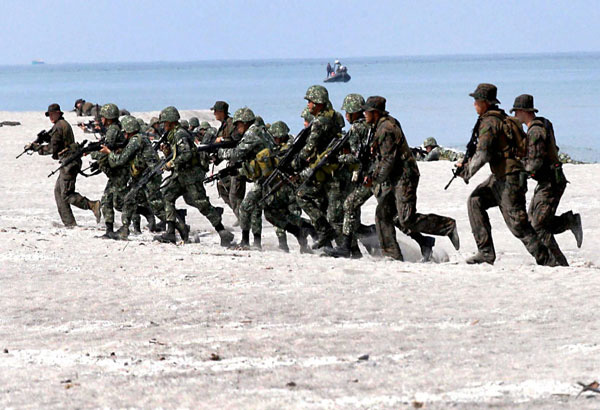
Marines from the Philippines during joint exercises with the United States in Antique Province this week.Credit
Agence France-Presse — Getty Images
Things are heating up in the South China Sea as China continues to position itself as the dominant player; correction: assuming the virtual ownership of the body of water which, after all, holds its name and must therefore, not be regarded as an international waterway accessible without question to all regional powers. And, as such, requiring permission from China to traverse those waters. It seems somehow fitting that China is busy securing itself at Mischief Reef.
Which is where China is now building a military base, vexing Vietnam and the Philippines to no end. China is busying itself building outposts at Scarborough Shoal, disputed territory far distant from its mainland. All in the interests of 'planting its flag' of sovereignty where other, neighbouring nations feel that their own proximity should logically declare their more legitimate interests, which China haughtily disputes and then ignore, precisely how any schoolyard bully would comport itself.
Last month off Mischief Reef the American Navy cruiser, the U.S.S. Chancellorsville was alerted to a Chinese frigate speedily approaching it from Mischief Reef, with a helicopter lifting off from the frigate, flying straight toward the U.S. cruiser. "This is U.S. Navy warship on guard. Come up on Frequency 121.4 or 243" was the message speedily relayed by radio from the ship's bridge. Response there was none. As the helicopter pilot hovered and circled, flying back to the frigate, the U.S. cruiser's captain alerted the crew that trouble might be ahead.
And the captain called up a Chinese speaker in Ensign Niles Li, when English messages were ignored. "You're up. They can't pretend they don't speak Chinese." Ensign Li communicated: "Chinese Warship 575, this is U.S. Warship 62. Today is a sunny day for a sea voyage, over." An inspired bit of diplomacy, warship to warship. "U.S. Warship 62, this is Chinese Warship 575. Today's weather is great. It is a pleasure to meet you at sea", responded the Chinese frigate, nicely defusing the tense atmosphere.
Warships have this about them; they are geared for serious business. Bristling with missiles, torpedoes and heavy artillery, each is capable of heaving its military gear into action with confidence, although neither would aspire to do so if they really had no need to. And they had no need to. But the Chinese frigate was there for a purpose, to shadow the American cruiser, and it did just that for the rest of the day.
Which didn't dissuade the Chancellorsville from its purpose; appearing in waters that China is making every effort to claim for its own, unreservedly. And the purpose of the American warship in the area was to support its allies, and to convince China that it is prepared to do so. Roughly 700 American patrols have passed through the Spratlys and other disputed island chains, asserting in essence that the sea is freely open to all nations.
The United States has accused China of militarizing the South China Sea. China is now returning the compliment, grumbling that this is precisely what the U.S. is doing; a nation located far from the region but which has dispatched its navy to interfere in China's security and plans to establish its main-player dominance among its neighbours. China is responding to the new agreement between the U.S. and the Philippines whereby five military bases in the Philippines are slated for American facilities to be built to deploy more American troops, planes and ships.
Check and Checkmate.
At the 6th US-Philippines
Bilateral Strategic Dialogue in Washington, US Deputy
Assistant Secretary of Defense Amy Searight said the deal was reached
under the Enhanced Defense Cooperation Agreement (EDCA). STAR/File photo
"I'm far from optimistic [about China]. Conflict is inevitable in all areas -- cyber, economic, military." "Our so-called peace was enabled by someone else -- Canadians, Australians and Americans in Korea, for example." "This [detente between China and Japan] is only temporary. For the rest of my life the China-Japan relationship will be characterized by 'cold peace'." Tomohiko Taniguchi, special adviser to Prime Minister Shinzo Abe
"China has no intention of engaging in the use of force, not only with Japan, but also with the United States." "Investment and trade would go down and undercut the economy, on which the credibility of Xi Jinping [President of China] rests." Satoshi Mirimoto, former defence minister/Democratic Party of Japan government
"They are trying to change the status quo by force in a western Pacific dominated by an American hegemon. We made the same mistake 80 years ago. They will not be successful." "Is the PLA [People's Liberation Army] a rational player? That's the biggest question for us." "Pessimism is easy -- people believe you. But China can do democracy, they can change. The turning point is coming within ten years -- will the Communist Party attempt to increase its already tight control, or do they have a [Mikhail] Gorbachev to start reform?" Kunihiko Miyake, research director, Canon Institute for Global Studies
Reclamation of Mischief Reef in the Spratly Islands in the South China
Sea. China is to build a petrol station on another disputed island in
the Paracels.
Photograph: Ritchie B. Tongo/AP
The Japanese people hold their government to a tight standard of non-militarization, a hold-over from the Second World War and the dropping of atomic bombs by the United States -- with which Japan was at war -- on Hiroshima and Nagasaki. When Japan declared it was defeated after those dreadful blasts, the U.S. set about helping the country reestablish itself. And at that time Japan pledged that its military would never again be used for offensive action, only for defense.
The Japanese people were so bitterly averse to their military taking them into the Second World War that traditionally, post-war, members of the military never dared wear their uniforms in public. The Japanese military became accustomed to travelling in civilian clothing, and changing into military uniform only when they had reached military installations wherever they were, in Tokyo or elsewhere. A soldier appearing in uniform in public risked insult and even attack by citizens.
Tokyo's wartime Yasukuni shrine where wartime elite military personnel were buried remains a despised symbol of Japan's military past. That past included an invasion of Korea and another of China. Japanese cruelty to Koreans and Chinese when it occupied those countries was legendary. Korea and China, 70 years after their invasion, occupation and subjection of humiliating and violent suffering under the Japanese military still harbour understandable rage against Japan.
In the present era, it is Japan and its people who are the pacifists and China which is the aggressor. But even thirty years ago on the streets of Tokyo, where courtesy, law and order and public passivity reigned, right-wing groups sometimes drove vans with blatant right-wing signage through the streets, with loudspeakers playing blaring martial music and strident voices barking militaristic slogans; most Japanese simply ignored their presence, going about their quiet business.
Now, however, a gradual recognition has emerged that Japan can no longer suppress the need for it to have a military geared to protecting itself which would have the capacity to do so; "proactive pacifism", giving Japan the right to send forces overseas for the first time since the Second World War has elicited large protests from among the population, against the Abe government which has brought in the concept. The fear that China may be preparing to risk war to achieve its ambitions in the South China Sea has all its neighbours on edge, over mutual territorial claims.
Traditionally, convention had it that Japan's spending on defence would be kept to a minimum. It has been capped at one percent of GDP; amounting to $45.8-billion. China, in contrast, which has increased its military spending by 360 percent in a decade to two percent of GDP, spends $216.4-billion annually. The protection of Japan and Japanese interests has been seen to by the United States, along with other countries in the recent past.
With Japan's push-back over the disputed island which both Japan and China claim in the East China Sea, China has backed up lately, with a more polite facade.
"But does that mean Xi has complete control over the military? I don't think many people would say yes to that question." Akio Takahara, professor, Graduate School of Law and Politics, University of Tokyo
"[The U.S. vessel entered Chinese waters] illegally and without the Chinese government's permission." "The action by the U.S. warship has threatened China's sovereignty and security interests, endangered the safety of personnel and facilities on the islands and damaged regional peace and stability." "[The U.S. should] correct its wrongdoing immediately, [not take further] dangerous and provocative actions." "If certain parties continue to stir up trouble and create tension, then China may be forced to come to the conclusion that it is indeed necessary for us to speed up and strengthen relevant capacity building on the islands]." Chinese Foreign Ministry spokesman Lu Kang
"You
don’t need to consult with any nation when you are exercising the right
of freedom of navigation in international waters."
"[Such a challenge to a questionable
sovereignty claim is] one of the reasons you have a navy — to be able
to exert influence and defend freedom of navigation in international
waters." John Kirby, U.S.
State Department spokesman
"That certainly includes the ability of our Navy to operate in
international waters. This is a critically important
principle, particularly in the South China Sea, because there are
billions of dollars of commerce that flow through that region of the
world every year — maybe even more than that — and ensuring the free
flow of this commerce, and that freedom of navigation of those vessels
is protected, is critically important to the global economy." Josh Earnest, White House press secretary
The USS Lassen conducts a trilateral naval exercise in May of 2015.
Photograph: EPA
China considers the impudence of America beyond contempt, its outrage is palpable; an infringement on its sovereignty is not to be taken lightly. In so doing the Americans stand guilty of profound damage to regional peace and stability. American interference in a strictly regional issue is inexcusable, for China's land reclamation program in the Spratly archipelago in the South China Sea is a matter between China and Vietnam, Taiwan and the Philippines.
USS Lassen sailed within 12 nautical miles of artificial islands built by China in the South China Sea, says Beijing.
Photograph: US Navy/Reuters
That those countries are unhappy because their own sovereignty has been trespassed and threatened should be of no concern to the United States. The Chinese foreign ministry solemnly declared that Beijing may decide to speed up its construction progress; should the Americans consider additional missions of this kind, the result could be to "trigger eventualities". Eventualities of the type that conform to the old Chinese curse "May you live in interesting times". In fact, we do, we certainly do.
The intentions of the Americans cannot have come as a total surprise to President Xi Jinping since at a conference during his visit to the United States last month President Obama clearly stated that the United States was prepared to operate, fly or sail anywhere permissible by international law. For its part, China dispatched warships into territorial waters of the U.S. back in August when five Chinese vessels approached within twelve miles of the Alaska coast at the very time that Mr. Obama was in Alaska.
In May, a U.S. Navy surveillance plan skimmed over three of China's five artificial islands without approaching the 12-mile territorial exclusion zones. At that time, on that occasion, Chinese Navy radio operators had given warning to the Americans that they must leave the area. In contrast, when the five Chinese ships were inside the 12-mile territorial zone off Alaska, not a hair was turned, nothing was said, the world turned as it must.
In the negotiations ongoing between the Arctic states of Norway, Canada, United States, Denmark and Russia, each of the Arctic countries assembling scientific data to prove their territorial claims in the Arctic, China has expressed interest in being involved, although the Arctic is half a world away from its shores. That being the case, it would be difficult for Beijing to protest American interest in the South China Sea, where its allies, Vietnam, Malaysia, the Philippines, Brunei and Taiwan have competing interests to China's.
China stated that it had taken precautions to monitor the USS Lassen while it passed close by the Subi reef where its artificial island sits, the centre of a regional dispute over maritime territory and sea routes. A missile destroyer and a patrol boat delivered a warning to the Lassen; in response the vessel sailed on its course. The mission was completed "without incident" as the guided-missile destroyer, accompanied by Navy surveillance planes, went on its planned way.
Beijing had previously warned it would "never allow any country" to violate its territorial waters and airspace around the artificial islands it has constructed by dredging up sand from the ocean bottom to layer coral reefs and rocks which are ordinarily below sea level. By raising their level to construct small islands, Beijing claims the resulting islands are Chinese possessions, claiming territorial ownership extends to the entire seabed, and the air above it.
Just as Moscow had a Russian titanium flag planted on the floor of the Arctic, China has constructed runways and buildings on the series of artificial islands over reefs, while claiming there is no military dimensions planned for the outposts so distant from their own shores. When the incident had passed, China's vice foreign minister, Zhang Yesui, reamed out U.S. Ambassador to China Max Baucus, in a formal protest.
Subi Reef, once submerged at high tide, now is large enough to host an airstrip, since China began its massive dredging operation. A surveillance tower and multiple satellite antennae are visible through satellite images on the island. International law does not recognize rights to territorial waters around artificial islands. At the site of another such island, Fiery Cross reef, a Chinese airstrip is under construction. Designed, China claims, for civilian use, not meant to affect navigation freedom in the South China Sea. Yet.
A satellite image from March
showed work on an emerging artificial island at Mischief Reef, part of
the Spratly Islands in the South China Sea. China has been turning
submerged reefs into islands to bolster its territorial claims.Credit
Center for Strategic International Studies, via Digital Globe
This represents a general opinion site for its author. It also offers a space for the author to record her experiences and perceptions,both personal and public. This is rendered obvious by the content contained in the blog, but the space is here inviting me to write. And so I do.