"What
can I say? We wee all sad. But we didn't have time to mourn him,
because we were so busy surviving ... We were told right away, 'You're
next!'." "They had guards watching us all the time,
keeping us awake on purpose, just to break us down physically and
mentally."
"The weaker we become, the more they laugh. They think it's funny like
hell." "John [Ridsdel] and me ... we became like soulmates. We were
thinking about -- planning is not the right word -- maybe dreaming, what
we were going to do when we got out of there."
Kjartan Sekkingstad, Norwegian, permanent resident of Canada
"His
[Abu Sayyaf terror suspect Anduljihad Susukan] giving himself up to Mr.
Misuari [Muslim rebel leader Nur Misuari] is not the surrender
contemplated under the law and does not make him immune from arrest." Maj.Gen.Edgard Arevalo Philippine military commander
Abduljihad Susukan, linked to the beheadings of hostages including two
Canadians in the Philippines, surrendered on Friday, officials say. (Davos City Police)
Like
the Islamic State's propensity to publicize the atrocities they
committed on their victims by video taping sophisticated theatricals of
horror leading up to the beheading of the 'infidels' they captured, the
Abu Sayyaf terrorist group, aligned with ISIL in the Philippines took
the same apparent pleasure in terrorizing, tormenting and ultimately
beheading those they took prisoner for ransom. In September of 2015, two
Canadians along with a Norwegian with Canadian connections and a
Filipino woman were abducted from a marina operated by the Norwegian in
Davao.
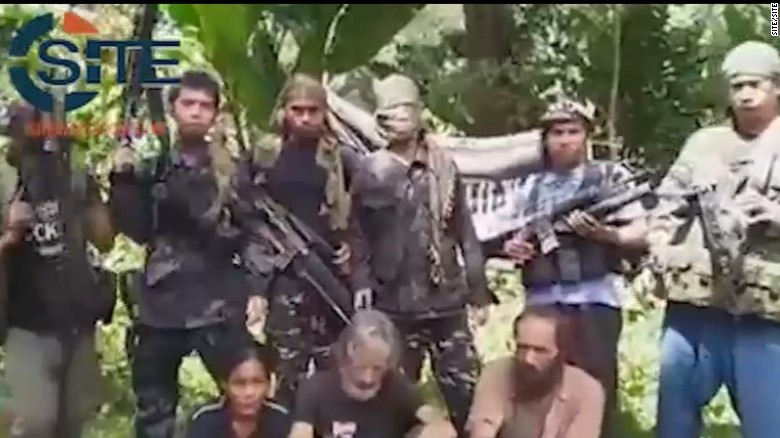
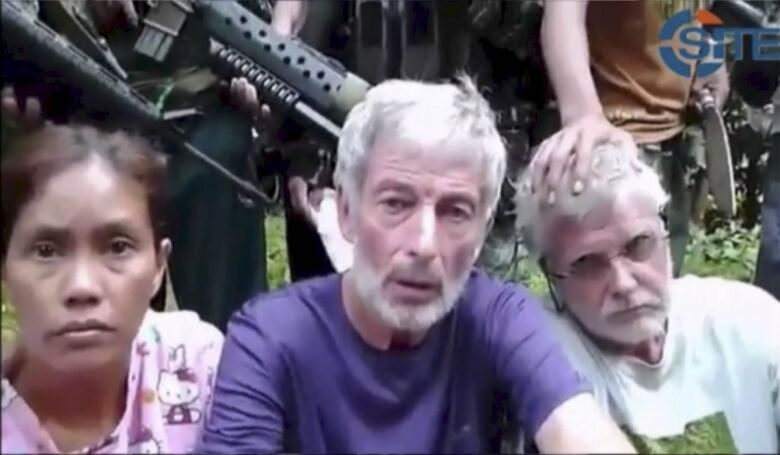
Canadians Robert Hall, centre, and John Ridsdel, right, were taken hostage by Filipino militants in 2015. (Site Intelligence)
The
terror group demanded a hefty ransom for the lives of John Ridsdel of
Calgary along with fellow Canadian Robert Hall. It wasn't the first time
Canadians were captured as they went about their business. There was a
precedent to the Philippines' event, when Robert Fowler, a Canadian
diplomat on assignment with the United Nations and his colleague Louis
Guay
were captured by al Qaeda in the Islamic Maghreb (AQIM) in
2008, held hostage in the Sahara Desert for 130 days. On their release,
facilitated by the Conservative government of Prime Minister Stephen
Harper, Mr. Fowler stated: "I owe a debt to Mr. Harper ..."
He also made a statement regarding the Liberal Party of Canada in March of 2010: "I
believe the Liberal party has, to a significant extent, lost its way,
at least in policy terms, and of course I mean, in particular, my area
of foreign policy terms, and is in danger of losing its soul...To this
observer, it seems that Liberals today don't stand for much in the way
of principles...I have the impression that they will endorse anything
and everything which might return them to power and nothing which won't,
whatever the merits of either. It's all about getting to power, and it
shows...I believe Liberals seem prepared to embrace an infinite array of
special interests in order to shill for votes rather than forging a
broad-based principled alliance founded in deep Liberal traditions, one
with a distinct social contract and an independent Canadian character,
which would protect, project and defend core Liberal values at home and
abroad..."
This was before the Liberals were
returned to power in 2015, but it was a statement recognizing the
Liberal hunger for power, determined to reassert their entitled place in
Canada as the perpetual governing party. Robert Hall, 66 and John
Ridsdel, 68, were out of luck when Prime Minister Justin Trudeau took
Stephen Harper's place. For he announced that Canada would not sully
itself by negotiating with terrorists, paying ransom to release two
Canadians. That 2010 statement was prescient; five years later, the
government of Canada stood firm on 'principles' and left two Canadians
to die horribly.
Spavor, Kovrig, U.S. Secretary of State Mike Pompeo.Manuel Balce REUTERS
In
2020 there is another episode with another two Canadians, this time
abducted by the Chinese Communist Party, charged with a nebulous,
evidence-lacking crime of 'espionage' against China: one, business man,
Michael Spavor, the other a diplomat-on-leave, Michael Kovrig, both left
to fend for themselves, trapped by circumstances whereby the CFO of
Chinese technology giant Huawei being held in British Columbia on an
extradition warrant issued by the United States has made them vulnerable
to Chinese-style prisoner-chess. And there they languish, imprisoned,
since December 2018, awaiting rescue from their nightmare, while the
Liberal government continues to play footsie with Beijing.
The
three men, Ridsdel, Hall and Sekkingstad, along with Hall's companion
Marites Flor were abducted in Septmeber 2014 from the Davao Holiday
Oceanview Marina on Samal Island. Ridsdell was executed in April, and
Robert Hall was beheaded in June, but before that happened the
terrorists teased him, telling him he was heading back to Canada. Then
they placed handcuffs on him, allowed him to hug Flor, and led him to
the place where the decapitation took place.
Susukan had been
involved in a conflict with another Islamist group where he sustained a
wound, losing an arm. He surrendered to the rebel leader Nur Misuari of
the Moro National Liberation Front which signed a tentative peace
agreement with the government back in the mid-1990s. Misuari then flew
to Davao with Susukan where he was handed over to the government of
President Rodrigo Duterte to face justice for the murder of the two
Canadian men and stand trial in kidnappings and executions on the island
of Borneo.
Another Abu Sayyaf terrorist implicated in the murder
of Robert Hall and John Ridsdel has yet to be brought to justice. As
another Abu Sayyaf commander involved in the deaths of the two
Canadians, Moammar Askai had died in a battle on the island of Bohoi,
killed by Philippines troops. Eventually after the two Canadians were
executed Flor was given her freedom in June of 2015. A few months later,
Kjartan Sekkingstad was also released; Norway had secured his freedom.
Philippine
police escort funeral parlour employees carrying the body of one of two
suspected Abu Sayyaf militants killed by authorities during a failed
kidnapping in Bohol, central Philippines, May 2017. AP
"The one-million prize is available to those who can capture them dead or alive." "But maybe dead would be a better option. I will pay you smiling." Philippines President Rodrigo Duterte "'Dead or alive' should not be taken literally." "Law enforcers are supposed to effect peaceful arrests, but they may use reasonable force if the subject of the arrest violently resists." "We want to make sure that those remaining are actually people
that need to be arrested." "We find it prudent to pause for a while, tally the count and make sure those who surrendered are those on the list." Philippines Justice Secretary Menardo Guevarra
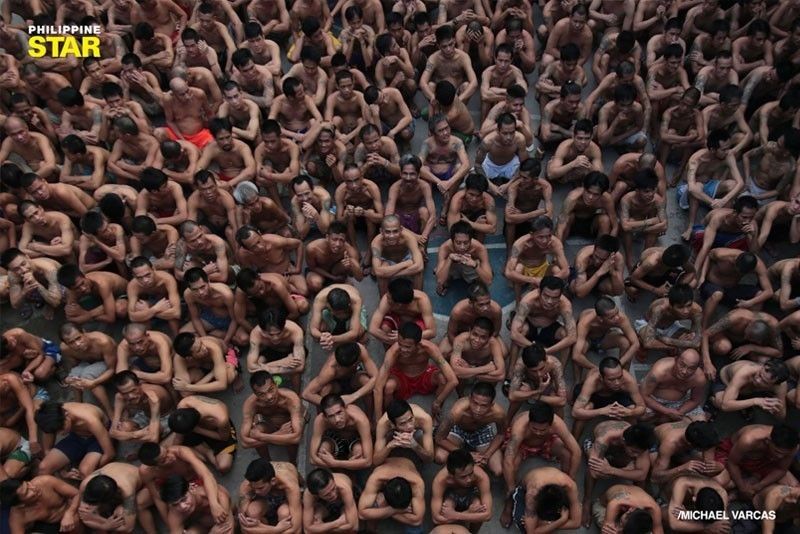
Duterte had offered prize money for each felon released by the government in a botched programme [File: Damir Sagolj/Reuters]
The Philippines has some of the world's most crowded jails. To address that problem the administration in power prior to that of Mr. Duterte passed a 'good conduct' law in an effort to reduce the jail population in the country. The good-behaviour reward program recently resulted in the release of a staggering number of prisoners in Philippine prisons. Over 1,700 criminals were mistakenly released alongside thousands of other prisoners, but the 1,700 represented those found guilty of seriously violent offences.
When the error was discovered, the crime-busting President Duterte offered a million pesos ($25,000) prize for tracking down each of those violent convicts remaining at large. Initially just under 700 of the erroneously-released prisoners had responded to the president's call to surrender. As a former mayor and prosecutor who once boasted of a plan to kill up to 100,000 criminals once he became president, Duterte is livid with rage over the release of rapists, drug pushers, killers.
As president he has attained notoriety for allowing police full rein to do as they wish when encountering what they claim to be drug traffickers. His "war on drugs" has caused police to kill thousands of urban poor dealers and users, killings considered executions according to rights activists. His inciting of vigilantism has drawn many criticisms, but he shrugs them all off, claiming tough talk like his is popular with millions of Filipinos.
And he is president, duly elected by Filipinos who expressly wanted an end to the rampant crime fuelled by drugs, so perhaps the manner in which he gauges his reputation with the ordinary person on the street is fairly accurate. Over 21,000 prison inmates had been released, with over two thousand of that number sentenced for crimes of rape, drugs, murder, bribery, plunder, kidnapping and arson making them obviously ineligible for release.
Two of Duterte's own appointees of the prison sentence were responsible through the corrections bureau, loyalists both, for the freeing of the 1,700 who failed to qualify for release.
When Duterte first ordered the released inmates through GCTA law to
surrender, he warned they should turn themselves in or they would be
treated as criminals. “Well, you know, things can go wrong,” he said on
September 4.
"ISIS has money coming into the Philippines, and they are recruiting fighters." "ISIS is the most complicated, evolving problem for the Philippines today, and we should not pretend that it doesn't exist." Rommel Baniaoi, chairman, Philippine Institute for Peace,Violence and Terrorism Research
"They convinced me [at age 11] that if you die in battle, you will be rewarded in the hereafter." "They said it was the right path." Jem Habing, 22, former Abu Sayyaf fighter
"The fight is not over"... The comment came just over a year after Isis was defeated in Marawi
City, after a five-month battle with government forces (pictured).
Photograph: Pacific P/REX/Shutterstock
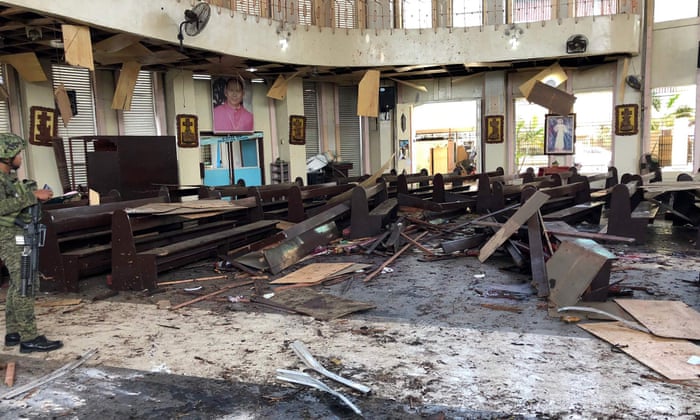
The Islamic State laid its claim to a pair of its suicide bombers causing the carnage during a January Sunday Mass at a Catholic cathedral in the Philippines when two bombs tore through the church compound, killing 23 people. To push home their point, Islamic State circulated on its dedicated chat groups an illustration of President Rodrigo Duterte kneeling on a pile of skulls with a terrorist over him holding a dagger, captioned "The fighting has just begun".
No longer does the Islamic State caliphate celebrate its existence in Iraq and Syria after four years of U.S.-backed bombs and Kurdish and Shiite militia fighters engaged in ground combat, finally extirpating the terrorist group from a territory once the size of Great Britain, taking up a third each of both Iraq and Syria, and planning even greater expansion before Russia entered the scene bombing while Syrian and Hezbollah troops and Iran-linked Shiite militias added to the toll taken on ISIS in Syria.
ISIS lost their precious caliphate territory but their ideological ferocity lives on in Africa and Asia. In the Mindanao island group of southern Philippines, a longtime haven for Islamist insurgents in a mostly Catholic nation, where dense wilderness and lax policing allows them to thrive, ISIL has gained dedicated converts. "ISIS has a lot of power", former child fighter Motondan Indama confirmed. "I don't know why my cousin joined, but it's happening all over."
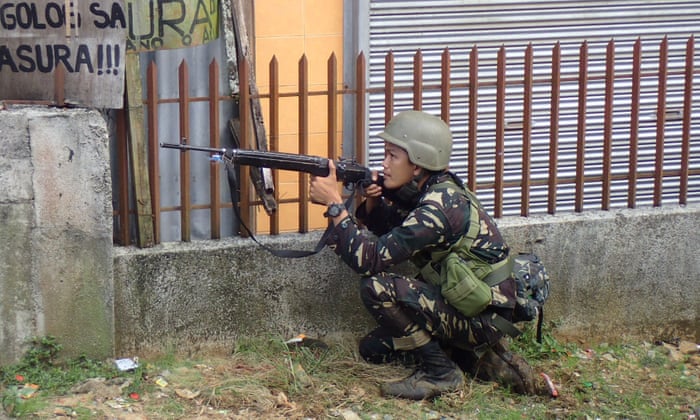
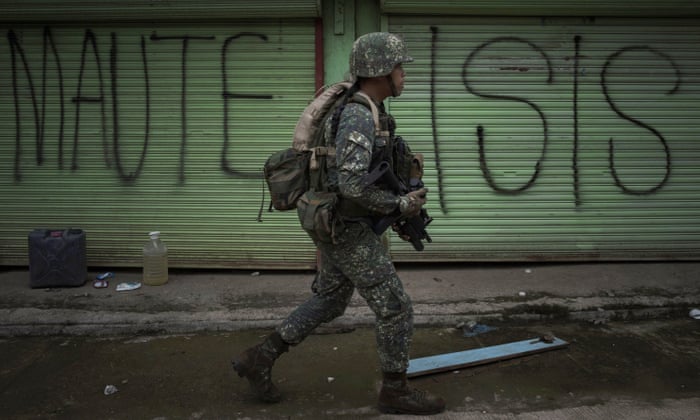
Philippines’ soldiers clear streets in the battle for Marawi in 2017.
Local authorities are monitoring Isis foreign fighters, with fears their
numbers may have grown.
Photograph: Jes Aznar/Getty Images
In 2015, ISIS made its initial foray into southern Philippines, to recruit by circulating online videos leading to hundreds of fighters from disparate Islamist groups to pour in from Chechnya, Somalia and Yemen, according to intelligence officials. Militants pledging allegiance to Islamic State took over Mindanao's city of Marawi, bringing the Philippines' military into five months of battle, leaving the largest Muslim-majority city in the country in ruins.
Among the 900 Islamists killed there were foreign fighters and the Islamic State's East Asia emir Isnilon Hapilon with them. Despite victory being declared, Islamic State loyalists have since regrouped. Ten thousand Philippine soldiers have been deployed in Jolo, site of the January 27 cathedral bombing, and airstrikes by the military have been carried out intensively. Police had declared the bombing of the cathedral case-solved, blaming it on Abu Sayyaf, a local Islamist group.
Abu Sayyaf and other local Islamists have for decades pursued a campaign of bombings and beheadings, thriving in the lawless wilderness interior and seas from Philippines to Malaysia and Indonesia. Global calls for jihad resounded in the Philippines in the 1990s when Filipinos left the battlefields in the Middle East.
A peace agreement was struck with the government and former Abu Sayyaf rebels, bringing autonomy to the Muslim south. During the ensuing ceremony, security concerns mandated the presence of Philippine soldiers vastly outnumbering the presence of former rebels.
Two bombs hit the church in Sulu in January. The first blast occurred
inside the church as mass was being celebrated, and was followed by a
second explosion in the parking lot as troops responded. Photograph:
HANDOUT/AFP/Getty Images
"Most of our crimes start with drinking in public places." "They have a drink, they hold people up, shoot each other, cause mischief." Inspector Adonis Sugui, chief investigator, Tondo police station, Manila
"It [martial law] ended with the arrest, torture, detention and disappearance of so many young people who were branded as enemies of the state." "I think you can expect more repression, more confusion, more contradictory statements from the president [Rodrigo Duterte]." "To the point that even his own people will not be sure what they should be doing." Jose Manuel Diokno, dean, De La Salle University College of Law, Manila
Homeless people detained by police in Manila Photo AFP Noel Cens
In the slums of Manila, 45-year-old Edwin Panis acted as a neighbourhood security officer. It was his duty to ensure local law and order in a nation that under its hardline enforcer president has slammed anyone suspected of pushing or even using drugs into bullet-ridden eternity. Mr. Panis, a law-and-order fan, voted to put Mr. Duterte into office, trusting him to clean up the crime-ridden streets and drugs-and-guns problems haunting the Philippines, as he had done as mayor of Davao City.
The law-abiding people of the Philippines were tired of struggling, of being harassed by the presence of criminal gangs, of fearing for their lives, and they welcomed Rodrigo Duterte's brash personality, his coarse persona, his promise that criminals would run at his presence, and he wasn't averse himself to dealing personally with criminals. He had killed, and he said, he would do so again.
Mr. Panis, on a hot night, stepped outside his cramped living quarters to have a smoke and share a beer with friends and neighbours. "The war on drugs has become a war on drunks", he observed following his surprise arrest at the rough hands of six plainclothes policemen with their holstered guns who had swept purposefully through the winding alleys of the slum where they had come across the informal gathering.
Drinking beer in public is now a criminal offence in a nation suffused with violent crime. From an unseemly social misstep to a criminal offence in one fell swoop under the rubric of 'cleaning up the streets'. A new initiative which Mr. Duterte had authorized, for the police to begin arresting people for infractions such as public urination, men outdoors with bare chests, smoking and drinking in the streets; representing public order violations. Violations in fact that men like Mr. Panis were authorized to deal with.
Over 50,000 people have been summarily taken into custody for offences such as these; Manila's slums are on notice. "There's no way not to be scared", Amy Jane Pablo, 37, noted, a neighbour of Mr. Panis. In the wake of two high-profile murders, "radical changes in the days to come" was promised by Mr. Duterte; that people idling in the streets represented "potential trouble for the public". No idling, no public drinking, no going out shirtless, no kidding.
It took no more than a week after the announcement for police to arrest 7,000 for loitering, public drinking and additional violations of neighbourhood ordinances. The public's mind has shifted to memories of martial law imposed in the Philippines under the military rule of Ferdinand Marcos in the suspension of normal law replaced by the imposition of military rule. From 1972 to 1981 martial law ruled in the Philippines to ensure that "ridiculous rules" were not flouted.
A backlash ensued when a man arrested for going out in public shirtless somehow died while in custody. The official story was he was having"difficulty breathing". Arresting loiterers was "foolish", denounced the president, not at all in line with what he had ordered. He had informed police to break up gatherings, not authorized them to harass people; they had obviously misinterpreted his intention.
This was not, after all, the war on drugs with its bloody, lethal consequences. Merely people being people.
Contradictory messages and sloppy communications echoing the persona of Donald J. Trump, an admirer of Mr. Duterte, who for all anyone knows returns the compliment.
"The Liberal government had pledged to uphold higher standards after the terrible Saudi arms deal but instead it is selling to the worst and most repressive regime in Asia where the president brags about personally shooting drug users and throwing people out of helicopters." "How long will it be until the [Philippine] military is using the helicopters during executions?" Steve Staples, vice-president, Rideau Institute, Ottawa
"Given President Duterte's abysmal human rights record -- which Ottawa is no doubt aware of -- this raises troubling questions about the risk of the helicopters being equipped with weapons and of their use in human rights violations." "Although the helicopters are being supplied for military use, they are classified by the Canadian government as civilian and thus their export does not require special authorization." Cesar Jaramillo, executive director, Project Ploughshares
A Philippine Air Force chaplain blesses a newly-delivered Bell 412 helicopter during a christening ceremony in Manila in 2015.Jay Directo/AFP/Getty Images
In the Philippines, President Rodrigo Duterte is waging an unremitting war on drugs during which an estimated 12,000 people have died, targeted for extermination on the basis that they are identified by police death squads given direction by the president, as drug users and dealers. The international criticism that has arisen in the face of this violence has stung Duterte, but he snarls in defiance, telling his critics, from Pope Francis to other heads of government to go to hell.
But for this government now in Canada a sale of 16 combat helicopters worth $234-million, is a consideration of far greater importance than their potential to be used by a murderous regime, let alone a decision to use those helicopters against elements of his population. Prime Minister Justin Trudeau is fully invested in seeing that the Province of Quebec be given advantageous employment priority over any foreign entity, since the Bell 412 aircraft would be built in Mirabel, Quebec.
An earlier arrangement to sell light-armoured vehicles to Saudi Arabia that the previous government in Ottawa had signed off on, was minimized by Trudeau during the election campaign that brought the Liberals to power, when Trudeau characterized them as being merely 'jeeps'. The ruling Liberal government then proceeded with the deal and will continue to provide Saudi Arabia with the vehicles, while involved in a conflict in Yemen that is killing civilians by the droves in the poorest of the Arab countries, involved in a civil war.
The very same group, the Canadian Commercial Corporation, that had brokered the $15-billion Saudi sale of light-armoured vehicles, is involved in this current helicopter sale. But without the Government of Canada signing off on the deal, it would never be carried through. Last year, reports came through that another type of armoured vehicle accessed from a Canadian company, was being used on their own citizens by the Saudis.
Given the fact that government rules in Canada call for curbing shipments to countries having a "persistent record of serious violations of the human rights of their citizens", and with the knowledge that the Saudis are known for their disturbing human rights record, this decision by the government is inexplicable, other than to acknowledge that it is that hungry for trade opportunities it can manage to overlook any infringements of human rights.
According to Canada's foreign affairs body, Global Affairs Canada, the helicopters are slated for use in "disaster relief, search and rescue, passenger transport, and utility transport", which is a precious statement on their part. Once the sale is made and the goods transferred to foreign ownership the seller has no right whatever in insisting the product be used in any particular way, and not for use in a manner that would reflect poorly on the seller.
A more realistic response has issued from Philippines Major General Restituto Padilla, military chief of plans, who stated: "The helicopters will be used for the military's internal security operations", and those operations, understandably, will reflect any issues and uses that the Philippine Presidents orders.
And then there is another issue that has cropped up in similar vein; an end-of-year statement by Canada's Defence Minister Sajjit Harjit that Canada has signed a new defence agreement with the United Arab Emirates supporting further military cooperation and which "also means opening doors for Canadian industry in the region" of the Middle East, already embroiled in more than enough violence, without Canadian-produced armaments to add to the fray.
Norway's government, in contrast to Canada's, has decided to suspend its exports of weapons and ammunition to the UAE in recognition of concerns their equipment could be used in the Yemen civil war of which the UAE is part of the coalition led by Saudi Arabia, fighting Houthi Shiite forces. The international community is well aware that Saudi Arabia has been bombing civilian targets. And as though that isn't sufficient reason for Canada to abstain, Germany too has halted arms shipments to Saudi Arabia in reflection of its Yemen war involvement.
"I don't like to fight. But this is our land and we will not let them take this like they destroyed Marawi." "That's why I have these [.45-caliber pistol and revolver]." Commander Hangilang, Christian militia fighter, Datusalibo, Philippines
"They [Islamic State local groups] may be close to being defeated in Marawi, but they can spread out." Commander Asiong, spokesman, Red God's Army
"[My Moro Islamic Liberation Front (MILF) fighters were] swimming while attacking [Islamic State fighters], because the swamp waters are very deep." Von al-Haq, MILF military commander
"It's an open mostly flat marshland, where you are open to sniper fire." "When you enter the swamps, you've already dug your own grave." "We used to fight the MILF, but they are now fighting alongside us. So what is the bigger enemy? It is the Daesh-inspired groups." Nassrolah Gani, 35, Philippine police officer
"They have won the battle strategically, as they have proven how long they can endure the fight against government forces. [The Marawi battle an example of] martyrdom that can inspire others." "Mindanao will continue to suffer the challenges of armed conflicts and violence because of many issues associated with the struggle of the people there for self-determination being advocated by the Muslim forces. It has simply become the new land of jihad." Rommel Banlaoi, security analyst, Philippine Institute for Peace, Violence and Terrorism Research
Armed police keep watch as men suspected of being Marawi militants arrive at the Department of Justice in Manila in July. Photo: AP
Islamic State of Iraq and the Levant may be on the brink of dissolving their presence in Syria and Iraq, losing the territory that made up the vast and growing empire of their caliphate as the U.S.-led coalition, the Kurdish military forces, Russian air cover, Hezbollah, Shiite militias and the Iranian Republican Guard Corps and Turkish forces give inestimable aid to the less-than-doughty and reliable Iraqi and Syrian military as they ush back against the terrorist group, but they still have a notable presence in Afghanistan, Libya and the Philippines.
Not to mention their supporters elsewhere in the world responding to the incitement to jihad spurred on by the public relations arm of the Islamic State, ready, eager and willing to do their part to further the aspirations of Islamic State. In majority-Catholic-Christian Philippines, an Islamist backlash against the prevailing order has kept government forces busy for years. Local Islamists on Mindanao were known for their kidnapping proclivities, holding foreigners for ransom and dispatching them when foreign governments failed to respond.
The growing menace of the influence of Islamic State was fully realized when local militias allied with ISIL and proclaiming themselves loyal to the terrorist group, attacked Marawi, and government troops and police responded resulting in a full-blown battle situation. Leaving the town catastrophically crushed with scant little to show for the government victory. What has occurred, however, is that traditional Islamist groups are fighting back against the Islamic State militias, aligning themselves with government forces.
Commander Ilangilang, formerly involved in fighting the Philippine army now is dedicated, along with her militia group to helping that army to forestall an anticipated next large Islamic State uprising. Fighting in the marshlands about 200 kilometers south of Marawi, the local militias fear their villages and farms will be next on the ISIL agenda and that the black flag of Islamic State will be geared to fly high and triumphant over the towns of Datu Salibo and Kauran.
The army, the MILF militia and Islamic State militants have been battling in a large swamp, with the alliance on the winning edge, reporting the recovery of improvised bombs and Islamic State flags. Police Officer Gani reports the intelligence that a number of Malaysian fighters, inspired by Islamic State, have joined the ISIL group, despite the recent death of its local leader.
Another frontier: groups in the south of the Philippines have pledged allegiance to IS. Photo: AP
Philippines/United States: No Divorce Just Separation
"I announce my separation from the U.S." "In this venue, your honors, I announce my separation from the United
States, both in military, not maybe social, but economics also." "America has lost now. I have realigned myself in your ideological
flow, and maybe I will also go to Russia to talk to Putin and tell him
that there are three of us against the world, China, Philippines and
Russia. It is the only way." Philippine President Rodrigo Duterte
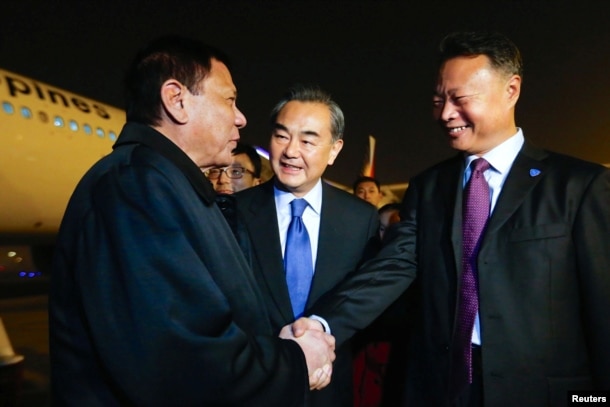
President of the Philippines Rodrigo Duterte (L) shakes hands with
Chinese ambassador to the Philippines Zhao Jianhua (R), as Chinese
Foreign Minister Wang Yi (C) looks on, at airport in Beijing, Oct. 18,
2016.
If the new president of the Philippines resembles any other public or political figure there are echoes of Donald Trump and Vladimir Putin in the ensemble that inhabit the psyche of this volatile, outrageous bumpkin who advertises himself as the saviour of his country, prepared to rescue, by whatever means present themselves, the Philippines from its descent into drug-addicted hell. To that end he has encouraged his police as well as anyone else who has a grudge to settle to feel free to destroy the lives of those they accuse of dealing in drugs, or addicted to drugs.
Among the thousands who have thus far lost their lives have been total innocents, people targeted because they had no protection, others because they had made enemies, and still others because they had succumbed to the lure of drugs and struggled to divest themselves of that irresistible urge, but failed. Because a strange type of temporary amnesty was declared tens of thousands of people who feared for their lives at the hands of Philippines security agents or those who have self-deputized, have turned themselves in to authorities as users and dealers.
They will be dealt with at some time in the future, having registered themselves as offenders appealing for mercy. And the Islamist threats that exist in the Philippines will also be dealt with by this pitiless crusader for whom no lives that appear complicit in his version of what constitutes crime are to be spared in the larger purpose of installing peace and security in a country their president has placed on alert; do crime, pay the ultimate price. Capital punishment meted out casually and with, he claims, due cause.
This rather unusual way to order a country and suspend due process in law and crime-solving inevitably produced international criticism, including that from the American administration. Because of the traditionally close social, political and cultural ties between the United States and the Philippines, ties that the U.S. has relied upon in its re-positioning itself as a Pacific nation of influence in the region in opposition to China's more recent badgering of its neighbours in extending Chinese sovereignty in areas other nations considered their own, the position Duterte has expressed has taken the U.S. by surprise.
But this is a volatile, undisciplined, undiplomatic temperament that has a tendency to say strange and disappointingly offensive things that do no credit to the man's supposed intelligence, nor to the future of the country he leads. Without doubt, Chinese President Xi Jinping will be pleased, as well as Vladimir Putin, with the embarrassment that the Philippine president's announcement will have brought to the prestige in the region of the United States. But such blowhards as Duterte are not abashed at what they bring to the fore.
And backtracking on his statement that elicited enthusiastic response from the politicians and business people he had addressed while on a visit to China, certainly failed to cause any embarrassment to him personally, for he has no shame. Duterte invited Barack Obama to "go to hell", while Venezuela's Chavez spoke of the odour of sulphur in the Satanic presence of former U.S. President George W. Bush; it comes with the territory, obviously.
"Symbolically none of this is good for the U.S., but in concrete terms the U.S. has thick skin. If the Duterte government starts to restrict U.S. access to Philippine bases or something like that, then the U.S. will have a problem", advised Malcolm Cook at the ISEAS-Yusof Ishak Institute in Singapore.
Oops, just kidding, says Duterte back in Davao, mentioning offhandedly the huge demographic of Filipino expatriates residing in the United States.
"When you say severance of ties, you cut the diplomatic relations. I cannot do that. Why? It's to the best interest of my country that we maintain that relationship". Besides which, Filipinos themselves would most certainly not approve.
Philippines released photos purportedly showing Chinese vessels near a disputed chain of reefs and rocks in the South China Sea. Still from video
"For most ASEAN leaders, Duterte represents a throwback to an uglier and more brutal form of Asian state, which taints ASEAN efforts to market itself as an increasingly progressive, modernizing trade block with a focus on trade data, rather than daily police-killing body counts." Phelim Kine, Human Rights Watch, New York
"[He] is a rock star not only in our country but also in other countries like Laos, Japan." "[This could be seen in] how the other foreign ministers and delegates have scrambled to get a selfie with our president." Martin Andanar, Philippines presidential spokesman
"We will continue to work to ensure that disputes are resolved peacefully, including in the South China Sea. [The international arbitration ruling on July 12 against China was binding and] helped to clarify maritime rights in the region." "I realize this raises tensions but I also look forward to discussing how we can constructively move forward together." U.S. President Barack Obama
Regional leaders at the Asean summit in Vientiane, Laos [Reuters]The ten leaders of the ASEAN countries are concerned about China's territorial claims overlapping their own in the South China Sea, but this is a powerful neighbour, and stirring a hornet's nest is not seen to be in anyone's interest. Perhaps of more concern is China's little proxy which considers itself a world player and exults in stirring fear and trepidation in its neighbours, in challenging the United States despite chiding from China to take a break from its ballistic missiles exchange with Iran and its nuclear detonation provocations.
Their concern about China is a muted one, even though China seems as impervious to criticism over its 'inalienable right' to claim territory disputed by the very fact that it is far from its coastline, and impinges on the territorial integrity of its neighbours' near coastlines. Pyongyang has ardently fashioned its incessant flaunting of intentions to threaten South Korea, Japan and the U.S. after the manner in which China feels free to do.
And now, ASEAN has a hero among them, an old-style dictator whose methodology in confronting challenges to his authority hearks back to the good old days when tyrants could just expunge the nuisance of challenges. Which is precisely what Rodrigo Duterte, the Philippines' new president has set about doing, to cleanse his country of drug lords and terrorists. Baldly giving expression to free reign for his national police to kill at will any suspects, without fear of legal repercussion.
President Duterte hugely relishes the awe in which he is held by his ASEAN partners, and will not countenance the delicacy of feelings expressed by an American president that justice must prevail, not vigilante action, killing people at random excess. He sees himself in the ASEAN coalition as an equal of exceptional will and capability among thugs. Enjoying his coarsely villainous reputation, which gives him great pleasure to flaunt.
His popularity among Philippines -- who have accepted that people will die, and sometimes innocent people, for the greater good of cleaning up the country -- is at a declared high. Public satisfaction with his agenda gives him all the support he needs. The two thousand who have been executed as drug dealers and users appears just to his extra-judicial experience. And the over 600,000 who have surrendered out of fear of being gunned down, just validates for him the success of his faultless reasoning.
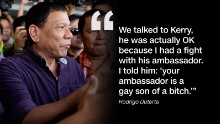
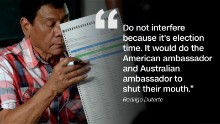
And his reasoning leads him to believe that if he can threaten and insult the pope, in Catholic-dominated Philippines and suffer no consequences, the United Nations secretary-general with no backlash, then President Obama of the United States can just fume as much as he likes at the insult when Mr Duterte spoke of him as a "son of a bitch" whose warnings insulted the integrity and sovereignty of the Philippines.
"We were really surprised when the president came out to announce it [list of officials charged with involvement in illegal drug trade]." "First, our defence is the truth. If you are not guilty, why should you be afraid?" Samsudin Dimaukom mayor, Datu Saudi-Ampatuan, Philippines
"How are the lists being prepared? Who are the sources?" "If they have evidence, they should file charges, and that's the only time they should disclose the name [of those the new government asserts are involved in the drug trade]." "He's now a runaway train. It's very revolting to me. So far, the victims of the summary killings are the lowly ones, the powerless, who cannot afford lawyers, who cannot seek audiences with the president." Senator Leila de Lima, former chairwoman, Philippine Commission on Human Rights
"He's doing what he [President Rodrigo Duterte] promised. He's not surprising anybody." "People like him because he is an action man." Ramon Casiple, executive director, Institute for Political and Electoral Reform
"Please, don't order me. [Do not create a crisis] because I will order everybody in the executive department not to honour you [Chief Justice Maria Lourdes Sereno, Philippine Supreme Court]." I'm not a fool. If this continues, you're trying to stop me, I might lose my cool. Or would you rather I declare martial law?" Philippine President Rodrigo Duterte
President Duterte, in his fresh new role from mayor to president, prepared to launch on the entire country the controlled police and vigilante anarchy that he imposed upon a once-drug-ridden, violent city transforming it into a rigid bastion of law and order, is undertaking a similar sweep of the entire country, to rid it of its drug-and-criminal-gang underclass and its reputation for being one of the most violence-driven countries in the world.
He is embarking on that ambitious aspiration through imposing his own brand of violence, crediting it with his past successes in tamping down crime. In the process a lot of people are being killed, most of them poor and defenceless, the vulnerable among the population who have no defences against the machinery of a state. The chief justice of the Philippine Supreme Court had the unmitigated gall to uphold institutional law and order in defiance of the president's decrees.
She instructed the seven justices appearing on a list that President Duterte produced naming one hundred and fifty high-placed officials involved, he claims, in the illegal drug trade, not to submit to arrest as ordered by the president, without a warrant. Chief Justice Maria Lourdes Sereno also announced her intention to investigate any allegations of the judges' connection to the drug trade.
"To safeguard the role of the judges as the protector of constitutional rights, I would caution them very strongly against 'surrendering' or making themselves physically accountable to any police officer in the absence of any duly issued warrant of arrest", wrote the chief justice, clearly at odds with the presidential order that all 150 named individuals turn themselves in to authorities within 24 hours, or they would be hunted down.
Shock and fear inspired over 600,000 drug users and dealers who had legitimate fears for their lives to respond by turning themselves in to authorities. Most were returned to their homes after police took their statements, with the understanding that they will face investigation at some later date. Since President Duterte called for the killing of drug dealers, an estimated 800 people have been killed by police or vigilantes in the few months since taking up his position.
Many of these unfortunates were gunned down in the street, a cardboard sign left beside the bodies identifying them as drug pushers. Many whose names had appeared among the 150 officials released by the government and read aloud one by one on public television last Sunday by President Duterte declare their innocence, and their support for the president's program to wipe out drugs and dealers.
The announcement of the names represents an invitation to a free-for-all from vigilante groups more than eager to go out on the streets and do their duty to the government. President Duterte's careful reading out of the 150 names on television is widely regarded as an invitation to kill by a man who states he is himself prepared to embark on such killing sprees to rid the country of drug dealers.
According to a Pulse Asia poll, Duterte received a 39 percent vote on election day. More recently, with his clean-sweep plans stated before the election took place now being implemented, his popularity has soared to 91 percent.
"[A] renaissance of classic power politics [increases] the risk of violent conflict between states including in Europe and its neighbourhood, as the example of Russia's actions in Ukraine demonstrate." "Our increased role in international security policy [leads Germany to accept responsibilities and leadership [as a] reliable partner [in international military missions]." Chancellor Angela Merkel's government draft document
"[The Japanese election results giving Prime Minister Shinzo Abe and his Liberal Democratic Party a majority] opened the door for a Japan that can go to
war [although a rearmed Japan] will also help deter North
Korea’s nuclear threat and check the rising military power of China." Munhwa Ilbo editorial, South Korea
Prime Minister Shinzo Abe of
Japan at the headquarters of the Liberal Democratic Party in Tokyo on
Sunday. His party’s victory could allow Mr. Abe to realize his long-held
ambition of revising the Constitution, which strictly limits the role
of the military.Credit
Toru Hanai/Reuters
Ghosts of the Second World War reborn. A passionately social-democratic Germany and a resolutely democratic and capitalist Japan, one in full rejection of the fascism of the Third Reich and its horrendous legacy, the other determined to continue its trajectory in close relations with the West, discreet for seventy years at the close of the Second World War, as sober allies of capitalist and democratic nations of the world, now find themselves at a crossroads.
A former ally of the Third Reich, the Soviet Union, much diminished in power and influence, has nostalgically envisioned the transitioning of the Russian Federation back to a near facsimile of its Soviet days of control of the neighbourhood and failing that, the extension of threats and aggression of a class sufficient to send shivers of renewed trepidation down the ramrod stiff spines of former satellites calling out for the comfort of security to its latter-day mentors.
And the once-feared aggressor of Korea and China whose historical brutalities have left indelible scars whose scabs fall off from time to time revealing renewed wounds of searing anger and blame, long since tamed with a U.S.-led policy of protection-at-home, where the very sight of its own uniformed military forces were sufficient for ordinary Japanese to become incensed with rage, now 'normalizes' its military as defenders abroad under Shenzo Abe.
In eastern Europe, NATO has mustered its members to give comfort and assurance to nations within Russia's near-abroad, a geography that Moscow considers its sole purview. But since the decision to invade long-suffering Ukraine and transfer its Crimean deep sea port to Russian possession hoping that in time the Donbass will follow, Lithuania, Estonia and Latvia have been placed on high alert, with the U.S., Germany, Britain and Canada coming to the rescue.
U.S. troops cross the Lithuanian-Latvian
border during tactical road march Dragoon Ride II in Subate, Latvia,
June 6, 2016. Reuters/Ints Kalnins/File Photo
Germany is preparing itself to take on responsibilities in reference to the white paper's recommendations, to be more fully discussed by Chancellor Merkel's cabinet. The document supports additional consolidation of Europe's defence industry, outdistancing Germany's previous white paper of 2006, where the country's intention was described as a "reliable partner". The shift in tone and intent recognizes Russia's new threatening assertiveness in Europe.
There are restraining caveats to satisfy the concerns of those whose memory recalls the Germany of World War II. Germany will be acting in full consultation with its European partners. The draft paper speaks to challenges facing all of Europe, from Russia's most recent provocations setting Europe on edge, on to the Middle East situation and the influx of a tide of refugees leaving Europe to cope with a situation that gives comfort to Vladimir Putin.
The issues of arming the Kurdish fighting forces in Iraq, taking part in the U.S.-led airstrikes against Islamic State in Syria, and agreeing to lead a North Atlantic Treaty Organization super-battalion deployed in Lithuania as a deterrent to Russia's geographic territorial ambitions, are all front and centre now in Germany which continues to spend 1.2 percent of GDP on defence, on its way to reach the NATO goal of 2 percent.
By contrast, most other NATO states spend well under even Germany's commitment on defence, while the United States which has been front and centre ensuring security for decades for
Western Europe alone, spent 3.6 percent in 2015. Under Angela Merkel's government, its military suspended conscription in favour of shifting to a fully professional army.
The news of China never stops coming, from its dedication to enlarging and modernizing its fleet of warships to challenging its neighbours over authority over the East and South China Seas. Today's win by the Philippines challenging China's assertion of historical rights in the South China Sea was supported by the international tribunal in The Hague, but celebrations seem premature when China fails to recognize the legal authority of the tribunal's decision.
"In terms of China’s domestic politics [the ruling] is unacceptable
to the regime and unfortunately the regime will perceive that the
Chinese people view that as unacceptable." "So there will be huge pressures on Beijing to respond, to save face,
to demonstrate with more than just words that it doesn’t abide by and
doesn’t credit the ruling with any legal validity and will not adhere to
it and will defend its ‘sovereign space’ in the South China Sea." Ashley Townshend, scholar, University of Sydney’s United States Studies Centre
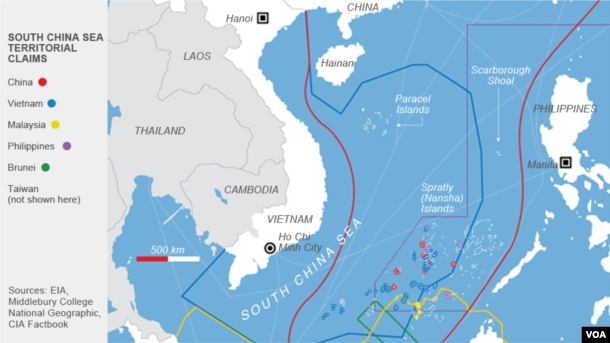
"The risk of conflict in the South China Sea is significant. China,
Taiwan, Vietnam, Malaysia, Brunei, and the Philippines have competing
territorial and jurisdictional claims, particularly over rights to
exploit the region's possibly extensive reserves of oil and gas. Freedom
of navigation in the region is also a contentious issue, especially
between the United States and China over the right of U.S. military
vessels to operate in China's two-hundred-mile exclusive economic zone
(EEZ). These tensions are shaping—and being shaped by—rising
apprehensions about the growth of China's military power and its
regional intentions. China has embarked on a substantial modernization
of its maritime paramilitary forces as well as naval capabilities to
enforce its sovereignty and jurisdiction claims by force if necessary.
At the same time, it is developing capabilities that would put U.S.
forces in the region at risk in a conflict, thus potentially denying
access to the U.S. Navy in the western Pacific." Bonnie S. Glaser, Senior Advisor for Asia, Center for Strategic and International Studies
The tension has been building for the last few years between China and its neighbours, China and the United States, in the East and South China Seas, where China invokes the power of a regional and world giant flexing its political muscles to assert its dominance over the region against the interests of its neighbours, even while making incursions and commandeering areas that have traditionally been the purview of other nations in the area.
Immense super tankers and container ships make their way through the South China Sea where $5-trillion in freight passes annually, inclusive of a third of the world's liquid natural gas. The Permanent Court of Arbitration in The Hague is set this month to issue a legally binding ruling. Once its ruling becomes public, Asian nations at loggerheads with China, along with the United States will have to determine what channels they will seek to defend navigation freedom.
China's claim to 85 percent of the South China Sea and those in the East China Sea have spurred it to lay claim to possession being nine-tenths of the law. It has been busy building 'islands' of sizeable dimension on which it has installed airfields denoting military installations for fighter jets, long-range surveillance drones, anti-aircraft and anti-ship missile batteries, made visible by satellite images.
Chinese giant dredgers have constructed new outposts on once-obscure outcroppings claimed by the Philippines and the Vietnamese, Japan and other nations in the region, and have been renamed by China. Leaving Vietnam, Brunei, Malaysia, Japan and South Korea with their overlapping claims, in deep consternation and concern for the future. The Philippines asked the international court for its ruling on shoals and reefs six times closer to Manila than to the Chinese mainland.
China's claims of a "historic right" to ownership of all it identifies as its own has echoes of its occupation of Tibet. The interests of the Communist Party of China are obvious enough; it intends to control navigation, the fisheries and the presumed large oil and gas deposits in those vast watery territories. And just as China has spent enormously to ramp up its military renewal, so too have its neighbours followed suit albeit hardly to the same degree.
Jane's posits that regional military budgets are set to increase from $435-billion in 2015 to $533-billion in 2020. Australia, Vietnam and India will be acquiring new submarines and assault vessels, as has China, along with the use of an old Soviet aircraft carrier on which to train pilots and sailors for the new carrier it is itself building. Submarines armed with nuclear weapons are to be deployed by Beijing in the Pacific Ocean.
This is in response to its allegations of U.S. anti-ballistic missiles being newly deployed in South Korea. Manila has asked of Washington that more visits by the U.S. forces be arranged. In similar vein, several thousand American marines are permanently on standby now in Australia. American, Japanese and Australian worships have joined in naval exercises.
The four billion people who live in that geographic region have ample reason to be slightly on edge.
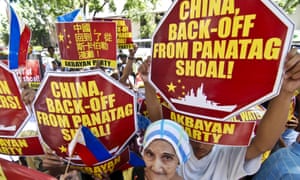
Filipinos protest in Manila stage demanding China pull out of the contested Scarborough Shoal in the South China Sea.
Photograph: Dondi Tawatao/Getty Images
"Duterte's [Philippine-president-elect Rodrigo Duterte] boastful brand of violent impunity should be a path to prosecution, not a platform for political office." Human Rights Watch "He might appear to be insensitive to women, but during his time as mayor [of Davao City, Philippines] he supported policies on behalf of women and programs for children." Luzviminda Hagan, congressional representative, Gabriela [women's rights group]
"His jokes are his connection to the common man. He knows what he is doing. He is a lawyer. He graduated from one of the top law schools. He passed the bar." "He is a very intelligent fellow." Benny Gopez, Filipino businessman
President-elect accuses bishops – who criticised him for calling the
pope ‘a son of a whore’ – of hypocrisy, saying they have asked him for
favours ... The tirade comes after Duterte cursed the pope in a speech in December
Photograph: Aaron Favila/AP
"It appears my government [Canada] has abandoned me and my family in this endeavour. We've [three remaining hostages of Abu Sayyaf] been here for eight months. I came to your beautiful country in good faith and in peace, and here I am [abducted, threatened with beheading]." "One of us has already been murdered [Canadian John Ridsdel]. We hope that you can work on our behalf as soon as possible to get us out of here. Please, the sooner the better. We're three-quarters dead right now." Robert Hall, former Calgarian, hostage of Abu Sayyaf
The pleas of Robert Hall, spurred on by his very real fear of death, threatened by the same fate that befell his fellow Canadian several weeks ago when the ransom demand of $8-million dollars each for the release of Marites Flor, abducted with Mr. Hall, Mr. Ridsdel, and Norwegian Kjartan Sekkingstad who had operated the Holiday Ocean View Samal Resort off the southern coast of Mindanao will have fallen on deaf ears.
Canadian Robert Hall. Screenshot
The simple fact being that the controversial new president of the Philippines is adamant that he plans to carry on his country's refusal to pay ransom to the Islamist jihadis who favour kidnapping foreigners as a means of extracting whopping sums of money from foreign governments to fund their jihad. European governments with the exception of Britain do respond to ransom demands while others like the United States and purportedly Canada, do not.
In one of his statements respecting the abduction situation Mr. Duterte advised in no uncertain terms that anyone unfortunate enough to be abducted by the jihadis boasting of their association with the Islamic State, should say their prayers and appeal directly to god, because the government of the Philippines is not prepared to do business with criminal terrorists.
Some might venture to say that in his former persona as mayor of Davao City, the president-elect himself had a penchant toward thuggishness. He could claim in his mocking defence that his thuggishness was practised in defense of the rights of the citizens of the city, and that he fully intends to bring to the office of president of the Philippines the very same techniques that brought down the criminal element in Davao.
The 71-year-old Mr. Duterte certainly has had experience, as a crime fighter, a prosecutor and no-holds-barred mayor proud of having stomped on criminals, giving them measure-for-measure the same kind of treatment they meted out to citizens. There were reputed to have been over a thousand extrajudicial killings in Davao during the 20 years this man was mayor.
During the presidential campaign the crude-talking Rodrigo Duterte boasted that he himself killed criminals, claiming the justification was that they were resisting arrest. Should he be elected, he promised, he would pursue criminals and kill them himself and should there be any resulting controversy he would use the power vested in him as president to issue a presidential pardon on his own behalf.
Despite what might seem to an unaware observer hearing his boastful statements and crude references to rape as expressions of unsuitability for public office, people who know him speak of him as a shrewd politician and a technocrat observing the need to help the needy. The Public Safety and Security Command Center built under his watch in Davao boasts live feeds from closed-circuit cameras throughout the city.
Close by, a dedicated building has a fleet of new ambulances and fire-trucks dispatched through an emergency call center, complete with a specially equipped ambulance for children, and a larger vehicle used as a hospital-on-wheels. All civic, social services provided free of charge to patients, and these are services unavailable elsewhere in the Philippines, reflecting their past mayor's values and priorities.
Human Rights Watch is not impressed. Without denying his achievements on behalf of those he served, there is the dark side of his administration and his personal attachment to fighting corruption and crime with extrajudicial violence. The thousand vigilante killings sully his record on human rights entitlements. But even as HRW accuses him of those violations, there are others who laud his straightforward defence of the defenceless.
But for the defenceless who are in the unfortunate position of being held as pawns in the battle of Islamist jihadists against the government of the Philippines it is futile to the look to that government to come to their aid, to prevent them from becoming beheading statistics carried out by the vicious jihadis whose first order of business is raking in millions, and second order instilling terror.
"I am embarrassed to be a Muslim. They shame us all when they cut people's heads off. Like the kidnappers, I am from Jolo Island. I am a Tausug and speak Tausug just like they do. But we are not like them and want nothing to do with them." "They say they do this because of our religion but that is only the opinion of Abu Sayyaf. They are only criminals." "Duterte's first privilege will be to stop these kidnappings." Abdur Racman, Davao, Samal Island, Philippines
"Abu Sayyaf are bad people. That is what we Muslims think. Like us, Duterte [newly-elected president-elect Rodrigo Duterte] doesn't like Abu Sayyaf, too. We are hoping that he can protect us from them." Sahara Teves, 25, Davao
"Contaminated [police generals facing corruption charges should] get out now [before the president-elect takes office]." "And if you are taken hostage there, say your Our Fathers because I will never, never pay anything to retrieve you." President-elect Rodrigo Duterte, Philippines
A screengrab from a video obtained by extremist monitoring organization
SITE purportedly shows three hostages held by Abu Sayyaf.
Rodrigo Duterte whose reputation as a hard-nosed, blunt-spoken enemy of the criminal element in the Philippines and whose recent electoral victory will have him shortly assuming the presidency, has informed the prospective new military head, Army Lt.-Gen.Ricardo Visaya that it is his intention that the military troops of the Philippines must be dispatched to destroy the Abu Sayyaf Islamist militia that has sworn allegiance to Islamic State.
The Islamist jihadis whose kidnapping exploits have convinced Filipinos that they are common criminals unaligned with Islam whose only interest in portraying themselves as an offshoot of Islamic State is to instill fear in prospective abductees, have recently beheaded a Canadian man whom they abducted with three others from the Oceanview Marina Resort when the ransom demanded was not handed over to them.
From left: Kjartan Sekkingstad, John Ridsel, Robert Hall, and Marithes "Tess" Flor
More recently another threat to behead the remaining of the two Canadians has been issued via a video with Robert Hall begging for the Canadian and Philippine governments to pay the $16.6-million ransom being demanded for his life. Norwegian Kjartan Sekkingstad and Marites Flor, abducted with the two Canadians are also awaiting rescue. The marina from which the four were abducted is now under heightened security; the 11 masked gunmen who succeeded in kidnapping the four would find it far more difficult to repeat their exploit.
There is a new watchtower built on the breakwater to the marina entry point and a coast guard vessel is moored inside the harbour, protected now by a double boom designed to prevent unwelcome vessels from entry to the area. That very same marina remains packed with small vessels on their trans-Pacific trips from the Philippine archipelago to Australia, Indonesia, Malaysia and Thailand. The island Paradise that had attracted the four people abducted remains a magnificent landscape. "I don't know why so many white men still go there, but there certainly is a lot more security", observed Mac Mac Cansatsut, who spoke of the mood having changed since the attack last year, with locals being cautioned to remain away from Oceanview Resort, a message that is obviously not getting through to tourists. Other resorts on the island have had visitors sign waivers to absolve them of any responsibility for their welfare before permission is received to go to the beach.
Relations between Christians and Muslims on Samal Island remain strained. At the waterfront slum in Davao a makeshift mosque is where the local Muslim population go to pray and to deplore Abu Sayyaf's agenda, denying that it has anything to do with the Islam they revere and have such a deep and abiding faith in.
This represents a general opinion site for its author. It also offers a space for the author to record her experiences and perceptions,both personal and public. This is rendered obvious by the content contained in the blog, but the space is here inviting me to write. And so I do.



![Duterte had offered prize money for each felon released by the government in a botched programme [File: Damir Sagolj/Reuters]](https://www.aljazeera.com/mritems/imagecache/mbdxxlarge/mritems/Images/2019/9/20/6137c5653ef04434ac1f63a20a8cb063_18.jpg "Philippines police told to stop manhunt after Duterte reward")


![Regional leaders at the Asean summit in Vientiane, Laos [Reuters]](http://www.aljazeera.com/mritems/imagecache/mbdmegaxxlarge/mritems/Images/2016/9/7/a1fc36004bb74f20a84ccce8ec7e095a_9.jpg "Beijing's South China Sea claims scrutinised at summit")
![Regional leaders at the Asean summit in Vientiane, Laos [Reuters]](http://www.aljazeera.com/mritems/imagecache/mbdxxlarge/mritems/Images/2016/9/7/2b6d6ce2bbf94af0b43d6483ca3244c7_18.jpg "Beijing's South China Sea claims scrutinised at summit")