"I am in shock. I had no idea. [The files must have been doctored and deliberately left as a] special gift [to Latvia], as part of a] disinformation operation [by retreating Soviet officers." "It is impossible that the KGB would leave behind a real list of agents in what it considered enemy territory." Rolands Tjarve, former director, Latvian post-independence national broadcaster
"He [Andres Slapine, Latvian cameraman shot and killed by Soviet troops with pro-independence activists in Riga, 1991] was a hero, not a traitor." "How can he have been a KGB agent? It makes no sense." Mara Sprudja, director, national archive
"Everything was in chaos in 1991. They could not organize a deep plot. they were too disorganized." "The documents released so far present] only part of a very big puzzle [giving names but no details regarding the purported informants' role for their handlers. This reflects a] fake reality." "As soon as someone is exposed publicly as an 'enemy', it is not easy for them to tell the truth." Indulis Zalite, former longtime director, Latvian documentation centre
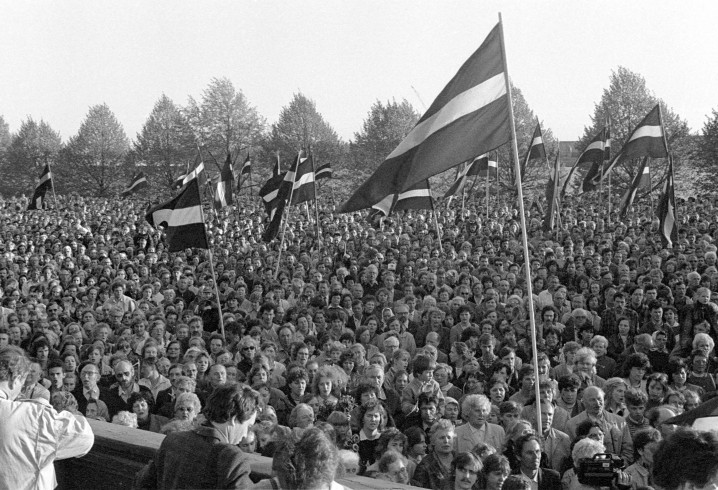
Latvian independence, 1991
Just as East Germans were shocked and appalled when former Stazi files neatly listing East German informers for the Communist East were published and names of those they portrayed, creating a fury of puzzled disbelief, so too is Latvia now undergoing a similar experience with recent revelations of betrayals under the Soviet yoke. Those whose names have been revealed are now passionately declaring their innocence; they never, ever acted as informants for the KGB; never were agents; the documents are false and utterly misleading.
As one of three Baltic nations now independent states since 1991, Latvia has spoken over the past 30 years with uncertainty over how to dispose of reams of documents left by the hasty retreat of the KGB. Bags of documents, files, briefcases full of secret files that the Cheka left behind. And while other former Soviet satellites such as Lithuania, Estonia and Georgia had their own KGB files to open and surprise themselves with, only Latvia had been left with a systematic index listing real and code names of over four thousand purported agents, inclusive of a digital archive of KGB activities.
Latvia's parliament took a vote and agreed the contents of the bags and the sacks stuffed with those secret files be posted online. Leaving it puzzled by the outcome; were so many among its citizens eager to aid the Soviet oppressors as collaborators and informers, or does this all represent a sinister, devious plot to sow disarray among the country's authorities disclosing fabricated records of betrayal at every level of society? Have they been the victim of Soviet secret police padding a list of informants to impress their superiors? Or was this a deliberate plant to shock Latvians in betrayal for the Soviets?
Some Latvians have now been identified as having been "in the bags", their ties to the files including a two-time former prime minister, the chief justice of the Supreme Court, a one-time foreign minister, leaders of the Catholic and Orthodox churches, three post-independence rectors of the University of Latvia, celebrated film-makers, and a number of Latvian television stars and writers. Releasing the names of people who succumbed to a terrible choice "in a different time and a different place has just created more confusion" not clarity, said Mara Sprudja, director of the national archive.
Lidija Lasmane, 93, a veteran of Latvia's Soviet era, wanted the documents released. She insisted historical truth must be known and an attempt made to answer a fundamental moral question: "How does a perfectly normal person become a beast ready to betray their friends, their family and their country?" Ah well, difficult times where the Soviet system placed people under dreadful pressure: "But every individual has a choice in the end. I knew from childhood that there is God and also the Devil. For me, there was never a real choice about what to do", she said.
Former GB Headquarters, the Corner House, in Riga, Latvia Akos Stiller Photos/The New York Times
"The West is smashing its geopolitical might on the anvil of its own foolishness. The authoritarian regimes in China and Russia are gleefully picking up the pieces." "In May 2016, Donald Trump promised a lot of winning. 'We're going to win so much'.,” he said, 'you’re going to be so sick and tired of winning. And 'you’ll say, ‘Please, Mr. President, we beg you sir, we don’t want to win anymore. It’s too much.' "
"He
turned out to be right. We just didn’t know at the time that the 'Mr.
President' he was talking about was President Xi Jinping of China."
"As Trump
makes his diplomatic tour of Asia, the West faces a simple and
unfortunate reality. There are four powers in the world that are strong
enough to meaningfully shape global affairs: the United States, the
United Kingdom/European Union, Russia and China."
Brian Klaas, Opinion contributor, USA Today
In this Saturday,
July 8, 2017, file photo, U.S. President Donald Trump, left, and Chinese
President Xi Jinping arrive for a meeting on the sidelines of the G-20
Summit in Hamburg, GermanyCredit:AFP
In most peoples' memories after the Second World War there were two super-powers recognized by the global community. There was the United States and its influence with its Western-nation allies, and there was the Soviet Union, with Russia and its satellites; Democracy and Communism dominating as two systems of government and social and economic structure serving as models to be emulated by the rest of the world, dividing the world into the two spheres of ideological conquest in effect; white and black, good and bad, depending on perspective.
With the collapse of the United Soviet Socialist Republic, suddenly there was a diminished Russia, freed Eastern European satellites, the rise of the European Union and the United States, with the award of the golden chalice of super-status going to the United States of America. The model for the current-day successful Republic, of the people by the people, though Communism felt it too represented the governance tool, by the people for the people. Post-USSR, the United States stood alone and proud as the arbiter of values and mores.
When nations construct their annals of national greatness attributing outstanding leadership to the prescient and the wise, human nature dictates that they construct a legend, not one necessarily faithful to the entire character of the individual celebrated, but given characteristics identified as heroic, for all countries are in need of national heroes, patriotism demands nothing less. And so, in the United States the two figures of greatest reverence, George Washington and Abraham Lincoln stand head and shoulders above their successors; attributions of greatness celebrated in their superior capabilities.
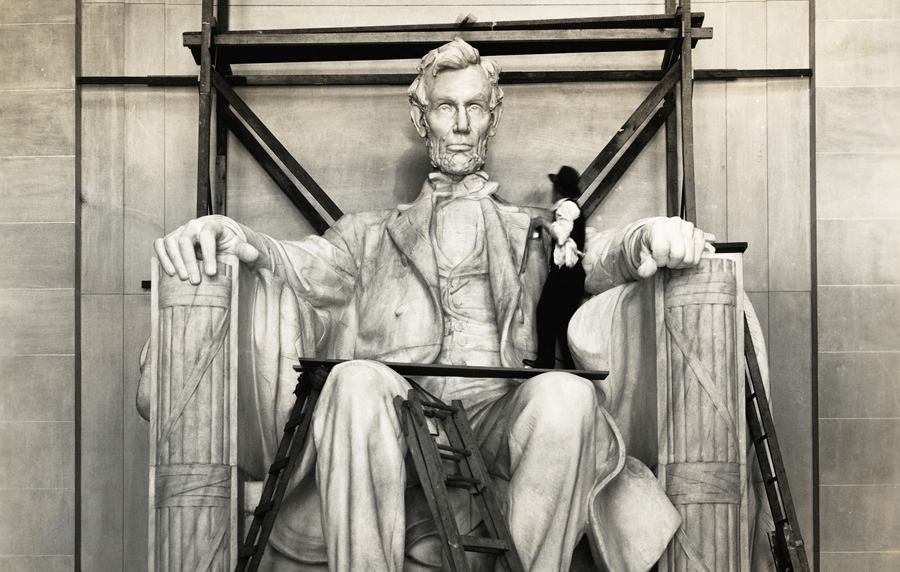
Finishing touches are made to the huge statue of
Abraham Lincoln, which stands just inside the entrance of the Lincoln
Memorial, prior to its dedication in Washington, D.C., on May 30, 1922.
Underwood & Underwood / Corbis
It is a mirage. A hopeful one. One denying and defying the reality that human nature strips human beings of the potential to be truly great in measure of conscience and performance on a scale that places them on a pedestal of greatness. But we must have our illusions and the belief in the superior traits and habits of outstanding people of great virtue in whom others may place their trust and admiration and whom the young can hope to emulate -- instructs institutions to produce their own histories and heroes to feed a national psyche.
Reverence is not reserved only for the faith and belief in the presence of a supernatural power we call God. God instructed the faithful not to produce false idols nor to make of the Almighty's existence a simulacrum to be worshipped. But those human beings whose legend is elevated to the position of saintliness and creative genius, of brilliant governance of humankind and the humble aristocracy of judicial wisdom can be sanctified and monuments of heroic size and likeness erected to their memory.
King Ramses II (The Great)
From antiquity to the present, such monuments have been the subject of both adoration and rejection; dictators order their graven images to be erected and adored. Later generations take it upon themselves to erect monuments to predecessors of great renown and respect resulting from their superior abilities to influence the lives of others for the good of the public weal. The former statues are hated and eventually destroyed, the latter remain as reminders of what human nature can aspire to, even those whose attributes are overblown, their failures overlooked.
The purportedly most powerful country in the world, the super-power has fallen on hard times. It's not just that it elected a deal-making, coarse-mannered, ill-natured celebrity who exemplified all the crude socially corrupt manifestations of the 21st Century, a man whose ignorance of world affairs, social courtesy and pluralist equality identifies him as intellectually bankrupt, or in the kind of cruder terms he uses himself; a moronic imbecile, for he represents in his elected presence the culmination of those lesser mortals who preceded him most recently.
All of whom served their country ill, all of whom served themselves first and foremost, all of whom failed the most basic tests of divorcing their most unwholesome emotional instincts in the lust for wielding power in a reflection of their limited natural intelligence and understanding of the impact it would have on their country and the extended world community.
The likeable pretender Bill Clinton whose womanizing fetish brought discredit to the presidency, George W. Bush whose sweet nature and bully impulse created a Middle East quagmire, Barack Obama whose sympathies with Islam opened America to invasion and the world to the Iranian threat, and their natural successor whose qualities embodied all the propensities of his predecessors.
The super-power waiting behind the drawn curtains in the global theatre is prepared to open the world community of trade and commerce to China's One Belt One Road to produce a global bazaar ruled by Chinese investment; trade and commerce have represented the universal state interests from antiquity to the present and China is now the world's topmost entrepreneur.
"Aiding the anti-Soviet war trumped non-proliferation policy interests ... (and the administration of then-president Ronald Reagan) used loopholes in U.S. non-proliferation laws to avoid the enforcement of sanctions on Pakistan." "The high priority given to a close U.S.-Pakistan relationship may have encouraged, as some journalists have alleged, State Department officials to warn the Pakistanis of the imminent arrest of their agents." U.S. National Security Archives review, George Washington University and the Nuclear Proliferation International History Project
American realpolitik in action rivals any that other self-serving governments choose to practise in their perceived interests. Just as the current President of the United States is engaging in a kind of diplomatic, high-level enabling with respect to the Iran-Nuclear Technology file, under the pretext that in so doing, it, along with its allies, are evading the potential for war when what they are doing is delaying the potential for a war that could eclipse all earlier world conflicts, so too did a previous administration look the other way when it had an obligation to put a halt to proliferation.
The U.S. administration, in 1987 had the opportunity to make an effort to put a halt to Pakistan's illicit ambitions to achieve nuclear weapons, but it decided to trade in that obligation for what appeared at that time to be a greater need to uphold their anti-Soviet stance during the Soviet invasion of Afghanistan. There was a twofold purpose to the perfidious strategies devised by the White House and the CIA; to train, arm and fund a mujaheddin group whose purpose was to fight a guerrilla war against the Soviet military.
And we know what that got the world; from that group of jihadists answering the call to defeat a foreign invader on land consecrated to Islam, was born the spark that led to al-Qaeda when a Saudi Arabian jihadist by the name of Osama bin Laden conceived of nurturing a battle-hardened group of fighters as "a vehicle to promote a global jihadi revolution". And they succeeded through determination, a love of conflict, and a hatred for the West, enabled by the wealthy in Saudi Arabia who supported them financially, while managing to keep them out of Saudi Arabia.
And, in the event, senior administration arms control officials in the United States were ragingly furious that they were expected not to enforce the 1985 U.S. non-proliferation law to honour their obligations, and to take steps to halt the $4-billion in annual American military and economic subsidies to the the government of then Pakistani dictator, General Muhammad Zia-ul-Haq. The U.S. wanted Pakistan on side to battle the Soviets in Afghanistan, and to funnel funding to the mujaheddin.
This absurdity would repeat itself many years later when it was the United States with its allies under the imprimatur of the United Nations that invaded Afghanistan to rout the Taliban and their honoured guests, al-Qaeda and bin Laden, post 9/11. In effect, the U.S. was battling the very guerrilla militias it had paid previously to train and to arm. And Pakistan was giving haven to the very Taliban that were warring with NATO troops, while continuing to accept its yearly stipends in the billions from the United States, to uphold the fiction that it was aligned with NATO in the battle against terrorism.
But of course it was the founder of the Pakistan People's Party, Zulfikar Ali Bhutto, father of later Prime Minister Benazir Bhutto, who was the father of nuclear Pakistan. He felt that if India could have atomic weapons, then so too should Pakistan. When he was foreign minister of Pakistan he visited Vienna to confer with a senior technician working as a nuclear engineer, Munir Ahmad Khan; they were in agreement that Pakistan needed a nuclear deterrent to India. And history was made.
A Pakistan-born Canadian businessman, 43-year-old Arshad Pervez, was arrested by U.S. Customs when the U.S. government was informed by an official at Carpenter Steel Corp. in Reading, Pennsylvania, of Pervez's enquiries to purchase 22,000 kilograms of high-strength maraging 350 steel, an alloy for gas centrifuge enrichment technology. He was charged also for attempting to obtain beryllium to boost the intensity of nuclear explosions for Pakistan's secret nuclear weapons program.
The man was convicted in 1987 of conspiracy to file false documents for an export license, for filing false documents and for attempting to export beryllium, a criminal offence under U.S. law. Inan Ul-Haq, a retired Pakistani brigadier-general directing the smuggling operation, managed to escape the U.S. just as authorities were moving in to arrest him. A month after Pervez was convicted and sent to prison for five years, Pakistan was granted a waiver from aid cutoff.
Continued aid to Pakistan, the president declared was "in the national interest."
Continued trust in the good word of a reliable Iranian partner for peace is presumably "in the international interest."
This represents a general opinion site for its author. It also offers a space for the author to record her experiences and perceptions,both personal and public. This is rendered obvious by the content contained in the blog, but the space is here inviting me to write. And so I do.