"You may have a very small chance of being the one they decide to detain, but it's years of your life."
"I have lots and lots of friends and relatives in China, as well as a business. But I feel like it's just not worth the risk."
"[The company has however compartmentalized information to protect the
organization on the ground], because you never know what can be
construed in the wrong way."
"We’ve
become very careful about that sort of thing [unintentionally arousing
Beijing's ire, and facing arbitrary detention in China]. And we didn’t
used to be."
Anne Stevenson-Yang, co-founder J Capital Research, Northeast U.S.
"Beijing's
record of detaining individuals in retaliation for the perceived
transgression of their home government should be a geopolitical risk on
the radar of every C-suite executive."
Hugo Brennan, Asia analyst, risk consultancy firm Verisk Maplecroft
"We have received calls from member companies about the possibility of arbitrary detention."
"Our view is that the risk is small, but it's not zero."
Ker Gibbs, president, American Chamber of Commerce, Shanghai
"It works because, while it is shocking, deeply harmful for the detainee
and places enormous political pressure on the foreign government, it is
also judged by foreigners as sufficiently rare as to be a manageable
risk, something that doesn’t really disrupt profitable business for
China."
David Mulroney, former Canadian ambassador to China
Increasingly, Westerners with business
interests in China are beginning to reassess the risks of travel to a
country that has increasingly made use of 'detention diplomacy' to
register its displeasure with other countries' attitudes toward
Beijing's policies and behaviour and specifically that of the Chinese
Communist Party ruling elite. Business executives now consider the risk
of being carried off by security agents in China, to become yet another
casualty of geopolitical tensions that have emerged between Beijing and
the West, most specifically the United States.
The
arbitrary detention and charging of two Canadians with espionage and
endangering the security of China when they were taken into custody in
2018 following hard on the detention of Huawei CFO Meng Wanzhou on an
extradition warrant by the United States which saw the RCMP arrest
Ms.Meng at a stopover at Vancouver International Airport in December of
that year appears to have initiated a new strategy for China, of
coercive diplomacy.
Michael
Kovrig and Michael Spavor remain imprisoned, subject to human rights
violations imposed by the CCP, including denial of access to a lawyer,
while Meng Wanzhou is free on bail to live in her two luxury Vancouver
mansions while her extradition case winds its way through the court in
accordance with Canadian and international law. Since the detention of
the two Michaels other countries have had to deal with their nationals
taken into detention in China, Australia among them.
This
new way of 'influencing' and demanding the attention of other countries
to China's growing clout through the world community has not endeared
it to the countries being targeted who also have raised the issue of
human rights violations with respect to Chinese Uyghurs' detention and
brain-washing, and Beijing's hard-handed anti-democracy clamp-down of
Hong Kong, along with its threats to Taiwan, added to Beijing's
assertion of rights-of-possession in the South China Sea and its
territorial aggression against India.
Anne
Stevenson-Yang of J Capital Research has realized riveting reservations
around returning to China to advance her business interests as research
director of her company, prepared now to give up her frequent business
trips to China. The risk of being taken in by security agents and
imprisoned on charges having nothing in relation to reality fails to
appeal to her sense of self-preservation. She and her husband and
children moved to the U.S. six years ago from China, now she fears the
risk of returning for any reason, personal or business.
A
dozen executives, diplomats, consultants and academics have given their
opinions in interviews, asking their names be withheld for security
purposes, many of them believing an increased risk in travel to China
will instruct them in future plans to avoid making themselves
vulnerable, with the potential of ending up in prison. Passage of a
security law in Hong Kong has failed to reassure that China's closed
justice system can be relied upon to mete out justice, as it were.
Police,
prosecutors and courts are known to hew the Communist Party line. Under
Chinese law authorities are able to arrest 'suspects' and maintain
incarceration for prolonged periods without trial under the newer and
increasingly wide-ranging national security laws. Chinese citizen Haze
Fan, a Bloomberg News staffer, was recently detained in Beijing with
China confirming that she is being held by the Beijing Municipal
National Security Bureau on suspicion of 'endangering national
security', but authorities refuse to release details of her case.
Mostly, without doubt, since there are none.
Semiconductor
Manufacturing International Corp representing the largest chipmaker in
China was placed by the Trump administration on a blacklist along with
over 60 other Chinese companies, leading the Chinese Ministry of
Commerce to threaten retaliation to the move denying Chinese companies
access to American technology, from software to circuitry. A move that
has increasingly soured China on all relations with Western sources.
China
maintains it is being maligned by the label of "hostage diplomacy",
being "totally groundless". No one, they stress, who respects the law of
the land would have any reason to fear arrest. In turn Chinese
executives express concern at the visit of spokeswoman Hua Chunying,
U.S. Foreign Ministry spokeswoman this month, claiming Meng Wanzhou's
arrest to be "100 percent a political incident". Zhao Lijian, a Chinese
foreign ministry spokesman hinted political intervention lifting
proceedings against Meng "could open up space for resolution to the situation" of the two Canadian Michaels.
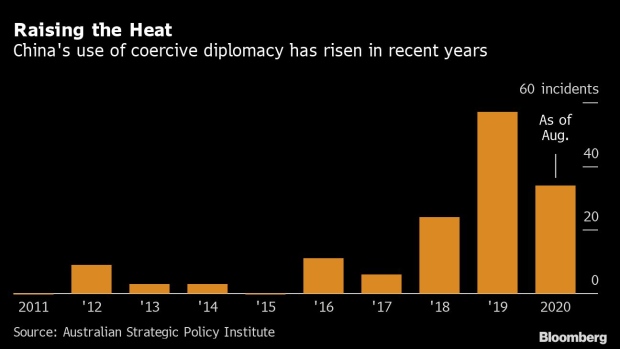
Data
on eight categories of "coercive measures" was compiled in a recent
report produced by the Australian Strategic Policy Institute noting
actions such as those Beijing has embarked upon have sharply risen in
the past few years through arbitrary detention, execution, popular
boycotts, pressure on specific companies, state-issued threats and
restrictions on official travel, investment, trade and tourism.
Beijing's novel initiatives on how to make friends and influence
countries.
"I know a lot of business people who are out of China now and are very afraid of going back",
one executive asking for anonymity, stated; he and others, in
particular former government officials working as consultants have
become increasingly wary. The U.S. State Department warned American
citizens they face risk of arbitrary arrest and exit bans; to avoid
unnecessary travel to China -- and the Canadian Foreign Affairs
department has issued a like warning. Little wonder relations are
frayed.
The Panopticon Is Already Heren The Atlantic
Xi Jinping is using
artificial intelligence to enhance his government’s totalitarian
control—and he’s exporting this technology to regimes around the globe.
"That's more than just Huawei. This is just a western bias against China. That goes back culturally." "The country and the company all need to learn how to tell a better story. This is why I'm now able to talk to you." "I don't think we trust anybody. We've operated for a long time on the basis you can't trust vendors to have secure equipment." Huawei spokesman
"There's nobody that does customer centric the way Huawei does customer centric." "Anybody that breaks those rules is automatically terminated. We've always had to pay more attention than our peers in the industry just to keep the playing field level." "It's time that we come together as an industry to get working with regulators, to get working with governments to build a common standard to say if you want to play in this space, this is what you have to do." Leroy Blimegger, global president, assurance and managed services, Huawei
"They've been a little naive perhaps ... all these political shenanigans are not something that they're used to." "It's the old chestnut that it's impossible to prove a negative. They can say till they're blue in the face, 'We'd never share information with the Chinese government'." Peter Richardson, research director, Counterpoint Research
Ren Zhengfei, a former military engineer with the Chinese military, began his now-giant communications/electronics corporation with modest funding soon after Deng Xiaoping had declared Shenzhen, a semi-rural city, open for business on a modified Communist free-enterprise model. The-then fishing village of some 30,000 inhabitants in 1987 has since grown through its status as a special economic zone with freer markets, into a massive metropolis of 12.5-million people. As Shenzhen has grown, so too has Huawei.
In 2017, the Chinese Communist Party brought the National Intelligence Law into service whereby all Chinese organizations and citizens are obligated to support, assist and co-operate with intelligence officials. This is their first order of business; to spy for or along with the CCP. Yet Huawei insists all security protocols are scrupulously adhered to by them. Charging that it is being targeted with anti-China biases by those resentful of its ascent to the top of its game worldwide. As though to stress its bona fides Huawei calls for industry-wide cybersecurity standards.
Since Huawei's chief financial officer, Meng Wanzhou, daughter of the company's founder, was arrested in Vancouver on an extradition request from the U.S. on charges of conspiracy to commit bank fraud, and China responded with great alacrity and even greater recrimination by arresting two Canadian businessmen, upgrading a third's prison sentence to a death sentence for drug running, the suspicion with which Huawei's security is viewed globally has intensified.
Huawei is busy courting contracts for 5G communications upgrades, assuring its potential clients of its security protocols and that the 32-year-old company has never and never would, acquire data on foreign nations through its systems distribution, holding to industry-wide cybersecurity standards. Its reputation has suffered quite a blow with the detention of Ms. Meng and the U.S. charges against the company erupting from manoeuvring to do business with Iran, despite U.S. sanctions.
Close to 50 percent of Huawei's $107-billion in global revenue emanates from business outside China; over a quarter of its revenues derive from contracts in Europe, the Middle East and Africa. North America, minus the U.S., supplied about $7-billion of Huawei's global revenue. It has invested research and development in Canada to the tune of $30 million annually; the third-largest target for R&D spending; 5G innovation centered to a large degree in Ottawa.
A hostess waits to welcome journalists at the Huawei Beijing Executive Briefing Centre in Beijing.Fred Dufour/AFP/Getty Images
Ten percent of its global research budget goes to basic research at Canadian universities. Recently a new report was released in the United Kingdom focusing on its Huawei CyberSecurity Evaluation Centre, set up as an oversight facility to test the company's gear for the presence of vulnerabilities. The report revealed "serious and systemic defects in Huawei's software engineering and cybersecurity competence"; that the U.K. security system could provide only limited technical assurance for the equipment; on the other hand that it "does not believe that the defects identified are a result of Chinese state interference".
Huawei has built over 1,500 networks around the world, built a base station on Mount Everest, its equipment was used in one of the first LTE networks with Telia Sonera in Norway. After three decades of accelerated growth Huawei is the world's largest telecommunications equipment manufacturers. It employs close to 188,000 people, operating in over 170 countries and regions of the world. In 2018 the company sold over 200 million smartphones as the third-largest smartphone provider globally.
The company has offered a lower price point to establish its foothold in emerging markets. Carriers in developed countries understood by 2009 that Huawei gave good service at a competitive price: "4G was the first time Huawei showed it could compete with the best", said Dexter Thillien, telecom analyst at Fitch Solutions based in London. With higher quality on offer, the company was able to compete even in Chinese cities where western company services had dominated. According to Thillien and other analysts, Huawei is in the lead with 5G, thanks to its massive investment in R&D.
Yet many governments nervously view what they see as a lack of transparency over Huawei's ownership structure and its relationship with the Chinese government. Australia and the U.S. have acted on that suspicion by banning Huawei. Parts of Europe seem to be swaying in the same direction, even while Germany, Italy and France seem to be leaning toward the Telus view in Canada to continue its collaboration with Huawei on the basis that the company's equipment is permitted in the periphery but not the core network.
While swearing it has never, would never spy for the Chinese government, that it follows the rule of law wherever it operates and blames suspicion on rogue employees, it isn't convincing everyone who matters. Huawei cannot shake itself free of suspicions that it acts as an arm of the state, its high-tech equipment could contain back doors allowing the Chinese government to conduct espionage or insert code with the potential to shut down an entire network....
A staff member of Huawei uses her mobile phone at the Huawei Digital Transformation Showcase in Shenzhen, China.Wang Zhao/AFP/Getty Images
"In Yemen, bomb, bomb, bomb every time. No water, no electricity, no job, no school, nothing. How can I give a good life for my son? "Word spread about Jeju, and I heard I may have a chance." Muaadh Galal Mohammed al-Razeqee, Jeju, South Korea
"They can take many wives and produce many children." "Now, there are five hundred of them. In ten and twenty years, how many of them will there be?" Yang Eun-ok, 70, leadr, Jeju protest
"There was no safe place in Yemen for me to hide." "I heard South Korea was open for Yemenis." Hani al-Junaid, 37, journalist, Jeju, South Korea
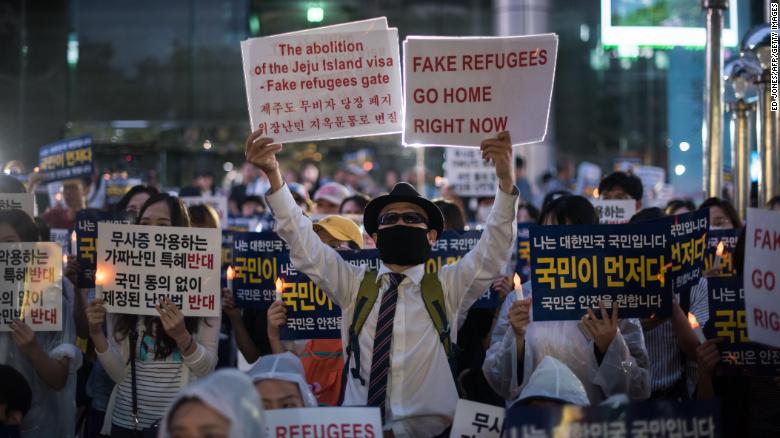
Anti-immigration activists attend a protest against a group of asylum-seekers from Yemen, in Seoul on June 30, 2018.
AirAsia in December began flying direct budget flights from Kuala Lumpur, Malaysia to Jeju in South Korea. Yemenites fleeing the deadly sectarian-fuelled civil war that has become a proxy war between the Shiite Islamic Republic of Iran and the Sunni Kingdom of Saudi Arabia, who were allowed temporary visas to travel to Malaysia -- yet another Muslim-majority country -- saw those direct flights representing a way into mainland South Korea for asylum seekers on the subtropical island.
In the last several months the island that has a reputation as a honeymoon resort island has been visited by asylum seekers for whom their homeland has become an utter catastrophe; death by Houthi Shiites, or Saudi bombs, desperation of malnutrition and disease, nothing left for them in their homeland -- a place of conflict that the United Nations titles "the world's largest humanitarian crisis".
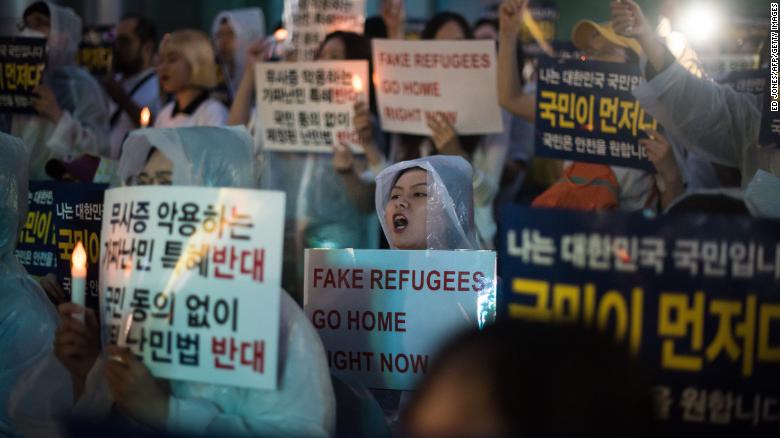
Jeju, off South Korea's southern coast, is where Yemeni refugees wait for the South Korean government to respond to their refugee applications. Their presence on the island, however, has led to an organized anti-asylum movement of "Let's kick out fake refugees!" A summer anti-refugee protest rally on Jeju reflected one held in Seoul. President Moon Jae-in received an online petition with 714,000 signatures, demanding a stop to taking in asylum seekers.
In the tumult of the violence of the civil war in Yemen, thousands of its citizens fled to Malaysia. One Muslim nation surrendering its population to another, for haven from destruction and death. But Malaysia will only permit the refugees a maximum relief of 90 days, refusing to even consider granting them refugee status. So they flee to Jeju and in so doing the former domestic vacation spot is no longer popular with South Koreans.
South Korea in 2002 granted permission to the island to introduce a no-visa policy for most foreign visitors; the perfect solution to fleeing Yemenis' search for haven, the refugees imagined. More recently, however, South Korea placed Yemen on its list of 11 other countries requiring visas to enter Jeju. The South Korean government barred 487 Yemeni asylum seekers still on Jeju from leaving for the mainland.
They must await the results of their applications for refugee status review while on Jeju. There are a relatively paltry several hundred Yemenis on the island, a minuscule percentage of the Island population of 660,000, yet their presence generates concern, sliding into fear. "If these people are safe, why doesn't the government let them move on to the mainland as they wanted to?" questioned Kim Jin-yi 32, an attendee of the Jeju protest.
Like Japan, South Korea prides itself on its homogeneous society, has been traditionally averse to receiving asylum seekers. Its location has helped in not presenting it as a major destination for refugees other than from its neighbour, North Korea and for whom the South has no qualms about accepting as compatriots.
In 2013, under pressure from rights groups, South Korea adopted a new law providing protection for refugees, seeing since then the number of asylum applications rise from 2,896 in 2014 to 9,942 last year. There are warnings internally circulating on the Internet of an invasion of Arab terrorists or rapists. The dysfunctional world of Islam creates the world's greatest number of refugees desperately fleeing oppression, violence and death.
Those Islamic countries not in conflict refuse to give haven to their co-religionists.
Anti-immigration activists attend a protest against a group of Yemen asylum seekers, Seoul, June 30, 2018.
This represents a general opinion site for its author. It also offers a space for the author to record her experiences and perceptions,both personal and public. This is rendered obvious by the content contained in the blog, but the space is here inviting me to write. And so I do.