"There was panic, but we knew we had to move. It's like we were on autopilot. [The crew] were in a daze, but they were all rushing to do their assigned jobs for our safety protocol ... maybe I looked dazed too."
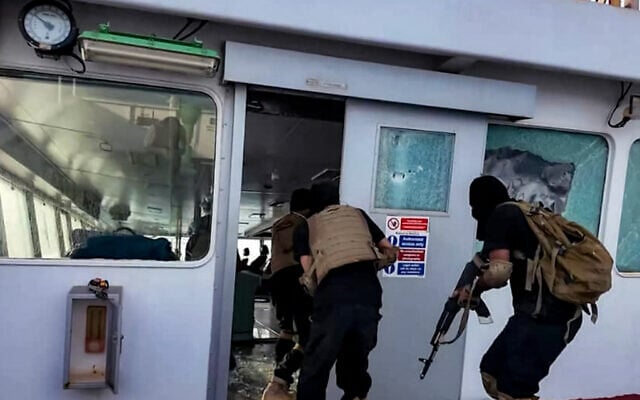
"There were speedboats from the right, left and back of our ship. There was also a bigger boat with around 15 crew who were attempting to board our ship, but luckily, our armed guards were able to stop them."
"I lost count of how many hits we took. The flooding had started so we decided to abandon the ship. We deployed our lifeboat, all 22 of us, and left our main vessel."
Filipino seafarer Cocoy
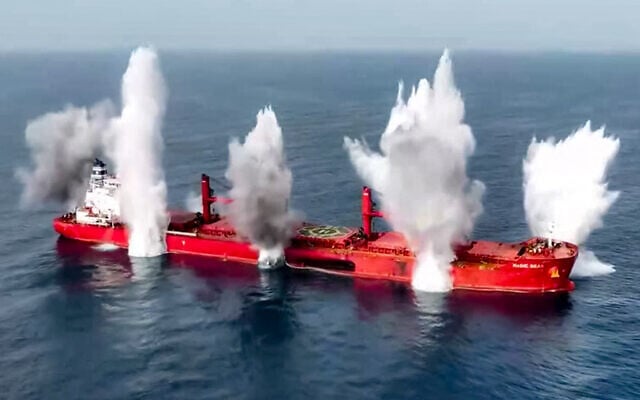
Smoke plumes rising on the Greek-owned bulk carrier Magic Seas after an
attack by the Houthis in the Red Sea, on July 8, 2025. (ANSARULLAH MEDIA
CENTRE / AFP)
Off-duty and resting in his cabin, Filipino sailor Cocoy was sent into shock when he heard his captain's voice boom over the cargo ship's intercom: "We are under attack". The sound he had earlier heard like a knock from within the vessel was then revealed to his realization that what he had dismissed as an ordinary ship's sound was that of gunfire exchanged by ship security and Houthi terrorists whose small boats were swarming the ship.
The assault on the Greek-owned Magic Seas on July 6 was the first in a long lull, with the Yemeni Houthis having agreed to suspend their attacks on Red Sea Shipping in an agreement with the U.S. to suspend bombing them in response to their predations on international shipping. Following the October 7 Hamas attacks on southern Israel and the IDF's bombing in Gaza to target the Palestinian terrorist group, Iran's Yemen proxies decided they would impose pirate-actions on any ships they identified as having a link to Israel, whether through ownership or trade.
Cocoy and the other crew members aboard the Magic Seas scrambled toward the "muster station" at ship's center, considered to represent the safest area on the ship should a projectile strike the vessel. There were 22 sailors aboard the ship, of whom 17 were Filipino. They huddled inside the muster station for close to five hours while the ship's three armed Sri Lankan security guards did their best to counter the attack.
"During the gunfight, the faces of my wife and child flashed before my eyes. I kept thinking ... will they survive without me?"
"I thought I was going to die."
"They were the longest hours of my life."
This handout image released by Yemen’s Houthi Ansarullah Media Centre on
July 8, 2025, reportedly shows Houthi-affiliated fighters carrying out
an attack on the Liberia-flagged bulk carrier Magic Seas at sea. (Photo
by ANSARULLAH MEDIA CENTRE / AFP)
Five ballistic and cruise missiles and three drones had been used by the Houthis in their attack on the ship. Filipino sailors sent home to the Philippines close to $7 billion in 2023, an amount representing a fifth of remittances its nationals forward to the archipelago nation. Up to 30 percent of the globe's commercial shipping force is comprised of Filipino sailors. Despite his 15 years as a seafarer, this was the first passage that Cocoy had experienced through the Red Sea, one he spoke of as a case of "really bad timing".
Cocoy and his shipmates spent three hours floating in the Red Sea after abandoning ship, before being picked up by a Panama-flagged container ship. They watched as the Magic Seas sank beneath the waves. A week later yet another vessel, crewed in large part by Filipino sailors, was attacked and sunk. Ten of those aboard the Eternity C, were rescued, while 15 of the crew are either dead or missing in the deadliest such assault since last March, when three people were killed in a Houthi missile attack on another ship.
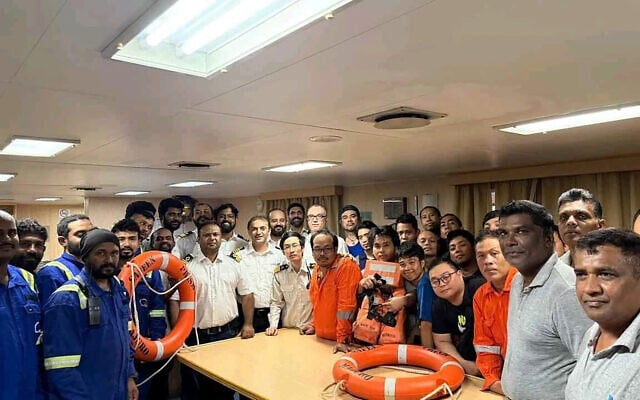
Members of the crew of the Greek-owned, Liberian-flagged commercial vessel
Magic Seas, posing for a picture with the crew of the Safeen Prism,
after they were rescued following a Houthi attack that forced them to
abandon ship, in the Red Sea on July 6, 2025. (UAE’s Ministry of Foreign
Affairs and International Cooperation / AFP)
The Houthis announced last week that they had "rescued" a number of the Eternity C's crew, to take them to a 'safe location'. The US. government promptly charged them with kidnapping. Lloyd's List, a maritime news journal, reported six Filipino seafarers as "believed taken hostage". Plagued by nightmares of the attack, Cocoy feels uncertain whether he will return to the sea, urging ship owners to discover routes avoiding the Red Sea.
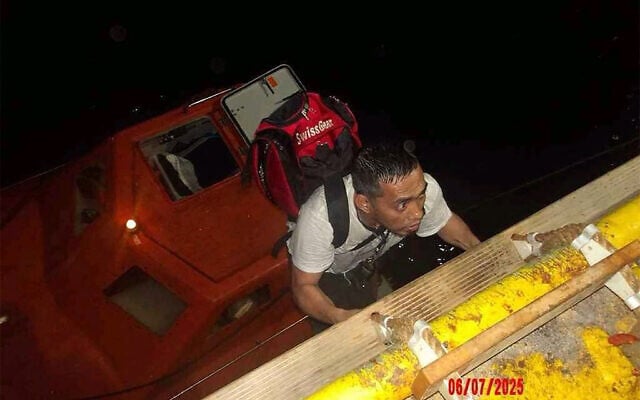
This handout picture provided by the UAE Ministry of Foreign Affairs
reportedly shows members of the Greek-owned, Liberian-flagged Magic Seas
commercial vessel climbing on board the Safeen Prism, after being
rescued following a Houthi attack that forced them to abandon ship, in
the Red Sea on July 6, 2025. (UAE's Ministry of Foreign Affairs and
International Cooperation / AFP)
"I felt terrified for the [missing] Eternity C crew."
"We were just lucky, because all of us survived ... I pray that many of their crew can still be located live."
"What happened to us was not normal. It's something that no one should ever experience."
"Yemen is already considered to be
the world's largest humanitarian crisis."
"The country is now also facing the overlapping threat of the
coronavirus pandemic, and the impact of recent torrential rain and
flooding." UNHCR spokeswoman Shabia
Mantoo
"There is now a very real probability that the virus has been circulating undetected and unmitigated within communities [based on transmission patterns and given the time passed since Yemen reported its first case]." "Since the first confirmed COVID case, we have warned that the virus
is now in Yemen and may quickly spread." "The factors are all here. Low levels of general immunity, high levels
of acute vulnerability and a fragile, overwhelmed health system." Lise Grande, humanitarian
coordinator for Yemen, UNHCR
"We urge all parties to the conflict in Yemen to immediately halt
fighting, to implement a ceasefire on the ground without delay, to
release all detainees and those forcibly disappeared, and to work with
the UN special envoy to urgently restart comprehensive and inclusive
political negotiations to end the conflict." 50 NGOs working in Yemen, including Oxfam, the Norwegian Refugee Council, Tearfund and the International Rescue Committee
UN warns of new humanitarian crisis as COVID-19 looms over Yemen [Khaled Abdullah/Reuters]
One of the poorest countries in the world, and the most insecure in the Middle East, Yemen, in the midst of a civil war, with millions of internally displaced refugees, now faces the very real prospect of becoming the hot-spot for the novel coronavirus caused by SARS-CoV-2, in the region. In a country facing famine and millions living in refugee camps lacking medical care, the feared invasion of the highly contagious COVID-19 has the potential of destroying untold number of vulnerable lives.
The first infections are being detected in Aden, the interim headquarters of the legal government-in-exile, torn from the country's capital Sanaa five years earlier by the Shiite-Iran-sponsored Yemeni Houthi group, in a war that has succeeded in creating what is described as the world's largest humanitarian-crisis-in-waiting. According to United Nations figures, a crisis that would outdistance in refugee numbers and deaths even that of Syria under the dread rule of Bashar al-Assad.
The population of 28 million, according to international health officials warning that an outbreak among the vulnerability of an embattled, politically-regionally-exploited situation is set to result and yet faces detection difficulties in a country whose health infrastructure, such as it was, has been massively degraded by poverty and war.
Damage caused by floods on a street in Aden last week.Credit...Reuters
The Aden-based government maintains an emergency committee for the coronavirus, in an effort, given its hopeless medical situation and the prospect of continued conflict, to advise and instruct, even in the face of the reality that implementation of any proposed method of attempted control would be futile, given the circumstances.
The first step in hoping to contain a potential outbreak is for authorities to be able to trace "patient zero", an issue that simply is not feasible with the tools at the government's disposal. There are also rumours of cases detected in the capital Sanaa under the control of the Houthis, who deny that any COVID-19 cases have surfaced there, whatever.
For the present, the Southern Transitional Council, a separatist group set on self-rule in southern Yemeni governorates including Aden, 24-hour temporary curfews have been announced. In Aden, mosques were closed until further notice, along with shopping centres and restaurants. Khat markets, a mildly stimulant green leaf chewed daily by many Yemenites, will be closed, the sale of khat banned. The equivalent of banning alcohol sales in Western countries struggling to contain the coronavirus.
A worker fumigates a residential area in the battle against the coronavirus on the outskirts of Sana, Yemen’s capital. Credit...Khaled Abdullah/Reuters
An anti-government protest in Tehran on January 14,
2020. Demonstrations erupted after Iran admitted to unintentionally
shooting down a passenger jet last week. Fatemeh Bahrami/Anadolu Agency via Getty Images
"Aware of the anti-Iranian mood on the Iraqi streets—exemplified by
protesters beating their shoes against portraits of Khamenei, just as
they had done with former Iraqi President Saddam Hussein in 2003—an
unnerved Khamenei did not hesitate to intervene."
"Referring to the unrest as a conspiracy orchestrated by the United
States, Saudi Arabia, and the 'Zionist regime' [Israel], the ayatollah
called
on forces in Iraq to 'remedy the insecurity and turmoil'—a metaphor
that served as a green light for Iranian-backed militias to quash
demonstrations in Iraq." "But Suleimani’s fingerprints have been found in other parts of Iraq too.
It recently emerged that the day after the protests started, the
Iranian general secretly flew to Baghdad to meet with security
officials. Suleimani called for a heavy-handed approach to deal with
people on the streets, reportedly saying, 'we in Iran know how to deal with protests', an implicit reference to
prior violent suppressions of peaceful demonstrations in Iran and, more
aggressively, in Syria. The death toll in Iraq surpassed 100 the day
after his departure, confirming the power of Iran’s word." Kasra Aarabi, Foreign Policy
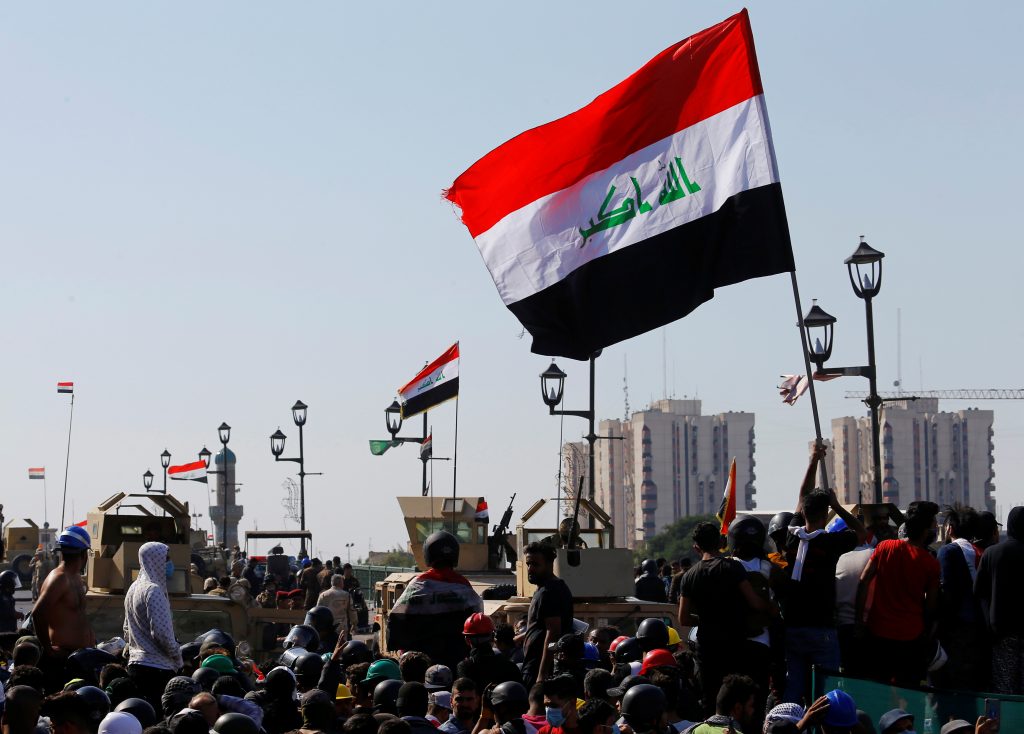
Protesters gather in Baghdad, Iraq, amid anti-government demonstrations on Dec. 10, 2019. Sabah Arar/AFP/Getty Images
"If there was no escalation recently in the region, those Canadians would be right now home with their families." Canadian Prime Minister Justin Trudeau
"In
Iraq and in Lebanon, society is rebelling against an entire political
class that, while ostensibly sharing power on a multi-sectarian basis,
is actually looting state resources and failing to provide the most
basic services.
The protesters, furthermore, do not want to be part of a quasi-Iranian
protectorate. Ominously for Iran, the Iraqi protests spread like
wildfire from Baghdad — a mainly Shia city — throughout the Shia
heartlands and holy cities of the south." "In
Lebanon, where demonstrations inside the capital have mixed Sunni and
Shia, Christian and Druze, the Shia southern suburbs, and other
Hizbollah strongholds in south Lebanon and the Bekaa Valley, have been a
sea of Lebanese flags rather than the Party of God’s strident yellow
banners.
In Iraq, militia snipers as well as security forces have shot
protesters, with more than 250 dead. In Lebanon, a tense peace has held —
so far. Nobody has forgotten the sectarian bloodletting of the 1975-90
civil war. Thugs from Hizbollah and allied Shia militia Amal have
attacked demonstrators." David Gardner, Financial Times
Iraqi demonstrators take part in one of the ongoing anti-government protests in Baghdad, Iraq, (Reuters)
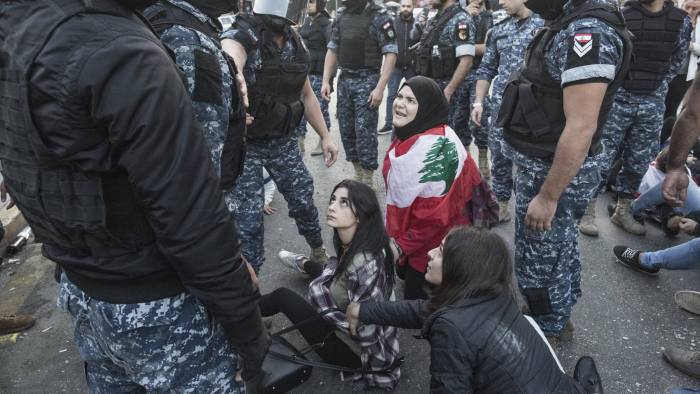
On Tuesday night, 59 people were arrested in Lebanon, protesting in
cities like Tripoli, Sidon, Bekaa and Beirut. Serious injuries to
protesters took place amidst riot police, broken windows, ambulances and
tear gas. Hundreds of thousands of protesters have come out since last
October to pour through the streets, protesting the government's
incompetence and Hezbollah's influence; most of all they raged against
the presence of Iranian interference in the country.
There have been nothing like the violence of those riots in Iran, though
the protests have been numerous and vehemently expressed in viral
antipathy against the theocratic government, the Basij and the IRGC
preoccupied with their interference in Syria, Lebanon, Iraq and Yemen,
while the nation's economy is in freefall as a result of biting U.S.
sanctions and Iranians are suffering privation. People on the streets of
Iran's cities decry the dictatorship they suffer under and call for
Supreme Leader Ali Khamenei's removal.
In Iraq, a wave of street demonstrations, strikes, marches and
occupations begun last October has seen brutal violence causing the
deaths of at least 500 protesters, and the injurious wounding suffered
by another 19,000, all of which failed to put an end to the protests.
Iraq has been coping with its most severe crisis since the 17 years of a
U.S.-led invasion and occupation to remove the Butcher of Baghdad,
Saddam Hussein which unleashed a sectarian backlash of slaughter.
And then there is Syria and the collapse of a former thriving country
whose crumbling into chaotic destruction of its society and its heritage
began with a quiet protest by Sunni Syrians over their second-rate
status in a minority Shiite-Alawite-dominated regime whose president,
Bashar Assad sneered at the 'terrorists' confronting his rule and
unleashed chemical warfare, barrel bombs, the targeting of hospitals and
schools and markets to convince Syrian Sunnis they have no future in
Syria.
Getty Images
The common denominator in these Shiite-led countries is their hegemonic
relationship with the Islamic Republic of Iran which had set out to form
a sectarian alliance of aggressive Islamist strength on its way to
achieving power and influence over its Arab, Sunni-majority neighbours.
Iranian tentacles throughout the Middle East, from Lebanon and Yemen,
Syria and Iraq to Qatar and Turkey has served to roil the geography in
an escalating hurricane of Islamist disequilibrium, long predating the
Hellfire missiles from a Reaper drone over Baghdad airport, targeting
Qassem Soleimani.
Yet, despite this background of escalating dysfunction, hundreds of
thousands of lives extinguished, millions of refugees created, amidst a
high-boiling point of distrust and fear born of hatred and vengeance,
Western leaders like Canada's Justin Trudeau quail at the prospect of
holding Iran to sole and full account for the Quds Force malfunction
causing the death of 176 passengers on Ukrainian Airlines Flight 752,
killing 57 Canadians of Iranian origin, and countless more Iranian
students heading to Canada on student visas.
From Damascus to Beirut, Baghdad to Sanaa, and Gaza included, the
Khomeinist regime holds full sway, plaguing the region with its
nefarious, violent agenda, exploiting sectarian divisions while
continuing to defy injunctions and sanctions against uranium enrichment
and technical advancements of the delivery systems in ICBMs. At the same
time exhorting its proxies to wreak havoc in the oil fields of Saudi
Arabia, while the IRGC speedboats hector and harass shipping in the
Persian Gulf and Strait of Hormuz.
So, in fact, the 'escalation' of hostilities does not rest with the
current White House administration which has finally departed in earnest
from the folly of its previous resident's disastrous 'agreement' for
nuclear deterrence of the JCPOA which Tehran endorsed but never intended
to implement, succumbing instead to steeper sanctions imposed by the
U.S. when it opted to have its satellite militias bomb U.S. bases in
Iraq and Syria, never anticipating that this administration would commit
to a 'disproportionate' response, which on reconsideration was entirely
proportionately appropriate.
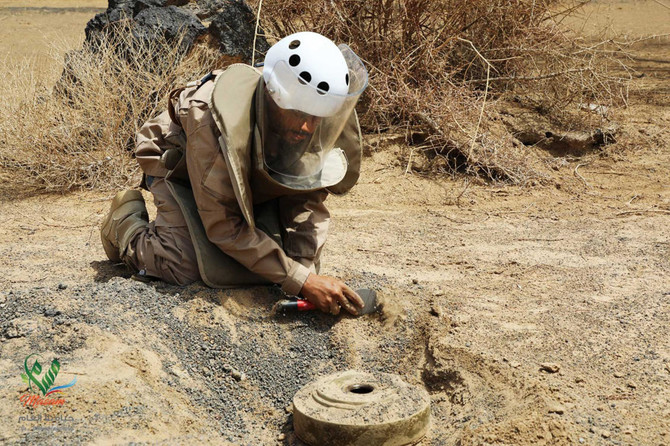
Houthis Carpeting the Ground in Yemen With Land Mines
"The scale of the problem is exceptionally large, and the impact is horrendous." "Most of the casualties we see reported are civilians." Loren Persi Vicentic, Landmine Monitor
"This is a war, so what do you expect us to do?" "Receive the other side with flowers?" General Yahia al--Sarie, Houthi officer
"The problem is the enemy's inhumane weapons, the land mines and improvised explosives." Saudi Brigadier General Mohsen al-Khabi
Land mines scattered by Houthis will remain a threat even if the latest negotiations succeed in halting the civil war. (AP)
"Mines today exist in every single area of Yemen." "It’s not being used as a defensive [or] offensive mechanism. It’s being used to terrorize the local
population across Yemen." Ousama Al-Gosaibi, program manager, Saudi-funded Masam demining project
The Geneva Conventions ban hidden mines and anti-personnel mines for use during war situations. Houthi officials claim they make use only of anti-tank mines and only on battlefields, not mines that are triggered by human footsteps, much less place any of them in civilian areas.
Independent observers and investigative reporters however, examined defused land mines to get a better understanding of what exactly has been occurring, with Saudi Arabia calling attention to Houthi mines. A war crime, to be sure. On the other hand, both the Kingdom of Saudi Arabia and the United Arab Emirates, battling the insurgent Houthis backed by Iran, have themselves committed war crimes through airstrikes killing civilians.
Their imposition of a partial blockade has placed the impoverished Arab country in a famine situation, desperately needing food relief and earning them the censure of the UN for what that's worth. It is, however, undeniable that all of the land mines and other explosive devices buried in Yemen were placed by Houthis, according to independent monitors. And mining represents a typical tactic used by a military force defending territory or retreating from it.
Nor is it exclusively military forces that make use of these IEDs and other explosives; infamously the U.S.-and-NATO-led mission against the Taliban in Afghanistan came up against the planting of IEDs, horribly destructive, killing and wounding civilians, farmers, children, foreign aid personnel, diplomatic and military staff. Islamic State fighters, the last of which are now being routed out of Syria by the Kurdish-led militias have been feverishly planting IEDs whose only purpose is indiscriminate death.
Saudi and Yemeni commanders speak of the presence of hundreds of thousands of unmarked land mines planted by the Houthis and valued by them as their most formidable defense against the better-armed and trained military forces. The conflict has been in near-standstill, irrespective of the Saudis' superior air power and allied resources of the Saudi-led coalition, because of the hidden explosives.
Untrained soldiers have been dispatched by the Saudi forces to clear minefields. "I removed two and the third one exploded" Sultan Hamad, a 39-year-old Yemeni soldier explained of the loss of a leg as he cleared mines on the front line near Marib in central Yemen. Over a half-dozen soldiers awaited fittings for prosthetic limbs at a Marib clinic.
Thousands of civilians have been wounded by the mines, along with an estimated 920 civilians killed, rights groups and other monitors stating the minefields will ensure that Yemen remains riddled with buried explosives to kill and maim unsuspecting civilians for decades until such time as the devices can be removed as occurred in Afghanistan, Colombia and Cambodia.
The Saudis hired a Western mine-removal company which has estimated that over a million mines were laid by the Houthis, a number that represents more than one mine for every 30 Yemenis; a concentration as high as compared to any other country post World War II in deadly conflicts. There are so many land mines placed along roads and among scattered settlements that the advance of Yemeni forces has remained in the same position for years.
Controlling much of northern Yemen, including Sanaa, Houthi authorities, in spite of the civilian casualties continue to claim they are not responsible for the thousands of injuries and deaths. In the last four years several Houthi missile parts have been recovered by the Saudis identified as coming from Iran. The Houthis themselves have established factories in production of thousands of their own land mines, each stamped with Arabic serial numbers.
Saudi-backed Yemeni soldiers showed off Houthi land mines, some disguised as small boulders with hidden infrared motion detectors. Close by in the district of Hairan in the desert of northern Yemen lay a heaped hill of over 4,000 mines recovered in the past several months. Houthis, according to Deif Ahmed Abdullah Saleh, a Yemeni army officer, were "carpeting the ground" with them.
During the Iraq-Iran war, the Ayatollahs convinced young Iranian teens to walk through fields planted with mines, carrying with them 'keys' to enter Paradise, so they could sweep through the area as human sacrifices, the youths 'martyred' as their presence set off the explosives to enable the Iranian armed forces to later proceed unharmed.
A member of Yemeni government forces holds mines during fighting against
Houthi rebels in the western port city of Hodeidah, Yemen, 19 June
2018. EPA
Celebrating A Generation Milestone of Islamic Republic of Iran Confronting the Corrupt and Unworthy World Order
"The
depiction of him [Iranian Supreme Leader Ayatollah Khomeini] as
fanatical, reactionary and the bearer of crude prejudices seems
certainly and happily false." "Having
created a new model of popular revolution based, for the most part, on
non-violent tactics, Iran may yet provide us with a desperately needed
model of humane governance for a third-world country." Richard Falk, professor of international law, Princeton University, The New York Times, 1979
Speaking at
a Washington, D.C. press conference, former UN Palestine Rapporteur
Richard Falk lashed out at UN Watch for “damaging my reputation,”
“stirring up trouble” for Falk and his colleagues, and “weakening”
UN efforts to “document Israeli violations of international law.”
Infallible judgement from emeritus professor of international law at one
of America's most prestigious elite universities. At a time when the
Islamic Revolution in Iran emboldened university students in Tehran to
lay siege to the U.S. Embassy and to hold American diplomats and
citizens hostage for 444 days in a stand-off that then-U.S. President
Jimmy Carter -- a conciliator of Middle East Arab and Muslim complaints
over the presence of the State of Israel, supportive of the violence
expressed by Palestinian terrorists whom he equated as struggling
against Israeli 'apartheid' -- was powerless to conclude.
The Islamic Revolution made its debut performance on the world stage, in
effect, by holding the most powerful nation in the world hostage to its
ire over 'U.S. interference' in Islamic affairs of state.
Notwithstanding that most Islamic countries depended on the United
States to shield them from the consequences of their own ill-judged
actions, much less the traditional hostilities they exerted in
confronting one another through the paranoid lens of tribal and
sectarian enmities.
Iranian students crowd the U.S. Embassy in Tehran (November 4 1979)
Richard Falk, infamously, was appointed United Nations Human Rights
Rapporteur in the Occupied Territories where he distinguished himself by
conspicuously demonstrating an outright hatred and contempt for the
State of Israel, damning it at every turn for the 'suppression' of
Palestinian rights and the 'occupation' over Palestinian territory: "The
best prospect for realizing Palestinian self-determination now is by
way of pressures exerted through grassroots mobilization". "We must strengthen the global solidarity movement, which includes
the boycott, divestment, and sanctions (BDS) initiative in relation to
businesses that profit from the settlements, as well as other forms of
non-violent resistance." "Third party Member States of the United Nations also have an
important responsibility to ensure they are not complicit in human
rights violations in Occupied Palestine."
Under his tenure the UN HRC issued countless sanctions against Israel
for assumed human rights abuses, charging it with violations of basic
human rights targeting Palestinians. No neutrality of judgement or
balance in viewing the commission of violence against Israel, much less
condemnation of Palestinian recruitment of future martyrs by a PA
curriculum for school-age children groomed to hate Israel and Jews and
inculcate in them a wish for martyrdom, much less the salaries paid to
those committing atrocities against Israeli citizens and honours
bestowed upon them.
So how did his prediction and smug confidence in the capabilities and
direction and future of the Islamic Republic of Iran turn out? Given
this man's orientation, very nicely. That the Ayatollahs preferred to
slap down the hand of accommodation proffered by another American
president, Barack Obama, was only Iran informing the U.S. it was aware
of its secret agenda to elevate Israeli interests over those of the
rightful inheritors of Jerusalem, the ancient city sacred to Islam, not
Judaism. They certainly read Obama wrong.
From the Republic's spectacular introduction of itself to the world at
large to the succeeding years when Britain authorized a security detail
to protect Salman Rushdie from the fatwa issued for his life, forfeit
for insulting the Prophet Mohammad, to the 1980s when Iran's Lebanese
Hezbollah militia was authorized to launch attacks internationally
against Jewish targets and the mass slaughter of thousands of political
prisoners in Iran, the Ayatollahs made their mark on Persian annals of
its civilized heritage.
Assassinations and bombings of international targets though
clandestinely pursued, were linked by intelligence agencies to their
source; gifts from Tehran to Buenos Aires and Berlin, for starters. A
different kind of student protest in 1999 was brutally suppressed,
followed by the green revolutionaries hoping to thwart the Republic's
plans to rule and ruin the nation indefinitely. And then came the covert
activities to acquire suspect nuclear facilities.
And who wants to recall Mahmoud Ahmadinejad's declaration in the United
Nations that the shining light of the Hidden Mahdi enveloped him as he
addressed the General Assembly? Or that even there in that hallowed hall
of world peace, unification and equality, he promised that Iran would
destroy the presence of the State of Israel, to barely a murmur of
dissent, more than equalling the earlier dated presence of Yasser
Arafat, dove in one hand, pistol in the other.
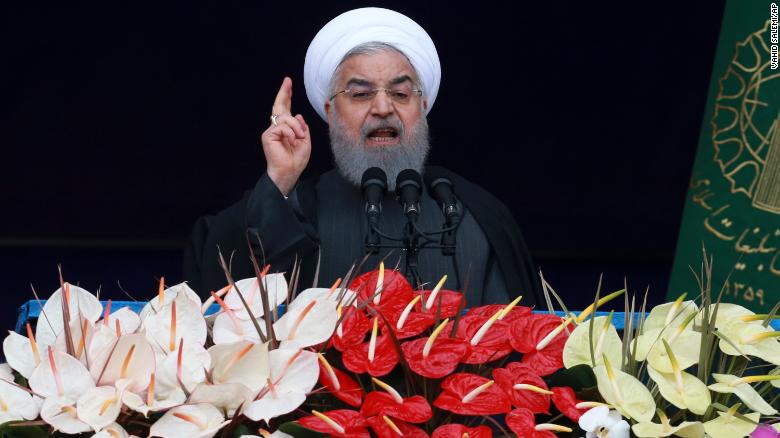
Iranian President Hassan Rouhani speaks during a ceremony celebrating
the 40th anniversary of the Islamic Revolution in Azadi Square, Tehran,
on February 11, 2019.
Yet eventually, the world saw and acclaimed the election of a 'moderate'
President of Iran when Mahmoud Ahmadinejad who in an earlier
manifestation as an elite follower of Ayatollah Khomeini successfully
practised the art of deceit and boasted of it afterward, presenting
Iran's aspirations as being wholly immersed in peaceful pursuits despite
all indications to the contrary, then led his country to another
victory with the implementation of the nuclear agreement, allowing the
country to get on with its intercontinental ballistic missiles program,
its nuclear program less prominently.
That Iran dedicated its Revolutionary Presidential Guard al-Quds
division to aid and support to the Alawite Shia Syrian regime enabling
the destruction of a half-million Syrian lives and the displacement of
millions of its Sunni citizens suited Shiite Iran very well indeed,
dispatching Hezbollah to the conflict zones and later Shiite militias
looking for blood to spill. And then came the Yemeni Shiite-brand
Houthis to destabilize Yemen and bring it firmly alongside Syria,
Lebanon and oddly enough Qatar, into the Iranian orbit.
Most certainly, the Islamic Revolution has earned its notorious place as
a threat to security in the Middle East, having aligned itself with
Russia and Turkey, all pleased to be seen as a triumvirate of solid
resistance against the West and its rapacious interests in despoiling
the Middle East of its inestimable resources which they would be far
more adept at doing in a far more collegial spirit of co-operation. For
the time being.
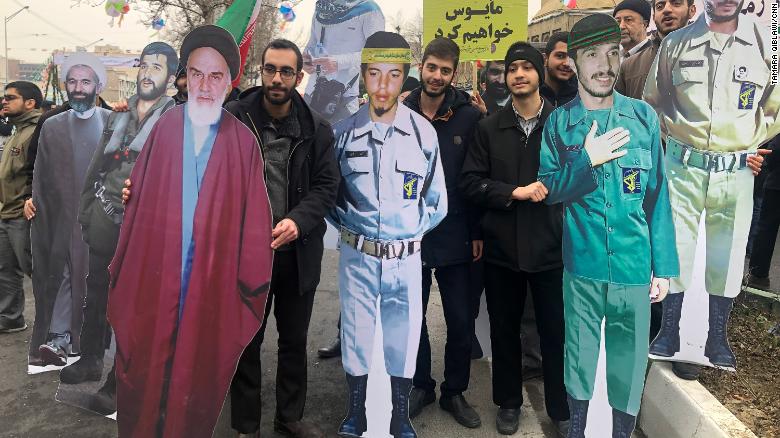
'Death to
America' protesters carry life-sized cardboard images of iconic
revolutionary figures, including Supreme Leader Rouhallah Khomeini.
"Families know that the only way their lives will change is if their sons join the war and bring them back money." Hager Shomo Ahmed, 16, Sudan
"The Saudis told us what to do through the telephones and devices." "They never fought with us." "Without us, the Houthis would take all of Saudi Arabia, including Mecca." Mohamed Suleiman al-Fadil, 28, Bani Hussein tribe
"The allegations that there are children among the ranks of the Sudanese forces are fictitious and unfounded." Turki al-Malki, spokesman, Saudi military coalition
Abdel-Hamid, a 14-year-old former child soldier, at a camp for displaced persons where he took shelter, in Marib, Yemen
AP/ Nariman El-Mofty
During Darfur's collapse when the government in Khartoum employed its forces including helicopter gunships and Janjaweed Arab horsemen to slaughter black Darfurian farming communities, raping women and girls, killing hundreds of thousands of people, displacing millions and creating a desperate refugee situation in 2004, the world began to take notice. That's about all the world did. Out of a total Darfurian population of 6.2 million, fully 4.7 were displaced, losing everything, their farms, their livestock, while between 200,000 to 300,000 lost their lives.
Hager Shomo Ahmed's family lived in despair after raiders stole his family's cattle leaving them destitute after a 12-year civil war. An unequal war; the Darfurians had little defence capabilities while the Khartoum government had its panoply of advanced war machines while the Janjaweed mopped up what the Sudanese military left behind. So the indigent Hager family welcomed a 2016 offer to pay up to $10,000 to have their-then 14-year-old son become a mercenary in their war with Yemeni Houthis.
The war in Yemen, according to the United Nations, represents the world's worst humanitarian crisis where an intermittent blockade by the Saudis and their coalition partners has placed 12 million Yemenites in starvation, where an estimated 85,000 children have died. The Saudis on the other hand, claim to be rescuing Yemen from a hostile group of Shiite Islamist reactionaries linked to and backed by the Islamic Republic of Iran.
Sadek, another 14 year-old former child soldier at a camp in Marib
AP/ Nariman El-Mofty
The Saudi and Gulf oil wealth enables the coalition to buy the use of mercenaries, tens of thousands of survivors of the Darfur conflict, and many of those taking up the offer are children. For close to four years, up to 14,000 Sudanese militiamen have joined the fight in Yemen alongside the local militia supported by the Saudis. Hundreds of them will never return home, casualties in a war far from their homes.
Virtually all the Sudanese mercenaries in the Yemen war represent the impoverished, battle-scarred region of Darfur, most becoming part of the paramilitary Rapid Support Forces, the tribal militia known as the Janjaweed, the very same Arab militias that preyed on black Darfurians at the behest of Khartoum. They were responsible for the systematic rape of women and girls, the indiscriminate slaughter and allied war crimes during the Darfur conflict.
The veterans among them now lead the deployment of the Sudanese mercenaries in Yemen. Many among the fighters are between the ages of 14 to 17; their parents bribed militia officers to take their sons to fight, desperate for the pay promised by Saudi Arabia. Children are estimated to represent at the very least, 20 percent of the Sudanese fighting units, a number in dispute since some returning fighters claim that children represent 40 percent of the units.
Nawaf, a 15-year-old former child soldier, in Marib
AP/ Nariman El-Mofty
Saudi and Emiratis officers involved in the command of the Sudanese fighters keep in contact by remote control, themselves remaining far from the battlefield, where they direct the units to attack or retreat remotely through radio headsets and GPS systems maintained by the Sudanese officers. "The Saudis would give us a phone call and then pull back", said Ahmed, 25, a member of the Awlad Zeid tribe. "They treat the Sudanese like their firewood."
According to now-16-year-old Hager, returned to Darfur in late 2017 from Yemen, his unit had lost 180 men in a period of six months of fighting. His Sudanese officers had allowed him to call his parents occasionally because he had been terrified constantly by his enforced military duty and the potential consequences. Now, both he and his parents are content; with his $10,000 pay he bought a house for his parents and ten cattle.
"The
intelligence pointing to a plan to detain Khashoggi in Saudi Arabia has
fuelled speculation by officials and analysts in multiple countries
that what transpired at the [Istanbul Saudi] consulate was a backup plan
to capture Khashoggi that may have gone wrong." Shane Harris, national security reporter, The Washington Post
"The
voice recording from inside the embassy lays out what happened to Jamal
after he entered. You can hear his voice and the voices of men speaking
Arabic." "You can hear how he was interrogated, tortured and then murdered." Anonymous authority
"I've
never been more disturbed than I am right now. If this man was murdered
in the Saudi consulate in Istanbul, that would cross every line of
normality in the international community." "There will be hell to pay [if the allegations of Saudi assassination were confirmed]." Republican Senator Lindsey Graham
"It symbolizes the departure of the United States as a restraining force against evil actors in the world." "Saudi
Arabia is a small nation that cannot defend itself without the support
of the United States, and therefore no Saudi leader would have made such
a brazen move without confidence that Washington, once the leader of
the liberal world order, would do nothing." Robert Kagan, The Washington Post
"I
think that [denying the $100-billion Saudi arms sale] would be hurting
us. We have jobs. We have a lot of things happening in this country." "...Part
of that is what we are doing with our defence systems and everybody is
wanting them and frankly, I think that would be a very, very tough pill
to swallow for our country." U.S. President Donald Trump
"Trump's
stance toward despots and authoritarians has generally been not to
judge their conduct and suggest it's a mere distraction from his
dealmaking." "And
that's also the case with Saudi Arabia, which Trump and his White House
have treated warmly as a partner against Iran and on trade." Aaron Blake, senior political reporter, The Washington Post
This
image, taken from closed-circuit TV video obtained by the Turkish
newspaper Hurriyet, claims to show Khashoggi entering the Saudi
consulate in Istanbul on Oct. 2. (Hurriyet via AP)
There is nothing, nothing at all new about most countries willing to
trade in weapons development, exporting highly technical arms to other
countries that have the treasury to pay for these expensive and
desirable pieces of war machinery, putting a blind eye to the
recipients' record on human rights and their casual commission of covert
atrocities. The Saudis were nothing if not clumsy in their execution of
a plan to silence a Saudi journalist living in self-exiled protection
in the U.S., as a sometime-contributor to The Washington Post.
As far as their intelligence itself goes, it seems strange that they
would view it as a cautionary reality that instructions to remove an
embarrassing irritation to the Saudis who happens also to have his
revelations published in a powerful investigative news source, that even
if they relied upon Donald Trump to express little interest, The Washington Post
would make up for that with righteous rage that 'one of their own' was
horrendously assassinated. Clumsiness is not monopolized by the
arrogance of the Kingdom of Saudi Arabia, for vindictive strikes at
'traitors' Russia has few peers.
It is an odd phenomenon that leaders of world powers focus on events
such as a single assassination as a national retributive step in ridding
irritants while the same country can be responsible for creating a huge
humanitarian crisis of refugees streaming out of Yemen not wishing to
be added to the mounting death toll from Saudi bombers targeting
civilian areas in their purported intention to hit the Houthi rebels
that the Iranian Shiite regime supports. Both Iran and Saudi Arabia have
a background of terrorist activities mounted by the followers of their
competing Islamic sects.
Crown
Prince Mohammed bin Salman and President Recep Tayyip Erdogan have
until now kept relations cordial in the interest of stability. CreditKayhan Ozer/Anadolu Agency, via Getty Images
As a symbol at the very least of support for human rights negated by the
ongoing sale of advanced warplanes to Saudi Arabia, the United States
makes itself complicit at a remove in the deaths of thousands of
civilian Yemenites. Just as it was remotely but acutely involved in the
development of al-Qaeda resulting from their Salafist Wahhabist Sunni
madrasses of which Osama bin Laden was a graduate and proponent, wholly
responsible for the devastating carnage of 9/11. But trade is trade, and
the sale of a hundred billion-worth of fighter jets is a good deal,
even if NAFTA wasn't.
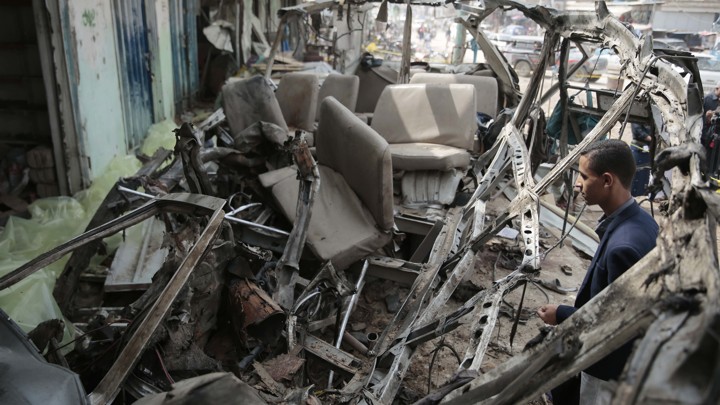
A man inspects the wreckage of a Saudi air strike on a crowded bus in Yemen.Hani Mohammed / AP
But of course, it isn't just the U.S. administration's venal trade with
Saudi Arabia; France, Germany, Britain and other human-rights-supporting
nations in the West would do just about anything to be able to invest
in and trade with the Islamic Republic of Iran, more than happy to
overlook its role in the incendiary slaughter of Syrian Sunnis by
Alawite Shiite Bashar al Assad's regime happily using internationally
proscribed chemical weapons and barrel bombs to destroy the rebels in a
civil war that Assad mounted on protesters he labels terrorists.
And then, there is of course, Canada, whose prime minister prides
himself on representing a country whose values and respect for human
rights (read: women's rights, transsexual rights in particular)
is a beacon of light in a troubled world. Where his administration
intended to restore relations with Iran, cut off by the previous
Canadian administration in recognition of Iran's far reach in spreading
jihad Shiite-style globally. Canada proudly demonstrated its credentials
in demanding Saudi Arabia free imprisoned human-rights supporters from
prison, earning the wrath of Crown Prince Mohammed bin Salman.
"Canada
is gravely concerned about additional arrests of civil society and
women's rights activists in Saudi Arabia, including Samar Badawi. We
urge the Saudi authorities to immediately release them and all other
peaceful human rights activists", reasonably enough
wrote Canada's Saudi-dismissed Ambassador to Saudi Arabia, Dennis Horak.
Yet Canada, the champion of human rights notwithstanding refused to
cancel its multi-billion sale of military 'heavy assault' vehicles to
the Saudi regime. Their use in Yemen is no doubt yet another factor in
the destruction carried out as a proxy war between the Sunni Kingdom and
the Islamic Republic.
We trust that governments act in the best interests of their populations
in a free and democratic society and uphold the values and traditions
and customs that most people in such countries hold dear. Yet it is from
among leading corporations that repercussions are being visited on
Saudi Arabia for its demonstration of invulnerability to accountability.
Prince Mohammed bin Salmon's Future Investment Initiative to begin in
Riyadh in two weeks' time is being shunned by high-tech leaders from
Richard Branson to Bob Bakish of Viacom, Dara Khosrowshahi of Uber
Technologies, Steve Case venture capitalist, Patrick Soon-Shiong owner
of the L.A. Times and Joanna Popper HP executive; along with Android
creator Andy Rubin.
In
this promotional image, taken by the Canadian Forces and hosted on the
General Dynamics website, General Dynamics Land Systems Canada Lav 6
vehicles like the ones being sold to Saudi Arabia are shown carrying
troops. (Combat Camera/General Dynamics)
"In Yemen, bomb, bomb, bomb every time. No water, no electricity, no job, no school, nothing. How can I give a good life for my son? "Word spread about Jeju, and I heard I may have a chance." Muaadh Galal Mohammed al-Razeqee, Jeju, South Korea
"They can take many wives and produce many children." "Now, there are five hundred of them. In ten and twenty years, how many of them will there be?" Yang Eun-ok, 70, leadr, Jeju protest
"There was no safe place in Yemen for me to hide." "I heard South Korea was open for Yemenis." Hani al-Junaid, 37, journalist, Jeju, South Korea
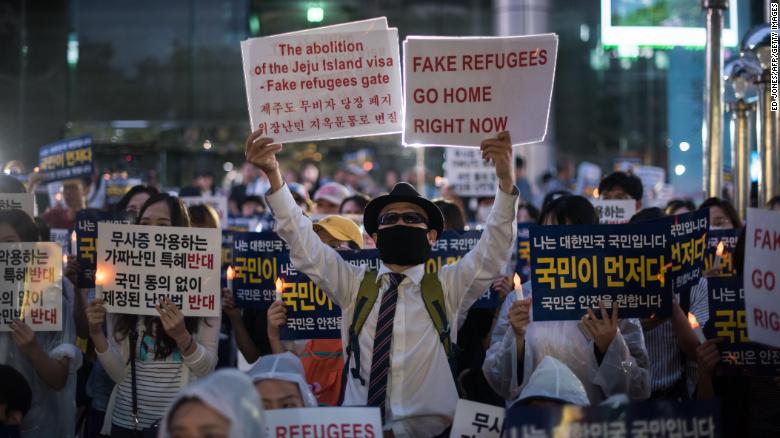
Anti-immigration activists attend a protest against a group of asylum-seekers from Yemen, in Seoul on June 30, 2018.
AirAsia in December began flying direct budget flights from Kuala Lumpur, Malaysia to Jeju in South Korea. Yemenites fleeing the deadly sectarian-fuelled civil war that has become a proxy war between the Shiite Islamic Republic of Iran and the Sunni Kingdom of Saudi Arabia, who were allowed temporary visas to travel to Malaysia -- yet another Muslim-majority country -- saw those direct flights representing a way into mainland South Korea for asylum seekers on the subtropical island.
In the last several months the island that has a reputation as a honeymoon resort island has been visited by asylum seekers for whom their homeland has become an utter catastrophe; death by Houthi Shiites, or Saudi bombs, desperation of malnutrition and disease, nothing left for them in their homeland -- a place of conflict that the United Nations titles "the world's largest humanitarian crisis".
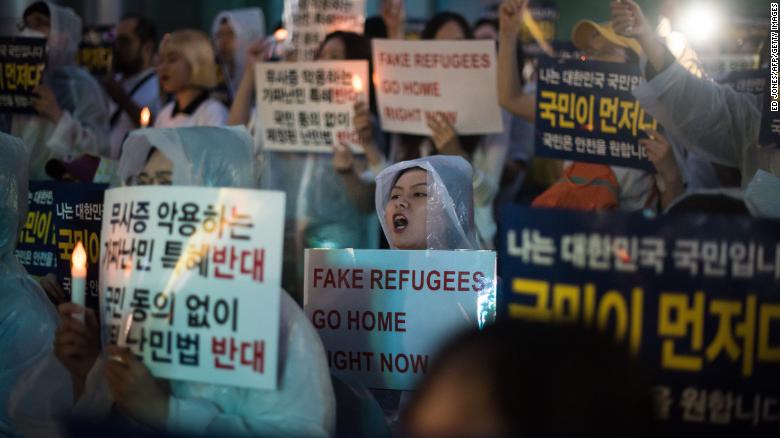
Jeju, off South Korea's southern coast, is where Yemeni refugees wait for the South Korean government to respond to their refugee applications. Their presence on the island, however, has led to an organized anti-asylum movement of "Let's kick out fake refugees!" A summer anti-refugee protest rally on Jeju reflected one held in Seoul. President Moon Jae-in received an online petition with 714,000 signatures, demanding a stop to taking in asylum seekers.
In the tumult of the violence of the civil war in Yemen, thousands of its citizens fled to Malaysia. One Muslim nation surrendering its population to another, for haven from destruction and death. But Malaysia will only permit the refugees a maximum relief of 90 days, refusing to even consider granting them refugee status. So they flee to Jeju and in so doing the former domestic vacation spot is no longer popular with South Koreans.
South Korea in 2002 granted permission to the island to introduce a no-visa policy for most foreign visitors; the perfect solution to fleeing Yemenis' search for haven, the refugees imagined. More recently, however, South Korea placed Yemen on its list of 11 other countries requiring visas to enter Jeju. The South Korean government barred 487 Yemeni asylum seekers still on Jeju from leaving for the mainland.
They must await the results of their applications for refugee status review while on Jeju. There are a relatively paltry several hundred Yemenis on the island, a minuscule percentage of the Island population of 660,000, yet their presence generates concern, sliding into fear. "If these people are safe, why doesn't the government let them move on to the mainland as they wanted to?" questioned Kim Jin-yi 32, an attendee of the Jeju protest.
Like Japan, South Korea prides itself on its homogeneous society, has been traditionally averse to receiving asylum seekers. Its location has helped in not presenting it as a major destination for refugees other than from its neighbour, North Korea and for whom the South has no qualms about accepting as compatriots.
In 2013, under pressure from rights groups, South Korea adopted a new law providing protection for refugees, seeing since then the number of asylum applications rise from 2,896 in 2014 to 9,942 last year. There are warnings internally circulating on the Internet of an invasion of Arab terrorists or rapists. The dysfunctional world of Islam creates the world's greatest number of refugees desperately fleeing oppression, violence and death.
Those Islamic countries not in conflict refuse to give haven to their co-religionists.
Anti-immigration activists attend a protest against a group of Yemen asylum seekers, Seoul, June 30, 2018.
The Immoral Quagmire of the Bloodsoaked Middle East
"It is high time for these relapsing tragedies to stop in Yemen." "No one should allow putting children in harm's way and making them pay such an unacceptable price." Robert Mardini, regional director, International Committee of the Red Cross
"U.S. military support to our partners mitigates non-combatant casualties." "Our support to the coalition consists of aerial refuelling and intelligence support to assist our partners in securing their borders from cross-border attacks from the Houthis." "Our non-combat support focuses on improving coalition processes and procedures, especially regarding compliance with the law of armed conflict and best practices for reducing the risk of civilian casualties." Rebecca Rebarich, spokeswoman, U.S. Pentagon
Whether it's a Russian spokeswoman speaking for Russia's aerial involvement in the searing conflict in Syria where President Bashar al-Assad has been responsible for almost a half million deaths, mostly of Sunni Syrians, and six million displaced Syrians, several million made refugees outside the country of their birth, or a spokeswoman for the Pentagon explaining how and why it is unblameworthy that the United States supports the Saudi-led coalition bombing civilians in poverty-stricken Yemen in its civil war, we could be looking at the interchangeability of accomplices to war crimes.
Granted, Houthi rebels lobbing rockets over the border from Yemen into Saudi Arabia calls for some response from the Saudi coalition, but one might be mistaken to believe that the Saudis' response aims for the military bastions that target it. Instead, the civilian casualty rate is soaring, and it might be difficult for anyone to believe that the bombing of hospitals in Houthi-held territory is accidental; again a situation reflected in Syria where Russian and Syrian bombers deliberately target hospitals so the injured in their bomb blasts would die instead of being treated for their wounds.
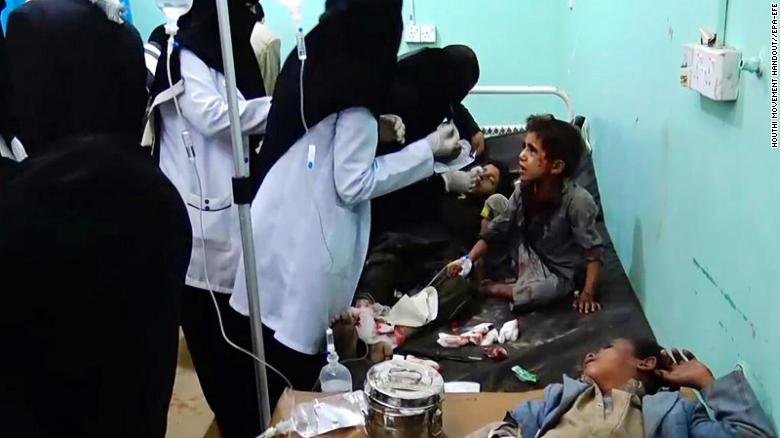
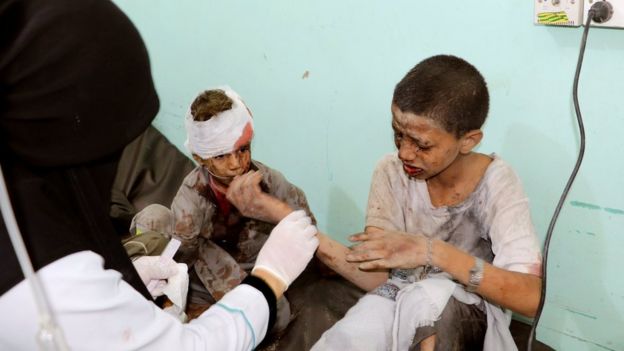
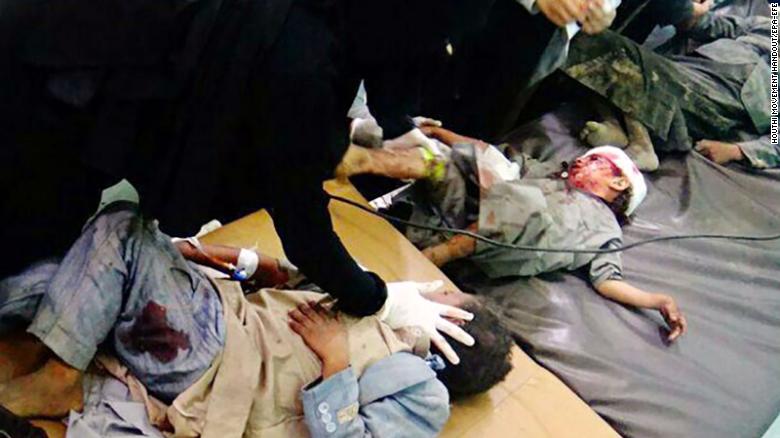
Whether it's a hospital or a bus full of children and adults returning from a day's picnic outing being targeted with a substantial loss of life, the situation is brutal, criminal and unforgivable. Yemen, embroiled in a conflict that most ordinary people have nothing to do with, as is typical in all such conflicts when sectarian forces challenge one another for primacy, is in a situation where tens of millions of people face starvation, where cholera rages, where death drops from the sky, unannounced and unselective.
Reuters The ICRC said it was sending extra supplies to help hospitals deal with the influx
And nor is it only the United States that is involved in supporting the Saudi-led coalition bombing Yemen back into the stone age. "This atrocity cannot be ignored. The U.K. government has been utterly complicit in the destruction. It has armed and supported the Saudi-led coalition right from the start. The death toll has spiralled and the humanitarian crisis has only got worse, and yet the arms sales have continued", stated Andrew Smith of the Campaign Against Arms Trade of the licensing by the U.K. of $6-billion worth of arms sales to Saudi Arabia.
The latest mass killing was the targeting of a bus in Dahyan district, northern Yemen, a stronghold of the Houthis, the bus heading back from a picnic and hit as it travelled through a busy market, stopped in its tracks by an airstrike. At least 50 people were killed outright, and 77 wounded. "Scores killed, even more injured, most under the age of ten", reported Johannes Bruwer, head of delegation for the International Committee of the Red Cross in Yemen.
The coalition's response was that the strike represented a "legitimate military action", a reaction to a missile fired at the south of Saudi Arabia which wounded eleven Saudis and killed one. An ICRC-supported hospital in Saada, held by the Shiite rebels, received 28 dead children all under 15 years of age, and 48 wounded, among them 30 children. "No excuses anymore. Does the world really need more innocent children's lives to stop the cruel war on children in Yemen?" protested Geert Cappeiaere, regional director in the Middle East and North Africa for UNICEF.
"The average person [in war torn Yemen] lives on tea and bread. It's just one meal a day." "They are in a weakened state, and that is why they are getting sick [in the cholera epidemic outbreak]." Jamie McGoldrick, UN humanitarian coordinator, Yemen
"People will continue to get sick, and they will always be treated like cattle here." "The international community should just make people stop fighting and help our hospitals." Aziz Ramadan, Yemeni Coast Guard officer
It's a telling phenomenon, that in the Middle East the enmities of ages past relating to tribal, clan, ethnic, sectarian and political violence is never far from the surface. From time to time unappeasable rage from one group to another bubbles up and hatred grows, nourishing bloodlust and conflict. In this century the Middle East has become accustomed to looking to the 'international community', and more singularly, the United States, to intervene and miraculously produce if not peace, then a temporary hiatus between peace and war.
Without such intervention they feel persecuted and deadlocked in arriving at any workable solution of their own invention whereby they might all live in peace with one another. Their passions, so close to the surface appear resistant to reason. That basic human rights should be the inheritance of all people anywhere and everywhere appears to elude their consciousness. And so, they inflict misery and carnage upon one another through their abrasive denunciations, threats and violence.
The one country that, under its current heightened fundamental Islamism appearing to initiate much of the hostile reaction that permeates the region is the Islamic Republic of Iran, with its glowering ayatollahs inflicting misery not merely in the region but far afield. Shiite Persia considers itself superior and closer to the Almighty than its Arab neighbours, most of whom practise Sunni Islam, representative of the majority of Muslims anywhere in the world.
Envisioning itself the ultimate authority on Islam and nourishing its ambitions to replace the command of Saudi Arabia as the custodian of the two most sacred sites in Islam, Mecca and Medina, Iran has been engineering a Shiite triangle as a power source with itself at the helm, to gain the legitimacy of authority and power that it craves and feels is rightfully its own. It has succeeded in alienating the Arab world against its machinations, and it has given the wider international community ample reason to suspect its ambitions go wider afield than the Middle East.
It is undeniably involved in creating and supporting terrorist groups to do its bidding both in the region and internationally. Iran's authority in Iraq, Syria, Lebanon (where its proxy jihadist militia Hezbollah holds sway) and Yemen, and the support it receives from Qatar, has it poised, alongside its growing thrust in ballistic missile and nuclear warhead enterprise, to present as the ultimate power in the Middle East. Its links to North Korea's nuclear and ballistic missile program gives the lie to its constantly-assuring critics it has only peaceful aspirations.
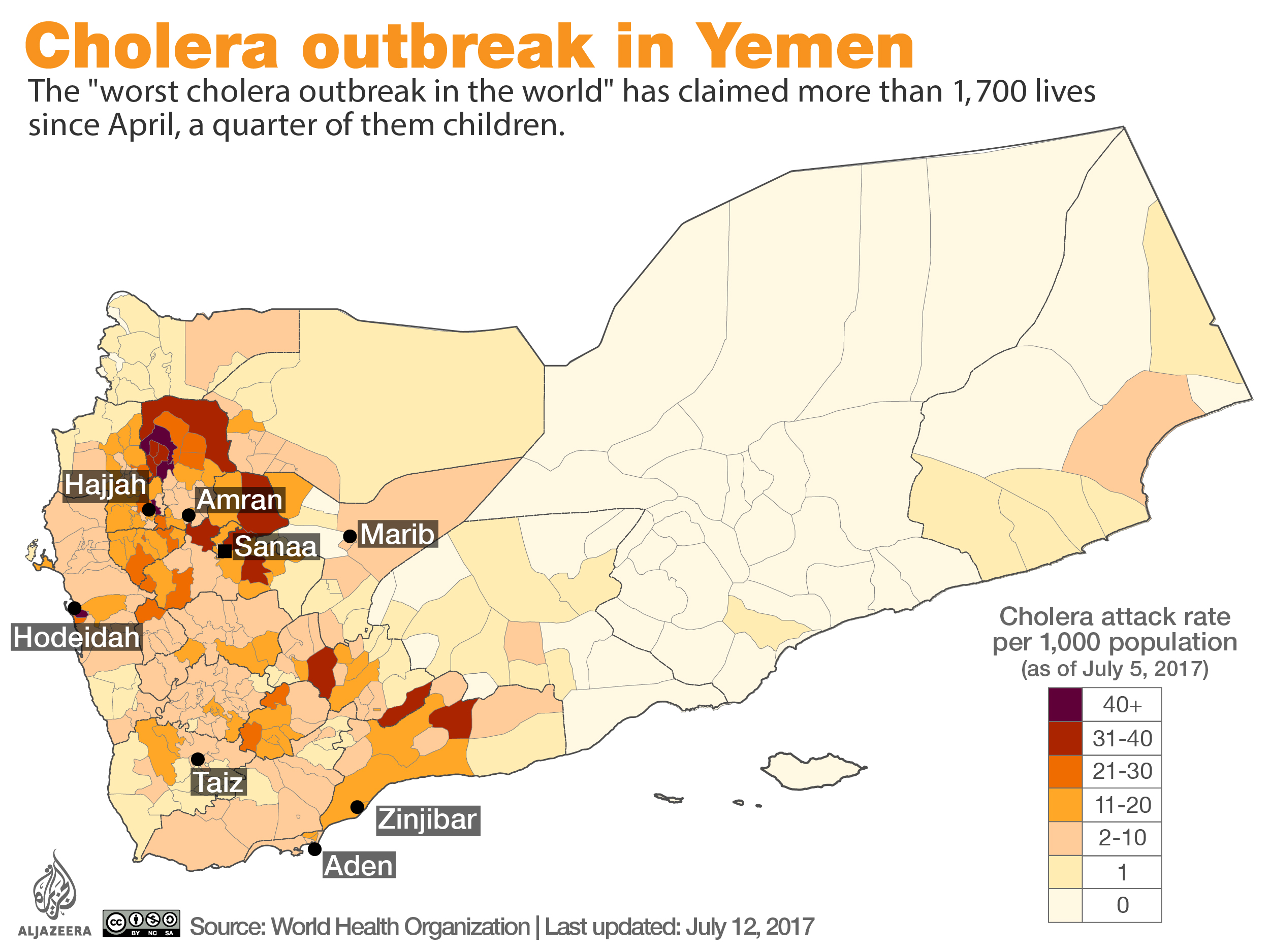
Iran's meddling in Yemen's politics, spurring the Shiite Houthi rebels to challenge the country's Sunni government has brought the impoverished nation into a state of vicious conflict. The country's damaged infrastructure and state of war has brought it to an even greater degree of destabilization. Half of its 27 million people have no access to clean water and two-thirds lack enough food. Their state bordering on mass malnutrition has made the population vulnerable to cholera, which has become epidemic.
At least 269,608 people in Yemen in 21 of its 22 provinces have been infected with cholera, with 1,624 dying of the bacterial infection caused by feces-contaminated water that modern sanitation and water systems have eradicated elsewhere in the world. Treatment is simple enough with rehydration solutions and sometimes antibiotics, but in Yemen where structures and systems are overburdened and supplies short and medical facilities destroyed by bombing mostly from Saudi Arabian-led forces, the situation is dire.
Clinics that remain struggle to cope. The state is so poor civil servants were no longer being paid and sanitation workers went on strike. Lack of garbage collection caused septic backups contaminating water wells, and when dirty rainwater polluted the wells even more, it was inevitable that cholera would ensue. The United Nations requires $2.1-billion for humanitarian relief in Yemen, easily supplied by a wealthy country like Qatar, but the UN remains reliant on the international community.
Iran, which began the conflict leading to this dire humanitarian crisis, has other fish to fry, destabilizing the world order alongside North Korea. The coalition of Sunni-majority Arab nations in the Middle East has embarked on a disagreement with Qatar for its support and friendship with Iran and in the process they are now divided, leaving Iran dismissive of their claims, content to see its enemies in a state of disarray.
This represents a general opinion site for its author. It also offers a space for the author to record her experiences and perceptions,both personal and public. This is rendered obvious by the content contained in the blog, but the space is here inviting me to write. And so I do.


![Yemen has reported one laboratory-confirmed COVID-19 case on April 10 [Khaled Abdullah/Reuters]](https://www.aljazeera.com/mritems/imagecache/mbdxxlarge/mritems/Images/2020/4/26/2aff47132d914fe6b0d37c72e4f07de1_18.jpg "UN warns of new humanitarian crisis as COVID-19 looms over Yemen")


/cdn.vox-cdn.com/uploads/chorus_image/image/66117840/1193609845.jpg.0.jpg)