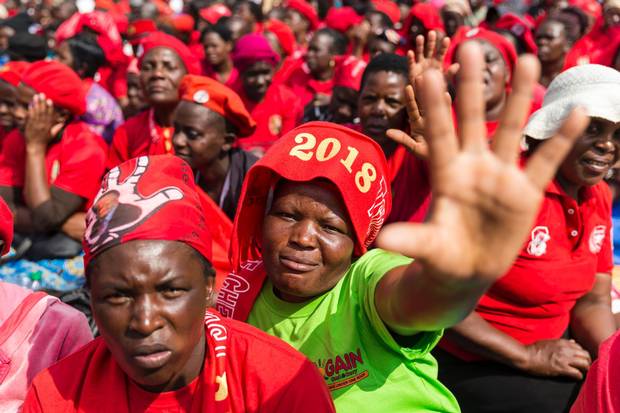
"The public hospital system has collapsed. Citizens are dying like flies. The power blackouts are now permanent. Hyperinflation has spiralled out of control." "But they sat and named roads after themselves." Tendai Biti, vice-president, opposition Movement for Democratic Change, Zimbabwe
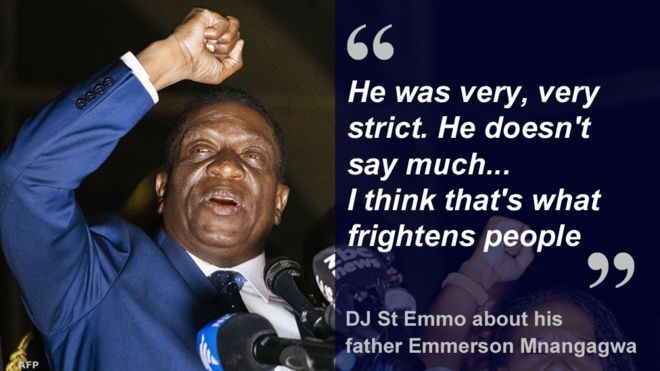
President Emmerson Mnangagwa rose to power in 2017 Getty Images
Zimbabwe, once the regional breadbasket that produced agricultural crops to feed its population and ample excess to sell to less productive countries, now imports a huge proportion of the food its population needs for survival. Under Robert Mugabe who ruled like a typical African tyrant belying the belief that he would lead his country forward in development when he was viewed as a saviour in the first years of his rule after independence, took the country down the path of total ruin.
The Rhodesian-era white settler-farmers who had farmed the land for generations, employing hundreds of thousands of farm labourers, feeding the nation, sending food crops abroad, loyal to the country, received a shock when their family farms were peremptorily expropriated by the state. They were forced from the farms, often violently, and some lost their lives in the process. The reason was to reclaim Zimbabwe's agricultural land and return it to its indigenous population.
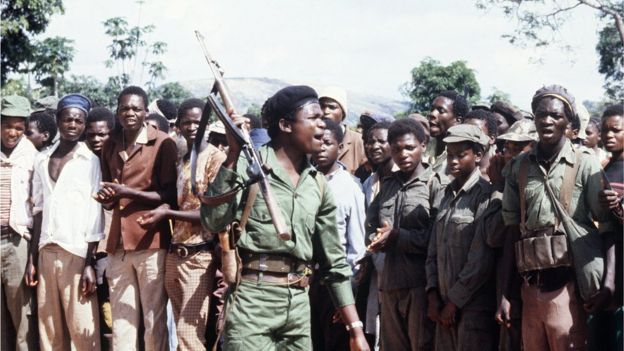
Those who fought for independence monopolize power. AFP
Black Zimbabwean farm workers lost their employment. The farms were given over to Mugabe's fellow 'freedom fighters' who had no idea how agrarian methods of raising crops would maintain a working farm. But they did relish the idea of land ownership. Even while the once-working farms lay fallow, no crops were grown because no one cared and no one knew how to proceed nor was interested in finding out how to restore the functionality of farms that once fed the nation.
patrick mpandawana
@patrick_mpa
Replying to
@larry_moyo
Breaking News: Prices Set To Fall And Exchange Rates Stabalise After Govt Announces New Street Names
2:12 AM · Nov 22, 2019, Twitter
Zimbabwe suffered sky-high inflation, unemployment soared, food and medicine became scarce, but President Mugabe saw nothing amiss and was disinterested in useful criticism while his people suffered. He is dead now; he almost ruled for life, but was eventually deposed and in his place is President Emmerson Mnangagwa whose administration has done very little to raise the hopes and expectations of Zimbabweans that their long-suffering travails are over.
He is too busy renaming streets whose names reflect the colonial era. In ten of the country's largest cities and towns, Harare included, thoroughfares are being renamed to reflect the name of the president, Emmerson Dambudzo Mnangagwa. Hughes Street, Etherton Road, and other British-type names are the past and are now consigned to the past. In their place will be Emmerson Dambudzo Mnangagwa Road, Emmerson Dambudzo Mnangagwa Street, and so on.
And nor are members of the Zanu-PF leading party to be ignored; streets are slated to be named after them as well, including that of Solomon Mujuru a party kingpin whose collection of confiscated farms when white farmers were purged, runs to 16. But Soviet leader Leonid Brezhnev will be memorialized by an Avenue and so will Fidel Castro and Chairman Mao. These are vitally important cultural, political and social steps forward for the country.
"All the other name changes are to cover up this wicked ambition", said Arthur Mutambara, veteran opposition figure, accusing the Zimbabwean president of striving to "immortalize himself." Like Robert Mugabe before him the current president is busy ensuring that he has the 'respect' of his fellow Zimbabweans, for whom he has done scant to ensure that their lives will see any kind of improvement any time soon.
He has other, more important things to take his time and notice and energy. As for example, the unveiling of a statue of himself in southern Zimbabwe, at Masvingo Airport. And no doubt many more in the planning stages.
"They [the estimated number of dead and humanitarian needs] are nowhere near the scale and magnitude of the problem. And I fear we will be seeing more in the weeks and months ahead, and we should brace ourselves." "The situation is simply horrendous, there is no other way to describe it. Three thousand people who are living in a school that has 15 classrooms and six, only six, toilets. You can imagine how much we are sitting on a water and sanitation ticking bomb." Elhadj As Sy, secretary-general, International Federation of Rd Cross and Red Crescent Societies "Yesterday [we] did a reconnaissance and we found another [inland] lake." "So we are still very early in the phase of identifying what the scope of this is, for who is affected and how many are lost." Emma Batey, coordinator, Oxfam, CARE, Save the Children consortium
"[What rescuers are seeing is] sometimes it's just a hut completely surrounded by water." "If islands are big enough, we can even see smoke coming out, meaning that they're cooking." "[It remains] super difficult [to estimate a death toll let alone the numbers missing]." Pedro Matos, emergency co-ordinator, World Food Program
"I've never seen anything like this. We were not warned. Suddenly the roof flew away." "[She and neighbours herded children away but] we lost some of them." "[They have received nothing from aid groups or the government] not even bread." Marta Ben, 30, mother of five
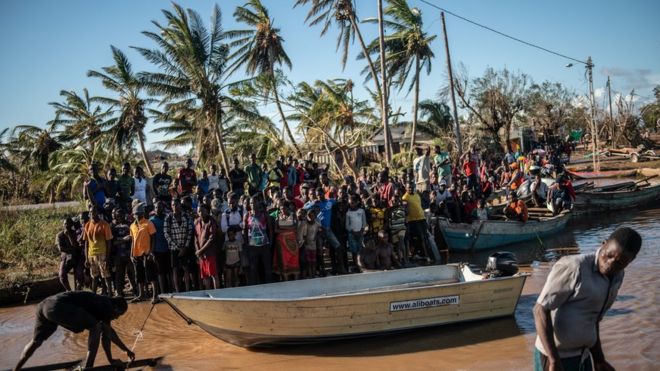
More than 65,000 people are already in shelters in central Mozambique [Enock Muchinjo/Al Jazeera]
Parts of Mozambique are finally seeing flood waters recede as the estimated number of deaths rises above a thousand, the number the country's president predicted earlier in the week. Thousands of dazed and fearful survivors are slowly making their pilgrimage toward Beira, the city where 90 percent of its infrastructure has been destroyed. Despite which, it has become a centre for rescue efforts for the entire region.
People have made their cautious way along roads heavily carved by the raging floods days ago, while others were rescued as part of a local effort by fisherman plucking stranded people from small islands, to bring them to safety. Despite the rain, helicopters take off to search for people clinging to rooftops and branches of trees. Water-borne diseases threaten as a result of water and sanitation systems being destroyed.
In the centres, children absent parents, separated in the chaos or newly orphaned wait to be tended to, confused and fearful. Women stake out places for themselves and their children on sidewalks with nowhere else to go, awaiting aid that hasn't yet reached them. They sit there, barefoot, nursing cooking pots, minding their children and begging those passing by for help.
In Zimbabwe, school children and their headmasters are missing. Miners operating illegally looking for gold and diamonds, have been swept into the raging rivers. In the worst-affected part of Zimbabwe, a woman who had left Chimanimani for the diamond fields to search for her son-in-law, who mined illegally, buried and mourned him.
"There are no jobs and all he wanted was to feed his family. He was with his colleagues. They thought it would be easier to mine since the rains would keep the guards and the police away from patrolling", said Maina Chisirlirwa of her son-in-law who was swept away while his colleagues survived. Even police, arresting illegal miners were swept away with their prisoners.
Thousands of people are still awaiting rescue from flooded areas across in southern Africa Getty Images
"He [police commander] said that mother and daughter Grace Mugabe wanted this place. So you better move away" "They left us out in the open [after destroying their homes]. We felt betrayed." "Even if they come back [the white European/Zimbabwean farmers] , that's fine as long as they give us another place." "We won't deny them. What we need is only some land where we can survive -- and title to the land." Denboy Chaparadza, Mazowe village leader, Zimbabwe
"Repossessing our land cannot be challenged or reversed." "[But I am] committed to compensating those farmers from whom land was taken." Zimbabwean President Emmerson Mnangagwa
Farmer Darryn Smart, centre, and his family are welcomed back to their
farm, Lesbury, by workers and community members Thursday in Tandi,
Zimbabwe.Smart’s return, facilitated by Mnangagwa’s government, could
mark a new turn in the politics of land ownership. (Farai Mutsaka / The Associated Press)
When he was Robert Mugabe's heavy enforcer, Emmerson Mnangagwa's violence in forcefully denying white farmers' titled ownership of large, productive farms that gave Zimbabwe its agricultural reputation with ample food to feed the population and more yet to send abroad whose sale brought great profit to the government, ensured the ruination of the nation's food supply. The confiscated land was then transferred to the ownership of Mugabe loyalists, recognized as those who fought for independence.
The Zimbabweans who had worked for generations for the white farmers, earning a living and proudly considering themselves well-remunerated and -respected farm workers were put out to pasture, while the new owners moved in, and while some made an effort to replace the work of the ousted farmers, others were content merely to be land owners, allowing the land to lie fallow, nothing but weeds thriving on the land abandoned to nature.
Mugabe's infamous land confiscation program led to a breakdown of the economy, high unemployment, soaring inflation and debt, a worthless currency, and hunger. The village leader and farm owner quoted above was describing the villagers of Hazowe's experience when hundreds of police exited their vehicles to issue an order that they vacate the village and their farms. Grace Mugabe wanted their land, for which they had no legal title. The Mugabes in fact, owned about 40 percent of all the confiscated farmland.
Refusing to leave, though their homes were destroyed, they experienced police harassment, threats and violence. The 146 families who were being violently coerced to leave Mazowe had themselves seized the land in 2000 from a white farmer under the land reform program. Still called Arnolds Farm, the 1,260 hectares of prime farmland and cattle ranching beside a lake had become home to those families. All of the country's richest most arable land was in the possession of a few thousand white settlers at a time when the country was called Rhodesia and white settlers ruled the country.
With Robert Mugabe finally persuaded to step down after 37 years as president, the latter decades completely ruinous to the fortunes of the country and its people, the government is attuned to the need to compensate the white farmers whose properties were seized, as a way of demonstrating to potential investors that theirs is a country of law and order where their investments will be safe for Western nations and international lenders to return.
Zimbabwe's economy is in dire need of Western assistance to revive itself. Almost all the Zimbabweans benefiting from the land policy by taking possession of farms the white farmers were violently removed from, were given no registered titles to the land they seized, although the government encouraged them to take the land. Government officials began mapping the 6,000 farms sized from the late 1990s under the fast-track program, to enable the country to qualify for international credit.
The raids in Mazowe no longer continue with the ouster of Robert Mugabe. Unlike the efficient and professional farming techniques that had rendered the land so productive, those families occupying the village practised a traditional type of subsistence farming. The tools and machines owned by the prosperous white farmers were not at their disposal; they were reduced to farming by hand. Which leaves the glaring question: since everything owned by the white farmers was taken from them in complete dispossession, what happened to that machinery?
It would have made sense for it to have been left on the farm for the use of the families that took possession of the farm to continue the agricultural purpose of the land. Corruption was so rife that while the farmers were given no compensation for the sacking of their property and its mechanical farming tools, even while the government invited black Zimbabweans to take the land, they likely took everything considered to be of any value to be given to those in power.
"Given the vitriol and hatred toward Grace Mugabe, I suspect she will move in and out [of her mansion in Harare] but spend more time out of Zimbabwe." Welshman Neube, opposition leader, Zimbabwe
"I appeal to all genuine people of Zimbabwe to come together. We are all Zimbabweans ... we need peace in our country and jobs, jobs, jobs." "He [Robert Mugabe] is now the former president of Zimbabwe." Emmerson Mnangagwa, Zimbabwean President-elect
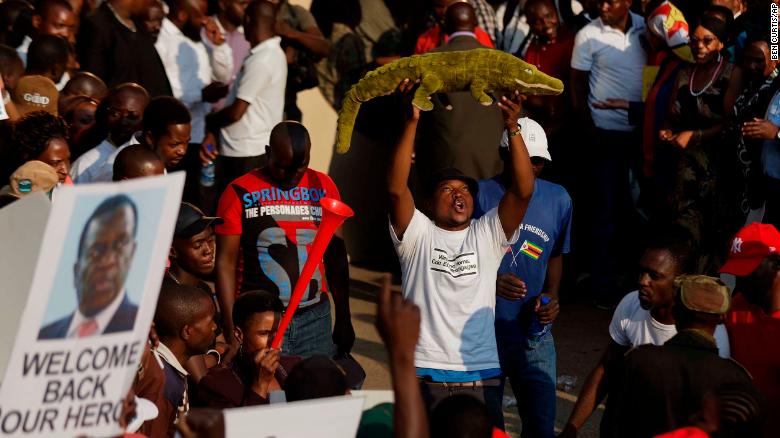
A supporter holds up a toy to welcome Emmerson Mnangagwa, known as "The Crocodile," back to the country on Wednesday in Harare. CNN
Mr. Mnangagwa, Robert Mugabe's former vice-president, is full of praise for the military with which he is closely aligned. He extended his praise to the speaker of parliament and the other party leaders who have all supported the dismissal of Robert Mugabe, Zimbabwean ruler-for-life-almost and their support for his return from exile after his summary dismissal as vice-president and heir to the presidential throne for which he considered himself to have been groomed.
At Mugabe's side for almost 40 years, one of the original freedom fighters who helped sovereignty succeed in independence from foreign rule when his country was Rhodesia, not Zimbabwe -- a British colony -- he is cut from the same cloth as Mugabe. Robert Mugabe may have made the decisions to brutally attack white Zimbabwean farmers and divest them of their holdings, in the process destroying the country's agricultural preeminence, but it was his enforcer, Mnangagwa, who enacted those decrees.
Known for vicious brutality, he was popularly referred to as the 'crocodile'. His own ambitions coincided in lock-step with that of Robert Mugabe's wife Grace -- who succeeded in persuading her doddering husband that she would far better carry on his priceless legacy that impoverished the country, sending it into hyperinflation, raising unemployment to impossible levels, creating food and medicine shortages while she burned through the state treasury on shopping sprees -- and she won.
When she persuaded her husband to dismiss his faithful colleague who had carried out all his destructive orders as the heavy of the team, neither she nor her husband imagined the reaction, which became a popular revolt in the guise of a military coup. While she fled the consequences, her husband remained in place to meet an African Union delegation to persuade him to step down, but he remained steadfast in his belief that he was beloved of his oppressed people until ZANU-PF dismissed him after the failure of diplomacy persuading a tyrant to depart.
Now Emmerson Mnangagwa is prepared to rule in the place of his former mentor. He will complete Mugabe's latest 'term' in office. And in taking his place he will without a doubt truly take his place. The people who believe that they have been delivered from the iron clutches of a tyrant are about to understand that Mugabe's replacement is a replica of the original. This is the fate of Africans; to be abused by one tyrant only to face similar abuse by another. The next 'election' will be held under the same conditions as all those which saw Mugabe 'elected' and re-elected.
As for the ambitions of Grace Mugabe, while they are shattered in the political-power sphere, she still has all the riches that she looted from the country that has reeled in a state of dysfunctional poverty for years. The agreement was reached that Mugabe and his family will remain in the country and permitted to retain possession of their 'assets'. The vast mansion in Harare that Grace Mugabe looted the treasury to build to house the nation's first lady will remain hers.
The farms she commandeered from other black Zimbabweans who had been allotted them after their divestiture from their white owners may be another thing, if anything remotely resembling justice and an effort to put Zimbabwe back on a working track is pursued. As for the vast wealth acquired by Grace Mugabe as the largest landholder and real estate portfolio in the history of the country, her personal adornments, designer clothing and jewellery, and the way she managed to acquire it all, who knows?
In continued deference to the elder statesman of African leadership post-colonialism -- a man whom even Nelson Mandela made no effort to reprimand for his ruination of a nation and his racial abuse -- for whatever few years left of his life Grace Mugabe will be safe. On his death she would be well advised to make her presence in Zimbabwe a mirage, taking with her into exile whatever she can spirit out of the country. The crocodile has a maw full of vengeful teeth.
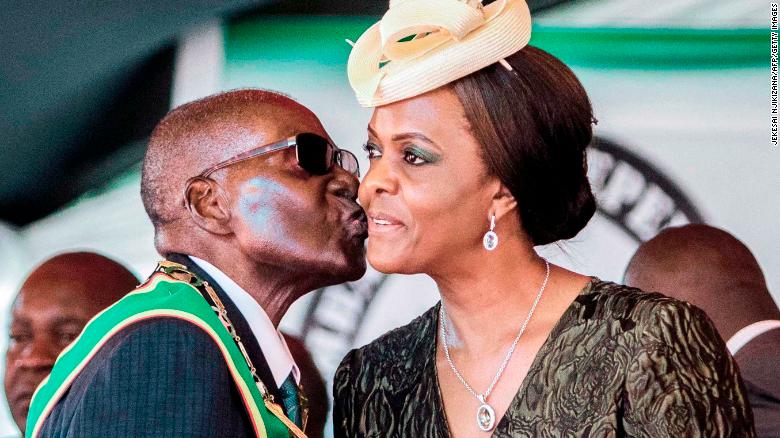
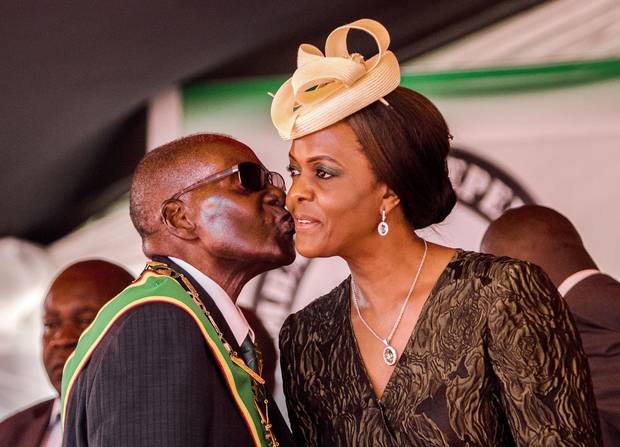
Robert Mugabe kisses his wife, Grace Mugabe, at Independence Day celebrations in Harare on April 18, 2017 CNN
"This is political theatre. Chiwenga and the army want to give Mugabe a soft landing, a dignified exit." "They are working on the choreography of how this will be done. By calling a full summit (the regional leaders] are showing respect for Mugabe, the last of the liberation war heroes. Mugabe wants the full fanfare as he exits stage left." "The regional leaders will be showing deference to Mugabe, even though they can't wait to see the back of him." Piers Pigou, southern Africa expert, International Crisis Group
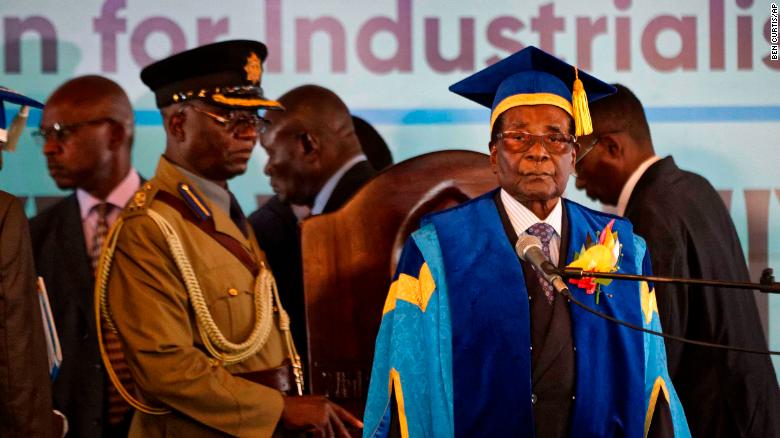
Zimbabwe's President Robert Mugabe, right, arrives at the Zimbabwe Open University in Harare. CNN
Isn't this typical Africa? That Mugabe transformed Zimbabwe from its colonialist oppressor state as Rhodesia and succeeded in bringing his country to independence was indeed something to celebrate. Initially, the white government in power, acceding to African rule as natural justice would have it, that the original inhabitants of a land and the vast majority of the country needed to shake off the shackles of third-class inhabitants to re-assume their heritage status represented an honourable undertaking and victory.
That the man who won independence for his country, renaming it and declaring that Black Rhodesians as Zimbabweans proud of their ancestry and their rule over their own land could also be generous in victory, slowly became transformed himself by 37 years in power to end up so harming the future prospects and prosperity of his country that he destroyed it, was unforgivable. His tyranny ensured that all the land was returned to black rule, including farms owned and operated by white Zimbabweans for generations, as functional, producing sources of food to feed the nation.
That all fell by the wayside as white farmers were violently thrown off their land, their properties confiscated and handed over to those who could claim they were in the forefront of freeing the country from its white oppressors. Which might have been viewed as just desserts, but which in the end, destroyed the nation's agricultural industry it once exported abroad as well as feeding itself. Now, food and commodities are scarce, unemployment is high, inflation skyrocketed and currency hugely devalued.
Supports of Zimbabwean opposition leader Morgan Tsvangirai rally in
Harare in August. The long-time MDC Leader’s illness but refusal to step
down has left the party rudderless, and in ‘a very bad place,’ one
activist says. JEKESAI NJIKIZANA/AFP/Getty Images
Opposed by a political party that is moderate in its outlook and a leader not seeking self-aggrandizement but the opportunity to lead the country back to prosperity and sound management, Morgan Tsvangirai, once dismissed from power sharing as leader of the MDC may be given the opportunity to return to government. Unless, as seems more likely ZANU-PF, Robert Mugabe's ruling party to which the nation's military appears loyal, will re-invest the presidency with the man Mugabe and the party had groomed to be his successor, a man with the same cutthroat instincts as Mugabe, named "the Crocodile", an erstwhile enforcer for Mugabe.
Envoys representing South Africa's Jacob Zuma, himself an embattled president mired in corruption and self-availment, had been tasked with persuading Mugabe that it would be in his best interests and that of the nation to 'resign' his presidency at age 93. While his wife Grace Mugabe has already fled Zimbabwe, knowing that the dismissed vice-president Emmerson Mnangagwa, who along with General Constantine Chiwenga, head of the armed forces would be likely to hold her accountable for Mugabe's latest excesses and insistence that she be his replacement, he had steadfastly refused to 'resign'.
Sanctioned by the United States in 2003 identifying him as one among other officials "who undermine democratic processes and institutions in Zimbabwe", Mnangagwa, widely considered to be as corrupt and abusive as Mugabe, is supported by the military and as such more likely than Tsvangirai, to replace Mugabe. The result of which could be that Zimbabwe's brief celebration at the removal of their dictator will be short-lived, when a replacement dictator steps in.
Robert Mugabe kisses his wife Grace during during the country’s 37th
Independence Day celebrations at the capital, Harare, in April, 2017.
Her unpopularity may drive voters to opposition camps, a senior member
of a rival party says, as she is ‘the most hated woman in Zimbabwe.’
JEKESAI NJIKIZANA/AFP/Getty Images
Mugabe's authoritarian rule and mismanagement of the country leading to the steep economic decline of the nation has made him a deeply unpopular figure, although he himself thinks that he is held in deep affection by ordinary Zimbabweans. That his wife Grace Mugabe, continued to spend huge sums of state treasury on designer clothing, jewellery, the building of several mansions, throwing costly parties while ordinary people suffered economic marginalization and scrounged for food, certainly failed to endear her to the population.
The unfortunate thing is that there will be no 'clean sweep' of the stables in this country; one corrupt megalomaniac will simply replace another. And the envoys from the Southern African Development Community which had sent them to appease Mugabe's hurt feelings by assurances given to him that he remains fondly regarded as one of the heroes of African liberation, will return whence they came, satisfied with a job well done.
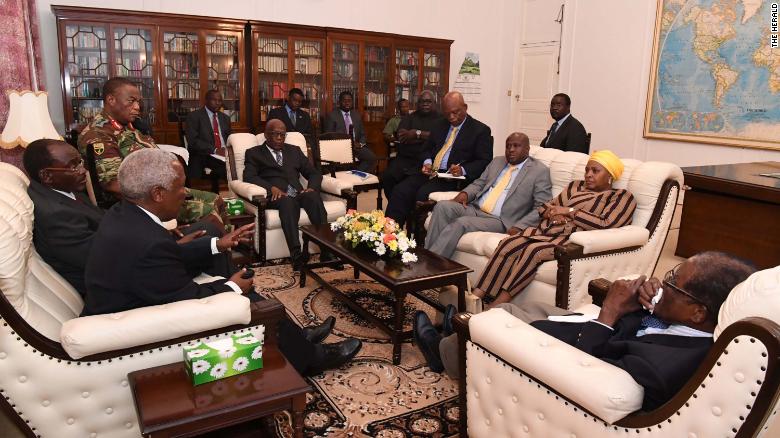
Mugabe in talks about his future, in this image tweeted by the editor of Zimbabwe's Herald.
Desperate dictator: China refuses Robert Mugabe's request for Zimbabwe bailout
Last fall, the needy nation figured on $30 billion in direct
budgetary aid from the Middle Kingdom. Now it appears the figure will be
zero.
By
Mxosili Ncube, Correspondent /
March 10, 2014
A
man rides in the trunk of a car being used as a private taxi in Harare,
Zimbabwe this month. The government has been cracking down on such
businesses. Tsvangirayi Mukwazhi/AP
Johannesburg
Last November, China pledged to give Africa some $1 trillion in aid over the next 12 years.
At the time, a clearly bedazzled Mugabe regime, just re-elected in late July, told itself, its creditors, and its citizens that Zimbabwe would reap a windfall of some $30 billion in Chinese loans and grants. It sent a series of delegations to Beijing for that purpose.
Zimbabwe and its autocrat, President Robert Mugabe,
need the money. The country is isolated, financially tattered, and
increasingly desperate economically. Its financial obligations are $11
billion in arrears, and with its ongoing ideological standoff against
the West, the nation is unable to borrow from the IMF, the World Bank
and the UN. It has no viable industries, and with more than 85 percent
of the population unemployed and an estimated 20-25 percent of
Zimbabweans living outside the nation, an inability to secure a
stability loan could breed serious political problems.
It
appeared that China would step in, solve the autocrat’s problems,
validate his so-called "Look East" policy, and gain a stronger foothold
in southern Africa. The bailout would help stabilize the government and
pacify a growing trend of middle- and working-class anger at the poor
economy and corruption. The aid was being called a “friendly boost.”
Yet
in what appears to be an embarrassing slap, China’s much-touted
bail-out – or at least Mugabe's portrayal of it – now appears to have
fallen through.
Mugabe's spokesmen have steadily downgraded the
size of China’s support – from $30 billion to $10 billion, to $3
billion, and then, in February, to $400 million.
Now it appears
China won’t play Santa Claus at all. In what may be a harbinger of a
tougher approach, it last week apparently ruled out any direct aid.
“We
don’t normally provide budgetary support to other countries but we try
to help Zimbabwe in our own way,” the Chinese ambassador to Zimbabwe
told reporters.
Chinese officials and the business community in Shanghai told the most recent Zimbabwe delegation, headed by Finance Minister Patrick Chinamasa, that he needed to offer bankable projects instead of promises like the one he tried to sell Beijing to get cash.
Mr.
Chinamasa had sought funding for the giant Zimbabwe Agenda for
Sustainable Socio-Economic Transformation (ZimAsset), a $27 billion plan
to bring economic revival. Zimbabwe’s entire annual budget is $4.5
billion, to give a sense of how large the request was.
Chinamasa’s
delegation tried to secure loans using the nation’s mineral reserves as
security. But the Chinese demanded an accounting of when Mugabe’s
projects would break even, and how a payment plan would work – which
Chinamasa did not appear to have ready.
"Mugabe cannot
economically hold fort from now till 2018 without a huge financial
boost, so we are likely to see more trips to China,” says Clive Moyo, an
economic analyst based in Johannesburg.
"But, as we have seen in
past times, such trips have mostly been fruitless when they concern huge
financial aid, yet we keep trying. We are now like gamblers who keep
putting money and efforts toward trying to land the jackpot, only to see
yet another heavy loss. Unfortunately, no one else can bail us out, so
it [is] a vicious cycle of hopes and heartbreaks."
Since their
controversial election victory last July 31, the Zanu (PF) government's
pleas for funding have gone unheeded, as more and more doors seem to be
closing in their bid to turn around an economy that has faced 15 years
of questionable management. Earlier this winter Chinamasa failed in
trips to Washington to secure IMF and World Bank loans.
The
African Development Bank estimates Zimbabwe needs $14 billion to pay
back lenders and be eligible for aid that stopped in 1999 because of
arrears.
Zimbabwe election was 'huge farce' - Morgan Tsvangirai
BBC News online -- 1 August 2013
Zimbabwe Prime Minister Morgan Tsvangirai dismisses Wednesday's election
Zimbabwe's
presidential election was a "huge farce", PM Morgan Tsvangirai has
said, alleging vote-rigging by rival President Robert Mugabe's camp.
Mr Tsvangirai said that Wednesday's poll was "null and void".
The largest group of election observers described the vote as
"seriously compromised" and said up to a million Zimbabweans were
prevented from voting.
Mr Mugabe's party - which is claiming a victory - denied the accusations, saying the voting went smoothly.
The 89-year-old leader is running for a seventh term as president.
The head of the African Union observer mission, former
Nigerian President Olusegun Obasanjo, said his initial assessment was
that the vote was free and fair.
And other regional observers have praised the peaceful nature of the election.
Observer Irene Peterson said the electoral commission had serious issues to address
The Zimbabwe Electoral Commission (ZEC) has five days to declare who won the poll.
The commission said vote counting at polling stations had
been completed on Thursday, and results were now being collated, the AFP
news agency reports.
It is illegal to publish unofficial election results in
Zimbabwe. Police have warned they will take action against anyone trying
to leak early results.
Extra police units - some in riot gear - have now been deployed in the capital, Harare.
Legal challenges are now likely to follow, but much will
depend on whether Zimbabwe's neighbours endorse the poll, the BBC's
Andrew Harding in Johannesburg reports.
The Southern African Development Community (SADC), the
15-member regional bloc, has said it will give its verdict on the
elections on Friday, AFP reports.
ZESN election findings
Pre-election roll in June:
- 99.7% of rural voters registered
- 67.94% of urban voters registered
- more than 750,000 urban voters missing compared to rural voters
Election day:
- 82% of urban polling stations turned away many potential voters
- 38% of rural polling stations turned away many potential voters
- poll "seriously compromised" by effort to disenfranchise about one million voters Source: Zimbabwe Election Support Network
Speaking at his Movement for Democratic
Change (MDC) headquarters in Harare, Mr Tsvangirai said: "Our
conclusion is that this has been a huge farce.
"The credibility of this election has been marred by
administrative and legal violations which affected the legitimacy of its
outcome.
"It's a sham election that does not reflect the will of the people."
The chair of the Zimbabwe Election Support Network (ZESN) -
the largest grouping of domestic observers - has told the BBC that the
voting was compromised as many people were unable to cast their ballots.
Solomon Zwana praised "the relative calm and peace that the
election has enjoyed", but said the organisation remained "concerned
about some cases of irregularities that have occurred in some areas".
The ZESN said that potential voters were much more likely to
be turned away from polling stations in urban areas, where support for
Mr Tsvangirai is strong, than in President Mugabe's rural strongholds.
It claims that up to one million of the country's 6.4 million eligible voters were prevented from casting their ballots.
The BBC's Lewis Machipisa looks back a decade to when he was forced to leave Zimbabwe
On Wednesday, villagers, MDC polling agents and the ZESN said
there had been voting irregularities in rural parts of Masvingo
province.
They said local traditional leaders and village heads had
lined up people, forcibly marched them to the polling stations and given
them voting numbers as if to cross-check who they had voted for.
They also allege that in these areas some literate people
were forced to pretend they could not read or write, and were assisted
to cast their vote in favour of Zanu-PF.
Zanu-PF spokesman Psychology Maziwisa denied that many voters had been deliberately prevented from registering.
He admitted that there were some irregularities, but stressed that both main parties had been affected.
"You've got to bear in mind that that was partly due to the
fact that resources were not being made available by the finance
minister who is Tendai Biti, who comes from the Movement for Democratic
Change party," Mr Maziwisa told the BBC.
He was speaking as Zanu-PF's senior members were already celebrating their victory.
"We have romped [to victory] in a very emphatic manner," one member - who asked not to be named - told the AFP news agency.
Zimbabwe election: Key facts
About 6.4 million registered voters
Vote for president and parliament
Zanu-PF's Robert Mugabe and MDC's Morgan Tsvangirai are the main presidential contenders
Mr Mugabe, 89, is seeking to extend his 33-year rule
Mr Tsvangirai, 61, hopes to become president after three failed attempts
The poll ends the fractious coalition between Zanu-PF and MDC,
which was brokered by regional mediators after disputed elections in
2008 that were marred by violence
First election under new constitution
Mr Mugabe has pledged to step down after 33 years in power if he and his party lose.
President Mugabe's Zanu-PF party and and Mr Tsvangirai's MDC
have shared an uneasy coalition government since 2009 under a deal
brokered to end the deadly violence that erupted after a disputed
presidential poll the previous year.
In addition to Mr Mugabe and Mr Tsvangirai, there are three
other candidates standing for the presidency: Welshman Ncube, leader of
the breakaway MDC-Mutambara; Dumiso Dabengwa of the Zimbabwe African
People's Union (Zapu), and Kisinoti Munodei Mukwazhe, who represents the
small Zimbabwe Development Party (ZDP).
If no candidate in the presidential vote gains 50% of the ballots, a run-off will be held on 11 September.
Zimbabweans were also voting for members of the new parliament in Wednesday's elections.
The Zimbabwe Election Commission is due to publish the results of this week's voting on Monday
This represents a general opinion site for its author. It also offers a space for the author to record her experiences and perceptions,both personal and public. This is rendered obvious by the content contained in the blog, but the space is here inviting me to write. And so I do.


![More than 65,000 people are already in shelters in central Mozambique [Enock Muchinjo/Al Jazeera]](https://www.aljazeera.com/mritems/imagecache/mbdxxlarge/mritems/Images/2019/3/23/551032f077144639818dbca7626fb87e_18.jpg "Cyclone-hit Mozambique: cases of cholera, malaria, typhoid")