"They [the estimated number of dead and humanitarian needs] are nowhere near the scale and magnitude of the problem. And I fear we will be seeing more in the weeks and months ahead, and we should brace ourselves." "The situation is simply horrendous, there is no other way to describe it. Three thousand people who are living in a school that has 15 classrooms and six, only six, toilets. You can imagine how much we are sitting on a water and sanitation ticking bomb." Elhadj As Sy, secretary-general, International Federation of Rd Cross and Red Crescent Societies "Yesterday [we] did a reconnaissance and we found another [inland] lake." "So we are still very early in the phase of identifying what the scope of this is, for who is affected and how many are lost." Emma Batey, coordinator, Oxfam, CARE, Save the Children consortium
"[What rescuers are seeing is] sometimes it's just a hut completely surrounded by water." "If islands are big enough, we can even see smoke coming out, meaning that they're cooking." "[It remains] super difficult [to estimate a death toll let alone the numbers missing]." Pedro Matos, emergency co-ordinator, World Food Program
"I've never seen anything like this. We were not warned. Suddenly the roof flew away." "[She and neighbours herded children away but] we lost some of them." "[They have received nothing from aid groups or the government] not even bread." Marta Ben, 30, mother of five
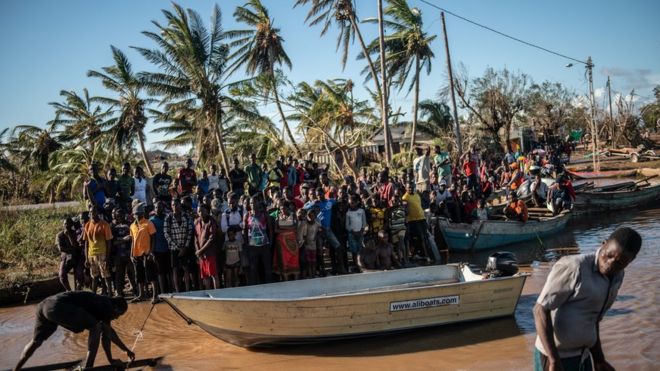
More than 65,000 people are already in shelters in central Mozambique [Enock Muchinjo/Al Jazeera]
Parts of Mozambique are finally seeing flood waters recede as the estimated number of deaths rises above a thousand, the number the country's president predicted earlier in the week. Thousands of dazed and fearful survivors are slowly making their pilgrimage toward Beira, the city where 90 percent of its infrastructure has been destroyed. Despite which, it has become a centre for rescue efforts for the entire region.
People have made their cautious way along roads heavily carved by the raging floods days ago, while others were rescued as part of a local effort by fisherman plucking stranded people from small islands, to bring them to safety. Despite the rain, helicopters take off to search for people clinging to rooftops and branches of trees. Water-borne diseases threaten as a result of water and sanitation systems being destroyed.
In the centres, children absent parents, separated in the chaos or newly orphaned wait to be tended to, confused and fearful. Women stake out places for themselves and their children on sidewalks with nowhere else to go, awaiting aid that hasn't yet reached them. They sit there, barefoot, nursing cooking pots, minding their children and begging those passing by for help.
In Zimbabwe, school children and their headmasters are missing. Miners operating illegally looking for gold and diamonds, have been swept into the raging rivers. In the worst-affected part of Zimbabwe, a woman who had left Chimanimani for the diamond fields to search for her son-in-law, who mined illegally, buried and mourned him.
"There are no jobs and all he wanted was to feed his family. He was with his colleagues. They thought it would be easier to mine since the rains would keep the guards and the police away from patrolling", said Maina Chisirlirwa of her son-in-law who was swept away while his colleagues survived. Even police, arresting illegal miners were swept away with their prisoners.
Thousands of people are still awaiting rescue from flooded areas across in southern Africa Getty Images
"We are not dealing with an accident, but with a crime against people
and nature. How many lives do we still have to lose [until] the
Brazilian state and mining companies learn from their mistakes?"Greenpeace Brazil Campaigns director Nilo D'Ávila
"I could only see people screaming and shouting. The sirens
did not work, only people shouting to advise others, everyone was
desperate." "[Two survivors in the hotel said employees didn't have time to advise anyone because] they could only
run for their lives." "It is devastating. Everyone here at the community is in shock. Nobody expected that to happen." Karolainy Stefany de Jesus, 21, nearby resident of Brumadinho, Brazil
"The National Security Dam Policy was
edited in 2010. It is a law that needed to be reviewed. After the
accident in Mariana, various projects were presented but we couldn't
finalize this change in the law, but this is essential."
"The
responsibility of monitoring and avoiding future disasters is on all of
us: private, state and federal. The idea is that we all sit at the
table, listen to specialists, review the regulatory framework and
improve this situation to avoid other disasters in the future."
Regional Development Minister Gustavo Canuto
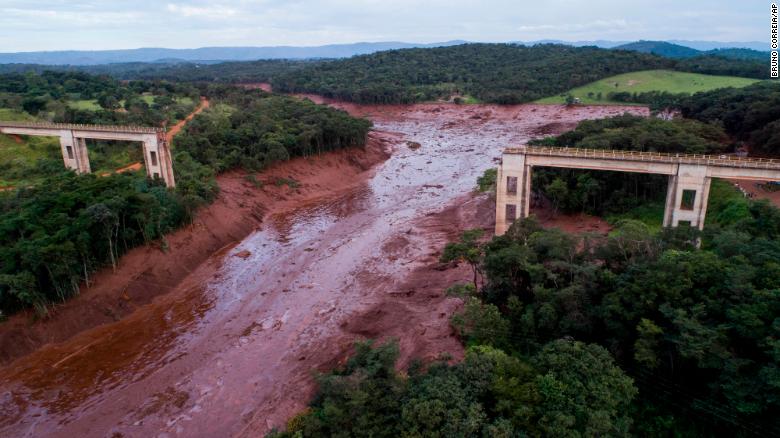
An aerial view shows a collapsed bridge after flooding from a breached dam Friday in southeast Brazil
"We attended periodic meetings at their
offices. No one had any information of any problems in the dam, but they
were less than transparent. They wouldn't even share with us the
presentations they made, for example."
"The
only possible response is the full restoration of the Rio Doce basin.
However, considering what happened in Mariana, I think we will still
suffer for this for a very long time."
Local environmental activist Carolina de Moura
The death toll of the disaster has eclipsed Brazil's last major environmental disaster in 2015.(AP: Silvia Izquierdo)
Firefighters in Brazil have poised themselves to do a balancing act; walking, crawling, searching for survivors or bodies of those killed after an iron ore mining company's buildings were inundated with ore waste after a dam collapsed. Nearby neighbourhoods were also inundated with mud that was comprised of ore waste. Hundreds of people are missing of the 427 known to be present at the time of the mud slide, and 65 people have now been found dead. Six Vale mining executives have been arrested.
The day following the catastrophic collapse and mud inundation the expectation of further rescues was damped, the death toll expected to grow "exponentially", according to the Minas Gerais fire department. The sea of red-brown mud that surged over the landscape when the dam was breached on Friday is hampering search efforts. Up to eight metres in depth in places, searchers are forced to walk around the edges or to crawl agonizingly slowly on to the mud to prevent themselves sinking and drowning in it.
Searches were mostly focused on the Vale mining company cafeteria which is where many of its workers were seated, eating their lunch before the dam ruptured. The world's largest producer of iron ore, Vale SA's is now being accused of knowingly placing peoples' lives at risk. Helicopters in their search for bodies repeatedly took off and landed non-stop at the site while on the ground dozens of rescue dogs with their handlers searched for bodies through mountains of mud.
Fears of a second mine dam collapsing in Brumadinho caused rescue efforts to be suspended for about ten hours on Sunday, and some 24,000 people were warned to get themselves to higher ground. Civil engineers later claimed the second dam no longer posed a risk of collapse and full attention was returned to the scene of the collapse. As time goes on the mud is releasing some of its moisture and drying out, giving hope to firefighters being able to reach areas previously closed off to their searches.
The slow progress has resulted in residents beginning to launch their own searches in a desperate attempt to find loved ones, as anger mounted at the mining company, and questions began to rise that no warning siren was sounded before the collapse.
Victims had no warning of the deluge that rapidly swept through the region. (AP: Leo Correa)
Volcanic Eruption, Tsunami, No Prior Notice, No Escape
"Suddenly, a one-metre [3.3-foot] wave hit me. I was thrown into the fence of a building about 30 metres from the beach and held onto the fence as strong as I could, trying to resist the water, which felt like it would drag me back into the sea." "I cried in fear... 'This is a tsunami?' I was afraid I would die." Azki Kurniawan, 15, vocational training student
"The tide rose to the surface and dragged all the people on site." "Unfortunately, when the current receded, our members were unable to save themselves while some did not find a place to hold on." Indonesian pop band Seventeen, statement
"Actually, the tsunami was not really big, only one metre.": "The problem is people always tend to build everything close to the shoreline." Gegar Prasetya, co-founder, Tsunami Research Centre Indonesia
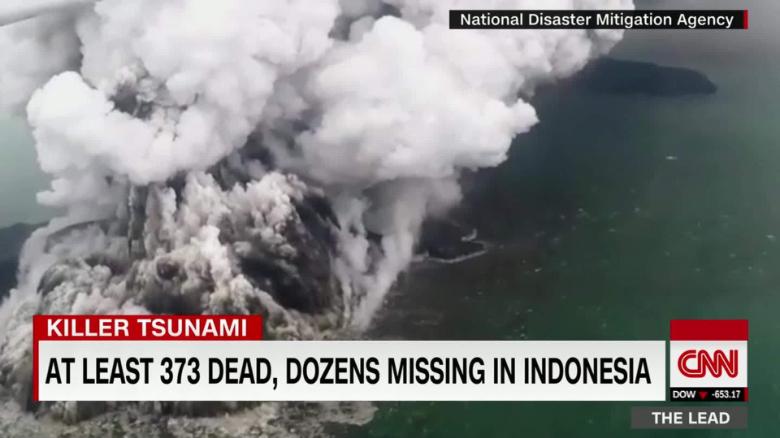
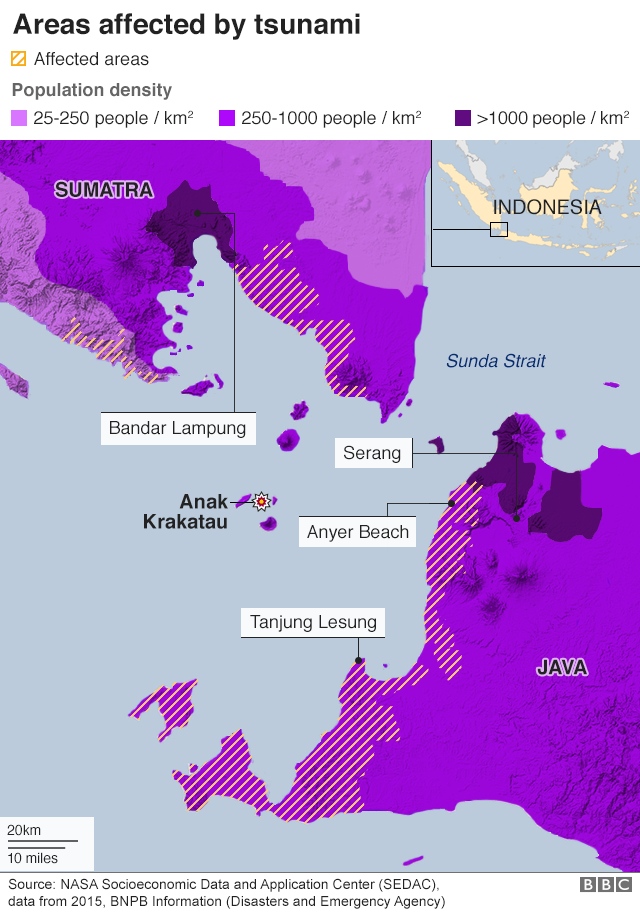
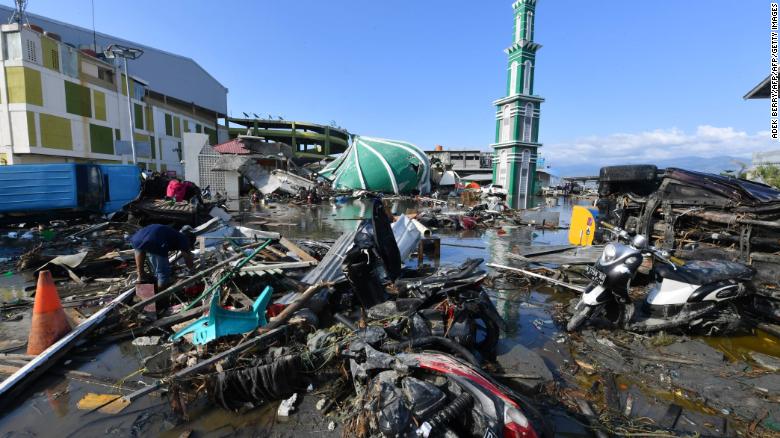
Indonesia represents a vast archipelago of over 17,000 islands, and has a population of over 260 million people who live along the "Ring of Fire", an arc of volcanoes and fault lines situated in the Pacific Basin. Saturday's tsunami was caused, in all likelihood, by a flank of the volcano collapsing; a large area of the volcano's slope giving way triggering a landslide or beneath the ocean, a disruption powerful enough to be capable of producing gigantic sea waves.
In 2004, a massive magnitude 9.1 earthquake hit Indonesia, spawning a horrendous tsunami off Sumatra Island which killed over 230,000 people in a dozen countries, most of them in Indonesia. Anak Krakatau volcano is considered to be the successor of the historical Krakatoa volcano that erupted massively in 1883, known to be the most devastating such event in recorded history, an event where over 30,000 people lost their lives when tsunamis ensued and so much ash crowded the sky that a drop in global temperature was recorded.
The explosion destroyed the huge volcano, sinking much of the island in the Sunda Strait between Java and Sumatra between the Indian Ocean and the Java Sea until around 1920 when Anak Krakatau began rising from the site, growing each year, and periodically erupting, considerably smaller though it is than the original Krakatoa.
Although scientists, along with some from Indonesia's Meteorology and Geophysics agency, felt the tsunami could have been caused by landslides below water; alternately above ground, on the steep slope of the Anak Krakatau volcano, tidal waves caused by the presence of a full moon were also cited as potential causes. Nine hotels and hundreds of homes were damaged or leveled by the waves in the city of Bandar Lampung on Sumatra.
At last count, 375 people lost their lives, 1,459 were injured and another 128 people are missing. All together, to date, 5,600 people have been displaced by the disaster. An astonishing 558 hotels were completely destroyed throughout the range of the tsunami's effects, and 60 restaurants, 350 boats and 9 hotels were heavily damaged. The cost in human lives and property destruction is enormous, particularly for a country that had experienced a deadly tsunami on the island of Sulawesi in September, caused by a powerful earthquake, when 2,500 people were killed.
Saturday night's tsunami came without warning to alert people to rush to higher ground. The waves ripped buildings from foundations in seconds.
"I could see my father still embracing my sister. I just cried. I was able to save other people, but I was unable to save my own family." "The ground I stepped on cracked -- water and mud came out, more and more from all directions." "I took a two-year-old [child] on my head, a three-year-old on my back, and held a five-year-old while struggling to swim out from mud to the asphalt road." Edi Setiwan, 32, Palu, Indonesia "Up to Saturday, we still saw many people screaming for help from the roofs." "But we could not do [anything] to help them." "Now, their cries are no longer heard." Idrus, 52, Palu, Indonesia
Still from Video -- Rescuers in Palu, Indonesia
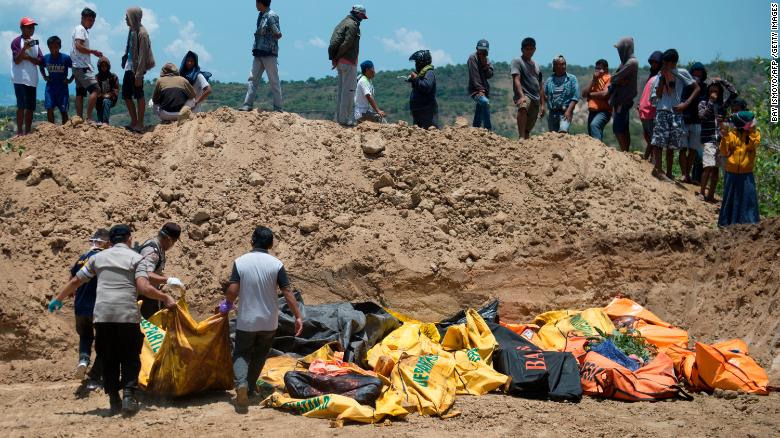
"There are still hundreds of victims buried in mud" in the area, noted disaster agency spokesman Sutopo Purwo Nugroho of the hardest hit area in the wake of a 7.5 earthquake that hit on Friday triggering a humanitarian crisis when a deadly tsunami of over three metres in height hit the exposed coastline around Palu on that fateful day. Over 1,200 people have so far been counted among the dead, a still-preliminary count where many others remain trapped under buildings that collapsed, difficult to get to because of the destroyed terrain.
Most casualties were quake-caused, and the result of the tsunami, but hundreds of people were trapped, crushed and killed by collapsing buildings; homes and hotels and shopping malls. Others were buried alive by the ground that underwent a liquefaction process when seawater washed ashore inundating unstable ground causing loose soil at the surface to collapse, the end result resembling a swamp of quicksand, where would-be rescuers desperately attempted to pull people out of the muck, saving some, but counting others among the dead, drowned in brown sludge.
Rescue teams evacuated people trapped under a 50-room, eight-storey hotel the earthquake had collapsed. Some were alive, while rescuers listened to the screams of others buried deep in the ruins through that long night, unable to reach and rescue them, the lights of their cellphones shining beneath the rubble. Three other hotels in Palu city also collapsed, their guests caught in the destroyed remnants of the hotels. It wasn't until Monday that rescue teams attempted the daunting, huge job of attempting to dig them out, no longer alive.
Sulawesi Island's Palu with its 380,000 residents was in ruins with toppled cellphone towers making communications in failure mode and electricity absent from downed power lines, plunging the ruined city in darkness. Countless residents are now in desperate need of food, water, fuel, medical attention and shelter. Thousands of panicked women and children have swarmed the city airport tarmac hoping to board military aircraft arriving with aid as authorities began burying bodies side-by-side in a mass grave, hoping to avoid a mass disease outbreak.
Edi Setiwan described seeing and feeling the neighbourhood he lived in sinking. He had attempted, after delivering his wife and year-old daughter to safety, to reach his parents' home roughly 300 metres away but he was met with a sea of mud. Along with other villagers, rescue efforts began, to save whoever could be saved, as ropes were thrown to people in pools of thick mud to pull them to safety. It was only the next day, Saturday, that he was able to reach the area where his parents lived.
His mother had been saved, but he discovered the bodies of his father and sister in the dark sludge.
Indonesian rescuers work on the collapsed Roa Roa hotel as they
try to find survivors in Palu, central Sulawesi, Indonesia, 01 October
2018. EPA/MAST IRHAM
"Improvement don't mean sweatshops no longer exist in Bangladesh. This reporter visited one in Dhaka, three days before the Rana Place anniversary. Fire buckets were filled with trash, emergency water bins were cracked and half empty, no one wore safety masks, most workers -- some in their early teens -- were barefoot, wiring was exposed, bolts of fabric and scraps littered the floors, window panes were broken, and the lone stairwell out of the tenement-like building was obstructed by cartons of finished product destined for Russia." Dana Thomas: Bangladesh Labor Reforms May be in Peril
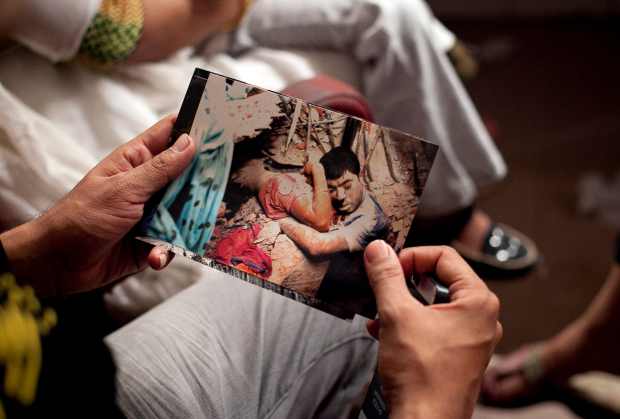
"[His girlfriend of three years was pregnant], That's why I joined Rana Plaza, [three days before the complex collapsed]." "'Help me!' people screamed. 'Save me!' they cried. But nobody was listening." "The labour law in this country is pro-owner, not pro-worker." "[When oversight reverts to local governance], all will return to how it was when Rana Plaza happened." Mahmudul Hassan Hridoy, 32, Dhaka, Bangladesh
A Bangladeshi man holds a photo from the Rana Plaza disaster. Photo: Getty Images
He was a nursery school teacher, but quit the position because it paid so poorly. Then he became a quality inspector for New Wave Style Ltd. for the increased income it promised, at Rana Plaza. He had worked there for two weeks when the collapse occurred. He was working on the seventh floor of the eight-story retail complex when everything crumbled and collapsed and when he gained consciousness it was with the realization that he was pinned under a concrete pillar, and he was no longer on the seventh floor.
He soon enough understood he was now on the second floor, lying beside a good friend, Faisal. Faisal worked on the second floor, as a sewing machine operator. "I'm not sure how, I guess my floor dropped down to his", he explained. And if he hadn't dropped down to the second floor, he might never have known how Faisal died, his skull crushed "And his brains were spilling out. I can't forget how his head exploded in front of me. Those memories still haunt me", he said.
He now walks with a crutch and dreadful headaches assail him His wife couldn't take the change and left. He founded the Savar Rana Plaza Survivors Association which now has 300 members who meet monthly. Two of the members of the group hanged themselves in 2015 and 2016. Opposite the street of the ruined and overgrown Rana Plaza sits a concrete monument of an enormous pair of sculpted fists holding a hammer and sickle, as a memorial to the victims.
India, Vietnam and Bangladesh are recognized as the least expensive places in the world to produce apparel; between them over 4.4 million workers are employed in 3,000 factories where the minimum hourly wage is 32 cents, which comes out to $68 a month. Name brands of respected clothing purveyors make their way to Bangladesh where $30-billion of "ready-made garments" identify Bangladesh as the world's second largest manufacturing center of clothing after China.
After Rana Plaza, those same international fashion brands created two five-year compliancy agreements in an effort to exonerate themselves from an obviously perceived view that they too were responsible for the tragedy, not only the sweatshops from whom they bought their cheaply-produced wares. Over 200 of them signed the legally binding Accord on Fire and Building Safety. The nonbinding Alliance for Bangladesh Worker Safety was led by Walmart and signed by 28 others, including Gap, Target and Hudson's Bay.
A study released by the Center for Global Workers' Rights last month revealed the impact of the Accord, proclaiming both to be successes citing that in the five-year period, over 97,000 hazards in 1,600 factories were rectified, providing safer environments for 2.5 million workers. "The Accord has undoubtedly saved lives", Liana Foxvog, director of Organizing and Communications for the International Labor Rights Forum, declared.
Unfortunately, both the accord and the alliance are on the cusp of expiring though advocates urge that a new accord be formed. But in Bangladesh there has occurred union repression, and labor leaders have been imprisoned. The Rana Plaza Donors Trust Fund an endowment underwritten by brands to the value of $30 million, compensated Mr. Hrdoy who used the $600 he received to open a drugstore.
Neither he nor the other workers and their families will forget April 24, 2013, when 1,134 workers died, and 2,500 more were injured, in the world's worst fashion garment industry disaster.
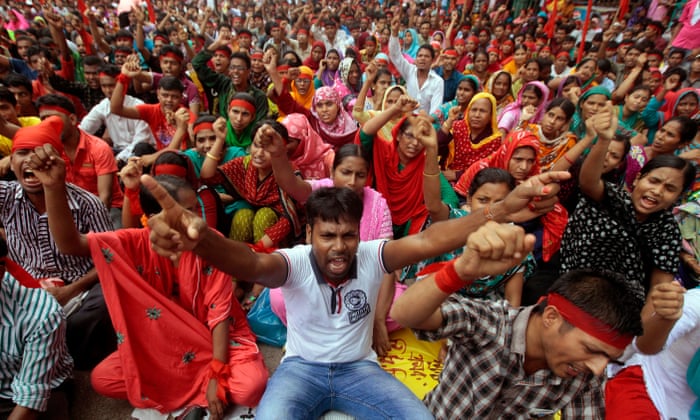
A garment worker protest in Dhaka in 2013, demanding a rise in pay as
well as compensation for the victims and those injured in the collapse
of the Rana Plaza building.
Photograph: AM Ahad/AP
"We are seeing the new boats, which are not equipped with anything, but they carry more people." "This is going to be even more disastrous for the migrants." Ayoub Gassim, Libyan coast guard spokesman
"It's really strange that smugglers would take off the engine [removing from the large inflatable rubber flotation devices the only method by which they can be moved in the choppy waters of the Mediterranean, before abandoning those packed into the rubber watercraft to their fate]." Flavio Di Giacomo, spokesman, International Organization for Migration, Rome
"Traffickers came and removed the engine from the boat and left the craft adrift." "This is not a only horrible number of deaths in one incident but it
strikes us as something that we haven’t really seen much of, which is
either deliberate punishment or murder of migrants." Joel Millman, spokesman, International Organization for Migration (IOM)
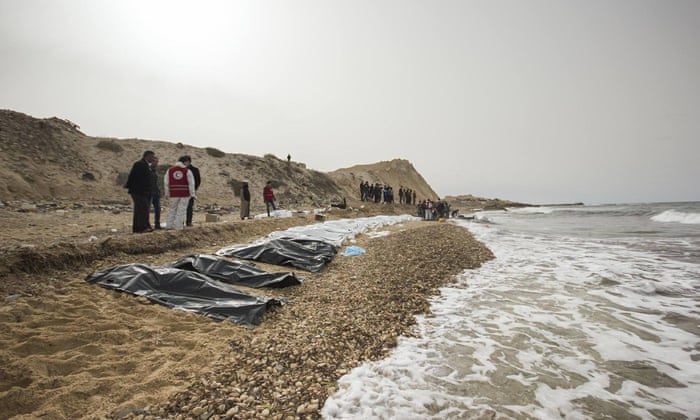
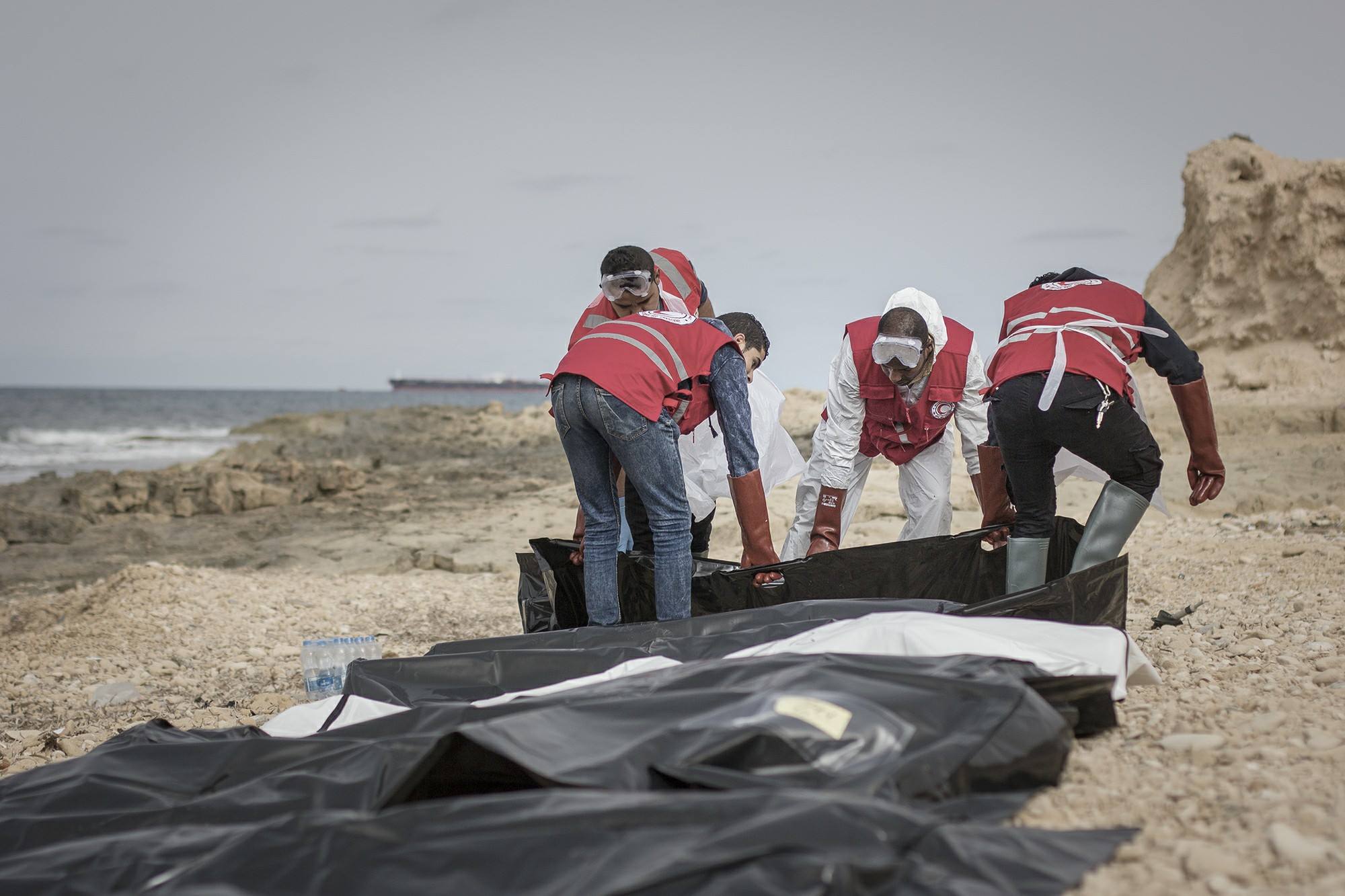
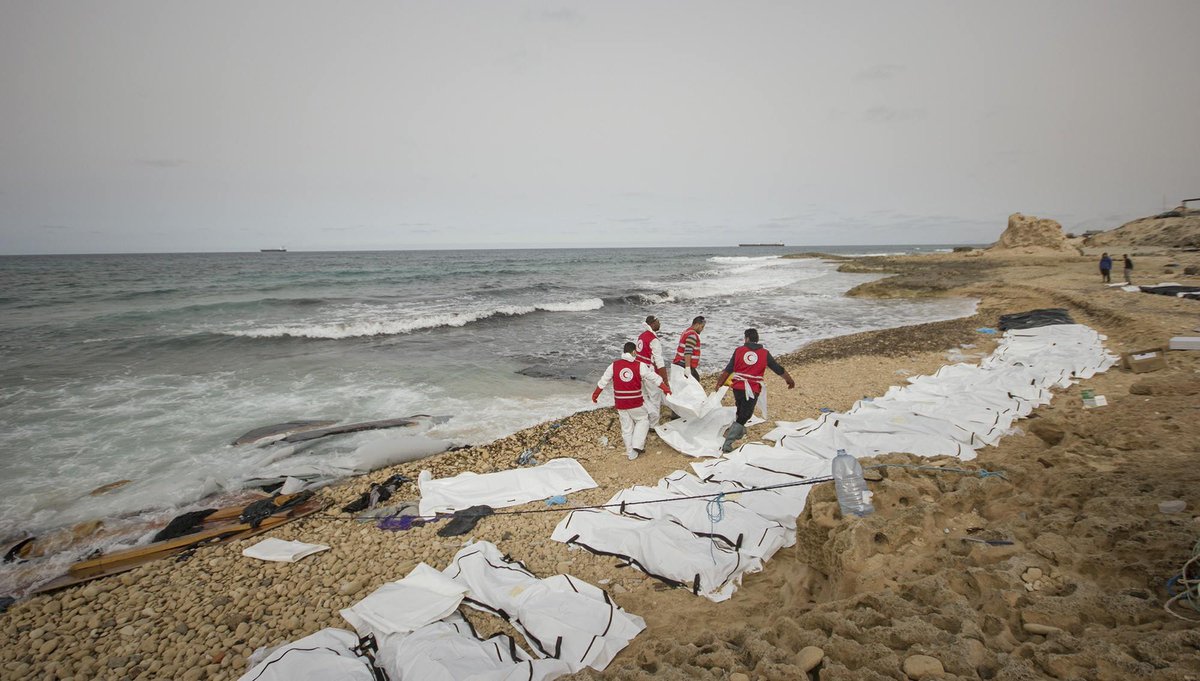
The bodies were found on the beach on Monday morning.
Photograph: Libyan Red Crescent
Not so strange, actually. The human smugglers don't concern themselves overly with the conditions they deliberately place vulnerable men, women and children in. Uppermost in their minds is the profit they will gain through their enterprise. And keeping their own costs to a minimum is key to exactly how much profit will fall to them. The rubber craft are expendable, the engines that drive them to their purported destination of freedom can be re-used, why waste them?
There is a world-wide pandemic that the World Health Organization has not yet addressed itself to. The propensity of people to risk their lives in a venture that clear thinking would identify as inimical to survival. Biologists were always baffled at the natural phenomenon of lemmings flooding a landscape in a mass move to commit themselves to a fated destiny, by throwing themselves over cliffs. Until they decided that wasn't what happened at all.
"An army of lemmings advanced with extraordinary purpose, 'never
suffering itself to be diverted from its course by any opposing
obstacles', not even when confronted by rivers, or even the branches of
narrow fjords. 'They are good at swimming'," explained Nils Christian Stenseth of the University of Olso in Norway. 'They can
easily go across small bodies of water, across small lakes'." It is predators like stoats that biologists now attribute their massive die-offs to.
In the world of humankind, the stoats are the corrupt governments that dispossess their citizens of their basic human rights, causing poverty and hopelessness, tribal repression and ethnic cleansing, amid sectarian-motivated conflicts. The governments that take for themselves the riches that natural resources gain, meant for the improvement of the country, while repressing and constricting opportunities for the masses.
IFRC MENA✔@IFRC_MENA
And apparently it is this mass of hopeless, opportunity-seeking, conflict-fleeing people who form the basis of the human herds that migrate from their countries of birth in hopes of arriving eventually at the shores of other, more successful, civilized countries whose leaders are infinitely less corrupt and less given to conflict and to leaving their populations to fend for themselves against hunger and deprivation. These are people who have convinced themselves that opportunities lie elsewhere.
And who, despite all the dangerous obstacles they most surely are aware of that they will encounter in the vast distances they must cover to reach a place of haven, embark on such journeys, risking those very real, and impending dangers. All the more so when it has become common knowledge that thousands of migrants and would-be refugee and asylum seekers have died attempting to cross from North Africa and the Middle East toward the shores of Europe.
The mass psychosis once attributed to lemmings now appears to have infected people desperate to escape their fate of limited life experiences, poor health outcomes, starvation, government instituted massacres and the stasis of mental and physical impoverishment. And so, for them there is no such thing as 'better judgement'. They compartmentalize the shocking news of thousands drowning when unstable watercraft disintegrate leaving their passengers to a watery fate. It happens, it will happen.
Their luck would prevail. They harbour such desolate thoughts of their circumstances that they feel, alternately, that taking the gamble is their only choice. That should they lose, all they will give away is a life not worth living. The temptation to reach a harbour where they will be accepted, however reluctantly, because there are sympathetic responses to their plight, and they will, given time, prosper there and obtain a life hitherto denied them, is the motivating factor.
There may be people indigenous to the country they are entering 'illegally' whose status is as compromised by poverty and lack of opportunity equal to their own, but they would not believe that to be so, in any event. They risk everything, and yet nothing. The popular sea traffic route to Europe gave up 74 dead bodies this past week, and winter is not yet over, leading those on the receiving end of the endless stream of migrants and death, to speculate on what spring will bring.
IFRC MENA✔@IFRC_MENA
The smuggling season reaching from Libya to Europe on a wintry sea route has begun with a vengeance; what is yet to come is horrendous in its outcome. Close to the bodies of the dead African migrants, more bodies were noted floating out further at sea, along with a torn rubber boat. The smugglers, noted Mr. Gassim, left Libya for Italy on Saturday and were left to drift for several days. The rubber boat was packed with up to 180 people; a number more likely to capsize such a fragile vessel.
But this obvious observation appears not to have deterred those who boarded from doing so.
A week ago Friday and Saturday over 500 other migrants were rescued while at sea. In January alone 228 deaths at sea were recorded. The total for 2016 was over 4,500 drowning deaths, migrants on smuggling routes from Libya to Italy, according to a European Border and Coast Guard Agency report. With the acknowledgement that the figure given represents a low estimate since so many deaths are unrecorded. With each year that passes the death toll increases over that of the year before.
The boats are poorly built, they are smaller than in previous years, yet they are packed tight with migrants, shipped in greater numbers than previously, to maximize profit. This year the average boat carries 150 each vessel, whereas in years previously the average per vessel had been roughly 100 migrants. Sub-Saharan Africa as well as the Middle East are the sources for most of the migrants, convinced a better life awaits them in Europe.
"The only thing I can say is hopefully, hopefully, our patriotic movement will overcome this terrible deception." "Right now I am being viciously attacked with lies and smears. It's a phony deal. I have no idea who these women are." Donald Trump, Republican presidential candidate
Mike Segar / Reuters
"It's coming in ['evidence' putting the lie to women's claims of Trump's sexual attacks], frankly, probably in a matter of hours." "It's astonishing to see the enormous coverage of these, of these really unfounded allegations, unestablished allegations, compared to an avalanche of emails coming out of Hillary Clinton's years as secretary of state." Indiana Governor Mike Pence, Trump running-mate
"You don't have to be a husband or a father to know that that kind of language [Trump's crude, sexist maunderings], those kinds of thoughts, those kinds of actions are unacceptable. They're not right.." "You just have to be a decent human being." U.S. President Barack Obama
Decent human being? Trump? Not even luke-warm. He is imbued with all the qualities of arrested adolescence; arrogance, block-headedness, ignorance, self-centeredness, hostility, resentment, racism, and rampaging sexism. His abysmal lack of experience, knowledge, judgement, diplomacy, integrity and the over0abundance of all the traits that signal its owner is anything but decent, mark the man's traits, his inner personal. What he spouts is what he is.
All of which is so self-evident in his lack of restraint even under duress, that it is gob-smacking unbelievable that a purported two out of five Americans inform pollsters they intend to vote for this sad excuse for a man. Those who have the impression that it is uneducated, rural and poor men who find his off-the-cuff assertions compelling, fail to notice that supposedly intelligent observers have succeeded also in rationalizing their support for this ignorant boob.
Governor Mike Pence, as well as other high-ranking Republicans in the public eye who continue to express their faith in the Republican candidate for president, simply and eloquently proffer proof of their own lack of integrity and trustworthiness through their unforgivable lapse of judgement, ethics and morality. They appear to have suffered no pangs of conscience by surrendering their moral principles and judgement in their professions of rank hypocrisy.
By: James Barrett
October 14, 2016
The entire situation facing the American nation, having to decide for whom to vote in a contest between two individuals, one of whom appears marginally superior to the abysmal inferiority of her male counterpart, represents a dark comedy of tragic proportions. What, truly, has become of the perceptive capacity of a nation? Each day brings fresh revelations, none of which do credit to the hopes of Americans as both presidential candidates continue to stew malodorously in the pot of their own malfeasance.
There is some bleak relief on the horizon with news that the least calamitous of the two candidates has pulled ahead in polls, and that the Republican National Committee has failed to raise funding equal to amounts it can generally be expected to be awarded by their faithful followers. The true pity is that someone of the ilk of Mitt Romney was not chosen to represent the now-disgraced Republican party of Abraham Lincoln.
The Turkish government has seen fit to prove its credentials as a member of NATO and an aspirant to the European Union which has been pleading with it to stop the flow of Syrian refugees into Europe, by arresting two Syrian nationals. Muwafaka Alabash and Asem Alfrhad deny any responsibility in the deaths of a number of migrants, although they have been identified as human traffickers. Their arrest dates back to an incident last year where a Turkish soldier was photographed holding the limp form of a child's body that was washed up on a beach.
Turkish gendarmeries escort 2 Syrians, arrested on
suspicion of causing deaths of 5 refugees including Aylan Kurdi,as they
are brought to court in Mugla, Turkey, in februaryPhoto: Anadolu /Getty
The death of Aylan Kurdi in particular, among the four others, including his brother and mother who also perished, gripped the tardy compassion of the world, as photographs were featured in the news media and a renewed interest was mounted on the plight of Syrian refugees, Sunnis attacked by their own Shiite government, facing arrest, torture and death as their communities were bombed and they were made homeless if they were fortunate enough to survive deadly assaults.
His family, father, mother and brother were among others who had shipped out on a flimsy craft from Bodrum, Turkey to attempt to reach the Greek island of Kos. The fates had other plans in store for the refugees, and the overloaded, inadequate craft capsized with a significant loss of life; five people drowned. Among them little Aylan Kurdi and his brother Galip, and their mother Rihan. Their father Abdullah, who had made the decision to attempt another passage after their initial one failed, survived.
The grief-stricken man told how he had attempted to save his family, but was unable to. His wife's family spoke of her fears of attempting another passage to Greece. Their first attempt had not instilled confidence in her that another would succeed, and her instinct was correct. Her unwillingness, however, given the society they stem from would have been overwhelmed by her husband's determination to risk all. And the price paid was the loss of his family.
But it was not just his family; the children of other parents sharing space on that unseaworthy craft died as well. The parents maintained afterward that their children died as a result of a poorly planned and executed mission. They too had felt reservations but decided to commit themselves to the venture, and their pain and loss certainly equals that of Abdullah Kurdi whom they accuse of having masterminded the journey and whom they blame for its disastrous ending.
The arrested men as well put the finger of blame for the failed venture that ended in five deaths on Abdullah Kurdi, as organizer of the trip. Each of the defendants has been sentenced to four years and two months in prison, reduced from the original sentence of five years. Assuredly a reduction of ten months' imprisonment will encourage the Syrian men accused of the crime. Particularly when prosecutors thought their crime serious enough to merit the maximum of 35 years in prison.
A paramilitary police officer carries the lifeless body of Aylan Kurdi, 3, who drowned off the Greek island of Kos
"There was some sound next to me. It did not feel right shortly after takeoff. The engine did not feel right." "I saw others were drowning. If I did not move quickly enough to help them, soon they would be dead." Huang Jin-sun, 72-year-old survivor of TransAsia Airways Flight ATR 72-600
"This kind of air safety incident not only wrecks countless happy families but also affects trust in our tourism climate among tourists from outside Taiwan." "We must undergo this bitter experience and make all-out improvements." Taiwan President Ma Ying-Jeou
A Taiwanese flight
carrying 58 people banked sharply onto its side, clipped a highway
bridge and careened into a shallow river shortly after taking off from
Taipei. At least fifteen people have been rescued with injuries, but
many were killed in the dramatic accident. Dramatic video clips
apparently taken from cars were posted online and aired by
broadcasters, showing the ATR 72 propjet as it pivoted onto its side
while zooming toward a bridge over the river Picture: AP
Now, there's an understatement. Improvements might begin with heeding the concerns of pilots who report troubling incidents of uncertain engine performance. The very pilot that flew the ill-fated ATR 72-600, in fact, wrote in his official log that he suspected something to be quite awry with one of the engines of the plane he was later to fly again with such disastrous results. His complaint was noted, but no maintenance of any substance was undertaken to determine what might have been wrong with the engine.
It was, in fact, a fairly new plane, but one that Pratt & Whitney last April serviced by replacing one of its engines, because of a problem with the original engine. In later examining the data contained on the retrieved black boxes, Taiwanese authorities conclude that pilot error might have led to the disaster. True, one of the plane's engines had malfunctioned, and one of the pilots declared "Mayday, mayday, engine flameout" to the control tower.
But flight authorities of the Taiwan Civil Aeronautical Administration in reviewing the evidence of the black boxes have theorized that when the first engine stalled, the pilots decided it might be wise to 'slow down' the ascent of the second engine, and that they in fact, shut that second engine down altogether, leaving the plane with no thrust whatever, leading to its calamitous fall from the sky.
Eleven people were missing, 32 declared dead, and fifteen were saved, when the TransAsia Airways turbojet with 58 aboard crashed on Wednesday. Flight 235's final moments were captured on video images from car dashboard cameras showing the left engine's propeller unmoving as the plane turned sharply, wings vertical and hitting a highway bridge as it then fell into the Keelung River.
In the space of a year, Asian airlines have made international headlines for spectacular crashes and mysterious disappearances. It is of a certainty that their reputation must suffer as a result. What, exactly is it about those Asian airlines which have proliferated in the last decade as air travel became more affordable for greater numbers of middle-class travellers than ever before, that is causing these dreadful anomalies in air traffic safety?
"Ukrainian traffic controller: "Rostov, do you observe the Malaysian by ... by the response?' "Russian traffic controller: 'No, it seems that its target started falling apart."
When the crew of Malaysian passenger jet MH17 failed to respond to Ukrainian air traffic controllers, they contacted their Russian colleagues in Rostov-on-Don to determine whether their radar system was still displaying MH17. Thus, the conversation above...
The report now issued by the Dutch Safety Board is purely technical in nature, in its study of the July 17 crash of Malaysia Airlines flight 17 over eastern Ukraine. The flight data recorder, recovered by the ethnic Russian Ukrainian protesters and handed over to investigators indicated nothing amiss as far as anything out of the ordinary was concerned; the jet was in good shape, the crew was alert and nothing appeared to threaten the flight.
One engine was in need of oil at the turnaround point at Amsterdam's Schiphol Airport from Kuala-Lumpur. The airliner was set to repeat its route, in reverse Other than that the Dutch service crew made a note that oil consumption was in the normal range. Because of the conflict, the Ukrainian government had posted a restricted airspace access zone to an altitude of 32,000 feet. And because it was a conflict zone, some airlines avoided flying over the zone.
Not Malaysian Airlines, because to do so would be to incur greater costs and longer travel time. The jetliner flew that day at the 33,000 foot level. There was some lightning, since it was raining. The air traffic controller in Dnipropetrovsk asked the MH17 pilots to increase their height to 35,000 to accommodate another plane but the pilots preferred to maintain their altitude as it was. So the other aircraft ascended to avoid the potential of airspace conflict.
Not more than several minutes afterward, the MH17 pilot asked permission to divert his plane 20 nautical miles to the left to bypass bad weather, and he was given clearance to do so. At 1:20 p.m. Amsterdam time, "a large number of high-energy objects", hit and penetrated the outer shell of the plane, destroying its airworthiness integrity, causing it to fly apart and out of the sky, along with its 298 passengers and crew.
Ukraine stated it had no planes in the vicinity at that time. Moscow claimed, along with the rebels, that there had been a Ukrainian jet flying close to the Malaysian airliner. Although ample evidence in recorded messages between the rebels and their Russian handlers exists to link them to the downing of the aircraft, they absolutely disown responsibility.
The cockpit voice recorder contained normal conversation, no mention of anything but normality. Nor was there mention of a Ukrainian fighter jet close to the Boeing at the same altitude before the crash. The black boxes indicate no cause for the crash. The Ukrainian military had no reason to shoot at overhead jets, since their opponents had none. The ethnic Russian rebels had taken possession of anti-aircraft weaponry capable of shooting down a jet at that height
Alternately, a Russian crew had been responsible. Although Air France and Emirates Airlines avoided flying over the combat zone and eventually the U.S. banned its carriers from the airspace, all responsible airlines should have followed suit. For Malaysian Airlines it was the bottom line, not due diligence in protection of safety for passengers that informed their decision.
But of course, if a trigger-happy belligerence exhibited by the Moscow-inspired separatists hadn't been a reality, as it remains to this day, the international community would not have been in mourning for its nationals made victim to virulent nationalism, as collateral damage.
"I was invited because I'm an expert. I illustrated how situations of panic should be managed discussing the human element in these situations. After all, I've sailed across every sea in the world. I know how one should behave in cases like this, how one needs to act when there are crew members of different nationalities." "How come that after the attacks on the Twin Towers, people were throwing themselves out of windows, while during the capsizing of the Concordia nobody did anything like that?" Captain Francesco Schettino, Costa Concordia
"Captain Schettino is a very able person and fully capable of managing difficult situations of panic, as he amply demonstrated [on the night of the disaster]." Domenico Pepe, defence lawyer
A group of Italian senators issued a statement, saying that it "offends the memory of the victims, and the image of Italy in the eyes of the world. It seems an insult to assign to him any capabilities of managing panic", they said, writhing in the agony of the knowledge that reading a newspaper account of Captain Schettino being invited to teach students at a distinguished Italian university how best to handle "situations of panic and crisis", would focus negatively derisive attention once again, on this unspeakable buffoon, and their country.
On trial he may be for multiple manslaughter and for abandoning the Costa Concordia hours before its emergency evacuation had been completed, but he was invited nonetheless to deliver a lecture to postgraduate students at Rome's La Sapienza University on July 5. His trial is in recess, but it will be reconvened in several months' time, and he will most undoubtedly be found guilty of all the charges levelled against him, but this university felt it appropriate to dredge this man's expert knowledge from his experiences relating to firm control of emergency situations.
So firmly in control was he of the Costa Concordia as it smashed into a protruding rock astride the Island of Giglio, running aground and capsizing, that he "accidentally tripped", my goodness, into a lifeboat before all the passengers and crew of the ship he commanded had been brought to safety and those who lost their lives were adequately accounted for.
Captain Schettino, like the proud professional he is, made use of a three-dimensional graphic of that fateful night when his neglect caused the Costa Concordia to run aground, in a demonstration of how he so ably manoeuvred events from there, and managed the evacuation of his ship, as he was duty- and honour-bound to do. It was his expertise and quick thinking that managed to have the cruiseliner capsize in water a few hundred metres from shore rather than allowing it to drift into deep water.
An absurd reversal of events and causalities that suit his purpose very well in assuaging his conscience and persuading the gullible that the investigating authorities and witnesses had it all wrong. Perhaps he just wasn't aware of desperately fearful passengers and crew leaping into the sea as the ship was perilously listing...? Oblivious to any reality that didn't suit his version of events completely exonerating him from self-guilt, and restoring to him his sense of seacraft and honour.
The education minister, Stefania Giannini stated that Captain Schettino's appearance at the university as far as she is concerned is "baffling", with the capsizing of the Concordia "an open wound" for Italy. But goodness gracious, Captain Schettino received an "academic recognition" for that lecture, part of a course by the department of forensic psychiatry.
A woman walks past graffiti of the missing Malaysia Airlines Flight MH370 in Kuala Lumpur. (File photo: Reuters)
By Staff writer
| Al Arabiya News
Sunday, 4 May 2014
Malaysian police on Sunday rejected a British report linking the
missing Malaysian flight with al-Qaeda, described it as “rubbish.”
Earlier,
it was reported that a group of eleven suspected terrorists with links
to al-Qaeda were arrested on suspicion of being involved in the
disappearance of Malaysian flight MH370 and were being interrogated
yesterday.
The suspects had reportedly formed a new terror group
that is believed to be carrying out bomb attacks in Muslim countries.
They were arrested last week in the Malaysian capital Kuala Lumpur and
in the state of Kedah.
“That’s rubbish! This has nothing to do
with the plane,” Inspector-General of Police Tan Sri Khalid Abu Bakar
told The Star on Sunday.
Flight MH370 disappeared from radar
screens in the early hours of March 8, about an hour into its flight
from Kuala Lumpur to Beijing, after climbing to a cruising altitude of
35,000 ft.
No distress signal was sent from the lost plane, and
about two-thirds of the 227 passengers and 12 crew aboard the plane were
Chinese. The airline said other nationalities included 38 Malaysians,
seven Indonesians, six Australians, five Indians, four French and three
Americans. It is thought to have crashed into the Indian Ocean
Despite an extensive multi-million-dollar air and sea search, no trace of the plane has been found.
The Daily Mail hadreported:
“The interrogations come after international investigators, including
the FBI and MI6, asked for the militants, whose ages range from 22 to 55
and include students, odd-job workers, a young widow and business
professionals, to be questioned intensively about Flight MH370.”
Last
month, an alleged plot by Malaysian Islamists to hijack a passenger
jet, in a similar style to the Sept. 11, 2001 attacks, was linked to the
disappearance of Flight MH370, Britain’s Telegraph reported.
The
connection to the Malaysia Airlines flight, which went missing on March
8, was being investigated following claims from an al-Qaeda
“supergrass” who recently spoke of a Malaysian plot in a New York court.
Saajid
Badat, a British-born Muslim from Gloucester, had said that four to
five Malaysian men had been planning to take control of a plane, using a
bomb hidden in a shoe to blow open the cockpit door, according to the
newspaper.
But in one of the most shocking revelations, Badat
said that he had met the Malaysian jihadists in Afghanistan, given them a
shoe bomb to use to take control of an aircraft, and that one of them
was a pilot.
Badat had been giving evidence at the trial in New
York of Sulaiman Abu Ghaith, Osama bin Laden’s son-in-law. He told the
court via video- ink that he believed the Malaysians, including the
pilot, were “ready to perform an act.”
The pilot of the flight,
Captain Zaharie Ahmad Shah, had also increasingly become spotlighted by
the media, after it was reported by Britain’s Mail on Sunday that he was an ‘obsessive’ supporter of Malaysia’s opposition leader, Anwar Ibrahim.
Last Update: Sunday, 4 May 2014 KSA 13:53 - GMT 10:53
"The ship would suddenly fall even with just a small turn. It should not make a sharp turn." "It should make a huge circle with one or two degrees of turn, but [the Sewol] made a small circle. So it fell." Lee Kyu Yeul, professor emeritus in ship and offshore plant design, Seoul National University, Department of Naval Architecture and Ocean Engineering
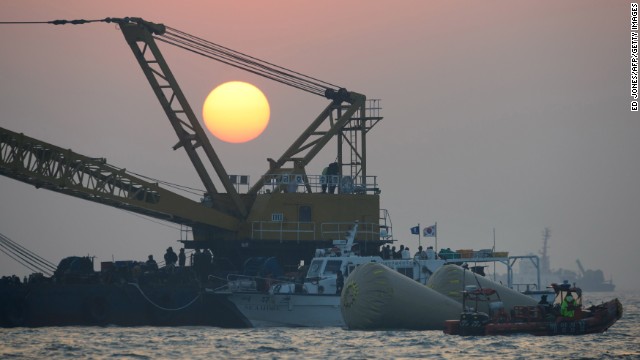
The sun sets over the site of the sunken ferry off the coast of the South Korean island of Jindo on April 22.
On Friday, South Korean prosecutors took the step of barring eight current and former officials from a maritime inspection agency from exiting the country as their investigation of the sinking of the 7,000 ton ferry Sewol continues. When it sank, it would appear that the ship was not carrying the amount of tonnage its manifest declared, but dramatically more.
The captain claimed in paperwork that the ferry he was responsible for had on board 150 cars and 657 tons of additional cargo, according to the coast guard. A vice-president at Union Transport Co., which loaded the cargo into the Sewol stated that at the time it capsized and sank it was carrying an estimated 3,608 tons. That represents three times the weight that an inspector who examined the ship during a redesign declared it was safe to carry.
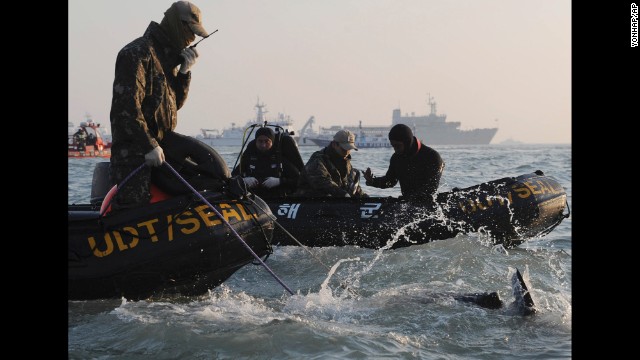
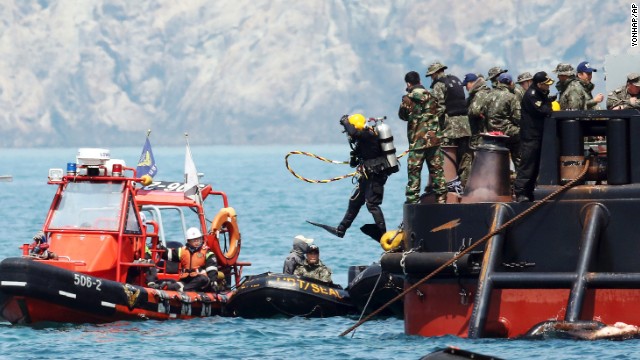
Search personnel dive into the sea on Wednesday, April 23.
The Korean Register of Shipping inspector declared that changes made to the ship resulted in its inability to safely carry no more than around 1,000 tons of cargo. His report clarified that for that cargo, it would require 2,000 tons of water as ballast for stability. The ship was capable of handling over 2,500 tons of cargo requiring only 1,000 tons of water ballast, before it had undergone those modifications altering its capacity.
Despite which the shipowner, Chonghaejin Marine Co. Ltd. reported cargo capacity of 3,963 tons. The company had chosen to completely ignore the safety specifications outlined by the inspector, leaving the permitted tonnage capacity unaltered from what was permissible before the ship had undergone redesign.
Which led Lee Kyu Yeul, in his assessment of the situation and its dreadful outcome, to theorize that the reported load could very well have primed the ship to tip, with the impetus of a significant turn. The ship turned 45 degrees before sinking, according to tracking data. Evidence from crew members' reports related they had attempted to produce a much less pronounced turn, but were unsuccessful.
Divers have so far recovered just under 200 bodies. Families who lost loved ones have much to complain about, including that some of the recovered bodies were delivered to the wrong families; identification gone awry. "There have been cases where the victims were wrongly transferred", admitted the government-wide emergency task force.
A diver jumps into the sea near the sunken ferry on Friday, April 25 Errors in identification has led to a new initiative where remains would be transferred to families henceforth only when an undeniable match could be achieved through more intensive processes using DNA testing, fingerprint, or dental records. Authorities have pledged to wait for more authoritative evidence than physical description before committing to a permanent transfer.
Prosecutor Yang Jung-jin, representing the joint investigation team, declared the sinking could be related to excessive veering, improper cargo stowage, modifications made to the ship, and tidal influence. Simulations and consultations with experts are hoped to lead to a conclusive answer as to cause.
In the meantime, the captain and eleven members of his crew have been charged and arrested for negligence and abandonment of those in need, largely 300 young students. They represent the most immediate cause of the disaster, but as will undoubtedly become increasingly evident, the guilt and responsibility will be far more widespread.
Rescue teams have entered the cargo deck on the sunken vessel
Prosecutors
in South Korea have asked a court to issue an arrest warrant for the
captain of the ferry that sank on Wednesday, officials say.
It was earlier revealed that a junior officer - and not the captain - was at the helm of the ferry when it capsized.
Efforts to find the 268 people still missing have been hampered by low visibility and strong currents.
Twenty-eight people are now known to have died in the disaster, with 179 people rescued.
Coast guard officials said on Friday two divers managed to
enter the cargo bay of the vessel, but could not identify or rescue
anyone due to items obstructing the way.
The vessel - named Sewol - had been travelling from Incheon,
in the north-west, to the southern resort island of Jeju. It capsized
and sank within a period of two hours, officials said.
Some 350 of those on board were students from Danwon High
School in Ansan, a suburb of Seoul, who were on an outing when the ferry
sank.
Investigations are focusing on the sharp turn the vessel took
before it started listing and whether an evacuation order by the
captain could have saved lives.
Rescue teams install buoys to mark the
position of the sunken ferry after the keel of the ship - visible until
Friday - disappeared under the surface
Relatives await news of their loved ones on the shore of nearby Jindo island
Some experts believe such a tight turn could have dislodged
heavy cargo and destabilised the vessel, while others suggest it could
have been caused by a collision with a rock.
In addition to the captain, arrest warrants are also being sought for two other crew members, reports say.
"The joint investigation team of police and prosecutors asked
for warrants to arrest three crew, including the captain," a coast
guard official in Makpo told AFP.
Captain Lee Joon-seok, who has already been quizzed by
police, was shown on television on Thursday apologising to the victims
and their relatives.
"I am really sorry and deeply ashamed. I don't know what to say," he said.
Maritime accidents in South Korea
1970: Sinking of passenger vessel Namyoung leaves 323 dead
1993: Sinking of passenger vessel Seohae Ferry leaves 292 dead
2007: Sinking of freighter Eastern Bright leaving 14 sailors missing
2009: Sinking of cargo ship Orchid Pia after a collision leaves 16 sailors missing
Source: Yonhap news agency
Details of the charges have not yet been made public.
The vice principal of Danwon High School, who was rescued from the ferry, was found dead on nearby Jindo island on Friday.
Kang Min-Kyu, 52, had been missing since Thursday and was
discovered hanging from a tree near the gym on Jindo island - where many
of the relatives of missing passengers have been staying.
Amid a major search and rescue operation, officials say air
has been injected into the ship to help any people trapped inside -
though officials have said that survivors are unlikely - and to help
refloat the vessel.
Three salvage cranes have reached the site, which officials
say may be used to raise the ship or move it to another area with weaker
currents.
But challenging conditions have hampered the search for a third consecutive day.
"Visibility is almost non-existent. You can hardly see your
hand in front of your face," one diver told AFP news agency after
returning from a trip.
Divers are beating back strong currents and poor visibility to try to gain access to the sunken vessel
As the hours pass, hopes of finding any survivors are fading
Students of Danwon High School leave messages for those missing in the ferry disaster
State prosecutor Park Jae-Eok earlier told journalists that the
third officer was in command of steering the ship when the accident
took place.
"Though surviving crews have different testimonies about the
situation, we've been investigating the captain as he was suspected to
leave the steering room for an unknown reason," Mr Park added.
But former ferry Captain Malcolm Shakesby told the BBC this was not uncommon.
"Depending on whether or not it was in pilotage waters, then
yes, the master would be expected to be on the bridge, but if it wasn't
in pilotage waters it's a common practice for one of the officers to be
doing navigation," he said.
Survivors have accused the crew of instructing them to remain where they were rather than evacuate the ship.
Messages and phone calls from those inside painted a picture
of people trapped in crowded corridors, unable to escape the
severely-listing ferry.
Their relatives, who have endured a long wait for news, released a statement on Friday calling for more urgent action.
"Our children would be shouting for help in the freezing
water... Please help us save our children," a representative of the
families said.
"The internal broadcast advised us to remain in our seats. But I could not stay put because the water was coming up. So I came outside with my life-jacket on." "I wonder why they didn't tell us to evacuate immediately." 57-year-old passenger on South Korean ferry
"People were shouting, Break the windows!' but the water came up too quickly and many could not come outside." Kim Seong-muk, ferry passenger
"The water rushed in, up to my neck, and it was difficult to climb to the top of the boat because it was badly tilted." "I saw shipping containers tossed off the ship's deck and floating in the water. I also saw a vending machine toppled and two girls trapped under it." Kim Tae-young, student ferry passenger
Rescue helicopters flying over the passenger ship Sewol as it sinks in waters off South Korea's southwestern coast on April 16, 2014 (Yonhap—EPA)
Kim Tae-young was in the ferry's cafeteria, and attested that many passengers remained in the cafeteria and game room when the ferry began its lean. The 6,825-tonne ferry Sewol had sailed from Incheon, west of Seoul, en route to the popular resort island of Jeju located 100 km off the south coast, when it sent out a distress signal on the morning of Wednesday, April 16. The ferry had a 920-passenger capacity, but was carrying roughly half that number.
It appears that the ship, operated by Cheonghaejin Marine, somehow sailed off course, and hit an underwater object with disastrous results. Its departure from Incheon had been delayed because of heavy fog. On the ferry besides its passengers and crew were 150 cars and trucks, somewhat below its capacity of 180.
South Korean ferry Sewol is seen sinking in the sea off Jindo April 16, 2014. (Korea Coast Guard/Yonhap/Reuters)
Even while the passengers became aware of something gone dreadfully wrong they were given instructions not to evacuate, to remain where they were. Among the passengers were 325 students from Danwon High School in Ansan, south of Seoul, embarking on a holiday. Of that number 75 have been known to have been rescued, while huge uncertainty surrounds the whereabouts of the others. The temperature of the water is around 12-C, likely to cause hypothermia in two hours.
South Korea's security ministry has stated that 174 passengers and crew had been rescued, and a handful of bodies recovered. Leaving about 284 people missing in the catastrophic sinking of the ferry. Passengers informed the media that the ship had started leaning heavily after a loud impact. The ferry later capsized and sank, only its top protruding. The ship's captain has apologized. It appears that he was one of the first to depart the ship.
That little fact of utter disregard for his responsibility toward those on the ship, and the instructions given to passengers that they should remain in their seats, speaks volumes about the professionalism of the captain, the ferry's crew and the company that operates the ferry. An executive at Cheonghaejin Marine Co., Kim Young-bung, proffered his company's "deepest apology", and somehow that has not produced much comfort to the parents collapsed in grief.
This represents a general opinion site for its author. It also offers a space for the author to record her experiences and perceptions,both personal and public. This is rendered obvious by the content contained in the blog, but the space is here inviting me to write. And so I do.
![More than 65,000 people are already in shelters in central Mozambique [Enock Muchinjo/Al Jazeera]](https://www.aljazeera.com/mritems/imagecache/mbdxxlarge/mritems/Images/2019/3/23/551032f077144639818dbca7626fb87e_18.jpg "Cyclone-hit Mozambique: cases of cholera, malaria, typhoid")