Sunday, November 30, 2014

What the Media Gets Wrong About Israel

The news tells us less about Israel than about the people writing the news, a former AP reporter says.

A Reuters truck drives through a bombed refugee camp in Gaza. (Yannis Behrakis/Reuters)

During the Gaza war this summer, it became clear that one of the most important aspects of the media-saturated conflict between Jews and Arabs is also the least covered: the press itself. The Western press has become less an observer of this conflict than an actor in it, a role with consequences for the millions of people trying to comprehend current events, including policymakers who depend on journalistic accounts to understand a region where they consistently seek, and fail, to productively intervene.

An essay I wrote for Tablet on this topic in the aftermath of the war sparked intense interest. In the article, based on my experiences between 2006 and 2011 as a reporter and editor in the Jerusalem bureau of the Associated Press, one of the world’s largest news organizations, I pointed out the existence of a problem and discussed it in broad terms. Using staffing numbers, I illustrated the disproportionate media attention devoted to this conflict relative to other stories, and gave examples of editorial decisions that appeared to be driven by ideological considerations rather than journalistic ones. I suggested that the cumulative effect has been to create a grossly oversimplified story—a kind of modern morality play in which the Jews of Israel are displayed more than any other people on earth as examples of moral failure. This is a thought pattern with deep roots in Western civilization.
But how precisely does this thought pattern manifest itself in the day-to-day functioning, or malfunctioning, of the press corps? To answer this question, I want to explore the way Western press coverage is shaped by unique circumstances here in Israel and also by flaws affecting the media beyond the confines of this conflict. In doing so, I will draw on my own experiences and those of colleagues. These are obviously limited and yet, I believe, representative.
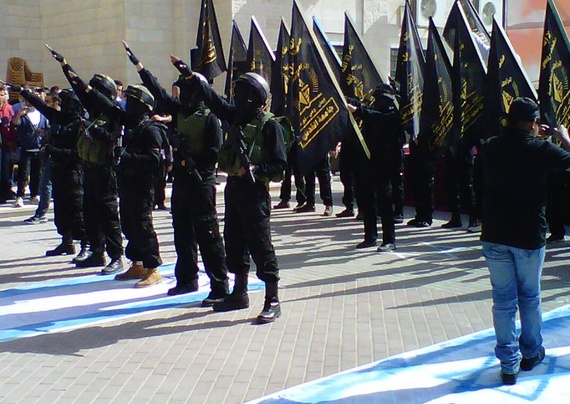
A rally in support of Islamic Jihad at Al-Quds University in East Jerusalem, in November 2013 (Courtesy of Matti Friedman)
I’ll begin with a simple illustration. The above photograph is of a student rally held last November at Al-Quds University, a mainstream Palestinian institution in East Jerusalem. The rally, in support of the armed fundamentalist group Islamic Jihad, featured actors playing dead Israeli soldiers and a row of masked men whose stiff-armed salute was returned by some of the hundreds of students in attendance. Similar rallies have been held periodically at the school.

I am not using this photograph to make the case that Palestinians are Nazis. Palestinians are not Nazis. They are, like Israelis, human beings dealing with a difficult present and past in ways that are occasionally ugly. I cite it now for a different reason.

Such an event at an institution like Al-Quds University, headed at the time by a well-known moderate professor, and with ties to sister institutions in America, indicates something about the winds now blowing in Palestinian society and across the Arab world. The rally is interesting for the visual connection it makes between radical Islam here and elsewhere in the region; a picture like this could help explain why many perfectly rational Israelis fear withdrawing their military from East Jerusalem or the West Bank, even if they loathe the occupation and wish to live in peace with their Palestinian neighbors. The images from the demonstration were, as photo editors like to say, “strong.” The rally had, in other words, all the necessary elements of a powerful news story.

The event took place a short drive from the homes and offices of the hundreds of international journalists who are based in Jerusalem. Journalists were aware of it: The sizable Jerusalem bureau of the Associated Press, for example, which can produce several stories on an average day, was in possession of photos of the event, including the one above, a day later. (The photographs were taken by someone I know who was on campus that day, and I sent them to the bureau myself.) Jerusalem editors decided that the images, and the rally, were not newsworthy, and the demonstration was only mentioned by the AP weeks later when the organization’s Boston bureau reported that Brandeis University had cut ties with Al-Quds over the incident. On the day that the AP decided to ignore the rally, November 6, 2013, the same bureau published a report about a pledge from the U.S. State Department to provide a minor funding increase for the Palestinian Authority; that was newsworthy. This is standard. To offer another illustration, the construction of 100 apartments in a Jewish settlement is always news; the smuggling of 100 rockets into Gaza by Hamas is, with rare exceptions, not news at all.

I mention these instances to demonstrate the kind of decisions made regularly in the bureaus of the foreign press covering Israel and the Palestinian territories, and to show the way in which the pipeline of information from this place is not just rusty and leaking, which is the usual state of affairs in the media, but intentionally plugged.

There are banal explanations for problems with coverage—reporters are in a hurry, editors are overloaded and distracted. These are realities, and can explain small errors and mishaps like ill-conceived headlines, which is why such details don’t typically strike me as important or worth much analysis. Some say inflations and omissions are the inevitable results of an honest attempt to cover events in a challenging and occasionally dangerous reporting environment, which is what I initially believed myself. A few years on the job changed my mind. Such excuses can’t explain why the same inflations and omissions recur again and again, why they are common to so many news outlets, and why the simple “Israel story” of the international media is so foreign to people aware of the historical and regional context of events in this place. The explanation lies elsewhere.
* * *
To make sense of most international journalism from Israel, it is important first to understand that the news tells us far less about Israel than about the people writing the news. Journalistic decisions are made by people who exist in a particular social milieu, one which, like most social groups, involves a certain uniformity of attitude, behavior, and even dress (the fashion these days, for those interested, is less vests with unnecessary pockets than shirts with unnecessary buttons). These people know each other, meet regularly, exchange information, and closely watch one another’s work. This helps explain why a reader looking at articles written by the half-dozen biggest news providers in the region on a particular day will find that though the pieces are composed and edited by completely different people and organizations, they tend to tell the same story.
The best insight into one of the key phenomena at play here comes not from a local reporter but from the journalist and author Philip Gourevitch. In Rwanda and elsewhere in Africa, Gourevitch wrote in 2010, he was struck by the ethical gray zone of ties between reporters and NGOs. “Too often the press represents humanitarians with unquestioning admiration,” he observed in The New Yorker. “Why not seek to keep them honest? Why should our coverage of them look so much like their own self-representation in fund-raising appeals? Why should we (as many photojournalists and print reporters do) work for humanitarian agencies between journalism jobs, helping them with their official reports and institutional appeals, in a way that we would never consider doing for corporations, political parties, or government agencies?”

This confusion is very much present in Israel and the Palestinian territories, where foreign activists are a notable feature of the landscape, and where international NGOs and numerous arms of the United Nations are among the most powerful players, wielding billions of dollars and employing many thousands of foreign and local employees. Their SUVs dominate sections of East Jerusalem and their expense accounts keep Ramallah afloat. They provide reporters with social circles, romantic partners, and alternative employment—a fact that is more important to reporters now than it has ever been, given the disintegration of many newspapers and the shoestring nature of their Internet successors.

In my time in the press corps, I learned that our relationship with these groups was not journalistic. My colleagues and I did not, that is, seek to analyze or criticize them. For many foreign journalists, these were not targets but sources and friends—fellow members, in a sense, of an informal alliance. This alliance consists of activists and international staffers from the UN and the NGOs; the Western diplomatic corps, particularly in East Jerusalem; and foreign reporters. (There is also a local component, consisting of a small number of Israeli human-rights activists who are themselves largely funded by European governments, and Palestinian staffers from the Palestinian Authority, the NGOs, and the UN.) Mingling occurs at places like the lovely Oriental courtyard of the American Colony hotel in East Jerusalem, or at parties held at the British Consulate’s rooftop pool. The dominant characteristic of nearly all of these people is their transience. They arrive from somewhere, spend a while living in a peculiar subculture of expatriates, and then move on.

In these circles, in my experience, a distaste for Israel has come to be something between an acceptable prejudice and a prerequisite for entry. I don’t mean a critical approach to Israeli policies or to the ham-fisted government currently in charge in this country, but a belief that to some extent the Jews of Israel are a symbol of the world’s ills, particularly those connected to nationalism, militarism, colonialism, and racism—an idea quickly becoming one of the central elements of the “progressive” Western zeitgeist, spreading from the European left to American college campuses and intellectuals, including journalists. In this social group, this sentiment is translated into editorial decisions made by individual reporters and editors covering Israel, and this, in turn, gives such thinking the means of mass self-replication. 
* * *
Anyone who has traveled abroad understands that arriving in a new country is daunting, and it is far more so when you are expected to show immediate expertise. I experienced this myself in 2008, when the AP sent me to cover the Russian invasion of Georgia and I found myself 24 hours later riding in a convoy of Russian military vehicles. I had to admit that not only did I not know Georgian, Russian, or any of the relevant history, but I did not know which way was north, and generally had no business being there. For a reporter in a situation like the one I just described, the solution is to stay close to more knowledgeable colleagues and hew to the common wisdom.

Many freshly arrived reporters in Israel, similarly adrift in a new country, undergo a rapid socialization in the circles I mentioned. This provides them not only with sources and friendships but with a ready-made framework for their reporting—the tools to distill and warp complex events into a simple narrative in which there is a bad guy who doesn’t want peace and a good guy who does. This is the “Israel story,” and it has the advantage of being an easy story to report. Everyone here answers their cell phone, and everyone knows what to say. You can put your kids in good schools and dine at good restaurants. It’s fine if you’re gay. Your chances of being beheaded on YouTube are slim. Nearly all of the information you need—that is, in most cases, information critical of Israel—is not only easily accessible but has already been reported for you by Israeli journalists or compiled by NGOs. You can claim to be speaking truth to power, having selected the only “power” in the area that poses no threat to your safety.

Many foreign journalists have come to see themselves as part of this world of international organizations, and specifically as the media arm of this world. They have decided not just to describe and explain, which is hard enough, and important enough, but to “help.” And that’s where reporters get into trouble, because “helping” is always a murky, subjective, and political enterprise, made more difficult if you are unfamiliar with the relevant languages and history.

Confusion over the role of the press explains one of the strangest aspects of coverage here—namely, that while international organizations are among the most powerful actors in the Israel story, they are almost never reported on. Are they bloated, ineffective, or corrupt? Are they helping, or hurting? We don’t know, because these groups are to be quoted, not covered. Journalists cross from places like the BBC to organizations like Oxfam and back. The current spokesman at the UN agency for Palestinian refugees in Gaza, for example, is a former BBC man. A Palestinian woman who participated in protests against Israel and tweeted furiously about Israel a few years ago served at the same time as a spokesperson for a UN office, and was close friends with a few reporters I know. And so forth.
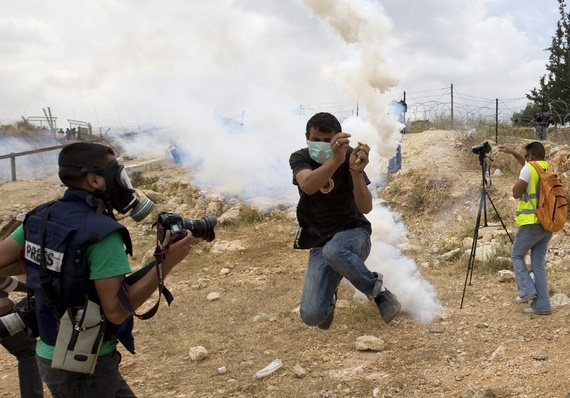
A Palestinian protester escapes tear gas fired by Israeli security forces during a demonstration in a West Bank near Ramallah. (Darren Whiteside/Reuters)
International organizations in the Palestinian territories have largely assumed a role of advocacy on behalf of the Palestinians and against Israel, and much of the press has allowed this political role to supplant its journalistic function. This dynamic explains the thinking behind editorial choices that are otherwise difficult to grasp, like the example I gave in my first essay about the suppression by the AP’s Jerusalem bureau of a report about an Israeli peace offer to the Palestinians in 2008, or the decision to ignore the rally at Al-Quds University, or the idea that Hamas’s development of extensive armament works in Gaza in recent years was not worth serious coverage despite objectively being one of the most important storylines demanding reporters’ attention.

As usual, Orwell got there first. Here is his description from 1946 of writers of communist and “fellow-traveler” journalism: “The argument that to tell the truth would be ‘inopportune’ or would ‘play into the hands of’ somebody or other is felt to be unanswerable, and few people are bothered by the prospect that the lies which they condone will get out of the newspapers and into the history books.” The stories I mentioned would be “inopportune” for the Palestinians, and would “play into the hands” of the Israelis. And so, in the judgment of the press corps, they generally aren’t news.
In the aftermath of the three-week Gaza war of 2008-2009, not yet quite understanding the way things work, I spent a week or so writing a story about NGOs like Human Rights Watch, whose work on Israel had just been subject to an unusual public lashing in The New York Times by its own founder, Robert Bernstein. (The Middle East, he wrote, “is populated by authoritarian regimes with appalling human rights records. Yet in recent years Human Rights Watch has written far more condemnations of Israel for violations of international law than of any other country in the region.”) My article was gentle, all things considered, beginning like this:
JERUSALEM (AP) _ The prickly relationship between Israel and its critics in human rights organizations has escalated into an unprecedented war of words as the fallout from Israel’s Gaza offensive persists ten months after the fighting ended.
Editors killed the story.
Around this time, a Jerusalem-based group called NGO Monitor was battling the international organizations condemning Israel after the Gaza conflict, and though the group was very much a pro-Israel outfit and by no means an objective observer, it could have offered some partisan counterpoint in our articles to charges by NGOs that Israel had committed “war crimes.” But the bureau’s explicit orders to reporters were to never quote the group or its director, an American-born professor named Gerald Steinberg. In my time as an AP writer moving through the local conflict, with its myriad lunatics, bigots, and killers, the only person I ever saw subjected to an interview ban was this professor.

When the UN released its controversial Goldstone report on the Gaza fighting, we at the bureau trumpeted its findings in dozens of articles, though there was discussion even at the time of the report’s failure to prove its central charge: that Israel had killed civilians on purpose. (The director of Israel’s premier human-rights group, B’Tselem, who was critical of the Israeli operation, told me at the time that this claim was “a reach given the facts,” an evaluation that was eventually seconded by the report’s author. “If I had known then what I know now, the Goldstone Report would have been a different document,” Richard Goldstone wrote in The Washington Post in April 2011.) We understood that our job was not to look critically at the UN report, or any such document, but to publicize it.
Decisions like these are hard to fathom if you believe the foreign press corps’ role is to explain a complicated story to people far away. But they make sense if you understand that journalists covering Israel and the Palestinian territories often don’t see their role that way. The radio and print journalist Mark Lavie, who has reported from the region since 1972, was a colleague of mine at the AP, where he was an editor in the Jerusalem bureau and then in Cairo until his retirement last year. (It was Lavie who first learned of the Israeli peace offer of late 2008, and was ordered by his superiors to ignore the story.) An Indiana-born Israeli of moderate politics, he had a long run in journalism that included several wars and the first Palestinian intifada, and found little reason to complain about the functioning of the media.

But things changed in earnest in 2000, with the collapse of peace efforts and the outbreak of the Second Intifada. Israel accepted President Bill Clinton’s peace framework that fall and the Palestinians rejected it, as Clinton made clear. Nevertheless, Lavie recently told me, the bureau’s editorial line was still that the conflict was Israel’s fault, and the Palestinians and the Arab world were blameless. By the end of Lavie’s career, he was editing Israel copy on the AP’s Middle East regional desk in Cairo, trying to restore balance and context to stories he thought had little connection to reality. In his words, he had gone from seeing himself as a proud member of the international press corps to “the Jew-boy with his finger in the dike.” He wrote a book, Broken Spring, about his front-row view of the Middle East’s descent into chaos, and retired disillusioned and angry.
I have tended to see the specific failings that we both encountered at the AP as symptoms of a general thought pattern in the press, but Lavie takes a more forceful position, viewing the influential American news organization as one of the primary authors of this thought pattern. (In a statement, AP spokesman Paul Colford dismissed my criticism as “distortions, half-truths and inaccuracies,” and denied that AP coverage is biased against Israel.) This is not just because many thousands of media outlets use AP material directly, but also because when journalists arrive in their offices in the morning, the first thing many of them do is check the AP wire (or, these days, scroll through it in their Twitter feed). The AP is like Ringo Starr, thumping away at the back of the stage: there might be flashier performers in front, and you might not always notice him, but when Ringo’s off, everyone’s off.

Lavie believes that in the last years of his career, the AP’s Israel operation drifted from its traditional role of careful explanation toward a kind of political activism that both contributed to and fed off growing hostility to Israel worldwide. “The AP is extremely important, and when the AP turned, it turned a lot of the world with it,” Lavie said. “That’s when it became harder for any professional journalist to work here, Jewish or not. I reject the idea that my dissatisfaction had to do with being Jewish or Israeli. It had to do with being a journalist.”
* * *
In describing the realities of combat in the Second World War, the American critic Paul Fussell wrote, the press was censored and censored itself to such an extent that “for almost six years a large slice of actuality—perhaps one-quarter to one-half of it—was declared off-limits, and the sanitized and euphemized remainder was presented as the whole.” During the same war, American journalists (chiefly from Henry Luce’s magazines) were engaged in what Fussell called the “Great China Hoax”—years of skewed reporting designed to portray the venal regime of Chiang Kai-shek as an admirable Western ally against Japan. Chiang was featured six times on the cover of Time, and his government’s corruption and dysfunction were carefully ignored. One Marine stationed in China was so disillusioned by the chasm between what he saw and what he read that upon his discharge, he said, “I switched to Newsweek.”

Journalistic hallucinations, in other words, have a precedent. They tend to occur, as in the case of the Great China Hoax, when reporters are not granted the freedom to write what they see but are rather expected to maintain a “story” that follows predictable lines. For the international press, the uglier characteristics of Palestinian politics and society are mostly untouchable because they would disrupt the Israel story, which is a story of Jewish moral failure.

Most consumers of the Israel story don’t understand how the story is manufactured. But Hamas does. Since assuming power in Gaza in 2007, the Islamic Resistance Movement has come to understand that many reporters are committed to a narrative wherein Israelis are oppressors and Palestinians passive victims with reasonable goals, and are uninterested in contradictory information. Recognizing this, certain Hamas spokesmen have taken to confiding to Western journalists, including some I know personally, that the group is in fact a secretly pragmatic outfit with bellicose rhetoric, and journalists—eager to believe the confession, and sometimes unwilling to credit locals with the smarts necessary to deceive them—have taken it as a scoop instead of as spin.

During my time at the AP, we helped Hamas get this point across with a school of reporting that might be classified as “Surprising Signs of Moderation” (a direct precursor to the “Muslim Brotherhood Is Actually Liberal” school that enjoyed a brief vogue in Egypt). In one of my favorite stories, “More Tolerant Hamas” (December 11, 2011), reporters quoted a Hamas spokesman informing readers that the movement’s policy was that “we are not going to dictate anything to anyone,” and another Hamas leader saying the movement had “learned it needs to be more tolerant of others.” Around the same time, I was informed by the bureau’s senior editors that our Palestinian reporter in Gaza couldn’t possibly provide critical coverage of Hamas because doing so would put him in danger.

Hamas is aided in its manipulation of the media by the old reportorial belief, a kind of reflex, according to which reporters shouldn’t mention the existence of reporters. In a conflict like ours, this ends up requiring considerable exertions: So many photographers cover protests in Israel and the Palestinian territories, for example, that one of the challenges for anyone taking pictures is keeping colleagues out of the frame. That the other photographers are as important to the story as Palestinian protesters or Israeli soldiers—this does not seem to be considered.
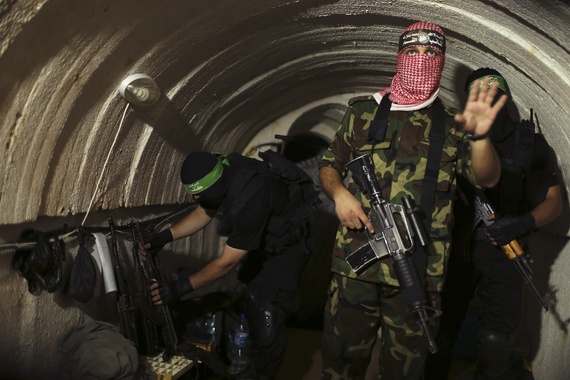
A Hamas fighter inside an underground tunnel in Gaza in August 2014, during a tour for Reuters journalists (Mohammed Salem/Reuters)
In Gaza, this goes from being a curious detail of press psychology to a major deficiency. Hamas’s strategy is to provoke a response from Israel by attacking from behind the cover of Palestinian civilians, thus drawing Israeli strikes that kill those civilians, and then to have the casualties filmed by one of the world’s largest press contingents, with the understanding that the resulting outrage abroad will blunt Israel’s response. This is a ruthless strategy, and an effective one. It is predicated on the cooperation of journalists. One of the reasons it works is because of the reflex I mentioned. If you report that Hamas has a strategy based on co-opting the media, this raises several difficult questions, like, What exactly is the relationship between the media and Hamas? And has this relationship corrupted the media? It is easier just to leave the other photographers out of the frame and let the picture tell the story: Here are dead people, and Israel killed them.

In previous rounds of Gaza fighting, Hamas learned that international coverage from the territory could be molded to its needs, a lesson it would implement in this summer’s war. Most of the press work in Gaza is done by local fixers, translators, and reporters, people who would understandably not dare cross Hamas, making it only rarely necessary for the group to threaten a Westerner. The organization’s armed forces could be made to disappear. The press could be trusted to play its role in the Hamas script, instead of reporting that there was such a script. Hamas strategy did not exist, according to Hamas—or, as reporters would say, was “not the story.” There was no Hamas charter blaming Jews for centuries of perfidy, or calling for their murder; this was not the story. The rockets falling on Israeli cities were quite harmless; they were not the story either.

Hamas understood that journalists would not only accept as fact the Hamas-reported civilian death toll—relayed through the UN or through something called the “Gaza Health Ministry,” an office controlled by Hamas—but would make those numbers the center of coverage. Hamas understood that reporters could be intimidated when necessary and that they would not report the intimidation; Western news organizations tend to see no ethical imperative to inform readers of the restrictions shaping their coverage in repressive states or other dangerous areas. In the war’s aftermath, the NGO-UN-media alliance could be depended upon to unleash the organs of the international community on Israel, and to leave the jihadist group alone.

When Hamas’s leaders surveyed their assets before this summer’s round of fighting, they knew that among those assets was the international press. The AP staff in Gaza City would witness a rocket launch right beside their office, endangering reporters and other civilians nearby—and the AP wouldn’t report it, not even in AP articles about Israeli claims that Hamas was launching rockets from residential areas. (This happened.) Hamas fighters would burst into the AP’s Gaza bureau and threaten the staff—and the AP wouldn’t report it. (This also happened.) Cameramen waiting outside Shifa Hospital in Gaza City would film the arrival of civilian casualties and then, at a signal from an official, turn off their cameras when wounded and dead fighters came in, helping Hamas maintain the illusion that only civilians were dying. (This too happened; the information comes from multiple sources with firsthand knowledge of these incidents.)

Colford, the AP spokesman, confirmed that armed militants entered the AP’s Gaza office in the early days of the war to complain about a photo showing the location of a rocket launch, though he said that Hamas claimed that the men “did not represent the group.” The AP “does not report many interactions with militias, armies, thugs or governments,” he wrote. “These incidents are part of the challenge of getting out the news—and not themselves news.”

This summer, with Yazidis, Christians, and Kurds falling back before the forces of radical Islam not far away from here, this ideology’s local franchise launched its latest war against the last thriving minority in the Middle East. The Western press corps showed up en masse to cover it. This conflict included rocket barrages across Israel and was deliberately fought from behind Palestinian civilians, many of whom died as a result. Dulled by years of the “Israel story” and inured to its routine omissions, confused about the role they are meant to play, and co-opted by Hamas, reporters described this war as an Israeli onslaught against innocent people. By doing so, this group of intelligent and generally well-meaning professionals ceased to be reliable observers and became instead an amplifier for the propaganda of one of the most intolerant and aggressive forces on earth.

And that, as they say, is the story.

Labels: , ,

Sunday, December 15, 2013

  15 December 2013

Far Right in Eastern Europe Makes Gains as Syrians Arrive

Nikolay Doychinov/Agence France-Presse — Getty Images   Members of Bulgarian nationalist groups patrolled Sofia, Bulgaria’s capital, last month, an example of “civil patrols” by nationalists in immigrant regions.

SVILENGRAD, Bulgaria — After spreading turmoil and desperate refugees across the Middle East, Syria’s brutal civil war has now leaked misery into Europe’s eastern fringe — and put a spring in the step of Angel Bozhinov, a nationalist activist in this Bulgarian border town next to Turkey.

The local leader of Ataka, a pugnacious, far-right party, Mr. Bozhinov lost his seat in the town 
council at the last municipal elections in 2011 but now sees his fortunes rising thanks to public alarm over an influx of Syrian refugees across the nearby frontier. 

Membership of the local branch of Ataka, he said, had surged in recent weeks as “people come up to me in the street and tell me that our party was right.” Ataka, which means attack, champions “Bulgaria for Bulgarians” and has denounced Syrian refugees as terrorists whom Bulgaria, the European Union’s poorest nation, must expel. An Ataka member of Parliament has reviled them as “terrible, despicable primates.” 

With populist, anti-immigrant parties gathering momentum across much of Europe, Ataka stands out as a particularly shrill and, its critics say, sinister political force — an example of how easily opportunistic groups can stoke public fears while improving their own fortunes. 

The influx of Syrian refugees has sown divisions across the European Union as the refugees add burdens on governments still struggling to emerge from years of recession. But Bulgaria is perhaps the most fragile of all the European Union’s 28 members. Modest as the numbers of refugees are here, the entry of nearly 6,500 Syrians this year has overwhelmed the deeply unpopular coalition government and added a volatile element to the nation’s already unstable politics. 

The arrival of the refugees and public fury over the stabbing of a young Bulgarian woman by an Algerian asylum seeker “has opened the floodgates” for far-right nationalists, said Daniel Smilov of the Center for Liberal Strategies, a policy research group in Sofia, the capital. “They see this as their big chance.” 

No matter how inflammatory its message or small its numbers, Ataka has had outsize leverage since inconclusive parliamentary elections in May left it critical to the survival of Bulgaria’s new socialist-led government, which has been besieged for months by protesters demanding its resignation over complaints of cronyism and corruption. 

Ataka’s denunciations of foreigners and local minorities like the Roma, or Gypsies, along with its demands for the return of “lost” Bulgarian territory, have pushed it to the forefront of a chauvinistic, nationalist trend gaining ground in several former Communist countries of Eastern and Central Europe. 

Like many populist parties in Western Europe, Ataka mixes right-wing calls for law and order and restrictions on immigration with economic policies that veer sharply to the left. But more than nationalist groups in richer countries to the West, Ataka is “virulently racist and anti-Semitic,” said Krassimir Kanev, head of the Bulgarian Helsinki Committee, an advocacy group working to improve the often dire conditions in government-run camps now housing the refugees. 

The party was more comparable to the neo-fascist Golden Dawn movement in Greece, he said, but conceded, “Ataka’s strategy works.” Yet while Greece’s government has cracked down on Golden Dawn, in Bulgaria, Ataka is in effect a government ally. “They have made the political debate harsher and harsher,” Mr. Kanev added, as Ataka and like-minded parties have defied predictions that xenophobic extremism would fade away as Europe’s poorer nations, particularly former Communist ones, became integrated into the European Union. 

Hungary’s far-right Jobbik, the third-biggest party in Parliament, stirred outrage in early November when it unveiled a statue in Budapest of a Nazi collaborator, Miklos Horthy, the country’s fascist leader during World War II. Later in November, in neighboring Slovakia, Marian Kotleba, a fiery nationalist notorious for incendiary comments about the Roma, won election as a regional governor.
Over the years, Ataka has allied itself with mainstream parties on both the right and the left, and even with an ethnic Turkish party that it previously wanted banned. 

Though Ataka won only about 7 percent of the vote and 23 seats in Bulgaria’s 240-member Parliament in the May election, this political shape-shifting has helped make it a kingmaker in the finely balanced assembly. It has used its ever-changing alliances to push through Parliament a ban on land sales to foreigners, in violation of Bulgaria’s commitments to the European Union, and also to prod the authorities to start building a high fence along part of the border with Turkey to keep out the Syrians. 

Despite its apparent opportunism, Ataka’s one constant has been its vicious rhetoric against foreigners and minorities. Alfa Television, a station operated by Ataka, denounces the refugees as radical Islamists and scroungers who will only bring violence and deeper poverty to Bulgaria.
Speaking recently on Alfa, which calls itself the “television of truth,” Magdelena Tasheva, an Ataka member of Parliament, said, “They are not refugees; they are terrorists.” She has also called them “savages,” “scum,” and “mass murderers.” She compared them to monkeys. 

Alarmed that Ataka’s rhetoric is stoking sometimes violent xenophobia, a group of longtime Syrian residents of Sofia recently filed a formal complaint against Ms. Tasheva with the country’s Discrimination Protection Commission, which said it was examining the matter. Ms. Tasheva declined to be interviewed. 

Mohammad Albramawi, a Syrian computer expert who emigrated to Bulgaria years ago and helped initiate the complaint, said he had received threatening telephone calls and was so intimidated that he had stopped speaking Arabic outside his home. “I have lived in Bulgaria for all these years,” he said, “and now I am frightened for the first time.” 

Ibrahim Ragheb, a 40-year-old father of six who fled Syria two months ago with 21 relatives, said the family planned to get to Germany but is now stranded in a holding center in a filthy school in a Sofia industrial zone. Mocking Ataka’s claims that refugees are all terrorists, he pointed to his 3-month-old granddaughter rolled in a blanket. “Does she look like Osama bin Laden?” he asked. 

Mr. Bozhinov, the Ataka leader in Svilengrad, said he had nothing against legal immigrants. But he fumed against those who sneaked across the thinly guarded border from Turkey, seeing them as a threat to Bulgaria’s and Europe’s security and economic well-being. They should be either sent back or moved on to richer countries willing and better equipped to take them, he said. 

“We are not a party of xenophobes,” he said. “But Bulgaria has lots of poor people of its own that need taking care of before refugees.” 

Syrian refugees, many of whom passed into Bulgaria after paying at least $550 each to people smugglers in Istanbul, say they have no desire to stay here, but European Union rules require that they seek asylum in the country where they are first registered and fingerprinted. 

The refugees, who mostly dreamed of getting to Germany or Sweden, say they never expected Europe to be like this. “This country is too poor,” complained Mohammed Hussein, a 24-year-old Syrian who has spent the last six weeks confined to a former military base at Harmanli, a desolate town near Svilengrad. “It is like living in a prison,” he said. 

Nikolai Tchirpanliev, a retired army colonel recently appointed to head the state agency charged with taking care of the refugees, said that the Syrians had helped wear out their welcome by complaining too much about stinking, clogged toilets and other problems in the camps and holding centers. 

“It is like when the Huns came to Europe,” he said, comparing the influx of Syrians to the wild, nomadic warriors who conquered much of Eastern Europe in the fourth and fifth centuries. Amnesty International and other groups that criticize conditions, he said, should stop condemning the Bulgarian authorities and “ask, ‘Why don’t these people know how to use toilets?’ ”

Labels: , , , , ,

Saturday, November 30, 2013

Don't Have To Like It: It's Reality!

"I am afraid that violent economic centrifuge is operating on human beings who are already very far from equal in raw ability, if not spiritual worth. Whatever you may think of the value of IQ tests, it is surely relevant to a conversation about equality that as many as 16% of our species have an IQ below 85, while about 2% have an IQ above 130,. The harder you shake the pack, the easier it will be for some cornflakes to get to the top."
"And for one reason or another -- boardroom greed or, as I am assured, the natural and God-given talent of boardroom inhabitants -- the income gap between the top cornflakes and the bottom cornflakes is getting wider than ever. I stress: I don't believe that economic equality is possible; indeed, some measure of inequality is essential for the spirit of envy and keeping up with the Joneses that is, like greed, a valuable spur to economic activity."
Boris Johnson, Mayor, London, England

The truth is, simply put, the morally elevating statement raised to the pinnacle of devotion to equality and in referred to hallowed in hushed tones as an "immortal declaration: that "all men are created equal" is all too often misunderstood. The American Declaration of Independence is a lovely document of high-minded assurance, but it is one that states simply that all men are equal under the law of the land and that they are free to engage in their pursuit of life, liberty and happiness, but there are no assurances that any of these aspirations will be achieved.

Nor does it mean that all of humankind is created with an equal endowment of genetic traits that would result in an even distribution of intelligence and capability among all persons. It is undeniable that within any society there are dullards incapable of grasping simple concepts, and there is the large middling group of individuals able to fend for themselves adequately, while beyond them exist those endowed with what might be considered more than their share of grey matter, enabling them to rise to the top of any society through their sense of curiosity, inventiveness and competence.

That rise does not necessarily result in people who assume power and more than their share of the goods of the world being outstanding citizens as human beings; many obviously are not, but they were capable of achieving office and riches by whatever means they employed, using their superior capabilities to attain what they set out to do. But to admit in polite company that we have more than our share of village dolts, and too few individuals interested in the world around them is to risk being labelled as indulging in "unpleasant elitism".

Mr. Johnson's speech which he addressed to the British Centre for Policy Studies as part of the Margaret Thatcher Lecture series, was as much and perhaps more, a cheering chorus for a free market economy and capitalism opening up the global economy to benefit as wide a range of populations as possible. Socialism and Communism were contrary ideologies attempting to counter capitalism and the end result was failure.

Individuals with disparate levels of intelligence and capabilities were to be treated as equal in the workforce, and they received, whether they were successful or failed at their enterprises, equal recompense. A kind of one-for-all and all-for-one. It didn't work. It is engrained in human nature that one is rewarded for the level of effort put into an economic-deriving activity. Those who were rewarded despite their lack of effort were complacently accepting, those who saw scant reward for prodigious effort were demoralized and stopped making the effort.

And lecturing them all, encouraging them on to perform and prove the thesis behind Marxism were the party faithful who used their hypocritical cunning -- in fact typical human behaviour --  to live in a manner nowhere near resembling that of the uncompetitive, unrewarding, dismal life of toil and scant self-respect they imposed on the great unwashed. To pave the way and ensure that no nuisance protests upset the apple cart as it was pulling into the town square, the intellectuals, the wealthy and the professionals were simply expunged from the scene.

There are two telling results from the experiment that took millions of lives and failed so spectacularly, an experiment in human and market manipulation that went gratingly against the grain that has been instilled in human nature from time immemorial. The Soviet Union eventually imploded. In North Korea, the old Marxist system prevails, the result being a grim police state, a shuttered kingdom as it were, an enforced misery of unfulfilled lives and malnutrition being the hallmarks, along with nuclear belligerence.

In China, North Korea's mentor-state, the elite were somewhat more discerning, but then they also had the burden of brutally manipulating infinitely greater numbers of people. The Chinese bureaucracy of Marxist ideology experimented just as the Soviet Union did, exhorting and exploiting their human capital and despite the deaths of millions of disposable people, who understood they must adore their tyrants or risk even greater numbers of people sacrificed to the prickly demands of their tormentors, finally surrendered to reality.

The dissolution of the Soviet Union led the remaining leadership to understand the depth of their dictatorial failure in a wholesale human-nature-manipulation experiment. Which hasn't stopped the current leadership from exerting a brutal autocracy that might be recognized as a kissing cousin to the former totalitarian rule; bullying and threatening and generally endearing itself to its former satellites who shudder uncontrollably at the very idea of having to resume that old union, frantically aligning themselves toward the West to fend off Eastern overtures.

China has recognized, just as Russia has, the advances to be made in the financial sphere through the relaxation of the old Communist ideals and the embrace of global capitalism. Their version is capitalism no matter the cause; unfettered and regulated only by the urge to grow itself into a giant of greedy entitlement, little different in fact from what is practised where the capitalist template was invented. And they have succeeded, perhaps beyond their wildest expectations. Hungering for even greater control of world trade.

Black Friday is becoming a universal event, to be celebrated not merely annually; but far more frequently. Capitalism makes a small percentage of those whose responding to its higher orders exemplifying success, rogues of immense wealth, social standing and power. Among them all or at least most of them there is a niggling sense of embarrassment at their own success. And this is the wretched little emotion that breeds philanthropy.

Apart from governments exerting the power of the state to exact a toll on such untold wealth in the manner of taxes so that a certain amount of those winnings can be redistributed at the state's will as it sees fit, grudging respect, as Mr. Johnson would have it, should be spared for the wealthy and no small amount of admiration at their success; they have earned it, in essence. By their determination, their enterprise, their capability, their intelligent manoeuvring.

"When Margaret Thatcher came to power in 1979, they faced a top marginal tax rate of 98%, and the top 1% of earners contributed 11% of the government's total revenues from income tax. Today, when taxes have been cut substantially, the top 1% contributes almost 30% of income tax, and indeed the top 0.1% -- just 29,000 people -- contribute fully 14% of all taxation."
"That is an awful lot of schools and roads and hospitals that are being paid for by the super-rich. So why, I asked, innocently, are they so despicable in the eyes of all decent British people? Surely they should be hailed, like the Stakhanovites of Stalin's Russia, who half-killed themselves, in the name of the people, by mining record tonnages of coal?"

Envy, jealousy, two of the nastier emotions that humans are given to expressing when confronted by the good fortune of those who have managed to advance their aspirations into reality by sheer intent to succeed. But of course Mr. Johnson, a highly intelligent man and an accomplished one as well, knows that very well. Mr. Johnson is more than capable of not only describing and understanding a situation, and pointing out to others how that situation arose and why it should be accepted. But he also -- a rarity -- is able to offer a solution to those who begrudge others their earnings.
"It seems to me therefore that though it would be wrong to persecute the rich, and madness to try and stifle wealth creation, and futile to try to stamp out inequality, that we should only tolerate this wealth gap on two conditions: one, that we help those who genuinely cannot compete; and two, that we provide opportunity for those who can."
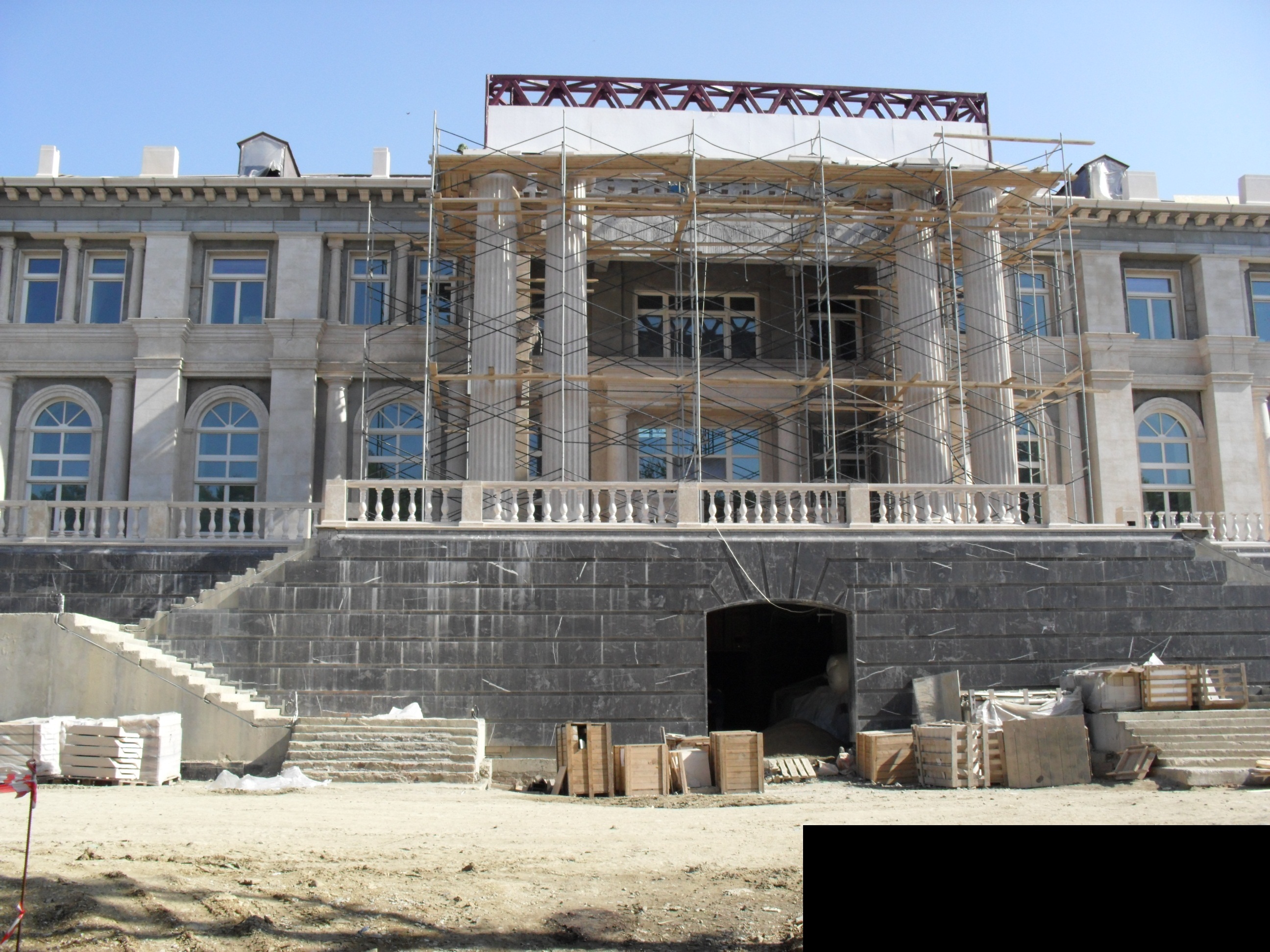
"Putin's Palace" File:Putin palace construction.jpg
Exterior of the palace under construction

Labels: , , , , , , , , , , ,

Tuesday, September 03, 2013

The Palestinian Authority's "Israeli Affairs Committee"

What is really needed is a "Palestinian Affairs Committee" that would go to every mosque, school, university, village and refugee camp in the West Bank and Gaza to talk about peace and coexistence with Israel. To win the support of the Israeli public for peace, it should start by showing the Israelis that it is making every effort to convince Palestinians to support peace.
Instead of preparing Palestinians for peace with Israel, the Palestinian Authority leadership has decided to focus its efforts on winning the support of the Israeli public for a peaceful settlement based on the two-state solution.

In the context of its efforts to "convince" Israelis to accept the two-state solution, the Palestinian Authority recently established a special "Israeli Affairs Committee" with the goal of promoting the idea among the Israeli public.

The committee's main task, in fact, is to scare Israelis that failure to accept all Palestinian demands would plunge the region into another cycle of violence and bloodshed. The Palestinian Authority is hoping that to avoid another intifada, intimidated Israelis would put pressure on their government to comply with Palestinian demands.

Over the past few weeks, in a bid to "influence" public opinion in Israel, this committee organized a series of meetings between Palestinians and Israelis, Palestinian sources told the London-based Al-Hayat newspaper.

The Palestinian committee, formed by Mahmoud Abbas, includes top PLO and Fatah officials Yasser Abed Rabbo, Nabil Sha'ath, Jibril Rajoub, Hanan Ashrawi and Mohamed Madani.

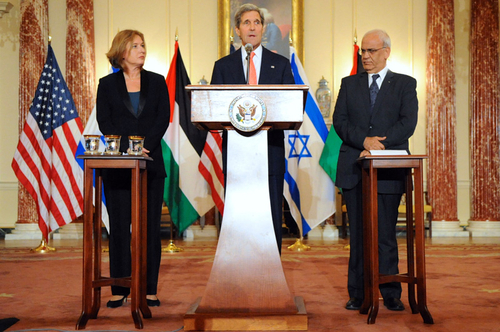
"Why should any Israeli believe the Palestinian Authority when most Palestinians appear to be opposed to the resumption of the peace talks?" asks Khaled Abu Toameh. In this photo, U.S. Secretary of State Kerry, Israeli Justice Minister Livni, and Palestinian Chief Negotiator Erekat address reporters in Washington, D.C., on July 30, 2013. [State Department photo/ Public Domain]

Last week, the committee organized visits by Israeli parliamentarians to Ramallah, where they held talks with Abbas and other Palestinian officials to discuss prospects for peace in the Middle East.
One of the committee members explained, "Those we are meeting are the leaders of Israeli society and they will decide its fate. The Israeli public no longer knows what is happening here in the Palestinian territories."

It is always nice, of course, to see Israelis and Palestinians meeting and talking to each other.
But instead of devoting its efforts and energies to trying to persuade the Israeli public to support peace, it would be more helpful if the Palestinian leaders in the West Bank also tried to win the backing of their own people for the peace process.

Why should any Israeli believe the Palestinian Authority when most Palestinians appear to be opposed to the resumption of the peace talks?

Abbas does not even have the backing of the PLO and Fatah leaderships for his recent decision to return to the negotiating table with Israel, and returned to the peace talks with Israel against the advice of the PLO leadership.

Instead of inviting Israeli parliamentarians to Ramallah, Abbas might have tried to persuade the PLO and Fatah to support his efforts to achieve peace with Israel.

The Israeli parliamentarians who met with Abbas in his office last week already support the two-state solution and the peace process.
But most PLO and Fatah leaders remain opposed to the resumption of the peace talks.

As Abbas was meeting with the Israeli parliamentarians, thousands of Palestinians in the streets of Gaza City were demonstrating against the peace talks and two-state solution.

These are the people with whom Abbas needs to work to change their hearts and minds. These are the people who need to be told that peace with Israel will only do good for the Palestinians.
Why should any Israeli believe Abbas when his own supporters continue to wage a campaign to combat "normalization" with Israel?

While Abbas feels free to receive Knesset members in his Ramallah office, other Palestinians continue to receive threats for talking to, or doing business with, Israelis.
What is needed is a special "Palestinian Affairs Committee" that would work toward preparing Palestinians for peace with Israel.

The committee members should be asked to go to every mosque, school and university in the West Bank and Gaza Strip to talk about peace and coexistence with Israel.
The members also need to visit every village and refugee camp to talk to as many people as possible about the importance of peace.

They should also meet with representatives of all Palestinian factions to try to win their support for the peace process.

It would also be a good idea if such a committee would ask the Palestinian Authority to "lower the tone" and stop rhetorical attacks against Israel that drive Palestinians towards more extremism.
Inciting Palestinians against Israel through the media and mosques only serves the interests of Hamas and other radical Palestinians. Moreover, the anti-Israel rhetoric eventually undermines Abbas and anyone who conducts peace talks with Israel.

The Palestinian Authority has chosen to "educate" Israelis about the significance of peace while it has done almost nothing to persuade its own people to move towards moderation and pragmatism.
If the Palestinian Authority really wants to win the support of the Israeli public for peace, it should start by showing that it is making every effort to convince Palestinians to support the peace process.

Related Topics:  Israel  |  Khaled Abu Toameh

Labels: , , , , , , , ,

Saturday, August 17, 2013

Errant Turn

"I am sorry that my actions hurt people. I'm sorry that they hurt the United States. At the time of my decision, as you know, I was dealing with a lot of issues, issues that are ongoing and continue to affect me.
"Although a considerable difficulty in my life, these issues are not an excuse for my actions. I understood what I was doing and the decisions I made. However, I did not fully appreciate the broader effects of my actions. Those factors are clear to me now."
U.S. Private Bradley Manning
Not his fault, poor young man. He was struggling with his sexual identity. A situation made far more complex by US military law that wanted to know nothing about the sexual orientation of its military members. Clearly the fault lies with society, with the confusion that it foists upon those considered not mainstream-gendered, and with a military apparatus that preferred not to complicate already complex relations between administration and human relations.

And then again, there is always childhood trauma to go back to; a mother who was raising a son while in a constant alcoholic stupor, and the very real possibility his "negative" personality traits represented a hallmark of fetal alcohol syndrome and Asperger's syndrome. That fairly well targets a full spectrum of social disadvantage and inherited misery. So, really -- not his fault.

The vulnerable state of this young man's persona came head-to-head with the "hyper-masculine" atmosphere prevailing in the military. His gender-identity disorder came full circle; a woman trapped in a man's body. And nowhere to turn. No release from pent-up confused emotions, no relief from the pressure, no one to confide to, nowhere to hide.

But it was within his capabilities, given his position, to take what others hid and reveal them. That might be construed as personal revenge against a system that made a mockery of the man uncertain of his malehood, feeling that nature and nurture had conspired to turn him inside out and upside down and spit him out a miserable hybrid whom society would despise.

Releasing diplomatic cables, war-zone logs and videos represented to someone who now claims to fully understand what he constructed in a monstrous lapse of intelligent judgement, a blueprint for emotional release, getting back at the system and at the society that made him something he was not and would not accept just what he was

He would prefer, at this juncture, not to be sentenced for life in prison, for the very thought of such a dread ending to a life deserving of some kind of break after serving a quarter of a century as a confused and vulnerable being, he would appreciate an life-saving alternative. Yes, he still disagrees about the choices his government made and the war its military fought.

But he realizes now that other alternatives were open to him, less spectacular and certainly far less punishing both to the country and to himself, as hapless victim of circumstances beyond his paltry control. He would like, please, to be permitted to attend college. Which would give him the opportunity to become a more "productive member of society".

In any event, his commanding officers should bear the brunt of responsibility for what poor Bradley Manning committed in betraying the trust of his country. Their oversight of the mentally-distressed young man should have yielded the realization that he was in no condition to be trusted and to be entrusted with the vital data he was permitted to manipulate.

So there, y'all.

Labels: , , , , , ,

Saturday, March 16, 2013

It may not beat the unbridled anti-Semitism expressed by British peer, Lord Nazir Ahmed, who, according to the Times of London, blamed Jews “who own newspapers and TV channels” for his 2009 jail sentence for his role in a fatal car accident. But you have to give Guardian assistant editor Michael White credit for trying.

The trouble started on Thursday when Times columnist Daniel Finkelstein posted a tweet wondering why the BBC had made no mention of the Lord Ahmed story. The tweet apparently annoyed White enough to generate the following unbelievable exchange, dragging settlements into the discussion for no reason:


And that was only the beginning.

As more people challenged White’s apparent need to bring Israel in out of the blue, White dug deeper into his position, sparring with everyone from Jeffrey Goldberg to host of Tweeters puzzled by his increasingly obscure arguments and insults.

Finally, White unleashed his best defense for the BBC’s failure to report thye brazen anti-Semitism from a Peer. The delay was caused by the BBC’s need to check its sources since Lord Ahmed’s interview was conducted in Urdu for a Pakistani network. It’s an ironic argument, especially in light of last week’s UN report clearing Israel in the killing of a child in Gaza which the BBC had previously – and incorrectly – blamed on Israel.


Standards do matter, Mr. White, but apparently not when it comes to Israel. Oh well, must be because of those settlements…

Labels: , , , , ,

Wednesday, March 13, 2013

Holy Smoke! Meet Pope Francis. He Has One Lung, Loves the Bus, and Hates Gay Marriage.

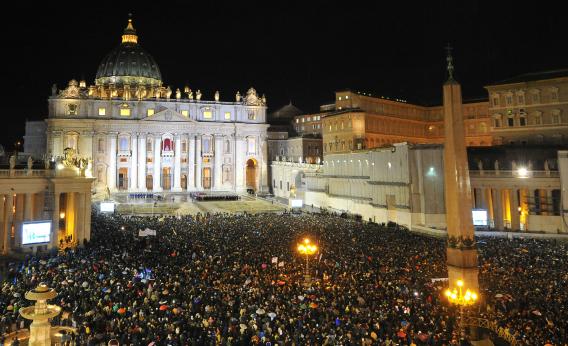
The crowd at St Peter's Square after white smoke billowed from the chimney of the Sistine Chapel announcing that Catholic Church cardinals had elected a new pope during a conclave on March 13, 2013, at the Vatican.
The crowd at St Peter's Square after white smoke billowed from the chimney of the Sistine Chapel announcing that Catholic Church cardinals had elected a new pope during a conclave on March 13, 2013, at the Vatican. Photo by Tiziana Fabi/AFP/Getty Images

And the new pope is: 76-year-old Jorge Mario Bergoglio from Argentina, who will now be known as Pope Francis.

His papal selection gives the Catholic Church its first non-European Holy Father in more than 1,000 years and represents something of an upset in what has traditionally been an unpredictable selection process. Bergoglio didn't crack most short-lists heading into the conclave, and was a major (33-1 at one point) underdog in the eyes of online bookies, making his selection that much more surprising because it happened on only the second day of voting.

At 76, Bergoglio is on the older side for election as pope. He's also an unconventional choice for a couple of other reasons: He's the first Jesuit pope in the church's history, and he's the first to hail from the Americas (although his father was an Italian immigrant). Perhaps fittingly, as his lack of a Roman numeral would imply, he's the first pope to assume the name of Francis. Oh yeah, and he has only one lung, having lost the other to an infection when he was a teen. Here's USA Today with a few more interesting tidbits about his simplistic life style:

Despite being Argentina's top church official, Bergoglio never lived in the ornate church mansion in Buenos Aires, preferring a simple bed in a downtown room heated by a small stove. For years, he took public transportation around the city and cooked his own meals.
The Catholic News Service describes his leadership style as "low-key and close to the people" and notes that to many in Buenos Aires, he is—or we suppose, was, now that he got the promotion of all promotions—known simply as "Father Jorge."


Here's how the National Catholic Reporter handicapped his chances heading into the conclave:
Though it's hard to say how seriously one should take the specifics, the general consensus is that Bergoglio was indeed the "runner-up" last time around [in 2005]. He appealed to conservatives in the College of Cardinals as a man who had held the line against liberalizing currents among the Jesuits, and to moderates as a symbol of the church's commitment to the developing world. ...
Another measure of Bergoglio's seriousness as a candidate was the negative campaigning that swirled around him eight years ago. Three days before the 2005 conclave, a human rights lawyer in Argentina filed a complaint charging Bergoglio with complicity in the 1976 kidnapping of two liberal Jesuit priests under the country's military regime, a charge Bergoglio flatly denied. There was also an e-mail campaign, claiming to originate with fellow Jesuits who knew Bergoglio when he was the provincial of the order in Argentina, asserting that "he never smiled."
Like many Latin American cardinals, Bergoglio has previously placed an emphasis on social justice and poverty work. Still, he is nonetheless seen by most as a theological conservative, like the man he is replacing. Unsurprisingly—but still noteworthy—is the fact that he waged an ultimately unsuccessful push to prevent Argentina from becoming the first Latin American country to legalize gay marriage, and declared that allowing gay couples to adopt children was discrimination against children.

Labels: , , , , ,

Friday, March 08, 2013

UN Verifies That Hamas Rocket Killed Gaza Child Whose Death Was Blamed on Israel

March 8, 2013 2:04 pm 

Jihad Masharawi tragically lost his infant child during the Hamas-Israel conflict. 

The UN Human Rights Council released an advanced version of its report on Israel’s November conflict with Gaza terrorists this week. The report is unusually fair to Israel, and disputes several claims made by Western media against Israel during Operation Pillar of Defense. Most significantly the report says that in all likelihood the 11-month-old child of a BBC employee Jihad Misharawi was killed during Operation Pillar of Defense by Hamas rocket fire rather than by Israel, the side initially blamed in reports by the BBC and several other media outlets covering the conflict.

The UNHRC report says:
“On 14 November, a woman, her 11-month-old infant, and an 18-year-old adult in Al-Zaitoun were killed by what appeared to be a Palestinian rocket that fell short of Israel.69
The footnote (69) says the case was monitored by the UN OHCHR, meaning that the UN itself investigated this case and believes that the attack came from a Hamas rocket.

A picture of the mourning father holding his recently deceased son became a symbol of Israel’s campaign in Gaza. His father was working as a stringer there and at the boy’s funeral blamed his son’s death on “the Jews.”

Labels: , , , ,

Monday, March 04, 2013

Islamic Exceptionalism

"If Israel wants to hear positive statements from Turkey, it needs to review its attitude. It needs to review its attitude toward us, and it needs to review its attitude toward the people in the region and especially the West Bank settlements issue."
Ahmet Davutoglu, Turkish foreign minister
Israel, in other words, should be more relaxed about the presence of Islamists seeking to find passage through waterways controlled by the State of Israel for the express purpose of shattering the blockade meant to shelter Israel from the prospect of Hamas importing arms and ammunition into Gaza, under the pretext of bringing in needed supplies for the people of Gaza.

And when armed groups attack Israelis, forbearance should be the order of the day, not self-protective reaction resulting in the untimely deaths of those who have been demonstrated to be the attackers. Turkey worries the bone of contention over where the responsibility lies, like a pitbull enraged by having been shown to be a danger to society, requiring to be sequestered for the safety of civil society.

Turkey takes issue with Israel seeking to protect its citizens from the incursions of those seeking to terrorize them. Ankara and Prime Minister Erdogan remain concerned over the welfare of Palestinians, and decry Israel's actions toward the Palestinians as oppressive. Somehow Turkey makes no connection to its own refusal to permit Kurds living in Turkey to be autonomous and self-sustaining.

What is fine for the turkey is not all that well for the gander.  In addressing the UN Alliance of Civilizations conference in Vienna this past week, Mr. Erdogan expressed his complaints over perceived prejudice against Muslims. Any thoughtful intelligence might think first about why it is that the world's most desperate situations of conflict and atrocities are committed by Muslims. And most often one Muslim sect committing bloodshed against another.

At the conference he claimed Islamophobia should be considered a crime against humanity "just like Zionism, like anti-Semitism and like fascism." The discrimination faced by Christians in Islamic nations is fierce and growing more fraught with each passing day as churches are torched and destroyed and Christians beaten and killed, just as occurred with Jews in those countries.

Islamic countries view the presence of religious minorities an affront to Islam. They offer no conciliatory protection toward even their own citizens of their own ethnic groups who prefer to worship a religion other than Islam. Yet they view the ages-old longing of Jews to return to their place of historical origin as fascistic? 

Tolerance for other religions is not high on the Islamic agenda, yet Muslims insist that they are owing respect by others.

Labels: , , , , , , , , ,

Wednesday, February 27, 2013

February 27, 2013 14:13 by
 
When is a terrorist not a terrorist?

Apparently, when it doesn’t fit the media’s narrative, like the coverage of Arafat Jaradat, who died in an Israeli prison this week.

Jaradat, a member of the al-Aqsa Martyrs Brigade, was arrested for throwing stones that wounded an Israeli civilian. Five days later, he died of a possible cardiac arrest.

The death became an international story when Palestinian officials claimed the autopsy report indicated he died as a result of torture. Israeli officials countered that the autopsy was inconclusive and what the Palestinians were calling signs of “torture” – bruises on his chest and broker ribs – may have been efforts to revive Jaradat after his heart failure.

Regardless of how he died, the media has an obligation to tell the truth about who he was, not to cherry-pick elements of his biography to give him a particular image. The Los Angeles Times, to its credit, was one of the few media outlets to include information about Jaradat’s terrorist affiliation, noting:
Musa Jaradat said his cousin had never been arrested before, but was a member of the Fatah Youth Movement and, according to Al Aqsa members who attended his funeral, part of the West Bank military brigade.

The Irish Times, the Sydney Morning Herald, and McClatchy News were the only other major publications to note Jaradat’s membership in the terror group.

Beyond those notable exceptions, the media bent over backwards to whitewash Jaradat and even, in some cases, the fact that he committed a violent crime. Here is how the New York Times described Jaradat and what he did:

After weeks of intensifying protests in solidarity with the hunger strikers, attention turned Sunday to Mr. Jaradat, who relatives said worked at a gas station, was the father of a 4-year-old girl and a 2-year-old boy, and came from a family in which all the men had spent time in Israeli jails. He was arrested last Monday over throwing stones at Israeli cars near a West Bank settlement during November’s conflict between Israel and the Gaza Strip.

The Times takes pains to present Jaradat as a family man with two small children and a regular job, but ignores the fact that he was a member of  a group designated as a terrorist organization by the US and the EU.
 
The New York Times also downplays the violence of stone throwing. It notes a general fact about what Jaradat did, where he did it, and when. But it completely ignores the fact that there was at least one victim. New York Times readers would never know that Jaradat was directly responsible for injuring someone.

In fact, the treatment the stone throwing incident is consistent with the general trend of coverage that downplays stone throwing as a minor offense, not as an act of violence. As more media coverage of a burgeoning Third Intifida surfaces, it is essential that the media cover stone throwing as acts of violence capable of wounding and even killing innocent victims.

CNN‘s coverage improved on the NY Times slightly. It included information about the Jaradat’s crime, but still ignored his membership in a terrorist organization: “Jaradat had been held for interrogation since Monday for a 2011 incident in which an Israeli citizen was injured by rock-throwing Palestinian protestors. Jaradat confessed, Israeli security sources said,” CNN reported.

And it wasn’t just the New York Times and CNN that ignored Jaradat’s ties to terror, sticking to the established narrative of Jaradat as an upstanding citizen devoted to his family. Other publications that covered the story without mentioning the ties to al Aqsa Brigades included the Washington Post, Christian Science Monitor,The Guardian,and The Independent,. among other media outlets.

There is a world of difference between reporting that a violent terrorist died in Israeli custody versus the prevailing narrative that a beloved father of two was tortured to death by Israel. As the story of Jaradat’s death continues to unfold, the media has an obligation to expose the public to Jaradat’s entire biography, not just those facts that are likely to draw sympathy.

Labels: , , , , , ,

Follow @rheytah Tweet