Palestinian Water (and Martin Schulz)
The Lack of Logic
The supporters of the
Palestinians think that by alleging a higher per capita use of water in
Israel they are accusing Israel, but instead they are emphasizing the
failures of the PA (here as in many fields). And while the Israeli
spokesman thinks that he is defending Israel with his lower per capita
figure, he is actually defending the PA against the charge of
incompetence.
The obligation upon Israel to supply water to the PA from aquifers in
Israel has nothing to do with whether the Palestinian population is two
million or four million or a hundred million, if that is what the
Palestinians want. That obligation derives from the amount of rainfall
in the mountains of the West Bank, and from nothing else.
Martin Schulz, the President of the European Parliament, is a
phenomenon that Israelis should appreciate: a leading European
politician who is a fervent admirer of their country. As such, he
accepted an invitation to address the Knesset, Israel's parliament, on
February 12, 2014. The Jewish Home party of Naftali Bennett, however,
reacted with demonstrative fury to a sentence in that speech which
referred to the water usage of Israelis and Palestinians. Quite
naturally, the media pounced on that reaction, with the result that his
praise of Israel went to waste and the whole matter continues to be
surrounded by confusion.
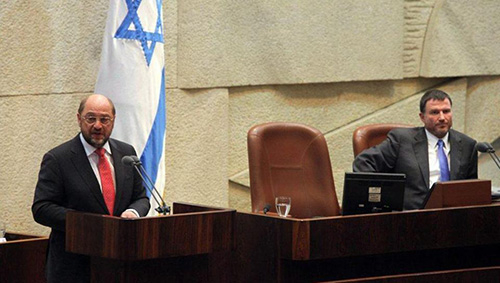
Martin Schulz (left), President of the European Parliament, addresses Israel's Knesset. (Image source: Knesset handout)
|
In what follows, we shall be partly involved in establishing the
facts of the case, but only in small part and without, say, going out to
measure water usage ourselves. Rather, the emphasis will be on showing
that there is generally no logical relationship between the facts
alleged and the conclusions drawn from them for propagandistic purposes.
First, here is exactly what Mr. Schulz said, quoting some
Palestinians that he had met in Ramallah: "One of the questions of these
young people, which most moved me, was: How can it be that Israelis are
allowed to use 70 liters of water per day, but Palestinians only 17?"
("
Einer der Fragen dieser jungen Menschen, die mich am meisten bewegt
hat, war: Wie kann es sein, dass Israelis 70 Liter Wasser am Tag
benutzen dürfen und Palästinenser nur 17?" Here we have translated word for word from the German rather than use the official translation, which is freer.)
In the current
English version
of his speech, posted on the official site of the EU Parliament
Presidency, the following disclaimer has been inserted into the
sentence: "although I could not check the exact figures" ("wobei ich die
genauen Zahlen nicht nachschlagen konnte" in the official
German version). At the time of writing, however, the sentence
without the disclaimer is
still available in the version of the speech on the website of the
Frankfurter Allgemeine Zeitung
and probably elsewhere, whether on internet or in printed newspapers.
Moreover, he can be heard saying it in that form in the Knesset, without
any disclaimer, in video clips
here and (behind the Hebrew voice-over)
here.
It was understandable that Mr. Schulz or his aides wanted to put the
matter straight by making that admission in the versions preserved for
posterity. By doing so, however, the fury of Mr. Bennett and his party
has been made less understandable. They were upset because organizations
such as Amnesty International have used such comparisons of water usage
to make
outrageous claims
against Israel. Yet Mr. Bennett's party was wrong to accuse Mr. Schulz
of lying: the latter had truthfully said that a Palestinian has asked
him that question.
Moreover, Mr. Schulz was a double victim: he was both actively misled
by Palestinians and passively misled by Israelis. Between his visit to
Ramallah and his appearance in the Knesset, he was invited to a dinner
hosted by Lars Faaborg-Andersen, the EU Ambassador to Israel.
As reported in
Israel Hayom
"Among those in attendance was Naomi Chazan, a former Meretz MK and
deputy Knesset speaker who is now a director in the left-wing NGO New
Israel Fund; Yossi Beilin, former Meretz leader and cabinet minister and
one of the architects of the Geneva Initiative; Ron Pundak, who helped
draft the Oslo Accords in 1993 and is a former director-general of the
Peres Center for Peace; Akiva Eldar, former Haaretz correspondent, and
Professor Manuel Trajtenberg, chairman of the Planning and Budgeting
Committee at the Council for Higher Education. Labor MK Hilik Bar was
the only politician at the event. No government or right-wing
representatives were invited."
Mr. Schulz, wrote the newspaper, "said that he had just visited the
Palestinian Authority, where he had been told that Israel did not
distribute water fairly. He also said he was told of infringements on
Palestinian freedom of movement. No one in the audience challenged
Schulz on the facts or tried to set the record straight."
After the speech in the Knesset, Mr. Bennett demanded an apology from
Mr. Schulz. But it is rather Mr. Bennett who should have apologized for
an impetuous and churlish reaction to a friendly speech that praised
the return of the Jews to their homeland, hailed the achievements of the
State of Israel, and affirmed: "Acting responsibly means for us a clear
avowal of Israel's right to exist and the right of the Jewish people to
live in security and peace. The European Union will always stand at the
side of Israel" ("Verantwortliches Handeln, das bedeutet für uns: ein
klares Bekenntnis zum Existenzrecht Israels und zum Recht des jüdischen
Volkes, in Sicherheit und Frieden zu leben. Die Europäische Union wird
immer an der Seite Israels stehen.").
In the meantime, Mr. Bennett took the opportunity of a visit to
Brussels to ask for a meeting with Mr. Schulz. Water was not discussed,
according to
reports,
but "a positive atmosphere prevailed" ("während des Gesprächs herrschte
eine positive Atmosphäre"). Although neither made any apology, they
agreed on the need for continued cooperation and Mr. Bennett gave Mr.
Schulz an ancient coin. Thus much Mr. Bennett made amends for his and
his party's behavior. To expect an apology from the dinner guests is
probably too much.
The European Ambassador, by the way, is in a different class. According to
another report in
Israel Hayom,
he wields both a big stick and a big carrot at Israelis and
Palestinians alike, offering to shower upon them financial benefits it
they reach peace and threatening them with penalties if they do not. He
adds that if the EU decides to cut its vast subsidies to the Palestinian
Authority (PA), "I think there is a great likelihood that Israel would
have to provide far more." But he is new on the scene: he has only just
presented his credentials
to Israeli President Peres and has time to learn. Israelis will not
sacrifice their security, however big the stick. Palestinians, whether
in Ramallah or in Gaza, will not abandon their ultimate aim of engulfing
Israel in a unitary Palestine, however many carrots are thrown at them.
The Hamas regime makes no secret of that aim; in the PA it is expressed
in numerous
petty ways or by demands for the "right of return."
Everyone is agreed, says the
Jerusalem Post, that the figures mentioned by Mr. Schulz
were wrong.
Friends of the Palestinians say that 70 liters of water per day is the
Palestinian figure (or rather 100 liters, of which 30 liters go to waste
in faulty infrastructure), while Israelis have 250 liters a day, so the
ratio is still close to 4:1. Uri Schor of the Israel Water Authority
counters that the figures are more likely 110 liters per Palestinian and
something under 170 liters per Israeli. Since January 2012, a
36-page study of the issues by Prof. Haim Gvirtzman has been available online. One can also consult almost thirty briefs on
water in the Middle East produced by CAMERA since 1995.
But this battle of ratios is not merely bewildering; it is irrelevant
to what the spokespersons for each side are trying to prove. Behind the
battle is the assumption is that a high ratio proves Israeli injustice
to the Palestinians, whereas a low ratio shows that Israel is better
than you thought. The conclusions for the propaganda war, however,
should be the other way round.
Over 95% of the Palestinians live in Gaza and the officially termed
"Areas A and B" of the West Bank, which were turned over to Palestinian
rule in 1995 (the differences between Areas A and B are immaterial
here). Since Hamas seized power in Gaza in 2007, of course, the PA is
now directly responsible only for those Areas A and B. Israel is
responsible for its own pre-1967 areas and for "Area C" of the West
Bank. Note that Jewish settlers live
only in Area C, where they outnumber the resident Palestinians.
In the meantime, however, the settlers have been connected to the
Israeli water grid; they do not draw water from the Palestinian grid.
Consequently, if Israelis, be it in Israel or as settlers in Area C,
enjoy much more water per capita than Palestinians, the relevant
implication should be that the State of Israel is doing a much better
job than the PA and Hamas in supplying water to the populations under
their respective rule.
So the supporters of the Palestinians think that by alleging a higher
per capita use of water in Israel they are accusing Israel, but instead
they are emphasizing the failures of the PA (here as in many fields).
And while the Israeli spokesman thinks that he is defending Israel with
his lower per capita figure, he is actually defending the PA against the
charge of incompetence.
That is the simple answer. It will be objected, loudly, that the
situation is not so simple. Indeed, it is not. But we shall see that the
complex answer is the same as the simple answer, at least in respect of
phony accusations against Israel.
For one thing, it is undeniable that Israel has invested much money
and expertise in expanding its sources of water. It is a world leader in
recycling waste water and in desalinating sea water. Whereas just a few
years ago recurrent droughts were becoming a nightmare, today Israel
has ample water. Only the price of water has also gone up: everyone pays
markedly more on the basic rates and there is a punitive charge for
households that use more than a certain upper limit of water per capita.
With expertise come exports. Bloomberg
recently reported
how "North of San Diego, Israel's IDE Technologies Ltd. is helping to
build what it says will be the largest seawater desalination plant in
the Western Hemisphere." That is just the biggest of Israel's overseas
desalination projects.
The Palestinians have done none of that. On the contrary, wastage of
water from leaky pipes and plain theft of water are rampant. The PA
complains that it cannot stop all that in Area C, but what about the 95%
of Palestinians who are indeed subject to the fearsome multiplicity of
Palestinians security services? A friend who just came back from a West
Bank town reported hearing from the locals that there nobody pays water
bills or even municipal taxes. This may have been boastful exaggeration,
but it testifies to an attitude.
There is, however, one major complicating factor in the West Bank.
Amid all the shouting about ratios, you will rarely find it mentioned,
so here it is. Rain falls predominantly on the mountain ridge running
from Jenin in the north to Hebron in the south, all of which, except
Jerusalem, is ruled by the PA. But most of the rain goes underground and
emerges far away in aquifers in pre-1967 Israel. So who owns this
water? Similar problems occur elsewhere in the world, but there is no
generally accepted legal procedure for solving them. The second Oslo
Accord of 1995 dealt with the issue by decreeing an annual quantity of
water that Israel would supply from its own sources to the PA. Before
1967, of course,
none of that water was given to the Palestinians.
Up to 1995, that is, Israel was responsible for the supply of water
to every individual Palestinian. In 1995, that responsibility was
transferred to the PA, except for the few Palestinians who reside in
Area C. Israel no longer has any obligation to
individual Palestinians in Gaza or in Areas A and B of the West Bank, but only an obligation to provide a
global
amount of water from within Israel to the PA, an obligation that it has
fulfilled. Since 1995, therefore, the per capita figure of water
available to a Palestinian in Ramallah or in Gaza is a criterion
exclusively for evaluating the performance of the PA or Hamas
respectively, not of Israel. The complex answer is indeed the same as
the simple answer.
Thus the real mistake of Mr. Schulz was not that his figures were false but that his figures were
irrelevant
to any evaluation of Israeli responsibilities. To quote such figures
was irrelevant in a speech made to Israelis in the Knesset. Moreover, to
insert the disclaimer after the event (a dubious move in itself) did
not eliminate his mistake but merely compounded the confusion.
Note that in Gaza the situation is the opposite of that in the West
Bank. In ancient history, Gaza and other flourishing settlements were
built where a geological formation accumulates water and dew (an
important factor in that area) that fall today partly in Israel.
Strangely, nobody has suggested that if Israel is obliged to send water
back into the West Bank, then Gaza should send water back into Israel.
On the contrary, Palestinians have drawn so much water from legal and
illegal wells in the Gaza Strip that the ancient water system has been
invaded by sea water and may soon be completely destroyed. So the Hamas
regime is becoming increasingly dependent on water from Israel, all the
while threatening Israel with destruction.
Gaza, of course, is the one place where the Palestinians could build
desalination plants. Only, say the Palestinians, Israel is obstructing
it. That complaint serves to distract attention from the implications of
Hamas rule in Gaza, so let us recall those implications.
To begin with, the Hamas regime is an offshoot of the Egyptian Muslim
Brotherhood and is clandestinely helping the Brotherhood in its
struggle against the new Egyptian military regime. The Egyptian army's
reaction includes the systematic
destruction of houses
on its side of the border with Gaza, in order to end the two-way
smuggling of personnel and goods via tunnels between Gaza and Sinai.
Gaza has thereby become totally dependent on Israel as a source of
supplies, including metals and building materials. These the Hamas
regime is using to create a new arsenal of rockets and a vast network of
underground tunnels in preparation for its next assault on Israel (as
recently reported by the
Times of Israel). The tunnels included a recent one that penetrated into Israel, from which Hamas hoped to kidnap more hostages like
Gilad Shalit. After discovering all that, Israel
clamped down again on the supply of cement to Gaza.
If Gaza had a government genuinely devoted to the wellbeing of its
citizens, then it would cut all relations with Ramallah and negotiate a
separate peace with Israel. After that, besides building desalination
plants, it could make its population rich by developing the natural gas
field in its territorial waters.
Instead, the Hamas regime's overriding concern is to turn its
citizens into an army indoctrinated with the supreme aim of "liberating"
cities in Israel. Recognition of Israel, let alone negotiations, is
totally excluded. It is hardly surprising that Israel does little more
for the Hamas regime than suffices to keep Gazans alive.
So who pays the bills for the water and electricity from Israel on
which Gaza depends? The PA in Ramallah. Only it does not pay: it owes
hundreds of millions of shekels to Israel because it fails to collect
bills owed to it by its own Palestinian customers.
Desalination in the West Bank, of course, is not a possibility, but
recycling of waste water would be. To date this hardly happens and the
Palestinians blame Israel. Let us look into their arguments.
To begin with, the PA has no money to spend on sewage treatment
schemes. This is because the PA has no money to spend on anything, but
depends on massive financial support from donors, principally the EU and
the US. Its tax revenues consist mainly of duties on imports, which are
collected on its behalf and turned over to it by Israel. Among the
reasons for the recent fall of Palestinian Prime Minister Salam Fayyad
was his attempt to introduce a fair
income tax.
The money, therefore, has to come from donors, while the sewage
plants would have to be built mainly in Area C of the West Bank. Here
Israel demands the creation of plants to serve both Palestinians and
Jewish settlements alike. But the donors reject that demand, saying that
they will give money only to serve Palestinians.
Here both the Palestinians and the donors have blinded themselves
with ideology. If they thought rationally, they would realize that if
Jewish settlements are handed over to the Palestinians, as they demand,
these settlements will need sewage plants
then, so why not build them
now?
Almost everyone except Naftali Bennett's party anticipates that if
there is ever a final peace treaty, then Jewish settlements, at least
scattered isolated ones, will be evacuated.
Moreover, Israel and the West Bank are so intricately interwoven that
the management of sewage will have to transcend any final border
between the two. Practical reason would demand that the whole area be
split into its geographical components and that a relevant scheme be
devised for each of these, regardless of peace negotiations. But
practical reason is constantly trumped by ideology, especially when the
PA can abdicate its responsibilities to donors.
Another complaint of the Palestinians is that the Oslo Accord of 1995
was supposed to be replaced by a permanent settlement five years later,
but twenty years have passed and much has changed. Agreed, but what has
changed? Mainly, that the Palestinian population has doubled, or so the
Palestinians say, just as it doubled in the previous twenty years.
But why is this an argument that Israel is now obliged to supply
twice as much water from its own water sources? The obligation upon
Israel to supply water to the PA from aquifers in Israel has nothing to
do with whether the Palestinian population is two million or four
million or a hundred million, if that is what the Palestinians want.
That obligation derives from the amount of rainfall in the mountains of
the West Bank, and from nothing else.
The Palestinians would have an argument if the rainfall had doubled
in the meantime. But the last decade has been one of droughts. The
winter of 2012-13 was an exception, but 2013-14 looks to be another
drought year. So if "what has changed" is to be the criterion, then
Israel could demand a reduction in its obligation. In fact, or so the
Israelis say, Israel is supplying more water than it committed to in
1995.
A further complaint is that Israel is demanding higher standards for
any new sewage plants in Area C than for many plants in Israel itself.
But this is to ignore the fact that Israel is constantly raising its own
standards, just as the EU is constantly raising standards for gas
emissions from cars. The complainants are simply refusing to admit that
Israel has developed a high culture of dealing with waste water, which
is becoming a model for much of the world except, apparently, for
Palestine.
Once again, we see that the Palestinian complaints about their water
situation are specious arguments based on irrelevant facts. Their
arguments serve merely to distract attention from their own massive
failure to provide for the needs of their population.
Mr. Schulz understandably felt
hurt and disappointed by the response to what he felt was a
pro-Israel speech.
So let us give that speech a little of the due attention that it failed
to receive. Here (as opposed to the remark about water) the quotations
will be taken from the official English translation, since its stylistic
adjustments do not affect the essence of the original German.
The speech began with his thanks for being permitted to speak in
German. Although this was his right, in retrospect it may seem to have
been a mistake. Had he spoken in English, many would have understood his
words immediately and doubtless applauded at appropriate places. The
awkward point about water might then have been met with mere silence.
What are intended as warm words do not have the same impact when one
hears them in the jerky monotone of simultaneous translation.
Two main elements can be detected in the speech. On the one hand, as
President of the European Parliament, Mr. Schulz was obliged, as he
emphasized in later interviews, to relay views widely expressed in that
body. That is, all the usual European clichés about the Arab-Israeli
conflict. This element was prominent in the later paragraphs of the
speech.
The other element was his own personal sympathy for, and admiration
of, Israel. That was evident throughout the earlier paragraphs of the
speech, but also reappeared in the later part. "The crimes committed by
the Nazis," he said, "were the reason I became involved in politics,"
and he went on to decry the reappearances of anti-Semitism in today's
Europe. So "Israel," he said, "embodies the hope cherished by a people
of being able to live a life of freedom in a homeland of their own. As a
result of the actions of brave men and women, Israel represents the
realisation of that very human dream." He then went on to praise
Israel's achievements in a paragraph that deserves quotation in full:
"Today, Israel is a robust democracy, a vibrant, open
society with all the conflicts that implies, and a modern economy. The
kibbutzim which once made the desert bloom have been replaced by
hundreds of start-ups and high-tech research centres in which work is
being done which will lead to the inventions of the future; minute
microchips and robots, computer tomography and ultrasound scanners.
Israeli researchers are world leaders in many areas. Israel has only
eight million inhabitants, but it can boast seven major research
universities, including the Technion in Haifa and the Weizmann Institute
in Revlion [sic], and 12 Nobel Prize winners!"
"Israel," he proclaimed, "has built a society founded on the values
of freedom, democracy and the rule of law. Israel and the European Union
share these values." On this basis he surveyed the recent developments
in neighboring countries, especially the "ever more brutal escalation of
violence" in Syria, "The Assad regime would rather massacre its own
population than give up power! Even children are being tortured and
killed. The opposition is also guilty of perpetrating appalling
massacres and recruiting child soldiers." He expressed understanding for
Israel's fears about Iran and for "what it means for parents in Sderot
and Ashkelon to live every day with the fear that their children may die
in a rocket attack on their way to school."
Only after all that did Mr. Schulz come to the EU clichés about the
two-state solution, the Israeli settlement program in the West Bank,
East Jerusalem and so on. But he also firmly emphasized that "the EU has
no intention to boycott Israel. I am of the conviction that what we
need is more cooperation, not division."
It was here that he quoted the young Palestinians in Ramallah, then
made a second remark that prompted Mr. Bennett to lead a walkout of his
party: "The blockade of the Gaza Strip is your response to attacks on
Israeli civilians and I can understand that. But it is stifling all
economic development and driving people to despair -- despair which in
turn is being exploited by extremists. The blockade may in fact
undermine, rather than strengthen, Israel's security." The last
sentence, of course, is another irritating European cliché.
What pro-Palestinian and pro-Israeli reactions to his speech have
alike overlooked is that those two remarks were almost the only
expressions of sympathy for Palestinians in a speech that was otherwise
overwhelmingly sympathetic to Israel. (He said, of course, that
Palestinians like Israelis "have the right to fulfil their dream of
creating their own viable democratic state," but that is another
habitual cliché.) So when the pro-Palestinians claim that "Schulz dared
to tell the truth," they are, albeit inadvertently, recommending his
encomium for the Zionist enterprise. And pro-Israelis have denounced a
speech that, studied in the Israeli education system, could serve to
counter "post-Zionist" skepticism in Israel itself.
In January 2012, Prof. Haim Gvirtzman of Bar-Ilan
published a study
entitled "The Israel-Palestinian Water Conflict: An Israeli
Perspective" under the aegis of his university's Begin-Sadat Center for
Strategic Studies. In response to the speech of Mr. Schulz, he also
issued a long summary of his earlier findings.
The main focus of his study was on the West Bank, where he sketched
the role of the British and Jordanian administrations before detailing
the immense improvements to the Palestinian water situation implemented
by Israel after 1967. He explained the nature of the various aquifers
and the post-1995 developments, then listed the ways in which the PA
fails to live up to its responsibilities.
Critics have fastened upon the fact that he refused to use the
official PA figure of 2.4 million for the Palestinian population of the
West Bank, preferring the figure of 1.4 million given in
another study
made by his university. Such a discrepancy seems incredible. Still,
Prof. Gvirtzman has a point if the PA figure includes, as he claims,
250,000 Palestinians living under Israeli rule in Jerusalem and 150,000
who moved to Israel under family unification schemes. All such draw
water from Israel, not from the PA.
His supposition was, of course, that a more favorable per capita
Palestinian water usage would reflect to the credit of Israel. As was
pointed out above, this is a misconception: it is the PA that would then
deserve more credit. The lower the amount of water available to the
average citizen of the PA, the greater the manifest inability of the PA
to fulfill its duties.
So, on the one hand, Prof. Gvirtzman published an outstanding
collection of facts, which others have widely used. On the other, by
taking sides in the controversy over the correct size of the Palestinian
population, he encouraged the false idea that Israel continued to be
responsible for per capita usage of water in places like Ramallah even
after 1995. That false idea reappeared in the speech of Mr. Schulz.
It would be helpful to rewrite the study of Prof. Gvirtzman so as to
make unambiguously clear what are the responsibilities of the respective
governments. This could be done by recasting the study in a different
sequence of sections.
The first section would describe the main aquifers. As it is, only
near the end of his study does Prof. Gvirtzman explain the nature of the
mountain aquifer, although this is crucial for determining Israel's
responsibilities in respect of Palestinian water. The second section
would cover earlier history: the situation on the eve of the British
Mandate, the developments introduced by the British, and the various
performances of Israel, Jordan and Egypt between the end of the Mandate
and the Six Day War of 1967. The third section would describe the
improvements during the period when Israel had sole responsibility for
the entire area west of the Jordan River (1967-1995).
The fourth section would explain that the principal issue facing the
negotiators in 1995 was how to share the water of the mountain aquifer.
It would emphasize very strongly the central fact: that the water falls
mostly in areas assigned to the Palestinians, but appears mostly in
areas of pre-1967 Israel. Therefore, when sovereignty was divided
between Israel and the PA, Israel had no further direct obligations to
individual Palestinians living under the PA, but only an obligation to
the PA itself. This obligation, it should also be emphasized, is
determined
exclusively by the amount of rainfall in the
mountains; it remains the same whether the PA rules over one hundred
Palestinians or one hundred million Palestinians.
The fifth section would record the revolution in water management in
Israel since 1995. The sixth and last section would expose the poor
performance of the Palestinians since then. It would need to have two
subsections: before and after the seizure of power in Gaza by Hamas in
2007. If he wants to, Prof. Gvirtzman could mention somewhere the
dispute over the size of the Palestinian population; he ought in that
case, however, to give per capita water figures for
both of the claimed sizes. But he should emphasize that the
bigger that population, the
greater
the failure of the Palestinian governments to meet their
responsibilities. As it is, Prof. Gvirtzman starts arguing about the
size of the Palestinian population near the beginning of his study, so
the reader gets the impression that it is upon
this issue, not the mountain aquifer, that everything hangs.
Put it this way. According to the PA, the population of the West Bank
doubled in the first two decades of Israel rule and has doubled again
since. If the population had remained stable, then – other things being
equal – the Palestinians would today enjoy four times as much water per
capita as they do.
If the Palestinians want to pursue a hectic increase in their
numbers, they must bear the consequences. They may be persuaded by the
extravagant promises of the new EU Ambassador to imagine that the EU
will always shower upon them the needed extra money and food. What the
EU cannot do is shower more rain upon them from the heavens.
Labels: Communication, Conflict, European Union, Israel, Palestinians
Ukraine calls up reserves against Russia. Putin spurns Obama’s call to de-escalate with fallout on Mid East
DEBKAfile Exclusive Analysis March 2, 2014, 2:22 PM (IST)

Russian military vehicles in Crimean town of Balaclava
It took US President Barack Obama 90 minutes of
intense dialogue with the Russian president to grasp that Vladimir Putin
is unshakably fixed on the course he has set for Ukraine and has no
intention of withdrawing the Russian troops he has positioned in the
Crimean peninsula. In fact, behind the diplomatic verbiage, Putin was
clearly on the offensive. He let it be understood that unless the US and
Europe rid Kiev of the “fascist gangs,” which had taken over, Moscow
would move forces into additional parts of Ukraine to uphold its
interests and “protect the Russian citizens and compatriots living
there” for as long as the interim regime remained in Kiev.
Not a shot has so far been fired in the Russian military takeover of
Crimea. This could change very rapidly and deteriorate into a head-on
clash between Russian and anti-Russian elements on Ukraine soil.
Putin was not impressed by Obama’s accusation of being in ”clear violation of Ukrainian sovereignty and territorial integrity."
Neither
was he deterred by the US president’s threat of “international
political and diplomatic isolation” - or even a Western boycott of the
G8 summer summit in Sochi.
After all, he stood alone at the opening and closing ceremonies of
the Olympic Winter Games - unattended by a single Western leader. After
that experience, he is not afraid to stand alone on Ukraine as well,
regardless of US and EU efforts to force him to abandon what he views as
an imminent strategic threat on Russia’s doorstep.
So the West would be more productively served by leaning hard on the
group of assorted protesters who seized power in Kiev and get them to
step aside, or else seek an understanding with Moscow. Military
brinkmanship will get them nowhere.
The basis of an understanding already exists. It was signed and sealed
on Feb. 21, the day before the pro-Western coup in Kiev, in a deal with
Viktor Yanukovich, brokered by the German, French and Polish foreign
ministers, for a unity government, an early election and a new
constitution curbing the president’s authority.
That deal was endorsed by Moscow as well as Washington. However, as time
goes and the escalation continues, that deal will fade, along with the
chances of a non-violent resolution of the Ukraine conflict.
Therefore, the US-EU tactic of turning the heat on Moscow is not just
an exercise in futility; it is proving to be a major strategic blunder
stemming from weakness, which now threatens to promote real violence and
bloodshed.
The Interim government’s security council chief Sunday, March 2
announced a general mobilization of Ukraine’s 1 million reservists after
placing the army on a combat footing. This step was virtually useless
in practical terms while providing Putin with further impetus to
continue his military expansion. He knows that the Kiev administration
is broke, so how can it feed, equip, arm and provide transport for
hundreds of thousands of troops? And does anyone know how many are loyal
to the new regime?
Belatedly, the interim government appealed to the West for help.
This grossly uneven confrontation takes place under the critical gaze
2,000 km away in the eastern Mediterranean and 3,500 km away in the
Persian Gulf of the leaders of Israel, Saudi Arabia, Egypt, Iran, Syria,
and Hizballah in Lebanon.
They may be said to share four significant conclusions:
1. President Obama was seen backing off a commitment to US allies for
the second time in eight months. They remember his U-turn last August
on US military intervention for the removal of Syrian President Bashar
Assad for using chemical weapons. They also see Washington shying off
from Russia’s use of military force and therefore not a reliable partner
for safeguarding their national security.
2. The Middle East governments which opted to range with Vladimir Putin
- Damascus, Tehran, Hizballah and, up to an initial point, Egypt, are
ending up on the strong side of the regional equation.
The pro-American camp keeps falling back.
3. American weakness on the global front has strengthened the Iranian-Syrian bloc and its ties with Hizballah.
4. Putin standing foursquare behind Iran is an insurmountable obstacle
to a negotiated and acceptable comprehensive agreement with Iran - just
as the international bid for a political resolution of the Syrian
conflict foundered last month.
With the Ukraine crisis looming ever larger, Israel’s Prime Minister
Binyamin Netanyahu’s scheduled meeting Monday with President Obama at
the White House is unlikely to be more than an exchange of polite
platitudes.
Labels: Communication, Conflict, European Union, Intervention, Russia, Ukraine, United States
Canada's Prime Minister: A Display of Rare Courage
"It [the new face of
anti-Semitism] targets the Jewish people by targeting Israel.... What
else can we call criticism that selectively concerns only the Jewish
state and effectively denies its right to exist, to defend itself, while
systematically ignoring or excusing the violence and oppression all
around it?" — Stephen Harper, Prime Minister of Canada
Invited to address the Knesset, the Israeli parliament in Jerusalem,
Stephen Harper, the Prime Minister of Canada, did not hold back in
expressing his government's support for the Jewish state as the lonely
and beleaguered democracy in the region. As Harper told members of the
Knesset, "Israel is the only country in the Middle East which has long
anchored itself in the ideals of freedom, democracy and the rule of law.
And these are not mere notions. They are the things that, over time and
against all odds, have proven to be, over and over again, the only
ground in which human rights, political stability and economic
prosperity may flourish.... through fire and water, Canada will stand
with you."
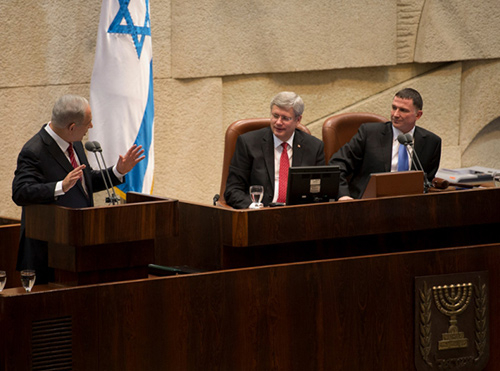
Israeli
Prime Minister Binyamin Netanyahu (left) introduces Canadian Prime
Minister Stephen Harper (center) at the Knesset podium, on Jan. 20,
2014. (Image source: Canada PM's Office)
|
Harper's address was a window into his heart and mind, and the
clearest expression without any equivocation of how Canada, under his
leadership, sees the bleak situation in the Middle East. It was also a
message from a leader of one of the G8 countries to member states of the
UN, and especially to other Western democracies, that Canada's embrace
of Israel transcends politics and is ethically grounded on moral
principles. As Harper stated, "Canada supports Israel fundamentally
because it is right to do so," because "the special relationship between
Canada and Israel is rooted in shared values."
Harper's recent visit to Israel was his first since being elected
prime minister in 2006 at the head of a minority Conservative Party
government. His minority government was returned in the 2008 election,
and then in May 2011 Harper's Conservatives finally won a majority in
the Canadian parliament. Throughout this period Harper demonstrated an
unflinchingly consistent, even politically courageous, support for
Israel at home and abroad when such support has been seen by many as
unwisely compromising Canada's even-handed approach in dealing with the
problems of the region.
Canada has seen itself for a long time now as a "middle power", its
influence in the world carefully harnessed through its role as a helpful
fixer in the UN and other multilateral bodies. This role and the
accompanying self-image over the past several decades assumed a default
position for Canadian foreign policy when dealing with the developing
countries of what until lately was described as the third world. It
helped position Canada to be seen as an honest broker between the rich
North and the poor South, and in this role Canada's political leaders
through the Cold War years and after found they were regularly praised
and courted by a majority of the UN member states. This meant, in time,
that Canada's views on issues that garnered the support of a UN majority
were also carefully crafted in part to maintain this position and
image, and the diplomacy at work to effect such a result was also
domestically resonant with a segment of the public that cared about
Canada's image abroad.
The effectively quasi-permanent majority of the UN is comprised of
developing countries of Asia, Africa, the Caribbean and South America.
Within this majority stands the Islamic bloc of 57 Arab and Muslim
states – all are members of the Organization of Islamic Cooperation
(OIC) – that, in voting together, can either make or break a majority
vote at the UN. It is this influence of the OIC and the votes it can
deliver that regularly isolates and reprimands Israel at the UN. It was
the machinations of the Islamic bloc that led to the notorious passage
of the UN General Assembly resolution in November 1975 declaring
"Zionism is a form of racism and racial discrimination." And though this
resolution was revoked in 1991 after the end of the Cold War, the
Islamic bloc in the UN yet pulls enough weight in voting numbers for
member states to be careful not to alienate it.
Canada's involvement in the Middle East goes back to the period
immediately at the end of the Second World War. Canadians contributed
significantly in blood and treasure through the war, and earned for
their country a place in the council of Allied powers. Canada was
present at the birth of the UN in San Francisco, and when the UN
deliberated over Palestine in 1947-48 Canadians were in the thick of the
negotiations. Lester Pearson, a Canadian diplomat then, in April 1947
was elected chairman of the First Committee, the body responsible to
make recommendations to the General Assembly on all political issues
brought to the UN; and the Canadian government appointed Justice Ivan
Rand of the Supreme Court of Canada as delegate to the UN Special
Commission on Palestine (UNSCOP). Both were involved in the eventual
decision to partition Palestine into two states, one for the Arabs and
the other for the Jews. Since then, in just about every major
development related to the Arab-Israeli conflict, Canada was at the
ringside in the UN's effort to broker some sort of settlement. During
the aftermath of the Suez War in 1956, Pearson, as Canada's Minister for
External Affairs, invented the role of peacekeeping for the UN when he
negotiated introducing UN Emergency Forces in the region to maintain and
monitor the ceasefire. Pearson was awarded the 1957 Nobel Peace Prize
for his efforts, and thereafter Canada's role as the peacekeeper in the
UN entered into the country's diplomatic folklore.
Canada's early record on the Middle East was primarily tactical. It
was in large part driven by considerations of maneuvering between
Britain and the U.S. over Palestine when the two powers differed over
its partition, and on recognizing Israel. This record was tainted by the
earlier decision not to open Canada to Jewish immigration when the
European Jews were in most need of safety, and Harper recalled this
history in his Knesset speech, stating "we have also periodically made
terrible mistakes, as in the refusal of our government in the 1930s to
ease the plight of Jewish refugees." But the support for the Jewish
state once Canada recognized Israel was never in doubt, though this
support in the UN was carefully managed not unnecessarily to unsettle
relationships with the Arab states.
For most of the period after 1945 the Liberal Party governed Canada,
hence it was responsible for formulating foreign policy and implementing
it. In the years that followed, Canada also gradually changed as a
result of a more open immigration policy, and immigrants from the Middle
East and the Muslim world in time came to express their interests
regarding foreign policy as it affected them or the places they left
behind. The controversies of the Middle East were imported into Canada,
and Ottawa's role in responding to the complexities of the Arab-Israeli
conflict entered into domestic politics.
Under the Liberal Party government of Prime Minister Pierre Trudeau,
Canada adopted the policy of official multiculturalism. It was felt that
the newly arriving immigrants, given their cultural diversity, should
be assisted in becoming Canadians. But the politics of multiculturalism
led political parties eventually to contend for immigrant votes,
especially in the growing urban centers, by appealing to their concerns.
As the numbers for immigrants from the Muslim world rapidly increased,
Canada's foreign policy towards the Middle East became an issue in
federal elections. It was therefore understood in Ottawa by the ruling
Liberal Party that a balanced approach towards the Middle East meant
working in tandem with the UN consensus approved by the Islamic bloc,
while broadening the base of support for the party among the growing
Muslim immigrant population, without unduly alarming the Jewish voters.
This Liberal version of a balanced approach became entrenched
institutionally in the government, in academia, and in the media; and
questioning this approach was considered irresponsible.
In the post-9/11 world, the Liberal government led by Prime Minister
Jean Chretien became even more cautious in stressing the importance of
Canada's balanced approach towards the Middle East. Canada deployed
soldiers in Afghanistan, in support of the UN resolutions, but
Chretien's Liberals kept a wary distance from the U.S. involvement in
Iraq. As organized Muslim opposition to President George W. Bush's "war
on terror" became increasingly vocal, Chretien's insistence that
Canada's role in the Middle East was entirely in keeping with the UN
consensus meant following closely the views of the Islamic bloc. The
result of such caution became indistinguishable from a policy of
appeasing Muslim opinion, of remaining mostly silent in the face of
rising anti-Semitism in Canada and abroad, and of watching without
voicing any opposition to the spread of anti-Israel campaigns across the
campuses of Canadian universities, with Israel regularly denounced as
an "apartheid state."
It is this corrosive culture of anti-Israeli politics and the rise of
the new anti-Semitism in the West that Stephen Harper and his
Conservative Party were adamant to confront without any apology. It did
not matter that Conservatives took power as a minority government in
2006 after more than a dozen years in opposition, and that for reasons
of electoral politics might have decided to tread softly on issues
relating to the Middle East. Instead Harper and his senior ministers, in
particular Jason Kenney, openly and unapologetically spoke about
support for Israel in language unheard of in Canada, while denouncing in
no uncertain terms the paranoid politics of the anti-Israel groups.
This unapologetic support for Israel by Harper in Canada's parliament
and at the UN earned the Conservatives the predictable disapproval of
opponents at home and abroad. The Islamic bloc in the UN made it certain
that Canada would not get the required votes for returning to the
Security Council for the 2011-12 sessions. This was the first time in
the UN history that Canada was denied the council seat as a rebuke for
its embrace of Israel. Harper's opponents, the Liberal Party and the New
Democratic Party, were quick to seize upon this rebuke as evidence of
how Harper had tarnished Canada's "even-handed" reputation at the UN.
Since Canada's more refined or elite opinion is mostly center-left,
Harper's position on the Middle East is readily explained as an uncouth
and self-serving effort to garner Jewish votes for the Conservative
Party. Former Canadian diplomats such as Paul Heinbecker regularly warn
Canadians how Harper's misguided policies have brought to ruin Canada's
reputation, earned over the years as a reliable even-handed UN member.
And academics such as Peter Jones, writing in Canada's national
newspaper,
The Globe and Mail, sneers how the Harper
"Conservatives hew to the dictates of the Israeli right in hopes of
securing votes in Canada." What remains unexplained, however, is how
this support for Israel is politically calculated to be a winner for the
Conservatives, when Muslims in Canada outnumber Jews by almost three to
one, according to the most recent census figures provided by Statistics
Canada.
Harper has shown rare fortitude, however, and even rarer courage
among the contemporary class of political leaders in Western
democracies, in remaining steadfast in his support for Israel. Speaking
in the Knesset, Harper stated, "Our view on Israel's right to exist as a
Jewish state is absolute and non-negotiable." He talked about a world
where "moral relativism today runs rampant... People who would never say
they hate and blame the Jews for their own failings, or the problems of
the world, instead declare their hatred of Israel and blame the only
Jewish state for the problems of the Middle East."
This is the new face of anti-Semitism, Harper noted: "It targets the
Jewish people by targeting Israel, and attempts to make the old bigotry
acceptable to a new generation." He repudiated the fashionable idea held
by many in the West that the root cause of the problems in the Middle
East is Israel. And to those who protest that criticism of Israel is not
necessarily anti-Semitic, he rightly asked, "What else can we call
criticism that selectively condemns only the Jewish state and
effectively denies its right to exist, to defend itself, while
systematically ignoring, or excusing, the violence and oppression all
around it?"
Stephen Harper's message to the Israelis, spoken in their parliament,
did proud to all Canadians who expect their leaders to speak truthfully
when it matters. In a world where the Jews have been treated
appallingly just for beings Jews, where many states regularly berate
Israel as a pariah state, and where the Holocaust still remains in the
living memory of Jews, the appalling truth is how the denial of these
truths grows and is expressed even within the UN that bears witness to
it, and was responsible for the establishment of the Jewish state.
As the first Canadian prime minister to address the Knesset, Stephen
Harper concluded his remarks by stating that in "the democratic family
of nations, Israel represents values which our government takes as
articles of faith and principles to drive our national life." This was
not high praise and cheap politics, it was instead the summing up of the
threads that bind the two democracies together in what rightly can be
called a "special relationship." It is worth celebrating.
Related Topics: Israel | Salim MansurLabels: Communication, Defence, Government of Canada, Israel