India's Operation Sindoor Against Pakistani Terrorists
"Pakistan and India have enough nuclear weapons to wipe the other side out several times over."
"Their nuclear weapons create a scenario for mutually assured destruction."
"[The
arsenals are a defensive move to prevent and deter further fighting,
because] neither side can afford to initiate such a war or hope to
achieve anything from it."
Syed Mohammed Ali, security analyst, Islamabad, Pakistan
"Pakistan
has every right to give a robust response to this act of war imposed by
India, and a strong response is indeed being given."
"[The] heinous act of aggression will not go unpunished".
Pakistan Prime Minister Muhammad Shehbaz Sharif
"Missile
strikes by India in Pakistan-administered Kashmir targeted at least
nine sites] where terrorist attacks against India have been planned."
"[The strikes - named] Operation Sindoor [were part of a] commitment [to
hold] accountable [those responsible for the 22 April attack in
Pahalgam, Indian-administered Kashmir, which left 25 Indians and one
Nepali national dead]."
India Defence Ministry
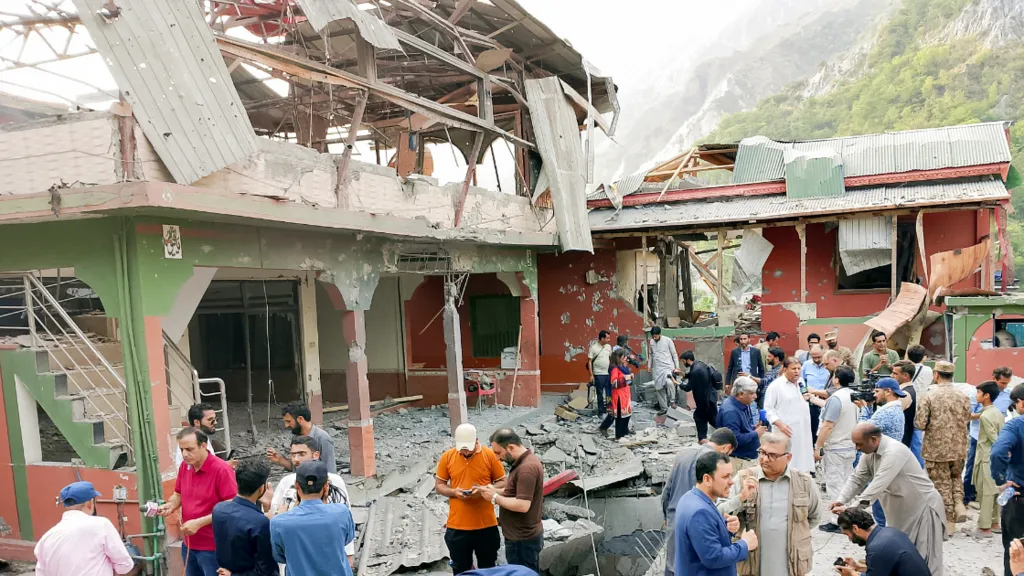 |
| People inspect a damaged mosque following India's strikes in Muzaffarabad in Pakistan-administered Kashmir AFP via Getty Images |
"Throughout 2024, violence continued in Kashmir in response to
increasing efforts by New Delhi to consolidate territorial control.
Attacks specifically targeted Indian travelers and workers in the
region. In June 2024, militants opened fire on a bus
carrying pilgrims traveling to a Hindu shrine in the town of Reasi. The
attack killed nine and injured over thirty. In October, militants killed seven in Kashmir at a construction site for a tunnel project connecting Kashmir to the northern region of Ladakh."
"On
April 22, 2025, tensions escalated after militants attacked Indian
tourists in Kashmir, killing twenty-five Indian nationals and one
Nepalese national. The incident marked the deadliest terrorist attack in
Indian territory since the 2008 Mumbai attacks. India blamed Pakistan
for harboring the group responsible for the attack and arrested two
Pakistani nationals as suspects. Pakistan denied any involvement, and its defense ministry even suggested
the attack was a “false flag operation.” Although no group has been
officially identified as responsible for the attack, the Kashmir
Resistance—an offshoot of LeT—claimed responsibility online."
Global Conflict Tracker
Both
India and Pakistan have a stockpile of nuclear weapons, each
'reminding' the other of a guarantee of mutually assured destruction
with neither country publicly disclosing their nuclear capabilities.
Each is thought to have amassed between 170 and 180 warheads; short-,
long- and medium-range. Each country has its own system of delivery to
launch and propel their weapons to targets. The arsenals serve as a
defense in prevention and deterrence of conflict beyond the
conventional.
Each
is aware that neither Pakistan nor India could survive a first nuclear
strike and be able to retaliate through "second-strike capability"; a
sobering perspective for any government. Both lay claim to Kashmir in
its entirety. Border skirmishes equate to instability in the region and
have for decades. A heavily militarized border divides each country's
part of Kashmir where three wars have been fought in the past. Armed
insurgents on the Pakistan side of the divide resist Indian rule, with
Muslim Kashmiris in support of the goal of uniting Kashmir under
Pakistani governance.
The
number of border flare-ups and attacks in India's portion of Kashmir,
prompted New Delhi toward an increasingly tough position on Islamabad,
accusing it of supporting 'terrorism', which more than adequately
describes the reality of the situation. India, as the most populous
nation on the planet, spent $74.4 billion on defence in the current
year; one of the world's largest arms importers.
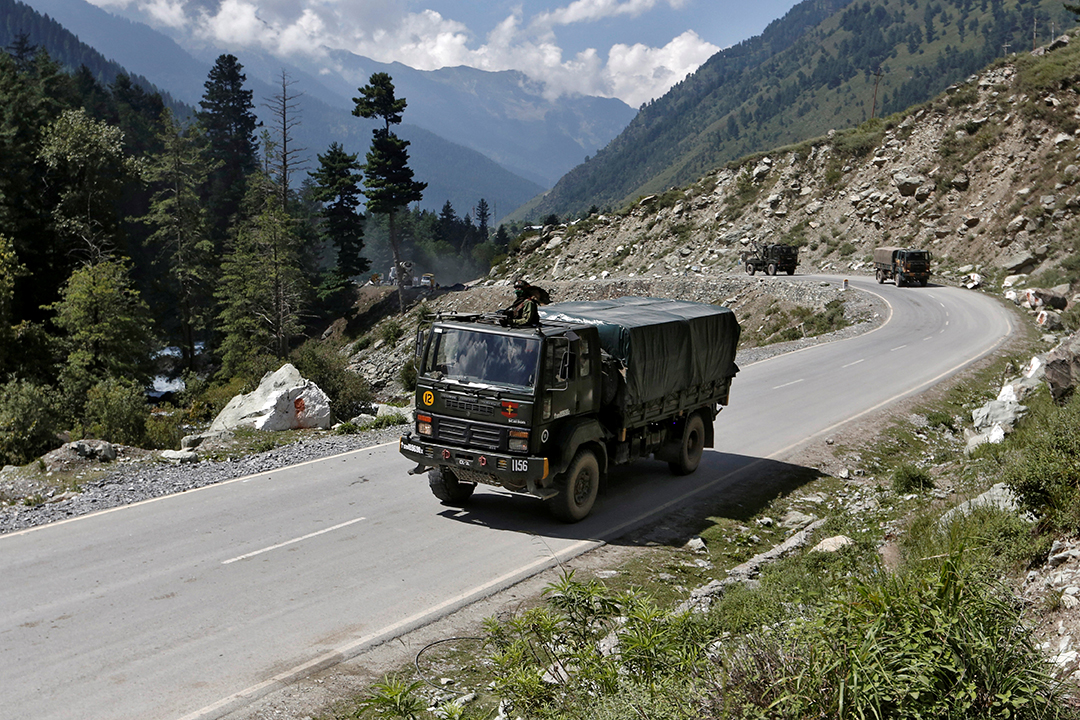 |
| Indian army Trucks on highway leading to Ladakh, Kashmir Danish Ismail, Reuters |
Although
Pakistan spends a considerable sum -- $10 billion last year -- in arms,
India has over double the number of active armed forces personnel than
Pakistan. But there is another looming threat that India has that
Pakistan doesn't share; its neighbour China, with its aggressive
maritime security stance in the Indian Ocean. On occasion both Pakistan
and India launch operations into airspace and territories controlled by
the other, intended for the most part to damage check-points,
installations or sites used by militants. Their lethal antipathy toward
one another is religion-driven, not territorial.
For
every step that India takes -- from closing down Pakistan's embassy in
India, shutting off a traditional water supply agreement to Pakistan,
closing its airspace to air traffic, to targeting sites in Pakistan
known to harbour Islamist terrorist groups -- Pakistan follows suit and
vows vengeance. Following missile strikes in Punjab province and
Pakistan-administered Kashmir, a heavy exchange of fire between the two
nations ensued. Pakistani Prime Minister Shehbaz Sharif commended his
armed forces for shooting down five Indian jets, hit, he claimed after
firing their missiles, while still in Indian airspace.
Three
planes fell onto villages in India-controlled territory, although India
made no official comments. During the April attack in Kashmir, some
survivors informed Indian media that the gunmen singled out Hindu men
and shot them dead at close range. Pakistan stands accused by India of
being behind the attack by a new militant group, Kashmir Resistance.
India has identified the group with links to Lashkar-e Taiba, a
Pakistani militant group long accused by New Delhi of being supported by
Pakistan.
 |
| Adnan Abidi, Reuters An Indian soldier stands guard on a highway in Kashmir |
Labels: Border Clashes, India, Kashmir, Muslim Militias, Mutual Assured Destruction, Nuclear Arsenals, Pakistan
The Implacable Schism: Pakistan and India
"Through the United Nations Security Council, we are studying it now, we
will raise it in General Assembly, we will talk to heads of States at
every forum... we will raise it in the media and tell the world."
"I am afraid that [India] will now carry out ethnic cleansing in Kashmir."
"They
will try to remove the local people and bring in others and make them a
majority, so that the locals become nothing but slaves."
Pakistani Prime Minister Imran Khan
"What was a temporary and transient provision cannot be treated as permanent. It had to go."
"No dynamic nation can allow this situation to continue. A historical wrong has been undone today."
"My compliments to the Prime Minister Shri Narendra Modi ji and the Home
Minister Shri Amit Shah for correcting a historical blunder."
"J&K [Jammu and Kashmir] integration with India took place in October 1947. Article
370 came into force in 1952, Article 35A came in 1954, four and seven
years later respectively. How can Articles 370 and 35A be a condition
precedent to merger?"
"The
decision of the government will help the people of J&K the most.
More investment, more industry, more private educational institutions,
more jobs and more revenue."
Arun Jaitley, BJP Leader
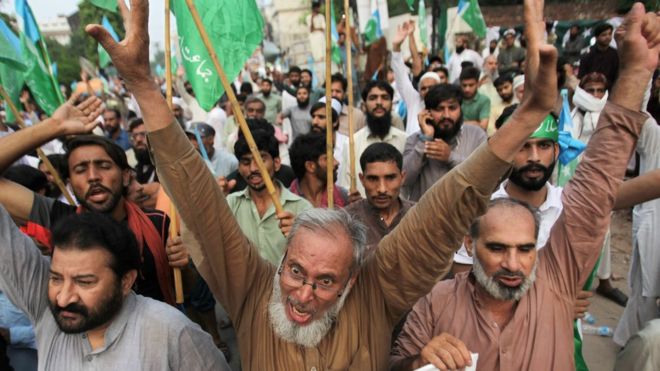 |
| Reuters, Protesters in Lahore, Pakistan chant slogans at a rally expressing solidarity with Kashmir |
China, which has done just that, importing Han Chinese to Tibet and to Xinjiang to water down the presence of Tibetans and Uyghurs to 'formalize' and present a picture of Chinese-style legalization of majority rule in both occupied territories; the former which has independent Tibet a part of China, the latter to dampen aspirations for separation from China, exercises the classic, symbolic stance of "do as I say not as I do", in supporting Pakistan in its claims for Kashmir, as opposed to India's administering of the long-disputed territory. According to China, India's declaration of Kashmir's total administration by India is "unacceptable".
Violence flares up constantly within the disputed area of Kashmir. And it is usually Pakistan and its military and most particularly its Inter-Services Intelligence agency that has stirred up passions, grooming Kashmiri Pakistanis to launch violent attacks against the Indian-administered area. The two nuclear-armed neighbours have come close to the outbreak of war in the past over Kashmir. India originally signed Article 370 in its constitution 70 years ago to accommodate Pakistan when it broke away from India as a sovereign state.
What India has reaped for all of those years is Muslim fanatical attacks in a concentrated determination to rid Kashmir of Indian rule altogether. The new decree revoking Kashmir's shared status can be seen as a direct result of Pakistan's incitement to Kashmiri Pakistanis to view themselves as victims of Indian Hindu discrimination who must agitate against India. The violence that flares up from time to time has worn India's patience thin. Leading Narendra Modi, a nationalist, to decide the issue once and for all.
India controls Kashmir and Pakistan had a semblance of autonomy in its segment which it abused, overplaying its hand time and again. India, as the country with the third-largest Muslim population in the world, is well placed to declare itself more than able to administer Kashmir entirely without the intervention of Pakistan whose role in fomenting unrest and violence led the way toward stripping it of any authority in Kashmir. Tellingly, in view of a militant backlash to complement the fury of Pakistan, Kashmir has been overrun with Indian troops intent on keeping the peace.
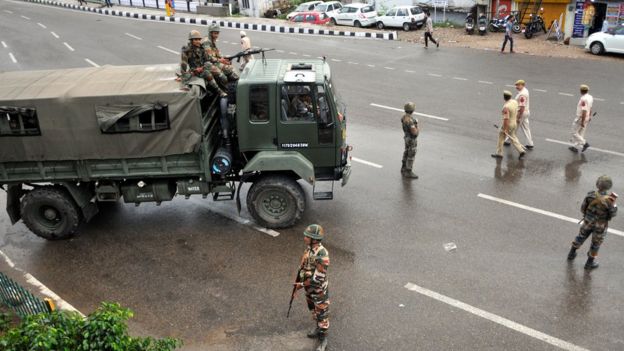 |
| Getty Images Kashmir is one of the world's most militarised zones
|
Placed under house arrest, a former chief minister of the region, spoke of the decision as the
"darkest day in Indian democracy. It will have catastrophic consequences for the subcontinent. They want to change the demography of the only Muslim majority state in India, and disempower Muslims to the extent where they become second-class citizens", she stated.
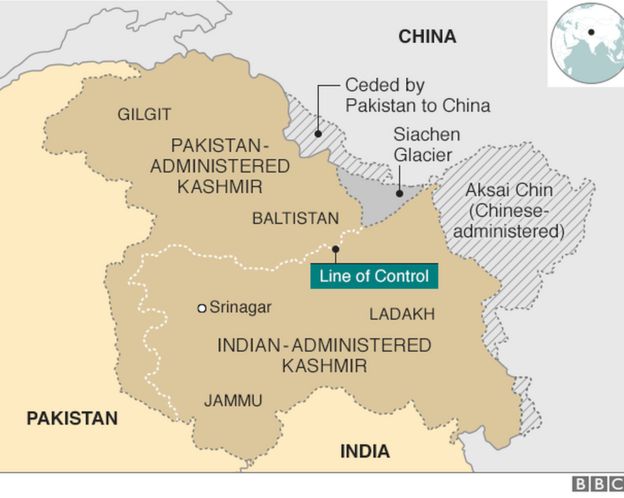
Labels: India, Kashmir, Militancy, Pakistan, Sovereignty, Violence
Nuclear-Armed and Furiously Mutually Defensive
"The world is watching our collective will. We trust our army's
capability and because of this, it is extremely necessary that nothing
should happen that harms their morale or that our enemies should get a
chance to raise a finger against us."
Indian Prime Minister Narendra Modi
"[Abhinandan is the] embodiment of a mentally tough, selfless & courageous soldier."
"During
these testing times the country stands, as one, behind him & his
family. Our efforts are on & under the #GenevaConvention we hope
that the brave pilot would return home soon."
General Vijay Kumar Singh, Indian Minister of State for External Affairs
"World history tells us that there are miscalculations in wars. But my
question to the Indian government is: Given the arms that we and you
have, can we afford any miscalculation?"
"It will neither be in
my control, nor in the control of (Indian Prime Minister) Narendra
Modi."
Pakistan Prime Minister Imran Khan
Wise and welcome words from a man now in charge of a country that has time and again agitated its population to nationalist fury over the dispute shared by both countries over the disposition of disputed Kashmir, which each claims as its own in its entirety, and which is currently separated in halves for each, amid high and volatile tensions. Pakistan has, time and again, been involved in violent Islamist attacks against both Indian Kashmir and within India itself, including a horribly deadly attack in Mumbai staged by Islamist extremists with links to the Pakistani military.
India, the largest democratic nation in the world, and with its current population edging toward 1.3-billion, slated to overtake China as the most populous country on the globe, is forever on guard to stave off attacks from Pakistan, its nuclear-armed neighbour. The two countries, both with nuclear stockpiles, each have a culture of highly nationalistic, agitated peoples quick to surrender to frenzied accusations against one another, but it is mostly Pakistan from which the violence emanates.
Infamously, Pakistan had allied itself with al-Qaeda, sheltering Osama bin Laden in Abbottabad until U.S. Navy SEALs dispatched him and buried him in the ocean. Pakistan arrested and imprisoned a neighbour of bin Laden's who suspected the compound next to his held the leader of al-Qaeda and his wives, and aided U.S. CIA intelligence in affirming that. The Pakistani, Shaik Afridi, a medical doctor, was accused by his government of aiding an enemy. And without Pakistan's aid the Afghan Taliban would never have been able to mount their constant attacks in Afghanistan against NATO troops.
The country distinguishes itself by its Islamist extremist roots. As it did when Pakistan-based Islamists attacked and suicide-bombed paramilitary police in Kashmir on Feburary 14 where 40 of those police died. In a reprisal attack, Indian fighter jets struck a militant group that it held responsible for the suicide bombing, destroying a hilltop training camp where Jaish-e-Mohammad jihadists appear to have been in preparation for an attack which materialized.
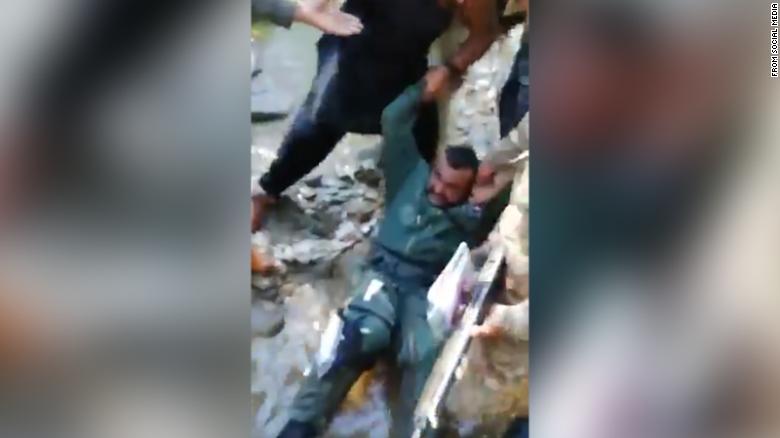
Pakistan sent its own jets to intercept the Indian raiding force and two of the Indian planes went down, one in Indian territory the other in Pakistani. The pilot ejected safely, was quickly surrounded by Pakistani locals who set about throwing rocks at the Indian pilot who responded with a gun to hold off his attackers. He was soon rescued by arriving Pakistani police who took him into custody as a prisoner. He was later shown by video across Pakistan on television, an infringement of the Geneva code on treatment of prisoners.
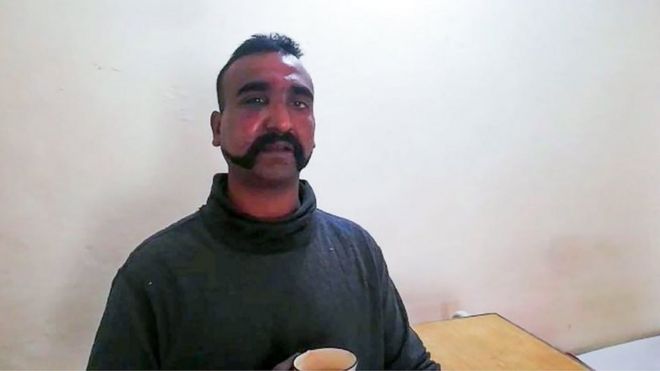 |
| Wing Commander Abhinandan Varthaman AFP |
News channels on both sides of the border, increasingly bellicose, aroused their viewers to even greater hostility against the other country. Domestic outrage in India over the Pulwama bomb attack soared. The anti-India jihadist Islamist JeM has al-Qaeda ties and is listed as a terrorist group since 2001 with the United Nations. Pakistan, for its part, denies any involvement in the attack, its usual practise of insisting on innocence when in fact it is generally involved in agitating for such attacks to go forward.
A Pakistani military spokesman made reference to his country's nuclear arsenal and the rhetoric escalated when he spoke of a command and control authority meeting whose purpose is to determine the use of nuclear weapons.
"You all know what that means", he stated meaningfully.
"We have no intention of escalation, but are fully prepared to do so if forced into that paradigm", stated Pakistani army spokesman Major General Asif Ghafoor.
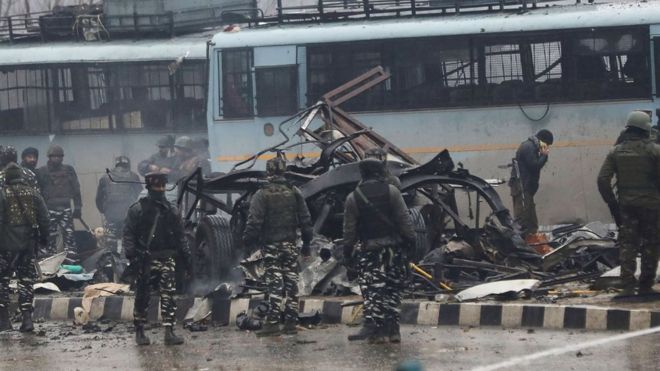 |
| The 14 February militant attack was the deadliest against Indian forces since the insurgency began Getty Images |
India is demanding the return of its pilot who though badly beaten appeared to be in good health. When questioned where his hometown was, queried about his aircraft and his mission by interrogators he remained mute. To all questions, he patiently responded
"You know I can't answer that", and nor was he required to, by the Geneva conventions.
Indian police had recovered several bodies from an Indian air force helicopter that crashed in a sector controlled by India of Kashmir; six Indian airmen and a civilian on the ground had been killed. The crash had occurred near an airport on the outskirts of the main city of Srinagar. The airport was closed down along with two others for civilian flights. Pakistan closed down some of its airports as well.
Now, the question is will the situation be defused when the Indian pilot is released on Friday as promised by Pakistani authorities?
Labels: Combat, Conflict, India, Kashmir, Pakistan, Tensions
Fanatics Countering Fanatics
"The situation is worse in terms of atmospherics, because the alienation and anger of young Kashmiris is now out of control."
"There is a sense of hopelessness with villagers, students and even schoolgirls coming out onto the streets. This has never happened in the past."
Amarjit Dulat, (former) head, Research and Analysis Wing, Srinagar, India
"The wave of Hindu fanaticism sweeping across India is hardening postures in Kashmir."
"There are no moderates espousing peace left in Kashmir any more. Mentally, we are all militants."
Khurram Parvez, human-rights activist, Jammu Kashmir Coalition of Civil Liberty
"This clampdown could trigger a blowback that will only aggravate anti-India sentiment in Kashmir."
"It will only exacerbate the challenge of containing Kashmir's spiralling violence."
Brigadier General Rahul Bhonsie (retired), Strategic Foresight Asia, New Delhi
![The emergent generation of stone-pelting young Kashmiris are calling the new wave of protests an 'Intifada', writes Hussain [EPA]](http://www.aljazeera.com/mritems/imagecache/mbdxxlarge/mritems/Images/2016/7/19/ae1a750e7c06488fa62ca79b5ac63bd4_18.jpg "Two centuries of oppression in Kashmir") |
| The emergent generation of stone-pelting young Kashmiris are calling the
new wave of protests an 'Intifada' [EPA] |
India and Pakistan have fought three wars; two of those wars involving the nuclear-armed adversaries -- whose conflicts have remained in the realm of conventional warfare, but given the nuclear arsenals both warehouse, the world waits with bated breath for Pakistan to somehow trigger a conflict from which neither country could recover -- relate to each claiming the right to fully possess Kashmir, the mountainous state in the Himalaya.
Because Kashmir is majority Muslim-populated Pakistan believes it should be handed over from India to Pakistan. Pakistan and Bangladesh were once part of India. In 1947 both countries signed an agreement allowing Pakistan to separate from India; that separation caused the madness of religious hatred between Hindus and Muslims to be unleashed and hundreds of thousands of Muslims and Hindus died in a paroxysm of violence at Partition when the two populations switched.
 |
| September 1947: Muslim refugees on the roof of an overcrowded coach railway rain near New Delhi attempting to flee India. Millions of Muslims migrated from India to Pakistan when Partition marked a massive upheaval across the subcontinent as Hindus living for generations in what was to become Pakistan were forced to flee their homes overnight. AP Files |
The same kind of bloody conflict ensued when Bangladesh demanded its sovereignty and separation from Pakistan. In 1989 an insurgency began in Kashmir which India has placed blame for on Pakistan. Logically enough, since Pakistan always seems to precipitate violent unrest in the geography; its vicious hostility to India has brought the two countries to the brink of war often enough. Pakistan's cultivation of Islamist terrorist groups, inciting bloody attacks on India have been numerous.
But India too has its ardently religious fanatics, and lately, under the rule of nationalist Hindu Prime Minister Narendra Modi, virulently orthodox Hindus have been accusing Indian Muslims of criminal activity for butchering cattle for consumption. For Hindus cattle are considered sacred. For Muslims they represent food. Attacks by fanatical Hindus against Muslim cattle-herders and butchers have been roiling the nation.
And in Kashmir, teenage Muslim schoolgirls in Srinagar have increasingly begun what in the West Bank of 'Palestine' is called an Intifada; attacks by Arab Muslims against Jewish Israeli citizens in the Middle East, fighters for Muslim sovereignty of Kashmir in the Indian subcontinent.
"Is it not better to die challenging the situation once and for all than to live with it and die a slow death every day?", one 14-year-old Muslim Kashmiri girl's rhetoric of dramatic purple prose posed.
Schoolgirls carrying backpacks with their schoolbooks, hurl rocks at Indian soldiers. Surrounding an Indian army armoured vehicle, kicking the doors, a group of schoolgirls called for the security personnel within the vehicle to fire on them. Clashes between Indian security forces in Srinagar and the local Muslim population can occur with flashpoint unexpectedness. The stability of normal life can suddenly evaporate and rock-hurling students erupt against security forces.
A mirror-image of what so frequently occurs in Israel with the Palestinian Authority spurring young Palestinians to do their duty of 'resistance' against the 'occupation'. Stoning by Muslim youth appears to be genetically inherited as a public and social pastime. The civil disobedience movement gripping a majority of Muslim Kashmiris expands "exponentially", a security official in charge of Kashmir stated.
"There is an overwhelming sense of siege in Kashmir and levels of isolation amongst locals have peaked", he warns.
The Indian military is in no mood to sit back at this point and just allow tensions to mount and perhaps fizzle. Random searches by the Indian army are guaranteed to further inflame Kashmir's Muslims. What has occasioned the searches was the kidnap and murder of a Kashmiri army subaltern. The "sweep operations" by the army, warn military analysts could become counterproductive, triggering furious militancy.
Again a repeat of what Hamas in Gaza, for example has engaged in; abducting Israeli soldiers, sending rockets from Gaza into Israel, provoking the Israeli Defence Forces to retaliate and invade. Now it's India's turn. Israel has a million and a half Palestinian Muslims living in the country as citizens. India's population of 1.3 billion includes 15 percent Muslim citizens. The population mix is reversed in Kashmir.
And Pakistan which controls a third of Kashmir denies inciting for a
"Kashmir freedom struggle", claiming its only contribution to that struggle is moral, diplomatic and political support. Indeed.

Labels: Conflict, Hindus, India, Kashmir, Muslims, Pakistan


