Egypt's Orthodox Coptic Church
"We are at a breaking point. People can't put up with any more of this."
"After that woman was stripped [an older Christian woman stripped naked by a mob], we couldn't be quiet, not after that."
"[What incensed Copts] is that officials came out denying the incident [had occurred]."
"In such attacks, every one of them [attackers] is released, not a single one has been punished, and that's what really upsets the Copts."
"So long as no one is punished, this is just going to get worse."
Bishop Makarios, Egyptian Orthodox Coptic Church, Minya, Egypt
"Everything is good. No one has been killed. No one has even been wounded."
"There's no conflict. The problem is really with the journalists writing about it."
Imam Mahmoud Gomaa, Muslim cleric
 |
| Gianluigi Guercia, AFP | Coptic Christians talk on August 27, 2013
inside the Amba Moussa Coptic church that was torched by unknown
assailants after the overthrow of President Mohamed Morsi |
The Egyptian Orthodox Coptic Church vastly predates the presence of Islam in Egypt. Conditions between Christians and Muslims have always been problematic. For one thing Muslims far outstrip in numbers, those of the Christian population. For another, Islam considers itself the complete, final and finished edition of monotheism; that Judaism and Christianity which followed it, were initial trials at monotheism but god perfected the final version and negated the previous two.
In Islam, it stands to reason that Jews and Christians should abandon Judaism and Christianity in favour of Islam. And because neither Jews nor Christians looked favourably upon this invitation extended by the Prophet Mohammad, they were persecuted and oppressed over the ages -- almost one and a half millennia -- made subservient and had taxes levied upon them as punishment, if they weren't slaughtered or enslaved.

A congregation of Coptic Christians in Egypt (AP)
In present-day Egypt, Coptic Christians remain oppressed and persecuted, and sometimes come under violent attack by Muslim mobs when rumours have it that disrespect has been shown to Islam or to the Prophet, by Christians. No new Christian churches may be built, and Christians may not interfere with Islamic proceedings; traditionally Christians had to defer to Muslims.
In Minya, Christians are prone to episodes of humiliating violence. Homes of Coptic Egyptians have been destroyed, Copts are attacked on the streets and messages of hate are scribbled on church walls. When the rule of President Mohammad Morsi and the Muslim Brotherhood was overturned episodes of violence were increased until the current government stepped in to quell the unrest. Under President Abdel Fattah el-Sisi, Egyptian Copts are given assurances of support.
A woman whose son was accused of having an illicit affair with a Muslim woman, was attacked, humiliated, stripped naked. The Muslim woman responded to those accusations by suing her husband for libel in bruiting about a false rumour to humiliate and harm her. The government of Egypt took steps to ameliorate the unrest between Muslims and Christians by clumsily appointing a Muslim cleric to build peace bonds between the two.
Despite protestations that no one has lost their life, according to Bishop Makarios, in July a Christian was stabbed to death by a mob in the Minya village of Tahna El-Jabal, and in Sinai a Christian priest was killed by ISIL terrorists, the ninth victim among Copts in the northern Sinai. The bishop expects that the perpetrator in the stabbing will eventually be freed, as has happened before.
Bishop Makarios stated:
"I have nothing to do with Mahmound Gomaa". In Minya, 40 percent of the population is Christian. The Coptic pope, Tawadros II, is attempting to deal with the issue of Muslim-versus-Christian unrest, where the ten percent of the Egyptian population represented by the Christian community continues to live in an uneasy state. The government has provided security, even as Egyptian Muslims have become increasingly hostile.
 |
| Pope Tawadros II (AP) |
Even so, Egyptian Copts make every effort to present to the outside world a situation of accommodation and less-than-strained relations between Christians and Muslims; that the Church has no problem working with the central government, and all is well. In Egypt, tolerance and religious harmony exists; except where and when it does not.
Labels: Christians, Egypt, Islamists, Prejudice, Violence
A National Powder Keg
"It is as if the deepest fault lines of our democracy have suddenly been exposed, perhaps even widened."
"Dallas, I'm here to say we must reject such despair. I'm here to insist that we are not as divided as we seem. And I know that because I know America. I know how far we've come against impossible odds."
U.S. President Barack Obama
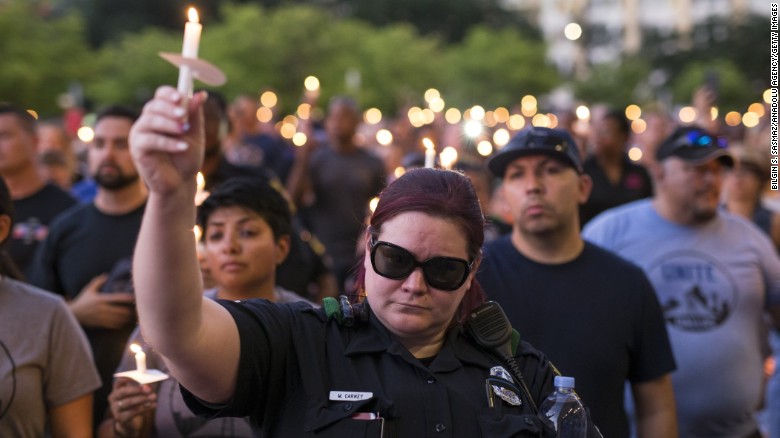 |
| Mourners attend a Monday candlelight vigil for five officers killed last week during protests in Dallas. CNN |
Has a pathological virus of bigotry and reverse-bigotry suddenly manifested itself in a cycle of violence, white against black, black against white, deviating from the usual black-on-black and white-on-black? Weapons seem always to be at the fore. Children carrying toy guns and being shot on suspicion of doing harm because they are black and seem to be threatening. Blacks turning their backs and running rather than be apprehended by a policeman looking to interrogate him.
A policeman confronting a street vendor, convinced he sees a gun nestled inside the belt of his trousers, initiating a response whose end results cannot be reversed. A man, stopped in his car, telling a police interrogator that he has a firearm in his possession by license, an admission that so frightens the man in blue that he shoots, convinced the man he has stopped demanding to see his license, is reaching for his gun and he will be the target.
And Black Lives Matter calling upon society to reject the suspicion of blacks, since they're just like anyone else in that society though they may be over-represented as gang members in a community, as drug pushers, as weapons dealers generally averse to law and order, contemptuous of both the law and those who keep it in order with their blue uniforms and their propensity to shoot first, rue the impulse later.
The two contradictory statements above by President Obama aside, the circumstances and details leading to the deaths of Philando Castile and Alton Sterling at the hands of police officers in Minnesota and Louisiana, have galvanized public opinion with the horror of the casual transitory nature of life and death in America awash with guns and mired in black-on-white fears and suspicions and assaults and white-on-black privilege and reactions out of proportion to reality when reality is allied with death.
Now there's something called intersectionality, where aggrieved groups make common cause with one another, making improbable, albeit welcomed links that seem to serve their agendas. Black Lives Matter, in asserting their claims to insufferable maltreatment by police in America, have found it useful to cast blame on other minority and ethnic/religious groups, like for example, Jews, who are always front and centre in causing trouble.
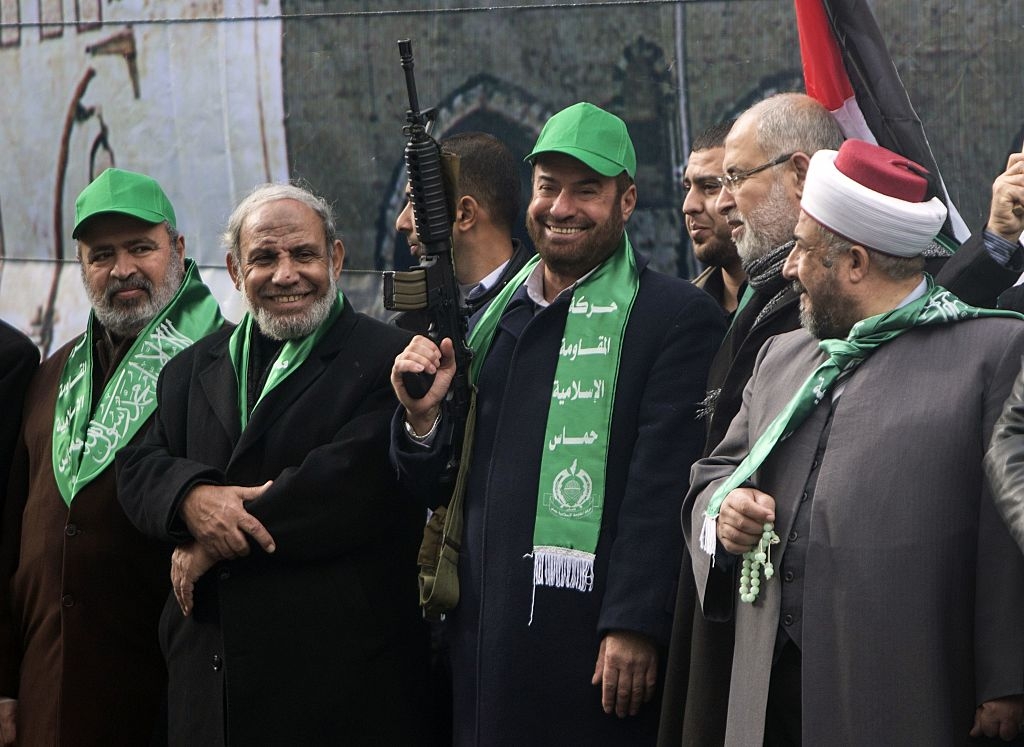
Black
Lives Matter activists have a sympathetic attitude towards groups like
Hamas, which embrace terror as a mode of resistance against Israel. BLM activists have visited Gaza to express solidarity with
Palestinians oppressed by so-called racist Israeli self-defense
measures - Gatestone Institute
"In the past 48 hours another two black men have been lynched by the
police.... We must remember that many US police departments train with
#IsraeliDefenceForces. The same forces behind the genocide of black
people in America are behind the genocide of Palestinians. What this
means is that Palestinians must stand with our black comrades. We must
struggle for their liberation. It is as important as our own.
#AltonSterling is as important as #AliDawabsheh. Palestinian liberation
and black liberation go together. We must recognize this and commit to
building for it."
New York University chapter of Students for Justice in Palestine (SJP)
The voices through text messages calling on black brothers to respond to police violence against blacks by pre-empting their intentions with violence directly assaulting blue uniforms are trickling through the ether at an alarming rate. In Michigan, two court bailiffs killed and another wounded by a white inmate: "In that fight the inmate was able to get the deputy's gun away and then
shoot the deputy and then move out from that area and kill the two
bailiffs", explained Berrien County Sheriff L. Paul Bailey.
Seems like it's open season on police agents. Blue Lives Matter.
And In Washington, police officers called to the southeast of the city by a gunshot-detecting system were shot at by people inside an SUV, with at least one of those in the vehicle shooting at police though none was injured and three women and two men surrendered at the scene and were taken into custody. It will take a long, long time before the United States recovers from its collective black-and-white shock at the killing of five police officers in Dallas, and the wounding of seven others.
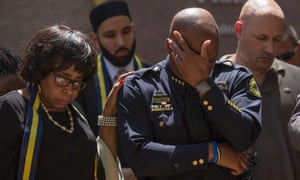 |
| David Brown prays during a a vigil at Thanks-Giving square in Dallas on
Friday, the day after the shootings. Photograph: Laura Buckman/AFP/Getty
Images
|
Labels: Bigotry, Firearms, Human Relations, Prejudice, Threats, United States

‘Israeli kindness changed my life,’ says Hamas escapee in Canada
Gay,
Christian-convert son of a Palestinian militant family tells Times of
Israel he found compassion where he least expected it, and most needed
it
A Palestinian teenager was arrested in Tel Aviv
in late 2006 for illegally entering Israel. It was the third time the
15-year-old from Nablus had crossed into Israel, fleeing his abusive
father. Now 24 years old, openly gay, and a convert to Christianity, he
is fighting for his life to remain a refugee in Canada.
The
boy belonged to an aristocratic family, in Palestinian Islamist terms.
His maternal grandfather, Said Bilal, was the head of the Muslim
Brotherhood in Nablus, who oversaw the activities of its Palestinian
branch, Hamas. His uncle, Muaz Bilal, was condemned in 2002 by an
Israeli court to 26 life sentences for dispatching suicide bombers into
downtown Jerusalem in the late 1990s, killing 21 Israelis and injuring
300 in two separate attacks. Two other uncles, Bakr and Obada Bilal, a
military Hamas field commander and an explosives expert, respectively,
were released from Israeli prison as part of the Gilad Shalit prisoner
swap in October 2011.
The trouble at home started when, as a
teenager, he began questioning the beliefs and actions of his parents,
both ardent Hamas supporters.
“I ended up having a big fight with them, and
ran to Israel,” the youth told The Times of Israel in a phone
conversation Monday from Edmonton, Canada, where he eventually sought
political asylum. A tragic experience in an Israeli prison cell that
night sparked a chain of events which would turn the teenager’s belief
system on its head, leading him to convert to Christianity and change
his name to John Calvin, after the 16th century French theologian.

A
Hamas prisoner released as part of the Shalit deal embraces his family
member in Ramallah, October 18, 2011 (photo credit: Yossi Zamir/Flash90)
“A horrific incident happened to me in jail. I
was raped by a Muslim man, and ended up getting assistance from Jewish
psychiatrists and from the jail administration, which helped me through
the worst thing that ever happened to me in my life. That ended up
changing my life entirely. The entire staff tried to help, including the
prison warden… They tried to keep it quiet because of the culture in
jail and even followed up with me after my release. This was not the
image I grew up with about Jewish people.”
Calvin said he was taught to
believe that Jews were ‘monsters whose goal in life is to kill and
destroy us in every opportunity they get’
Calvin, who requested that his original name
be withheld for fear that his family would track him down and harm him,
said he was taught to believe that Jews were “monsters whose goal in
life is to kill and destroy us in every opportunity they get.” But far
from attempting to destroy him, Calvin’s jailers showed “humanity and
compassion,” he said.
“I lost faith in everything I knew. My belief
collapsed on itself and was absolutely destroyed. From that point on, I
had to develop my own beliefs and ideologies [after being] exposed to
the truth — that Jewish people were not the monsters I was taught they
are. They were actually normal people who showed humanity and compassion
in my time of need.”
He defined his upbringing as “extremist,” quoting by heart an Islamic oral tradition (hadith)
he was taught in high school stating that “he who dies without having
waged one attack for the sake of Islam has died as an infidel.”
“At home, we’d memorize the Quran and study Islamic doctrine. We were a faith-based family,” he said.

Palestinians
hold Hamas flags and chant slogans during a celebration organized by
Hamas in the West Bank city of Nablus, on Friday, August 29, 2014 (photo
credit: AP/Nasser Ishtayeh)
Upon his return to Nablus, Calvin distanced
himself from his family, and would only visit their home once a week. He
took up a job as a shoemaker, eating and sleeping in the workshop. At
around the same period, Calvin, the eldest of four brothers, began
taking an interest in Christianity, secretly reading the Bible away from
his parents’ watchful eyes.
By the time he was 19, he was ready to
formally convert. But when in March 2010 his mother caught him speaking
on the phone to a priest whom he had called to inquire about baptism,
all hell broke loose. After he confessed his Christian beliefs to his
parents, his father tried to stab him with a knife, and Calvin jumped
out the window to escape. He hid in another West Bank city, where he
joined a Christian community and began to attend church services.
There, he met a Canadian pastor who offered
him a scholarship for a Bible college in Toronto, which he rejected. But
in June that year in Ramallah, he happened upon his father, who
physically assaulted him. Calvin was arrested and sent to a Palestinian
Authority jail in Nablus for “disrupting the public peace.” He was
placed in a cell with over 60 convicts, many of them Hamas members, some
on death row.
‘When I first entered PA jail, the inmates gave me three days to repent and convert back to Islam or be killed for apostasy.’
“For the first time in my life I saw that
prisoners were allowed to carry steak knives in jail,” he said. “When I
first entered, the inmates gave me three days to repent and convert back
to Islam or be killed for apostasy.”
Calvin said that the PA jail administration
was aware of his predicament but nevertheless informed the dangerous
inmates of his background, also allowing Muslim clerics to enter his
cell and try to convert him back to Islam, but to no avail. A month
later he was released from jail, still a believing Christian. No charges
were leveled against him, and he never faced a judge.
After a short stay with his grandmother — whom
he describes as “the first lady of Hamas,” and who also tried to
convince him to return to the Muslim fold — Calvin learned of his
father’s plan to kill him. Friends helped him flee to Jordan, where he
accepted the scholarship to study in Canada. In late December 2010 he
arrived in Toronto, later moving to Alberta to conclude his theology
studies in 2012.
Calvin arrived in Canada on a student visa,
requesting refugee status in June 2011. But in July 2012 his case was
suspended by Canada Border Services Agency, when the Ministry of Public
Safety decided that Calvin’s association with his family in Nablus prior
to age 18 constituted membership in Hamas, which Canada designates a
terror organization.

John Calvin in Edmonton, Canada, January 5, 2015 (photo credit: courtesy/John Calvin)
Following a legal back-and-forth with CBSA
over the past two years, Calvin was informed on New Year’s Eve 2015 that
his refugee request had been denied and he could be deported within 30
days, after an immigration official found that he had
knowingly assisted Hamas
by transferring coded messages through Israeli checkpoints and even
shooting at IDF jeeps, as he testified to Canadian immigration. Calvin
told Canadian daily Edmonton Journal Monday that he did not understand
the messages he conveyed and never shot the gun, given to him as a
birthday gift by his grandfather at age 14.
“A deportation order is the equivalent of a
death sentence. Even if it wasn’t because I’m Christian, it would be
because I’m gay,” said Calvin, who came out to his parents in a phone
call from Canada two years ago. “I said: ‘I’m gay and deal with it. I
don’t really care what you think.'”
He still sometimes calls his mother — who
separated from his father in 2012 — from a masked phone number. “Even in
Canada I’m not absolutely safe from my family’s harm,” he said.

Mosab Yousef, son of Hamas founder Sheikh Hassan Yousef. (photo credit: Yonatan Sindel/Flash90)
Calvin realizes how similar his story is to
that of the “Green Prince,” Mosab Hassan Yousef,
the son of Hamas leader Hassan Yousef, who converted to Christianity
and fled to the United States after serving as an informant for Israel’s
internal security agency, the Shin Bet.
“We met at a party of a mutual friend in
Canada. He seems to be a kind, decent person, though I don’t really know
him,” he noted. “However, in my case I did not work with Israeli
intelligence.”
Recalling his experiences in Israel eight years ago, Calvin’s message was optimistic.
“Don’t judge a book by its cover,” he said.
“Sometimes the smallest, simplest act of kindness and compassion can
change someone’s life forever, like myself.”
Labels: Canada, Hamas, Homosexuality, Immigration, Islamism, Israel, Prejudice, Security
Blame To Share
"We get mad at racism, but most government outrages have structural roots. The left doesn't want to go after police unions because they're unions. The right doesn't want to because they represent law and order. Politicians of all stripes shy away because they are powerful."
David Brooks, The New York Times
"[Law enforcement has a] tough job. Understand, our police officers put their lives on the line for us every single day. They've got a tough job to do to maintain public safety and hold accountable those who break the law."
U.S. President Barack Obama
(a)"Is my child safe, and not just from some of the painful realities of crime and violence in some of our neighbourhoods, but safe from the very people they want to have faith in as their protectors?"
"That's the reality."
(b)"[The police killings are a]particularly despicable act [that] tears at the very foundation of our society. An attack on all of us."
"Our city is in mourning, our hearts are heavy. We lost two good men who devoted their lives to protecting all of us."
New York Mayor Bill de Blasio
"Police officers feel like they are being thrown under the bus."
"There is blood on many hands, from those that incited violence under the guise of protest to try to tear down what police officers do every day. That blood on the hands starts on the steps of city hall in the office of the mayor."
Patrick Lynch, president, Patrolmen's Benevolent Association
"We've had four months of propaganda starting with the president that everybody should hate the police."
"The protests are being embraced, the protests are being encouraged. The protests, even the ones that don't lead to violence, a lot of them lead to violence, all of them lead to a conclusion. The police are bad, the police are racist. That is completely wrong".
Rudolph Giuliani, former mayor, New York
-

- Investigators at the scene of the deadly shooting of two NYPD officers. (AP photo)
Do police commit abusive acts? A WNYC News (New York) found that 40% of the "resisting arrest" charges were filed by 5% of officers with the New York Police Department; most officers avoid confrontation leading to that charge, others look for them. In some areas of the U.S., union contract rules give officers a 48-hour cooling off before being questioned; they can access names and testimony of accusers and cannot be threatened with disciplinary action during questioning.
One Oakland, California policeman shot and killed an unarmed 20-year-old in 2007, and seven months later he killed another unarmed man, shooting him three times in the back while he was running away. He was fired, but appealed through his union and was compensated with back pay when he was reinstated. A union executive informed a news outlet that Fraternal Order of Police representatives lobbied
"maybe 80% of senators and half the House" in defence of police militarization.
If ever there was a polarizing issue on police action it is the long-established informal but blatant, informal protocol of targeting blacks for special attention. The reason for which is obvious enough; though not representative of a population majority, they are responsible for what might be termed the lion's share of criminal activity. In the 17% population pool of black Americans, 93% of black homicide victims from 1980 through 2008 were killed by blacks. And while 84% of white victims were killed by white offenders, they're also a larger pool.
Blacks are over-represented in prisons in comparison to their population numbers, and that is mostly because the black population generates more crimes within society. Cause and effect cannot be ignored. And then there is the cause and effect of historical marginalization and demonization, prejudice and demoralization. A witch's brew of discrimination and poverty leading to an attitude that unfair treatment leads to social antipathy and acts of social criminality.
In the vast hub of humanity it brooks ill indeed that a mayor, voicing his personal concern for his own biracial son speaks of the dangers lurking in the shadows of a society with a black underclass viewed with perennial suspicion and little room for caution due to endemic fear common among the public and the police who represent their fears as well. He has every right to do so, and to put on the record his acute awareness of the tentative and often dangerous place in a largely white society with a background of racism, of young black men perceived as trouble.
The implied criticism of the public security agents tasked with maintaining order and public safety does not go over well when it is the mayor who points out the unfortunate obvious, with all the complexities involved, and then attempts to mollify those outraged feelings by expressing views in support of the difficult job faced by police in such a socially fractured society. Police believe that the mayor supports the protesters staging anti-police rallies, and his words aided that perception.
Labels: Conflict, Crisis Politics, Prejudice, Racism, United States
August 7, 2013 8:47 am

Israeli President Shimon Peres meets with Pope Francis April 30, 2013. Photo: Israel GPO.
JNS.org
- As newly elected leaders of their respective Christian faiths, Pope
Francis I and Egypt’s Coptic Pope Tawadros II face a wide array of
internal and external challenges. One presides over a global church of
1.2 billion, the other a smaller Mideast church of 12-18 million. But a
primary challenge for both is the fate of Middle East Christianity,
which is on the verge of extinction in the region where the religion was
born.
Early in their papacies, both Pope Francis and Pope Tawadros have
shown a willingness to break from convention and challenge the status
quo. But as leaders of ancient churches with two very distinct sets of
issues, they also must put aside past doctrinal and theological issues
to work together to confront the challenges of preserving their faith
and bringing peace and stability to the Middle East.
“The [Catholic] church has had an abiding concern of all people and
in particular of people who are persecuted for their faith,” Stephen
Colecchi—director of the Office of International Justice and Peace for
the United States Conference of Catholic Bishops (USCCB), an assembly of
all active and retired U.S. Catholic leaders—told
JNS.org.
During a historic meeting between the two popes in May, Pope Francis
assured Pope Tawadros of his support in the face of persecution of Egypt
Christians, citing the New Testament verse, “If one member suffers, all
suffer together; if one member is honored, all rejoice together” (1
Corinthians 12:26).
“This is a law of the Christian life, and in this sense we can say
that there is also an ecumenism of suffering: Just as the blood of the
martyrs was a seed of strength and fertility for the Church, so too the
sharing of daily sufferings can become an effective instrument of
unity,” Pope Francis said.
Despite Christianity being the largest religion in the world with 2.2
billion followers, according to Pew Research Center, it is also one of
the most persecuted faiths. According to Open Doors, a
non-denominational Christian human rights group, more than 100 million
Christians are persecuted worldwide, with eight of the top 10 countries
for persecution of Christians being Muslim-majority states.
The Roman Catholic Church considers itself the world’s “one true
church” and the only church to which Jesus gave explicit authority
through his apostle Peter, who later became the first pope, in a process
known as apostolic succession, according to the Catholic doctrine.
The modern Catholic Church is actually composed of the Latin Church,
where the vast majority of the world’s 1.2 billion Catholics belong, and
the Eastern Catholic Church, composed of smaller churches scattered
throughout Eastern Europe, the Middle East and even India.
The Eastern Catholic Churches maintain many of their own traditions
and hierarchy separate from the larger church, but are in full communion
with the Catholic Church, most importantly recognizing the Pope as
their leader. Two of the largest Eastern Catholic Churches are the
Maronite Church in Lebanon, with about 3.5 million adherents, and the
Melkite Greek Catholic Church, one of the largest groups of Christians
in the Levant with 1.6 million adherents, including in Israel and the
Palestinian territories.
Like the Catholic Church, the Coptic Church of Egypt goes back to the
foundations of Christianity. According to tradition, their church was
established by one of Jesus’s apostles, Mark, in 42 CE, from which it
derives its apostolic legitimacy.
Coptic Christians constituted a majority of Egypt’s population until
the Middle Ages, when Islam, introduced by the Arab invasions in the 7th
century, eclipsed their religion. Today, Coptic Christianity comprises
nearly 10 percent of Egypt’s 85 million people, making it the largest
single Christian community remaining in the Middle East.
Like all religions, the divisions between the different churches in
Christianity have had a tense history with various doctrinal and
theological schisms. For much of their history, the Catholic and Coptic
Churches have had little formal relations. However, today under the
dynamic leadership of their respective popes, the two ancient churches
are attempting to forge a common message in the face of mutual threats,
such as from radical Islam.
During the Egyptian revolution in early 2011, then Coptic Pope
Shenouda III was slow to criticize former Egyptian President Hosni
Mubarak. Elected to the Coptic Papacy in 1971, Shenouda was a pragmatic
and conservative leader who relied on Egypt’s successive secular
governments for protection against Islamic fundamentalists.
Despite the arrangement, Coptic Christians faced a number of attacks
over the years by Islamic fundamentalists and often accused Egypt’s
security forces of not doing enough to protect them. This put Shenouda
in a difficult position—between maintaining relations with the secular
state and protecting his followers. As a result, he was often reluctant
to speak out against the government.
“[Pope Tawadros’s] predecessor, Pope Shenouda III, refrained from
directly confronting [President Hosni] Mubarak and his regime. But it
looks like the current Pope Tawadros is fed up, especially with the
unprecedented attack on the cathedral,” Halim Meawad, co-founder of
Coptic Solidarity, a U.S.-based international Coptic human rights
organization, told
JNS.org in April following the attack on St. Mark Cathedral, the holiest site in Coptic Christianity.
After the attack, Pope Tawadros harshly condemned recently ousted
Islamist President Mohamed Morsi for not doing enough to prevent the
violence. It was one of the first times in recent memory a Coptic leader
spoke out against the government.
Prior to that incident, Pope Tawadros was also an outspoken critic of
Morsi’s new Egyptian constitution, which he accused of discriminating
against Christians. Unlike during the uprising against Mubarak, the
Coptic Church under the leadership of Pope Tawadros played an active
role in Morsi’s ouster.
“[Pope Tawadros] got himself very involved and spoke up loudly
against the Muslim Brotherhood; he actively encouraged his followers to
participate in the demonstrations on June 30,” Meawad said.
Following Morsi’s ouster, Pope Tawadros, along with Grand Imam of
al-Azhar University Dr. Ahmed el-Tayyib and secular opposition leader
Dr. Mohamed ElBaradei, publicly supported a roadmap for a new government
presented by General Abdul Fatah al-Sisi, chairman of the Supreme
Council of the Armed Forces.
Pope Tawadros’s public profile during the uprising has made him a target for Islamists.
“The Islamists issued several death threats against Pope Tawadros. As
a result and at the security forces’ request, he has canceled his
weekly sermon and meeting with his congregation for the 5th consecutive
week. His movements and whereabouts are all secret,” Meawad said.
While Pope Tawadros has made headlines for his role in revolutionary
Egypt, Pope Francis has also become something of an international
celebrity. Since becoming Pope in March, Pope Francis has brought what
many consider to be a new dynamism to the Catholic Church. Shunning the
traditional regal trappings of the papacy, Pope Francis’s populist
message, concern for the poor, and willingness to touch upon
controversial issues facing the church (such as atheism, homosexuality
and the role of women) has made him a popular leader. Pope Francis, who
recently said he would consider a visit to Israel next year, has also
continued the church’s concern for the plight of Mideast Christians.
“Since being elevated to the papacy, Pope Francis has frequently
spoken about issues of violence against Christians in the Middle East,”
USCCB’s Colecchi told
JNS.org.
Additionally, Pope Francis has vocally supported Christians in Syria
who are trapped between opposing sides in that country’s bloody civil
war.
“My thoughts at this moment also go to the Christian communities who
live in Syria and throughout the Middle East,” Pope Francis said in
remarks to the Pontifical Council Cor Unum, the Vatican’s main Catholic
charity. “The Church supports the members of these communities who today
find themselves in special difficulty. These [communities] have the
great task of continuing to offer a Christian presence in the place
where they were born. And it is our task to ensure that this witness
remain there. The participation of the entire Christian community to
this important work of assistance and aid is imperative at this time.”
Colecchi told
JNS.org that both the Vatican and the USCCB have worked hard to protect Syrian Christians.
“The Holy See has repeatedly called for both sides [in the civil war]
not to be armed. The USCCB has worked with the international community
to get a ceasefire in Syria. A prolonged conflict does not serve to help
all elements of the Syrian people,” he said.
A number of Catholic aid organizations, including the Caritas
Internationalis relief organization and Catholic Relief Services, are
active throughout the Middle East, especially in aiding the refugees
displaced by the Syrian conflict. Colecchi said these organizations
provide aid to anyone regardless of their faith, not just to Christians.
“Ultimately the only way to preserve Christian presence is to build
inclusive societies, with people who are respectful of all backgrounds
and faiths,” Colecchi said.
Labels: Christianity, Conflict, Heritage, Islamism, Middle East, Prejudice
Racially-Charged Politics in America
The oldest race-relations entity in the United States has gathered a petition with 450,000 signatures for the purpose of proving to the justice department that they must, as a result of popular outrage and demands, reopen a civil rights investigation against George Zimmerman, the neighbourhood watch individual who took his assumed duties very seriously indeed. He is partly Hispanic, and the teen-age Trayvon Martin with whom he had a violent encounter, was black.
Although it might make sense that two visible-minority groups, both of which have suffered injurious rights issues in their country might find common cause with one another in insisting on the values of equality being extended unconditionally to their individual ethnic groups, relations between the two are not always harmonious. But that's an aside. What black Americans, incensed that Mr. Zimmerman has been found not guilty of second-degree murder in the death of the youth contend, is that his racist attitude caused the death.
It's far more likely that he viscerally reacted to the incident of seeing a young man he didn't recognize in his neighbourhood as being a punk, out for mischief, set on doing no good to anyone. It's how he characterized his initial response to the presence of Trayvon Martin who did him no injury, but simply was walking along in the gated community on his way from a convenience store to the house where his father was staying with his girlfriend.
Mr. Zimmerman's sense of entitled responsibility to his community included his volunteer badge and familiarity with local police, along with his possession of a registered firearm. He felt, although he was cautioned by the police with whom he came in contact that night, that it was his duty to follow the young man. His actions both alerted and alarmed Trayvon Martin who obviously feared that someone was behaving in a manner that directly threatened him with violence.
His reaction, described by Mr. Zimmerman as an attack on himself that caused him in turn to fear for his life, was predictable enough. Seventeen-year-old Trayvon Martin took the initiative to protect himself from a perceived predator, and the older George Zimmerman, unable to match the physical prowess of the younger man, drew his firearm and killed the youth.
It was an accident that his own aggressive zeal to protect his community from a perceived threat caused.
Death by unfortunate misadventure. Trayvon Martin was not at fault for his own untimely death. George Zimmerman is, through the default of an fatal event occurring as a result of his own decision-making despite cautionary advice to desist. Accidents do happen, even those caused by stupidity, and this was a stupid accident by all accounts.
Trayvon Martin had only his fear and his hands to protect him; George Zimmerman had his fear and his gun. Clearly, no match.
The worst that could have happened to Mr. Zimmerman is that he would have come out of the exchange well beaten physically and perhaps mentally chastened. The worst that happened to Trayvon Martin is that because of an incident that no one might have imagined might be conceivable in a civilized society, his life was tragically forfeit.
What the NAACP might be advised to do at this juncture is to calm the heightened emotions of their followers and supporters by standing down from their position, and turning their long-overdue attention elsewhere. To the culture in the United States of America among black youth where petty crime, drug-dealing, ignorance of civility and defiance of authority is prevalent.
Where a stark division exists between and within the black community, of largely law-abiding citizens all too often victimized by their own fears and resentments fuelled legitimately enough by past issues of dreadful discriminatory practices and crimes. Where black-on-black crime, inclusive of murder and celebrated by rap 'music' has become the culture.
And where fear of black gangs is prevalent as a result in the larger society.
Does that not comprise an issue of far greater urgency that needs addressing than this sadly unfortunate affair? The Centres for Disease Control and Prevention has just issued a study concerning homicides among youth in America, having dropped in the last 30 years among youth aged ten to 24.
That's the good news. The bad news is that there has been no drop in homicide rates among young black men.
"If we really want to reenergize the declines in youth homicide and try
to knock it off where it is right now as the third leading cause of
death for young people, we need to be more proactive and focus on
primary prevention" of violence, suggested Corinne Ferdon, a behavioral
scientist with the CDC's Division of Violence Prevention and an author
of the report.
Labels: Crime, Human Relations, Prejudice, United States


