"There is no question that the U.S. extradition request has put
Canada in a difficult position. As prime minister, you face a difficult
decision. Complying with the U.S. request has greatly antagonized
China," "Removing the pressures of the extradition proceeding and the
related imprisonment of the two Michaels will clear the way for Canada
to freely decide and declare its position on all aspects of the
Canada-China relationship." "The two Michaels [Kovrig and Spavor; former diplomat and entrepreneur respectively] were taken in direct retaliation for the arrest
in Canada of Meng Wanzhou. We believe that the two Michaels will remain
in their Chinese prison cells until Meng is free to return to China." June 23 letter to Prime Minister Trudeau, 19 signatories, former government ministers, diplomats
Meng Wanzhou, chief financial officer, Chinese telecom giant Huawei
"I would like to stress once again that things between China and Canada have come to this stage not because of China." "The Canadian side is well aware of the crux of the problem. It should take immediate and effective measures to correct the mistakes and crate conditions for bilateral relations to return to the right track." Zhao Lijian, Chinese foreign ministry spokesman
"Minister Champagne again reiterated that the cases of Michael Kovrig and Michael Spavor remain a top priority for the government of Canada and that Canada continues to call on China to immediately release both men."Foreign Affairs Canada spokesperson
The stalemate continues. The espionage charges and imprisonment of two innocent Canadians who happened to be in the wrong place at the right time for them to be kidnapped by Chinese authorities under guise of Chinese law protecting the country from the malign influence of foreigners engaged in espionage with the intention of doing harm to China. Beijing, of course, denied time and again that the two Canadians were spirited away and imprisoned on trumped-up charges in retaliatory action against Canadian law that respected a U.S.-Canada extradition agreement when Canada was asked by the U.S. to extradite Huawei's CFO to stand trial in the U.S. on charges of fraud.
Death sentences were judicially applied to four other Canadian citizens who had been charged with drug trafficking. Chinese authorities placed a hold on its long-time importation of Canadian canola products and pork unsettling Canada's agricultural industry by cutting off export to one of the country's largest importers of Canadian grain and livestock products. All the while, the government of Canada while asking its allies to exert pressure on China for the release of the two Canadians, went about business as usual with China.
At a time of an impending global pandemic crisis, Canada sent PPE equipment to China to aid its COVID-19 emergency, then found itself entirely without that critical personal protection equipment for Canada's embattled health professionals once the SARS-CoV-2 virus made its speedy way into Canada. Then Canada signed off on a contract with Chinese pharmaceutical companies to co-test a promising coronavirus vaccine, the Chinese company in direct tandem relationship with the Chinese military.
Contracts were signed with Chinese companies for technical equipment for Canada's embassies and consulates abroad, as though Beijing wouldn't dream of using such equipment as a cyber-entry to Canada's diplomatic, trade and intelligence communities. And despite that Canada, as a member of the "Five Eyes" group of the U.S., New Zealand, the United Kingdom, and Australia, sharing intelligence, remains the only one among the five not having yet decided to exclude Huawei Technologies from its 5G network upgrade.
Former Prime Minister Jean Chretien along with other former high-echelon parliamentarians, plumps for tighter trade relations with China, having led a number of trade delegations to China when he was prime minister, to pave the way for his private post-government plans to curry favour with Beijing, and bring high profit margins to corporations doing business with his post-government employment in a prestigious law firm, is in favour of capitulating to Beijing's demands.
Rather galling, at the very time when Beijing has chosen to surrender its pretense of rule-of-law in conjunction with international standards, admitting finally that the capture and incarceration of the two Michaels was a retaliatory act. Typically, the Peoples' Republic of China political elite speak to other countries in paternalistic chiding statements behind which lie hard threats of dangerous times ahead when other countries fail to give China its due; other nations are always invited to 'correct their mistakes' to restore China's confidence in them. The 'right track' achieved to Beijing's satisfaction.
The most recent request by Canada through its foreign affairs minister, Francois-Philippe Champagne to release the two Michaels and to commit to clemency for the four Canadians sentenced to death elicited the response making it clear that all these pressure tactics are directly related to the intention by the government of Canada to honour its international agreements, in this case an extradition request by the U.S. Beijing has slammed the door on expectations it might miraculously honour international norms in diplomacy, insisting anew that the release of Meng will automatically ensure the release of the Michaels.
A woman holds an anti-CCP sign outside of Huawei chief
financial officer Meng Wanzhou’s hearing at the BC Supreme Court in
Vancouver, British Columbia on Monday, May 27, 2020. (Ben Nelms/CBC)
"Coming across the border in a way that tries to circumvent the law or defy proper procedure is no free ticket to Canada." "They must prove they need Canada’s protection to keep them safe. Seeking asylum is not a shortcut to get around normal immigration
rules and procedures." Public Safety Minister Ralph Goodale
"It's becoming apparent to us that they've [Nigerians] obtained these visas to come to Canada to make asylum claims." "(But) I want to make it clear there are no formal negotiations with respect to the Safe Third Country agreement," "The pieces are coming together it’s just a matter of time, but I don’t
expect this to take months, it’ll take a matter of few weeks." Immigration Minister Ahmed Hussen
"We estimate that a bit more than 90 per cent of irregular migrants
do not meet our criteria [to claim asylum], and that they must leave." Transport Minister Marc Garneau
A tide of migrants crossing illegally into Canada has become a daily event in the past year. U.S. President Donald Trump's assertion that he would put an end to the millions of illegal migrants living in the United States has spurred many of those migrants to leave the U.S. before they are removed, and try their luck in Canada, instead. They are aware that were they to cross at legal border crossings they can be turned away, given the Safe Third Country Agreement between Canada and the U.S. whereby the first country of entry is responsible for those who enter seeking status.
Crossing the border illegally, by avoiding official ports of entry means that those crossing can be arrested. But the moment they assert their intention to declare themselves refugees planning to submit a refugee application, they are no longer detained and are instead sent on for provincial aid agencies and arms of the provincial government to provide shelter, food and other social services while awaiting due process in approving or rejecting those applications. The federal government has been inept in meeting the challenge of illegal crossings.
Shelters in cities like Montreal and Toronto are filling with these refugees. Who require medical attention as well as lodging and food. Services already strained for Canadians are being further distended to encompass the needs of migrants. And because there are so many crossing into Canada, estimated at 400 daily, the system is over-strained; both the capacity to keep abreast of the applications and the humanitarian need to provide the basics of shelter and food.
It can take well over a year before an application is dealt with, and the greater the backlog the greater the length of time it takes to dispose of the application. When the result is a refusal of refugee status, the individuals involved may then proceed on to a number of appeals, the entire process extending over years. Some whose applications are refused cannot be found for extradition, having moved on to live illegally in Canada.
A family of asylum claimants walks across the border into Canada from the United States in February 2017. THE CANADIAN PRESS/Paul Chiasson
Last year, as the amnesty for Haitians came close to an end, the influx of those preparing to claim refugee status was comprised mostly of Haitians, although El Salvadorans and Eritreans were part of the mix as well as people from other Latin American and African countries. Most are economic migrants and as such do not qualify for refugee status. By crossing illegally and declaring themselves refugees they are deliberately pushing ahead of those of their counterparts making legal applications to emigrate. At the present time the group most represented by a rising tide of would-be refugees are Nigerians who make application for travel visas to the United States for defined periods as visitors, but who, as soon as they arrive in the United States, head straight for a border with Canada to cross illegally and once done, declare themselves refugees. Whereupon they are ushered toward services meant to look to their immediate needs as they await the drawn-out and ever-lengthening process of application review. The government has begun a program of installing temporary facilities to service the needs of illegal crossers, close to the border. Canada's dilemma will soon resemble that faced by France, by Italy, by Greece, with holding camps, disorder, resentment and unrest, unless a firm hand is taken to control the situation, starting with altering the Canada-U.S. agreement that has failed the test. As soon as the last of the American temporary protection status nationals have been given a disinviting status, Canada can expect volumes of new illegals crossing the border to try their luck in Canada.
"Canada is now in a weaker position and all this has done is create more uncertainty. Why is the prime minister jumping the gun to open up NAFTA [North American Free Trade Agreement] with the Americans?" Rona Ambrose, interim Conservative [Parliamentary opposition] leader
"Naive would be a polite term. There is no reason for us to be leading with our chin on this. We are not the target and so should keep our powder dry until at least we know more precisely what is planned by an administration that has not yet taken office." "We should do our homework quietly, talk to potential allies quietly, discuss privately with the new team but not panic." "In a rush to seem relevant, we risk becoming a dog in someone else's fight." Derek Burney, former PM Mulroney's chief of staff, Canada-U.S. Free Trade Agreement negotiator
Chris Wattie/Reuters
There are hundreds of thousands of Americans who have employment thanks to the implementation of the North American Free Trade Agreement that links the three countries on the continent in trade and production. So well linked in fact, that it is sometimes not possible to delink the integration of production, shared between the trade partners. The trade pact has had the effect of increasing business between all three countries, Mexico, Canada and the United States.
Granted, the U.S. has lost manufacturing jobs and they will never return. Some have gone to Mexico as manufacturers reach out to cheaper manufacturing opportunities thanks mostly to lower wages in Mexico. But far more manufacturing jobs have been lost to China in the United States as elsewhere throughout the industrialized world, where cheaper-to-produce products are demanded by populations in Europe and North America, giving China the upper hand in lower production costs and the allure of international trade.
In the wake of the surprise election results that transformed the expectations of the world into one of incredulous acceptance on November 8 when Donald Trump was the successful candidate in the American presidential election campaign, the man's various, often surprising announcements of intentions to be carried out from the Oval Office are disturbing nations across the globe in anticipation of changes they cannot yet quite fathom, but which are hovering on the near horizon.
For Canada, as for Mexico, one of the foremost disturbing campaign pledges was the renegotiation of NAFTA, which Mr. Trump believes does not sufficiently advantage the United States. That the man knows little of the trade agreement and its results is beside the point. What is the point is that through executive order alone he will have the capability of voiding the agreement as it presently stands, to demand a renegotiation process that will satisfy his insistence that the U.S. be awarded the lion's share of any agreement.
In particular he seems to nurse an especial grievance against Mexico. Not only on the trade and production side, but most certainly on the immigration side; which is to say specifically, the presence of millions of illegal immigrants from Mexico living and working in the United States. He has claimed it to be his intention to effect a mass deportation, classifying Mexicans as 'thieves' and 'rapists', in his inimitable wretched language of massive offensiveness.
Canada's Liberal prime minister, comfortable with the presidency of Barack Obama, despite that this president went out of his way to single-handedly stop a Canadian oil pipeline meant to ship Canadian oil from Alberta to the American west coast refineries despite that the State Department itself had given the enterprise more than once a clearance to proceed, is now faced with the prospect of a new American president whose position is far more adversarial, or so Prime Minister Justin Trudeau anticipates.
He has taken the abjectly craven avenue of prostrating himself and the country's interests before the contemptuous diplomacy of the president-elect, to offer to take part humbly in an enterprise that does not yet present itself as a reality-in-waiting. Canada and the United States last year did a trade exchange that slightly benefited Canada more than the U.S. to the total value of $760 billion-worth of goods. Exports to Canada from the U.S., on the other hand, since the implementation of NAFTA, have doubled.
That cannot be too hard for a new American administration to accept. There is, of course, the fact that Canada is far more trade-dependent than the United States with its huge population base and for which trade is an accessory to its GDP, not the issue of primary importance that it is for Canada. But the U.S. needn't fret about the situation, they have a trade partner who is more than willing to abase himself as a preliminary to undertaking a re-negotiation of a deal that Congress always assured would benefit America more than it would Canada.
"[Re-opening the deal] would be a disaster." "In the 23 years since the creation of NAFTA there has been a remarkable
process of rational economic integration among member countries,
allowing them to benefit from their relative comparative advantages and
resource endowments." "A sudden breakup of such symbiotic relationship would inflict pain on all countries involved." Jorge Mariscal, analyst, investment giant UBS Wealth Management
Donald Trump, Bill and Hillary Clinton and Melania Trump at the Trumps’ wedding reception, in January 2005.Credit
Maring Photography/Getty Image
Canadian Tax Dollars Financing American High-Tech Jobs?
"[But ...] the bottom line is that Canadian government money is going to support high-tech jobs in the United States." "The question is whether this should continue?" Chuck Black, analyst, Toronto
"For MDA [McDonald Dettwiler and Associates] or any company that is looking for EDC [Export Development Canada] support, we review each transaction on a case-by-case basis to ensure that the benefit to Canada is clear and positive." "In MDA's case, EDC's consideration would likely be based on the direct benefit to MDA's operations in British Columbia and Quebec." Phil Taylor, spokesman, Export Development Canada
Export Development Canada has financed several satellites being built at Space Systems Loral in Palo Alto, California. Handout/Space Systems/Lora
Echoes here of Ontario's Algonquin College subsidizing higher education in the wealthy country of Saudi Arabia, through Ontario taxpayers, when Algonquin College came up with the brilliant idea that it would contract with the Saudi government to operate a vocational college offering education to rural Saudis, and in the process grow Algonquin's reputation as an international player in the field of education. Trouble was, the Saudis who enrolled at the campus lacked the basic academic foundation to understand the courses they enrolled in, and Algonquin lost the millions it hoped to gain, forcing it to pull out and pay a penalty by aborting its contract.
When Canada still had its Conservative-led government, the-then government of Stephen Harper blocked the sale of British Columbia-based MDA to Alliant Techsystems of Minneapolis, on the basis of protecting Canada's space industry from foreign buyers. It was recognized then, as it should be now, that in the best interests of Canada, a taxpayer-supported industry that builds satellites whose cost of research and production is underwritten by Canadians, should never fall into foreign hands.
Evidently, the new Liberal-led government that sought to reverse all Conservative-led government initiatives, failed to recognize when that vital Canadian interest was cut out from under their notice by a company determined to have its way. And its way was that Space Systems Loral (SSL) of Palo Alto, California, should be given the opportunity to administer the affairs of a company that the Canadian taxpayer is on the hook for. MDS did an end-run around government notice of its activities.
It brought in a new chief executive officer, an American citizen who now operates the company remotely, from its San Francisco headquarters. Registered as a corporation in Delaware, SSL MDA Holdings, Inc. is de facto now an American company funded by the Canadian Export Development Canada, but posing as a Canadian business operating in both the U.S. and Canada. Early this month a series of senior appointments was announced. A retired U.S. air force general with a background in space operations and a former American defence intelligence official with a background at the Central Intelligence Agency were brought on board as senior appointments.
Export Development Canada made a March 2015 announcement that $190-million for a satellite to be built in California by SSL for a Spanish telecommunications operator was going forward. How this enterprise could be interpreted as being beneficial to Canada relates as a mystery. And yet seven months later it was revealed by Azerbaijan that EDC was once again financing yet another telecommunications satellite at the same American facility costing $190-million for the Azerbaijan satellite. MDA emphasizes that SSL is an American company, so there are no illusions there.
Only Export Development Canada appears to be suffering under the delusion that the pride of Canada's space technology industry is no longer Canadian, yet it steadfastly remains loyal to financing its construction of satellites, as though building them in California, providing critical jobs to American experts in the field somehow benefits Canada, and therefore Canadian taxpayers should be paying their salaries for the production of the satellites benefiting Spain and Azerbaijan.
According to Steve Staples, vice-president of the Rideau Institute think tank in Ottawa, instrumental in the 2008 decision to halt the American purchase of MDA's space division, the latest moves by the company represent a "stealth takeover of sensitive technology that Canadian taxpayers paid for". How that can be intelligently rationalized is anyone's mad guess.
Handout/Space Systems/Loral Export Development Canada has financed several satellites being built at Space Systems Loral in Palo Alto, California.
"Although Tsai is not a named beneficiary of the trust, she had complete control over Marston's finances and had the ability to distribute the trust's assets at her discretion." "Based on the fact that Marston is 92 years old, was not in good health and did not drive, there was nothing to indicate that those purchases primarily benefited Marston or were purchased in her best interests." Legal Court affidavit
Christin Angle Real Estate/trulia.com150
Bradley Place, Palm Beach where Nancy Tsai lives. Tsai faces charges
that she took advantage of a 92-year-old woman muddled by Alzheimers,
conning her into spending $2.35 million on a penthouse and a Bentley,
according to arrest records.
Imagine, a glamorous wealthy socialite from Palm Beach arrested by police on suspicion of embezzlement. Clearly a misdirection of police resources. Claiming that someone like Nancy Tsai, well known as a philanthropist and a member in good standing of the Palm Beach leisure celebrity class would stoop so low as to exploit a 92-year-old woman afflicted with Alzheimer's disease; accused of grand theft in looting large sums of money from the woman's trust account.
Who do they think they're dealing with? This is a woman who founded the Canadian Breast Cancer Foundation, a champion of the arts, a former Torontonian married to a millionaire real estate developer. And on his demise she married a billionaire investor and Wall Street fund manager. She was arrested in her Palm Beach condominium, to appear on the public "Booking Blotter" of the Palm Beach police. Ruinous to her reputation.
Nancy Tsai had known Helga Marston, now 92, for 40 years, and she was well trusted. So much so that she opened a trust account at UBS Financial on her behalf and was granted Power of Attorney, later named trustee to the account. UBS Financial became nonplussed then serious concerned when it understood large amounts to have been drawn from the account administered by Ms. Tsai for the uber-wealthy Ms. Marston.
$2,292,000 for a penthouse apartment; $302,000 to renovate the apartment; $170,000 for a 2013 Bentley Continental GT V8 coup, registered to Ms. Tsai; $101,200 for a 2013 Mercedes S550, an executive-level sedan; and lease payments for a 2013 Mercedes E350S4 luxury wagon. Oh, and other incidental expenses like flight in a private jet from West Palm Beach to Toronto as sole passenger. Restaurant and shopping bills, the whole shtick.
Let's face it, though, those are a lot of costly vehicles for an extremely elderly woman who doesn't drive. But Ms. Tsai wanted everything to be just so for her friend. Ms. Marston signed her agreement for the penthouse to be in Ms. Tsai's name. That occurred after Ms. Marston's doctor, Gabriela Goldstein, informed police her patient had "zero" mental capacity.
Oh, and again just incidentally, Ms. Tsai and her daughter, E. Sarah Paul were named in a March 2013 amended will as beneficiaries of the wealthy Ms. Marston's property. It's just so sad that suspicion falls on trustworthy people just because they want to do the right thing for elderly people who are confused by age and medical-health circumstances.
"Yes, Canada is not Mexico. It doesn't have a drug war going on; it
didn't have 6,000 homicides that were drug-related last year. "Nonetheless, to the extent that terrorists have come into our
country or suspected or known terrorists have entered our country across
a border, it's been across the Canadian border. There are real issues
there." April 2009
Secretary of Homeland Security Janet
Napolitano says the United States will not treat the Canadian border
differently from the Mexican border. ((Joshua Roberts/Reuters))
Janet Napolitano, May 27. Let
me say once again, we know and I know that 9/11 terrorists did not
cross the Canadian border. I regret that the Canadian media only seems
to hear an early misstatement by me to that effect. So let me be
perfectly clear: we know that.
That, of course was then, back when Janet Napolitano
was newly appointed to the new Homeland Security file. Since then much
has changed. The 9,000-kilometre boundary itself has changed, from the
once-proudly-vaunted friendly border between two North American giants
(geographically speaking) who shared so much in common with one another,
to what it currently represents. What it currently represents is the
description Ms. Napolitano made and later grumpily withdrew.
Since
the attacks of 9/11, radiation detectors, hidden ground sensors,
security cameras and Predator unmanned patrol planes have seen plenty of
action in protecting the United States from theveryREAL
potential of dangerous terrorists infiltrating that country through
Canada's porous borders. That there was one mere incident of a terrorist
making an attempt to enter the U.S. from Canada when "millennium
bomber" Ahmed Ressan made the unsuccessful try in 1999 is irrelevant.
His
attempt, prior to the 2001 devastation, raised no alarms about the
border. It was only with 9/11 when the well-planned and -executed attack
on the World Trade buildings, the Pentagon and the failed attempt
killing plane passengers in Pennsylvania took place that Canada took
centre stage in blame. When it was, of course, the Americans who had
issued visas to all the 9/11 attackers, politely allowing them entry to
the States.
Border Patrol agent staffing on the border
has increased since then from roughly 340 agents in 2001 to about 2,200
in July, with 120 land ports-of-entry staffed by over 3,600 CBP officers. CBP's
Office of Air and Marine has 157 air and 111 marine interdiction agents
along the border. Approximately six thousand arrests have taken place
annually, and interdictions of some 40,000 pounds of illegal drugs yearly, along with minor immigration charges.
The Hearst Newspaper
group conducted a 2009 analysis of arrests and court records,
discovering the U.S. government has been apprehending ordinary illegal
immigrants. There has been a distinct paucity approaching zero of
suspected terrorists leaking from Canada into the United States. But
urban legends and paranoia die hard deaths, clinging to life even though
rational discussion may take place and experience and evidence argue
otherwise.
"As
far as I am aware, all recent threat assessments have pointed to the
northern border as the most likely point of entry into our country for
terrorists. "In the early to mid-1990s, San Diego and El Paso
were ground zero for both illegal immigration and drug smuggling. In
response, the border patrol threw all of its resources at those two
areas without also strengthening the other areas of the border. "Like
Arizona, the northern border is ripe for the exploitation of not only
alien and drug trafficking, but also for facilitating the illegal
entrances of terrorists and those that would do this country harm. "If
we selectively limit manpower to current locations with high volumes of
illegal crossings, all we have really achieved is shifting the point of
illegal entry to a different location." Brandon Judd, president, National Border Patrol Council
Mr.
Judd, who represents over 17,000 unionized Border Patrol agents was
speaking before a House of Representatives subcommittee on national
security. He spoke in sanguine terms about his confidence that
terrorists infiltrate the border from Canada into the United States, and
the need for increased security to ensure his country is protected from
harm.
The purpose of the subcommittee is to hear testimony respecting reforming the pay system for the agents.
America
must not become complacent, he urged, about the dangers that lurk along
the border with Canada. Uppermost in mind, always must be the memory of
"the ongoing threat ... to the safety of the American public".
Has
this man got an axe to grind other than for a commitment to growing the
numbers of agents acting on the border, and increasing their salaries
commensurate with the presumed danger of guarding America from
Canada-based terrorists?
According to a July 29 letter to the American Petroleum Institute, Thomas Herrmann, acting director for safety assurance and compliance at the U.S. Federal Railroad Administration advised that a broad investigation has been launched into whether the shipping practices of the industry are in compliance with federal safety regulations.
The American Petroleum Institute has thus been put on notice that its members will be requested to hand in analytical data on the content of their shipments of crude oil. Along with other information on loading practices for said crude oil. Should such data not be made available, the FRA is prepared to conduct its own testing.
This follows directly on the July 6 catastrophic derailment of an unmanned runaway train carrying crude oil from a North Dakota extraction source through the Quebec rail town of Lac-Megantic to its destination, an Irving oil refinery located in New Brunswick. The train carrying the 72-tank-car load of crude exploded in deadly chemical fireballs in the centre of town after derailing, killing 47 town inhabitants and razing buildings and homes.
Police helicopter view of Lac-Mégantic, the day of the derailment
For its part, Canada's Transportation Safety Board is in the process of analysing the tankers' contents. To determine whether the contents reflect accurately what had been identified on the shipping documents. The fire in its intensity appeared abnormal in nature, contrasting with the waybills content listings. An investigation is also underway to examine the tanker cars themselves, assessing whether they reflected the correct safety classification for hazardous oil carriage.
Crude oil, blended from various source wells before being shipped, is not tested before being pumped into tanker cars. Shippers are, as a result, not fully knowledgeable regarding chemical properties present. One shipper had placed the highest hazardous crude into a rail tanker suited for only the lowest degree of crude, as an example. "It is critical that shippers determine the proper classification of the crude oil", stated the FRA letter.
Rail cars are frequently overloaded, the FRA discovered. As crude oil heats and expands during transportation, overloading can result in leaks. Leaks from crude oil tankers are seen to be doubly frequent as leaks from alcohol, representing the next highest hazardous material. Finally, cars in a unit train "do not typically pass over weigh-in-motion scales in classification yards"; cannot, therefore be identified as overloaded.
Then again, fracking compounds make their chemical and corrosive way into the crude oil during the extraction process. Hydrochloric acid from cracking (aiding in the release of crude from oil well rock formations), mix with the crude. Resulting in an "increasing number of incidents" involving corrosive damage to the interior of tank cars, impacting "manway" covers, valves and fittings.
A preliminary investigation into whether industry properly analyses and classifies substances in crude oil shipments for their corrosive and flammable potential led the FRA to discover these safety problems. This kind of content verification is necessary to enable shippers to ensure the crude is transported in tanker cars equipped to contain hazardous materials in the event of an accident.
And there it is, the accident.The devastating train crash in Lac Megantic, Que., prompted the U.S. investigation of its rail practices.Photo: The Canadian Press
"I'm not impressed at all by the behaviour of MMA, and from the beginning of the process its behaviour has been lamentable. I find it scandalous." Quebec Superior Court Justice Martin Castonguay
"We're keeping a hawk's eye on a company that doesn't talk to us or inform us of anything and it makes no sense." Guy Farrell, Quebec chapter, United Steelworkers union
"The company is basically insolvent, so it doesn't mean much for the people. It's like when someone is terminally ill and you place them in palliative care rather than leave them out on the street." Louis Coallier, Lac-Megantic lawyer, questioning why a rail company authorized to transport hazardous material was permitted to take out only $25-million in liability insurance, hardly enough to cover mounting claims against it.
Sometimes people get caught
up in a web of activities because they feel their conscience leads them
to it, not fully understanding just what it is they are committing to,
nor the consequences of so doing. It's hard to feel compassion for
anyone being charged with terrorism-related activities. As in the
support of those engaging in terrorism. Of course it has been said time
and again in various contexts concerning a number of different
circumstances that one person's terrorist is another person's freedom
fighter.
If there is a genuine circumstance where an
ethnic group of people representing a minority demographic in a
majority-led nation governed by representatives of the majority who
exercise a position of oppressive tyranny over the minority, refusing
them recognition, citizenship legitimacy, equality, language rights,
cultural connections and heritage affiliation, it cannot come as a
surprise that the minority group will attempt to agitate by any means
possible for a geographic separation. A land of their own.
This
is the position of the world's Kurdish population, a large ethnic group
caught in a system of national boundaries that sundered their
traditional lands from a cohesion they once claimed, separating them and
making of them minorities within the geographic boundaries of countries
where they represent a minority demographic. Kurds have large ethnic
enclaves in Turkey, Iran, Iraq and Syria, and have fought for a separate
homeland of their own to little avail.
In Sri Lanka,
a large but minority presence of Tamils who are also present in numbers
in India, have agitated, violently, for a separate, sovereign homeland
of their own. The trouble is countries with majority populations insist
that minorities not harbour plans to separate, to hive off part of an
established geographic region of their own. The government of Sri Lanka
fought for years with the savagely militant Tamil Tigers. And finally
prevailed, after a bitter struggle on both sides, the Tigers dispersed.
And a Canadian Tamil, Suresh Sriskandarajah, now 32, involved himself, after a visit to Sri Lanka in the wake of the 2004 tsunami disaster, in an effort to help furnish the Tigers with arms. He was born in Sri Lanka
but is a Canadian citizen who was president of the University of
Waterloo Tamil Students Association. He was also a lively entrepreneur
who involved himself in charitable work. And he was committed to finding
a peaceful resolution, even while he engaged in supplying the Tigers
with arms.
"The defendant helped the LTTE,
and organization that pioneered terrorist tactics and has killed
numerous civilians in brutal terrorist attacks, obtain sophisticated
military technology and equipment. Claiming to fight for freedom, the LTTE
instead created a climate of fear and bloodshed, systematically
assassinating those who stood in the way of their terrorist goals", said U.S. attorney Loretta Lynch(!) in a New York court on Tuesday.
She spoke as Suresh Sriskandarajah
pleaded guilty to all charges brought against him, that he and several
co-conspirators between September 2004 and April 2006 helped a Tamil
Tiger procurement officer research and acquire aviation equipment,
submarine and warship design software, night vision equipment and
communications technology, according to prosecutors. A joint
FBI/RCMP probe identified the men involved and the engineering graduate
was arrested and extradited to New York to stand trial there.
"This is not what I'm supposed to be doing", he said in an interview. "I
don't want to waste my life in custody. I just want to forget about
this and move on and become a productive member rather than wasting time
in jail. I just want to see this resolved and move forward in life and
contribute back to society", he said.
Perhaps surprisingly, he has the sympathy of the judge hearing his case, who, though stating "The seriousness of the charges cannot be overstated",
is still conflicted over the part the young man played in the affair.
The court was in possession of a letter from the government of Sri Lanka urging that American authorities abandon prosecution of Mr. Sriskandarajah, because of "his publicly recognized efforts to secure a lasting, peaceful reconciliation for the Tamil people."
An endorsement of good character from the very source he had armed a terrorist group against, and that is purely amazing. Judge Dearie noted that: "Given the history of Sri Lanka's prolonged and bitter conflict", that request represented "an extraordinary initiative that evidences Suresh's legitimate and admirable work."
It
is conceivable that the young man will be sent back to Canada. That he
will be considered by the court to have served sufficient time in
apprehension awaiting trial since his arrest in 2006, although it is
still possible that he could face up to 15 years in prison. Which any
reasonable person might be persuaded by his circumstances to consider
cruel and unusual punishment.
"I
don't know if he spoke to other, closer friends about his more
ideological interests, but with me it was that he was worried about
finishing [his degree]. He felt a certain financial pressure to finish
as soon as possible because he did not have a bursary. They were the
ordinary preoccupations of a student." Driss Mrabet, graduate student, Universite Laval
What
is it about young men from Middle East countries and their almost
universal penchant to come to North America to study engineering? Why is
engineering of such a magnetic pull to young Muslim men? Is it an odd
quirk that relates somehow to the penchant for other young Muslim men to
test the tensile strength, chemical combustibility, and engineering bona fides of those who construct Western buildings?
One
thinks of the World Trade Center, and of other buildings world-wide,
inclusive of the London Metro, Spain's train system, and Indonesia's
luxury hotels, along with India's Mumbai transportation hub and hotels.
Of course there are also attacks on synagogues, on churches and mosques
as well. Boom, and down they come. Does knowledge of engineering help?
What is this fascination with engineering?
Chiheb Esseghaier and Raed Jaser,
both living in Canada, one a permanent resident albeit refused
citizenship due to his criminal record, the other a doctoral student at a
research arm of the Universite du
Quebec were fascinated with trains as well. Their aspiration was to
inflict mortal damage on innocent Via Rail passengers as a symbol of the
repugnance that Canada aroused in them.
Ahmed Abassi, the engineering student, recruited Chiheb Esseghaier to violent jihad. Finding success in that radicalization he travelled on to New York City to work his magic on other potential jihadists.
A strange way to repay the privileges granted him in Canada where he
arrived in 2010 from Tunisia. Working toward a graduate degree in
chemical engineering in Quebec City, marrying a young Tunisian woman.
Marked quickly by U.S. authorities as a terrorist intending to
"commit acts of terror and develop a network of terrorists here, and to
use this country as a base to support the efforts of terrorists
internationally", he is in custody. Charged with two
counts of fraudulently applying for a U.S. work visa to enable him to
commit acts of terrorism, he faces 25 years on each count, should he be
convicted.
"I
think Canada has frankly had a much less serious problem with
terrorist-related security threats and home-grown terrorism than many
other Western countries including the United States. Having said that,
we can [not] and must not be complacent", commented Immigration Minister Jason Kenney.
Now
he's done it, and it's too late to retract; there's just something
about crowing about how fortunate we've been, to turn the tide of
fortune and history, and decidedly not in our favour.
Former U.S. Vice-President and presidential-hopeful Al Gore, better known now as a very vocal instructor on green living and the dismal future of atmospheric collapse that awaits us Earthlings should we fail to heed his warnings, has amassed quite a fortune for himself. He is estimated to have a net worth of $200-million, perhaps more. Fortune aside, he has shared a Nobel Prize, and his books continue to earn him capital.
He was not exactly penurious as a senator, then a Democratic presidential candidate after his stint as vice-president -- worth just under $2-million. But then he sold his little-known Current TV network to Al Jazeera, and his share options with Apple and earned himself $100-million. As spokesman for the health of the environment we all share and pollute, he has world-wide recognition and respect.
No doubt as far as he went at Harvard in journalism and Vanderbilt University in law school without graduation, he parlayed what he learned in academia into a future for himself, even while running for public office. Mr. Gore's speaking engagements earn him $175,000 for each of his earnest and well-rehearsed public appearances.
In a well-considered bit of public relations, profits from his climate books go directly to his non-profit organization, the Climate Reality Project. His literary environmental work funding his environmental charity. It's just fine that he sold his cable TV network to Qatari interests because Al Jazeera, so he claims, has high quality, extensive climate coverage, best in the world.
So the fact that oil money has profited him is merely incidental to the larger picture of environmental degradation and citizen responsibility. That would be everyone else's responsibility; he goes out of his way to spell out the damage done and what should be done to ameliorate it, but living in a 20-room, 20,000-square foot mansion in Nashville, an energy-burning behemoth can be overlooked; a fellow has to live somewhere.
He has another 'somewhere'; an ocean-front six-bedroom, $8.9-million villa in Montecito, California. The Tennessee Center for Policy Research claims the Nashville house used almost 221,000 kilowatt-hours of electricity in 2006, which works out to some twenty times the national average household consumption. But then life is full of inconvenient truths.
But there's lots of those inconvenient truths. Consider: while Al Gore laments the unfortunate Alberta-based oilsands, he must certainly be aware, as an energy and pollution expert, that the greenhouse gas emissions from coal-fired electricity stations in his country pollute 40 times greater than do the oilsands. The U.S., in fact, accounts for 22% of global GHG emissions; Canada for 2%.
Working that out in relative terms, with a population nine times greater than Canada, the American greenhouse gas emissions are eleven times higher than Canada's. That would be Canada, to the north of the 49th parallel a geography well known to be much colder than that of the greater United States, with commensurately higher home-heating needs.
"So these two ... they're going to making sure that we're investing in American energy, that we're doing everything that we can to combat the threat of climate change, that we're going to be creating jobs and economic opportunity. "They are going to be a great team." U.S. President Barack Obama
Pete Marovich/Bloomberg
American environmentalists are ecstatic; their president has come through with the promise implicit in his re-election. In his second term, the president will get down to business.
His choice of 'green quarterback' Gina McCarthy, a committed and outspoken environmentalist to become head of the Environmental Protection Agency will provide some impetus to the White House's response to the U.S. State Department's lapse, in pronouncing TransCanada's Keystone XL pipeline as representing a good choice to proceed with in its latest environmental assessment.
The announcements have been parsed by eager environmentalists as assurance that President Obama's second-term agenda on climate change and energy sufficiency for the country will be led by the head of the EPA, not Congress. It will be the EPA's final assessment and advising of the Obama administration on the $76.-billion pipeline to carry millions of barrels of bitumen weekly from Alberta's oilsands to the U.S. Gulf Coast that will resonate and compel the awaited response.
As for the chosen head of the Energy Department, who better than a nuclear physicist to be assigned that key role. Ernest Moniz currently ensconced at the Massachusetts Institute of Technology, to be energy secretary. A man the president has praised as a "brilliant scientist" who will take the lead in ushering the United States into a self sufficiency state of energy production coupled with environmental and climate protection.
The State Department's ecological analysis of the XL pipeline has not set well with the EPA. Nor with the powerful environmental lobby in the U.S., responsible in part for the re-election of the president. "A lot of voices still have to weigh in on the pipeline, and the EPA has a role to play in that. We expect the EPA's voice to be elevated on Keystone moving forward", said Gene Karpinski, president of the League of Conservation Voters.
There have been, with this president, an awful lot of show-downs between those who consider themselves responsible stewards of the future and those who feel themselves stuffed uncomfortably between current energy needs being satisfied expeditiously and economically, eschewing any further reliance on hostile states whose petroleum assets have been benefiting the United States, and the criticism being leveled against their near-sighted vision.
Canada will be waiting with bated breath to hear the results of the final determination on this mutually beneficial, mutually troublesome file.
Few energy projects have inspired the level of vitriol
surrounding the Keystone XL Pipeline, that would run 1,700 miles
from Alberta, Canada through the United States to refineries on the
Gulf of Mexico.
The oil sands of Alberta are estimated to hold 170 million170
billon barrels of petroleum, the largest reservoir of black
gold outside of Saudi Arabia.
Because the pipeline crosses an international boundary,
President Barack Obama has the final say over whether to give the
project a green light. Here are three reasons to build the pipeline:
1. The oil isn’t going to stay
buried.
American environmentalists oppose the pipeline partly because
they oppose the burning of fossil fuels – especially those
extracted from relatively dirty “oil sands.” But if America doesn’t
build the pipeline, that oil is still going to be processed and
enter the environment. It’ll just get bought by China and other
countries looking for cheap and plentiful energy. And TransCanada,
the company behind the pipeline, is already working on contingency
plans to do just that.
2. The pipeline isn’t a disaster waiting to
happen.
Opponents say that the proposed route dangerously strays over
part of the Ogallala Aquifer in Nebraska, which supplies water for
20 million people.
The governor and legislature of Nebraska has urged president
obama to start building. TransCanada has already agreed to redirect
the pipeline to minimize hazards. It’s also agreed to encase the
pipeline in cement and post a $100 million bond to cover any
possible cleanups.
3. It will help the economy. Estimates for jobs related to the pipepline run everywhere
from 6,000 to a quarter of a million, with TransCanada saying it
will hire 15,000 workers to build the thing. The exact figures are
unknowable, but once it’s up and running, Keystone XL will adds
billions of dollars in ongoing economic activity and tax
revenues.
President Obama has the authority to stop the pipeline if he
determines that it’s not “in the national interest.” Given the
potential upsides of the project, the relative ease with which
environmental concerns can be addressed, and the president’s own
commitment to
what he calls “an all of the above energy strategy,” it’s
hard to conjure up a strong case against building the Keystone XL
pipeline.
About 2.30 minutes. Produced by Meredith Bragg. Written and hosted by Nick
Gillespie.
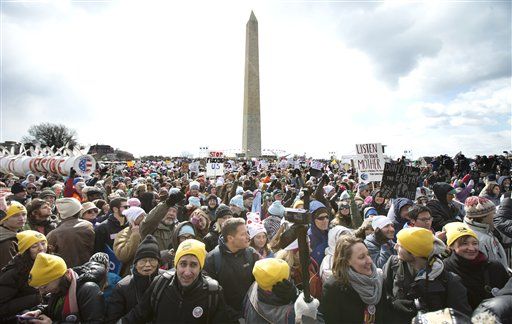
It was estimated that a crowd
approximating thirty-five thousand devoted environmentalists showed up
in Washington on the National Mall to deliver a message to their
president and it sounded something like this: “We are unstoppable, another world is possible” and “Hey, hey, ho, ho, Keystone pipeline’s got to go.” and it looked something like this:
Thousands of protesters gather at the
National Mall in Washington calling on President Barack Obama to reject
the Keystone XL oil pipeline from Canada, Sunday, Feb. 17, 2013. (AP Photo/Manuel Balce Ceneta)
They
have a mission to save the United States from environmental
degradation, and they most certainly do not wish their country to
purchase petroleum from a country whose largest extractable source is
named the 'tarsands'. This is not a pejorative, it is a realistic
summation of the dirty hydrocarbons that the product also called
bitumen, represents, though not to the governments of Alberta and Canada
who prefer the daintier term 'oilsands'.
There
certainly are a whole whack of problems being posed in extracting that
product without impacting deleteriously on the environment. And in all
likelihood there is no way of pulling that dirty oil out of that
generous geological cache that will not be of some level of harm to the
environment. Engineers are working on it, to extend their very best
scientific efforts to prevailing in producing methodology that will be
least destructive.
It is not the clean-to-refine oil
extracted so effortlessly from Saudi Arabia and elsewhere in the Middle
East and Venezuela. The United States is buying oil from Saudi Arabia
and Venezuela, two sources that support virulently anti-human-rights
governments. Needless to say transporting oil from Saudi Arabia has its
own deleterious effect on the environment. Apart from enriching a
society that has been the source of fanatical Islam itself posing a
threat of an entirely different kind to the West.
In
2009 an agreement was signed between Canada and the United States, with
Prime Minister Stephen Harper and President Barack Obama launching the
Clean Energy Dialogue, agreeing to support emissions reductions targets
contained in the 2009 Copenhagen Accord of 17% below 2005 levels by the
year 2020.
But the $5-billion Keystone XL pipeline for
the delivery of 830,000 barrels of heavy Canadian crude daily to Gulf
Coast refineries is not a palatable option for the environmentalist
groups that have rallied against it at a time when the United States,
because of shale gas and new fracking methodology anticipates becoming self-sufficient in energy by 2035. To which Harvard researchers Michael B. McElroy and XI Lu have this to say in a January-February 2013 release:
Supplies of natural gas
now economically recoverable from shale in the United States could
accommodate the country’s domestic demand for natural gas at current
levels of consumption for more than a hundred years: an economic and
strategic boon, and, at least in the near term, an important
stepping-stone toward lower-carbon, greener energy. But even though natural gas is relatively “clean”—particularly
relative to coal burned to generate electricity—the “fracking” process
used to produce the new supplies poses significant environmental risks.
We must ensure that procedures and policies are in place to minimize
potential damage to local and regional air quality and to protect
essential water resources. We need to make sure that extraction of the
gas (consisting mainly of methane, with small amounts of other gases)
from shale and its transport to market does not result in a significant
increase in “fugitive” (inadvertent) emissions of methane (CH4)—which is
10 times more powerful as a climate-altering agent, molecule per
molecule, than carbon dioxide (CO2, the most abundant greenhouse gas).
Canada
now supplies the U.S. with 100% of its imported electricity, 85% of its
natural gas imports, and 27% of its oil imports, representing over
twice as much as the 12% supplied to the U.S. by Saudi Arabia. Enbridge
alone transports more oil to the U.S. than the Saudis. And Canada is a
neighbour with great stores of natural resources, with no agenda to fund
Islamist militias on a jihad-roll.
Over
99% of Canada's oil and gas exports end up with the United States; such
exports to the U.S. increased to $102-billion in 2011 from 1992's
$17-billion. The U.S. is on the receiving end of a very good deal;
security of supply to the U.S. in return for security of demand to
Canada, which exchange courtesy is a by-product of the Canada-US Free Trade Agreement.
American
unions back the pipeline because they know that in their construction
industries there is high unemployment and the pipeline deal will produce
tens of thousands of jobs for Americans. Fifty-three American senators
support Keystone because they recognize its energy-security promise. As
for Canada, which can look forward to selling its oil elsewhere in an
energy-hungry world, it is getting short-shrifted.
Canadian
oil is sold at a discount to the U.S., significantly below the world
price. Which isn't so wonderful for Alberta's and Ottawa's finances.
Both the provincial and federal governments are coming up billions short
in royalties and tax revenues. It's rather an absurd political
stand-off, with environmental groups preferring to ignore the fact that
coal-fired U.S. power emissions are higher in greenhouse gas emissions
than Alberta heavy oil.
"We are telling the president, and have been telling the president, that a thorough review was appropriate, that following the proper protocols needed to be done to make sure that this was going to be a secure, safe pipeline...that it's going to be constructed with the most highly skilled people in the world...all those reviews completed and the reroute around the aquifer in Nebraska done, the time is now to issue the permit." "We believe our closest ally is Canada. Canada has resources that we are currently importing from around the world, and we are spending huge amounts of blood and treasure for those imports. If we can save money, lives and blood by working with our closest ally on their natural resources that we desperately need, that is what we should do." Sean McGarvey, president, building and construction trades unit, AFL-CIO
President Barack Obama's state of the union address formalizing his investiture for his second term as chief executive and commander in chief of the United States made many allusions to the country's middle class, their problems and aspirations and the need for an improved economy and more job creation. Mr. McGarvey has those same concerns and feels that settling the controversy around the Keystone XL pipeline will solve at least some of those problems to a good degree.
And he is not alone. The American Federation of Labour and Congress of Industrial Organizations representing the country's largest union federations aided the re-election of Mr. Obama. Just as, indeed the environmental movement, faith in their president intact, also helped in Mr. Obama's re-election to a second term, hoping that their support of the president would result in his support of their environmental concerns.
And Keystone XL is a primary concern of U.S. environmental groups.
In the American construction industry there is a downturn reflecting a struggling economy that has impacted on other sectors as well. For the construction industry unemployment is at 16%, and Mr. McGarvey believes that 20,000 construction jobs could result out of the TransCanada Corp. project in his country if the pipeline were to be given the go-ahead. So far no one in the administration has given any indication which way the decision will go.
Organized labour is with the pipeline as well as large manufacturers and small businessmen, willing to support the project because they seek energy security with the knowledge that a strong energy partnership with Canada is in their best interests, just as it is in Canada's. The U.S. Chamber of Commerce, the American Petroleum Institute, the National Association of Manufacturers and the Business Roundtable are all lined up in support of Keystone XL.
A bipartisan letter to the president with the signatures of over 145 congressmen urging approval of the pipeline went out last month. Similarly a letter from the Senate also was sent to the president. "If [Canada's oil] doesn't come to the U.S. it will go to the Far East, and I know that we can refine it cleaner globally than most of the refineries in the Far East. The U.S. doesn't have a closer friend than Canada", said U.S. Congressman Gene Green, a Democrat, who led the effort that resulted in the congressional letter.
"Every barrel of oil we can buy from Canada, a friend, is one less barrel that we have to buy from the Mideast where we have a lot of enemies. The additional carbon content is far less of a concern to me than being dependent on Mideast oil and sending money overseas to people who hate us", added Republican Senator Lindsey Graham. "For the Chinese to be able to successfully lock down the oil sands supply would require us to do something incredibly short-sighted and ill-advised."
Canada is the only country that has regulations on greenhouse gases among the top five suppliers of oil to the United States; Canada, Mexico, Venezuela, Saudi Arabia and Nigeria. Cindy Schild, senior manager of refining and oil sands at API, who leads the Keystone XL campaign said: "StatsCanada, as well as our Census Bureau, have analyses that show that for every dollar that the U.S. spends in Canada, $0.89 is returned to the U.S. economy. You don't see that with our other trading partners."
Those are the voices of the pro-pipeline activists. Then there are the voices of the anti-pipeline activists. And their voices are many, from the Sierra Club to the Natural Resources Defense Council, and high-profile activists like Robert F. Kennedy Jr., and actress Daryl Hannah, two among the 48 protesters that were arrested in yesterday's protest at the White House. They insist bitumen carried from Alberta's oilsands to the U.S. Gulf Coast would be environmentally disastrous.
Screenshot from Twitter.com user @thinkprogress
"The science is clear. Climate change is not just an economic issue, it is a moral issue. I do not believe that Keystone XL will happen. I believe that President Obama and Secretary Kerry will do the right thing. And we need to show our support." Robert F. Kennedy, Jr.
"Since
(Stephen) Harper was elected as prime minister, foreign policy has
shifted to be very much supportive of Israel's position ... and I think
it brought public opinion with them. "Many
people I think were assuming that this government was somehow out of
step with public opinion when it comes to its very hawkish, hard-line
stance on Iran. When in fact, I think they're both shifting public
opinion but they're also being led by public opinion. "You
could then ask 'What's that going to do to the Arab Spring? What's
that going to do to the price of oil? What's that going to do to any
kind of hope of a rapprochement between the West and the Islamic world? "I think those are pretty compelling arguments for people to maybe take a second look at this." Rudyard Griffiths, co-organizer, moderator, The Munk Debates
The question posed to a group sampling of Canadians and Americans, conducted by Ipsos Reid on behalf of The Munk Debates elicited a nine-out-of-ten response in agreement with the statement: "the world cannot tolerate an Iran with nuclear weapons capability".
The result of the survey - that 92% of respondents were in agreement
reflected the same response both north and south of the border.
The
result seemed to come as a surprise for Mr. Griffiths, preparing for a
semi-annual contest of debates on issues currently facing Canada as well
as the international community. According to Mr. Griffiths, Canada has
moved away from its traditional role as 'honest broker' between
conflicting sides in the Middle East. Mr. Griffiths appears to be
uncomfortable with the government's unequivocal stance reflecting
reality.
Some eight percent of Americans, nine percent of Canadians, stated their disagreement with the statement, "the world cannot tolerate an Iran with nuclear weapons capability". A clear and unequivocal minority. British Columbians and Albertans were most strongly opposed to a nuclear-capable Iran, with 94% agreeing with the statement.
And surprisingly Quebec hosted the next most strongly opposed to Iran having nuclear weapons, at 93%.
Following
was Atlantic Canada at 921%, Ontarians at 90%. The relatively weakest
response came from Saskatchewan and Manitoba, at 87% agreeing. Mr.
Griffiths' interpretation is that in all likelihood those who support
the argument finding a nuclear-capable Iran intolerable, would also
support a pre-emptive strike to destabilize and prevent Iran's nuclear plans.
And it is that conclusion that he finds troubling, asking, what's
next, how would that impact the price of world oil, how might that lead
to better relations between the West and the Islamic world? How
indeed? The thing about the Arab world and Muslim societies within that
world is that they seem to respect power, equating power with might,
military might. They look askance at those who seek peace first and
foremost.
These are traditional tribal mentalities,
aggressive bully mentalities, and bullies always make the cardinal error
of believing implicitly that those who advocate for peace are
inherently weak, lacking self-respect and a sense of honour, and
therefore both respect and honour should be denied them. They believe
that those lacking self-respect and honour will not fight to defend
themselves.
That seems to encourage the jihadist
mentality that urges those inclined to ride roughshod over those whom
they identify as adversaries. Accommodation and co-operation are
utterly foreign concepts in these situations; the impulse is to gain
advantage by means of violent action and reaction. And this is a
society that does not seem to learn by experience, by and large.
One
that is so deeply mired in aggression, the concept of honour, of
honourable jihad and the sacred necessity of advocating for the spread
of Islam throughout the world, a mission that was embarked upon in the
7th Century and has never accommodated itself to the impression of
honouring their own sacred scriptures which sometimes urge respect for
others, and sometimes insist on warring with others, they remain
conspicuously conflicted.
But it is the ordinary people
among them wishing to live in harmony with others whose voice cannot be
heard over the bellicose din of the bullies among them clasping the
primacy of Islamist
conquest at all costs, including the lives of insufficiently pious
Muslims who suffer. Until they awaken from their slumber of submission
to the oppressive predations of Islamists among them, nothing will change from their end.
Which
doesn't mean that the other side of the equation, the West's response
to the deadly turmoil existing within and exiting from the Middle East
with its most current manifestation of social dysfunction optimistically
named the Arab Spring and realistically recognized as the opportunity
that has led to the Islamist Springboard, need not be awake to the threat that continues to emanate from that corner of a very volatile world.
The world cannot, should not and will not tolerate Iran with nuclear arms.
This represents a general opinion site for its author. It also offers a space for the author to record her experiences and perceptions,both personal and public. This is rendered obvious by the content contained in the blog, but the space is here inviting me to write. And so I do.