"Do
Canada's values permit those First Nation chiefs -- some of whom are
mini-Trumps -- to systematically violate equal justice under law to
those they govern, enabled by Canada's blind and deferential eye?"
"When is this conversation going to open up?"
"Some
[membership] applications, like the children of an incumbent chief, are
processed quickly and secretly ... It is very lonely and challenging
for individual members, or those entitled to be members, to hold a rogue
exercise of power accountable."
"They [Chiefs] understand the requirement for nation rebuilding. They know
that inequality is bad for everyone and that almost every modern social
problem is more likely to occur in a less-equal society. So they want to
build a society founded on equality and spiritual values." "But other elected leaders do not know this. Power, in their hands,
is treated as absolute, personal power. It’s cut loose from standards of
procedural fairness, principles of justice, equality, transparency,
accountability and fiduciary selflessness. The inherent right of
self-government does not justify absolute power and harming people."
"But they [Parliamentarians] look away. They don’t want to interfere or appear colonial.
They defer to the inherent right of self-government. They look good and
it mitigates the federal fiduciary risk."
"Canada
created this condition and its abdication consummates an unholy
political union with self government sovereignty assertions."
Indigenous lawyer Catherine Twinn
Catherine Twinn says Canada has abandoned First Nations citizens by ceding its oversight powers to band councils. Photo: APTN News.
"The
[First Nations] communities know full well what LNG [liquid natural
gas] is all about. They approved it They signed onto it. They wanted the
training. The media is not telling the whole story.:
"There
is a well co-ordinated, well-funded machine shutting down Canada. the
agenda is basically anti-fossil fuel, but also forestry and mining."
"This machine has set back Aboriginal reconciliation by 20 years."
"Most Canadians are becoming painfully aware that there is a distinct
movement underway to undermine our resource economy and with it, undo
the achievements of Aboriginal community leaders who have been
successfully reconciling Aboriginal rights and title with the Crown for
the past 15 years."
"Many of those lining up against the Coastal GasLink pipeline are
non-Aboriginal, while some are even from south of the border." "Foreign influence is nothing new, but what we are seeing today is a
well-executed campaign financed by the likes of Tides Canada and the
U.S.-based Rockefeller Foundation."
"Researcher Vivian Krause has well documented the source of these
funds and has followed the distribution of money to environmental
activist groups here in Canada. If she wasn’t taken seriously before,
I’m sure Canadians will take another look at her research today." "Caught in the middle are First Nations such as the Wet’suwet’en,
whose people are being divided by a question of authority between the
elected band council members and hereditary chiefs. The other group
that’s caught in the middle are everyday British Columbians — including
fellow Aboriginals who just want to get home, to work or to the
hospital."
"The fact of the matter is that all 203 First Nations in British
Columbia have different approaches to governance. The last thing any of
us need is intervention from foreign groups that want to hijack our
future for their own objectives."
Ellis Ross, Indigenous leader, Liberal MLA, British Columbia
Harrison
Thunderchild, a member of Thunderchild First Nation, is taking the
First Nation to court to force them to comply with the First Nations
Financial Transparency Act. Provided photo./ Saskatoon
Tribal governments in charge of close to one million Indigenous
Canadians are accountable to no one. They should be accountable to the
people they govern, but they are not. They think of themselves as
all-powerful, and they behave as though they are, in distributing the
assets of reserve funding from the federal government, and managing the
welfare of the community. In so doing they favour friends and relatives
and supporters, while neglecting the equal rights of all tribal members
of a reserve.
And the way the current federal government hoves to non-interference in
Aboriginal affairs, the situation in many of the reserves continues to
fester, as council members and chiefs accrue all benefits to themselves,
and control the well-being of the entire reserve population as they see
fit. Those within the community who chafe at the inequality of the
situation are punished by a smaller share of whatever it takes to meet
quality of life guidelines, from the choice of housing on down.
There are no fewer than 632 First Nations tribes in Canada, all
considering themselves independent nations and a law unto themselves.
Some councils are a credit to their tribes, managing their
responsibilities well, and leading their reserves into prosperity as a
measure of meaningful guidance and governing decisions. All too many
others are complete and utter failures under petty dictators who siphon
off tribal funding for those they privilege including themselves.
Since 2015, when the current Liberal government of Justin Trudeau took
office, law and order has been left to tribal chiefs and councils. Most
First Nations operate their own election process, their police forces,
and provide vital services such as housing, health care and aligned
benefits, passing and enforcing their own tribal laws. The Trudeau
government handed full autonomy to tribal governments, by choosing to
set aside enforcement of the First Nations Financial Transparency Act
brought in by the previous Conservative-led government.
That Act made it mandatory for all bands to publish public audits of
band finances; audits of band expenses, inclusive of council and chief
compensation. What was once mandatory has become optional. And while
many bands take the high road and publish that data for public scrutiny
knowing they have nothing to hide, many others choose to ignore the
need to be fiscally and publicly accountable because they do have much
to hide.
Billions of tax dollars are involved in the transfer of funding to all
the band councils. Audits of band expenses may or may not now take
place. When those audit requirements are waived by the band council, and
there is nothing to publish, to inform members of the reserves how the
funding meant to be equally distributed among all band members in the
upkeep of band resources, they are kept in the dark although activists
within the reserves tend to have a fairly good idea of how deeply their
rights are being ignored.
In the previous government that enforced the requirement to post band
audits, civil rights actions involving some band members and their
leaders were undertaken by the federal government. Now, "The compliancy burden has shifted to those least able [to insist on them] -- the band members", points out Catherine Twinn. "Few
can afford to hire lawyers, go up against the resources in the command
of chief and council and risk their necessities, such as housing,
program supports and jobs, often controlled by the elected leadership."
Last winter's rail blockades by protesters spurred and inspired by
hereditary chiefs who had overridden the authority of elected chiefs in
rejecting construction of a liquefied natural gas pipeline in British
Columbia, temporarily froze the country's rail transport. The pipeline
had been poised to proceed in the wake of years of negotiating with the
affected tribes through whose traditional land the pipeline would be
built. Support for the project was overwhelming among the tribal
residents and their elected chiefs.
A proportion of profits to be allocated to the tribes, and a significant
number of jobs guaranteed, along with appropriate job training. The
hereditary chiefs, against the judgement and support of the pipeline by
the elected chiefs, set up illegal road and rail blocks, demanding a
stop to the project. According to prominent Indigenous leader Ellis
Ross, climate change radicals had manipulated the protests with an aim
to shut down the nation's resource base through the power politics of
dividing people over a project for future prosperity that would bring
them together in a common purpose.
Prime Minister Justin Trudeau, left, poses for a selfie with Tsuu'Tina First Nation councillor Emil Starlight in early 2016
"Japan touts a low-emissions Olympics, but in the very same year, it will start operating five new coal-fired power plants that will emit many times more carbon dioxide than anything the Olympics can offset." Kimiko Hirata, director, Kiko Network, climate action
"They say temperatures are rising. We've known that for a long time." "It's time to do something about that." Tetsuya Komatsubara, 77, resident, Yokosuka, Tokyo Bay
Coal awaits transport at a Japanese port. Almost all of the nation's supply is imported.
BLOOMBERG/GETTY IMAGES
Japan speaks of its plans to transition to a more climate-resilient economy, with innovations such as roads to reflect heat. Organizers of Japan's upcoming summer Olympics have stated that electricity for the Games will be sourced from renewables in energy. The underlying reality appears somewhat at odds with this, however, with its decision to re-invest in coal. To the extent that the country has made plans to build up to 22 new coal-burning power plants over the next five years, known to be one of the dirtiest sources of electricity.
There are 17 identified sites where -- in the following five years while the world is focused on carbon dioxide emissions in the fight against global warming -- those 22 coal-burning plants are meant to be situated. This return to a disputed and rejected old energy source, tried, true and reliable, but horribly polluting, comes as a result of the alarm raised over the Fukushima nuclear disaster of a decade ago, following an earthquake and tsunami. Where a design flaw in the reactor was the cause of the nuclear plant collapse. "Why coal, why now? It's the worst possible thing they could build", commented a homemaker in Yokosuka, the identified site where two of the coal-burning units are to be erected. Altogether, the 22 power plants would result in emissions producing close to the annual carbon dioxide of all passenger cars sold in the United States. And how this situation reflects on Japan's efforts to portray its Tokyo Olympic Games as one of the greenest ever, is a mystery.
Kobe Steel power plant from an apartment balcony in Kobe. (Photo:Ken Kobayashi)
Environmental groups in Japan are accustomed to focusing their ire on nuclear power. With news of the coal-fired plants' impending construction, local residents have turned to taking the government to court over its approval of the new coal-burning plants, arguing that the plants' effect will serve to degrade local air quality, endangering communities through contributing to climate change.
Scientists in Japan attribute a heat wave that occurred in 2018, killing over a thousand people, to climate change. Heat concerns have led the International Olympic Committee to move the Tokyo Olympics' marathon events to a city that experiences cooler temperatures, about 1,100 kilometers north of Tokyo. In a Tokyo summer, residents strive to leave the city's hot, humid environment for temporary cooler environs. A Tokyo summer is hardly an appropriate venue for strenuous athletic events to take place.
Coal produces over a third of Japan's power generating requirements. Even while older coal plants will begin being retired to eventually reduce overall coal dependency, Japan still has expectations that it can meet more than a quarter of its electricity needs into 2030 from coal. Coal consumption has been on the rise for decades in the energy-deficient country, reliant on imports for most of its energy needs, and attempting to wean itself away from foreign oil imports ever since the 1970s oil shock.
Add caption
Japan's government feels the country's utilities must continue to invest in fossil fuels to ensure a diversification of energy sources and lessen dependency on any one type. About four-fifths of Japan's electricity needs are met with natural gas and oil. Renewal sources of energy led by hydropower produce about 16 percent. Up to a third of Japan's power generation was once provided by nuclear energy which has since plummeted in 2017 to 3 percent.
Scientists registered an increase in the temperature of waters off Tokyo representing over one degree Celsius over the past decade. The result of which is dwindling fish stocks. Local fisherman Tetsuya Komatsuhara, who operates a duo of small fishing boats diving for giant clams, can feel the rise in water temperature on his skin. He is concerned that the new plants would strike yet another blow to a fishing business already declining.
A coal depot at
Sakata Kyodo Coal Power Plant in Sakata, Yamagata Prefecture: Coal could
make up more than half of Japan's energy mix by 2030. (Photo by Ken
Kobayashi)
"Global energy consumption was up 2.3 percent in 2018, roughly double the average annual growth rate since 2010." "Fossil fuels met almost 70 percent of the new demand for the second year running, with demand for natural gas especially strong. Global natural gas consumption was up 4.6 percent, while oil rose 1.3 percent and coal increased 0.7 percent." "China, India and the United States accounted for 70 percent of all energy demand and 85 percent of the net increase in emissions." "In the United States, natural gas demand spiked ten percent ... an increase roughly equivalent to the gas consumption of the United Kingdom. That spike was complemented by strong demand for oil, especially from the petrochemical sector. American oil demand was up by 540,000 barrels per day in 2018, the largest increase in the world. That resulted in a 3.1 percent increase in U.S. carbon emissions." International Energy Agency report, Paris
"I often hear concerns from investors about Canada's falling position in the world." "Our capacity to grow and advance our economy is stalling." Dave McKay, chief executive, Royal Bank
Former President Barack Obama was an especial darling of the U.S. environmental groups. They saw him as one of their own, steeped in concern over the environment, concerned over Global Warming and with them in a concentrated effort to stem the tide of growing carbon emissions blamed as human-made threats to nature as we know it, the effects of petrochemicals, their extraction and energy use deleterious to the future of the planet.
Protesters said Obama's entire presidential legacy rests on the Keystone XL project. Photograph: James Fassinge
At a time when the United States was using massive amounts of dirty coal to keep its energy needs afloat, and fracking was proliferating to the alarm of geologists, President Obama sturdily kept faith with his nation's confirmed environmental activists, portraying himself as committed by delaying and then finally refusing to allow a Canadian pipeline to be built to carry Canadian crude to refineries on the U.S. West Coast. At the very same time, American pipelines were given the green light.
Nam Y. Huh/AP American environmental organizations fighting the Keystone XL pipeline say there’s no climate-change plan Canada could possibly adopt that would make them back down.
So that's that. Canada now has an heir to Barack Obama's legacy as the Green Knight, with Justin Trudeau tilting at the very same windmills and in the process halting any progress in Canada to convey Western oil and gas to Eastern Canada, content to preserve the tradition of Canada importing Saudi oil and leaving Alberta oil in the ground, on the way to ostensibly curing Canada of its addiction to heating winter homes and operating factories with fossil fuels.
Justin Trudeau's administration has now succeeded in bring a carbon tax to all provinces in the country and its territories. This puts the Liberal government's aspirational stamp of environmental progressivism indelibly in place. As the Environment Minister in the Liberal Cabinet stated: "It's a fact that pricing pollution is the most cost-effective way to cut pollution". Others argue that without carbon there would be no life on Earth.
The federal Environment and Climate Change department recently released its latest study which claims that Canada has been warming at twice the average rate of the entire world. Canada, scolded retiring environment commissioner Julie Gelfand, is not doing enough to combat climate change. What the Environment and Climate change report also stated is that the warming is "effectively irreversible"; that what happens outside our borders will fashion our future.
China and India are using more coal than ever before. With three billion people combined in China and India alone, Canada's modest 37 million population hell bent on reducing reliance on traditional energy resources to run the economy the question is what good is Canada's reduction in use and associated strategy of taxing energy in the face of those gigantic populations and their countries' determination to grow their economies irrespective of signing on to the Climate Change agreement?
Not to be discouraged, and happy to do its part, Canada forges ahead with two bills meant to further hamper fossil fuel extraction, refining, delivery and use. Certain beyond any doubt to be costly to the country's prosperity, but assured to be pleasing to environmental concerns, Canada's climate change policies are lonely initiatives in a larger sea of complete indifference by the very countries whose use and abuse of the environment proceeds apace.
Global Energy and C02 Status Report: Oil -- International Energy Agency
"[The frequent occurrence of minor earthquakes was related to fracking.]" "Most
importantly, the area is located near the southern edge of the Sichuan
basin, near mountains that were formed by tectonic plate movement, which
means that the area has large fault lines underground." "Southern Sichuan is an area with particularly strong seismic activity.
Earthquakes happen due to the long-term accumulation and sudden release
of geological stress. From a scientific point of view, the vibrations in
the Earth's crust caused by shale gas fracking can continuously create
underground geological stress which leads to small earthquakes, but this
can also help avoid large earthquakes in future." Wang Xinzhi, professor of geology, Southwest Petroleum University, Chengdu
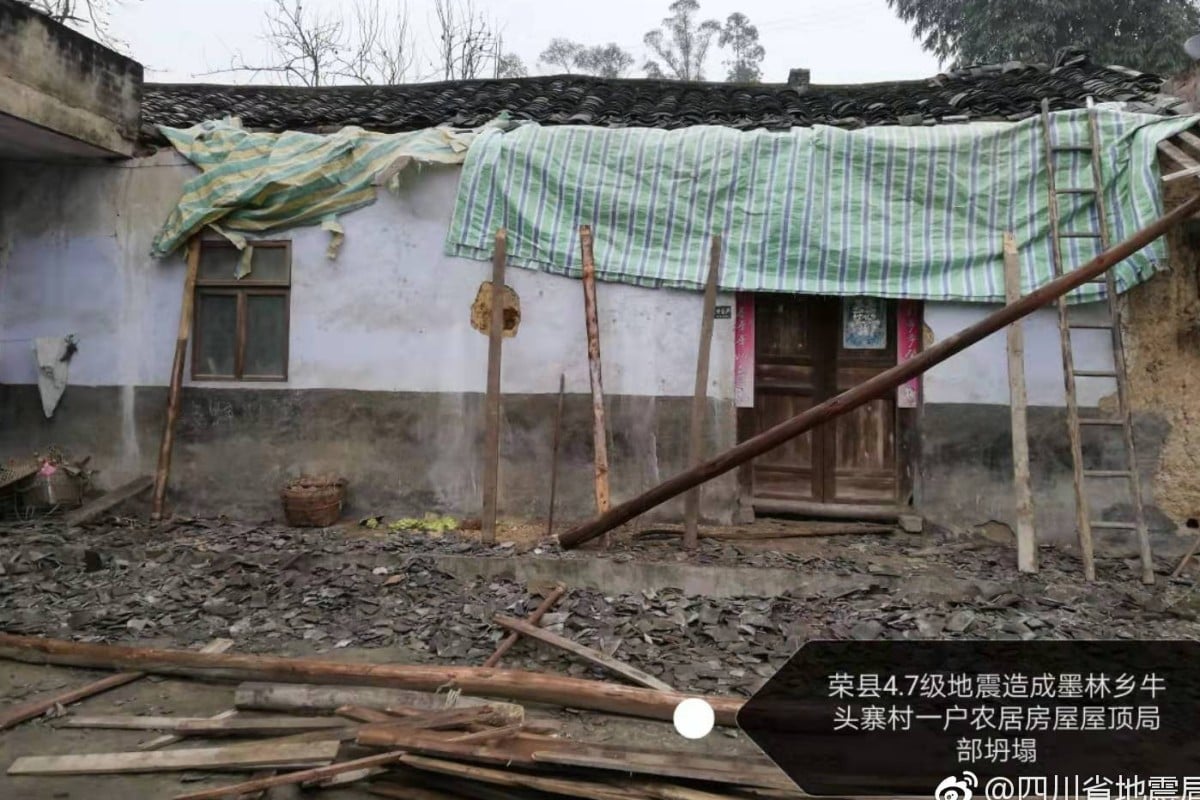
In Rong county, Sichuan, two people were killed and 10,000 buildings
were damaged in earthquakes protesters say were triggered by fracking
for shale oil. Photo: Weibo
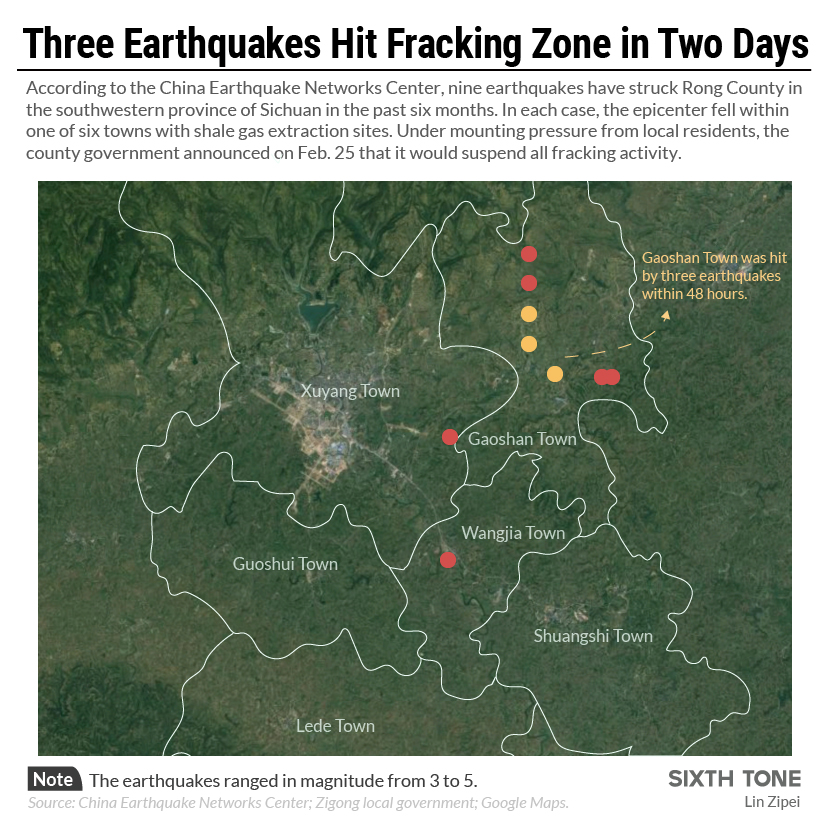
On February 24, Gaoshan, a farming village in Sichuan Province, was struck by an earthquake before dawn. Two more earthquakes followed the next day. A major earthquake hit Sichuan in 2008, leading to the death of close to 70,000 people. That, to the people living in Gaoshan, was a natural disaster of tremendous proportions, unavoidable, a fact of life because nature cannot be tamed. The tremors they experienced in February, however, they recognize as human-derived. "The drilling", sobbed Yu Zhenghua, surveying her home.
Hydraulic facturing (fracking) technology has revolutionized the production of natural gas and oil, famously in the United States, but a boom has resulted in China as well. And with that boom has come controversy, arising everywhere fracking takes place. Thousands of residents of the village converged in Rong Cunty at a government building in protest of fracking in the hills and valleys where they live.
Security guards tried to restore order, to convince the protesters to disperse. Which they did once officials announced the suspension of fracking operations until the results of a government survey were known. Elsewhere in the region, however, fracking operations continue. Like all other countries that have embraced fracking as a revolutionary technology to free up energy reserves, China entertains thoughts of becoming energy independent, no longer reliant on foreign energy sources.
It now faces unanticipated public fury in concern over social and environmental challenges seen to threaten the country, despite its tight control of political concerns. "Sichuan is a major earthquake zone, so there is clearly a risk (inherent in fracking", explained Philip Andrews-Speed, a geologist located in Singapore. Two people died in the three earthquakes that hit the village, and another thirteen were wounded. Over 20,000 homes in three villages were left damaged, nine of which completely collapsed.
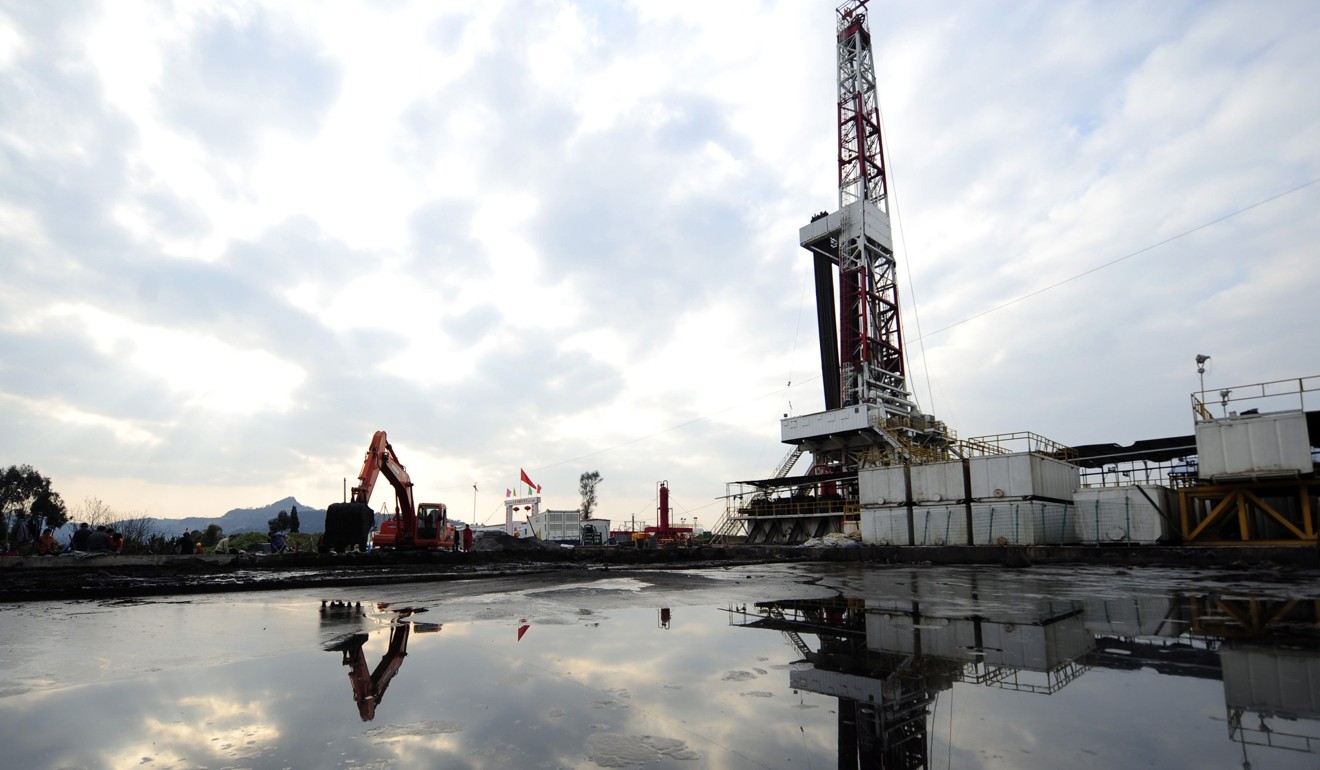
Work on a natural gas appraisal well goes on behind a pond of drilling waste in Sichuan province. Photo: Reuters
In the event, roughly 1,600 people were displaced, evacuated and having to move in with relatives or forced to live in hundreds of blue tents distributed by the local authorities. The retaining wall holding up the property along a steep hillside buckled at Ms. Yu's house and deep cracks gouged the stuccoed brick walls of the two-story house her son had built for her. "My house was built only twelve years ago, and now it is like this", she mourned.
The damage would be repaired, the authorities promised. Sitting atop the largest recoverable reserves of shale gas in the world, according to the U.S. Energy Information Administration, China's government has set itself goals to expand fracking in the years ahead, hoping to repeat the U.S. fracking boom. Stumbling blocks have arisen, however, since shale deposits are deeper in China, at 3.5 kilometers in Rong County, making them more expensive to tap. As well, in a process requiring the heavy use of water, scarce in some regions, adding another complication.
China's dense population makes problematical many of its best shale deposit sites, located in crowded areas, including Sichuan, with its over 80 million people. There are 39 separate wells in the 15 platforms in Rong Country, drilled or already in operation. Roads to the sites are rutted, sometimes impassable as a result of the heavy equipment involved in fracking. The once scenic valleys and terraced fields have been mutilated with the presence of long black tubes.
A noticeable increase in tremors and quakes after production began worries Rong County residents, the latest of which seismic events appeared to inflame anger beyond the accustomed simmering point. "What on earth do you want from us? Will you take the matter seriously only when there's loss of life?" one woman write on Weibo.
"Lower prices are not all good news for consumers. The economic benefits are counterbalanced by increasing reliance on the Middle East for imported crude oil and the risk of a sharp rebound in price if investment dries up." "It would be a grave mistake to index our attention to energy security to changes in the oil price. Now is not the time to relax. Quite the opposite: a period of low oil prices is the moment to reinforce our capacity to deal with future energy security threats." Fatih Birol, executive director, International Energy Agency
"This is [a] man-made crisis in our industry we have created ... And I think all we're doing is irresponsible." Mohammed bin Hama al-Rumhy, Oman oil and gas minister
"It's a movement of an era of scarcity to one of abundance; it's a movement from a world of unexpectedly strong demand and tight supplies to a world of ample supplies -- even over-supplies -- and weaker demands." OPEC's not the only balance of the market. The United States is back in the role of swing producer, a role it hasn't exerted in six decades." Daniel Yergin, vice-chairman, IHS Inc.
"As we saw back in 2008, high oil prices proved to be unsustainable, and the price fell sharply following the great financial crisis. But this works in the opposite direction. A prolonged period of low oil prices is also unsustainable, as it will induce large investment cuts and reduce the resilience of the oil industry, undermining the future security of supply and setting the scene for another sharp price rise." Saudi Prince Abdulaziz bin Salman bin Abdulaziz, deputy minister, petroleum and mineral resources
OPEC fracked - The Commentator
The chief of Saudi Arabia's state-owned oil company asserted the country plans to persevere in its record level production of crude oil and low profit, even though short-term economic suffering is the result. Originally, it was felt that Saudi Arabia's move in that direction, persuading all the members of OPEC to agree, was to punish Iran making it difficult for the country under sanctions to sell even on the black market. Now that the agreement over its nuclear program has become history, Iran is preparing to sell freely on the open market again.
The market will become even more crowded with excesses of fossil fuel inventories, forcing prices to remain low enough for investors to hesitate and explorations to halt; barely making extraction and refinement worthwhile. But this is a bubble that will eventually burst, with demand outstripping supply, and the concerns in the industry are that it will be unprepared to meet that demand.
China will not, as the world's largest consumer of fossil fuels, forever burn coal. As it is, their environmental pollution level is sky-high.
In the city of Shenyang airborne grit was so heavy that day looked more like night over the past week-end. Data released by the Shenyang Environmental Protection Agency revealed the density of toxic carbon particles -- PM 2.5 to be over 1,000 micrograms per cubic meter. A full 40 times greater than what the World Health Organization considers a safe level of pollutant. Locally, officials claim the pollution levels topped 1,20, but the Xinhus news agency put that figure at 1,400.
World oil prices are currently 50 percent of what they were last year. The United States, with its robust reliance on shale oil has found its way back into the mass production industry to satisfy a greater portion of its energy needs. And that state of affairs, even though the United States has its own share of carbon-polluting dirty coal plants, has led the American President to declare that his country has no need of a pipeline from Canada to Texas refiners, even while American pipelines have proliferated.
Lakota
24 west of Rocky Mtn House
Canada has the world's third-largest store of petroleum, but these are oilsands, complicated to extract, and energy-intensive in the process; on the other hand so is fracking and just as polluting. Without an eager market in an atmosphere of over-production and cheap prices, there is little incentive for the investment required however, at the present time. China's weakening economy will translate to a pause in its acquisitions to meet its production requirements leading to needed increased employment levels.
"We are hopeful that we will see in 2016 ... a correction. Don't ask me how big, that's for the market to decide. Don't ask me who is going to play that role. It's not going to be OPEC only. This is an international effort. Everyone has a role to play." Emirati Energy Minister Suhail Mohamed al-Mazrouei
"There is
an urgent need to strengthen the combat and mobilization readiness of
our forces and other military forces up to a level which guarantees an
adequate reaction to threats to national security from continuing
Russian aggression." Oleksander Turchynov, secretary, Ukrainian National Defence Council
Smoke billows from Donetsk international airport during heavy
fighting between Ukrainian and pro-Russian forces on May 26, 2014.
Reuters
The agreement from December between Ukraine's Russian-speaking separatists and the Ukrainian military for a cessation of hostilities has undergone one breach after another, making it sufficiently clear that the conflict will continue to the bitter end. Fighting erupted again on the perimeter of the Donetsk international airport, as the secessionists attempted to attack government forces, killing two soldiers. The military has suffered a clear setback as Russian forces advance.
The airport is now a wreck, in any event, its runways no longer intact, explosions having left the wreckage of craters everywhere, the facility no longer capable of being used as an airport since April. It's relevance to both the military and their adversaries remains symbolic. "Unfortunately, there are two (Ukrainian soldiers) killed", commented a senior member of the Ukrainian army general staff, Vladyslav Seleznyov.
The Ukrainian parliament is determined to beef up its front-line forces by resuming conscription. A security official had given notice that sharply increased Russian military activity in the east of the country has given new heart to the separatist rebels. "Russian aggression is continuing. There has been a significant surge in the intensity of firing", grimly stated Oleksander Turchynov, secretary of the national defence council.
In addressing parliament, he advised that 8,500 Russian servicemen were now fully actively engaged in eastern Ukraine. Ukrainian military positions had been fired on over a hundred times, a record for the new year. Four Ukrainian soldiers were wounded on Wednesday. Moscow still denies its troops are integrally involved in the civil war, despite the incontrovertible evidence that Kyiv insists it is in possession of.
The shelling of a passenger bus on Tuesday at an army checkpoint, has led to increased military action by Russian forces. The bus that had set out from Donetsk on a regular route had been hit from a shell fired within the rebel-occupied areas; clearly the target had been the Ukrainian military, and the bus just happened to be in the wrong place at the wrong time; somewhat like the unfortunates on board the Malaysian passenger jet shot down by the rebels.
Predictably, as in the horrors of the Malaysian airliner debacle, the separatists have denied responsibility for the deaths of the bus passengers, even while Kyiv lays the blame squarely at their feet. A decree by President Petro Poroshenko to revolve long-serving troops at the front and bring in reserve veterans along with partial conscription, was supported by Ukraine's parliament.
Even while Moscow denies any involvement in Ukraine, other than moral support for its expatriate community, President Putin has ordered Gazprom to cut supplies to and through Ukraine, claiming it was siphoning off Russian gas to steal what they could conceivably get away with, characterized as "transit risks for European consumers in the territory of Ukraine".The fallout for which is far-reaching, with gas exports cut by 60% to Europe.
Within hours of the edict, Europe found itself in an energy crisis. Ukrainian gas companies confirmed Russian supply cut-off. The European Union responded furiously that the sudden cut-off was "completely unacceptable", which must have been music to Vladimir Putin's smug ears. Gazprom CEO Alexey Miller explained that Russia is working on shifting its natural gas flows from Ukraine to a route through Turkey.
According to Russian Energy Minister Alexander Novak "the decision has been made". As the world's largest natural gas supplier, Gazprom now plans to send 63-billion cubic meters through a link proposed under the Black Sea to Turkey, spurning shipments through Ukraine where 40% of Russian gas exports to Europe and Turkey had passaged Ukraine's Soviet-era gas network.
Europe finds itself in an emergency situation as winter sets in, leaving Bulgaria, Greece, Macedonia, Romania, Croatia and Turkey bereft of gas shipments from Russia through Ukraine. This is Russia in its element, conducting its usual business-as-usual-Moscow-style; a confrontation on two fronts; military intervention in Ukraine, and gas cut-offs to Europe, teaching them not to meddle in the affairs of the Russian Federation.
Not quite ready to build a pipeline to China.
Photographer: Alexey Druzhinin/AFP/Getty Images
"Russia has abandoned the troubled South Stream project and will now be building its replacement with Turkey. This monumental decision signals that Ankara has made its choice to reject Euro-Atlanticism and embrace Eurasion integration." "In what may possibly be the biggest move toward multipolarity thus far ... Turkey has done away with its former Euro-Atlantic ambitions. A year ago, none of this would have been foreseeable, but the absolute failure of the US/ Mideast policy and the EU's energy one made this stunning reversal possible in under a year. Turkey is still anticipated to have some privileged relations with the West, but the entire nature of the relationship has forever changed as the country officially engages in pragmatic multipolarity." "Turkey's leadership made a major move by sealing such a colossal deal with Russia in such a sensitive political environment, and the old friendship can never be restored ... The reverberations are truly global." Andrew Korybko, 'Cold Turkey: Ankara Buckles Against Western Pressure, Turns to Russia', Sputnik News
"We were negotiating concerning an advance and the advance was an element of the price negotiations. But as we have reached a final agreement on the price, we are not considering the possibility of receiving an advance as a financial instrument to further lower the price [offered to China]."WOT?!! Alexei Miller, head, Gazprom
The 'advance', unfortunately did not materialize. China was offered a better gas price on the basis of investing substantially into the 30-year deal to supply 38 billion cubic metres of natural gas yearly to China in a $400-billion contract to supply China with gas through a new pipeline, Power of Siberia. That much-celebrated deal, meant to thumb-nose the European Union by teaching both it and Ukraine another lesson in pipeline diversion, simply failed to materialize.
The generosity of a presumed Chinese advance to begin the building of the gas infrastructure would have aided Moscow enormously. On the basis of a projected $55-billion pricetag, no doubt heads were spinning at the prospect of China ponying up at least a tenth of that total to help matters along and spur the initial construction. The offer originally was that an advance would translate into a lower gas price for China. But the advance was withheld and the gas price ... what about that price?
With the plummeting returns on gas and oil is it even remotely possible that clever Beijing energy authorities bargaining with Moscow would not foresee a fluctuating market and await near-delivery before settling on a price? Headaches there are many. For Moscow, in any event. The Power of Siberia infrastructure to funnel that gas to China may have been under-priced. New costing speaks more like $70-billion.
Given that Russia is teetering on the brink of recession where will the wherewithal to build the pipeline arise from when the East European Gas Analysis consultancy cites an even costlier estimate of $100-billion required by Gazprom to build the pipeline. Funding can no longer be raised through financial markets in the West. And Russia's state National Welfare Fund has a lineup for funding from the $80-billion kitty.
And then there's the deal with Turkey, the replacement of the South Stream pipeline blocked by the EU with new plans to lay pipe across the Black Sea. It will prove more costly to deliver gas to Turkey bypassing the Ukraine route to "reduce Ukraine's role as a gas-transit country to zero". The European Union countries dependent on Russian gas (30% of imports) bought a significant 160-billion cubic metres of natural gas from Gazprom last year.
Turkey doesn't seem convinced that the pricing offered by Russia will really benefit the country. Turkish Energy Minister Taner Yildiz holds that no firm deal, despite the triumphant trumpeting of Moscow for at-home public consumption, to soften the bad-news blow of recession, had actually taken place. President Putin and Prime Minister Erdogan simply agreed to keep discussing diverting the Black Sea pipeline to Turkey.
Turkey isn't much enamoured of the Russian offer of a 6% discount, and a counter-offer was proffered. Moscow is now anticipating unhappily the prospect of supplying Turkey with gas at a lower price than it would have received from its European consumers out of South Stream. And there goes its argument to the West and the U.S. in particular to stop interfering in Russia's Ukraine adventure.
The sanctions by Moscow-averse adventurism by the West has left Mr. Putin with a sincere wish to upstage his tormentors by demonstrating ably how many options he has to diversify the country's export base, and nothing would please him more than to leave his old EU customers with whom he has had such uneasy, bullying relations in the past, out in the dark and the cold.
Pity indeed that the realities of the marketplace and a meagre cash cupboard leaves Russia in actual fact, with so few options but to return to its traditional client base meekly in need of a boost to its faltering finances.
The Middle East has long relied on the United States to maintain a balance of what passes for moderation in that highly volatile area. That oversight by the most powerful and persuasive nation on Earth has latterly undergone a tectonic power shift. Under the Obama administration the United States has gradually shifted away from its conventional role and its traditional allies in the Middle East. When Barack Obama visited Egypt shortly after his presidential inauguration he spoke to the Muslim world that a new day was dawning between America and the world of Islam.
President Barack Obama with President Hosni Mubarak, Cairo, Egypt, June 2009 Photo: Stephen Crowley/The New York Times
He was speaking of course of Arab/Muslim resentment over perceived and actual interference in the Middle East by the United States. There have always been polarizing views over the position of the U.S. in the Mideast; resentment that Israel has always seemed a protectorate of the U.S. Yet relief when the U.S. assembled allies to free Kuwait from Saddam Hussein's belief that it should be part of Iraq. And anger at the manipulations between oil-producing sheikdoms and kingdoms and the U.S.
Where once the United States of America was the champion of Israeli existence in a swamp of Islamic fury, and where the U.S. cultivated Saudi Arabia and managed Egypt, that has all undergone a change of sudden and stunning proportions. The terrorists representing al-Qaeda who destroyed the World Trade Centre in New York and took the lives of almost three thousand people, were mostly of Saudi origin. Their leader, a Saudi of Yemeni origin, set out to destroy the Saudi regime and set its sights on the U.S. as well.
Even so, the bonds between Saudi Arabia and the U.S. remained tightly oil-obsessed. But the United States electorate is tired of fighting Middle East/Muslim wars; Iraq and Afghanistan, and the U.S. administration set itself the goal of becoming energy-independent of Mideast oil; it can be said with confidence that the U.S. funded the rise of fanatical Islam through Saudi Wahhabism generating jihad, a central duty of pious Muslims. Wealthy Saudis financed al-Qaeda just as they finance the Islamic State of Syria and Al-Sham.
The predicament now for the Middle East is an implosion of violent jihad-borne Islamofascism with the rise of a totalitarian Sunni caliphate, ISIS, in competition with Shiite Iran and its proxy Shia militias, fundamentalist Islamists whose threat is more than equal to that of ISIS. And Saudi Arabia, with the U.S. poised to become completely oil-sufficient no longer requiring oil from the Middle East has found itself cast adrift. With ISIS threatening invasion on one flank, Iran threatening on the other.
The Saudis viewed with no little degree of alarm the offhand manner in which the U.S. divested itself of interest in Egypt after having supported a Muslim Brotherhood government once they abandoned Hosni Mubarak; reacting unfavourably to seeing the Brotherhood deposed. Under the Obama administration the Brotherhood had legitimacy and Egypt now finds itself partially divorced from the good graces of the U.S. In this, Egypt has a counterpart in where Israel finds itself, in the bad books of the Obama administration.
U.S. policy has seen a 90-degree turnabout under President Obama. The shift has left doubts that the U.S. will push too hard over Iran's nuclear aspirations. That being the case, Saudi Arabia now has more in common with Israel than would be otherwise, with both countries in dread of the Islamic Republic of Iran acquiring nuclear weapons. While Saudi Arabia is in a political-religious war with Iran, Israel is in Iran's sights as a blot on Islamic geography waiting to be destroyed.
Where Saudi Arabia might have fondled the thought that at some point the U.S. would honour its threat to destroy Iranian nuclear installations for fear of its acquiring nuclear warheads, that is no longer the case. The power that could destroy Iran's installations will not, Israel that wishes to, cannot. Iran suffered under the U.S.-led sanctions, yet now the sanctions have been partially lifted and negotiations appear stalled at the point where it seems the U.S. is prepared to surrender key demands to Iran's ambitions.
The result of which has been a sudden glut of Mideast oil on the international market at bargain-basement prices that might go lower yet. Saudi Arabia has led the way to lower per barrel prices, taking a hit it is prepared to weather leaving it reliant on its vast currency reserves. Whereas Iran, with its much slimmer currency reserve, and ailing from the effect of the sanctions, needs higher per barrel oil prices to lift it from its economic slump.
Saudi Arabia has no intention to going to war with Iran to preserve itself, not in the conventional sense. But it can and will continue to lower oil prices a little more, leaving Iran to struggle with a critically leaner revenue source. A situation that, just coincidentally, impacts Russia, Syria and ISIS as well, all dependent on sustained high oil per-barrel prices to keep them ticking along. Russia, already in recession, and Syria in parlous straits, getting their just desserts, courtesy of Saudi Arabia.
Supporting Terror: EU States Buying Islamic State Oil
EU Ambassador to Iraq reveals EU states purchasing oil from jihadist terror group, refuses to divulge names of states.
By Ari Yashar
First Publish: 9/7/2014, 11:33 AM
EU states helping to fund ISIS?
Reuters
The Ambassador for the European Union (EU) in Iraq, Jana Hybaskova,
admitted last week that several EU member states have bought oil from
the Islamic State (IS, formerly ISIS) terrorist organization that has been brutally conquering large portions of Iraq and Syria.
Hybaskova made the revelation at the European Parliament Foreign
Affairs Committee, but refused to divulge the names of the countries
despite being asked numerous times, reports the Turkish Daily Sabah.
The US is leading a western effort
to aid Iraqi government and Kurdish forces in rolling back IS's gains -
with some effect - but the various seizures of infrastructure and
resources have led IS to be assessed as the "world's richest terrorist organization," and with EU states aiding it by buying IS oil, that economic power fueling the jihadist group seems only likely to grow further.
Regarding IS's ability to export its captured oil stores, Turkish
Minister of Energy and Natural Sources Taner Yildiz rejected claims his
state was importing IS oil on July 31, shortly after the UN threatened
sanctions on states purchasing or transporting IS oil.
According to securityestimates
IS has hundreds of foreign jihadists in its ranks, including many from
Western nations. The terror group has been actively recruiting from the
West, through such means as flashy propaganda videos in German and English - a phenomenon that has western government nervous over the possibility that recruits could return home to carry out terrorist attacks.
"Putin may not get to host the G8, but if he gets to go to Normandy with everybody, it begins to diminish the appearance of isolation." Steven Pifer, former U.S. ambassador to Ukraine, senior fellow, Brookings Institution
"He's going to hear a very strong message from Polish officials that the mission has not been accomplished. In fact, the work has only begun." "I think there is no political appetite for further sanctions [by European allies]." Heather Conley, Europe scholar, Center for Strategic and International Studies
"We very much admired that the people of Ukraine have turned out in huge numbers to elect President-Elect Poroshenko. We've admired his commitment to pursue dialogue and to aim to reduce tensions and put Ukraine on a positive path." Ben Rhodes deputy national security adviser, White House
File photo shows U.S.
President Barack Obama during an arrival ceremony at the presidential
palace in Warsaw, Poland. Monday, June 2, 2014, Obama begins a four-day
trip to Poland, Belgium, and France against the backdrop of successful
national elections in Ukraine. He will likely press European leaders to
maintain pressure on Russia for its threatening moves in Ukraine, while
seeking to dispel fears from Poland and other NATO allies that the West
could slip back into a business-as-usual relationship with Moscow. (AP
Photo/Charles Dharapak, File)
While many American corporate interests are bypassing the sanctions strategy emphasized as being so hugely successful by their president, he will himself be pressing European leaders to maintain pressure on Russia over its mendacious undercover operations in sowing the seeds of civil war in Ukraine. Russia's economy may be weakened, but that hasn't stopped it from investing billions in its Black Sea fleet upgrades.
Moscow thanks the French for providing it with an amphibious assault ship, with another bound for the Russian Far East. Russia may now be planning having a permanent home for its nuclear bombers in Crimea for the first time. With Ukraine's political system in crisis, Vladimir Putin holds a veto over Ukraine joining NATO, and he's working overtime to stall Ukraine from closer ties with the European Union. "Russia's recent actions recall the days when Soviet tanks rolled into Eastern Europe. But this isn't the Cold War. Our ability to shape world opinion helped isolate Russia right away", claimed President Barack Obama during his Wednesday West Point military academy address. While Canada, the U.S., Denmark, the Baltic states and Poland envision more robust economic sanctions to Putin's Ukraine agenda, Britain, Germany, France and the rest of southern Europe are less than enthusiastic.
But has the West isolated Moscow? Although it is no longer the G8, the Group of Seven major industrial countries, spurning the meeting Russia was scheduled to host this week, are meeting in France on Friday to mark the 70th anniversary of the D-Day invasion of Normandy. And present will be President Putin. One-on-one talks with France are scheduled between Presidents Putin and Hollande.
But, no, not between Presidents Putin and Obama; nothing formal, in any event, though they will have some level of contact. Simply because Mr. Putin will be present at the event does not constitute a return to business as usual. Dear me, no. Not the impression that Poland gets from where it sits, nor Ukraine for that matter.
Ukrainian President-elect Petro Poroshenko will hold his first bilateral meeting with Obama in Warsaw at the 25th anniversary of Poland's first post-Soviet free elections.
At Brussels, leaders of the G7 nations are set to meet to discuss what can be done to wean Europe off Russian energy. Well, the EU is thinking Norway, and thinking of better, more efficient and less use of energy resources.
But with Europe's close economic ties with Russia, hmm, there's the challenge in spades. Which led Ms. Conley to state her doubts.
Russia and China forge closer ties, as EU explores sanctions
Russia
looks east: 'The Eurasian Economic Union is due to be launched on 1
January 2015 regardless of the situation in Ukraine' (Photo:
dolmansaxlil)
Russia and China forge closer ties, as EU explores sanctions
BRUSSELS - Russia is rolling out two
major projects – a gas pipeline and a Crimea deep water port – with
China, as EU countries and the US weigh options on economic sanctions.
Russia’s ambassador to the EU, Vladimir Chizhov, told EUobserver on
Wednesday (16 April) that work on the “Power of Siberia” pipeline and
the Chinese construction of a 25-metre-deep port in Crimea are
proceeding as normal despite the Ukraine crisis.
Describing the pipeline as a “mega-project”, he said it will pump 60
billion cubic metres (bcm) of gas a year from the Kovykta and
Tchayandinskoe gas fields to Russia’s far east, with a branch line to
deliver up to 38 bcm a year to China.
He noted that Gazprom and China’s CNPC have a “legally binding”
agreement from 2013 and that exploitation of the Tchayandinskoe field
should start in 2019.
“One important issue is still pending – that of price. Gazprom and
CNPC are negotiating on this subject, and their positions are gradually
drawing closer together,” he said.
“The project is aimed primarily at delivery of gas to Russian regions
and at developing industry in the Russian far east. The export of gas
is considered in this context as a factor which improves (significantly,
one should admit) the economics of the project, but not as a
prerequisite for its realisation,” he added.
Chizhov said Moscow and Beijing are also going ahead with plans for
Chinese firms to build a deep water port in Crimea as part of “a new
transport corridor from Asia to Europe – ‘The Economic Belt of the Great
Silk Route’.”
He indicated that Russia’s annexation of Crimea – deemed illegitimate
by the UN – has done nothing to stop the port investment, worth $3
billion in the “first stage” alone.
The Russian diplomat said the main concern is environmental rather than political.
The current plans envisage the excavation of an “enormous trench”
near the Crimean town of Frunze and the filling of it with sea water by
demolishing a dam.
“A number of ecologists and environmental organisations protested
against the project arguing that it would create unrepairable damage to
the ecological systems and environment of the region, which is famous as
a seaside resort … Environmental concerns must be addressed as a
priority,” he noted.
He added the Ukraine crisis has also done nothing to slow Russia’s
plan to launch a “Eurasian Union” with Armenia, Belarus, Kazakhstan and
Kyrgyzstan next year.
“The Eurasian Economic Union is due to be launched on 1 January 2015
regardless of the situation in Ukraine or any other country not involved
at this stage in the integration process … Negotiations on accession of
Armenia are expected to be completed soon and those with Kyrgyzstan are
also under way,” he said.
His statements came on the eve of high-level talks between the EU, Russia, Ukraine and the US in Geneva on Thursday.
The EU and US have warned they will blacklist more Russian officials
and companies unless Russia de-escalates by pulling back its troops from
the Ukrainian border and by denouncing separatists in eastern Ukraine.
The EU has also warned it will impose economic sanctions on Russian
energy, minerals, banking, and high-tech firms if its army invades
mainland Ukraine. But the Nato allies made clear they will not go to war
with Russia no matter what it does to the former Soviet state.
“Talk doesn’t replace actions when it comes to what’s happening on
the ground, and that we will continue to prepare, as we’ve said,
additional sanctions and other steps, if we can’t get some de-escalation
here,” US state department spokeswoman Marie Harf told press on
Wednesday.
She added: “We’ve said that we’re not considering lethal assistance
to Ukraine at this time … and the [US] President has said there is no
military solution here.”
For their part, European Commission officials in Brussels on
Wednesday distributed sealed envelopes to EU states’ ambassadors
describing the potential impact of EU-Russia sanctions on their
countries if the Union goes ahead.
Reuters reports that member states have until 22 April to reply
before the commission finalises its sanctions proposal. It quoted one EU
official as saying: “We can't have a situation where a set of sanctions
ends up having a retaliatory impact on one member state or two or three
member states. If there are going to be repercussions from this, they
have to be shared out."
The UK and former Soviet and communist EU countries are the most
hawkish. But Cyprus, France, Germany, Greece, Italy, Portugal and Spain
have voiced wariness in recent meetings.
For his part, Cypriot foreign minister Ioannis Kasoulides told German
daily Die Welt on Wednesday that EU countries should be free to opt out
from the measures.
He said an EU-Russia economic war "would destroy Cyprus' economy”.
"There are very strong economic ties between Cyprus and Russia. If
sanctions are really necessary, then every member state should decide
for itself whether to take part," he noted.
EU companies – including Germany’s Basf, the UK’s BP, and Italy’s ENI
– are reportedly lobbying capitals to hold back due to the potential
impact on their interests in Russia.
The EU’s industry commissioner, Italian Antonio Tajani, has also
broken ranks on EU institutions’ promises to take a tough line.
“We are not the US, we don’t have shale gas as they do, so any move
to sanction them [Russia] would hurt our companies a lot,” he told the
FT on Wednesday.
“At a time when Europe is getting back on its feet after the worst
[economic] crisis in decades we need to be very careful and use our
judgment before shutting down important investment and trade relations
such as the ones we have with Russia.”
Iran's Foreign Minister Mohammad Javad Zarif and Vladimir Putin. Exploring other options? Photo by Sergei Karpukhin/AFP/Getty Images
European countries have made it clear in recent weeks that in light
of the most serious test of EU-Russia relations in years, they’re
looking to reduce their dependence on imports of natural gas from
Russia.
Joshua Keating is a staff writer at Slate focusing on international affairs and writes the World blog.
As the Economist noted a few days ago, “an immediate casualty is likely to be Russia’s South Stream pipeline,” which was intended
to bring Russian gas through the Black Sea to Europe, circumventing
Ukraine. That’s good news for projects like the Trans Adriatic Pipeline,
due for completion in 2018, which would bring gas form the Caucasus via
Turkey, cutting Russia out of the equation altogether. Or if the
current thaw in diplomatic relations continues, it could be good news
for Iran. Home to the world’s second-largest natural gas reserves, the
sector has been undeveloped after years of sanctions.
Perhaps reading the writing on the wall, Iranian Trade Minister Mohammad Reza Nematzadeh said yesterday
that "Iran should be considered a reliable partner for natural gas
supplies to Europe,” claiming that the government was looking into a
pipeline to transport gas from southern Iran to Turkey.
The Ukraine crisis may also impact the ongoing international
negotiations over the country’s nuclear program, where Moscow has
traditionally been Iran’s primary backer. Russia’s delegate to the talks
between Iran and the P5+1, Deputy Foreign Minister Sergei A. Ryabkov, hinted last month
that “We wouldn’t like to use these talks as an element of the game of
raising the stakes. … But if they force us into that, we will take
retaliatory measures here as well.”
The P5+1 have, with fits and starts, showed signs of presenting a
united front on sanctions and Iran’s nuclear program. Any division in
the ranks is likely to be to Iran’s advantage in the talks going
forward.
Russia and Iran have even been tentatively discussing a gas trade deal that the U.S. says would go against the terms of Iran’s interim nuclear agreement.
Iran and the U.S. are currently locked in a dispute over the U.S. decision not to grant a visa to Tehran’s pick for U.N. ambassador, a participant in the 1979 taking of hostages
at the U.S. embassy. I have to imagine this would be a much bigger
story, both for the media and on Capitol Hill, if Russia weren’t drawing
everyone’s attention right now.
If Iran somehow comes out of this looking like a distant second on
the list of states seen as threatening to the EU and U.S., and can
maintain its relatively cordial relationship with Russia at the same
time (the Iranian government has been studiously noncommittal in its statements on the crisis), it may turn out to be one of the unlikely winners of this mess.
Germany
is an enlightened leader in the global battle to reduce CO2 emissions, a
pioneer in renewable energy and community power projects and a champion
of energy efficiency.
Or so the common narrative goes.
But try telling that to Monika Schulz-Hopfner. She and her
husband, along with 250 other residents of Atterwasch, a quiet village
near the Polish border, face eviction from their home of 30 years to
make way for the Janschwalde-Nord coal mine.
And not just any old coal, but lignite, the dirtiest form of this ancient fossil fuel that is mined in vast opencast pits.
If the plans go ahead, the village, parts of which date back more than 700 years, will be demolished.
"Since the plans for the mine were unveiled in 2007, we have
lived with this constant threat, which has taken over the lives of every
individual and the community as a whole," says Mrs Schulz-Hopfner.
"Every single decision we make is affected by it."
And the residents of Atterwasch are not alone.
In the eastern German region of Lausitz, nine villages are
under threat, where up to 3,000 people could lose their homes to make
way for five new lignite mines that are fuelling the country's renewed
thirst for coal. Two further mines are under consideration.
The mines are needed to power a new generation of coal power plants.
Two new lignite plants were opened in 2012, with a further
two in the pipeline. Another two hard coal plants also opened last year,
with a further five opening this year or next, with two more awaiting
licences.
The effects are already being felt. Lignite production in
2012 hit its highest level for almost 20 years, while initial estimates
suggest this brown coal was used to generate 162bn kWh of electricity
last year, more than in any year since 1990. The use of hard coal also
increased, meaning the two energy sources accounted for 46% of Germany's
overall energy production.
The impact on CO2 emissions has been immediate. "There has been
an increase of between 5%-7% in CO2 in the past two years," says Prof
Claudia Kemfert, head of energy at the German Institute for Economic
Research.
And this in a country that aims to reduce emissions by 40% from 1990 levels by 2020.
As Prof Christian Hey, secretary general of the German Advisory Council for the Environment, says: "Germany has a coal problem."
There are many reasons why.
One is the low cost of carbon. "Due to the failure of the
emissions trading system, the price of CO2 permits is very low," says
Prof Hey. "The EU has failed to address this issue."
The opencast lignite mines in Germany cover tens of square kilometres
Oversupply and a fall in demand for energy - and therefore
permits - during the economic downturn means the price now stands at
around three euros per tonne of CO2. If everything had gone to plan, the
price would be more than 10 times that by now.
Overcapacity has also pushed the price of coal lower, while
the lignite industry has benefited to the tune of 60 million euros from
being exempt from supporting the renewables industry, says Prof Hey.
This means the fossil fuel has moved down what is called the
merit order curve. This was introduced in Germany in the 1990s, and
determines the order in which energy sources are used to satisfy demand.
The cheapest source is used first, the second cheapest second, and so
on.
What is lignite?
Over time, peat is converted into lignite, which is then, due
to heat, pressure and chemical changes over millions of years, converted
into hard coal
The energy intensity of lignite is the lowest of all forms of coal, making it the least efficient
Because it is less dense, lignite burns much faster than hard coal
Lignite is extracted from opencast mines, which cover a far greater area than the deep mines used to extract hard coal
Lignite contains less carbon but more sulphur than hard coal
Source: World Coal Association, Store Norske
Renewables are currently the
cheapest, followed by nuclear. Lignite comes next, followed by hard
coal. And as the government has resolved to phase out nuclear power by
2022, lignite will move further down the curve.
Until the carbon price rises, then, lignite is set to remain at the heart of German energy production.
"This is one of the biggest inconsistencies of the energy
transition, and if the government wanted to address it, it could," says
Prof Hey.
"To address this paradox, the government needs to adopt a
regulatory approach on coal. It is relying on the market, rather than
regulation, and this is key to the problem."
Or as Prof Kemfert puts it: "The government isn't doing anything."
In fact, the new coalition has said that all fossil fuel
power sources are equally important for the security of supply for the
foreseeable future.
But despite government inaction, there are some reasons to believe the growing use of lignite may not last.
All the new coal plants built in recent years, together with
those that are due to open this year and next, were given the go-ahead
about 10 years ago, when energy prices were much higher than now. Some
argue that such massive investments are simply not viable in today's
economic climate.
Campaigners want to stop new coal mines and the expansion of older mines
As Mariana Heinrich at Poyry Managing Consulting says, these
plants "represent the end of a business cycle and not a longer term
trend".
More importantly perhaps, "there is no public or political
appetite for building [new coal plants] for the next 30-40 years,"
argues Lars Waldman, senior associate at the Agora Energiewende think
tank.
And he says that lignite is not needed to fill the gap that
will be left by phasing out nuclear power, a decision taken as far back
as 2000.
"We hope and think that gas will fill the gap, as there is
enough installed capacity," says Mr Waldman. This capacity is largely
dormant right now due to the cheap price of coal, and the rising price
of gas.
Mrs Schulz-Hopfner wants to see more renewables, not lignite
"From the economic side, renewables and gas can be the cheapest way to cover all demand."
Mrs Schulz-Hopfner will take little comfort in that.
"It is idiotic. We don't need more and more lignite because
we are using more renewable energy," she says. "If we Germans truly want
the Energiewende (energy transition), then no more villages should be
demolished."
But the new generation of coal plants means the fossil fuel will remain a key component of Germany's energy mix.
The fact that lignite will always be cheap to produce, allied
with a powerful pro-coal lobby in German politics, means the temptation
to rely on this dirty fuel will remain strong as long as the carbon
price remains low.
For a country that, in so many respects, is a leader in clean
energy, not to mention committed to stringent carbon dioxide emissions
reductions, this contradiction seems odd to say the least.
This article is part of a series of features on the
future of energy. The next, published on Monday 14 April, will look at
attempts to mine coal more cleanly.
This represents a general opinion site for its author. It also offers a space for the author to record her experiences and perceptions,both personal and public. This is rendered obvious by the content contained in the blog, but the space is here inviting me to write. And so I do.