"Predicting the development of the outbreak as early and as reliably as possible is critical for action to prevent its spread."
"Internet surveillance data provided an accurate and timely prediction about the outbreak and progression of COVID-19."
Cuilian Le, Shanton University, Shanton, China
"[Two popular search engines and a popular social-media platform] were able to predict the disease outbreak one to two weeks earlier than the traditional surveillance systems."
"COVID-19 is a rapidly spreading infectious disease. It is important to predict the development of this outbreak as early and as reliably as possible, in order to take action to prevent its spread."
"The availability of early information about infectious diseases through Internet search engines and social media will be helpful for making decisions related to disease control and prevention."
"This study reveals the advantages of Internet surveillance using Sina Weibo Index, Google Trends and Baidu Index to monitor a new infectious disease."
"Reliable data can be obtained early at low cost."
Research study, Eurosurveillance journal
Medical workers from outside Wuhan check their
mobile phones at a riverside park by the Yangtze River in Wuhan of
Hubei province, the epicentre of China’s coronavirus disease (COVID-19)
outbreak, March 26, 2020.Reuters/Stringer
There is the meticulous research that is carried out by researchers based on data, that is time-consuming and precise and reliable. And then there is another kind of 'research' which is really observational, taking note of the number of times that individuals seek information online through popular search engines about the very same topic that scientists are focusing on. The surge of public interest enquiries, however, is much more immediate in the results obtained by observing their numbers to alert to a pending health concern of great magnitude.
And if the health community takes its cue from the sudden surge of public interest, to react swiftly and appropriately to stem a rising tide of infections, they would have the benefit of acting earlier with the end result that they have the opportunity to respond more swiftly with a more effectively reactive outcome. A new study suggests that search engine traffic is able to predict virus hotspots well before the spread of an infection sends rising numbers of people to hospitals.
Published in Eurosurveillance, a journal on infectious disease surveillance that is peer-reviewed and associated with the European Centre for Disease Prevention and Control, this novel method of tracking an impending public medical concern to enable the health community tr respond efficiently and more immediately before the issue becomes an emergency, speaks directly to the lag in response currently at issue in the case of the global pandemic of the novel coronavirus epidemic.
The traffic generated by public enquiries on the outbreak suggests that search engine traffic provides a reliable measurement of emerging viral hotspots far in advance of hospitals being besieged by patients struck down by an epidemic. Monitoring search engine enquiries routinely could have given health authorities a much earlier window on the viral contamination whose spread has arrested the world in a chaotic effort to stem the tide. Which has become a dread public health threat, and destabilized the global marketplace in the process.
Researchers first examined daily numbers of new laboratory-confirmed cases and suspected cases of the novel coronavirus from the National Health commission of China in the first several months of the COVID-19 emergence in Wuhan, China. February 4 represented the peak of daily new laboratory-confirmed cases while February 5 represented the peak of daily new suspected cases. This was compared with search enquiries and social media posts in China using Google, Baidu, and Sina Weibo, for the weeks prior to the laboratory virus data.
January 25 represented the peak number of searches in Baidu for "coronavirus" and "pneumonia", and the same date resulted for the peaks for the same keywords on Google Trends. The translation of that data is that the peak of apparent citizen concern related to a spreading viral illness was eight to ten days sooner than laboratory-confirmed cases and five to seven days earlier than new suspected cases.
"His work has inspired countless plots and attacks. It's hate speech. It should come down, period. Like child porn, it should be expeditiously removed." "There are a lot of sources for the teachings of Islam that do not come from a man who became one of the world's most notorious terrorists." Mark D. Wallace, chief executive, The Counter Extremism Project, Washington
"Some people seem to think there's a one-to-one relationship between watching these videos and carrying out terrorist attacks, but people watch these videos for all kinds of entirely legitimate reasons. {Censoring them] would certainly make it more difficult for ordinary citizens to learn the motivations, grievances and worldview of those who call for violence against Americans." Jameel Jaffer, American Civil Liberties Union
"[YouTube has] clear policies prohibiting terrorist recruitment and content intending to incite violence. [But it permits] videos posted with a clear news or documentary purpose." YouTube statement
"The half-life of Awlaki's message is amazing. It really is like plutonium. It's toxic, and it doesn't go away." Patrick M. Skinner, former C.I.A. counterterrorism officer
"It's not a technical problem. It's a policy issue. I think the speech and privacy issues are tricky." "But to say there's nothing we can do about it is cowardice." Hany Farid, professor of computer science, Dartmouth College, New Hampshire
Anwar al-Awlaki was a United States-born cleric and propagandist for Al Qaeda.Credit
Site Intelligence Group, via Agence France-Presse — Getty Images
Anwar al-Awlaki was the first American citizen who was deliberately targeted in a strike carried out under the direction of the CIA by Joint Special Operations Command in 2011 in Yemen when two Predator drones hit the vehicle he was in, killing the occupants. The cleric was completely committed to being the influential voice of al-Qaeda, inspiring recruits to kill Americans by planning and directing attacks against civilians.
Since his death his recorded sermons have served to inspire countless jihadists.
He inspired the shootings by Nidal Hassan that took place at Fort Hood, Texas, the brothers Tsarnaev Boston bombing atrocity, and the most recent slaughter in San Bernardino, California, along with numberless other aspiring jihadists. Some of whom have simply continued his style of propaganda and efforts to enlist recruits to jihad, along with those who have carried out their own attacks in deference to the urgings of al-Awlaki.
His videos, along with bomb-making instructions, are readily available on the Internet, and have never lost influence among jihadi aspirants. A growing movement, as a result, aimed at influencing Internet companies to remove his work is gaining momentum. The impact of his influence is undeniable, and even while free speech and the freedom to access information and data is celebrated, it's difficult to find anything positive in the ready availability of bomb-making instructions and the Islamist-inspired urging to commit murder.
The issues of technology, national security, freedom of speech and religious messaging are all involved. The weight of the cons against the pros dictate that the formidable power of the man's Islamist influence be removed from easy access. The fact that as a cleric he recorded lectures on the life of the Prophet Mohammad complicate matters further; on the one hand he could be conceived of as an expert on Islam; on the other a proponent of the fierce ideology of violent jihad.
Muslim activists along with civil libertarians who have never seen an issue surface that they couldn't defend with breathless asperity in the name of liberty, balk at the very thought of eliminating access to this man's hateful legacy. A civil rights group located in Washington, Muslim Advocates, rejects a ban on the cleric's recordings, claiming that YouTube should remove any violence-inciting material irrespective of its source "and not make an exception based on people's faith".
Twitter suspends accounts of Islamic State supporters using their site for messaging. The largest collection of Awlaki's inflammatory material, though found in many places on the web, is distinguished on YouTube which has been unmoved by calls to remove the cleric's most provocative material. A search for "Anwar al-Awlaki" will produce over 61,000 results, many representing explicit endorsements of violent attacks on Americans.
Alexander Meleangrou-Hitchens, a lecturer at King's College London, has pointed out that Awlaki's lectures on "The Hereafter" which purports to examine the Islamic concept of paradise, actually helps jihadists to "rationalize and come to terms with their own deaths, thus helping them prepare for attacks".
"Organizations can't say, 'We're losing the arms race'. They have to say they are bulletproof. It is a business reality." "Let's say RBC comes out and said, 'We're really not that good at privacy. We probably have some problems protecting your data'. Would you bank there?" "If [companies] have valuable data, breaches are mathematically inevitable." Scott Montgomery, chief technical strategist, Intel Security Group, Intel Corp.
"If they haven't been breached, they will be. I think every organization will concede today that it'll only be a matter of time. [Attackers] are spending lots of time learning and looking for vulnerabilities. In many cases, the attackers know more about the internal IT infrastructure than the organization knows." Ali Solehdin, senior product manager, Absolute Software Corp., Vancouver
Carl Court/Getty Images Ashley Madison's high-profile hacking was pretty much inevitable, even though its former CEO had said otherwise.
"I said, how's it going? And she said, 'I really don't know. It's so hard to manage. I'm not sure which tools are valuable [in cybersecurity] and which aren't." This was the response that Scott Montgomery got from questioning a woman who was the CIO of a global enterprise in speaking of her organization's fight to combat data breaches; using a web of 80 cybersecurity tools, built by 60 manufacturers.
What is known is that confidential data are stolen and leaked just about everywhere now. In the process disrupting operations, cutting into stock prices and having a price of millions in cleanup attempts. Yet most company heads state with seeming confidence that their data are entirely safe. And then, when it becomes public knowledge that they've been breached, they express the quandary of helplessness.
And they end up like Toronto's Avid Life Media Inc., facing lawsuits seeking class-action status in Canada and the United States when the "King of Infidelity" was brought down some notches as Ashley Madison accounts were made public and the company squirmed attempting to evade responsibility for its attitude of confidentiality not backed up by true security.
Breaches have become commonplace. FireEye Inc.'s latest annual threat report states that the presence of breaches typically go unnoticed for about 205 days before the discovery is made that security is a word, not a reality. According to a survey by PwC cybersecurity, incidents detected by 9,700 respondents increased in 2014 to 42.8 million, representing 117,260 attacks a day. They increased from 20.5 million in 2013 and 3.4 million in 2009.
In many instances, when breaches are revealed, it is discovered that there are disaffected people with personal grievances against a specific company involved; current and former employees. PwC claims staffers represent the most-cited culprits of security breakdowns. The number of corporate email addresses found in the Ashley Madison database represents a case in point.
In conversation with an American two-star admiral in charge of the Navy network rife with malware, Scott Montgomery recalls telling him that the situation of infected files and vulnerable systems represented a potential disaster The admiral was unconcerned until he was made aware that the intelligence used to complete military missions could be compromised and possibly altered by an adversary.
"They want Europeans in general. They want anyone to come, to fight, to create the Islamic state, to make the caliphate." "We estimate there could be five thousand and within the year, there could be ten thousand. ... We are facing not just a problem of security, but a problem of society." Sebastien Pietrasanta, French lawmaker
"They are able to reach and find out what is important to these people,
what motivates these people, and then they create an ability to fill
that need, initially through the social media, Internet." "And then when they bring them on board, they continue to
address these basic wants, of value, of a purpose -- a sense of
something as a part of a larger good. And whether it's right, wrong or
indifferent, they are able to reach into these people and find that
motivation." Air Force General Philip Breedlove, NATO supreme allied commander for Europe
"It is phenomenally exciting for them to be part of this, this secret
club. And once that takes root ... that excitement
completely outweighs anything we can do to try to counter it." John G.
Horgan, University of Massachusetts' Center for Terrorism and
Security Studies
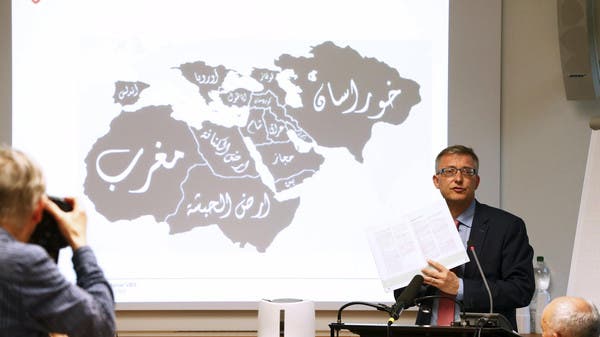
Swiss Federal Intelligence Service NDB director Markus Seiler speaks
in front of a map showing the territories where the Islamic State has
presence. (File: Reuters)
That problem within society is the sinister attraction of fanatical Islamist jihad to impressionable people in the West not averse to flirting with brutally radical Islam. Not just young Muslim men and women who think of themselves as Islamic idealists yearning for a return of the fabled 'caliphate' that would unite all Muslims worldwide in a ironclad union capable of assuming control and command of the non-Muslim world under the aegis of the caliphate, but Westerners who admire the fanatical appeal, eager to ally themselves with what they feel is a conquering horde.
This
file image taken from a militant website associated with Islamic State
extremists, posted Saturday, May 23, 2015, purports to show a suicide
bomber, with the Arabic bar below reading: "Urgent: The heroic martyr
Abu Amer al-Najdi, the attacker of the (Shiite) temple in Qatif", which
the Islamic State group's radio station claimed responsibility for. (Militant photo via AP, FILE)
The skills learned in the West by Islamists who grew up there and became adept at using American-style public relations and publicity to advance a cause are being used to great effect by Islamic State publicity. Their news and propaganda organ, Al-Bayan reaches tens of thousands in an audience with links shared on social networks. And through those links and the smooth delivery that vaunts itself as a new and exciting way of life open to all through jihad, Europeans are being attracted in ever greater numbers.
The newcast for Al-Bayan, the voice of Islamic State, sounds like a National Public Radio knock-off. and Western governments appear incapable of doing anything to intervene. "Soldiers of the Caliphate" are given breezy accounts of the latest news for Islamic State which never looses a skirmish, always succeeds in killing its enemies, and goes swiftly from one victory to another on its way to conquering the world. Irresistible for psychopaths who appear never to get enough of gory details and videos, thrilled to their very core.
And so, they bestir themselves to be part of this brave new world where killing and mutilation is the way to go, with no restraints on the imagination for those whose warped mental condition stills them to the pain and suffering inflicted on other human beings. The world has no shortage of sociopaths and psychopaths, young and old, from various ethnic backgrounds and cultures, excited by the prospect of the kind of life that Islamic State so generously offers, inclusively. "We thank our listeners for tuning in" blandly closes the show after the narratives and the news. The broadcasts come complete with martial music and soothing tones of the announcers with quite distinct British accents though they are hardcore Islamists eager to spread the word to the world at large. They broadcast in three languages now, speaking of the huge successes of suicide attacks, and the martyrs that make them all possible, an honour to aspire to.
Those who have experienced this brilliant new way of life and who have decided to abandon their lives under Islamic State don't seem eager to inform the world why they have turned their backs on their former aspirational presence with ISIS. A third of European fighters are said to have returned to Europe, while others continue to stream out of Europe to take their place in Syria. Of course the fact that ISIS threatens those who abandon them with death is a powerful deterrent against betrayal.
There are calls, nevertheless for new recruits to join the jubilantly successful jihadists and in the process to make something useful of their lives. Doctors are needed and one video shows physicians in scrubs featuring an Australian with blue eyes in a neo-natal ward. Physicians are promised that they will be aiding Muslims suffering from "a lack of qualified medical care", so a sense of mission of another kind imbues the message.
On the broadcasts there are regular presenters; one woman from Glasgow who aids British girls to reach Syria; a fighter from the Netherlands who obligingly offers jihadi interviews, a Frenchman exhorting his countrymen to emigrate to the new caliphate. Brookings Institute researchers J.M. Berger and Jonathan Morgan discovered over 46,000 Twitter accounts actively supporting Islamic State, within a two-month period. If one account is shuttered, others swiftly emerge.
The battle for contact in the social universe of the Internet seems to be swinging toward Islamic State.
"Privacy has never been absolute right, and the debate about this should not become a reason for postponing urgent and difficult decisions [achieving balance between privacy and security]." "They [ISIS] are exploiting the power of the web to create a jihadi threat with near-global reach. The challenge to governments and their intelligence agencies is huge -- and it can only be met with greater cooperation from technology companies." "There is no need for today's would-be jihadis to seek out restricted websites with secret passwords: They can follow other young people posting their adventures in Syria as they would anywhere else." "I understand why they have an uneasy relationship with government. They aspire to be neutral conduits of data and to sit outside or above politics. But increasingly, their services not only host the material of violent extremism or child exploitation, but are the routes for the facilitation of crime and terrorism." "However much they may dislike it they have become the command-and-control networks of choice for terrorists and criminals, who find their services as transformational as the rest of us." "I suspect most ordinary users of the Internet are ahead of [technology companies]: They have strong views on the ethics of companies, whether on taxation, child protection or privacy; they do not want the media platforms they use with their friends and families to facilitate murder or child abuse." Robert Hannigan, director, GCHQ (Government Communications Headquarters), London
This is an undated image of GCHQ in Cheltenham England released by British Government on Tuesday Nov. 4. 2014
Here are the giants of social media, reamed out for their enablement of terrorist groups like ISIS to reach their target audience with no shield, no guardians, nothing to stand in the way of their ability through the auspices of networking sites like Facebook, Twitter and Google to send their bleakly nihilistic message to susceptible young Muslims to join them in violent Islamist jihad. With no reason to hide their presence, since there are no penalties, ISIS and al-Qaeda-linked groups flaunt their presence openly.
Islamic State Times@ISTimes2
· 10h10 hours ago
This's how schools & universities look like in #IS, where single-sex education is still alive.
Their supporters and members now understand full well they have the freedom to download whatever they wish to, to make whatever incendiary statements that appeal to them, whatever slanderous incitements they lay claim to, with no sword of potential banishment hanging over their keyboards. The new director of Britain's electronic eavesdropping agency has challenged the American companies dominating the Internet to do better.
To do something, almost anything, to turn the situation around. Pointing out that foreign jihadis in Syria and Iraq had realized a picnic of released information from the leaked intelligence hijacked and publicized by former U.S. intelligence contractor Edward Snowden. He spoke scathingly of the Islamic State of Iraq and Al-Sham representing"the first terrorist group whose members have grown up on the Internet", glorying on the Internet, enabled by social media.
European government officials have already on earlier occasions conferred with companies like Microsoft and Twitter to reach some kind of understanding on how terrorist groups utilize the social media networks to proselytize, gain new adherents, convince new recruits that their futures lie with committing to extremist expressions of violent jihad, surpassing all previous terrorism successes in convincing recruits to jihad.
Unlike in the past when al-Qaeda groups "saw the Internet as a place to disseminate material anonymously or meet in 'dark spaces', [ISIS] has embraced the web as a noisy channel in which to promote itself, intimidate people and radicalize new recruits." He referred in specific to messaging and social media sites and apps, exampling Twitter, Facebook and WhatsApp.
He has called for greater cooperation with intelligence and surveillance agencies on the part of the social media sites, as a commitment to aid against the conflict with Islamofascism. Taking their example from more tightly regulated telecommunications companies. The looseness of experience in the casual interplay between legitimate and forbidden videos was amply demonstrated in June when ads for the National Citizen Service, a British government organization, the BBC, charities and corporations ads ran next to extremist videos.
Videos spreading Islamist propaganda meant to stimulate young Muslims to join the conflict in Syria were presaged by legitimate government and business advertisements, creating an impression adverse to controlling the violently nihilistic message openly advanced by fanatical Islamists whose goal is the destabilization of Western democracies in pace with the growth and forward march of their extremist totalitarian ideology.
Islamic State Times@ISTimes2
·
Nov 4
#IS Special Forces :)
The mea culpa advanced by YouTube was its unfortunate automated advert allocation, lacking the sensitivity and common sense of a human hand discerning between the legitimate and the obscene. The added gut-punch was that ads-generating money could have been funnelled to the extremists since YouTube, like most sites, shares income from advertisers with groups providing content.
"I
cannot overstate it -- at the heart of jihad worldwide, in Syria and
Iraq, as well as what is happening now in Canada, the U.S. and Europe,
are American social media companies." "They are helping to drive it. If it were not for them, recruitment, fundraising and communication would not be what they are." Every major designated terrorist organization is active on all of these accounts [YouTube, Facebook, Twitter, etc.]" "Now,
tweeting from the battlefield gets your message out in a second
everywhere throughout the Middle East and the West. It is absolutely
effective." Steve Stalinsky, executive director, Middle Est Media Research Institute, (MEMRI), Washington
Twitter/Abu Turaab
Mohammed
Ali posted this photo of “Abu Dujana.” It was taken in Dier Ezzor,
Syria’s sixth largest city. (Abu Turaab / Twitter) - See more at:
http://news.nationalpost.com/canadian-isis-fighter-abu-turaab-identified-as-mohammed-ali/#sthash.XdUkaZQT.dpuf
This is the single common thread that connects the global narrative of communication between jihadists
and their prospective recruits. With those who haven't made the leap
from their faith in Islam to embrace violent jihad but who waver in
indecision having their minds settle finally on a resolute and binding
determination to adapt themselves to the radicalization of their faith
in the belief that this is god's will, because the murmurings and
on-line pressures are so persuasive.
The message that
has been inexorably spread through the Internet finds itself inveigling
the worm of honour-in-jihad and martyrdom-for-the-cause into the minds
of the uncertain and the doubtful, imbuing them with the final certainty
that they have chosen, with a little bit of help from the Ethernet
doubling as god's whisper to them personally, scrubbing any doubt that
they might not chose the right path, has become paramount in the march
of new recruits to terrorism.
All the old platforms and the smaller, newer, and trendier ones like Ask.fm, Kik, WhatsAPP and SoundCloud,
have become popular venues through which the message of jihad can be
spread, the vulnerable exploited through the process of constant
reinforcement. The messages can be found wherever those looking for
affirmation search for them, landing neatly and appealingly in their iphone messages, never far from hand and eye.
Communication
is immediate, compelling, satisfyingly solution-oriented. Audios,
speeches, videos from the front lines, how-to guides to the perplexed,
and personal encouragement along with hip jokes and camaraderie right
directly, and instantly, to the smartphone. Mr. Stalinsky
has the expertise to interpret all of this, and more, and he knows with
the unerring clarity of an expert in online communications and security
where all the assistance comes from.
The social media companies whose close-up-and-personal message-enabling has become a vital part of everyone's
personal, social and business communication life expedites those darkly
menacing aids to jihad as adeptly and swiftly as they do the loving
messages from family and the supporting ones from friends and
acquaintances, along with the business alerts that users are so attuned
to. Twitter, he contends is the major jihadi platform today through its lack of proactive monitoring.
Let's not, while we're at it, overlook LinkedIn for its inestimable assistance in facilitating links to Islamist terrorists. Sending out suggestions to anyone who might wish to be 'linked' to terrorists like Chiheb Esseghaier, arrested by the RCMP and charged with plotting to commit a terrorist act in Canada but whose presence on LinkedIn has never been taken note of, with the site continuing, since his arrest to promote him as a "valuable contact who may help you in your career".
Chiheb Esseghaier, one of two men accused of plotting a terror
attack on rail target, is led off a plane by an RCMP officer at
Buttonville Airport just north of Toronto on Tuesday April 23, 2013.
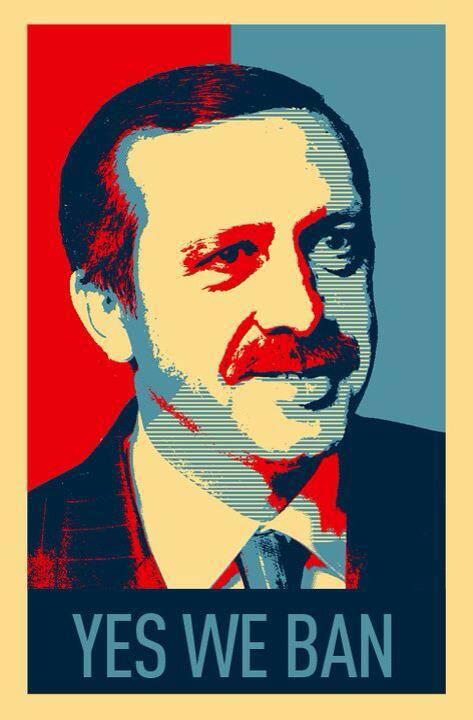
The social media prohibitions were widely criticised and ridiculed by Turks
Turkish Prime Minister Recep Tayyip Erdogan has criticised a court ruling which lifted a ban on Twitter.
The court had told the country's telecommunication
authorities the two-week-old ban must be lifted as it was a breach of
freedom of expression.
Mr Erdogan had vowed to "wipe out" Twitter after users spread corruption allegations involving him and his son, which he denied.
On Friday another court ordered the lifting of a similar ban on YouTube.
Mr Erdogan said his government had complied with the ruling on Twitter but that he did not respect it.
"I don't find it right and patriotic that the Constitutional
Court has adopted such a decision," Mr Erdogan said, according to the
Hurriyet website.
"While they are protecting an American company, our national and moral values are being disregarded."
Friday's ruling regarding YouTube reportedly stated that 15 videos should remain blocked.
Users across the country had found many ways of circumventing the prohibitions, which were widely criticised and ridiculed.
The controversy over social media coincided with the campaign for local elections on 30 March, won by Mr Erdogan's AKP party
This board at an opposition party office in Istanbul told users alternative ways to access Twitter
Mr Erdogan ordered the Twitter ban after recordings of
corruption allegations linked to him and members of his family were
posted and shared online. He said the recordings were fake and edited.
The ban was imposed on 21 March on the grounds that Twitter
had failed to remove the allegations of corruption involving senior
officials.
However the constitutional court ruled on 2 April that the ban was illegal.
On Thursday, Twitter's public policy team said it was "encouraged by the news from Turkey" and welcomed Turkish users back to the site.
Following the Twitter ban, the government had also banned
access to YouTube, after a video on the website appeared to reveal top
officials discussing how to stage an undercover attack inside Syria.
Foreign Minister Ahmet Davutoglu is apparently heard asking about the
possibility of sending tanks in.
The YouTube recording, posted anonymously, has not been
verified as authentic. Mr Erdogan alleges that such recordings are being
fabricated to turn people against him.
"The shutdown of an entire social platform is unacceptable. Besides, as I have said many times before, it is technically impossible to close down communication technologies like Twitter entirely. I hope this measure will not last long." President Abdullah Gul, Istanbul, Turkey
"Prime Minister Erdogan's move spells the lengths he will go to censor the flood of political damaging wiretap recordings circulating on social media." Emma Sinclair-Webb, senior Turkey researcher, Human Rights Watch
"Twitter, schmitter!" "I don't care what the international community says. Everyone will witness the power of the Turkish Republic." Prime Minister Recep Tayyip Erdogan
Millions of Turks have responded to their prime minister's edict that Twitter, for them, no longer exists as a social tool with which to mock the dignity of their government. In response to which, Mr. Erdogan's collegial partner in the elite echelons of governance, the president himself, mocked him on his personal Twitter account.
The absurd spectacle of a prime minister of a first-world country living a third-world reality of tyranny, threatening to "root out Twitter" itself makes a mockery of the descent of sanity into delusion. Turkey's prime minister is raging-hot furious that his veneer of integrity has been shattered by recent revelations. Revelations brought to the fore by a long, secret investigation by police, augmented by the judiciary.
The corruption scandal that has brought his government colleagues into disrepute and which has taken the great man himself and his son into the country's burgeoning annals of recorded ill-doing has destroyed the carefully engineered image of a trustworthy and proud government ruling Turkey through grand Islamist ideals, overruling well over a century of Kemal Ataturk's democratic secularism.
Just as Mr. Erdogan rooted out the old guard in Turkey's elite levels of the military to ensure they could not foment a rebellion against the rule of the Islamist Justice & Development Party, accusing them of plotting to overthrow the government, sending 330 of Turkey's military to prison, senior commanders for life, he turned his attention as a result of the corruption scandal to arresting police and lawyers and jurists in mass arrests.
The corruption charges stem from an orchestrated slander attack by his "enemies" using social media to wage their war. In obedience to Erdogan's demand that Twitter be shut down in Turkey its telecommunications regulator defended the ban, issued, they insisted, to protect the rights of Turkish citizens as Twitter had bypassed orders to block specific accounts. While defending themselves in a Turkish court, the social platform did even more.
Instructions to Turkish users of Twitter were tweeted to Turkish users; how to bypass the closure using text messaging services in both Turkish and English. A few major Turkish newspapers where no love is lost between the Prime Minister for his repressive treatment of journalists, have published step-by-step instructions on how to bypass the shutdown using virtual private networks.
Within twelve hours of the ban the hashtag #TwitterisblockedinTurkey had been copied over a half-million times, reflecting Turkey's position as among the top ten users worldwide of the social network platform. But it is President Gul's open defiance of the Prime Minister's truculent orders that represents the real blow to Erdogan in the lead-up to local elections.
That's when, on March 30, Turks will be given the opportunity to express their dissatisfaction on the rule of their prime minister and his Islamist party. And that's when the interesting part of all this turmoil will kick into full gear.
Members of the Turkish Youth Union hold cartoons depicting Turkey's
Prime Minister Recep Tayyip Erdogan during a protest against a ban on
Twitter, in Ankara, Turkey, Friday, March 21, 2014. Turkey's attempt to
block access to Twitter appeared to backfire on Friday with many
tech-savvy users circumventing the ban and suspicions growing that the
prime minister was using court orders to suppress corruption allegations
against him and his government. Cartoon in center reads: Erdogan, left,
to his Ankara Mayor Melih Gokcek " we will rip out the roots of
Twitter." Gokcek: "don't say it." (AP Photo/Burhan Ozbilici)
BlackBerry Ltd to cut 4,500 jobs, announces close to $1-billion writedown
Matthew Braga | 20/09/13 | Last Updated: 20/09/13 6:13 PM ET
Mario Tama/Getty ImagesChief
Executive Officer Thorsten Heins was counting on the new BlackBerry 10
phones — introduced in January to good reviews — to reverse a sales
slide. Instead, its market share continues to slide and BlackBerry
remains unprofitable.
With
no buyers in sight, and a massive inventory of unsold phones,
BlackBerry Ltd. will cut 4,500 jobs worldwide as executives seek to keep
their company alive as it teeters on the brink of disaster.
BlackBerry
announced Friday it would be laying off nearly 40% of its global
workforce, marking a new nadir for a company that’s seen its share of
ups and downs.
Here is a look at some of the numerical milestones for BlackBerry, previously known as Research In Motion:
• Entertainment industry awards: 2 (1994 Emmy for technical innovation, 1999 Academy Award for Technical Achievement)
• Lowest stock price: $6.10 (Sept. 24, 2012)
• Years the BlackBerry has been in existence: 14 (first BlackBerry
wireless handheld device in 1999, first BlackBerry smartphone in 2003)
• Years as a publicly traded company: 16
• Years in business: 29 (founded in 1984)
• Countries in which the company has offices: 36
• Highest stock price: $149.90 (June 8, 2008)
• Countries in which BlackBerrys are sold: 175
• Number of employees cut in most recent layoff: 4,500
• Number of remaining Employees: 8,200
• All-time high number of employees: more than 20,000
• Current subscribers: 72 million
• All-time high number of subscribers: 80 million
• Projected loss for second quarter of current fiscal year: between US$950 million and $995 million The Canadian Press
The struggling Canadian smartphone maker also announced Friday
afternoon that it expects to post a loss of nearly US$1-billion dollars
when the company reports its second quarter earnings next week, citing
“the increasingly competitive business environment impacting BlackBerry
smartphone volumes.”
The move confirms an earlier report that the company had plans to
reduce its workforce by up to 40% by year’s end, as part of ongoing
restructuring efforts.
For many Canadian investors, it is an eerie reminder of Nortel
Networks’ last days, when plummeting sales, heavy write downs and
widespread layoffs sent the country’s last reigning tech giant into a
free-fall from which it was unable to recover.
“The company has sailed off a cliff. What do you expect when you
announce you’re up for sale. Who wants to commit to a platform that
could possibly be shut down?” said BCG Partners analyst Colin Gillis.
BlackBerry has slashed more than 7,000 jobs since 2011, and hundreds
more in recent months, as it struggles to compete with competitors such
as Apple Inc., Google Inc. and even Microsoft Corp., whose smartphones
and app ecosystems have proven more attractive to consumers — and even
enterprise customers — than BlackBerry’s own.
“They’re trying to arrest their slide by cutting head count. I think
that’s going to make it really difficult,” said Pacific Crest Securities
analyst James Faucette. ”There’s also some hope that by taking these
steps right now, it helps cleans things up for any type of potential
deal or acquisition that they’ve been very forthright about seeking.”
The Waterloo, Ont.-based company is also expected to write down as
much as US$960-million in unsold inventory — based mostly on the
severely diminished value of its Z10 touch-screen phone. It’s last
three write downs — a pretax expense of US$485-million in December 2011,
a second charge of $267-million the following March and a third write
down of US$335-million in June 2012 — were attributed, in part, to the
company’s similarly ill-fated PlayBook tablet.
BlackBerry’s fate is inextricably tied to the success or failure of
BlackBerry 10, the smartphone maker’s revamped mobile operating system,
launched in January to much fanfare by chief executive officer Thorsten
Heins.
Mr. Heins is planning to reduce his company’s total headcount to
7,000 full-time employees worldwide as part of ongoing cuts. The company
had 12,700 employees as of the end of March, the last time it has
reported the size of its workforce.
Shares in the company plummeted as low as 24% as investors
reacted to the news and could have been much worse, had the company not
already been trading below what many feel is the value of its cash and
assets, assuming the company is broken up and sold off. BlackBerry stock
closed down $1.79, or $17%, at $8.73 on the Toronto Stock Exchange.
In August, chief executive Thorsten Heins announced the formation of a
special committee to examine the company’s “strategic alternatives.”
Such alternatives could include a joint venture, a move to go private or
an outright sale. The committee is still evaluating its options,
according to a statement from the company.
SAUL LOEB/AFP/Getty ImagesThe inventory writedown is mostly based on the value of Z10 touch-screen devices, the company said.
In a surprise move, the company announced a restructuring of its
smartphone portfolio from six devices to four, with two high end and
two-entry level phones. BlackBerry’s flagship Z10 device – which was
used to launch its revamped BlackBerry 10 platform – will be “re-tiered”
as an entry-level device, alongside the company’s recently announced
Q5. The BlackBerry Z30 – a new, 5″ smartphone announced this week – and
the Q10 with QWERTY physical keyboard, released in April, in will be
considered the company’s high-end phones.
BlackBerry sold about 5.9 million smartphones in the second quarter,
it said, down from 6.8 million in the quarter previous. It also
anticipates $1.6-billion in revenue – with service revenue, generated
primarily by 3.7 million legacy BlackBerry 7 devices, accounting for
about half of that figure.
“The revenue and device shipment numbers are pretty surprising given
how weak it is. I think many of us were expecting a pretty difficult
quarter, but this much worse than we anticipated,” said UBS Research
analyst Amitabh Passi.
BlackBerry also announced plans to reduce operating expenses by
approximately 50% by the end of Q1 FY2015. The company is expected to
report $2.6-billion in cash, and no debt.
The adjusted second-quarter net loss will be as much as US$265-million, more than triple the loss expected by analysts.
But amid all of the company’s early financial disclosures, an update
on its ongoing pursuit for a saviour was nowhere to be seen.
BlackBerry is due to report second-quarter earnings on Friday, Sept. 27.
"We are extremely disappointed that the Russian Federation would take this step. Obviously this is not a positive development. "We are evaluating the utility of a summit."
The Russian decision to give official haven to Edward Snowden "undermines a long history of law enforcement co-operation...". White House press secretary, Jay Carney
A long history of law enforcement co-operation -- between the White House and the Kremlin? That will be news to many. Now, if he spoke of a long history of conflicted resolutions, unhelpfully malicious opposition, strident demands, imploring entreaties and failed expectations that might have seemed more reflective of the state of "co-operation" between Russian and American authorities.
Slight exemptions exist, as in, for example, the intelligence that was forthcoming from Russian authorities to Americans at the time of the Boston Marathon bombings. That was then, this is now, and it's like apples and oranges; they're not the same fruit. When it comes to threats recognized by he United States against its interests; think North Korea, Iran, Syria; Russia is non-co-operative.
And while the United States fulminates and blusters, issues statements of disappointment and regret with undertones of returning the compliment, might even the most casual of international observers feel that the United States, with reversed situations, would happily hand over a Russian who had absconded with Russian intelligence, prepared to hand it over to the United States?
Of course, Vladimir Putin is strategically playing both to ends; on the one hand he cagily insists that Russia has no interest whatever in taking possession of any of the purloined documentation, and forbids Edward Snowden under pain of ejection from his safe haven, should he release any further documents, and on the other, he has finally appeared to relent in the face of the young man's dilemma, offering him asylum.
Edward Snowden will not pay the price of choosing to betray the trust placed in him as a secure risk in American intelligence gathering, if the Kremlin has anything to do with the matter. And since Edward Snowden's erratic flight took him to the various venues where he was certain national disinterest in furthering the interests of the United States could be assured, their reaction did have a great deal to do with denying America its prosecution of a traitor.
And as of two days ago, Edward Snowden was politely escorted out of Moscow's Sheremetyevo Airport to the safety of Russian-shielded anonymity, while accused by his country of espionage activities. The Russian Federal Migration Service has issued a document passing as a passport, good for one year, but eminently renewable. And permitting the man who prefers Russian-style democracy and government respect for the rule of law, judicial, corporate and social corruption to that of his native land's.
Of course this has nothing whatever to do with any kind of objective respect for human rights, privacy, protection from government surveillance of its citizenry or conflicting political stances between the two countries. It is, simply, Russia's larger, broader, more all-encompassing concern for truth and justice. While America seeks to prosecute an insider who accuses it of peeking into peoples' privacy, Russia has earned its reputation as an abuser of the press; worse, complicity in deadly brutality against journalists.
But the United States is capable of rallying civilized world opinion against the Kremlin's decision to prosecute and persecute their already-hidden gay community, taking steps to ensure that the international community arriving in Sochi for the Winter Olympics know that they too will be targeted for prosecution under Russian law if they so much as wink at one another.
None of this is the work of Vladimir Putin, needless to say.
The decision, insists Yuri Ushakov, an aide to the great man, rested solely with immigration officials. "It has nothing to do with the president or his administration", said Mr. Ushakov. Surely he crossed his heart, crossed his fingers and toes, when he said that. Crossed his eyes and winked insanely?
As for the United States administration in defence of its huge Internet, email, smartphone scrutiny in the interests of public safety and the net of danger cast over America by Islamist terrorists...how other than by using this wide-net system would they ever have come to the conclusion through picking up Internet messages that a new jihad-attack plot has been hatched by al-Qaeda, leading to the temporary closure of American missions in selected Muslim countries?
Years ago, long before countries entered the modern era of electronic surveillance through the Internet, Britain raised international eyebrows and criticism from its peer countries, let alone groups invested in issues of privacy and human rights for its move to install thousands of closed-circuit video cameras in public venues. That issue became the bane of civil liberties groups and other privacy social advocates. It was 'way ahead of the game.
British authorities remained unfazed and proceeded with the installation of those monitoring cameras in public venues, insisting that their installation represented a move forward in authorities' need to respond to the growing incidence of public crime. Police and public security had another tool to effectively follow the activities of social deviants who set out to destroy public property and to haunt the vulnerabilities of the law-respecting public.
Of course, long before the advent of those first closed-circuit video cameras there was the kind of human intelligence agencies, as security arms of the government that engaged famously in political and commercial espionage. To gain both political, military and industrial knowledge from both friends and foe, almost alike. To have an intelligence leg-up on what one's colleagues and adversaries were about. Admittedly that was before international terrorism entered the equation.
And now that Wikileaks surfaced on the global scene, along with its righteously determined Julian Assange and his multitude of supporters, we have additional intelligence leakers, like Army pcf Bradley Manning, and now private security contractor Edward Snowden, both believing that they were behaving in a responsible manner, alerting ordinary citizens and leaders of other countries alike, to the vast volumes of confidential secret data being acquired through espionage.
The United States intelligence community, so eager to portray China as the world's most egregious spies, revealed to have captured secret bulk data acquired through a massive U.S. surveillance project, spying on its allies like Germany, for example. Tapping into fibre cables to defy security of national interests, Internet access is eased by Five Eyes collaboration, an alliance of the U.S. Britain, Canada, Australia and New Zealand.
A TV screen at a shopping mall in Hong Kong shows a news report
Saturday of Edward Snowden, a former CIA employee who leaked top-secret
documents about sweeping U.S. surveillance programs. The Justice
Department has charged Snowden with espionage for and has asked Hong
Kong to arrest him. (Kin Cheung / AP)
And, as much as the United States has gained massive data through its wide-and-deep covert espionage, according to Edward Snowden, now ensconced in Hong Kong with possible extradition to his home country on the near horizon to face serious espionage charges, it would appear through information he released to the Guardian that Britain's espionage network has surpassed even that of the U.S.
According to the Guardian, quoting Edward Snowden, the surveillance he has highlighted represented "not just a U.S. problem. The U.K. has a huge dog in this fight.... The (GCHQ) are worse than the U.S." Not a very happy endorsement for the state of privacy and security in either country. Where the ethics relating to espionage on citizens is raging.
By last year, according to Guardian accounts, GCHQ was handling 600 million telecommunications each and every day. When under attack, deny: "Our work is carried out in accordance with a strict legal and policy framework which ensures that our activities are authorized, necessary and proportionate", assured a GCHQ statement.
Sounds familiar, having heard the original of this clone previously.
It is simply our governments taking the initiative to protect us, and if we don't like it, well fellas, too bad. The world we all inhabit is a dangerous place.
It wasn't all that long ago -- several months back in fact -- that newspapers were full of accounts of Chinese cyberspying on vital American sites, both federally official arms of the American government and industrial sites. The Chinese up to their old tricks, busy with official-secrets and industrial espionage, eager to take possession of both state secrets and confidential files meant only for privileged U.S. authorities, along with corporate blueprints that could give the Chinese an enterprising leg up.
Why waste time in formulating successful entrepreneurial and scientific formulae when same could be had through subterfuge and illegal cyber-entry to restricted sites, allowing the downloading of vitally useful information?
Much indignation ensued. Accusations and counter-accusations. Denials and 'proof' that made hash of those denials, since the intrusions were traced directly to Chinese military infrastructure; if the cyber-hacking wasn't institutional, directed by the Government of China, it was encouraged by that same government to allow cleverly skilled Chinese to infiltrate secret sources that would prove useful to China.
Latterly, U.S. President Barack Obama and Chinese Premier Xi Jinping met in California on a semi-official get-together to discuss the thorny issue of cyber-espionage, both agreeing that it was unfortunate and unhealthy for the furtherance of peace and understanding, respect and mutual regard for countries to embark on such disreputable issues such as espionage, federal or industrial.
Each country ostensibly interested and invested in consolidating a more co-operative connection with one another. Each represents, after all, a world power. In a world that seems to grow increasingly unstable, incrementally.
Now a self-aggrandizing and hawkishly self-righteous tilter-at-windmills has emerged. Betraying his own country's security intrusions, he has laid wide open the United States' hypocrisy in accusing China of what it is itself guilty of, and more. Robert Mueller, director of the FBI, assures newly-outraged Americans -- furious now at their own government for its spying proclivities against its own population, let alone foreign elements -- that it is all perfectly legal: "The legality has been assured by the Department of Justice", he has informed the House of Representatives' judiciary committee.
For, it seems, the Foreign Intelligence Surveillance Court "has ruled on these two programs, monitors these two programs and has assured the legality of the efforts undertaken in these two programs"... and this, under a president in whom Americans placed their trust that he would lead them to a path quite different from those which his predecessors -- in particular the much-reviled George W. Bush chose to take. So much for illusions. For what's a nation's government to do when it sees itself under fire from its own citizenry, even while claiming it is motivated by the desire and the need to protect that same citizenry from the evils of foreign attackers, augmented by those recruited by vile interests to attack from within?
In the process, young Edward Snowden has achieved semi-heroic status from his hideaway in Hong Kong where he has found much sympathy with his outrage over his government's perfidious stance. America's allies have been disconcerted to have revealed the extent of United States' surveillance of their own state activities; Germany appears to have been a particular target, though no other countries' secrets have been ignored in the voracious quest for data.
Official Beijing no doubt quietly looks on amused at the revelations striking the very country that has gone on for so long accusing it of computer-based attacks. China's own Internet security chief has affirmed that his country has acquired more than significant data confirming U.S.-based hacking. Diplomatically, however, he has refrained from blaming the American government itself, choosing instead to emphasize how unhelpful it would be, and recommending co-operation in battling cyber-attacks.
And then there was Air Force Colonel Dai Xu, writing on his Sina Weibo microblog: "I have always said, the United States' accusations about Chinese hacking attacks have always been a case of a thief crying for another thief to be caught."
Demonstrators
shout slogans as a man takes pictures with his mobile phone during a
protest near India's parliament in New Delhi in February. The protests
followed the gang rape of a female student that shook the nation in
December. A phone app, Circle of Six, that summons quick help for women
in threatening situations, is coming to New Delhi. Adnan Abidi/Reuters/File
When Vice President Joe Biden—a longtime opponent of violence against women—announced the Apps Against Abuse technology challenge in 2011, Brooklyn, N.Y.,-based filmmaker and activist Nancy Schwartzman knew she had to respond.
Dowser.org Dowser.org reports
on the practical and human elements of social innovation, highlighting
creative approaches to social change to help people understand how to
build better communities and a better world.
Never mind that she had never created an app or written a line of
code in her life; a firmly held passion for reversing rape culture and
the fact that 19 percent of university-age females report sexual assault was motivation enough.
The Circle of Six
app invites users to designate six friends as their “circle” of people
from whom they can seek help when in trouble. With one tap, users can
send a text requesting to be picked up (complete with a GPS tag), ask to
be interrupted with a phone call, or say they need to talk about issues
of abuse in their relationship. It also provides external hotlines and
resources for those experiencing or wanting to stop abuse.
When the team’s creation originally won the White House challenge, it was intended for college-aged females in the United States. But when the Indian press devoted significant coverage to the app in the midst of a brutal gang rape of a 20-year- old New Delhi woman, Schwartzman noticed Indian downloads went from a few hundred to several thousand.
With India’s terrible record of addressing sexual assault—in 2012, 600 reported rapes in New Delhi alone resulted in only one conviction—Schwartzman saw an opportunity to adapt the app for a specific audience.
Thus,
nearly a year after the app’s official launch and in honor of Sexual
Assault Awareness Month in the US, the Circle of Six app has launched a
New Delhi-specific version. The localized version is translated into
Hindi and provides local hotlines and resources for users to reach with
one tap. Schwartzman is also in talks with Mexican health officials to
launch a localized version in Mexico City.
The
design and utility of the app is meant to challenge some commonly
misheld notions about rape and violence, such as the idea that "stranger
danger"—or rape by an unknown individual—is the main threat.
“I
was always really looking at sexual assault between people that know
each other—at work places, dorm rooms, spring break.These are gray-area
experiences that are certainly violating to women, but not treated that
way by the courts or the media.”
The app—which now has 55,000
downloads in 26 countries—is designed to give women an “out” when they
are in an environment where sexual advances may be socially acceptable
(while at a house party or working at a bar, for example) but can still
feel uncomfortable or threatening.
Instead of wondering “What do I do? Who do I call? Where am I? Should
I walk home?” the app takes those variables out of the scenario and
embeds them in one’s phone. Females aren’t then forced to wonder “who
will come pick me up at 4 a.m.?” because they’ve already asked friends
ahead of time to be part of their “circle.”
Even though her app
mostly addresses issues relating to acquaintance rape, Schwartzman
believes that all forms of violence and harassment against women are
related and thus the solution must be holistic—and most importantly, it
must include men.
“The fact that it’s just a given that any urban
park will empty out at dusk of women—and that if you don’t accept that
as a woman you’re ‘asking for it’—is insane,” she said. “Circle of Six
gives men the opportunity to be accountable to someone by being part of
their circle, to help to stem the tide of rape culture, and to call out
bad behavior when they see it.”
This represents a general opinion site for its author. It also offers a space for the author to record her experiences and perceptions,both personal and public. This is rendered obvious by the content contained in the blog, but the space is here inviting me to write. And so I do.